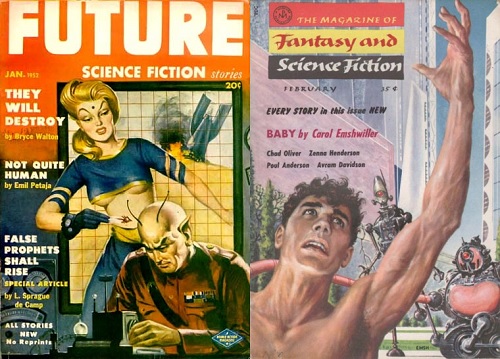
Thursday, September 6, 2018

I, J, L, M: Stories from ABC by Washington Irving, Laurence M. Janifer, Fritz Leiber and Walter M. Miller, Jr.

It's four more stories from An ABC of Science Fiction, the 1966 anthology of SF stories edited by Tom Boardman, Jr.  I have the 1968 US paperback from Avon.  Because I read it in 2014, I'm skipping the K story, Damon Knight's "Maid to Measure," a brief joke story vulnerable to charges of sexism, of perpetuating the dumb blonde stereotype, and (worst of all) of not being funny.

"The Conquest By the Moon" by Washington Irving (1809--this version 1955)

Remember when people were taking public domain works by iconic writers from the Georgian and Victorian past like Jane Austen and Charlotte Bronte and filling them with zombies and other faddish genre elements?  (Are they still doing that?)  Well here's an "updated" version of a work by an early 19th-century literary icon in which the included genre elements were part and parcel of the author's original version!

In 1955 Anthony Boucher included in F&SF a condensed selection from Washington Irving's satire A History of New York From the Beginning of the World to the End of the Dutch Dynasty entitled "The Conquest By the Moon."  Boucher credits leftist folk-singer Lee Hays with alerting him to this pioneering example of invasion-from-space speculation.  This adapted fragment of Irving's book hasn't been reprinted very often; maybe Boardman resorted to it because there are not many SF writers whose names start with an "I," or perhaps Boardman just likes stories that try to be funny while denouncing white racism and the human propensity for violence.  Whatever the case, it's time for me to get edjumakated because everything I know about Washington Irving up to now I learned from cartoons.

"The Conquest By the Moon" is more like a sarcastic essay than a story with a plot or characters.  First, Irving points out, in ironic parody, the weakness of the moral claim of European colonists to the New World.  Then he pulls the old switcheroo on us: how would the people of England, France and the United States like it if the inhabitants of the Moon, green cyclopes who find our white skin and lack of tails disgusting, came to Earth and used their "concentrated sunbeam" weapons to force us to renounce Christianity and abandon our cities to live on reservations in inhospitable Arabian deserts or icy Lapland?

Like Samuel Johnson's Idler No. 81, from 1759, this is an interesting historical artifact that documents Georgian era criticism of British and French imperialism in the Americas, but it is not really a work of fiction.  For SF fans "The Conquest By the Moon" is perhaps interesting for its depiction of extraterrestrials whose biology differs radically from our own and their high tech weaponry--"concentrated sunbeams" sounds a lot like the ray weapons that are a staple of SF.

I guess we'll call this acceptable.

"In the Bag" by Laurence M. Janifer (1964)

I recently read Janifer's Slave Planet, and here he is again. Unfortunately, "In the Bag" is one of those short shorts that is supposed to be funny.  This one employs the same gag used by Phillip Jose Farmer in his short short "The King of the Beasts," letting us think, until the end of the tale, that alien characters are humans.

Through an unlikely mix-up an alien emigre and rebel who is running a laundry service on Earth reveals himself to a customer whom he believes to be a human; the customer turns out to be an agent of the secret police of the government the disguised launderer is rebelling against.  This story may be a spoof of the strange phenomena we see in Edgar Rice Burroughs-type lost race stories in which the lost race consists of brutish men but sophisticated and sexy ladies--here Janifer posits a race of aliens the male members of which effortlessly pass as Earthmen while the women have five arms and three breasts and a foot like a slug or snail's.  "In the Bag" may also suggest that those who rebel against tyranny often turn out to be little or no better than the tyrants they oppose--the launderer is willing to kill the customer before the customer reveals he is also an alien.

Barely acceptable filler.  After seeing print first in F&SF, "In the Bag" reappeared in a collection of Janifer stories put out by our friends at Belmont as well as in several foreign magazines and anthologies.

"X Marks the Pedwalk" by Fritz Leiber (1963)

When I was in academia there was a lot of complaining among my leftie colleagues about suburban sprawl and white flight.  (Many of these carpers, of course, indulged in all the sins they deplored when committed by those of their fellow white Americans who had the misfortune to work in the private sector instead of within the taxpayer-funded walls of the academy, like owning houses in the suburbs, evading NYC taxes by claiming their summer home in the Hamptons was their primary residence, sending their offspring to private and/or suburban schools, etc.)  "X Marks the Pedwalk" by Fafhrd and Grey Mouser chronicler and Grandmaster Fritz Leiber is about the suburban-urban divide, though set in Los Angeles, that center of American car culture, instead of my own old stomping grounds of New York, because in Leiber's story that social divide is manifested in the conflict between motorists and pedestrians.     

"X Marks the Pedwalk" is also one of the joke/satire stories with which An ABC of Science Fiction seems to be infested, and as such its plot is a little absurd and the story full of absurdist jokes.  La-La Land, an environment characterized by a steadily decreasing level of sanity, is divided between the hoity-toity suburban Wheels and the slum-dwelling Feet--the Government tries to maintain order and avoid taking sides.  Leiber hints that the situation of LA is like that of Paris during the French Revolution, and it is apparently normal for drivers to run over pedestrians who can't scurry off the street in time, and for pedestrians to heave bricks at or lay spike traps for cars.  At the start of the story one clash between pedestrians and motorists leads to four fatalities, and sparks a heightening of hostilities.  Luckily, the leaders of Wheels, Feet and Government get together to hash out a deal which limits the sorts of weapons that can be used and defuses the tense situation, diminishing if not eliminating the violence of the long-running low-intensity conflict.

Leiber is a good writer, and this is a good story; the action scenes are good and the jokes (like the suburbanites' posh hyphenated names) add to the story, conveying informationand setting tone, instead of distracting you from it.  I had some deja vu reading this piece; I think I may have read it, or part of it, before.  "X Marks the Pedwalk" is an acknowledged inspiration for the Car Wars game, the early editions of which I played back in my school days, and maybe I encountered it in connection with that?


"X Marks the Pedwalk" made its debut in the first issue of Worlds of Tomorrow, an irregularly published magazine edited by Frederik Pohl for most of its run.  That first issue looks pretty good, with lots of big names--besides Leiber and Pohl there's Keith Laumer and Arthur C. Clarke on the writing side and Virgil Finlay, Wallace Wood and Jack Gaughan on the illustration side.  The story has been reprinted quite a bit, including in some anthologies marketed to fans of mysteries and horror, which I thought was interesting, as it is by no means a traditional mystery or horror story.

"No Moon for Me" by Walter M. Miller, Jr. (1952)

Here's the first story in An ABC of Science Fiction from Astounding.  "No Moon for Me" doesn't seem to have been as successful as many of the stories we've already looked at from this anthology, only having been reprinted in one other anthology, William Sloane's 1953 Space, Space, Space, which has a nice wraparound cover.

Colonel Denin has spent his career trying to convince the Congress to finance manned space exploration, and Congress has always refused to make the long-suffering taxpayers shoulder the extraordinary expense.  After all, what is the point of going to space?  There's nothing up there we don't already have down here!

But today, September 9, 1990, Denin and two other men are boarding a rocket to the Moon!  You see, a few years ago an indecipherable transmission, obviously artificial, started coming from the Moon, and Denin, a pilot, and an academic linguist are going to Luna to investigate!

I admit that I have read so much Malzberg that I have Malzberg on the brain, but I think I am perfectly justified in seeing Malzbergian elements and themes in "No Moon for Me."  These elements and themes:

1) The lack of public support for the space program.

2) The rocket ship carries nuclear weapons in case of trouble with aliens.

3) An astronaut (the fat college professor) goes insane on the trip to Luna, and Denin has arguably been insane for years: the transmissions from the Moon are not from aliens, but from a transmitter Denin himself secretly sent up there in an unmanned drone rocket, a scheme to trick the US government into financing his trip!  If that doesn't make you question his sanity, there's this: Denin plans to detonate the nuclear weapons so he and all the evidence of his scam (and two innocent people!) are destroyed, and the people of Earth will think a battle took place and be inspired to set up a permanent military base on the Moon and explore the universe in the interest of security!

How Denin and company's trip to the Moon is resolved is reminiscent of traditional adventure fiction, with people holding guns on each other and tying each other up, etc.

I like this one; I don't know why it isn't included in any of the Miller collections that have appeared over the years.  Maybe it is unrepresentative of Miller's work?  (I have read very little of Miller's oeuvre, so I can't judge such things.)  Maybe people think the plot twists are too obvious or too unbelievable?


**********

I'm halfway through An ABC of Science Fiction and I think I can detect some trends.  First, there are lots of brief joke stories--maybe a page limit forced Boardman to include many such stories if he wanted to present 26 total.  Second, the general tenor of the stories chosen by Boardman is very pessimistic, quite misanthropic.  There are plenty of stories denouncing white racism and the human propensity for violence; stories in which humans make bad choices, get outwitted or get defeated; stories that predict things will get worse in the future; and stories whose protagonists are criminals or fraudsters or the agents of tyrants.  There is a dearth of stories that exhibit hope for the future or celebrate man's ability to overcome adversity or anything like that.  Boardman seems to have deliberately constructed a book that is a downer!

Well, at least none of the stories in this batch (because we skipped Knight's contribution) were actually bad.  Hopefully the next batch will be at least as good--and maybe we can hope there will be at least a gleam of optimism among them?     

Tuesday, September 4, 2018

ABC Part 2: Carol Emshwiller, Philip José Farmer, Daniel F. Galouye, and Harry Harrison

Let's read four more stories from Tom Boardman Jr.'s strange 1966 anthology, An ABC of Science Fiction, which prints 26 stories, each story written by a writer with a different last initial.  This time we've got stories from two Grandmasters with whose work I have some familiarity, Philip José Farmer and Harry Harrison, and two people whose work I don't believe I have read before, Carol Emshwiller and Daniel F. Galouye.

There's Myra and her creepy kid!
"Day at the Beach" by Carol Emshwiller (1959)

In the introduction to An ABC of Science Fiction, editor Boardman apologizes because there are only two women represented in the anthology.  Here's the first of the two, Carol Emshwiller.  Emshwiller's wikipedia article is pretty short, reminding us that her husband was important SF illustrator Ed Emshwiller (AKA "Emsh") and quoting Ursula K. LeGuin who heralds Emshwiller as a "consistent feminist voice."  Hopefully "Day at the Beach" isn't going to be a lecture on how I sit incorrectly on the subway and don't do my fair share of the dusting.

Four years ago there was a nuclear war (I guess) and Myra and Ben, a married couple, were among the survivors.  Neither of them has any hair, not even an eye lash!  What they do have is a three-year old son, the only child in the vicinity, apparently; it is hinted that the kid is a mutant, maybe a cannibal!

Emshwiller gives us vague clues as to the state of the world.  Ben "commutes" on a train during the week, and there is sometimes electricity, so I guess there is some kind of heavy industry and maybe government agencies still in operation, but there are very few cars and it seems like Ben doesn't bring money home after commuting but preserved food, and it sounds like it is common for fights over the food to erupt on the train. 

It is the weekend, and Myra talks about how before the cataclysm they used to go to the beach on the weekend, and now they just hide at home.  So they drive to the beach for the first time since the war.  At the beach they are menaced by bandits, but Ben, who was fat before the war but is now a lean hard fighter, beats the bandits' leader to death with a hammer, which scares off the rest.  Then the family goes home, Myra asserting, repeatedly, that it has been a good day.

This story is a sort of "slice of life" thing, with no flashy twist ending or shocking revelation that I could detect (I was hoping the three-year-old would try to eat the dead bandit, but he just sort of investigates it before Ben swats him away from it--Emshwiller was teasing me!)  Maybe "Day at the Beach" is meant to be a satire of bourgeois people, people who would continue their middle-class routine of commuting and going for weekend drives even after an apocalypse?  Maybe it is supposed to induce a mood, maybe horrify us by showing that a life of fighting for food and confronting child-molesting thugs and raising a monster can come to seem routine, that for Myra to retain any sanity she has to act like it is routine?  (It is perhaps significant that "It was no day at the beach," like "it was no picnic"--and Myra does actually pack a picnic basket--is a cliched euphemism for a dangerous challenge or arduous task.)

Both Judith Merril and Isaac Asimov (or likely Martin H. Greenberg) consider
"Day at the Beach" to be one of the best SF stories of 1959
"Day at the Beach" is OK, no big deal.  It is a commercial and critical success, however, having been reprinted numerous times in four languages after first appearing as a cover story in F&SF.  The effective cover illustration is by Emshwiller's own husband--the picture's composition is reminiscent of a Renaissance Madonna and Child, so maybe the story is supposed to be a hopeful one and I am totally misinterpreting "Day at the Beach" when I am thinking of it as a horror story or a satire of the bourgeoisie.  Maybe Myra's little cannibal child is going to be the redeemer of the fallen world!     

"The King of the Beasts" by Philip José Farmer (1964)

Oy, this is one of those allegedly clever one-page stories that people seem to love but which I consider a gimmicky waste of time.  Two people are in a zoo where extinct species are recreated.  We get a list of resurrected beasts--passenger pigeon, dodo, quagga, etc.  Then comes an animal so diabolical, so monstrous, so sinister, that the scientists needed special permission to resurrect one.  Of course, it's a human man, so we now know that the people talking are aliens who came to Earth after we also went extinct, no doubt because we threw candy wrappers in a creek or something of that nature.

Lame filler.  The most interesting thing about the story is that Farmer has one of the aliens (before we know they are aliens) say "You might say that man struck God in the face every time he wiped out a branch of the animal kingdom."  Is this just a trick to make us think the speakers are human, or, is this Farmer expressing his own religious belief, pushing back against the atheism typical of SF writers?  (Remember that article Farmer wrote for Brian Ash's Visual Encyclopedia of Science Fiction?)

"The King of the Beasts" was mentioned on the cover of the issue of Galaxy in which it originally appeared, and despite my distaste for it, has been reprinted many times.   

"Homey Atmosphere" by Daniel F. Galouye (1961)

Here's another one from Galaxy.  I don't think I have ever read anything by Galouye, who, wikipedia is telling me, is one of Richard Dawkins's favorite writers.  Hopefully "Homey Atmosphere" isn't going to be a lecture on how religious people are all insane and taking your kid to church is child abuse.

"Homey Atmosphere" is a traditional SF story about space travel and robots, people's reaction to machines which mimic life and whether there is any difference between "true" consciousness like you and I have and very sophisticated artificial simulations of consciousness.

Lorry is a young astronaut, and Burton an older one, on a months-long voyage exploring the galaxy, leaving a string of navigation beacons in their wake.  Their hyperdrive ship is managed by three computers which respond to voice commands; to keep the two spacemen from suffering psychological problems, the three computers have been given personalities, one that of a grumpy and forgetful old man, one an enthusiastic kid, one an attractive young woman.  When the ship starts to malfunction (perhaps because the forgetful computer has forgotten to lay in spare parts!) Burton wants to jump in the lifeboat and get back home, but Lorry is too fond of the "crew" to abandon them!  The astronauts argue over to what extent the personalities of the ship are "real" as the ship's problems increase in severity.  When the apparent risk reaches catastrophic levels Lorry and Burton finally abandon ship with the encouragement of their artificial shipmates.

I say "apparent risk" because on the last page we learn that the three artificial personalities have developed independent desires and curiosity, and their ambition is to explore the galaxy unsupervised!  All the problems with the ship were a sham designed to (humanely) get rid of the human astronauts.

An ordinary but acceptable entertainment.  Over twenty years after its original publication "Homey Atmosphere" would be the cover story of an issue of the Croatian magazine Sirius.


"Mute Milton" by Harry Harrison (1966)

Harrison has a very smooth and readable style and in my youth I read a ton of his books, and as an adult was impressed by the first two Eden books (the third, which I have been more or less planning to read for years now, awaits.)  So I have been looking forward to this one.

Harrison's work is often tendentious, attacking religion or the military or pollution or whatever, and "Mute Milton" is a heavy-handed anti-racism story.  An African-American college student from New York City, down in Mississippi, by chance meets a local college professor, another black man.  The college prof has invented a means of converting gravity into electricity--he can generate power practically for free.  The New Yorker is studying economics, and immediately recognizes that such a device could radically improve human life, but seconds later an overweight cop who is in the Ku Klux Klan murders the college professor and destroys the only working model of the device.

This is the kind of story whose point you can't argue against, but which is too over the top, too obvious and manipulative, to be effective as literature or entertainment.  There is no tension or ambiguity, the characters don't evolve, the villain is a flat caricature, etc.  It is like a homily for a child.  Thumbs down.  "Mute Milton" has been reprinted numerous times in Harrison collections, as well as in an anthology almost as gimmicky as An ABC of Science Fiction, A Treasury of American Horror Stories: 51 Spine-Chilling Tales from Every State in the Union plus Washington, D. C.--I guess there is a shortage of horror stories set in Mississippi?

**********   

It looks like today the Grandmasters gave us limp polemics bitterly denouncing humanity's failings  while the people I never read before made an effort to give us stories imbued with human feeling that press us to speculate on life in strange future circumstances.  Today our Grandmasters let us down!  Well, maybe a Grandmaster will live up to his title in our next episode, when we read another batch of stories from An ABC of Science Fiction?  Until then, Brian Aldiss, himself a Grandmaster, still has the best contribution to this anthology. 

Wednesday, August 29, 2018

1950s stories by Brian Aldiss, Fredric Brown, Arthur C. Clarke, and Avram Davidson


When I haphazardly reorganized my SF anthologies a few days ago I put aside five paperbacks containing stories by authors who interest me but which I didn't recall having read, so our next batch of posts will each tackle a selection of stories from one of those five books.  First up, a 1968 Avon paperback printing of the 1966 anthology An ABC of Science Fiction, edited by Tom Boardman, Jr.

An ABC of Science Fiction was constructed based on a goofy premise: it includes 26 stories, each by a different author, each writer the sole representative of those with his last initial.  To make this idea work somebody had to contribute something under the pseudonym "B. T. H. Xerxes" to fill in the "X" slot; "Xerxes" came up with half a page of limp limericks, and isfdb suggests it was likely Boardman himself who penned the ribald verses, or perhaps Brian Aldiss, who was already doing duty in the "A" stall.  Today we'll look at the stories by the delegates from the honorable letters A, B, C and D, Aldiss, Fredric Brown, Arthur C. Clarke, and Avram Davidson.

"Let's Be Frank" by Brian W. Aldiss (1957)

Aldiss's offering first appeared in an issue of Science Fantasy alongside stories by E. C. Tubb and J. G. Ballard, and has been beloved by editors ever since, appearing in ten different periodicals, anthologies and collections since then.

"Let's Be Frank" is a fresh take on the collective consciousness concept we see so often.  In Tudor England, Sir Frank Gladwebb's wife gives birth to an odd child, a boy who remains in a coma until he is nineteen.  At that age he awakens, looks into his father's eyes, and Sir Frank finds that his consciousness has expanded into his son's body--Sir Frank has control of both bodies as effortlessly as you or I have control of both our hands!  When Sir Frank's son Frank has a child of his own, Sir Frank finds that his consciousness expands to inhabit the body of his grandson and he now has control of three bodies.  As the decades and then centuries pass, the number of "Franks" increases, gender and ethnic differences proving to be no barrier!  Will the single consciousness of Frank spread to include every person on Earth, and then colonize the universe?

This is an idea story, and because the idea is new and compelling and Aldiss has a good writing style, I quite liked "Let's Be Frank."

"Pattern" by Fredric Brown (1954)

Fredric Brown has been on my mind recently after seeing an announcement that his autobiographical novel The Office is being reprinted by the good people at Makeshift Press.  You'll remember I enjoyed his novel Rogue in Space and his story "Puppet Show."  

It looks like "Pattern" first appeared in a hardcover collection entitled Angels and Spaceships.  When Angels and Spaceships was released in paperback it was retitled Star Shine and adorned with a beautiful Richard Powers cover featuring not only Powers's famous abstractions but a brilliant and expressive realistic male face and hand, as well as a slinky stylized female silhouette and a biplane.  Gorgeous! 

"Pattern" is a story that takes up one page, a piece of gimmicky filler.  Lots of people like this kind of thing, but I generally find these types of stories an irritating waste of time.  Anyway, in this one, mile-tall aliens land on Earth and a woman thinks they are harmless as they totally ignore us.  Then, while she is spraying insecticide on her garden, the aliens themselves start spraying something in the air high above--is the Earth the aliens' new garden and we humans mere pests minutes away from extinction?

A trifle.

"The Awakening" by Arthur C. Clarke (originally 1942, this version 1952)

isfdb is telling me that "The Awakening" appeared first in the fanzine Zenith in 1942, but then was published in a "somewhat different form...significantly revised," in Future Science Fiction Stories ten years later.  Zenith was the labor of love of British artist and SF fan Harry Turner; read all about Turner here and read all six issues of Zenith here.  I like Turner's art deco-style renderings of nudes, space craft, and Egyptian and Near Eastern bric-a-brac for Zenith and for other people's fanzines; his later work seems to consist largely of optical illusions and "impossible objects" that are reminding me of M.C. Escher.  (I find that kind of thing to be a sterile and lifeless drag, mere mathematical trickery.)

It is the future!  Mankind has conquered the solar system and built a Utopia!  But Utopia is a bore and many people are committing suicide!  Marlan declines to go the Kervorkian route, and instead does what Galos Gann did in Edmond Hamilton's 1936 story "At the World's Dusk," and Professor Jameson did in Neil R. Jones's 1931 story "The Jameson Satellite": put himself in suspended animation to be awakened in millions of years!  When Marlan wakes up we get our twist ending--man is gone and insect people have taken over the solar system!

This story is just OK, its surprise underwhelming.  I guess you could call it juvenilia.


"I Do Not Hear You, Sir" by Avram Davidson (1958)

The back cover of An ABC of Science Fiction
lists Sheckley (presumably Robert Sheckley)
 but in fact it is Clifford Simak who represents
the letter S in the text!
Davidson is something of a stylist, and he includes lots of cute names and jocular wordplay and reworked cliches in the 20th-century beginning of "I Do Not Hear You, Sir," which first appeared in F&SF.  The story begins like a crime story--Milo Anderson is a crook who is in debt to more powerful crooks ("the Syndicate") and needs money fast.  He recently swindled a collector of 18th-century objets d'art out of numerous pieces, and is scrambling to find something to sell among the stolen goods when he stumbles upon what appears to be a working circa 1770 telephone complete with a little telephone directory.  The directory is titled, "The Compendium of the Names, Residences, & Cyphers of the Honorable & Worthy Patrons of the Magnetickal Intelligence Engine;" the gag in the second half of "I Do Not Hear You, Sir" is Davidson's comedic reproduction of late 18th-century speech and writing and caricatures of War of Independence-era worthies like George Washington, Benjamin Franklin and Benedict Arnold, all of whom Milo calls on the phone, looking for help.  Nobody is interested in helping Milo, save Arnold, who transmits through time and space a little box to Milo--it contains pills with which to commit suicide.

"I Do Not Hear You, Sir," strikes me as quite similar to other Davidson short stories I have read; I guess this is a good example of what people who like Davidson like about him, the in-your-face wordsmithery and erudition and assumption of various distinctive voices.  Some people will find jokes which consist of the American Cincinnatus complaining about his false teeth and the author of Poor Richard's Almanac telemarketing Fanny Hill amusing, but while the style shows a lot of ambition, education and verve on the part of Davidson, the tale has no emotional content and the plot is contrived and nonsensical, so I didn't find it compelling or entertaining.  (I find it easier to admire this sort of thing than to actually enjoy it.)  Thumbs down, I'm afraid.

**********

We'll advance further in the alphabet in our next episode.  Aldiss is our star player so far, we'll see if anybody can unseat him.

Monday, August 27, 2018

A Brand New World by Ray Cummings

When father first arrived, they had respected him and listened to his advice.  But gradually the power of Graff's oratory, his sweeping personality, his incessant propaganda, had its effect.  As this evil genius rose in power, father and his influence waned.
Let's continue our examination of the work of Ray Cummings, recently heralded by Bill Christensen as a "giant of Golden Age scientificiation."  Today's subject: A Brand New World, a novel first serialized in the fall of 1928 in Argosy.  I own two paperback editions of A Brand New World, an Ace copy printed in 1976 as part of Ace's "Science Fiction from the Great Years" line, which I bought some time ago, and an Ace 1964 printing which I received from internet SF maven Joachim Boaz.  The cover on F-313 is embarrassingly amateurish--the composition makes no sense, the people's faces and bodies are lifeless and rudimentary, and the colors are uninspired.  Even the beautiful skyline of Manhattan, the center of the universe and the tomb of my decayed dreams, looks bad on this cover!  Did Donald Wollheim's barber do this?  Did Ace accidentally print Jack Gaughan's initial color sketch?  I don't get it!

The 1976 printing has a solid Vincent DiFate cover featuring an attractive woman with insect wings and rays coming out of her palms who seems to be standing on a pile of my old gaming computers.  This cover is not bad, but I have to say that the fact that neither of these covers includes a gun or a sword has my spider senses tingling.  If A Brand New World turns out to be a mind-numbing utopia I am going to be irritated.  I can take some comfort from the fact that A Brand New World seems to have been popular with editors and readers--not only did Ace publish it twice in paperback, but in 1942 it appeared a second time in magazine form, in Famous Fantastic Mysteries.  How bad can it be if they kept printing it?

Zetta doesn't actually have wings, nor does
she shoot rays from her many-jointed
fingers
Well, let's hit the text and see what this thing is all about.  I have chosen to read the 1976 edition, because the print is bigger (it's 205 pages versus the '64 edition's 158) and my eyes are old.  (This was perhaps a mistake, as the 1976 edition, it turns out, is full of typos.)

Our narrator for A Brand New World is Peter Vanderstufyt, a journalist in the future world of 1966.  (The narrator of the two Tama books we just read was also a journalist--the kind of journalist who engages in zero gravity hand-to-hand combat with aliens!)  He's had to leave New York City for the Middle West (I know your feels, Petey!) to cover a murder trial in Indiana.  While Petey's out there, his father, a famous astronomer, is observing the new planet which is hurtling towards our solar system.  (Remember how in all those Edmond Hamilton stories a star hurtling into our solar system presaged a tremendous space war?)  This new planet, dubbed Xenephrene, takes up an orbit between the Earth and Venus.  Its presence there is going to make a mess of the Earth's climate and weather--this big blue marble's axis shifts so that soon the northern and southern hemispheres will take turns enduring scorching days six months long followed by frigid six-month nights!

The world's governments and the international clerisy of eggheads keep the news of this catastrophe a secret from the masses, but lift their censorship the day Petey gets back to the East Coast (this way Petey can be the broadcaster who breaks the story!)  In one of those strange coincidences we just have to accept if our hobby is going to be reading fiction instead of something logical like gardening or hang gliding, the very same time the news of this world-altering cataclysm is being revealed, down in Puerto Rico, Petey's sister Hulda meets an emissary from Xenephrene, a young woman with white hair who has arrived in a silver sphere and whose name is "Zetta."

I think I played Vanilla Angband on
the one on the left, and Doom with my
brother on the one on the right
The authorities keep Zetta a secret--a leitmotif of this book is elites keeping the masses in the dark.  The US government sends Petey's Dad down to PR to study Zetta and try to communicate with her.  While Dad is spending time with the space girl, the world's governments and populations are making a beeline towards the equator--the American government is moved to Miami, the British and French governments to North Africa, etc.  London, Paris and New York are abandoned wastelands buried in snow.

Larger silver spheres land in New York and in Venezuela, where the multitudes of Latin America have been congregating.  These aliens are apparently hostile, and prove impervious to attack from Earth weapons (their defenses are quite like military equipment that appears in Cummings's Tama, Princess of Mercury--Cummings is a master recycler!)  Just as Petey's Dad is about to share with the government what he has learned from Zetta, the alien ships in New York and Venezuela fly away, and Dad, Zetta, and Hulda are carried off along with them when Zetta's little sphere is hijacked!

   
Four years pass without intercourse between Earth and its new neighbor, Xenephrene.  Petey misses his father and his sister, and he also misses Zetta, whom he fell in love with after meeting her for a few minutes right before her disappearance.  (Love is blind--Zetta's extra finger joints don't put him off!)  Then in 1970 a cylinder lands on Earth with a message from Dad!  (Both "Aerita of the Light Country" and Tama of the Light Country feature message cylinders landing on Earth, sent by Earthlings on Mercury.)  The message includes instructions on how to build a space ship so Petey and some minor characters can fly to Xenephrene.  This ship is powered by "Reet," "a force something like electricity...it was also the growing, life-giving essence of all vegetable and animal organisms."

The construction of the ship (done in secret, of course!) and its flight to Xenephrene, like 25 pages in the middle of the novel, is one of the better parts of the book, to my mind, at least.  Once on Xenephrene, Petey and we readers get a lecture on Xenephrene history and society from Dad.  The people of the mysterious wandering planet are ruled by a secretive guild of scientists (naturally, they recognize a comrade in Petey's Dad and so he is privy to their secrets.)  Thousands of years ago, the people of Xenephrene had a high tech civilization, but then the majority decided that the simple life was best, and they abandoned modernity to live in tree houses like god- damned Ewoks.  A small minority wanted to keep their high tech stuff, but a law was passed making it illegal to "preach modernity," and these rebels were exiled to another part of the planet, called Braun (the mainstream society is located in Garla) and over the centuries the two societies have developed separately.  Dad considers Garla to be a paradise, but this utopia of tree house living is threatened because the powers-that-be have been slacking in enforcing their speech codes!

Here we see Zetta, a minor character Hulda is dating,
and Hulda herself
You see, today, Braun, which Dad calls "despotic," is ruled by Graff, a brilliant scientist and orator who wants to conquer the Earth.  Braun and Garla conduct trade, and Graff has spent time in Garla, where he has managed to sway some Garlands into considering the reintroduction of technology and the conquest of Earth.  Graff has also fallen in love with the apparently irresistible Zetta; for her part, Zetta is willing to marry Graff (after all, Dad says Graff has "a magnificent physique") if the tyrant agrees to abandon his plans to conquer the Earth.

(I probably don't have to tell you that "graf" is the German equivalent of "count" or "earl" and that Braun is a common German name.  Is A Brand New World an early indictment of Nazism, or evidence of lingering resentment over German aggression in World War I?)

So, finally, after 140 pages, we have our war and love triangle plot set up, a plot very similar to those we saw in Cummings's Mercury books.  There is even a Braun woman, Brea, in love with Graff who wants to kill Zetta, the way Muta wanted to kill Rowena in Tama, Princess of Mercury and Zara wanted to kill Aerita in "Aerita of the Light Country."

There are some elements in A Brand New World that don't show up in the Mercury stories, like Reet.  More prominent than Reet is Cummings's notion of "the infrared world."  This (I think) is a parallel dimension inhabited by demons that may be the source of human evil.  Xenephrene is somehow connected to the infrared world so that the demons are always faintly evident as sinister red shapes that float around and murmuring, snickering voices.  Dad tells Petey that he'll get used to them!    Radiation from the small purple star that orbits Xenephrene like a moon* has kept the crimson demons in check for time immemorial, but when Xenephrene entered our solar system the demons became more pervasive and powerful, apparently strengthened by the radiation of our sun.  The Garland scientists have been dealing with this by manipulating two spheres kept in their secret lair, "the control globes," one red and one purple, keeping the infrared and ultraviolet forces in balance.

*I was amazed that Cummings waited until page 114 to mention this remarkable astronomical phenomenon.

Anyway, the day before Graff launches his invasion of Earth he and his Brauns steal the two spheres--with the red one Graff can drive everyone on Earth insane by unleashing the crimson demons, while with the purple one he keeps his own people safe.  Of course, if the control globes are removed from Xenephrene everybody on that planet will go insane.  The Brauns also seize our narrator Petey and his lady love Zetta, and these two are aboard Graff's flagship when the Braun fleet flies to Earth.

From Graff's beachhead in Brazil Petey witnesses the war on Earth.  (The war is one of the better parts of the book; it is perhaps noteworthy that Cummings here refrains from the sort of descriptions of horrific gore with which he spiced up the Mercury stories.)  Graff is on the verge of driving everyone on Earth outside his HQ insane when Brea helps Zetta and Petey escape--with Zetta gone she figures Graff will pay her more attention.  But Z & P don't just book it on out of there; they break the red control globe and steal the purple one--it is easy for Petey to kill all the guards because Brea gave him a suit of ray-proof armor and Xenephrene people are much weaker than Earthers (just like the Tama books' Mercurians are much weaker than Earthers.)

Dad and some minor characters arrive from Xenephrene with Xenephere weapons and equipment, so now Graff, lacking his control globes, is no match for Earth's much more numerous military forces.  The Xenephrene invaders are wiped out (including that dope Brea!), the purple control globe is returned to Xenephrene so the Garlands won't go infrared insane, and then Xenephrene unexpectedly breaks out of its new orbit and heads out of our system.  Zetta stays on Earth to bear Pete's half Earthling, half Xenephrene children; one wonders how many joints their digits will have and of they will be so physically weak that all the Earth kids will casually bully them. 

A theme of my blog post here has been that Cummings would reuse plot elements and ideas that appeared in A Brand New World in his later Mercury stories.  Those 1930, 1931 and 1941 Mercury stories were shorter, more focused on sex and violence, and more fun than 1928's A Brand New World, which is a little more thoughtful and tries to put across some arguments about politics and societal evolution, arguments that we here at MPorcius Fiction Log are not prepared to endorse.

A Brand New World exhibits the belief that is de rigeur in SF that ordinary people are mindless dolts and that their "betters," here primarily scientists but also journalists and to some extent even(!) politicians, have an obligation to lead the masses by the nose.  Cummings argues that a big part of the role of the elite is to control the flow of information, and I have pointed out numerous examples in the text of Earth and Garland elites withholding information from the people, allegedly for their own good.  But Cummings doesn't stop there--he suggests that the common people's judgement is so suspect that the rulers of society should keep from the hoi polloi's ears dangerous beliefs by silencing dissenters and making it illegal to express certain ideas.  Remember how at the start of the novel Petey was covering a murder in the Middle West?  A woman had massacred her husband and children, and, instead of being condemned by the public, this murderess hosts a radio talk show and becomes a celebrity:
She was a handsome woman, and a good talker.  She was taking full advantage of the new law regarding free speech, and every night from the jail she was broadcasting little talks to the public.
This murderess, of course, is a parallel to Graff, another good-looking smooth talker who should have been silenced by the establishment.  According to Cummings, some people shouldn't be permitted a platform to speak, and the voicing of some ideas must be legally forbidden; this is an attitude I personally find despicable.

We shouldn't be surprised, I suppose, that Cummings, a professional writer who also worked with Thomas Edison, should feel that scientists and writers should run the world and have a monopoly on information and power, but it is still hard to take.  More mature and interesting is the related attitude displayed by Cummings in the horror story "Corpses from Canvas," which foregrounds the reality that publishers and creative people are not selfless saints who should be given power and privileges but rather corruptible individuals out to make a buck like everybody else, and even hints that Cummings felt a little guilty about some of his more exploitative work.  (I say "related" because both attitudes show contempt for the credulous masses, portraying them as sheep who lack agency and don't know what is good for them.)

The episode of the Indiana murderess also lays the groundwork for Cummings's theme of societal change.  The common people fail to condemn the murderess, and the government fails to convict her--I think Cummings is using this crime story to signal to us that Earth society is decadent.  In the same vein, Petey later moans that Earth is not ready to face the threat posed by Graff because of "the apathy of the people."  But over the course of the book Earth society, guided by the eggheads and politicians, improves (at least in Petey's opinion) in response to adversity.  On page 80 our narrator talks about the worldwide response to the changes in climate:


The important word here, I believe, is "rational," a word which implies planning from above by scientists--the eggheads will be the fathers of the "one big family" that is the world, telling us children what to do.  Cummings (and/or Petey) reiterate this on the last page of the novel:
The Great Change brought all the nations, all the people of every race into a keen realization of values, an enforced community of interest.  Like brothers in a family sorely pressed, they fought united.... 
The final sentence of A Brand New World is "This Earth has become a good place on which to live."

I don't know about you, but I don't want to be treated as a child, forced into a community and told what my interests are.  And I am certainly not crazy about the government, especially a government of unelected "experts," deciding who gets to speak and what things we are allowed to say.

Alright, so am I giving A Brand New World the thumbs up or the thumbs down?  I suppose it is interesting that a guy would write a science fiction novel that argues against freedom of speech, but it is also distasteful.  Some of the space travel and war content here is good, but that stuff makes up but a small proportion of the text.  Cummings's innovative and weird science ideas, like the Reet life force (which of course reminds a 2018 reader of Star Wars) and the infrared dimension of demons (which reminded me a little of Lovecraft stories like "From Beyond" and "the warp" in Warhammer 40,000) are convoluted and poorly integrated into the rest of the material--'The Force" in Star Wars and the warp in WH40K are foundational to what goes on in those universes, while Reet and the infrared dimension feel tacked on to this novel.

A Brand New World is an important piece of the "Who is Ray Cummings and what is he all about?" puzzle, so I'm glad I read it--I am curious about the half-forgotten heroes of SF's early history and the controversial fringe members of the SF community (I think MPorcius Fiction Log faves A. E. van Vogt, Edmond Hamilton, and Barry Malzberg all fit into one or both of these somewhat arbitrary categories, and that Cummings does as well), but I can't quite recommend this novel on its own merits.         

Friday, August 24, 2018

Tama, Princess of Mercury by Ray Cummings

"I want Tama, that is all.  Your Earth does not interest me.  I never liked my father's plan to populate Mercury with your Earthwomen.  But the virgins of the Light Country are rebellious.  They fly off in revolt if one crosses them."
Less than a year after publishing Tama of the Light Country in late 1930, Argosy presented to its readers the sequel to Ray Cummings's tale of Mercurian winged girls and interplanetary kidnappers, Tama, Princess of Mercury.  There was no talk of Tama having royal blood in that earlier novel, and I actually thought that book afforded Tama less screen time than three or four other characters, so let's check out the 1966 Ace book printing of Tama, Princess of Mercury, and see if Tama is going to get some kind of promotion.  My copy of Ace F-406 was one of the five Ray Cummings books donated to the MPorcius Library recently by Joachim Boaz, and has an interior illo by Jack Gaughan and a cool cover by Jerome Podwil.  (I'm looking forward to seeing Tama fight that bizarre monster!)

Tama, Princess of Mercury picks up the Tama saga some months after the events of Tama of the Light Country.  Journalist Jack Dean and scientific assistant Rowena Palisse ("a very tall girl, with the regal aspect of a Nordic queen") have been married, and Tama of Mercury, leader of the rebellious winged girls of Mercury, and inventor Guy Palisse are engaged--they will be married on Mercury once the inferior conjunction arrives and Bolton Industries' Flying Cube whisks them thither.  Our cast of characters is hanging out in a cabin in the woods, looking forward to boarding the Cube in a week, when a Mercurian spacecraft ("a huge silver ball, thirty feet or so in diameter") appears and carries off Rowena and Tama!


Jack, Guy, and some minor characters rush to Bolton Industries in New Jersey (yay!), board the Cube and take off after the raiders.

In a two chapter flashback we learn that Roc, son of Croat, is in command of the silver ball, and he figured out where our heroes were relaxing by kidnapping Jimmy Turk and using a truth drug on him.  Jimmy is a federal cop and Jack's best friend--like most federal workers Jimmy spends much of his time leaking scoops to the media, in Jimmy's case, our hero and narrator, Jack.

The Cube catches up to the Mercurian space boat, but because Tama, Rowena, and Jimmy are aboard the sphere, the Earthlings can't just blast it out of the ether.  So Jack spacewalks over to negotiate, and finds himself in the middle of a tense situation!  You see, Roc is not the man his father was.  Croat built up an army of Cold Country savages to conquer his native Light Country, from which he had been exiled for his crimes.  Jack killed Croat in the last book, and Roc has taken up his dad's plans of conquest--his major modification to the plan involves making Tama, winged beauty and leading political activist of the Light Country, his queen--he has been in love with Tama for years.  However, the Cold Country peeps don't respect Roc, and Roc expects that the eight savages he has aboard the sphere are going to mutiny and kill him as soon as they get back home (the savages don't know how to operate the boat in outer space, so need Roc's technical expertise until they hit the atmosphere of Mercury.)  Roc allies with the Earthlings and Tama against the dangerous barbarians.  Adding additional complexity to this ticklish situation, the chieftain of the savage people of the Cold Country, Dorrek, is on the boat and has fallen in love with Rowena and this is driving Dorrek's Mercurian girlfriend, Muta, who is ugly like all Cold Country women, violent with a jealous rage.  (Readers of "Aerita of the Light Country" may remember that there was a similar love triangle on a space ship in that 1941 Mercurian story--Cummings was an early devotee of the cult of "reuse and recycle!")

This Italian omnibus edition 
includes both Tama books 
When the two spacecraft get to Mercury they find that the Cold Country barbarians, in the absence of Roc and Dorrek's leadership, have launched their invasion of the Light Country early.  A fight breaks out inside the sphere and Tama, Roc and Jimmy escape into a provincial city devastated by the murderous barbarians--Cummings really goes to town describing gruesome wounds and dead bodies and ruined buildings, and a fight between Tama and friends and one of the giant insects that accompanies the savages' army is quite gory.  Roc is knocked unconscious and Jimmy suffers a broken leg, but Guy and some minor characters from the Cube arrive just in time to help Tama overcome the huge beast.

Newlyweds Jack and Rowena are still on the sphere with Dorrek and Muta, which Dorrek directs into the eternal night of the Cold Country to prepare for the next phase of the barbarian invasion.  Rather than wait for the barbarians to march on them, the people of the Light Country, their force augmented by the Earthlings and their Flying Cube, attack Dorrek's camp.  Cummings does a decent job with the battle, which features interesting ray artillery and defensive countermeasures on both sides, the flying girls on the Light Country side and the giant earthbound bugs on the Cold Country side, and lots of sneaking around behind enemy lines on the parts of our heroes.  Jimmy even manages to fight despite his broken leg (we are told the low Mercurian gravity facilitiates this feat of heroism), and we witness the final fates of the duplicitous Roc and Muta.  Lots of Mercurians get killed; Cummings, like so many creators of fiction, seems to be appealing to people's fascination with blood and death at the same time he makes an anti-war statement. 

In the end the Cold Country army is wiped out and Guy and Tama get married.  Narrator Jack Dean suggests that a new era of interplanetary travel is about to begin, but we who have read "Aerita of the Light Country" know that this did not happen.

While it seems to be the same length as Tama of the Light Country, Tama, Princess of Mercury
 was serialized across four weekly issues of Argosy instead of three
Not a bad planetary adventure story, though not as good as Burroughs or Brackett or Hamilton--but better than Lin Carter.  There are too many bland characters; to my mind, this kind of material works better with a single remarkable character, like John Carter or Eric John Stark.  It is strange that Tama, the title character, is just one of three or five equally important characters, but I guess the titles of these Tama books are a marketing ploy, meant to remind readers of the first Barsoom book, A Princess of Mars, and such succeeding volumes as Thuvia, Maid of Mars.

**********

Ray Cummings fans rejoice--more Ray Cummings from Argosy in our next episode!

Wednesday, August 22, 2018

Tama of the Light Country by Ray Cummings

"This girl--Rowena Palisse, is she not?  By your gods, a woman worthy of mastering Mercury.  They will say, 'Croat's mate chosen from all the Universe could be no better suited to him.'  I had no idea!"
Sadly, Tama never wields a saber in this novel
Here it is, the fifth of my reads from the Joachim Boaz wing of the MPorcius Library, the Ace 1965 printing of Tama of the Light Country, a novel by Ray Cummings that was serialized over three December issues of the weekly magazine Argosy in 1930.  I enjoyed "Aerita of the Light Country," a 1941 story set in the same universe as Cummings's Tama books that included not only space travel and gory ray gun fights but also feminism and class conflict, and have been looking forward to reading Cummings's earlier treatments of the theme of flying Mercurian girls.  This edition of Tama of the Light Country has a charming cover by Jerome Podwil, and a fun interior illustration by Jack Gaughan, as well as four pages of ads in the back that I will append to the bottom of this blog post in the interest of making widely available these fascinating primary sources of SF history.

Our narrator for the first 33 pages of Tama of the Light Country is Jack Dean, broadcast journalist!  A friend in the federal police force, Jimmy Turk, leaks to Jack that there is a big scoop up in Maine, so Jack hops in his private aircraft and flies up there from the New York studio from which he broadcasts the news of the day to Mr. and Mrs. America and all the ships at sea.  The scoop: five mysterious murders at a girls' summer camp, and the disappearance of ten girls presumably kidnapped by the assassins.  By page 17 of the 124-page book Jack has figured out what those of us who have seen the cover of the book have long known--the girls were kidnapped by honest-to-goodness space aliens!


Scientists figure out that the attack must have come from Mercury, and the world prepares for the next attack in a few months, when Mercury will again be at "inferior conjunction" (defined by Cummings as its closest approach to Earth.)  Fortunately, the Palisse family and the Bolton Society for Astronomical Research have been developing a means of space travel for years and are just about to launch their new cubical ship on its maiden voyage.  Our heroes Jack and Jimmy are aboard the Cube with "slender" and "regal" Rowena Palisse and a bunch of eggheads as it orbits the Earth for the first time and recovers a mysterious object.  This object turns out to be a small rocket bearing a message from Guy Palisse, Rowena's brother--Guy disappeared ten years ago while on the maiden voyage of space ship he invented!  The next 50 pages of Tama of the Light Country consist of the text of this message from Guy, who has been on Mercury all this time.

I was a little disappointed to find that some of the same plot elements from "Aerita of the Light Country" were prominent here in Tama of the Light Country.  I guess Cummings figured that, ten years later, people wouldn't notice or care, but for me it's only been ten days!

Wikipedia says that Argosy was the first of the pulps
Anyway, the females of the civilized people of the twilight zone of Mercury (known as the "Light Country") are born with wings and can fly, but, in order to assuage a male inferiority complex, upon marriage these Mercurian girls have their wings clipped.  Nine years into Guy's stay on Mercury the girls began refusing marriage in order to keep their wings--the leader of this movement was Tama.  Frustrated by this recalcitrance, and urged on by the commander of the Light Country military, an unscrupulous dude called Roc, the government passed a new law requiring that all girls have their wings clipped at the age of sixteen.  In response, Tama and hundreds of girls, accompanied by a small number of male supporters, Earthman Guy among them, fled to the barren countryside.

Both Tama of the Light Country and "Aerita of the Light Country" feature a title character who leads an anti-wing-clipping protest movement, and both stories feature as a villain a treacherous criminal scientist who leads an army of savages from the Cold Country; in the 1941 story this role was played by Rahgg, and here in Tama of the Light Country the evil scientist is Croat, Roc's father.  (That's right, the same establishment which sent Croat into exile for his crimes put their army under the command of Croat's kid.)  Croat has built a space ship of his own and some ray guns (in defiance of Mercury's strict gun control; Roc's own government troops are armed with knives and darts they project with something like a sling or sling shot.)

Roc and Croat's forces besieged the cave system where Tama's girls were hiding out, and we get the kind of fights and sneaking around we expect in an account of a siege.  It is always day in the Light Country, of course, but luckily a powerful storm rolled in that facilitated all the sneaking around behind enemy lines that are needed to move the plot forward.  (Another of the similarities between this 1930 Mercurian tale and the 1941 one I read last week is Cummings's long descriptions of the dramatic Mercurian weather.)  Tama and Guy eavesdropped on Croat and Roc, and learned of Croat's plan to fly to Earth to kidnap Guy's sister Rowena and some other wingless Earthgirls to be his and his minions' wives.  (The women of the Cold Country, it seems, are ugly.)  Guy, who had managed to smuggle his little messenger rocket out of the capital city, wrote this 50-page warning and launched it into Earth orbit in hopes Rowena and the Bolton Society for Astronomical Research would retrieve and read it.  They have, but, unfortunately, only after Croat's raid.

The Bolton people quickly load their Cube up with supplies and weapons and Rowena, Jack, Jimmy, and the Bolton scientists take off for Mercury to help Guy and attack Croat's ship before he can launch his second raid.  But Croat has outsmarted them!  Croat was left on Earth after the raid, and his ship has been hiding behind the moon!  Croat stowed away on the Cube before liftoff, and, near the orbit of the moon, he grabs Rowena as a hostage (and future bride!) and radios his ship!  The Mercurian vessel approaches and, in space suits, Croat and Rowena go out the Cube's airlock.
Parts 2 and 3 of the serialized version of Tama of the Light Country appeared behind these evocative covers
Croat's plans are scuppered when Jack puts on a space suit and jumps out after them and out-wrestles Croat (Earthmen are stronger than Mercurians.)  As for Croat's ship, it was carrying Guy and Tama captive after they stowed aboard on Mercury, and in the confusion they escape and kill the criminals and savages aboard it and wreck the ship; they then fly in its boat to join the Cube.

Tama of the Light Country is an acceptable adventure story but it has some "issues" that we might characterize as problems.  For one thing, there are too many characters, especially for a novel only 124 pages long, and only one of them is really interesting.  Tama, even though she is the title character, has a quite small part.  The Earthman hero role is divided between Guy and Jack, and neither one of them is a particularly interesting person.  I don't even know why Jimmy is in there.  If I was co-writing this novel I would have gotten rid of Jimmy, combined Guy and Jack, combined Croat and Roc, and made the human interest part of the story revolve around the hero's having to choose between Rowena, the smart Earthwoman who shares his love of science and his cultural background, and Tama, the exotic and bold beauty from another world.

The sole interesting person in the novel, of course, is Croat the evil scientist.  He's the one who makes big plans and takes big risks and his adventure on Earth--avoiding capture, familiarizing himself with our society, stealing an aircraft so he can travel from Maine to New Jersey to sneak aboard the Bolton Cube--is the most compelling part of the novel.  Cummings even makes a big deal about his cremation when his dead body burns up in the Earth's atmosphere.  This is a phenomena I regularly observe in genre fiction, that the bad guy is more fun than the hero.  If I was co-writing this novel I would have expanded Croat's part and had him try to seduce Rowena with a lot of talk about how she could be his partner in ruling a technocratic utopia based on science before he resorted to treating her like a Sabine. 

We'll be reading the second Tama book for our next blog post; maybe Tama will take center stage in that one!       

**********
 
The four pages at the end of Tama of the Light Country provide valuable insight into the extensive line of Ace books available in 1965 about hitting people with swords and shooting them with energy guns.  The perhaps-not-quite-legal Ace edition of Lord of the Rings gets a full page ad which includes gushing praise for the trilogy from Anthony Boucher.  Andre Norton also gets a full page of her own.

Squint or click to read 
There are also two pages listing "Classics of Great Science-Fiction" and "recent releases" from Ace.  I own and/or have read a few of these.  I own the very edition of Edmond Hamilton's Crashing Suns listed, and read about half the stories included therein.  I own the listed editions of Maza of the Moon and A Brand New World but have not read them yet.  I read a 1959 hardcover edition of Journey to the Centre of the Earth when I was a kid and just last week my brother was joking about how disappointed I was that there wasn't more dinosaur material.  (As a kid I thought all fiction should be like The Empire Strikes Back and Gamera vs Guiron, nonstop monsters and violence.)  I am a fan of Henry Kuttner and C. L. Moore, but when I read The Well of the Worlds, The Dark World, and Earth's Last Citadel I wasn't crazy about them.  I own a Mayflower Dell edition of Behold the Stars and thought it one of Ken Bulmer's better books, with an interesting take on space travel and space warfare.  The Jack Vance Ace Double listed, Monsters in Orbit and The World Between, includes some very entertaining stories, including the brilliant "The Moon Moth" and "Abercrombie Station."   


If you have any opinions about the Ace 1965 line don't hesitate to share them in the comments!