Showing posts with label Scholz. Show all posts

Friday, January 12, 2024

Weird Tales, March 1938: McClusky, Prout, von Scholz, & Price

The March 1938 has two of our favorite things on its cover--a fleshless human skull and a topless human lady!--and if the lure of death and sex isn't enough to make you part with your hard-earned two bits, the cover also lets you know the interior contains work by four big names in the worlds of the weird and of science fiction: H. P. Lovecraft, Henry Kuttner, Thorp McClusky and Jack Williamson.  A regular murderers' row of speculative fiction!

We talked about this issue's Lovecraft reprint ("Beyond the Wall of Sleep") when we read selections from a 1949 August Derleth anthology, and about the Kuttner contribution ("The Shadow on the Screen") in one of our many Kuttner-centric blog posts.  The Williamson, part one of the serial "Dreadful Sleep," I'll perhaps look at in the future.  Today we'll examine the story by McClusky, plus three stories by men whose names don't appear above the death's head on the cover, Mearle (AKA "Merle") Prout, Wilhelm von Scholz and E. Hoffmann Price.

"The Thing on the Floor" by Thorp McClusky (1938)

In 2020 we read McClusky's "The Crawling Horror," which reminded me of John W. Campbell, Jr.'s "Who Goes There?"  Two years later we read McClusky's story about how beautiful women can rob you of your soul, "The Woman in Room 607."  The heroes from "The Woman in Room 607," police commissioner Charles Ethredge and detective Peters, reappear here in "The Thing on the Floor;" it looks like there are five Ethredge and Peters stories, four of which (including today's specimen) were collected in the 1975 volume Loot of the Vampire.  

There's a new sensation among the rich people of the city--Dmitri Vassilievitch Tulin, a hypnotist said to be able to cure people's ailments, including cancer and hemophilia--for a price!  Top cop Charles Ethredge thinks Dmitri is a mere charlatan, of course, and is a little annoyed when his fiancĂ©, Mary Roberts, can't attend a concert with him because her friend Helen Stacy-Forbes has invited her to one of Dmitri's Thursday evening performances at his brownstone.

Sitting in the Tulin household, among two dozen of the city's wealthiest people, most of them women, half of them desperately sick and the other half mere thrill seekers, Mary gets her first glimpse of the hypnotist who has the society crowd all in a flutter.  Dmitri turns out to be an "obscene" "monstrosity," a pale and ugly man over six feet tall, bald and immensely obese.  (If you were wondering how Virgil Finlay might draw a fat guy, his illustration to "The Thing on the Floor" here in Weird Tales will go some distance to satisfying your curiosity.)  After explaining his philosophy (matter and energy are not real, but only "temporary conceptions of an infinite, timeless Mind" with a capital "M") and demonstrating to the assembled upper-middle class ladies his powers to preserve his clients' health by shooting his servant, who is unharmed, Dmitri holds court at a party with the amazed witnesses to his feats.  Apparently impressed by Mary's beauty, he ushers her and her pal Helen into a private room where, ostensibly, Helen will be hypnotized to determine if she, like her brother, is a hemophiliac.

The scene shifts to two weeks later, and the second half of the 18-page story relates how Mary's cousin's jewels turn up missing and the cuz and Charles figure out Dmitri hypnotized Mary into lifting them, and then how Ethredge and heroic detective Peters confront Dmitri and force him to free Mary from hypnotic slavery.  In the final struggle we get a gruesome scene of sexualized violence as Mary is tortured via hypnotism, her body contorted in agony, and then two little ironic twists at the ending: Dmitri himself is undone via psychological trickery, and his servant, after having survived being shot and otherwise wounded scores of times, upon Dmitri's demise suddenly suffers the effects of all those bullets and other forms of abuse--it is the devastated body of this man that is the "thing" of the title.  

This story is alright; while the step-by-step descriptions of Dmitri's demonstrations feel kind of long, the entertainment value of the body horror ending help to redeem the tale.

"Guarded" by Mearle Prout (1938)

I don't think I've ever read anything by Prout, who has four fiction entries at isfdb, all of them for stories that were printed by Farnsworth Wright in Weird Tales.  "Guarded" was chosen by Stefan Dziemianowicz, Robert A. Weinberg and Martin H. Greenberg for reprinting in 1993's 100 Ghastly Little Ghost Stories, and takes up four pages here in the magazine of the bizarre and unusual.

"Guarded" is a pedestrian story, though competently told, about feuding hillbillies in Tennessee who chew tobacco and have names like "Jed" and "Ezekiel."  Jed Tolliver hates the Simmons family, whom he thinks of as "foreigners" because they moved to TN from VA or some such place.  Jed shoots down Abner Simmons from ambush, and when he goes to gloat over the dying "foreigner," Abner uses his last breaths to tell his murderer that he won't let him kill the last of the Simmons, his brother Ezekiel.  And, sure enough, some days later, when Jed tries to ambush Ezekial, some mysterious force throws off his aim; some months later Jed tries to sneak up on Ezekial and stab him in the back, but somehow ends up cutting his own throat!  As Jed dies, he hears "a light mocking laugh."

Acceptable filler.   

"The Head in the Window" by Wilhelm von Scholz (1938)

This story, we are told, was "adapted from the German" by Roy Temple House, a well-respected linguist and editor of a scholarly journal.  Wilhelm von Scholz was a German writer who during the Second World War edited a Nazi periodical and wrote verse praising Hitler.  The German wikipedia page on von Scholz lists over two dozen works by him (I can't find an English wikipedia page on the man, but Terence E. Hanley has put up a blog post about Scholz based on that German wikipedia page at the cool blog Tellers of Weird Tales) but von Scholz has only two entries at isfdb, and the other one is a story printed only in German.  (If you were wondering, House has only one fiction entry of his own at isfdb.)  It seems this English version of "The Head in the Window" has only ever appeared here in Weird Tales, and is five and a half pages in length.

Von Scholz and House may not have made extensive contributions to the canon of English language speculative fiction, but this story here is a good one; with its effective pacing, vivid descriptions and well-drawn characters with real personality, "The Head in the Window" makes the McClusky and Prout efforts which appear alongside it, with their boilerplate plots and cardboard characters, look poor in comparison.  

A nervous German painter and his nervous little dog are living in Italy alone in a relatively remote house.  On a walk home late at night after spending the evening drinking with fellow artists, this dude has some disquieting encounters but also receives inspiration for his next canvas.  Using a man he saw on his creepy night walk as a model, he sketches out the composition for this next painting, but is stumped because he can't quite come up with an appropriate face for the central figure of the painting--in the dark he didn't get a good look at this guy's face.  In the middle of the night he awakes to find the man he saw, his inspiration, pressed up against the glass of one of his windows, his face clearly visible and displaying unmistakable marks of horrible abuse, as if the man has been beaten or even murdered!  Then the gruesome figure vanishes!

The next morning the astonishing truth is revealed to the German painter--the man he saw on his walk and then at his window was a peasant reputed to have psychic powers who, having sensed that the painter would be attacked by robbers, sacrificed his own life to preserve the German's!

I like it.   

"The Girl from Samarcand" by E. Hoffmann Price (1929)   

Here we have a "Weird Story Reprint."  "The Girl from Samarcand" first appeared in a 1929 issue of Weird Tales, and would reappear in the Price collection Strange Gateways in 1967 and in 1986 in an Italian anthology with a titillating Boris Vallejo cover.  The decision to reprint it here, almost ten years after its debut, was a good one, as it is a solid tale based on believable human personalities and relationships as well as compelling descriptions of art and magic.

Three years ago, Diane, an attractive society girl of New Orleans, married Hammersmith Clarke, a sort of adventurer guy who made his fortune in the East acquiring Oriental rugs for sale in the West.  (Samarcand, AKA "Samarkand," is a town in Uzbekistan, as my globe-trotting readers already know.)  Diane and "Ham," as she calls him, have had a difficult relationship because hubby seems more interested in sitting around at home looking at his world class collection of centuries-old rugs than going out on the town with Diane, or even talking to Diane.  "The Girl of Samarcand" can be seen as a story about how jealous women can get of their husbands' hobbies or work; we might even see it as a sort of wish-fulfillment fantasy for men whose wives demand more attention than they want to give them.

Price does a good job of making his descriptions of the dynamics of the Clarkes' relationship and of all the exotic rugs entertaining, and the final revelations and resolution of the plot are not bad.  A new rug arrives from Ham's primary contact with the East, a rug he didn't order but which is so astoundingly beautiful he doesn't even consider refusing.  Engrossed in staring at this rug, he devotes even less attention to Diane, driving her to leave him.  Then, one night, as the light of the moon lands on the new rug, a gorgeous "Yellow Girl" appears--it is a girl Ham met in the East twenty years ago and spent but a single night with.  The woman explains that he and she were forbidden lovers centuries ago, and were both executed for their illicit affair, but, before she was killed, she wove her soul into this rug.  By contriving to get the rug into Ham's hands, she has travelled from beyond death to be with him again, but can only remain for as long as the moonlight lay upon the rug.  Even worse, she can do this trick but once!  So Ham agrees to return with her to the next world.

Pretty good.         

**********

I'm satisfied with all four of these stories, two of which are actually good and deserving of recommendation to fans of the uncanny.  The March 1938 issue has been an easy step in the long journey that is my quest to have read at least one story from every issue of Weird Tales with a 1930s cover date.

Saturday, April 23, 2022

Barry N. Malzberg: "Something From the Seventies," "The High Purpose," "All Assassins," and "Understanding Entropy"

So far I have read eight stories from my copy of the Arkham House collection of Barry Malzberg stories published in 2000, In the Stone House, blogging about them here and here.  Today we read four more.

"Something From the Seventies" (1993)

Not a good start to today's operations!  "Something From the Seventies," which debuted in F&SF and has been reprinted in a 1994 Italian anthology and in 2013's The Very Best of Barry N. Malzberg, is not good! 

Aliens have conquered the Earth, and alien historians or journalists or intelligence agents are interrogating people, trying to learn about the 20th-century history of the United States.  The story consists of a guy giving capsule assessments of Richard Nixon, Gerald Ford and Jimmy Carter, and impressionistic "takes" on the 1960s and the 1970s; for example, he characterizes the 1970s as a time in which the world was run via blackmail ("Everybody had something on everybody else.")  

There is no plot or character to this story, bad enough, but there are also no jokes or interesting insights--Malzberg's opinions seem pretty conventional, and it is not like this is a scholarly paper with citations of primary sources or a literature review that synthesizes and critiques secondary sources, it is just a guy rambling like we could all ramble about the decades in which we lived as adults.   

Gotta give this one a thumbs down.

"The High Purpose" (1985)

This story is a collaboration with Carter Scholz, and appeared in an issue of F&SF in which Harlan Ellison complains about how (in his view) the Hollywood studios sabotaged the releases of Dune and Return to Oz and Algis Budrys examines Gene Wolfe's Free Live Free, which I will have to reread one of these days.  Back in 2016 I read Scholz's story "The Ninth Symphony of Ludwig van Beethoven and Other Lost Songs" and I liked it, so a good omen.

In our last blog post we read Malzberg stories that expected you to know about Shakespeare, Bizet and Leroux, and "The High Purpose" expects you to be very familiar with Raymond Chandler and Dashiell Hammett--it is full of references to their lives and work, references I really was unequipped to get.

The plot consists of the two mystery writers driving cross country, from California to New York, because one has suggested "getting away" from their work for a while.  Somewhere along the way two professional hitmen started following the authors; the story proper covers the stretch of driving from Ohio to Gotham.  Who are the killers and why do they want to kill Chandler and Hammett?  I don't know; one of my theories is that they resent the writers for giving the world a false image of underworld life, another is that they are characters from mystery novels, figures who were created by Chandler and/or Hammett or their imitators, and want revenge for the crappy lives their creators gave them.  Anyway, at the last moment, right before crossing the George Washington Bridge, the killers pull up behind C & H as they wait at the toll booth--the killers are in position to blow away the writers, but they can't bring themselves to do it, and let their quarry escape.  Why?  I don't know.

A lot of the text of "The High Purpose," as I have already suggested, is about Chandler and Hammett's relationship with each other--what each thinks of the other's writing and career and character--and about each man's relationship with the women in his life.  Maybe experts on Chandler and Hammett's lives will enjoy being reminded of all this stuff, but I never heard about any of it before, so I don't know what to make of it.

The spirit or tone of the story is bleak; "The High Purpose" suggests that life is inexplicable and that the most important thing about life is the inevitability of death, and reminds us how very little we really know about lifer and death even though we think about them all the time.  At least that is what I am getting out of it; of course, maybe I am just projecting a lot of that.  There is also a lot about how difficult the writer's life is, you know, the envy of other writers, the influence of other writers, frustration that you were trying to write something important ("literature") and it is treated like disposable entertainment ("genre"), how writers drink hard and act like jerks, etc.

It seems unfair for me to give this story a thumbs down, seeing I am not its audience--fans of Chandler and Hammett are its audience--but I can't say I enjoyed it, so my hands are tied.  Now, I know I gave "Time-Trackers" a thumbs up in my last blog post, even though I know little about Carmen and The Phantom of the Opera, but that story had interesting SF ideas and scenes of violence and danger that sparked some kind of feeling in me; the corresponding scenes of driving and of people bickering here in "The High Purpose" did nothing for me.

"All Assassins" (1989)

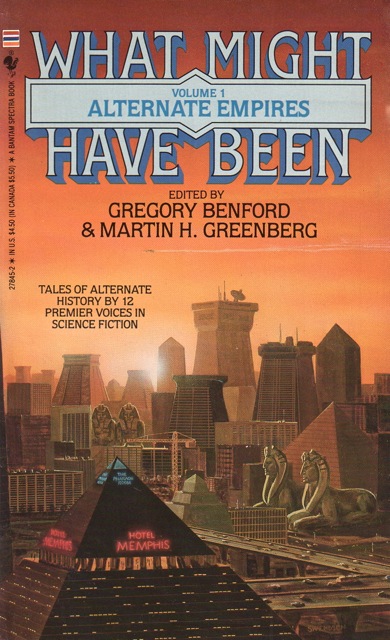
"All Assassins" made its debut in Gregory Benford and Martin H. Greenberg's anthology of alternate history stories, Alternate Empires, which has appeared in a number of different editions.  Alternate history is one of my least favorite SF subgenres, but you never know, maybe I'll like this one.

Ah, Malzberg never seems to tire of writing about the Kennedys.  “All Assassins” is written in the voice of Lee Harvey Oswald in an alternate universe in which Nixon won the presidential election in 1960 but in 1964 was succeeded by Johnson, who won a second term in 1968.  All this time John F. Kennedy has been a senator, and Oswald has been his appointment secretary; among Oswald’s jobs are placating the senator’s irascible father Joe, driving the senator around, and procuring sluts for the senator to bang.  Oswald doesn’t fit in with the randy boozy chummy Kennedy and his friends, guys who are always cracking jokes about “pussy” and Oswald’s apparent celibacy, and from the inside, Oswald, an idealist and a commie (or maybe just a pinko), sees how vulgar and corrupt the Kennedys and their henchman are--Oswald really wants to end American involvement in the war in Vietnam, but Kennedy and the other Democratic big wigs care more about ass and booze than government policy. 

The 1972 election is coming up, and Kennedy is probably going to be the Democrats' nominee.  When Oswald learns the senator is going to give a speech in Dallas which he implies he is not going to work to abandon the war, even though Oswald has been lead to believe he is the “antiwar candidate,” Oswald snaps and plots to murder Kennedy while the senator is giving a speech, using the “old point-thirty-eight Smith & Wesson” he got from the Fair Play for Cuba Committee.     

Acceptable...maybe a marginal positive score.  While I don’t know enough about Dashiell Hammet and Raymond Chandler’s relationships with women and with other mystery novelists to get any emotional or intellectual juice out of “The High Purpose,” I know at least something about American politics and foreign policy in the postwar era and have my own opinions about it and so the events depicted in “All Assassins” engage me and I am willing to grapple with the task of figuring out whatever Malzberg is trying to say in this story.  I can also identify with the experience of being stuck among a bunch of people with whom one really doesn’t fit, of being the odd man out of a group, the group’s court jester or foil, and I think Malzberg does a good job with his alternate Oswald’s psychology here.

“Understanding Entropy” (1994)

This little story has an odd and interesting publication history, and seems to have been embraced by the SF community, or at least to have been strongly supported by some members of that community.  “Understanding Entropy,” four pages in In the Stone House, first appeared in an issue of the magazine Science Fiction Age which features an essay by David Brin titled “Only Science Fiction can solve the perplexing problem of gun control.”  A year later the story was reprinted in Locus as a paid advertisement by the publishers of Science Fiction Age.  A year after that, “Understanding Entropy” appeared in Nebula Awards 30, edited by our new friend Pamela Sargent.  Two years later, in 1998, it was included in the Readercon 10 Souvenir Book.  In 2007, seven years after resurfacing in In the Stone House, “Understanding Entropy” was included by Michael Bishop in A Cross of Centuries: Twenty-Five Imaginative Tales about the Christ.  In that Bishop anthology, Malzberg provides a very brief afterword, saying the story was written in memory of a close friend who was also Malzberg's lawyer.

In his cagey allusive way, Malzberg doesn’t use the words “AIDS” or “gay” or “Jesus” in the story, but it is clear that “Understanding Entropy” is about a man, Martin Donner, who leaves his wife for a man and contracts AIDS and then dies in the hospital, his body wrecked by numerous illnesses.  The narrator is Jesus, who contacts Donner at various points in his life (Donner thinks these contacts are dreams or hallucinations) to ask him if satisfying his need to live his authentic life--that of a gay man--is worth the price of self-destruction and the betrayal of his family.  Donner offers different answers at different points in his life; the idea that living a life that does not express your true nature is like dying young and in agony is a central metaphor of the story, and the question is, is it worth experiencing one of these deaths to avoid the other?  Another metaphor is the idea that Donner is like Jesus, his death the result of being his true self, like that of Christ's on the cross. 

The story works, and it is easy to see why people would like it; it is short and economical, addresses not only timely topical concerns, but timeless concerns about how we balance duties we might have to ourselves and to others as well as how we assess the risks attendant with the pursuit of our desires.  Like "All Assassins," at the center of "Understanding Entropy" is a tragic figure one is expected to sympathize with, but Malzberg doesn't just let this sympathetic figure off the hook--JFK and Martin Donner have agency and responsibility, and we don't necessarily have to approve of all the risky and antisocial actions they took just because in the end something unfortunate happened to them.

Today's climate, in which "cultural appropriation" can be a topic of heated discussion, perhaps provides another lens through which to view this story and another way in which it might be viewed as controversial; I don't believe Malzberg is a Christian or a homosexual, but he doesn't let that stop him from putting words in the mouth of Jesus Christ in a story about the choices and sufferings of a gay man and his family.

I'm glad I can finish up this blog post with a story that is provocative and compelling after starting off with some clunkers that I couldn't really get into. 

**********

We'll be spending more time with our cheerful friend Barry in our next episode.  See you then!

Thursday, September 29, 2016

1977 stories by George Alec Effinger, Gene Wolfe, R. A. Lafferty and Carter Scholz


Fellow SF fan R. R. Nurmi,
we salute you!
It's Part Two of our look at Terry Carr's Universe 7, an all original anthology from 1977.  I own a hardcover copy of the book club edition which was formerly in the library of Des Moines resident R. R. Nurmi.  I own several volumes from the Nurmi library, including Anthony Boucher's A Treasury of Great Science Fiction

"Ibid." by George Alec Effinger

I know there are Effinger fans out there.  Well, here is where I tell you people that you have to buy a copy of Universe 7 because it is the one and only place where "Ibid." has appeared.

This is a decent Twilight Zone-style story that touches on Cartesian philosophical issues (can we trust any of our sense impressions?) and the question of whether life has any meaning if we cannot be confident of our knowledge of the outside world (if we can't tell if friends and family really like us or if our work is truly valuable, why not just become a slacker, a drunk or a suicide?)

Cathy Schumacher is an academic who suddenly finds messages directly addressed to her in academic journals, students' papers, supermarket celebrity magazines, even the local TV news!  Is she going insane?  Are mysterious eldritch forces aiding her? Tormenting her?  These bizarre problems are piled on top of more ordinary problems Schumacher is facing, the kinds of problems faced by many (most?) ordinary people: her work (teaching uninterested students about English literature) seems pointless and her daughter and husband are distant--he in fact may be having an affair.  Her response to these problems, revealed on the final page of the story?  Taking up alcoholism!

I like "Ibid."'s structure and themes, and the style is fine.  For a while I thought it should be more scary--the story doesn't transmit to the reader a sense of horror, it is a bit cold and clinical.  (If I opened up a supermarket tabloid and saw a headline that read "Hey, MPorcius, look out!" I'd probably just die right there on top of my cart full of Count Chocula and Ovaltine.)  But thinking further on the story, I have decided that it is less about the heavy kind of cosmic horror represented by the impossible messages, the kind of horror that drives people in H. P. Lovecraft stories insane, and more about one of the quotidian sadnesses of life, that we cannot have any confidence that those whom we love love us in return, the kind of sadness represented by Schumacher's relationships with her daughter and husband, the kind of sadness we see in Proust.  Because this sadness is so common, is experienced by so many of us, a low key tone makes sense, and keeps the story from descending into soap opera melodrama.  

Good.

"The Marvelous Brass Chessplaying Automaton" by Gene Wolfe

I don't have to tell you that Wolfe is widely regarded as the best SF writer of all time and all that.  I read "The Marvelous Brass Chessplaying Automaton" in my copy of Storeys from the Old Hotel years ago, and here I go again.  This story must be highly regarded, it having been included in the Tor 2009 collection Best of Gene Wolfe.

It is centuries in the future!  The human race is reduced to a kind of Early Modern technological and political level, though educated people have knowledge of the computers of the past and can identify weather satellites in the night sky.  Perhaps to evoke thoughts of the Thirty Years War as well as Cold War fears of a NATO vs Warsaw Pact ground war, the story is set in Germany and people fling around references to Burgermeisters and have names like Hans and Gretchen and Karl.  A war with the Russians is underway, and has been for a long time; soldiers and deserters are everywhere, and in the distance can be heard the thunder of siege guns.  

A man comes to the village of Oder Spree who claims to own the sole surviving operable computer, a computer devoted to playing chess!  After the machine is demonstrated, an academic purchases it for the University, only to find the machine is a scam (much like the late 18th-century "Turk" automaton which captured the imagination of Europe and played such luminaries as Benjamin Franklin and Napoleon Bonaparte); a skinny mutant, a genius chess player with an oversized brain, hides inside the machine to make the moves.  The mutant falls in love with a local blue-eyed blonde and decides he wants to stay in Oder Spree; to this end he conspires with the academic to get his money back from the con artist, but a terrible tragedy results from their desperate plan.


Very good.  You've heard me praise Wolfe before, so you won't be surprised to hear me say the story is economical, full of memorable images, pulls at the heart strings, has clever foreshadowing, interesting premises, and a puzzling mystery.  Shall I voice my theory regarding the mystery?  Of course I will!  The mystery is that the chess-playing machine, to the surprise of the double-crossing scam artists, seems to start working on its own.  Now, Wolfe is a Christian who believes in the supernatural, so it is not impossible that we are to suspect that the machine is animated by ghost or deity as a means of punishing the sinful cheaters who callously put the blonde woman's life at risk.  A related possibility (one the unnamed narrator puts forward, but remember that Wolfe is famed for his use of unreliable narrators) is that the mutant has telekinetic abilities even he doesn't understand--it is his own guilty conscience that brings the antiquated machine to life.  But my favored theory (reflecting my cold-hearted materialism, perhaps) is that the machine is being used in strong sunlight for the first time in a long time (Wolfe mentions the sun and bright sky more than once) and the sunlight has recharged the computer's batteries via unremarked upon solar cells, allowing it to operate as it did a hundred or more years ago.

Like I often do with Wolfe stories, I read it twice in one day, enjoying it both times. Highly recommended.          
 
"Brain Fever Season" by R. A. Lafferty

This story is, according to isfdb, the final installment of a series of stories called "Men Who Knew Everything."  The story is a little opaque; maybe I would have had an easier time "getting" it if I had read some of the previous stories in the series.

The story's characters are immortal and eccentric geniuses who manipulate the world from behind the scenes.  Significantly, they "set up" the equator and the four seasons. The idea behind this story is that there are additional "seasons" which affect not the weather and length of the day, but the human mind.  There are, for example, seasons during which there is a flurry of large scale construction (the Great Pyramid of Giza was built during such a period, we are told) or a sudden flowering of artistic production.  In this story there is a sudden explosion in interest and publication of high brow scientific and philosophical writing, "an information-and-invention sort of fever," across the Northern Hemisphere.

Of course, all this stuff I'm just telling you in a few sentences is revealed gradually through clues over  story's 17 pages, accompanied by lots of jokes and farcical explorations of the ramifications of the abrupt elevation of intellectual prowess of the average man.  This isn't a "realistic" look at what might happen if everybody all of a sudden got smarter (like Poul Anderson's Brain Wave), but a funny, silly story in which geniuses feverishly write books in 18 hours and publishers get them printed and into the stores in five hours, a response to the public's fervid demand for material like "Emanuel Visconti's Costive Cosmologies Freed," the widespread demand for which actually predates the completion of the book's first draft.

A recurring motif of the story is likening the desire for knowledge to sexual desire; people "howl" that they are "hot" for a book and "have to have it right now," and the brain fever season is compared to the rutting season or oestrous period of animals. The explosion in human brainpower first becomes evident when publishers and sellers of pornography (famed for being able to produce and distribute material quickly) start selling mass quantities of books like a Tibetan grammar and a volume on plate tectonics.

"Brain Fever Season" is alright, not great.  I didn't laugh at the jokes (many are just lists, like of funny names) and I didn't feel like my work figuring it out had a commensurate payoff.  Maybe I would have enjoyed it more if I had been already familiar with Barnaby Sheen and his troupe of weird geniuses.  Besides in Universe 7, you can read it in the 1984 collection Ringing Changes, in English or Italian!


"The Ninth Symphony of Ludwig van Beethoven and Other Lost Songs" by Carter Scholz

I've never read anything by Scholz before, but on isfdb I see he has worked with Barry Malzberg and Kathe Koja, writers whose short stories I like, and has some kind of collaborative relationship with critical darling Jonathan Lethem.  A good omen.

The intro to "The Ninth Symphony of Ludwig van Beethoven and Other Lost Songs" contains what I like to think of as "mysteries," even if you skeptical types out there would probably call them "typos."  Carr tells us that Scholz has a story in Alternities--I just read Alternities and there is no Scholz story in there!  He also tells us Scholz has a story in Clarion IV--there is no Clarion IV listed on isfdb, though probably Carr is referring to Clarion SF, the fourth Clarion anthology.  Finally, we are told Scholz has contributed a story to Output, but what exactly Output is, my five-minute Google search does not reveal.

Enough with the mysteries, on with the story.  "The Ninth Symphony of Ludwig van Beethoven and Other Lost Songs" takes place in 2016.  A means of sending a person's consciousness back in time to inhabit the brain of another person has been developed; you can't influence your host, but you can see through his eyes and share his thoughts.  The main character of the tale, Charles Largens, is a musicologist, and he has his mind sent back in time to ride as a passenger in Beethoven's head.

A large proportion of the story concerns academic angst and office politics: the grantmaker will pull the grant if they find out how the money is being spent, guys compete over a promotion to head of a department, Largens has sex with another academic's wife, composers suffer writer's block, Largens worries that he shouldn't have abandoned his creative career as a composer to become a mere critic and historian of music, he realizes that his academic career has been manipulated by his mentor, etc.

The science fiction elements of the story revolve around the fact that, while your host won't be influenced by a single or a handful of visiting psyches from the future, so many scholars enter the head of a fascinating cultural giant like Beethoven that ol' Ludwig Van begins to pick up the "crosstalk" and it has a terrible negative effect on him.  Beethoven's output is diminished as he loses sanity (the famous Ninth symphony ceases to exist!) and Largens begins to notice differences between the 2016 he leaves for the 1800s and the one he returns to after each transfer.  In the end of the story Largens acts to shut down the dangerous time travel program and abandons scholarly life to return to his true calling, creating new music.

This story is well-written and constructed.  The idea that scholarly research work is sterile and stifling, and can render a creative person impotent (one character literally gets too caught up in his Beethoven research to be able to achieve an erection and have sex with his wife) is provocative, reminiscent of the way (one suspects) that actual soldiers and politicians look down on military and political historians, athletes look down on sports journalists, novelists look down on critics, etc.  (Scholz's story also reminded me of Proust's idea that things like friendship are a waste of time for the true artist, distractions from his real work, his art.) Sterility, like impotence, is a theme of the story--2016 is called a " barren year" and we learn in an aside that New York City has been reduced to a population of only two million, so that instead of new buildings going up, buildings are actually being torn down!  Sounds even worse than the real 2016!

Worth checking out.  "The Ninth Symphony of Ludwig van Beethoven and Other Lost Songs" would later appear in British and German anthologies.


***********

A good anthology, with seven stories that I can definitely recommend and only one clunker.  Universe 7 earns the MPorcius Seal of Approval.