Showing posts with label Wyndham. Show all posts

Wednesday, September 9, 2026

Fantastic, Jan '59: R Bloch, J Wyndham, R F Young and L M Janifer

Let's read four stories from the January 1959 issue of Fantastic, sister magazine to Amazing, both of which at this time were edited by Cele Goldsmith.  This issue has a memorable but somewhat mysterious cover by Phil Berry and, inside, two solid interior illustrations by the great Virgil Finlay, one of a woman being murdered in fetishistic fashion, the other of men in spacesuits in serious distress.  The editorial is by editorial director Norman Lobsenz, and in it he laments the death of Weird Tales and Unknown and the apparent lack of respect currently afforded fantasy--all the good authors today, he fears, seem to be focusing on science fiction, so that there is no heir to Lovecraft, Poe or Machen.  Lobsenz thinks there is still a market for good fantasy and suggests Fantastic will include more fantasy in coming issues.

Check out all this exciting content, and today's four stories, in their original magazine form, at the internet archive here, which is where I will be reading them.

"The Screaming People" by Robert Bloch

The title of Bloch's story is promoted on the cover, but not Bob's name, for some reason.  Remember when we read Bloch's cover story from the January 1960 issue of Fantastic and I found it to be "one nihilistic story...[in which] Bloch suggests that the human race is so crummy that its destruction is not a tragedy but a consummation devoutly to be wished"?  And then there was Bloch's cover story to the August 1960 issue of Fantastic, which I considered "twenty-four (24) pointless pages" consisting of a "bunch of bad jokes and then a bunch of superficial alternate history goop" and finally "a long and absolutely unconvincing utopian tract" proposing the theory that "the institution of the family is the cause of all our problems."  Hopefully Bob has a better attitude this time around!  (Or could it be that I am the one who needs an attitude adjustment?)

"The Screaming People" starts with a very good sequence of like half a dozen pages (this thing is like 35 pages long in toto), the depiction of a man committing terrible crimes at the direction of a mysterious voice in his head.  Our narrator, Steve, works in broadcast advertising, in sales, in Los Angeles, and has a lot of psychological trauma after a terrible car accident.  Has this trauma opened him up to control by some demon or alien or something?  Whatever the voice is, it wakes him up at night and directs him to dress, walk to a mansion, sneak in, murder an old man in his bed and steal some item from the mansion before returning home.  Our guy thinks it's all a terrible dream, but after his lovely red-headed wife wakes him in the morning he finds the box that once held the item he stole in the supposed dream right there in his jacket pocket!

Skipping work, he rides the bus to his shrink, neurosurgeon Dr. Wagram--along the way he passes many Los Angeles landmarks and Bloch takes this opportunity to rag on L. A., to compare its denizens to vampires and suggest LA is a world of fakery.  (Bloch attacks the City of Angels and Hollyweird in lots of his stories, something that surprised me when I first started reading him.)  Steve has a kind of breakdown as he arrives at his doctor's house, but recovers in the special room the good doctor has prepared for him--a room that reminds him of the security of the womb!  

We learn more about that traumatic automobile accident.  Our guy was thirty years old when he was in the one-car crash in the desert between L. A. and Las Vegas, suffering injuries that put him into a coma.  The doctor was the first to come upon the accident, and took our guy on as a patient, shepherding him back to health.  The narrator physically recovered under the care of this immigrant from Germany, but Steve has amnesia and can remember nothing that occurred before the accident.  The generous doctor helped him get a job, where he met his wife.  Bloch gives us a flashback to the conversation in which Steve convinced Roxie the aspiring but talent-deficient singer to marry him.        

We learn about Wagram's medical practice.  The good doctor takes on the brain injury and psychiatric cases that other doctors believe are hopeless, and employs innovative and controversial techniques.  These techniques are morally questionable--Wagram is a mad scientist!  For example, if a patient has sadistic or masochistic tendencies, or sexual problems, Wagram provides the sufferer life-like mechanical dummies to act out his or her perverse fantasies with!  Yikes!  As for patients whose insanity is caused by horrible memories, Wagram administers shock treatment that removes those pesky memories to reduce their personalities to that of a baby still in the womb--then he can build their personalities up again, in effect creating new people!

Steve realizes, largely through coincidences but also through the kind of detective work that involves threatening and torturing people to get them to tell their secrets (you know, the detective methods that work in real life, unlike that Sherlock Holmes "the lint on your lapel proves it was you who dun it" nonsense), that Wagram is using his memory erasing and personality crafting skills to build a sort of criminal army, and Steve himself is one of Wagram's top soldiers!  And Wagram isn't working alone--other people, people who represent Hollywood and how corrupt, mercenary, and deceptive Tinsel Town really is, are in league with Wagram, and Steve has to confront each of these backstabbing lying pieces of human garbage one by one--who will live and who will die as the successive gory climaxes hit and then hit again?  And of the survivors, who, if anybody, will be sane at the end of the story?  

Robert Bloch and Cele Goldsmith have foisted some real clunkers on us (have I mentioned Bloch's cover story for the November '58 issue of Fantastic, a story that I called "an unconnected jumble of dumb puns, winking references to science fiction cliches, and gory images"?) but "The Screaming People" is a winner.  The hypnosis scenes are good, the gore is good, and the one gruesome-catastrophe-after-another ending is good.  Bloch's negative portrayals of psychiatry/psychology and Hollywood here ring true, or at least feel appropriate to me, a skeptic of those institutions.  I don't deny that "The Screaming People" suffers from some of the usual shortcomings of detective fiction, like the convoluted conspiracy and the long scene in which the (amateur, in this case) detective explains the criminals' scheme and how he figured it out, but these elements don't sink the story.  So, thumbs up for "The Screaming People."    

"The Screaming People" would be reprinted in the Bloch collection Chamber of Horrors and in a Finnish collection with a particularly gruesome cover.  

We've now read, I think, four stories that appear in Chamber of Horrors, today's entry, plus:
 "Method for Murder," 
a version of "Two of a Kind," 
and "The Unpardonable Crime"

"The Troons of Space: Mars A.D. 2094" by John Wyndham (1958)

The editor's intro to "The Troons of Space: Mars A.D. 2094" reads "In this third part of his novel-length saga written especially for Fantastic, famed British author John Wyndham ('The Day of the Triffids') writes a deeply penetrating story of man in far space."  But isfdb says that this story had already appeared in New Worlds over in Albion in 1958 under the title "The Thin Gnat-Voices."  I'm not going to expend any energy trying to figure out who was trying to trick who here.  Instead, I'll remind you I've already read some Troons stories: "The Asteroids, 2194," and "Idiot's Delight."  I think there are five Troons stories, so we still have a way to go until we are fully Trooned out here at MPorcius Fiction Log; seeing as I didn't give either of those two stories a positive review, we may never fully Troon out.

Our narrator is a Troon on Mars, one of the first people to land on the red planet, a descendent of a long line of Troons who each played a major role in the early stages of the exploration of space.  Wyndham uses the Troon family as a way to tell a fictional history of the future, and we get a long history lesson about the war that destroyed the northern hemisphere and left Brazil and Australia the leaders of civilization.  As is usual in these stories, nobody can be blamed for starting the nuclear war, the implication being that the liberal West is no better than the Soviet Union.  The narrator is British by ethnicity, a citizen of Brazil, one of his ancestors a British officer who was on vacation in Jamaica when the Northern hemisphere was wiped out and who was made head of the Brazilian space agency.

Then the narrator's own biography.  He was chosen to be one of three crewmen on the first ship to Mars, a ship designed and built by his father's team.  The ship lands on its tail as according to plan, but the surface of Mars turns out to be unstable, in many places a thin crust over a vacuity, and one of the ship's three legs breaks through the surfsce into a cavern and the ship falls on its side.  One of the crewmen dies, and another is hit in the head and becomes insane.  The radio is also wrecked.  The insane man at first suspects that the narrator is a Martian, and then that there are Martians outside plotting an attack on the stricken ship, and finally that the narrator is in league with the Martians.  I took this to be a satire of people in the West who feared communist spies or an attack from the USSR--Mars is a totally barren desert, as the narrator saw while the madman was unconscious--there are no Martians.  I don't read the current SF magazines, and I wonder if they are full of stories that imply that people who worry that Muslims will attack Christians and Jews or that Russia will try to conquer Eastern Europe are insane.

Much of the plot of this story consists of the narrator trying to get the maniac to come to his senses about the nonexistent Martians and to help get the radio fixed and the ship back into operation, efforts that come to nothing.  The madman tricks the narrator into leaving the ship, then the madman makes a desperate attempt to get the ship to take off from its horizontal position.  The attempt fails and the madman dies, stranding the narrator on Mars, where he drifts in and out of sanity.  We get a little lecture on how man cannot accomplish anything alone, how important "corporate strength" is, not only to conquering space, but to maintaining sanity:
We need numbers to sustain us; in numbers we can dispel the terrors; alone, we are weak, mutilated. Taken from our pool of corporate strength we gasp, we wriggle defenselessly while the terrors circle round, slowly closing in . . . 
I guess this is a plea that we make friends with the Soviet Union?  Or just temper our individualistic culture with a hearty does of collectivism?

The actual science and technology stuff in "The Troons of Space: Mars A.D. 2094," the space suits and space ship and the little aircraft the narrator constructs and all that, is good, and Wyndham's writing is very smooth and professional.  But the fictional history parts of the story (which is 28 pages total; like 8 or so are the history lesson) drag, and as I have suggested, I am not impressed with the story's ideology.  The story also lacks passion, feels slow.  I'm calling it acceptable; people who think the space program  is a mistake or who blame the West for the world's problems may like it more than I did.

You can find "The Troons of Space: Mars A.D. 2094" AKA "The Thin Gnat-Voices" (the latter title a reference to Rupert Brooke's "The Jolly Company," which is quoted in the story) in the Troon collection The Outward Urge.  I'm a Wyndham skeptic, but he is very popular, and The Outward Urge, sometimes credited as a collaboration between Wyndham and his pen name Lucas Parkes, has been reprinted many times.  One Italian edition has a cover featuring a hot babe smoking a cigarette, which is kind of funny.  Is there a hot babe in a Troon story I haven't read yet?  I wouldn't associate Troons with hot babes based on my experience with Troons thus far, but I guess anything is possible.


"Passage to Gomorrah" by Robert F. Young

I feel like I've been reading lots of stories with prostitutes lately.  There was Harlan Ellison's "Pennies Off a Dead Man's Eyes," Harlan Ellison's "The Very Last Day of a Good Woman," and Harlan Ellison's "The Toad Prince, or Sex Queen of the Martian Pleasure Domes."  Well, I guess I have just been reading lots of stories by Harlan Ellison lately.  Anyway, the editor's intro to Robert F. Young's "Passage to Gomorrah" tells us that the story is about "the Galaxy's most beautiful whore."  Wow!

Lady Berenice, the blonde-haired and blue-eyed "lady of the stars" (groan) is being exiled to Polaris 2 aboard a one-crew, one-passenger star ship.  She flirts with the pilot, Cross, and Cross gets sexually frustrated because he doesn't have enough money to afford the services of such an expensive prostitute.  He is so discombobulated that, when he gets a message form HQ that a time storm is up ahead, instead of coming out of hyperspace he pushes the wrong buttons and dives right into the storm!

Hyperspace travel in this story exploits a "separation of pure space and pure time from the thing-in-itself, or from basic reality," contracting a parsec to half a kilometer, allowing interstellar trips to take place in hours or days instead of years.  In a time storm a ship is likely to find itself in pure time, and its passengers and crew to relive past experiences.  Because "in pure time, individuality does not exist," people on a ship that enters a time storm will experience each other's pasts as well as their own.  Could it be that Cross' subconscious caused him to push the wrong buttons out of a desire to experience the sexy sexy past of the Lady Berenice?

We get a bunch of flashbacks to the two characters' childhoods, learn why Cross became a space pilot (he was ashamed as a child because he proved too scared to climb a tree all the way up and the other kids taunted him) and why Berenice became a whore (her father and mother fought all the time and Dad was often away on business and then left for good when she was ten.)  
“I’ll show them! Space is a tree, in a way. Space is a tremendous tree reaching up into infinity, and I’ll climb as high into it as I can get and I’ll laugh back down at them in their silly suburban houses...."
The anti-suburban theme, common in 20th-century literature, in this story manifests itself in odd ways:
“Think about it, Nate,” his father went on, puffing self-righteously on his suburban pipe. “You’re still young. You’re only 19. Why don’t you wait for a while...."
"Suburban pipe"?  Good grief!  Young never presents an urban milieu or sensibility to contrasts with the suburban milieu and beliefs his characters rail against; in "Passage to Gomorrah," "suburban" is just a euphemism for "conservative" or "religious."   

Considering the social geography Young concocts for his story, "provincial" or "Earthbound" might have been a better word for him to use than "suburban" to describe the villains of his story.  Through the flashbacks of our two characters, we learn that, in Young's fictional universe, society on Earth and society beyond its atmosphere are totally separate.  People who opt to go to space surrender their rights as Earthers, including the right to marry and have kids, because the radiation in space means that the children of people who spend time in space are mutants--even "monsters."  Because spacemen can't get married, to relieve their horniness the world's oldest profession, still looked down upon on Earth because of religious prejudice, is in space a noble calling--one minor character calls it "The Galaxy's Noblest Profession."  Whenever a woman does get pregnant with a mutant child she is exiled to Polaris 2, AKA Gomorrah, the world of mutants.  That is why Berenice is headed for Polaris 2--she apparently neglected to use her Farbes and Donniger contraceptor-field and got preggers, though she insists the device malfunctioned.

(One of the interesting things about "Passage to Gomorrah" to a 21st-century audience is how it suggests that abortion is so unspeakably horrible to 1959 people that it isn't even mentioned in the story, even though you have to imagine the kind of adventurous or desperate women who would abandon their families and friends on Earth to become prostitutes would be quite willing to have an abortion to avoid exile to some planet purportedly full of monsters.)     

We follow the careers of these two spacers, the eager male tryhard adventurer who quickly rises in the ranks and the resigned whore who hates her clients.  Young's story at one and the same time seems to be trying to convince the reader that objections to prostitution are silly, the result of the irrationality of religion, and to portray being a prostitute as terrible.  I guess he explains in a half-assed way that prostitution in outer space is gross because it is controlled by corporations--I guess goofy attacks on big business go hand in hand with goofy attacks on religion and on the suburbs.  

Then comes our first twist ending.  Berenice is preggers not because her contraceptive device failed--she is carrying Cross's child because they have sex in the time storm and being in a time storm sometimes causes things to happen out of sequence--she had sex with Cross today, and this lead to a pregnancy that began a few weeks ago.

Because Cross and Berenice in the time storm are reliving their lives, and each other's lives, Young has the audacity to reprint in the second half of the story an entire page of dialogue between them from earlier in the story, so we can relive that conversation along with them--annoying.

Anyway, after going through the time storm together, and having sex that has resulted in pregnancy, Cross and Berenice are like the platonic ideal of a married couple, though legal or religious marriage is denied them--they know each other better than any married couple on Earth could, having lived each other's lives.  Berenice is radiant:
...her face, bereft now of all the hardness and the cynicism civilization had imposed upon it, was like a little girl’s.
Our other twist is that the mutants on Polaris 2 are not hideous monsters but beautiful angels with wings and everything!  Space radiation is not bad for people, but turns them into the incubators of homo superior!  How ironic that the whores the religious establishment denounces are the source of the angels those religious dopes glorify on their stained glass windows!  The corporations have kept this astounding fact secret from the Earth.  Cross and Berenice take up residence on Polaris 2 AKA Gomorrah, where people don't live in suburbs but on farms.

If you read 20th-century fiction you encounter plenty of attacks on religion and big business and the suburbs, and some of them are silly, and "Passage to Gomorrah" is one of the sillier ones.  The story isn't very well-written or exciting, either.  The plot is crazy, audacious, so I guess that makes it kind of interesting, but it is not a good read, the science makes no sense but is merely a contrivance to set up the anti-religion plot, and its arguments are asserted rather than argued.  Gotta give Young's story here a moderate thumbs down; it not terrible like Laurence M. Janifer's "Expatriate," but still bad.

This strange artifact reappeared in a 1966 reprint magazine, The Most Thrilling Science Fiction Ever Told and is also in a 21st-century Young collection from Ramble House.

I think I've read eleven Young stories now.  Zoinks, it is links time.


Probably I should do an analysis of these almost-dozen stories and see how many of them bitch about the suburbs and religion.  Maybe next time I read a Young story...if there is a next time.

"Replace the Horse" by Laurence M. Janifer

"Replace the Horse" was reprinted in the 1968 Janifer collection Impossible?  In the intro to that collection, besides bragging about how thin he is ("People who diet hate me,") Janifer tries to give the impression that he is a special guy and a special writer, a rebel who wants to do new things, wants to break the rules.  More endearingly, Janifer is also generous to those who helped him, among them Cele Goldsmith (he says "Cele Lalli," using her married name) whom he singles out as perhaps the editor most willing to let him experiment (in contrast to Horace Gold and John W. Campbell, Jr., who each made him rewrite a story eight times.)  I wonder if Lalli gave the writers at Modern Bride, where Lalli worked for three decades, over ten of those years as Editor-in-Chief, as much opportunity to experiment as she gave SF writers during her six or seven years at Amazing and Fantastic.

I've read enough stories that could have used some additional editing from Goldsmith's Amazings and Fantastics that I am skeptical of her laissez-faire editing style,* but I have to congratulate her and Janifer on "Replace the Horse," which is a kind of P. G. Wodehouse style story that is quite fun. 

*See the aforementioned Fantastic cover stories by Bloch and Jim Harmon's "Measure for a Loner,"   

Our narrator is a horse trainer who gets mixed up in the schemes of a scientist.  This egghead has invented anti-grav and wireless energy transmission.  The scientist thinks he can make more money through cheating at horse races than selling his paradigm-shifting technology to the government or private industry, and wants our narrator to act as his trainer to make his scam look more legit, and to be his guide through the world of horse racing.  The scientist buys a pathetic old horse that anybody with any experience at the track can tell is a loser and puts a saddle on it that has, concealed within it, an anti-grav "printed circuit."  Given enough power, the anti-grave device reduces the weight of saddle and jockey to zero, so the horse can race totally unencumbered.  The scientist has built power generators and transmitters into a pair of binoculars--as long as somebody is training the binoculars on the saddle, even this old worn out nag can outrun a good horse.

As we expect, things eventually go down the tubes, but for a while there our protagonists are really making money running this specially equipped horse.

Good jokes, a good style, an entertaining story, thumbs up.  I'm surprised "Replace the Horse" hasn't been printed more often--aren't there a stack of anthologies of allegedly humorous SF stories?  This story of Janifer's deserves to be in those.  Well, just this summer "Replace the Horse" appeared in a webzine called Black Cat Weekly and edited by John Gregory Betancourt, so maybe now it will get the attention it deserves.  (The same e-issue of Black Cat Weekly also includes Young's "Passage to Gomorrah," so I guess Betancourt just read this issue of Fantastic.)

**********

The Bloch and Janifer are winners, the Wyndham is respectable, and while it is not good, the Young at least is crazy.  So, a good, memorable, issue of Fantastic.  Goldsmith edited over 70 issues of Fantastic and I am sure we will be reading from more of them, so stay tuned.

Thursday, February 19, 2026

Merril-approved 1958 stories by J Williams, R Wilson, J Wyndham and R F Young

The day we all doubted would come has finally arrived.  The day we finish our tour of 1958's speculative fiction and bid farewell to our guide, critical darling (though one of our favorite critics, Barry Malzberg, has had some choice things to say about her) Judith Merril.  For what seems like forever, I have been reading and blogging about selected stories from the alphabetical honorable mentions list in the back of Merril's SF: The Year's Greatest Science-Fiction and Fantasy, 4th Annual Volume.  And today the light at the end of the tunnel is visible up ahead as we arrive at the last letters of the alphabet, "W" and "Y" (Merril didn't encounter any stories by "X" or "Z" authors she felt worth recommending.)  Today's blog post will be the final of this long term project.  

(Find at the bottom of this post a long list of links to the previous posts in this series.)    

Merril includes on her list five "W" stories and one "Y" story, and five of these pieces of fiction are easily accessible to us cheapos.  Sadly, Merril's first "W" story, "Piggy" by Paul Wallach, appeared in an issue of Swank that I can't find any scans of.  As for her second "W," that is James White's "Tableau," which we read in 2020.  it is the remaining three "W" tales and the "Y" piece we'll be reading today in scans of the publications in which they debuted.  Let's hope this project will be ending on a high note with four great stories!

"The Hunter and the Cross" by Jeanne Williams 

Jeanne Williams seems to have penned many historical novels about the American West, as well as a few fantastical sex or romance novels.  There are four short fiction credits at Williams' page on isfdb; this one is the third.  "The Hunter and the Cross" debuted in Fantastic, in an issue with some weaker than usual Virgil Finlay illustrations and an ad on the back cover for the Science-Fiction Book Club that highlights John Christopher's No Blade of Grass ("The book that SHOCKED the editors of The Saturday Evening Post"), which I read back in 2015.

"The Hunter and the Cross" is a story about Catholic mysticism, with lots of blood and some fetishistic sex undertones, set in a village in New Mexico.  The first paragraph sets the scene and offers some foreshadowing thusly:

It was the trail of the Penitentes, where they marched in the night wind, leaving a track of blood in the snow. There on the mountain at Easter they crucified one of their number, enacting the passion of Christ.

Soledad is a gorgeous girl who got married to some old geezer who can't get it up.  One day she is out in the woods getting water, and Gil, from the village on the other side of the mountain, comes by.  A great hunter, he is carrying the corpse of a mountain lion, his kill dripping blood on him.  Gil has banged the hot wives of many of the men back in his village, including those of "the jefe" and "the colonel," but when he sees Soledad he thinks this is the hottest chick he has ever seen!  He aches to possess her, but something keeps him from taking her by force and then carrying her off to his village.  Is it the cross that hangs between her breasts?  Is his love for her turning him into a believing Christian?

Gil takes lodgings in Soledad's village, gives the mountain lion's pelt to Soledad as a gift, starts attending church, even joins the Penitentes, who slash and flagellate his back, drawing blood, a process that deepens Gil's understanding of the sacrifices endured by Christ, a process Williams describes with gusto.

His back was a raw mass. In his belly was acrid sickness. But now he was one of the Brothers of Blood.

When Gil, feverish, makes a lonely pilgrimage up the mountain, a peon, I guess the Devil in disguise, tempts him with peyote, an episode I expect is to remind us how Satan tempted Jesus during those 40 days in the wilderness.  Gil resists, but only for so long--after he succumbs, he, apparently, transforms into a monstrous mountain lion that terrorizes Soledad's village, devastating the crops and slaying multiple farmers.  The jealous women of the village blame beautiful Soledad for the murderous attacks, accusing her of being a who transforms into the lion.  It doesn't help that they catch her caressing the lion's pelt Gil gave her.  Gil realizes Soledad loves him as much as he loves her!  

In an effort to save Soledad, Gil promises the villagers he will kill the monster cat after he's finished participating in the current ecstatic Penitente ritual, in which his fellow Penitentes have assigned him the role of Christ.  When they tie him up to the cross, Gil feels himself transforming into the monster lion again!  In front of everybody!  Soledad comes to him, her love redeeming him and turning him into a human again before he dies--this miraculous event proves to those watching that Soledad is not a witch.

A wild and crazy story that treats Christianity with deadly seriousness, condemns drug use, and also has the elements you expect to see in women's erotica/romance ("the hunkiest of hunks who has cuckolded all the elite men of his town comes to my town and can't resist my looks and I convince him to go monogamous for me.")  The style is a little weak and the plot construction is a little clunky, but not terrible.  We'll call it acceptable.

I can't find any evidence that "The Hunter and the Cross" was ever reprinted, and it is a little curious that Judith Merril, whom I think of as a Jewish Marxist, would recommend this ecstatic Christian story, but maybe she liked that it was written by a woman and included a woman falsely accused of witchcraft who, in the end, resolves the plot with her bravery?  And maybe Merril, who was always trying to convince people that genre boundaries were a scam, thought the story a prime example of how broadly SF could be defined, how science fiction/fantasy devices like a guy transforming into a monster could be used for almost any purpose, to push almost any agenda.

"Man Working" by Richard Wilson

It seems this story, which debuted not in a magazine but in the fourth of Fred Pohl's Star anthologies, has never been reprinted in English, though it would show up in a 1970s German version of the Star series entitled Titan and in a 1984 French anthology.  I believe this will be the fifth story by Wilson I have read.  Back in 2016 I denounced his apparently well-regarded tale "The Story Writer."  I liked "The Big Fix" and "Lonely Road" much better when I read them in 2024.  But in January I read Wilson's "Course of Empire" and thought it terrible.  So I guess anything can happen today with "Man Working."

As it turns out, "Man Working" is a trifling joke story, though it has some good SF concepts.  You might argue that it is an anti-racist or pro-diversity story, and/or that it pokes fun at the banal stock phrases used by liberals who preach tolerance.  The jokes and plot are not bad, they just don't amount to much.  We're calling it acceptable.  

It is the near future.  A skyscraper 528 stories high has been built in Chicago.  Unfortunately, a global depression hit soon after the mile-high tower was completed, so today only the lowest ten stories are occupied--floors 11 through to the observation deck are abandoned...or so they want us to believe!

In fact, the top-most stories are occupied by extraterrestrials of various species resident here on Earth in secret.  These long-term visitors are not alien government spies or the recon squad of an invasion force or anything like that--most of them are somehow involved in show biz.  There's an alien who can pass for human who uses his psychic powers to perform magic on Earth stages--it is rumored he has kidnapped a human woman, an Earth magician's assistant whom he made disappear but has not reappeared, for sexual purposes.  There is a blob alien who, a handsome leading man on his planet, takes monster parts here in Earth films.  Another alien is doing research on Earth for a book he is writing.  One alien is trying to sell an English translation of an alien novel.  And so on.    

Almost no humans know about these aliens; our narrator, a down on his luck show biz guy with experience as a publicity man, is himself in the dark.  If he doesn't make some money soon he'll be thrown out of his residence hotel--he is so low on funds he hasn't had his shoes shined in two days.  (Some of the details in the story remind you it was penned in the 1950s.)  He can make a few bucks if he can find a mind-reading act for a TV show airing tonight.  He spots an old friend, an old crony from happier days, and asks for help.  This second guy knows all about the secret a mile above Chicago's mean streets.  He takes our narrator up to the top of the 528-story building via its ultra hi-tech secret entrance to try to find a mind-reading act.  Some of the humor of the story lies in the amazement of the narrator that these aliens are on Earth, some in how his friend impresses upon him that the aliens are just folks with souls like you and me, so don't call them "aliens" because that is "Earth-supremacy talk," and besides they are better than humans.

There are lots of mind-reading ETs in the building, but none are really suitable for the TV spot, but our narrator makes the money he needs by taking a role as a monster in an alien movie--the aliens think us humans are as hideous and scary as we humans think blob people are.

Acceptable filler.  Maybe the "immigrants are just as good or better than we are and none of them are going to try to change our culture, abolish dog-owning or pork-eating or anything like that" angle attracted Merril's admiration.

"Idiot's Delight" by John Wyndham 

This is one of Wyndham's Troon stories.  We read another, 1960's "The Emptiness of Space" AKA "The Asteroids: 2194" way back in 2015. Damn, I've been running this blog a long time.  "Idiot's Delight" has been reprinted many times since its debut in New Worlds, often under the title "The Moon A.D. 2044" or just "The Moon," including in Fantastic, a Troon collection titled The Outward Urge, and several anthologies.  I'm reading the New Worlds version, which is like 35 pages long.

John Carnell, editor of New Worlds, spoils the theme of the story in his little intro, which alerts you to the fact that "Idiot's Delight" is a sad British wish fulfillment fantasy--the British become the leaders of the post-World War II effort to colonize space--and a lame bit of bolshie apologia that suggests doing anything to deter or defeat a Soviet attack is a waste of resources.  Ugh.

The first part of Wyndham's story establishes that fifty-year-old Michael Troon, commander of the British moon base, is a giant among men, that Britain's moon base would never have been established if not for his heroic efforts.  But, boo hoo, today his subordinates don't appreciate him!  They may even mutiny!  Well, at least one of his crew is still on his side--a beautiful thirty-year-old woman doctor.  They have a philosophical discussion on how good things can cause or be the result of bad things (the Roman Empire was brutal but laid the foundation for European civilization, cars and airplanes kill people but are extremely useful, etc.) and then we get the expository dialogue that sets the scene.

Ten days ago, war between the Soviet Union and the West erupted.  As is usual in SF stories, nobody knows if it was the liberal capitalists or the totalitarian communists who started the war--many members of the SF community sympathize with the USSR and its goals, so SF stories are very reluctant to say anything critical of the USSR, at least not without also saying something bad about the United States.  The American and Soviet moon bases launched many missiles, fully participating in the war, and, apparently, have been destroyed, but Troon (apparently) has held back, launching only a small notional number of medium-sized missiles, presumably to preserve the British moon base because he doesn't care about anything more than he cares about the quest for the stars.  His men are unhappy because they came to the moon to deter the Soviet Union and, if necessary, to defend Great Britain with the many heavy atomic warheads they think the base is equipped with, and under Troon's leadership the base has failed to fulfill its raison d'etre, not done all it could to protect their homes and families.  Troon's defense is that he hasn't received orders from Earth to launch the full complement of missiles, but his gung ho subordinates don't believe him or think he should launch them anyway on his own initiative.  (The example of Nelson at Copenhagen is invoked.)

Troon takes a walk in his space suit on the lunar surface and reminisces, and Wyndham provides us a flashback to Troon's life and career.  As a nepo-baby, son of a hero, Troon had the public prestige to convince the British government and public that a British moon base was a good idea, and Wyndham describes the various PR and psychological strategies Troon employed to get the British moon base constructed and some of the technical aspects of the base.  

Halfway through the story Troon returns to the base interior and we get more conversation with that female doctor that reveals how Troon has temporarily defused the tension between him and his subordinates.  We also get a brief feminist sideline, exposition on why women are on the base--to raise morale--which includes the assertion that women are more adaptable than men.      

In the second half of the story a handful of Soviet troops, including the Soviet moon base commander,  come to the British base claiming to be the only Soviet survivors on Luna.  The Soviet officer describes in detail how his base destroyed the American base but then American robots destroyed his base--Wyndham goes to great lengths in this quite long section of the story to make the communists sympathetic and the Americans appear alien and sinister, to make you hope the Soviet soldiers, who have killed all the Americans on the moon, survive the US retaliatory strike.  Wyndham goes even further--the wily Reds are smarter than the Americans and Troon's British subordinates--the commies are fully aware that the British moon base never had a full arsenal of heavy missiles, just that notional number of medium missiles that have already been expended!  That is our twist ending--the British moon base was toothless all the time, a sham!  

We readers are then encouraged to look forward to a future in which British tricksters and communist murderers join forces to explore the stars. 

Obviously I think a story which paints the monstrous gangsters who ran the Soviet Union and their thugs as more sympathetic than the elected leadership of the United States and members of America's armed services is disgusting.  But let's try to put that aside and judge whether this is a good or bad story based on whether it achieves the author's goals and whether it is entertaining or interesting to the reader.

All the technical stuff about building a moon base and the operation of war robots and so on is good.  The action scenes in which the heroic Soviets face the evil American robots are good on a literary and entertainment level even though their purpose is morally reprehensible, and Troon's walk on the surface of the moon is not bad.

So much for the good parts.  Now the problems.  Most of the story is a series of conversations, which is kind of boring.  Then there is the attractive doctor.  We hear all about how elegant she is and her nice hair and pretty eyes blah blah blah but then she vanishes from the narrative half way through, playing little role in the plot.  She was just there so Troon would have somebody to talk to, and when the Soviet commander appears she offers no more use to the author so he discards her.  Another problem: we are kept in suspense by the question of the unfired missiles, the mystery as to why Troon hasn't launched the missiles and why HQ back on Earth hasn't ordered the launch of the missiles, only to find that there are no missiles, that Troon isn't making an heroic or foolish decision--he isn't making a decision at all because there is no decision to make.  This is deflating.  Finally, it is a little depressing and annoying that the whole story is an endorsement of elites deceiving the public and those who look to them for leadership.  This is typical SF stuff, but it never sits well with me, as people who have followed my blog are well aware.

I am giving "Idiot's Delight" a thumbs down, but I can see why, with its celebration of elite manipulation, pro-Soviet and anti-American content, and two lines of tacked-on feminism, that leftists like Merril would like it.

(If you want to hear me attack more of Wyndham's work check out my blog post about Re-Birth AKA The Chrysalids.)

"Lucas Parkes" is a pseudonym of Wyndham's

"Magic Window" by Robert F. Young 

There is a typo in the vary last line of SF: The Year's Greatest Science-Fiction and Fantasy, 4th Annual Volume--"Magic Window" is cited as having appeared in Fantastic Universe when it in fact debuted in the same issue of Fantastic as Williams' "The Hunter and the Cross," which we read earlier today.  "Magic Window" reappeared in a 1968 reprint magazine, in a 1977 Japanese Young collection, and in a 2011 American Young collection.      

This story is pretty lame, like a saccharine thing from a mainstream magazine or a particularly sappy episode of The Twilight Zone.  I guess Merril liked it for its valorizing of the creative artist and its contempt for the boring ordinary people who actually do the real work that keeps society functioning.  This is today's reminder that if you work an ordinary job in an office or factory or something like that, the people who write the books you read and perform the music you listen to and make the shows you watch think you are a little Eichmann. 

A salesman living in a big city one day stumbles upon a sidewalk sale of art--a pretty girl has only one painting for sale but nobody stops to consider buying it.  The painting catches the salesman's eye, and he talks to the girl briefly.  All day he thinks about the painting, which sounds (to me) like a totally boring piece of junk a kid would produce, but which I guess Young wants us to think is magical--a landscape with sparkling lakes and a night sky full of stars of many colors.  Good grief.  Our guy can't stop thinking about this painting and it distracts him while he's trying to make sales and when he has lunch with his fiancé.  Young makes clear that the fiancé is a square and that ahead of the salesman lies a square life in the suburbs with a house and kids.

Instead of keeping his dinner date with his fiancé, the salesman returns to the side walk sale to find only one artist remains, you know who, and she has not sold her painting.  He buys it and takes the artist to dinner and they talk about Keats and Wordsworth blah blah blah.  He takes her home and she shows him the window--she calls it her "Magic Casement"--through which she looks to see the visions she paints; he just sees the bricks of the building across the alley.  She pleads with him, saying she can help him see the magic in the world, begs him to not become just another cog in the machine, another person who watches TV, but he leaves.

Some weeks later the salesman sees the girl on the street, looking unhealthy.  Later he goes to her apartment but the landlord tells him the girl has left.  It is May 1st, which I guess is significant; maybe another reference to Keats' "Ode to a Nightingale," maybe a reference to the start of summer or International Workers' Day or something.  Back home the salesman unrolls the painting and finds it is now a painting of bricks, not of a fairy tale landscape.  The salesman is a sensitive person who had the opportunity to become a beatnik or hippy or whatever, but he has thrown that chance away to join the masses, working a 9 to 5 and watching TV with a suburban wife and suburban kids in a suburban house.

In general I have sympathy for the theme of middle-class men who regret settling down to a boring wife and a boring job instead of leading a life of risk or creativity or adventure or something.  I love The Kinks' Soap Opera, for example.  But Young's story here is sterile and lifeless, like something anodyne for a kid with no edge, no challenge, no excitement or personality, obvious banal filler.  Thumbs down!


**********

I feel like our journey through 1958's SF is ending with a bang.  I didn't think any of today's stories was actually good, much less great, but they run the gamut of topics that might appeal to the woman who became the cheerleader of the New Wave and they are provocative and are certainly inspiring a big reaction in me.  Jeanne Williams' story is odd, a combination of ecstatic Catholicism and a womens' romance novel, something that is surprising to see in a SF magazine and on Merril's honorable mentions list.  Richard Wilson's entry on Merril's list is a mere joke story but it has some interesting SF elements and is pretty economical.  Today's John Wyndham story has politics that I find quite aggravating, but the story is ambitious and covers a traditional SF theme in a traditional SF format (a future history of the quest to conquer the stars) and its big action scene and the technical scientific stuff is well-handled.  Robert F. Young's story is the blandest bit of filler, but certainly representative of the outlook of many people in the SF community.

Well, this has been an interesting project, and I will probably embark on a similar expedition in the near future.  For now, find below a link to each of the previous entries in our exploration of Judith Merril's honorable mentions of 1958 SF stories.  

Poul Anderson and Alan Arkin
Pauline Ashwell, Don Berry, and Robert Bloch
John Brunner, Algis Budrys, and Arthur C. Clarke
"Helen Clarkson" (Helen McCoy), Mark Clifton, Mildred Clingerman and Theodore R. Cogswell
John Bernard Daley, Avram Davidson and Chan Davis
Gordon R. Dickson 
Charles Einstein, George P. Elliot, and Harlan Ellison
Charles G. Finney, Charles L. Fontenay, Donald Franson, and Charles E Fritch
Randall Garret and James E. Gunn 
Harry Harrison, Frank Herbert, and Philip High
Shirley Jackson, Daniel Keyes, and John Kippax

Monday, October 21, 2024

Beachheads in Space: L del Rey, A E van Vogt, J Wyndham and N Bond

We're going back Jack, and doing it again--reading from a paperback edition of an anthology edited by August Derleth and with a cover illustration by Richard Powers, that is.  I bought Beachheads in Space, Berkley G-77, years ago, I think at one of the Second Story Books locations, maybe Rockville, MD, fabled in story and song, maybe Washington DC, the belly of the beast.  This 1957 edition contains half the stories of the 1952 hardcover edition--who decided what stories would make the cut and based on what criteria?  The SF game is full of heartbreak, I guess.

We've already read two stories that appear in G-77, Donald Wandrei's "The Blinding Shadow," which we liked, and Eric Frank Russell's "Metamorphosite," which I thought merited a "mild to moderate recommendation."  The previous owner of my copy of Beachheads in Space graded the stories in the volume, and he seems to have thought the Russell was excellent and the Wandrei poor.  (Unless "E" is for "evil" and "P" is for "perfect," which I suppose is possible in this crazy world of ours.)  We're going to read four more selections from Beachheads in Space today and see what we think of them and whether our opinions jive with the assessments of my predecessor.

Grades issued by the previous owner of my copy of Beachheads in Space
looks like Eric Frank Russell was his fave with A. E. van Vogt coming in second;
we see Donald Wandrei and Nelson S. Bond in the garbage

"'The Years Draw Nigh'" by Lester del Rey (1951)

Here we have a downbeat story that suggests there is nothing in outer space worth finding and mankind is going to go extinct when it no longer has any frontiers to conquer.  Say it ain't so, Lester!

It is the future!  Human life has been extended many centuries, thanks to rejuvenation treatments.  On Mars was discovered the ruins of a high tech civilization that must have expired ten million years ago.  The human race used Mars as a star port from which to launch forty starships carrying forty hardy and optimistic bands of explorers hoping to find new worlds to colonize, hoping to meet other intelligent races.  That was centuries ago.  By fifty years ago, 39 of the star ships had returned--not a single one had found an inhabitable planet or evidence of alien life, after exploring thousands of systems!  Earth's culture went into decline and the Mars star port was closed. 

The plot of our story here is set in motion when the sensors detect the approach of the fortieth star ship.  The Mars star port is reopened and operated by only one man.  When the ship touches down only four men, a fraction of the vessel's original complement, emerge.  The explorers found alien ruins on a distant world, and to everyone's dismay they proved to be ruins easily identified as those of the long dead Martian civilization.  Just like us Terrans, the Martians explored the galaxy, found nothing worth conquering, and then lost all ambition and faded away!  The men of the final ship and the guy managing the Mars port, seeing life is hopeless and civilization has nothing left to achieve, decide to forgo their next rejuvenation treatment!
 
A downer!  We'll call this one acceptable; del Rey does a good job of setting the mood of fatigue, decay and hopelessness, but the characters don't do much and there isn't much plot progression or climax; you might call it a mood piece, the bleak tone of which is maintained from start to finish.  Previous owner calls it fair and I am right there with him.

"'The Years Draw Nigh'" made its debut in Astounding, in the same issue as Eric Frank Russell's "Ultima Thule," which we read two years ago and which I can recommend.  "'The Years Draw Nigh'" has been reprinted in del Rey collections.


"Repetition" by A. E. van Vogt (1940)

It has been a while since we grappled with the bewildering oeuvre of the Canadian madman who is so close to our hearts, A. E. van Vogt.  "Repetition" debuted in Astounding, in the same issue as the first installment of L. Ron Hubbard's Final Blackout, which we read way back in 2014, and Lester del Rey's "Reincarnate," which we just read in July, and Leigh Brackett's "The Treasure of Ptakuth," which we haven't read yet.  (Maybe soon!)  "Repetition" would become a component of the 1959 fix-up novel The War Against the Rull and would be reprinted in anthologies starting in the 1970s under the title "The Gryb."  

"Repetition" is a traditional science fiction story with space suits, alien monsters, and a hero who saves the day with quick outside-the-box thinking that leverages his knowledge--the title refers to the fact that this guy has had adventures on many planets and learned how to deal with many situations, and so has solutions to the problems he encounters during the course of the story because he has already dealt with similar problems.  At the end of the story he gives a little speech about how if mankind is to unite in peace to conquer the galaxy, people will have to learn techniques to prevent war and use them again and again throughout history the same way he has used tried and true techniques to overcome monsters.

The solar system is on the brink of war!  The Earth-Venus union is at odds with the Mars empire, and one of the points of contention is Europa--the Martians want control of Europa, and the Europans, who have built five cities in the fifty years since the colony on Europa was founded, want to maintain their independence.  As the story begins, our hero Thomas, an important politician from the Earth-Venus union, is flying over the surface of Europa with his guide, the Europan Bartlett.  Bartlett is leading Thomas into a death trap--the Europans are aware that the Earth-Venus union wants to allow Mars control of Europa in order to avoid war, and so these hardy colonists have hatched a wild scheme to murder Thomas and short circuit his appeasement policy.  But Thomas is an expert judge of character and psychology and a seasoned adventurer and survives the murder attempt, and Bartlett is too much of a gentleman to just kill Thomas himself in cold blood.  So, Bartlett sets the controls of their jetpack space suits, energy weapons attached, so they fly off into space, leaving them to die in the barren and monster-haunted Europan wilderness.  But Thomas insists he isn't licked yet, that they can survive the long march to one of the Five Cities.  To the amazement of Bartlett, Thomas figures out how to defeat the native monsters without any high tech weapons, ensuring their survival.  During the march the men argue over interplanetary policy, Thomas eventually convincing Bartlett the appeasement policy is a good one--it is essential to avoid war because all of the solar system's resources must be dedicated to developing star ships, and giving a diplomatic "win" to the current Martian government will enable them to prevail in the coming election against the war party, and then join the Earth-Venus union.  It seems that Thomas' skill in fighting the monsters and his ability to read Bartlett's psychology are as important in convincing Bartlett as are facts and logic.

The adventure portions of the story are pretty good--the equipment, the monsters, the descriptions of perils and landscape and so on.  The means Thomas employs to kill the most dangerous monster, the thirty-foot-long armored gryb, and the political discussions around the fate of Europa and the relationship among Earth, Venus and Mars, are pretty complicated, contrived, and unconvincing, but somewhat entertaining.  "Repetition" is certainly a good example of van Vogt's totally out-of-left field thinking, and perhaps Astounding editor John W. Campbell, Jr.'s dedication to shaking readers up and presenting counterintuitive thinking that bucks conventional wisdom, that our man Van offers a scenario strikingly similar to the crises around Czechoslovakia and then Poland in 1938 and 1939 and makes a go at convincing the reader to side with the appeaser instead of the patriot eager to fight for his country.

I like this sort of thing, and agree with previous owner that "Repetition" is moderately good.

As I read the version of the story in this rapidly decaying copy of Beachheads in Space I consulted a scan of the appropriate issue of Astounding and the only differences I found were in punctuation and in the relationships between paragraphs--the magazine version has section breaks between scenes that are eliminated in the Beachheads version, and at least once two magazine paragraphs were combined into a single paragraph for publication in Beachheads.  Then I took a glance at the version, titled "The Gryb," in my copy of The Proxy Intelligence and Other Mind Benders and it seemed this version restored the magazine punctuation and section breaks.  I wanted to see what changes to the story van Vogt wrought to make it fit into the novel The War Against the Rull, but internet archive was down, so while in Frederick, MD I stopped at the WonderBook there and bought a paperback copy of the novel put out by Ace with a John Schoenherr cover.

Chapters VI, VII and VIII of War Against the Rull consist primarily of the revised material from "Repetition" and much of the original story has been excised or altered.  The murderous guide is now a woman, and much of the psychology stuff has been removed or changed to instead reflect female psychology.  The location has been moved to an extrasolar system and all the business about appeasing Mars to influence the Mars election is gone; instead we have political jazz related to the Terran relationship with alien races, the ezwal and the Rull.  The only things that remains unchanged are the barren landscape and the monster fighting elements.  These changes are all for the worse--most of the intellectually challenging stuff is gone--but the scenes are still entertaining in a surface action-adventure way. 

German and Dutch translations of
Proxy Intelligence and Other Mind Benders

"And the Walls Came Tumbling Down..." by John Wyndham (1951)

John Wyndham has a high reputation but, as I never tire of telling people, I wasn't crazy about The Chrysalids AKA Re-Birth.  Maybe I'll like this story, which debuted in an issue of Startling containing a story by Edmond Hamilton I haven't read yet and much discussion in the letters column related to whether or not the magazine should have monsters and sexy girls on its covers--many correspondents seem to think that the magazine will sell better if it switches to astronomical paintings and abandons the traditional "garish" and "lurid" and "oversexed" covers that readers are ashamed to let their relatives at home and strangers on the street see them carrying.  Just tell those judgmental normies "I was born this way" and "I'm just being me," people--let your freak frag fry!

The gag of "And the Walls Came Tumbling Down...," the title of which appears with more or fewer ellipses depending on where it is printed, is that silicone-based aliens arrive on Earth and are amazed and disgusted to find carbon-based life.  You'll be proud to hear that the carbon-based life shoots half the arrogant interlopers' ships right out of the sky and then when the aliens land in the wilderness it is only a days before humans have discovered them and wiped them out.  CBL!  CBL!

The text of the story, which I guess is supposed to be funny, bug has some gruesome horror elements, is a series of reports from an expedition to Earth by the telepathic silicon creatures, crystal people, who approach Earth and are fired upon repeatedly; many of the crystal people are killed before they land.  Later events in the story suggest that the silicon ships were destroyed not intentionally by anti-aircraft weapons but accidentally by radar or radio waves.  

The surviving aliens then land in a desert, which they consider a paradise because of all the silicates just laying around.  Some gorge themselves on all the available silicates and grow to huge size.  Others study the trees and animals and people inhabiting the area, finding it hard to believe that an automobile, which exhibits the hardness and straight lines they associate with intelligent life, is not alive and certainly not intelligent but that soft sacks of tubes are in fact alive and may be intelligent.  One reason for confusion in the interactions between human and alien is that the crystal people and their equipment are totally transparent to visible light, essentially invisible to the human eye.  A pair of people crash their car right into the fortification thrown up by the aliens around their ship.  The aliens can read human minds but humans cannot pick up alien thought transmissions.

The aliens dissect a person and thusly inspire a woman to scream and the frequency of her scream causes one of the aliens to shatter.  The story proceeds from there, with more and more people, including the authorities, arriving to investigate and try to rescue those people captured by the aliens, who are fully in sight behind the invisible but bullet-proof walls of the alien redoubt.  When women see the dissected person they scream, causing more of the aliens to shatter.  Eventually the aliens try to shoot down the humans with their weapons--sonic artillery that can shatter crystal people and equipment, but whose waves merely sound like queer music to humans.  When sound of the aliens' weapons is played back by the humans through a police radio, likely simply accidentally, the alien ship, fortifications and personnel are destroyed.

An acceptable sort of minor thing.  "And the Walls Came Tumbling Down" has reappeared in Wyndham collections, including "Best of" books.  If this is among Wyndham's best work, maybe I'm fated to forever be a Wyndham skeptic.  Previous owner considered it fair.


"To People a New World" by Nelson S. Bond (1950)
                 
This one debuted in Blue Book, a magazine that only rarely comes up in my SF explorations.  This story was considered poor by the previous owner of my copy of Beachheads in Space, and has not been reprinted very much; besides Beachheads you can find it in the Bond collection Nightmares and Daydreams.

This is a pretty lame story, obvious and boring; a SF magazine probably would have rejected it for being elementary and banal, and I don't know why Derleth selected it for republication. 

A family--Dad, Mom, two boys--live in a post-nuclear-war world, having set up a productive farm and being able to hunt and fish with bow, sling and spear.  Every year Dad goes away for a month to scavenge in a nuked city.  He avoids touching metal and there is no metal on the farm--metal retains radiation and would make them ill, or so Dad thinks.  They have never met any other people since the cataclysm.

When he is sixteen the narrator, one of the two boys, accompanies Dad to the city.  He finds a book which talks about machines and buildings and so forth, and the narrator likes it and secretly brings it home.  When Dad finds out about it he orders the narrator to destroy it, as books and technological knowledge were what brought on the nuclear war, but the narrator loves the book and loves the idea of rebuilding a technological society and hides the book and studies it closely in secret.  When his brother catches him reading he threatens to tell Dad and the narrator kills him.  The narrator is forced to leave his family and the last word of the story is his name: "Cain."  I guess we are supposed to think that our civilization is built above the ruins of a previous civilization obliterated in a nuclear war and the Biblical story of Adam and Eve and Cain and Abel is based on these survivors of that disaster.

Lame twist ending, very little plot, we're giving this one the old thumbs down.  When I read Bond's "Prescience" back in January I liked it enough to say the kind of thing I say all the time, that I should read more by this author, but today's Bond experience is dampening my ardor a little.

**********

I like the van Vogt, but the other three stories we've looked at today are leaving me feeling like this paperback edition of Beachheads in Space is an underwhelming anthology.  The Bond is lame and feels like it is not aimed at a SF audience but a mainstream audience unfamiliar with SF themes and tropes.  The del Rey and Wyndham are competent, but are not thrilling or heroic or inspiring--you might call them tragic but they lack tragic grandeur, depicting mere blunders and people at the mercy of their environments, and seem to belittle the human race and suggest exploring space is a waste of time.  Do we crave these sorts of flat mopey stories in which people's fates do not reflect their aspirations and abilities?  Not really.


Sunday, September 11, 2022

Imagination, December 1950: John Wyndham, Mack Reynolds and Milton Lesser

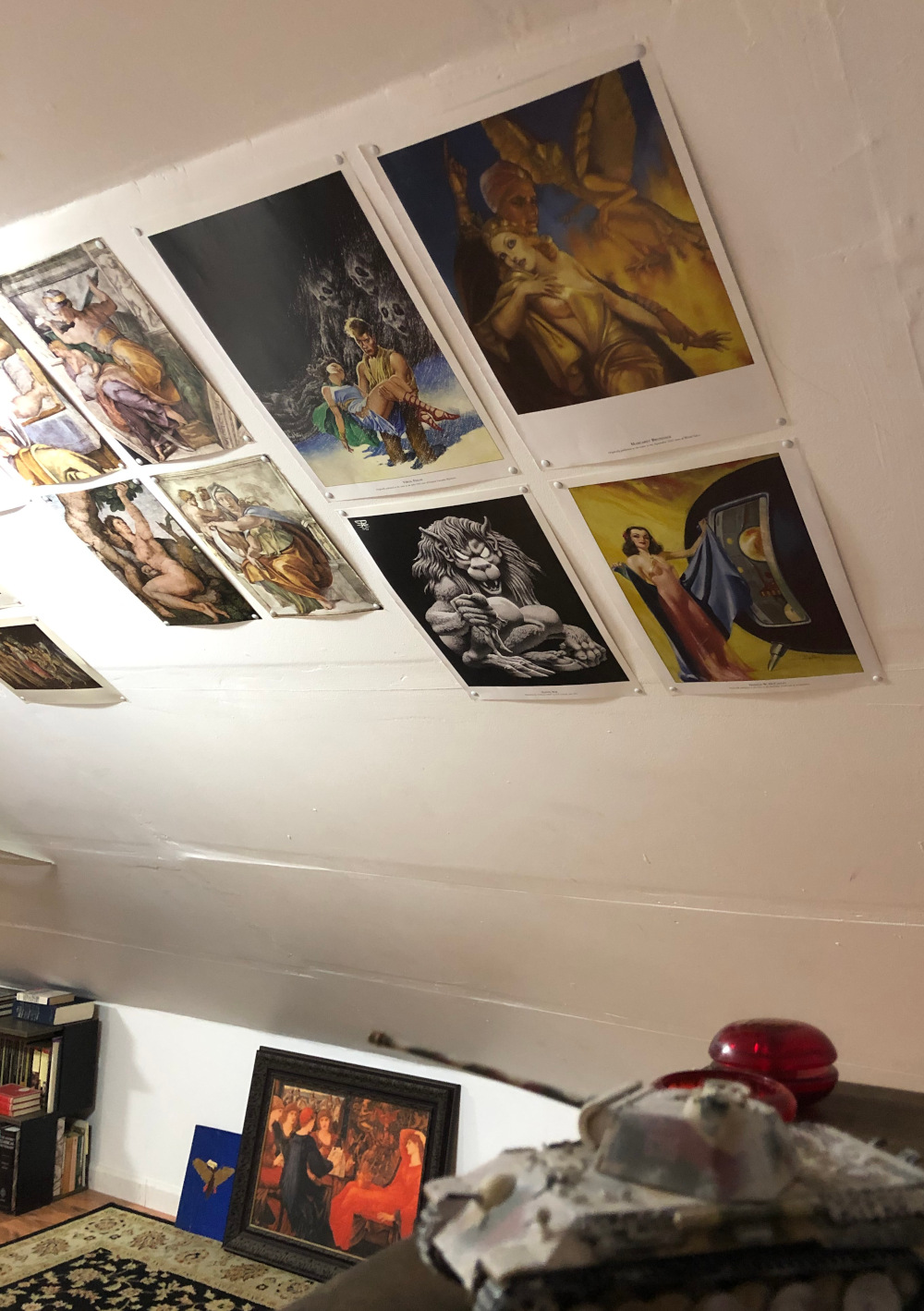
As readers of my twitter feed may remember, I bought a book of posters of art from pulp magazines in August.  In September I chose four of these posters to tack up here in MPorcius HQ: a Hannes Bok illustration of H. P. Lovecraft's "Pickman's Model;" Margaret Brundage's cover of the issue of Weird Tales with Clark Ashton Smith's "The Empire of the Necromancers" (one of the best of Brundage's productions;) Virgil Finlay's cover of the July 1942 issue of Famous Fantastic Mysteries; and Harold McCauley's cover for the December 1950 issue of Imagination.  It seemed appropriate to have actually read something connected to each of the four images, and so today we tackle three stories from that 1950 issue of Imagination, a magazine then edited by Raymond Palmer.  I'm reading these stories, all by people we have talked about here at MPorcius Fiction Log before, in the scan of the original issue of Madge (as we fans call Imagination) available at my favorite website and yours, the internet archive.

"Technical Slip" by John Wyndham 

John Wyndham, famous author of Day of the Triffids and Re-Birth AKA The Chrysalids, bore the legal name John Wyndham Parkes Lucas Beynon Harris, and "Technical Slip" appears here in Imagination under the name John Beynon.  The story would reappear four years later in the Wyndham collection Jizzle, and the next year after that in a paperback anthology by Groff Conklin which I own, Operation Future, and have already blogged a little about.  I didn't read "Technical Slip" when I sampled the contents of Operation Future back in 2017, maybe because Re-Birth had rubbed me the wrong way, maybe because I didn't recognize Wyndham under that disguise.

"Technical Slip" is one of those stories about a guy selling his soul to the devil, and also a time travel story.  It is well-written, but underwhelming and ends up feeling trifling.

Our dude is a 60-year-old Englishman, on his death bed.  He sadly reflects that all the wisdom he has acquired over a long and successful career is about to vanish.  Then a guy appears whom we are obliquely obliged to understand is a representative of the devil, though the devil in this story seems more like the manager of the bureaucracy that maintains the universe than a malevolent figure.  Having adapted to the rise of the market economy, these bureaucrats no longer barter boons for souls, but sell their wares for money.  After the hero agrees to hand over a large fraction of his wealth he is given a chance to live his live over again, and finds himself seven years old again, back in 1910, but with all his memories intact.  Wyndham does a good job describing the world of 1910 through the hero's eyes, and of depicting the sadness of seeing his little sister, knowing she will soon be crippled for life in an accident, seeing his father and knowing in a few years he will be killed fighting in the war, and seeing his uncle and knowing the financial disaster unk is going to be responsible for.  Wyndham succeeds in painting both a striking visual landscape and a moving emotional landscape here and is to be commended for doing so--all this stuff rang true to me.

The hero wonders if he can use his knowledge of the future to his advantage, and the advantage of the world--could he perhaps prevent or shorten the World Wars?  His test case is his sister, and when he  saves her from the accident which, in his first go round of life crippled her, he has proof that he really can change history!  But then the bureaucrats step in and weaken the protagonist's hold on his memory; their failure to do so initially is the "technical slip" of the title.  Our protagonist forgets he has lived through the tumultuous first half of the 20th century before and his efforts to alter history for the better are quashed.    

I felt like the plot sort of fizzled out, but Wyndham's technique in that middle section of the story when our hero is back in 1910 as a kid and retains his 1960s knowledge, is quite good; "Technical Slip" is better than most deal-with-the-devil stories and does something more literary with the idea of time travel than do most time travel stories.  So, I'll give it a moderate recommendation.

"Tourists to Terra" by Mack Reynolds 

Reynolds had a remarkably strange and diverse career as a radical leftist activist, a travel writer for men's magazines, and a SF writer whose work I generally dislike (check out the links for my past comments on some of these topics.)

"Tourists to Terra" is a brief gimmicky story.  Life on an alien planet has become too easy, too luxurious, driving wealthy individuals to seek new thrills.  One of the extravagant pastimes their advanced technology has made possible is travelling to primitive planets like our Earth to participate in wars among the natives.  The early scenes of "Tourists to Terra" the story depict these aliens--who look just like Earth people and equip themselves with anti-grav devices and special armor and weapons--fighting in the Trojan War, Reynolds rehearsing the scene from Book V of the Iliad in which Diomedes injures Aphrodite.  (This is one of the numerous SF stories that offers a theory of the source of some ancient myth, legend or religious belief.)

The complaints of the beautiful woman who will be the germ of the Greek goddess of love over getting hit by a spear convince the people running the space cruise that it would be safer to get their customers involved not in hand-to-hand combat but in a war fought with firearms in which they can act as snipers, killing natives from a distance from a place of concealment.  (These aliens think of us as no more than game animals.)  These aliens have the ability to not only efficiently travel between the stars, but through time, so the ship's crew crosses the eons to 1945 in search of a war affording opportunities for safe sport.  But our Earth technology has advanced faster than they anticipated, and by chance their ship materializes at an atomic bomb test site just moments before the detonation--the thrill-seeking aliens and their space ship are totally annihilated.

This disposable bit of ephemera would not be reprinted until 2011.

"It's Raining Frogs!" by Milton Lesser

This will be the fourth story by Lesser we have read here at MPorcius Fiction Log.  Feel free to feast your glazzies on my scribblings about "'A' as in 'Android'," "The Graveyard of Space" and "Ennui."

"It's Raining Frogs!" begins with an epigraph from Charles Fort's Lo!  Fort apparently loomed large in the minds of SF writers and fans in the middle of the 20th century--Lo! was serialized in Astounding in the early Thirties when F. Orlin Tremaine was editor, Tremaine's successor John W. Campbell, Jr. recommended Fort's collections of questionable reports of unusual phenomena as source material, Eric Frank Russell praised Fort highly, Damon Knight wrote a biography of Fort, and so on.  The epigraph here mentions frogs, Fort arguing that all the universe shares a single existence, so you can study the entire whole from any starting point, be it economics, the life of Napoleon Bonaparte, or frogs.

Myra is a beautiful, intelligent and athletic woman, and an enthusiastic fan of Fort and student of Fortean phenomena.  She is married to George, a mediocrity in the looks and career department, but something special anyway--he is what Myra calls a "catalyst," a man who attracts Fortean phenomena.  When he rolls large numbers of dice the totals do not follow normal bell curve expectations, and sometimes frogs and other small creatures start falling from the sky upon him, spontaneously.  The main plot of this story concerns how George, unwittingly, summons a man from another dimension, and not just any man, but the King of the Fourth Dimension.  Like George, this alien monarch (who looks exactly like an Earth man) is married to a woman who dominates him, something he is quick to tell George and Myra.        

This king from the Fourth Dimension and Myra have a longish conversation about the physics of two-dimensional, three-dimensional, and four-dimensional universes, but eventually His Majesty gets worried his wife will be angry if he isn't home soon, and wants to leave, but he can only return to his universe with the permission of George, who summoned him.  George refuses, Myra insists, and in response to George's intransigence she starts hitting him--it is hinted that this sort of spousal abuse is a normal feature of their married life.  For the first time after years of marriage, George asserts himself; he outwrestles Myra and spanks her, breaking her will and becoming master of his home.  

The Queen of the Fourth dimension arrives, and tries to dominate the situation by seducing George; she also sets about using her alien powers to steal a fortune in jewels from Earth to take back home.  George not only stands up to her but his example inspires the King to stand up for himself and become master of his relationship.  The stolen jewels are returned to their rightful owners and everybody lives happily ever after in both our dimension and the Fourth now that these troublesome hot women know their place.

Obviously a story which suggests that women are selfish and greedy and that specimens of the weaker sex who are intelligent and attractive will use their brains and looks to run roughshod over everybody if a man doesn't firmly assert dominance over them runs counter to the values we in 2022 all hold dear or at least pretend to ascribe to if we know what is good for us.  Putting that hot potato aside, "It's Raining Frogs" is too long and repetitive, and the mechanism of how George summons frogs, beetles, birds, a henpecked king and a sexalicious jewel thief of a queen to our universe is poorly worked out.  George does not voluntarily summon these aliens--in fact, he considers these phenomena a nuisance, they are appearing against his will--but for the plot to work we are expected to believe he can by an act of will send them back or confine them here.  Seems a little contrived.  

Weak filler.  Like Reynolds' "Tourists to Terra," "It's Raining Frogs!" would have to wait until this century to be reprinted.

**********

Imagination is one of those magazines the critics look down upon, and I didn't exactly find a storehouse of ammunition today with which to challenge their dim assessment, though "Technical Slip" demonstrates Wyndham's considerable writing ability and "It's Raining Frogs!" is a useful document for those interested in the relationship of Charles Fort to SF and those looking for evidence of sexism in SF (spanking fetishists may also want to check it out!)

Speaking of stuff the critics look down upon, we've got a 1973 sword and sorcery novel coming up, so have your square-cut mane and mighty thews ready the next time you surf on over here to MPorcius Fiction Log!