Showing posts with label Lumley. Show all posts

Thursday, November 6, 2025

DAW The Year's Best Horror Stories I: R Bloch, B Lumley, E C Tubb & R Campbell

At one of the Hagerstown, MD, antique malls I frequent I recently spotted a paperback copy of the first of The Year's Best Horror Stories anthologies published by DAW.  Printed in 1972, this thing had a Karel Thole cover with a cool lizard and some enigmatic human figures on it.  (This image actually appeared first on Urania 561 in 1971 and has nothing to do with the stories in the DAW book.)  isfdb is telling me that The Year's Best Horror Stories numero uno is actually one of many reprints of a British horror anthology edited by Richard Davis and printed in 1971, and the stories in it debuted in three different years.  Well, let's ignore all that confusion and read four of the stories from the book, those by Robert Bloch, Brian Lumley, E. C. Tubb and Ramsey Campbell.  (Davis also selected for his book "Prey" by Richard Matheson, a great story I have already read that I recommend to you all.)  The copy of The Year's Best Horror Stories I saw was too dear, fifteen bucks, so I will be reading the stories in scans from divers sources.

"Double Whammy" by Robert Bloch (1970)

I'm reading this one in a scan of the issue of Ted White's Fantastic in which it first appeared.  I took a quick look at the Jeff Jones illo on page 33 and at the letters column and Fritz Leiber's book reviews--there seemed to be a lot of typos and printing errors.  Leiber talks about some works of criticism of Tolkien, and offers his own tentative theory as to why Tolkien is popular--"I’d guess it’s because he winningly presents high-minded, self-sacrificing heroes to a generation weaned on cynicism, protest, and sex."  This isn't a bad theory, but it is funny to hear it from Leiber, whose own work seems to be full of cynicism, attacks on traditional values and outrĂ© sex--I feel like only last week we read a story by Fritz in which we learn that Jesus Christ was the product of Mary being raped by a snake-millipede from outer space, and of course the Grey Mouser is a serial rapist and burglar.

OK, let's get to Bloch and "Double Whammy."  Genre fiction writers love the idea of the travelling carnival or circus and we genre fiction readers often find ourselves exploring such milieus; looking through the archives of my own blog I see I have read a stack of novels and stories that involve a circus or carnival--if you dare, check out some links to blog posts from just the last few years!

Today we add "Double Whammy" to the stack.  And it is a fine addition, an entertaining black magic and psychological horror and disastrous sexual relationship story that uses the setting of the carnival as well as readers' discomforts and prejudices around race, ethnicity and class to great effect.  Thumbs up!

Rod is the barker at the carnival, and he is good at it, and enjoys tricking the local rednecks into parting with their dough to see the freaks.  Rod is also secretly having sex with teenager Cora, the hot and horny granddaughter of the gypsy lady who runs the fortune telling scam.  Rod should be happy, but he has a psychological problem.  The freakiest of the freaks is the geek, a 50-something white drunk who, in order to finance his booze habit, has taken the job of putting on a "wooly wig" and burnt cork to make himself look like a monstrous African wildman.  The geek capers and gyrates in a pit while Rod talks him up, and then Rod throws a live chicken into the pit and as the audience watches the geek bites off the living bird's head!  Rod has developed the irrational fear that he somehow might become a geek himself, maybe if he starts hitting the sauce himself.

Things become very difficult for Rod when Cora reveals she is pregnant and wants to get married.  Rod has contempt for Cora--he considers her of low intelligence, and he has a racist attitude towards gypsies (whom he conflates with "spicks") besides--so he obviously is not going to marry her, even if he told her he would the first time he banged her.  He hits her to snap her out of a crying fit, and tells her to have an abortion.

When Cora turns up dead after trying to remove with a knitting needle the clump of cells which is Rod's child, the Basket Case, a man with no arms or legs, warns Rod to run for the hills, as the grandmother has, according to the Basket Case, black magic powers that she has used to devastating effect before on those who have trespassed against the honor of that hot little dish that was her granddaughter.  Because of other poor decisions Rod has made, Rod can't get away quite yet, and is thus ripe for grandma's effort to achieve vengeance on him.  What horrible fate does she have in store for Rod, and does he have any chance to escape it?

Bloch sometimes ruins his stories by explicitly explaining the psychology of his characters and  y tiresomely hammering away at his social commentary, but in "Double Whammy" he shows rather than tells and the story totally works.  For example, because he doesn't get too preachy or over the top, in "Double Whammy" Bloch is able to exploit liberals' contempt for Southern hicks, white people's fear of exotic ethnic minorities, and squeamish people's unease with the deformed, making the story disturbing on multiple levels or from multiple vectors.  A high spot in Bloch's long career.

(Oh yeah, and no jokes!)

I recently said that Robert Silverberg's "To the Dark Star" was like the model of a modal science fiction story, and I think maybe Bloch's  "Double Whammy" is a similar exemplar for horror stories.  Both "To the Dark Star" and "Double Whammy" put a big helping of SF content up front (astronomy in Silverberg's case, deformity, gore and black magic in Bloch's) alongside an equally large serving of human relationship drama, and include a noticeable but subtle social commentary element, while leaving out distracting unnecessary fripperies like jokes and psychedelia.

Besides the Bloch collections Cold Chills and Last Rites, you can find "Double Whammy" in multiple English and foreign language anthologies.     


"The Sister City" by Brian Lumley (1969)       

In 2008 or '09 I borrowed a bunch of Brian Lumley collections from the NYPL, including Haggopian and Other Stories which reprinted "The Sister City," and so I may have read this one before.  We'll see.

Well, I don't specifically recognize "The Sister City," but it is a pretty pedestrian, derivative, and imitative piece of work full of references to Lovecraft stories.  We might even call it a shaggy dog story, as the narrator travels around a lot but doesn't actually get very far, ending up almost where he began, and he doesn't really face obstacles or deal with problems along the way, and there is not really much of a surprise ending or any suspense.

"The Sister City," like so many Lovecraftian stories, consists of a memoir or testimonial and a bunch of supporting documents, reports by and correspondence among the authorities.  As a youth, the narrator was injured during the war, apparently by the explosion of a German bomb which hit his house and killed his parents.  Our narrator has odd hairless skin and webbing between his digits, so we know from page one this guy is the product of miscegenation between man and beast or has aliens among his ancestors or is some kind of monster or something.

After two years in the hospital our guy, whose reading during his recovery has inspired in him a fascination with lost cities, travels the world, visiting such sites as the pyramids at Giza and ruined cities mentioned in Lovecraft stories.  He discovers ancient artifacts and reads prehistoric inscriptions and so forth.  These travels are, I guess, meant to build atmosphere, as they don't have any bearing on the plot, though they offer the narrator opportunity to exercise his special powers, like his ability to swim like a fish and understand, in spoken or written form, just about any language. 

Back home in England he is presented with a sealed envelope, left him by his parents to be opened when he is 21; if he had just stayed home he would have gotten this envelope.  The letter in the envelope explains that he is the member of an ancient race of aquatic reptile people who live in an underground city beneath the Yorkshire moors.  These lizard men have a convoluted life cycle, and in early life look almost like boring old homo sapiens like you and me, and so their reptile parents leave them on English doorsteps or at English churches or wherever to be raised by humans--you see, the underground city's conditions are difficult and not healthy for lizard people until they transform from mammal-looking kids into full scaly adults.  As if that isn't contrived and silly enough, the narrator's parents decided to break the laws of their race and live among humans themselves with sonny boy instead of just leaving the narrator to be raised as an orphan or by adoptive human parents or whatever, but then they started looking too squamous to pass as Englishmen and so faked their own deaths by blowing up their house during a Luftwaffe air raid and retreated to the underground city.  In dreams they beckon the narrator join them in their subterranean colony now that he is an adult, and it is suggested the narrator isn't just a joe-six pack lizard man, but lizard man royalty or even some kind of lizard god.

The supporting documents provide clues about how the narrator got back to the underground city and also hint that the British economy's tireless need for fossil fuels is going to result in the accidental and likely genocidal uncovering of the subterranean city of the narrator's people.

Merely tolerable.

I read "The Sister City" in a scan of Haggopian and Other Stories which had more typos than I expected.  The story debuted in the oft-reprinted (in varying forms) Tales of the Cthulhu Mythos, edited by August Derleth.


"Lucifer!" by E. C. Tubb (1969)

This is a good Twilight Zone-style story.  Tubb employs a brisk non-nonsense style that is quite effective.  It is noteworthy that Tubb doesn't explicitly explain the title of the story, but expects you to be familiar with the Bible or Milton or DorĂ©.

A man with an extraordinarily attractive face but a clubbed foot is working at a morgue.  This guy is totally unscrupulous, and a sadist besides.  He steals a ring from a dead body--unknown to him, the body is that of a visiting space alien, a sort of incognito tourist.  

The sadist soon figures out that by pressing the button on the ring he can turn back time 57 seconds.  This is a terrific boon--he can easily get rich by cheating at gambling games, and makes enough money to have his foot repaired.

The ring opens up other means of piling up the moolah--like by being a gigolo!  The sadist becomes the world's greatest lover because he can touch a woman a certain way and if she doesn't respond well, he can just go back 57 seconds and touch her a different way, and keep it up until he touches her in all the ways she most desires--from her perspective, he is caressing and kissing and otherwise pleasuring her in all the ways she wants, saying all the words and playing all the little games that most excite her, without her having to tell him what to do!

The former morgue attendant doesn't just use the ring to make money, but to satisfy his perverted, most diabolical desires.  Obviously he can grope strange women and then go back in time when they scream or strike him or whatever.  But this guy isn't just a horndog--he's a sadist!  He can punch a woman's teeth out or poke her eyes out and enjoy her agony for 50 or so seconds and then go back in time to before he struck her.    

This all sets the scene for the horror climax.  The sadist is on a transatlantic flight.  The plane suffers a catastrophic failure in a storm and he is sucked out a hole in the fuselage and falls towards the ocean as the stricken plane falls beside him.  He can't figure out a way to prevent the accident only 57 seconds before it occurs, so he is doomed to experience his fall towards the ocean again and again and again.

I like it.  "Lucifer!" debuted in a magazine I don't know I have ever thought much about before, Vision of TomorrowVision of Tomorrow, published in Australia, lasted only a dozen issues across '69 and '70.  "Lucifer!" has been reprinted in a Russian anthology, an anthology on the theme of scary airplane flights edited by Stephen King (yeah, sure) and Bev Vincent (some kind of Stephen King superfan), and in the 2024 issue of Cemetery Dance's annual Weird Fiction Review.

Jeder Damon hat seinen Preis Horror Stories is a German anthology of stories
drawn from multiple books edited by Richard Davis

"The Scar" by Ramsey Campbell (1969)

This is a somewhat complicated story largely about difficult family relationships and other ordinary life challenges, like running a business.  As the story proceeds, Campbell gives the reader reason to consider several different possibilities as to what is going on and question the sanity of several of the characters, and he also devotes quite a lot of ink to describing street scenes, fog, garbage under foot, the state of rooms and their decor, and so on, I guess to set the mood and to give the reader clues about class issues.

We've got three main characters and two minor but important named characters.  Harriet is married to Jack the jewelry store owner, and they have two kids.  Harriet has always had a pretty good life, but she has a brother who has had bad luck and is kind of a loser, Rice.  Rice has trouble communicating with people and making friends, and Harriet has sort of pressured Jack into acting like he is Rice's friend, hanging out with him regularly in a pub in the crummy part of town where Rice lives in a dilapidated apartment and having Rice weekly come over to their middle-class house.  For his part, scatterbrained ineffectual Rice would like to do something to help Harriet and Jack, earn their friendship and affection, be more than the beneficiary of their pity. 

Rice one evening tells Jack in his clumsy halting way that on the bus he saw a man who looked just like Jack save that he had a scar on his face, and mentions the doppelganger legend that suggests that if you see your double you will soon die.  Jack is in no mood for such depressing talk because he is already stressed out over the recent rash of robberies of stores--will his store be next?  

The next time Jack walks to the slum to hang out with Rice, which he doesn't even want to do but does out of duty, he is attacked in an alley and suffers a wound on his face.  The mysterious attacker brags that he is going to rob Jack's store and abuse his children.  As the story continues, Harriet and Rice find that Jack is acting kind of crazy, bitter and even cruel, presumably driven unstable by the attack and by the robbery of his store, which has occurred as predicted.  Rice even comes to fear that the two kids are being abused by Jack, and begins considering ways to save the kids and his sister from Jack, inspired in part by a book he read in which a guy sacrifices himself to save his friends.  

We readers get clues and red herrings suggesting a number of possible explanations for what is going on.  Could Rice be lying about the doppelganger, or only believe in it because he is insane, and have attacked Jack himself because he is jealous over Harriet (Campbell hints that Rice is sexually attracted to his sister) and the kids and envious of Jack's success?  Or maybe it is Jack who is insane and/or evil (Campbell hints that we are not supposed to like Jack by having Jack think callously about the poor and show contempt for The Lord of the Rings) and actually faked the robbery of his store to get sympathy or insurance money or something.  Or maybe the doppelganger is real, and has killed Jack and taken his place, first giving Jack the scar that matches its own so it could better infiltrate Jack's home and abuse his family.

In the last violent and bloody sequence of the story, Rice tries to solve the problem that is Jack or the imposter and we get a better sense of whether either or both of the two male main characters is a hero, a villain, or simply a victim.

This is the most sophisticated and challenging of today's four stories, though it is less fun than Bloch's and Tubb's more easily digested tales.  I have to admit I don't really understand the monsters' operations--why is the monster who imitates Jack walking around with Jack's face before killing or displacing Jack?  And why does the monster include in its imitation of Jack a scar Jack doesn't have yet?  I briefly thought that maybe the "monster" was just a criminal who happened to look like Jack, but in the end of the story it becomes clear that there is a whole race of these doppelgangers and one of them is planning to impersonate Rice.  Some scenes seemed to be suggesting that the doppelgangers cut off people's skin and wear it as a disguise, but that doesn't jive with other scenes, like, again, Rice seeing Jack's double while Jack is alive.  Maybe the monsters can achieve a look a bit like that of an individual human and then don their targets' skin to complete the disguise?  There is also the possibility that the monsters are just the depraved inner desires of Jack the grasping businessman and Rice the incompetent pervert come to life and "The Scar" is more like an allegory or fable about the evils fathered by capitalist and classbound English society and not an actual science fiction story that is supposed to make logical sense.   

I can moderately recommend "The Scar;" the family dynamics and the descriptions are all good, if a little long-winded and tricky--the mechanisms of how the monsters behave is the only real problem, and maybe I am just too dumb and lazy to figure out just what is going on.  I read the story in its original typo-ridden form in a scan of issue #13 of Startling Mystery Stories.  Besides in the various forms of Richard Davis anthologies out there and Campbell collections, you can find it in Lost Souls: A Collection of English Ghost Stories and Doubles, Dummies and Dolls: 21 Terror Tales of Replication.  


**********

The Lumley just sits there, but the stories we read today from Davis' first Year's Best Horror Stories volume are all emotionally and/or intellectually engaging, and are all full of gore and death and creepy sex.  
         
More horror stories from anthologies in the next gruesome episode of MPorcius Fiction Log!
         

Friday, October 13, 2023

Weird Tales, Feb '38: Lovecraft & Lumley, Kuttner, Ball, Moretti

Back in January of 2021 I set myself the sacred duty of reading and blogging about at least one story from each of the 115 or so issues of Weird Tales published in the 1930s.  Great strides have been made in this quest; in fact, I have covered at least one story from each issue published from January 1930 to January 1938!  And I can prove it at the links below!

1930  1931  1932  1933  1934  1935  1936  1937  JAN 1938

Today we wrangle some stories from the February 1938 issue, including works by the premier Weird Tales writer, New England's Howard Phillips Lovecraft, and one of our favorite scribblers, Henry Kuttner, the young man from California.  And in the spirit of exploration which I like to think characterizes this journey, we'll read two stories by individuals we've never read before, one by Clifford Ball and one by M. G. Moretti.  I chose these two stories because I liked their titles, a perfectly legitimate means of discriminating, I'm sure you will agree.

"The Diary of Alonzo Typer" by H. P. Lovecraft and William Lumley 

"The Diary of Alonzo Typer" appears under William Lumley's name in Weird Tales, but it is one of the many stories which H. P. Lovecraft revised for others.  In the introductory matter to my copy of Arkham House's The Horror in the Museum and Other Revisions, scholar S. T. Joshi tells us he has seen Lumley's draft for this story as well as Lovecraft's revision, and HPL "preserved only the nucleus of the story...all the prose is his."  I am reading "The Diary of Alonzo Typer" in my hardcover edition of that collection, unlike the Kuttner, Ball and Moretti stories, which I am reading in the internet archive scan of the original 1938 magazine.

The title character of "The Diary of Alonzo Typer" is a specimen of the type of person we meet all the time here at MPorcius Fiction Log, the student of the occult who travels the world investigating weird phenomena.  Typer's diary takes up the lion's share of the story (like 16 pages in the edition I am reading), which the preceding frame (like three pages) tells us was discovered in the 1930s in a ruined 18th-century house near a mysterious circle of stones (a "cromlech" of "menhirs"); this long-abandoned house was home back in the 18th and 19th centuries to a family reputed to be deeply involved in witchcraft, the van der Heyls.

Typer's diary chronicles his 1908 exploration of the van der Heyl house, from which he finds that, once having entered, he cannot escape.  Lovecraft rehearses many of the themes and elements characteristic of his work, like degeneracy and miscegenation, the horror of learning one's own identity, and the reading of a pile of documents that reveal forbidden lore and esoteric history.  The portraits on the walls in the house indicate the van der Heyls had ophidian and swine-like features, suggesting they interbred with aliens, and the local villagers who supply Typer with food are described as "degraded idiots" of "singular hereditary strains."  In the house, Typer discovers such books as The Necronomicon as well as an elaborate drawing of a statue of Cthulhu or some similar monster, plus plenty of alien hieroglyphs.  Among other amazing tidbits, Typer learns about how millions of years ago the Earth was colonized by spacefaring Venusians.

What stands out to me as distinctive about "The Diary of Alonzo Typer" is how Typer sees many ghosts of long dead van der Heyls as well as visions or hallucinations of clawed alien monsters--I feel like this is a device Lovecraft doesn't regularly employ.    

Finally, on Walpurgis night, Typer, having put together all the many clues in the house and prepared his protective spells, unlocks the vault in the cellar behind which he has been hearing the slitherings of a titanic monster.  He also realizes that he is himself a van der Heyl, and has been fated to open the vault whether he wants to or not.

"The Diary of Alonzo Typer" is a decent slice of Yog-Sothery, though not as good as, say, "The Shadow Over Innsmouth," which deals with much the same themes and elements.  Besides a multitude of Lovecraft collections, the story has been anthologized by Peter Haining, Robert M. Price and Franklyn Searight. 

Way back in 2014 I read a sequel to "The Diary of Alonzo Typer" penned by Brian Lumley, and I didn't like it; at the link I say it had a good plot but was full of extraneous material.

"World's End" by Henry Kuttner

"World's End" is a time travel story that doesn't really hold together--in particular, the plot resolution didn't satisfy this reader.

Young Blake and his senior citizen colleague Norwood have spent seven years building a time machine, and today Blake is strapping on his vacuum suit and gathering together his books, binoculars, rifles and other essential equipment for his maiden voyage to the future!  He throws the bakelite switch and finds himself in the first of a series of bizarre locations tens of thousands of years in the future.  One such setting is a snowy plain from which he sees on the horizon a vast black form, like a wall or glacier or something, rushing towards him.

Blake is then transported to the lab of a man of the future, a dwarf with a huge head!  Future brainiac explains that centuries ago a meteor landed on Earth from which sprang an alien life form, a sort of black void, that has slowly been devouring the Earth.  By the time the people of Earth had developed a disintegrator ray effective against the monster it had reduced most of the Earth to an uninhabitable waste, and today there are only a few hundred human beings left alive.  With their disintegrator ray artillery they can hold off the black void, but the survivors are running out of fuel to power the ray projectors and so will soon succumb to extinction.

The big-brained dwarf is excited to learn of Blake's time machine; his people have teleporters (that is how he brought Blake here to the last little bit of inhabitable Earth) but have never developed time travel.  Future man says that if Blake can carry him and a pistol-sized disintegrator ray projector back in time to the moment the meteor carrying the black void first arrived on Earth, he can neutralize the menace and save the human race!

Future man boards the time machine and he and Blake try to go back in time, and we get our disappointing twist ending.  Blake reappears in his 20th-century lab, having totally forgotten his future adventures.  Norwood doesn't even realize Blake ever left--Blake reappeared the same moment he departed, as if throwing the bakelite lever did nothing.  It seems that the universe forbids that you travel backwards in time to a moment before your birth, and also prohibits retention of memories of events yet to happen, so Blake's trip has been fruitless--he has no recall of anything that occurred in the future, and we readers must assume the future man's effort to save the world of the far future was a failure.

I don't like the way time travel works in the story, but putting that aside, "World's End" suffers a bigger, literary, failing.  The fact that the scientists' seven years of work on the machine, and Blake's and the dwarf's adventures, yield absolutely zero result is pretty annoying--it makes reading the story feel like a waste of time.  We expect something to happen in a story, that the characters or their environment will change, and when that doesn't happen, it is frustrating.  I suppose that some will appreciate how Kuttner "subverts reader expectations" of an Edgar Rice Burroughs-style ending in which the hero who visits an alien milieu proves to be the savior of the sympathetic natives and the undoing of their enemies, but I have to say I found this subversion more irritating than refreshing.  

I'm going to grade "World's End" barely acceptable; I like the menace in the story, the future brainiac and the vacuum suit, and can forgive the problems with the time travel; my real gripe is with the resolution (or, perhaps I should say, lack thereof.)

"World's End" would not be reprinted until our 21st century, when the good people at both Haffner Press and Centipede Press put out huge Henry Kuttner collections within a year of each other.

"The Goddess Awakes" by Clifford Ball  

"The Goddess Awakes" is a sort of long (26 pages here in WT) and pedestrian Conan-style story.  Two thieves who have taken up careers as mercenary soldiers flee the battlefield upon which the army of which they were members has been routed and climb a mountain only to be captured by the women soldiers of a remote kingdom whose citizens are all women.  These women have a queen but she is dominated by a centuries-old wizard and his giant black panther; this creep has decreed, for generations, that the nation's men toil out of view, slaves whose minds are dulled to insensibility by drugs.  Our heroes get thrown unarmed into the arena with the panther, but the queen and one of the soldiers have fallen in love with them and toss them the weapons they need to defeat the Brobdingnagian feline.  Then the queen kills the wizard, the kingdom's men are freed and our heroes are acclaimed the new leaders of the country.    

Ball's basic plot outline (two hunks arrive in a nation of women under the thumb of an evil wizard and his monster and trigger a reassertion of the women's natural heterosexuality and the overthrow of the wiz and monster) is good but his execution is poor.  The text of a good Conan story focuses on heroic feats, creepy magic and scary monsters, building up a weird and/or horrible atmosphere and advancing a plot in which there are high stakes.  Unfortunately, Ball here in "The Goddess Awakes" expends a lot of ink on mildly humorous dialogue between the two main characters, so his story feels more like a light-hearted buddy movie than a tale of uncanny horror or thrilling sword-and-sorcery; his bargain-basement efforts to produce witty banter are distracting and undermine any possibility of fear or excitement.

(It is hard to successfully integrate sword-and-sorcery thrills and humor in an adventure story; the biggest success I can think of is Jack Vance's two Cugel books.)   

We are generously grading "The Goddess Awakes" barely tolerable.

"The Goddess Awakes" would see print again in 1976 in Lin Carter's anthology Realms of Wizardry (in his intro to the tale, Carter calls "The Goddess Awakes" "superbly rousing;" I beg to differ.)  The Weird Tales devotees at DMR books in 2018 published a volume containing all of Ball's stories under the title The Thief of Forthe.

"The Strangling Hands" by M. G. Moretti

Moretti only has one story listed at isfdb, and this story has never been reprinted--we are really peering into the dim corners today at MPorcius Fiction Log.

In our last episode we read a story by David H. Keller in which black Africans unleash a supernatural vengeance on a white man who mistreated them, and "The Strangling Hands," which is adorned with a good drawing of a witch doctor by fan favorite Virgil Finlay, has a similar theme.  

Our narrator is a professional writer who got scooped by an amateur writer!  You see, our guy was one of five men on a dangerous expedition in Africa, and everybody sorta kinda agreed he would chronicle the adventure and publish a book on it.  But narrator's best friend, also on the trip, published his own account as soon as they got back to New York, rendering narrator's book unsalable!  Hilarious!

The narrator hasn't spoken to his frenemy since, and some years have gone by, but out of the blue he hears from the guy, and grudgingly goes to see him.  It turns out that the other three men who accompanied them on the African expedition have died under mysterious circumstances.  One of the capers the five adventurers indulged in while on the Dark Continent was stealing the eye from a statue in a temple of Death, an institution whose regularly scheduled festivities include human sacrifice by strangulation.  The three men who have all turned up dead these last few months all had this eye in their possession (each having inherited it from the previous victim.)  Now the amateur writer has custody of the eye, and he tells our narrator that every night he sees the horrifying image of black hands creeping closer and closer to his white throat!  Obviously the priest of Death is performing decolonization activities via long distance magic!  The narrator of course thinks the deaths are just a coincidence and his backstabbing buddy is just lying, or maybe the target of an elaborate prank.

Still, he is persuaded to spend the night with his friend, a night of terror in which he learns the astonishing truth!

This is a good black magic story.  I groused that Clifford Ball rendered "The Goddess Awakes" a drag with his emphasis on totally lame jocular dialogue between his two main characters, but M. G. Moretti here does caustic dialogue between two buddies right--via their speech Moretti develops an interesting relationship between the two men, and the stuff they say, instead of seeming incongruous and distracting from the horror/adventure aspects of the story, actually helps build an atmosphere of tension and uncanny wonder.  

Thumbs up!  It is too bad there is only one Moretti story out there!  

"From Beyond" by H. P. Lovecraft (1934)

This February 1938 issue of Weird Tales reprints "From Beyond," one of H. P. Lovecraft's Dream Cycle stories, a piece which made its debut in 1934 in the fanzine The Fantasy Fan.  I am reading it in my copy of Dagon and Other Macabre Tales.

Short and to the point, this is an effective story.  Lovecraft adds interest to the tale by doing more than he usually does to develop his character's personalities and human relationships.

Our narrator has a fat and emotional friend who is conducting some crazy research leveraging his knowledge of both electronics and metaphysics.  The narrator warned him that this might be dangerous, and the researcher, a real sensitive sort, threw a fit and broke off their friendship.

Over two months later, fatso summons the narrator to his lab in his big attic.  Shockingly, this dude is now skinny and haggard, his hands trembling, his formerly clean shaven face covered in whiskers.  Even more shockingly, the mad scientist has plotted an elaborate revenge on the narrator, whom he says "discouraged me when I needed every drop of encouragement I could get...."  The complicated electrical machine he has finally completed generates radiation which revivifies vestigial and atrophied senses that we humans don't even realize we have; under the influence of the machine, people can "see" into and "listen" in on parallel worlds that coexist with our own--when the vengeful inventor turns the machine on, the narrator can sense all kinds of extradimensional monsters floating through the attic walls and even his own body.

The horrifying twist is that the radiation from the machine also enables some of the alien monsters to sense and interact with our own world!  In fact, the researcher's own servants have all vanished without trace, carried off or devoured by alien entities!  And the mad scientist gloats that the narrator is next!  Can the narrator escape?

Thumbs up!  Lovecraft can be long-winded and repetitive, and his stories often lack human feeling, so it is fun to see him producing in "From Beyond" a brisk and economical tale with a human relationship and an exciting personality at its center.  

Like most of Lovecraft's work, "From Beyond" has been reprinted a billion times, including in anthologies like Jack C. Wolf and Barbara H. Wolf's Ghosts, Castles and Victims: Tales of Gothic Horror and Xavier Aldana Reyes' Promethean Horrors: Classic Tales of Mad Science.

**********

A mixed bag, but the Lovecraft stories go to show that the man from Providence deserves his high reputation, and I really liked one-hit-wonder M. G. Moretti's "The Strangling Hands."  So, a satisfying step in our long march through the pages of the unique magazine.  We may return to this issue one day, as it contains (under a pen name) part of a werewolf serial by Manly Wade Wellman that has been reprinted multiple times and so perhaps is worth checking out.  Time will tell.     

Thursday, December 5, 2019

Nightmare Stories by Brian Lumley, Tanith Lee, and Ramsey Campbell

I hate living in the suburbs, and yet I reside in the suburban no man's land between Baltimore and Washington, D.C.  I hate driving, and yet every day I find myself behind the wheel weaving between the yawning potholes and the suicidal deer, the reckless pedestrians and insouciant cyclists.  I hate going to the mall and yet...well, you get the picture.

At a mall bookstore where they play hideous music and apparently make all their money selling Hogwarts paraphernalia and tricking people into joining their 10% discount club (annual membership fee, $25), among the thirty-five telephone-directory-sized copies of It on the horror shelves, I spotted a newish anthology by Stephen Jones, The Mammoth Book of Nightmare Stories.  Seeing quite a few familiar names on the contents page, I resolved to read those tales from the anthology by those writers who interest me that I could find at the indispensable internet archive.  By chance, all three of the suitable stories are by Britons; sadly the Denis Etchison and Poppy Z. Brite stories from the volume are not available at the internet archive, while I have already read the included story by Harlan Ellison, "In the Fourth Year of the War," which I blogged about when we read DAW's The Year's Best Horror Stories: Series VIII, edited by Karl Edward Wagner.)

"The Viaduct" by Brian Lumley (1976)

I have mixed feelings about Lumley, and over the years this blog has seen me praise some of his work and slag other specimens of his writing.  Here I am rolling the dice again; call it research into the legacy of Lovecraft and Arkham House if any explanation is necessary.  "The Viaduct" first appeared in Ramsey Campbell's anthology Superhorror, which is kind of a funny name, and was later included in the 1993 Lumley collection Fruiting Bodies and Other Fungi; I am reading it in a scan of the Tor hardcover edition of that collection.  (Fruiting Bodies and Other Fungi also includes the long story "Born of the Winds," which I declared "an acceptable Lovecraft pastiche" when I read it back in 2016.)  "The Viaduct" was chosen by David Drake and Martin H. Greenberg for the 1996 volume A Century of Horror: 1970-79: The Greatest Stories of the Decade, so how bad can it be?

Two boys are messing around at the beach near a massive viaduct, a bridge that carries trains one hundred and fifty feet above a river.  The boys have been practicing at the playground at their school, carrying themselves hand over hand on the overhead bars of a "climbing-frame," what we in America call "monkey bars" or a "jungle gym"--their object is to swing hand over hand across the viaduct via the one hundred and sixty rungs under the viaduct's walkway.  (These are brave kids!)

The boys spot the "village idiot," Wiley Smiley, a mentally retarded nineteen-year-old, fishing on the other side of the river.  They throw stones in the water next to him, the splashes getting him wet and enraging him.  Their victim being on the other side of the river, the boys think they are safe.

These boys may be brave, but they are also stupid, because they decide that today is the day to swing Tarzan-style across the river on those metal rungs far above the river.  Most of Lumley's story (like 21 pages total here) is a tense adventure/chase sequence, as the boys hang under the railway and Wiley Smiley takes advantage of this period of vulnerability to exact his revenge.

isfdb categorizes "The Viaduct" as "non-genre," and there are no speculative elements to it; it is a mainstream story about the psychologies of three not very likable characters who are under terrible stress and do things that no decent or sensible person would do--"The Viaduct" is also a quite effective tale of terror and gore.  Thumbs up!

"These Beasts" by Tanith Lee (1995)

"These Beasts" made its debut in F&SF, in an issue in which Charles de Lint uses his book review column to promote an anthology of stories about child abuse that includes a story of his own (he explains that he is donating any money he makes from the book to charity and that the book is really really important to the cause of dealing with the problem of child abuse.)  In the intro to the story in F&SF editor Kristine Kathyrn Rusch quotes Lee's explanation that the idea for the piece came from her husband John Kaiine.  "These Beasts" would reappear, ten years before the publication of The Mammoth Book of Nightmare Stories, in the 2009 Lee collection Tempting the Gods.

"These Beasts" is a clever entertainment, a jewel-like exercise in mood and style that reminded me of Clark Ashton Smith. Carem, the son of a whore in a sort of Arabic setting, has made his fortune robbing tombs.  He learns the location of a desert tomb more closely guarded and more richly appointed than any other, and leaves his two wives behind to undertake the perilous operation of looting it.  Lee fills her story with intriguing sorceries and magic devices as well as sharp images, but as in Lumley's story, there are also some pretty foul crimes and some pretty gruesome bloodshed.  While Lumley's "The Viaduct" is disturbing thanks to its realism, Lee's story, set in a kind of never never land and written in the style of a dark fairy tale or "Oriental" fable, is more lighthearted and fun, but equally absorbing.   A sober assessment might consider it a trifle, but "These Beasts" is a well-crafted and satisfying story I really enjoyed.  Thumbs up!

"Needing Ghosts" by Ramsey Campbell (1990)

I was a little dismayed when I realized how long this story was--"Needing Ghosts" first appeared as an 80-page chap book in 1990, and it is like 90 pages in the scan of  the 1993 Campbell collection Strange Things and Stranger Places in which I was to read it.  This volume has a dumb cover illustration, an off center image of a kitchen knife penetrating the spine of a book.  (This image is based on an image from "Needing Ghosts," but in the story the book is pinned open by a knife, face up so it can be read.)  I'm skeptical of Campbell's work, and 90 god-damned pages would be a slog if "Needing Ghosts" was tedious, as I have found several of Campbell's stories to be.  I was rolling the dice again...and this time they came up snake eyes!

In keeping with the title of Jones's anthology, "Needing Ghosts" is like one of those bad dreams in which every single thing you try to do, no matter how simple, is a complete disaster.  You forget your name, you forget where your big meeting is, you have trouble opening a door, you lose a piece of paper with info you needed, you go into a store to buy something and the clerk ignores you, you have a bill for which a cabbie can't make change, your credit card breaks in half, etc.  All these things, and more, happen to the protagonist of "Needing Ghosts," Simon Mottershead.

"Needing Ghosts" begins with middle-aged Mottershead, who suffers some pretty severe memory loss, waking up in the predawn, slowly becoming aware of his surroundings, and the story consists of Campbell describing in voluminous detail his every move over the course of a day.  We learn more and more about this guy's character and life as the day proceeds, as Mottershead remembers things about himself.  At the same time the story becomes increasingly surreal and absurd.  I enjoyed the first 25 or so pages of "Needing Ghosts," all the detailed descriptions of this guy's looking around his house as if he'd never been there before, riding a ferry and then riding a bus full of disabled people, his confused memories and poor vision and all that, and Campbell's many weird metaphors and similes:
Shoving his copy of the voucher into his pocket together with the pointed blades which are the halves of the [broken credit] card, he pokes his arms through the straps of the rucksack and flounces out, his book bumping his s;pine as if it's trying to climb the bony ladder and reinsert its tale into his brain.
But after the protagonist got off the bus the story became more and more dreamlike and surreal and ridiculous, with one striking but nonsensical image (an army of half-assembled mannequins on the street beckoning to him) after another (a table with a single chair set for a speaker, on the table a glass and a carafe--the carafe contains not water, but a film of dust), all of them piling up one on the other but adding up to nothing significant.  The more we learn about the mysterious protagonist the less interesting he is--Mottershead is a novelist who has abandoned his writing career and wants to open his own used bookstore and is scheduled to speak at a library today, where, unable to remember the titles or plots of his own books, he offers banal anecdotes and self-indulgent observations about being a writer ("Writing's a compulsion.  By the time you're any good at it you no longer have the choice of giving it up.")  Campbell fails to inspire any emotion in the reader--Mottershead is totally boring and you don't care about his unbelievable interactions with the bizarre characters he meets.  Much of the middle third of the story consists of the protagonist getting into arguments and fights and chases with the staff of the library and various bookstores as he tries, and fails, to find his own books on their shelves.  This gets repetitive and irritating.

In the last third of this interminable story the protagonist remembers he has a family, and spends page after page trudging through a forest amid thorn bushes and trees with whole sentences and paragraphs carved into them, trying to get to his family's house.  When he gets to the house he finds it is now the "Wild Rest Home," inhabited by senile pensioners and burly nurses.  The nurses want to admit him, but after a chase through the countryside, Mottershead gets on a bus that takes him back to the ferry, which takes him back home.  We long-suffering readers finally learn that Mottershead has either murdered his wife and kids and suffers delusions they are still alive, or that they are still alive and he has delusions that he has murdered them--the former seems more likely.  Presumably most or all of the 60- or 70-page long story of his trip from the island to the library and bookstores and rest home was also a delusion.       

I guess "Needing Home" is about the burdens of being a writer, how your mind can be taken over by your fictional creations and how frustrating and sad it is to know how few people admire or even know about the work you have poured your heart into and all that.  A realistic story on this theme could be effective, but a surreal dream-story about a disappointed writer just comes across as tedious--all the weird images of libraries as big as shopping malls and bookstore clerks dressed as frogs put distance between the reader and the character, making it harder rather than easier to identify with his feelings.  Campbell absolutely fails to move the reader--who cares if this boring guy is nuts or a murderer or whatever?--and no part of this long story is sad or scary or exciting.  The long passages and many scenes about being a writer frustrated that nobody knows his work have no connection to the plot element of being a murderer--Campbell gives only the barest hints that Mottershead might be a killer until the very end, and the protagonist's family receives almost no attention until like 60 pages in.  Rather than being a natural conclusion to the rest of the story, a satisfying climax that grows organically out of the first 60 or 70 pages, the "this guy murdered his family" part of "Needing Ghosts" comes out of nowhere, like it was just tacked on to an unrelated story that was lacking an ending.

Thumbs down!

**********

After the Lumley and the Lee, which were well-paced and well-proportioned and written in styles suited to the material they presented and atmospheres they sought to generate, the Campbell felt like an unwieldy leviathan, blundering ponderously in no clear direction before finally beaching itself in an inappropriate place where it unceremoniously expired.  Sad!

Tuesday, October 8, 2019

1976 Frights by Brian Lumley, Joe Haldeman, and William F. Nolan

Let's read more from Kirby McAuley's Frights, a 1976 anthology of horror stories devoted to contemporary terrors.  In the last two blog posts we read the contributions of Psycho scribe Robert Bloch, SF Grandmaster Poul Anderson and his wife Karen, unique wordsmith and critical favorite R. A. Lafferty, and military SF icon David Drake.  Today, it's stories by the author of Necroscope, Brian Lumley, the author of The Forever War, Joe Haldeman, and the co-author of Logan's Run, William F. Nolan.  I am reading a scan of the US hardcover first edition that is available at the internet archive, that indispensable website for the impecunious student of 20th-century culture.

"The Whisperer" by Brian Lumley

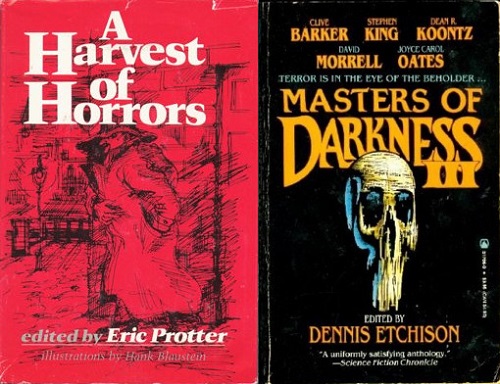
"The Whisperer" would go on to be the title story of a 2001 Lumley collection and was also anthologized by Dennis Etchison and Eric Protter, so I think we have a right to expect this will be a story representative of Lumley at his best.

Lumley's work, I have found, is uneven, but I am happy to report that "The Whisperer" is pretty good.

Benton, a British office clerk, is terrorized by a hunchbacked dwarf, a hideous creature who wears a floppy black hat and smells powerfully of the sewer.  First, the bowler-clad office worker encounters this apparition on the commuter train--the monster uses its hypnotic power to make the train conductor direct Benton to a less comfortable train car.  Then, a few months later, the dwarf is in a pub Benton visits for lunch, and the creep uses his powers to steal Benton's beer!  When Benton later asks the train conductor and the barman about the little weirdo, they profess to have never seen the apparition!

Benton becomes obsessed with this haunt, his habits and character taking a turn for the worse as he spends his time searching for the malodorous dwarf.  A few months after the episode in the pub comes a horrendous turn of events--Benton returns home to find the dwarf having sex with his wife!  Benton drives the monster off, and then confronts, and strikes, his wife, who claims she has no idea what Benton is talking about!  Benton's wife leaves him and Benton begins searching for the dwarf even more fervently, armed with a knife, intent on slaying his tormentor.  Who will live and who will die when the final showdown comes?

This story is well-written and well-paced, and actually disturbing.  Maybe, for reasons of class resentment, we are supposed to find the crimes inflicted on Benton amusing, but I did not find them amusing--I identified with the victim and his hopeless quest for vengeance and for answers.  Because Benton's quest is hopeless--he ends the story dead in a gutter, and we are never afforded any clues as to what the monster is and why he chose to harass and destroy Benton.

Unless we are expected to observe the torture, cuckolding and murder of a member of the bourgeoisie with the glee of a malicious working-class brute or a supercilious Marxist university professor, I interpret this story as a reminder that ordinary people are essentially helpless when confronted by crime, that justice and safety are impossible to secure, that everything we have--our property, our families and our lives--can easily be taken from us by anybody who is strong enough and brazen enough to do so.

Thumbs up for this black nightmare of a story.


"Armaja Das" by Joe Haldeman

"Armaja Das" has been anthologized by Gardner Dozois, Thomas F. Monteleone, and Margaret Weis, so here we have a piece that has been embraced by the speculative fiction community!

"Armanja das," the story tells us, is Romani for "we curse you"--this is a story about Gypsies!

John Zold is a rich man, a talented mathematician who left academia to make a pile of money in private industry as a computer programmer--he has designed a piece of software that gives computers the ability to mimic human feeling and talk to a computer user as if it is his or her sympathetic friend.

Zold works in Manhattan, lives in Dobbs Ferry.  His Romani parents fled Europe during the Nazi era, but were murdered in America, leaving him an orphan.  John became totally assimilated to English-speaking American culture and, as a wealthy man in his late thirties, has been financing a charity that encourages other young Gypsies to assimilate.  Many Gypsies in America resent this charitable effort, considering that Zold is "stealing their children," and Zold receives threatening letters in the mail featuring that phrase, "armanja das."  Early in the story an ancient little Romani woman sneaks into his building in Dobbs Ferry and casts a spell on him.  Of course, Zold doesn't believe in magic, but immediately after the curse is put on him he is unable to perform in the bedroom and he develops carbuncles on the back of his neck.

Conventional medical professionals prove unable to cure Zold's impotence or his skin problems, which get worse, much worse, and, suffering a severe fever and covered head to tow in hideous boils, he seeks out help from a Gypsy herbal  healer or "white witch."   However, the evil witch who cursed Zold in the first place has deep ties within the Gypsy community and no healers will tend to him!  Desperate, Zold turns to the computer personality that he designed himself!  The computer, with access to libraries all over the world, comes up with a Gypsy spell that will transfer the deadly curse to somebody else and guides Zold in performing the ritual!

Unfortunately, the curse does not transfer to the witch, as Zold hoped, but to his computer.  The curse then spreads to almost every computer in the world, making them "impotent"--this causes havoc because, for example, all electricity in New York City is handled by a computer, so the curse brings the greatest city in the world to a standstill.  The only computers that are immune are the computers managing the Soviet and American nuclear arsenals--when they sense that the world's computers are out of commission they interpret that as a vulnerability amongst the enemy's ranks and both computers launch nuclear strikes.  Civilization is almost wiped out, and the Gypsies, who hadn't come to rely on machines as did all other cultures, are now on top of the heap!

The first half or two-thirds of this "Armaja Das" I took to be a serious piece on assimilation and alienation and psychosomatic illness, and I suppose it is, but the end feels like a nonsensical joke story, undermining much of what I liked about it.  Perhaps we should admire the story for the way it mixes high technology and traditional superstitious beliefs, a reflection of our real 21st-century lives, in which book store browsers will find that there are more shelves for books on ghosts, witchcraft and the tarot than there are for computer programs. 

Acceptable.


"Dead Call" by William F. Nolan

Like the Lumley and the Haldeman story we are looking at today, William F. Nolan's "Dead Call" has been widely anthologized.

This story is very short, and a little gimmicky.  The narrator answers the phone, and it is his friend Len, dead for four weeks, on the line!  Len says that death is nice--peaceful, with no pressure!  Len reveals that his car accident was no accident, that he committed suicide, and is glad he did!  I guess dead people have ways of knowing things, because he tells the narrator that his wife is cheating, his daughter is a junkie who hates him, and his boss is about to fire him.  Len suggests that, seeing how things are going, that the narrator also commit suicide, and the narrator takes his advice.   

In the last few lines of this story the narrator addresses the reader directly, suggesting that, seeing how things are going, we join him in death.

Acceptable.


**********

Maybe we should see these three stories as reflecting particular 1970s concerns about increases in crime rates and divorce rates.  Maybe this is something I should keep in mind when I read three more stories from Frights in the next exciting installment of MPorcius Fiction Log.   

Saturday, March 17, 2018

Early '70s horror stories from Brian Lumley and Ramsey Campbell

Turn out the lights!  Pull up the covers!  It's time to get scary!  Our next MPorcius Fiction Log project is to read DAW No. 109, The Year's Best Horror Stories: Series II, edited by Richard Davis and printed in 1974.  Beloved actor and World War II intelligence officer Christopher Lee provides a foreword to this anthology in which he tells us he is widely read in the horror genre, and of the stories he has read recently, only about 15 percent are successful.  Fortunately, according to Lee, all the stories appearing in this volume are members of that small elite!

Even though this book is called The Year's Best Horror Stories, the publication dates of the stories in it range from 1971 to 1973.  This American book is, it appears, a selection of stories from two British anthologies edited by Davis, 1972's The Year's Best Horror Stories No. 2 and 1973's The Year's Best Horror Stories No. 3.  This makes me wonder if Lee's foreword is literally about the eleven stories here in this book, or if it is just a reprint of his foreword to The Year's Best Horror Stories No. 2.

(A detailed bibliographic article by Todd Mason about the DAW Year's Best Horror anthologies at his blog was helpful to me in solving the mysteries of this volume.)

We'll start with four stories, two by Brian Lumley and two by Ramsey Campbell.  I have had mixed feelings about these gentlemen's work, so there is a significant chance I will have to disagree with Lee about these tales.

"David's Worm" by Brian Lumley (1971)

"David's Worm" first appeared in a magazine called Pulp in 1971, a magazine I am not having any luck finding info about online.  It has been reprinted in several places, including in the British collection The Second Wish and Other Exhalations.

I actually recognized this story almost at once; I must have read it in the US collection Beneath the Moors and Darker Places when I borrowed if from the New York Public Library over ten years ago.  It is an acceptable horror story based on the now exploded belief that planarians who eat other planarians gain the knowledge of the worms they have devoured.  The style is sort of oddly folksy, perhaps an effort to simulate the way a vocal storyteller might relate the story face to face in a bar or around a campfire or something.

A "radio-biologist" is showing his seven-year-old kid slides of small living things, amoebas and diatoms and so on, that have been irradiated to death.  The kid thinks he sees a planarian on a slide move, so he steals the slide and puts it in a pond.  The worm is revived, and begins eating everything in the pond and growing to tremendous size (for a planarian.)  It takes on the personality and attributes of those it digests, including a dog and an aggressive pike, and eventually eats the seven-year-old.  The monster invades the scientist's house and tries to eat the kid's parents--the quick thinking boffin destroys the creature, but not before it chillingly speaks in his child's voice.

This story always reminds me of the alzabo from Gene Wolfe's Book of the New Sun.   

"Haggopian" by Brian Lumley (1973)

"Haggopian" first appeared in F&SF (read it for free at the internet archive, cheapos!), and would later be the title story of a Lumley collection.  This is a Lovecraftian piece, with an elaborate frame in which the narrator is a journalist who secures an interview with the titular Richard Haggopian, famous but reclusive ichthyologist of mixed race (Armenian and Polynesian, among other ethnicities), on his tiny private island near Greece.  Haggopian has a weird sheen to his skin, wears dark glasses indoors and out, and walks oddly.

The scientist tells the journo the story of his career, how he travelled around the world, finding evidence of Cthulhu and Dagon and other ancient aliens and gods on sea coasts from New England to Polynesia to Africa.  To be honest, all these direct references to Lovecraft stories do not add to Lumley's story; they just make it longer.  Haggopian's story could be told without any reference to Innsmouth or any of that stuff.

The significant portion of Haggopian's tale is that one day he caught an intelligent hagfish, a slimy eel-like four-foot long parasite, of a previously undiscovered species.  This creature, like a vampire, has hypnotic abilities it uses to seduce its victims; said victims not only submit to its biting and drinking of their blood, but actually derive (sexual?) pleasure from giving their life force to the hideous fish!  In the same way that a vampire can turn its victims into vampires, the hagfish has altered Haggopian's physical makeup, so that he can now breathe underwater and has an additional organ (not unlike a second penis, frankly) that can latch on to other living things and suck their juices.  This interview with the narrator will be Haggopian's last--he is almost fully transformed into a fishman, and will soon abandon the human race and the surface world and join the hagfish monsters' subterranean community.  It is strongly suggested that Haggopian has been sucking the blood of his current wife (a Greek fashion model--vampires always get the best chicks!) and that she will soon become a fishperson herself and join him in the briny deep, and that his first wife is already down there awaiting him.

This story isn't bad, if we ignore the superfluous direct references to Lovecraft stories and characters.  Writers who would emulate Lovecraft should expend their energy achieving the Providence weirdo's tone and mood and so forth, not just throw catchphrases and words famously used by Lovecraft into any old story in a cheap attempt to get us Mythos fans on their side.


"Napier Court" by Ramsey Campbell (1971)

Alma is a young Englishwoman who works at a museum and plays the flute; she lives with her parents in a big Victorian house called Napier Court.  She has a cold, and is looking forward to spending two weeks in bed resting while her nagging, smothering parents are away on holiday--she has plans to read Eugene Ionesco's Victims of Duty in the original French, which wikipedia is leading me to believe is an absurdist play drawing on Ionescu's difficult relationships with and mixed feelings about his parents and the theater.

Alma's ex-fiancee Peter, recently dropped at the insistence of her parents, and her friend Maureen, are god-damned commies, who tell her that her love of music and the finer things is just a way for her to hide from the suffering of the local poor and the people of Hiroshima and all the other victims of the bourgeoise.
"Why must you and Peter always look for the horrid things?  What about this house?  There are beautiful things here.  That gramophone--you can look at it and imagine all the craftsmanship it took.  Doesn't that seem to you fulfilling?"
"You know we leftists have a functional aesthetic."
This chick Alma is surrounded by downers!

Anyway, from the local gossip mongers and from Maureen, Alma has gotten the idea that her house full of beautiful things is haunted; the previous owner is said to have committed suicide after losing his money in the stock market.  Shortly before his death he complained of a mysterious inhabitant of Napier Court, and in his suicide note he wrote of "fading into the house."

Alone in the house, weighted down with regrets that Peter is gone but also obsessively recalling all the times he contemptuously derided her music and badgered her with his political convictions, Alma either goes insane (maybe in part because of some medicine she takes) or the house comes to life and absorbs her.  It also seems possible that she masturbates with the flute.  It's all a little vague and confusing.

The repeated references to Ionesco, Vietnam, and sexual relationships suggest that this story demands some kind of ideological analysis.  What could the story's ideology be, and what critical theoretical lens should we employ to analyze it, fellow students?

Marxist/class analysis:  Alma, like the rich dude who owned Napier Court before her parents, cares more about property than the suffering poor and the non-white victims of what I call the Pacific War and the struggle against communism and my college professors called America's imperialistic pursuit of markets.  (Alma not only expresses affection for the house and her flute and her records, but doesn't give back Peter's ring when she reluctantly breaks off their engagement.)  Social justice is served when she becomes one with the house, essentially choosing to marry and have sex with property instead of Peter.  This analysis is buttressed by the way Alma's mother decries Alma's relationship with Peter, whom Mom says "is beneath her." 

Freudian/pro-sex analysis:  Alma has normal healthy sexual desires, but her stuffy bourgeois upbringing and her parents, who police her every move, keep her from fulfilling them with Peter.  Alma's mother isn't sexually attracted to or fulfilled by her husband (they sleep in separate rooms), and Mom takes out her frustrations by obstructing Alma's relationship with Peter, of which she is envious (Mom at one point remarked that Peter was "a handsome bugger.")  Alma resolves her desires by having sex with the flute and the ghost, whom she "marries" when she becomes one with the house.   

Feminist/individualist analysis:  Alma is a creative and sensitive soul with her own ideas of how to live her life, but our patriarchal society crushes her!  Peter and the ghost of the previous house owner treat her as a sex object, always trying to get into her pants whether or not she affirmatively consents.  Peter, ostensibly an ally because he is always blithering about the poor and non-whites, in fact is an oppressor, psychologically dominating Alma--he tells her what to think, mansplains why her hopes and dreams are stupid, and renders her psychologically dependent on him.  (He does to her all the things those "game" theorists say you should do to get girls.)  Mom, herself the victim of the patriarchal institution of marriage, sees that her daughter is in trouble, but, her psyche colonized by Victorian bourgeois nonsense about heterosexual love (Mom has a collection of 19th-century Valentines Day cards), is incapable of modeling a strong independent woman for Alma, and just nags her daughter, stifling poor Alma and sabotaging Alma's efforts to achieve independence.  In the end Alma is wholly absorbed by the male/collective entity of the house, like a subservient, oppressed wife.

Good work, class!  Next stop, grad school!  (Destination: Starbucks!)

"Napier Court" isn't bad, but it feels kind of long and tedious; individual scenes are crowded with too much detail, and all the descriptions of figures and shapes behind Alma or in the corner or wherever get repetitive.  "Napier Court" first appeared in August Derleth's Dark Things and would be included in the Campbell collection Dark Companions and an oft-reprinted anthology of stories about haunted houses.

"The Old Horns" by Ramsey Campbell (1973)

This is a muddled mess of a story, difficult to get a handle on, and unable to excite enough interest to make the challenge of figuring it out worthwhile.

A bunch of people go on a picnic to the beach.  Near the beach is dangerous soft ground amid some fungus covered pine trees; the characters liken it to quicksand.  This danger zone is called "The Old Horns."  Our narrator is an introverted poet who tries to compose a poem but is distracted by his companions.  One member of the group is a boorish guy, George, who is always trying to flirt or get his hands on the women.  George talks about pagans, celebrating their open attitude towards sex, and the narrator tries to correct him, saying that paganism was degrading, dehumanizing.  The poet uses the word "rot" to describe the effect on the human soul of paganism, and describes the Old Horns as being full of rotten wood on the next page, connecting the place and paganism.

The picnickers play hide and seek.  Our narrator, while hiding, witnesses some kind of strange dancing parade of people in strange outfits and over-sized masks, a sort of pagan ritual--this vision turns out to be just a dream.  He returns to the group, but George is missing.  Everybody figures George made his way home to watch Julie Christie on TV (Campbell loves to mention literary and pop culture figures in these stories--in "Napier Court" he mentioned Michael Caine.)  But the narrator suspects George is trapped in the quicksand or something, and when everybody goes to a restaurant, our hero heads back to the beach to look for George.  He sees George in the darkness, in a reflection in a pool.  George is moving jerkily (perhaps foreshadowed by the robotic gait of a child's clockwork doll in an earlier scene as well as the narrator's dream) and appears to be headless, the moon visible between his shoulders.

What am I supposed to get from this story?  If you abandon yourself to sexual license you will lose your soul?  Does the title refer to the Devil?  Our culture has been so sympathetic to paganism and promiscuous sex for so long that a story taking a contrary view is a good idea, but this story just isn't all that good.  "The Old Horns" is just too vague and too confusing, feeling flat and inspiring no emotion.  Thumbs down!

"The Old Horns" first appeared in the collection Demons by Daylight.

**********

Today's Lumley stories, which are just trying to be icky and fun, are too simple and obvious, and the Campbell stories, which aspire to literary and philosophical significance, are too confusing and vague.  Maybe the writers in the next installment of our look at DAW No. 109 will be better able to achieve a happy medium?

**********

The back cover of DAW No. 109 tries to piggyback on the success of the 1973 film The Exorcist, which I saw in a special rerelease ("Version You've Never Seen/Extended Director's Cut") in a crowded Manhattan cinema with my wife in 2000.   I'm a queasy sort, and the elaborate medical scenes near the beginning of this version of the picture brought me close to fainting.  The famous possession scenes didn't have any effect on me, partly because the audience laughed all through them.  (Audiences similarly impeded my enjoyment of 2000's Uzumaki, which I saw in a little theatre in the Village during my brief Japanophile phase when I would hang around Jim Hanley's Universe in the shadow of the Empire State Building reading entire volumes of Maison Ikkoku and at a midtown Japanese bookstore marveling at the insane work of photographer Nobuyoshi Araki and draughtsman Toshio Saeki.)

Remember when we caught DAW trying to capitalize on the popularity of Star Wars?

The back cover also advertises A. E. van Vogt's The Man With A Thousand Names, which we read during our 2016 van Vogt Marathon