In 2015 Baen Books published Onward, Drake!, a tribute to David Drake of Hammer's Slammers fame edited by Mark L. Van Name. Among the twenty all-new tales and essays in the volume are stories by MPorcius faves Gene Wolfe and Barry N. Malzberg, as well as one by Cecelia Holland, whose novel Floating Worlds I recently picked up. Always interested in Wolfe and Malzberg's work, and curious to get a taste of what Holland is all about, I obtained a hardcover copy of Onward, Drake! via interlibrary loan to read those three stories.
(Nota bene: You can actually read Wolfe's "Incubator" and Holland's "SUM" for free at the Baen website.)
"Incubator" by Gene Wolfe
Each story in this book has an afterword in which the author talks about his relationship with David Drake. Wolfe points out that he, Drake, and Joe Haldeman are perhaps the only speculative fiction writers to have been under enemy fire in wartime. Wolfe also says, that, while SF strives to present worlds that are more or less plausible, that "The future will not be plausible. It never is. Thus, the story you have just read."
"Incubator," less than four pages long, is directly and indirectly about plausibility, about to what extent we can believe what we read and hear and see. Set in a future in which people have apparently transcended traditional biological conventions (there are androids, "shemales" and "woe men" and some of the characters seem to have had three biological parents), all the characters express doubts about specific knowledge, and one dismisses even the possibility of knowledge. "No one can see reality. The mind processes a pattern of light reported by the optic nerves. The mind interprets that."
As for plot, I guess a person goes to a remote building in response to a summons; at this place she is shown a valuable , "The Egg," which is said to contain "all the old humankind." The sight of it causes her to flee. In keeping with the story's theme, it is difficult to tell precisely what is going on. (It is hinted that this egg is cracking and whatever is inside it will soon be unleashed...maybe 100% all natural men and women who will threaten this future of androids and shemales?)
Deliberately inscrutable, I guess a demonstration of the adage "the past is another country" as well as a discussion of the possibility of true knowledge.
"SUM" by Cecilia Holland
Holland's story is almost seven pages long and, to my surprise, touches on some of the same epistemological issues that Wolfe addressed in his story--it starts with two characters arguing over the possibility that their lives may just be illusions or hallucinations, that instead of being soldiers in the Dutch army searching for Spanish spies for Prince Maurice, they might simply be dead or insane.
The narrator, an officer in charge of five men, enters a house to hunt for the Spanish "cloaked investigators" but triggers an explosive booby trap and ends up buried alive under the wreckage of the house. Most of the text concerns his efforts to dig himself out of the wreckage. Holland includes references to Ovid and Nicole Oresme (Drake is a Latinist and an Ovid aficionado) and clues in the text pile up until even an uneducated goofball like myself can figure out by the end that the narrator is in fact Rene Descrates, the famed philosopher.
This is a competent thriller type of story; the literary and philosophical content providing an additional layer of interest and fun.
"Swimming from Joe" by Barry Malzberg
I've never seen Spalding Grey's Swimming to Cambodia or the film The Killing Fields so I am probably missing elements of Malzberg's nine-chapter story here. (Those nine chapters take up only three pages, so I can't be missing too much, I guess.)
The protagonist of this story is a guy named Hammer who was serving with the U.S. military in Korea in 1954 when Marilyn Monroe visited the American troops there and became obsessed with the actress. Today, in 1969, he is serving in Vietnam and imagines he sees a huge balloon of Monroe floating over the "killing fields." Malzberg compares Monroe, who was "killed by Hollywood," to Hammer's comrades ("the Slammers") killed by "the War." (Malzberg loves the metaphorical construction in which institutions or abstract entities kill people--in his 1980 essay "Mark Clifton: 1906-1963" he says that "the death certificates of all three [Clifton, Henry Kuttner and Cyril Kornbluth] should have listed science fiction under cause of death.") More interestingly, Malzberg/Hammer suggest that Monroe's death made her immortal, and that the memory of her is what is keeping Hammer alive "in country."
In the afterword to "Swimming from Joe" Malzberg tells the interesting story of how he first came into contact with Drake--Drake wanted to send a fan letter to Raymond E. Banks and Malzberg's former employers at the Scott Meredith Agency directed Drake to Malzberg. The two writers became friends--Malzberg says "He may be the closest friend I have." Malzberg also reminds us that he served in the Army briefly stateside, and plugs "Final War," one of his most famous stories.
**********
Of these three stories the Holland is the most conventional and the most entertaining--it has a plot you can follow, dramatic tension and jokes, and a puzzle for you to figure out, the kind of stuff most people who read fiction are looking for. "SUM" has made me think Floating Worlds will be a good read. The Wolfe and Malzberg stories are sort of what we expect from those less conventional writers, though I think "Incubator" is less satisfying than most Wolfe stories, while "Swimming from Joe" is sort of average for Malzberg.
More short stories in the next episode of MPorcius Fiction Log, but we'll be returning to the mid-20th century for them.
Showing posts with label Holland. Show all posts
Thursday, May 23, 2019
Friday, January 19, 2018
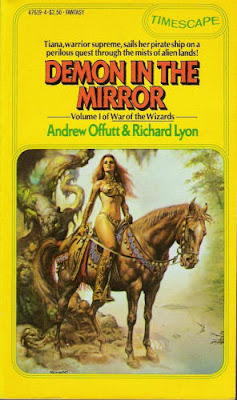
The Demon in the Mirror by Andrew Offutt & Richard Lyon
Tiana's long career as a pirate asea coupled with her certain knowledge of her own bastardy, had given her an ever-fierce thrust for independence and a will that was passing strong. Both drove her now. Her being flashed with scarlet anger. Every ounce of her strength channeled into the arm that strove to drive her sword into this monster in human form.I purchased my copy of the 1980 edition of 1978's The Demon in the Mirror because of my interest in Andrew J. Offutt's odd career. I had no idea who Richard Lyon was. A little googling indicates that Richard K. Lyon was a successful research chemist and a SF fan who, inspired by Robert E. Howard and by his own wife, wrote The Demon in the Mirror but found himself unable to sell it. He shared the manuscript with Offutt, who revised or rewrote it and succeeded in selling it to Pocket Books. (Lyon tells the tale of The Demon in the Mirror's genesis and talks about his career as a scientist at the website Bewildering Stories, a sort of web magazine devoted to speculative writing.) The Demon in the Mirror is Part One of a trilogy entitled War of the Wizards; I own all three volumes of the trilogy, and if I like this first book, I'll read all three, one after the other. If I can trust Andre Norton and Jerry Pournelle, whose gushing blurbs (Norton likens Lyon and Offutt's work to that of sword and sorcery icons Howard, Fritz Leiber and C. L. Moore, while Pournelle suggests Offutt and Lyon have contributed something innovative to the field) adorn the back cover of my copy of the novel, I can be certain I am going to love it!
Tiana is a beautiful lady pirate ship captain! She fights with a rapier and wears a tight shirt so her boobs will distract the people she is trying to murder in the course of her profession! She and the crew of her ship, the Vixen (sexy!), have just captured a heavily armed merchant ship and exterminated its crew. While her men are drunkenly celebrating their victory, Tiana explores the prize, overcoming hideous monsters and deadly traps to get her mitts on the treasure the vessel was transporting--books of magic and a mummified hand. The hand, as all readers were no doubt hoping, is still alive!
![]() |
| Squint or click to read the ecstatic praise for The Demon in Mirror from Andre Norton and Jerry Pournelle |
Back ashore, Tiana sells the magic books to a mysterious and sinister wizard going by the name of Lamarred; the sorcerer explains that the living dead hand is that of the wizard Derramal. (Oh, boy.) Some time ago, Derramal was chopped into pieces and the pieces scattered about the globe, but he can be brought back to life if all the pieces are assembled. Why should Tiana put back together this human jigsaw puzzle? Because Lamarred te;lls her Bealost is alive, but only Derramal knows where he is!
The meat of the book that follows, as Tiana and foster father Caranga split up to gather up all these dismembered wizard parts, is episodic, almost like a series of short stories, in each of which a fragment of Derramal's body is recovered. Tiana retrieves Derramal's other hand from a cult of vampire women who worship a giant bat, and then a burglar called Bandari the Cat helps her defeat a tribe of barbarians and get to the top of an unscalable mountain, the burial site of Derramal's right arm. The ascent is achieved by what amounts to parasailing on the updrafts generated by a thunderstorm--Bandari's people call this "highriding." This whole highriding bit was like something out of a SF story, as it is entirely based on chemistry and physics, not magic or supernatural powers. To get down the mountain Tiana and Bandari slide down an ice field, a scene I suspect is an homage to a similar scene in Leiber's memorable Fafhrd and Grey Mouser tale "The Seven Black Priests." Derramal's left arm is in some royal family's catacombs, and to spirit herself into and out of the closely guarded subterranean vault Tiana must outsmart doublecrossing aristocrats, torturers and guards; within the catacombs she has to contend with the resident ghouls before she can retrieve the grisly object of her quest.
Meanwhile, Caranga, hunting for Derramal's legs, sails Vixen to an island where he and the crew outwit an evil alchemist and battle an army of spider-women who have the power to cloud the human mind with illusions. Later, in this world's equivalent of Africa, they battle invisible monsters in the abandoned city where rest Derramal's feet. In an interesting change of pace from the rest of the book's third-person narration, Caranga's adventures are related in the first person by Caranga himself.
![]() |
| Later editions of the novel crop Boris Vallejo's painting, I guess to make it uniform with other books in the "Timescape" line |
In the last few chapters of the novel, by adding up clues she has collected along with Derramal's body parts, Tiana figures out the tragic truth of Bealost's fate and the horrifying relationship of Derramal to Lamarred. (The ending of the book actually has some of the feeling of the climax of a detective story in which the protagonist explains how he or she figured everything out and exposes how earlier events held a significance the reader may not have realized at the time.) By stitching together the body of Derramal (did I mention that Tiana is also a skilled surgeon?), Tiana precipitates the inevitable world-threatening showdown with a Lovecraftian alien entity that the world's most powerful wizards had been cowardly postponing, and via detective work and trickery she neutralizes this extradimensional menace and saves the world.
At 180 pages, The Demon in the Mirror may be too long, and the tomb-raiding episodes that make up much of the middle section of the book may be a little too similar; too many of them seem to involve Tiana or Caranga spotting a structural weakness in the temple or tomb they are raiding and taking advantage of this Achilles's heel to demolish the structure. On the other hand, each individual episode is entertaining, and at the end Lyon and Offutt make an effort to neatly tie the whole novel and all its threads and incidents together with a bow, so that even if, as you were reading it, the book felt a bit like a series of self-contained stories, when you are finished it does feel more or less like a coherent whole in which early events and lines of dialogue were laying the groundwork for some kind of pay off later on. I'd judge The Demon in the Mirror moderately good, and definitely more polished and better structured than the two sword fighting capers we recently read, Kandar by Ken Bulmer and Kothar and the Wizard Slayer by Gardner Fox; Offutt and Lyon's book feels like something the authors put some serious time and effort into.
What to make of our heroes, Tiana and Caranga? The fact that The Demon in the Mirror's protagonist is a take-charge woman raises the question of to what extent we should see the novel as some kind of feminist work, and to what extent merely one that uses a female character to titillate male readers. Obviously there is a lot of room for individual readers to decide this for themselves, but I will note that the text repeatedly draws attention to Tiana's "jiggle and bounce," to her "rounded thighs crowding her snug short breeks," her "large firm breasts" and on and on, and that the threat of nonconsensual sex is an oft-recurring theme, especially the danger of Tiana being raped but also the possibility of men being seduced by monsters that look like human women. Also noteworthy is the significant number of female villains, and Tiana's repeated use of her sexuality to manipulate men.
Similarly, should we laud the authors for striking a blow against racism with their portrayal of Caranga as a brave adventurer, able leader, and wise and loving father, or cringe at their depiction of him as an oversexed and booze-loving former cannibal who provides much of the book's comic relief? Is his relationship with Tiana a hopeful vision of amity between the races, or yet another instance of a "magical negro" selflessly guiding white people to success and glory?
Well, we'll see what Offutt and Lyon do with Tiana and Caranga in the second part of the War of the Wizards trilogy, The Eyes of Sarsis.
**********
My copy of The Demon in the Mirror has three pages of ads in the back, presenting to the SF community Pocket Books' line of fantasy and science fiction paperbacks. Among the promoted books we see Michael Bishop's Eyes of Fire, a 1980 revision or "complete rewrite" of Bishop's 1975 novel A Funeral for the Eyes of Fire. Since June 2015 I have owned a 1975 Ballantine printing of the original novel under the Funeral title, but have not read it yet. Joachim Boaz considers the 1975 version "a masterpiece."
Advertised on the same page as Eyes of Fire we see Richard Cowper's Road to Corlay, which tarbandu wrote about in 2012, and Kate Wilhem's Juniper Time, which Joachim wrote about in 2014. Also promoted is a one-volume edition of F. M. Busby's The Demu Trilogy from 1980; I read a 1974 edition of the first Demu book, Cage A Man, and liked it.
Listed on a page devoted to "science fantasy" (one which I've actually already written about, back in 2014), are the first two Dying Earth books by Grandmaster Jack Vance, the original collection of stories, which I feel is a bit overrated, and the first Cugel book, Eyes of the Overworld, which I adore and strongly recommend as a brilliant entertainment. On the top of the "science fantasy" page is Cecilia Holland's Floating Worlds. I don't own a copy of Floating Worlds, but I plan on reading it someday; a few years ago I read something about it someplace that made it sound weird, controversial and challenging.
If you have anything to say about any of the books advertised on these pages, don't hesitate to get it off your chest in the comments!
Thursday, November 6, 2014
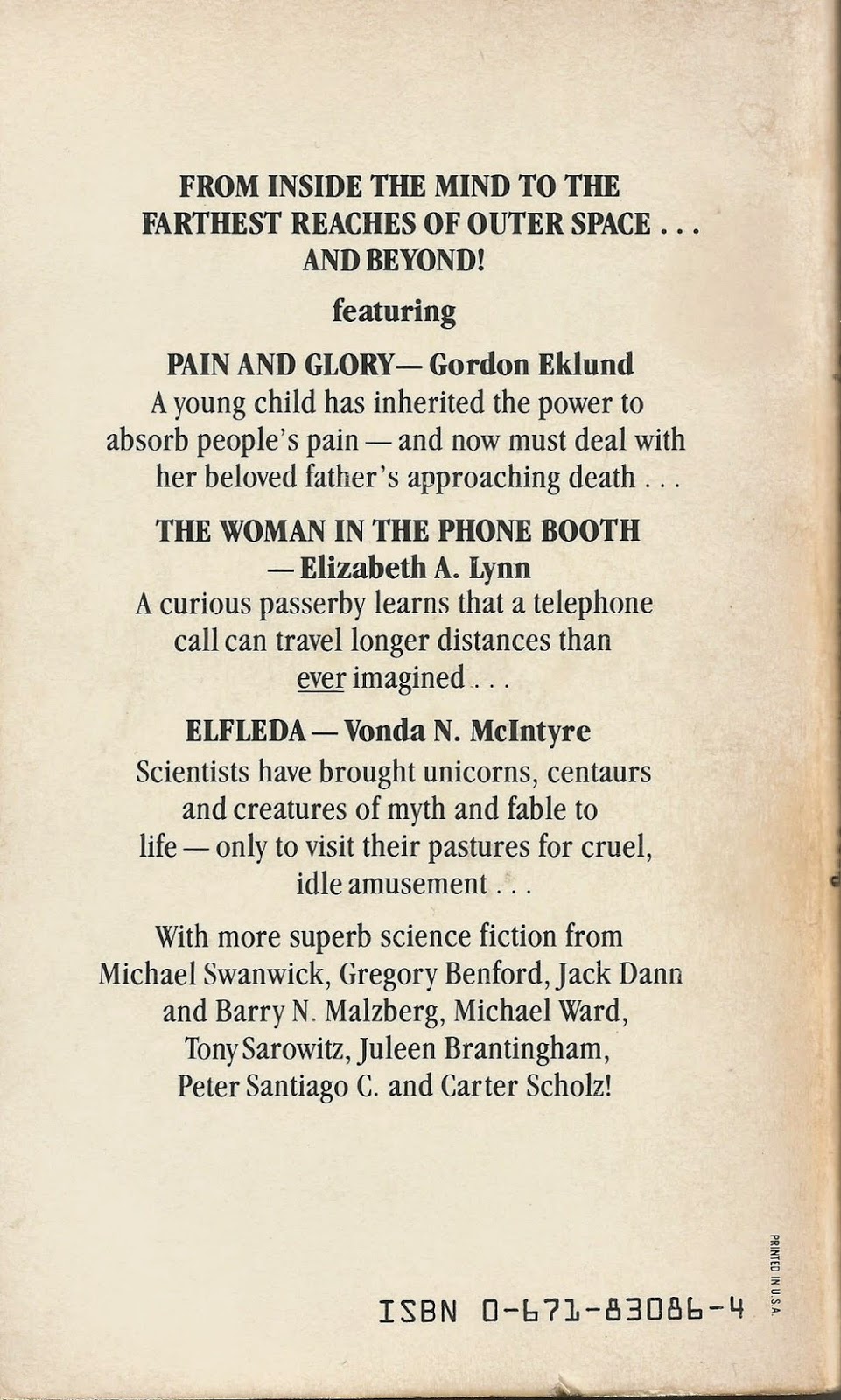
1981 stories by Vonda N. McIntyre, Gordon Eklund, and Jack Dann & Barry Malzberg
On November 2nd the wife and I went to a flea market held in the 4-H building at the Iowa State Fairgrounds. Many vendors had box after box of romance novels, and box after box of Westerns, but one vendor had about a dozen boxes of SF paperbacks. My poor wife waited patiently while I went through each box; unfortunately, almost all the books were recent, less than 25 years old. I purchased only a single book, 1981's New Dimensions 12, edited by Marta Randall and Robert Silverberg. (Randall's introduction seems to suggest that she did all the editing, and Silverberg's name is on the cover to help sell copies.) I bought it because Barry Malzberg and Vonda McIntyre's names appeared on the contents page, and today I read their contributions, as well as a story by Gordon Eklund.
"Elfleda" by Vonda N. McIntyre
I was impressed by McIntyre's early '70s story "Only at Night," a primary reason why I purchased New Dimensions 12.
Through elaborate surgical techniques unscrupulous scientists have recreated mythical creatures like centaurs, unicorns, and mer-people, apparently by grafting the torsos of human accident victims to the bodies of animals. These half-human, half-animal creatures are kept in a park, and are periodically visited by normal humans who use them as sex slaves.
The sixteen page story is a first person narrative by a centaur, Achilleus, and its theme (beyond callousness and cruel exploitation) is disappointment and unrealized desire. Achilleus is in love with a unicorn, Elfleda, a human woman whose torso is attached to a quadruped body and has a horn implanted in her skull. Elfleda has always rejected Achilleus's advances; his love is unrequited. Most of the creatures in the park are obedient to their human masters (due to some kind of brain implants or something) but Elfleda is allowed her freedom, and doesn't have to participate in the orgies organized by the normal humans.
One day the "creators" trick Elfleda, using an unwitting boy as bait, and try to capture her with nets and ropes. Achilleus tries to rescue her, and breaks his leg in the process. As per time honored equestrian tradition, Achilleus is euthenized as Elfleda is led away.
"Only at Night" was also about the callousness of people towards their unfortunate fellows, but while I found that story powerful, "Elfleda" is just OK. Despite the strange sexual content of the story (for example, Achilleus and Elfleda have two sets of genitals each, their human ones and the set from their animal bodies, which permits some outre erotic gymnastics) there is nothing about the story that makes it stand out to me. "Elfleda" gets a passing grade, but I didn't find it special.
"Elfleda" is afforded an unmemorable illustration by Wendy Rose.
Gene Wolfe wrote two stories on a similar theme and topic, 1979's "The Woman Who Loved the Centaur Pholos" and 1981's "The Woman the Unicorn Loved," which I read over seven years ago, according to my notes, and do not remember very well. My notes suggest I wasn't thrilled with them, either.
"Pain and Glory" by Gordon Eklund
I gave Gordon Eklund's novel A Trace of Dreams a marginally negative review, and I described his story "Home Again, Home Again," as "lame" and "poor." But as people who watch sports might say, let's give him another swing at the plate, or chance at bat, or something.
In "Elfleda" we had a woman writing a first person narrative in the voice of a man, and here we have a male writer writing a first person narrative in the voice of a 16-year old girl.
Kelly Cohen of San Francisco is the youngest of the seven children of Isaac Cohen. The Cohens have the power to relieve the pain and anxiety of people they touch. Kelly regularly visits the poor neighborhoods and eases the pain of a catalog of unfortunates: the 12-year old black girl with a birth defect who is molested by a 14-year-old boy, the gullible hippies who are trying to live off the grid and are adherents of the guru Matthew Samson (does that rhyme with "Charles Manson?"), the old woman who is so poor she eats dog food, a blind man, a deaf girl, a drug addict.
Isaac Cohen is dying, and his kids, among them a high-powered lawyer, a sociology professor, and a Berkeley student, gather round. (The Berkeley student, an aspiring poetess, is always urging Kelly to lose her virginity.) Isaac tells Kelly the story of how his Ukrainian village of psychic Jews was massacred by the SS. Kelly learns that many of her siblings have lost their power to relieve pain, perhaps because they have lost the ability to love, or because they got sick of the responsibility their talent brought and were tired of being different.
This is a pedestrian story, I guess an allegory for the burnout experienced by social workers and doctors and for the idea that Jews are an "other" wherever they go and/or a "chosen people" with special abilities and responsibilities. There is nothing particularly noteworthy about it. I'll judge this one barely acceptable.
"Parables of Art" by Jack Dann and Barry N. Malzberg
Attention Malzberg completists: according to isfdb, "Parables of Art" has only ever appeared in this volume.
I enjoyed "Down Among the Dead Men," a Dann collaboration with Gardner Dozois, and I generally like Barry Malzberg, so after reading the mediocre McIntyre and Eklund selections, I expected this to be my favorite of the three. My expectations were realized.
Fans of Malzberg will not be surprised to hear that this story is four pages long but is divided into three chapters. Nor that it begins, "Walter Taplin was forty-five and a failed artist." Taplin is "enormously fat," as is his wife. We are told that the couple has lots of sex.
Taplin discovers a secret room at the back of his house; within this room he has the ability to create exciting paintings that are sought after by gallery owners and collectors! (The authors tell us Taplin's early work was like that of Rosa Bonheur, while his work in the secret room is reminiscent of Bosch.) Taplin enjoys critical and financial success, and loses weight! But he has less time for sex!
Taplin's wife is envious of her husband's success, and jealous that he spends less time with her, so she seals the secret room with concrete. Life returns to normal (meaning: lots of sex!)
This story is crazy, feels new, and made me laugh. Winner!
*************
For me, Dann and Malzberg deliver, but the McIntyre and Eklund just sit there inoffensively. Still, I can see people embracing the McIntyre and Eklund for their conventional earnest liberalism, and finding "Parables of Art" offensive for its selfish and obese female villainess. (But is she really a villainess? If we view a happy love relationship as more important than fame and fortune, maybe we should see her as a heroine!)
***********
The final page of New Dimensions 12 is an advertisement for "science fantasy" novels. Of the seven books listed, I have only read the two Jack Vance books, The Dying Earth and The Eyes of the Overworld. I think The Dying Earth is overrated, but I love The Eyes of the Overworld to death, and consider it one of the most fun books I have ever read. I'd probably give the Poul Anderson and Theodore Sturgeon selections a try, but I'm weary and leery of L. Sprague de Camp. William Barnwell I've never heard of. Cecilia Holland's Floating Worlds is widely discussed and apparently sui generis, so I am intrigued, but I've heard it is over 600 pages, which is an investment I am reluctant to make.
"Elfleda" by Vonda N. McIntyre
I was impressed by McIntyre's early '70s story "Only at Night," a primary reason why I purchased New Dimensions 12.
Through elaborate surgical techniques unscrupulous scientists have recreated mythical creatures like centaurs, unicorns, and mer-people, apparently by grafting the torsos of human accident victims to the bodies of animals. These half-human, half-animal creatures are kept in a park, and are periodically visited by normal humans who use them as sex slaves.
The sixteen page story is a first person narrative by a centaur, Achilleus, and its theme (beyond callousness and cruel exploitation) is disappointment and unrealized desire. Achilleus is in love with a unicorn, Elfleda, a human woman whose torso is attached to a quadruped body and has a horn implanted in her skull. Elfleda has always rejected Achilleus's advances; his love is unrequited. Most of the creatures in the park are obedient to their human masters (due to some kind of brain implants or something) but Elfleda is allowed her freedom, and doesn't have to participate in the orgies organized by the normal humans.
One day the "creators" trick Elfleda, using an unwitting boy as bait, and try to capture her with nets and ropes. Achilleus tries to rescue her, and breaks his leg in the process. As per time honored equestrian tradition, Achilleus is euthenized as Elfleda is led away.
"Only at Night" was also about the callousness of people towards their unfortunate fellows, but while I found that story powerful, "Elfleda" is just OK. Despite the strange sexual content of the story (for example, Achilleus and Elfleda have two sets of genitals each, their human ones and the set from their animal bodies, which permits some outre erotic gymnastics) there is nothing about the story that makes it stand out to me. "Elfleda" gets a passing grade, but I didn't find it special.
"Elfleda" is afforded an unmemorable illustration by Wendy Rose.
Gene Wolfe wrote two stories on a similar theme and topic, 1979's "The Woman Who Loved the Centaur Pholos" and 1981's "The Woman the Unicorn Loved," which I read over seven years ago, according to my notes, and do not remember very well. My notes suggest I wasn't thrilled with them, either.
"Pain and Glory" by Gordon Eklund
I gave Gordon Eklund's novel A Trace of Dreams a marginally negative review, and I described his story "Home Again, Home Again," as "lame" and "poor." But as people who watch sports might say, let's give him another swing at the plate, or chance at bat, or something.
In "Elfleda" we had a woman writing a first person narrative in the voice of a man, and here we have a male writer writing a first person narrative in the voice of a 16-year old girl.
Kelly Cohen of San Francisco is the youngest of the seven children of Isaac Cohen. The Cohens have the power to relieve the pain and anxiety of people they touch. Kelly regularly visits the poor neighborhoods and eases the pain of a catalog of unfortunates: the 12-year old black girl with a birth defect who is molested by a 14-year-old boy, the gullible hippies who are trying to live off the grid and are adherents of the guru Matthew Samson (does that rhyme with "Charles Manson?"), the old woman who is so poor she eats dog food, a blind man, a deaf girl, a drug addict.
Isaac Cohen is dying, and his kids, among them a high-powered lawyer, a sociology professor, and a Berkeley student, gather round. (The Berkeley student, an aspiring poetess, is always urging Kelly to lose her virginity.) Isaac tells Kelly the story of how his Ukrainian village of psychic Jews was massacred by the SS. Kelly learns that many of her siblings have lost their power to relieve pain, perhaps because they have lost the ability to love, or because they got sick of the responsibility their talent brought and were tired of being different.
This is a pedestrian story, I guess an allegory for the burnout experienced by social workers and doctors and for the idea that Jews are an "other" wherever they go and/or a "chosen people" with special abilities and responsibilities. There is nothing particularly noteworthy about it. I'll judge this one barely acceptable.
"Parables of Art" by Jack Dann and Barry N. Malzberg
Attention Malzberg completists: according to isfdb, "Parables of Art" has only ever appeared in this volume.
I enjoyed "Down Among the Dead Men," a Dann collaboration with Gardner Dozois, and I generally like Barry Malzberg, so after reading the mediocre McIntyre and Eklund selections, I expected this to be my favorite of the three. My expectations were realized.
Fans of Malzberg will not be surprised to hear that this story is four pages long but is divided into three chapters. Nor that it begins, "Walter Taplin was forty-five and a failed artist." Taplin is "enormously fat," as is his wife. We are told that the couple has lots of sex.
Taplin discovers a secret room at the back of his house; within this room he has the ability to create exciting paintings that are sought after by gallery owners and collectors! (The authors tell us Taplin's early work was like that of Rosa Bonheur, while his work in the secret room is reminiscent of Bosch.) Taplin enjoys critical and financial success, and loses weight! But he has less time for sex!
Taplin's wife is envious of her husband's success, and jealous that he spends less time with her, so she seals the secret room with concrete. Life returns to normal (meaning: lots of sex!)
This story is crazy, feels new, and made me laugh. Winner!
*************
For me, Dann and Malzberg deliver, but the McIntyre and Eklund just sit there inoffensively. Still, I can see people embracing the McIntyre and Eklund for their conventional earnest liberalism, and finding "Parables of Art" offensive for its selfish and obese female villainess. (But is she really a villainess? If we view a happy love relationship as more important than fame and fortune, maybe we should see her as a heroine!)
***********
The final page of New Dimensions 12 is an advertisement for "science fantasy" novels. Of the seven books listed, I have only read the two Jack Vance books, The Dying Earth and The Eyes of the Overworld. I think The Dying Earth is overrated, but I love The Eyes of the Overworld to death, and consider it one of the most fun books I have ever read. I'd probably give the Poul Anderson and Theodore Sturgeon selections a try, but I'm weary and leery of L. Sprague de Camp. William Barnwell I've never heard of. Cecilia Holland's Floating Worlds is widely discussed and apparently sui generis, so I am intrigued, but I've heard it is over 600 pages, which is an investment I am reluctant to make.
Subscribe to:
Posts (Atom)