Friday, March 21, 2025

F&SF, Oct '67: R McKenna, A Davidson and S R Delany

We recently read R. A. Lafferty's "Camels and Dromedaries, Clem," which debuted in a 1967 issue of F&SF also containing stories by Fritz Leiber, Avram Davidson, J. G. Ballard, and Samuel R. Delany.  This is an issue full of big names, so let's return to it.  We've actually already read the Leiber, "The Inner Circles," under the title "The Winter Flies."  The Ballard contribution is one of the Vermillion Sands stories, and I'm thinking if and when I read them I'll read them in batches, devoting an entire post to Ballard.  (Note that we did read the first Vermillion Sands story, "Prima Belladonna," two years ago.)  So, to round out this blog post, let's read the included story by Richard McKenna, who is most famous for writing the novel The Sand Pebbles.  

"Home the Hard Way" by Richard McKenna    

This is a decent adventure story; you might say it has hard-boiled elements.  It seems to draw on McKenna's experience in the U. S. Navy.

Big strong balding Webb is a level 3 biotech in the space navy of an interstellar human civilization, a somewhat brutish working-class guy who has worked his way up in rank with hard work and native intelligence.  His assistant is a pretty brunette, Chalmers, as good a tech as he--he trained her.  They make a great team in the biotech lab of the naval vessel on which they serve, the Carlyle.  The main job of biotechs is operating, maintaining, and repairing equipment that can turn almost any kind of matter into food.

The Carlyle has been spending a long period of time on a remote colony on Planet Conover, to which they were drawn by a distress call.  This is the most beautiful world our heroes have ever seen, but I guess it is hard to find food there.  The captain of the Carlyle thinks the Conover colony is doomed--it is far off the space lanes, so starting profitable trade will be hard and if there is another problem there may not be a naval vessel close enough to help.  And the captain assumes help will be required--the colony's leaders are trying to build an aristocratic state, and selected most of the colonists for low intelligence, which this means that nobody on the colony is smart enough to operate the biotech machines that make food, and, the captain predicts, there will be a violent revolution soon enough, the peasants rising up against the aristocracy.

The noble families in charge of the colony try to convince Webb and Chalmers to desert the Carlyle and join the Conover aristocracy.  Webb is convinced because a sexalicious blonde promises to marry him, but Chalmers is more duty-minded, and she is in love with Webb, making her immune to the Conover ploy of setting her up with some guy.

Chalmers reports the whole sordid business to the captain and Webb's effort to desert is a failure.  As the Carlyle continues its patrol around this section of the galaxy, Webb tries repeatedly to desert so he can get to Conover and that blonde.  He has a series of adventures, getting caught and stripped of his rank and so forth.  McKenna has a running joke about Webb's bald spot--whores caress it, the police hit him on it with truncheons when he fights them, etc.  There's also a whole thing about how Webb, once an officer, now demoted to the level of a rating or enlisted man or something, is miserable because he can't get comfortable around anybody any more, no longer fitting in among any class of people on the ship.    

The crisis of the story comes when Webb, hiding out after deserting, tries to contact the criminal underworld so he can sell on the black market some equipment he stole from the Carlyle and gets mixed up with space pirates.  These merciless corsairs of the void need a guy who can make food out of rocks and twigs just as much as the colony on Conover does, but they aren't going to offer him a curvaceous blonde bombshell--they are going to condemn him to a life of slavery and danger committing crimes and fighting his former comrades.  Chalmers independently, without alerting the captain, launches a rescue mission to save the big stupid lug.  She gets captured, and it looks like she might get gang-raped by the pirates, but she and Webb manage to escape, killing the pirate captain on the way out.  Chalmers figures out a way to keep Webb from getting in trouble with the captain--in fact, she turns him into a hero!  Webb comes to his senses and marries this jewel among women and the two plan to move to Planet Conover when their commitments to the space navy are up, I guess in seven years or so.

This story is not bad, but I thought it odd the lovers were going to go to Conover--it had sort of been established that the Conover colony was doomed and/or the people on Conover were jerks.  Maybe we are supposed to think that by the time Mr. and Mrs. Webb got to Conover the doomed aristocratic colony would be gone and they would start a totally new colony--Webb does use the word "homestead."

"Home the Hard Way" would reappear in two anthologies edited by Charles Waugh and Martin H. Greenberg, Love 3000 and Starships; the latter also has Isaac Asimov's name on it--the German edition has only Asimov's name on it.  Abgespaced.


"The Power of Every Root" by Avram Davidson 

There are two "novelettes" in this October 1967 ish of F&SF, McKenna's "Home the Hard Way" (like 21 pages) and Davidson's "The Power of Every Root" (about 18.)  The editor's intro to Davidson's story tells us it is a crime story featuring police corruption and black magic--I shouldn't read these intros until after I've read the story, I know, I know.

That intro also tells us that Davidson lived in Mexico for a while, and "The Power of Every Root" is set in Mexico.  And it is not exactly a loving portrait.  Right at the beginning we get the idea that Mexican men are forever visiting quack doctors and native shamans to cure the venereal diseases they contract regularly.  Davidson also makes much of the Mexican government's pomposity and quixotic drive to secularize its superstitious population.  

The main character of this somewhat farcical story is young cop Carlos, whose blunders have him always in trouble with the chief of police.  He's on the brink of losing his job!    Recently, Carlos has been afflicted by aches and pains and, worst of all, horrifying visions.  He visits the quack doctor, who assumes wrongly that Carlos is having trouble using the toilet or performing in bed.  Carlos flushes the pills this sawbones gives him down the toilet and goes to the local "native herbalist and wizard," a "curandero," who assumes Carlos is the victim of witchcraft or poisoning and warns him to only eat his wife's cooking.

Early the next morning, Carlos decides to try to catch the people illegally harvesting wood from the forest, thinking a big arrest will improve his standing with the chief.  In the dark, he stumbles upon a freshly dead body missing its head.  When some kids come by he sends one of them to get the police chief, and then he guards the body, falls asleep, wakes up to find the body gone.  He thinks he'll lose his job or be arrested himself if the chief learns he has lost the body, so he decides to murder one of the wood stealers and put that guy's body in place of the lost one!  After slaying one of the thieves and decapitating the corpse, Carlos collapses, sick or insane.

Then comes the explanation of the story's mysteries and resolution of the tragedy of Carlos.  Everybody in town, except Carlos, knew that Carlos' wife was a treacherous slut having sex all the time with the two most brazen of the wood thieves, a pair of cousins.  The chief of police, giving Carlos more credit for detective skills than he deserves, concludes that Carlos finally figured this out and killed the thieves in an understandable act of vengeance--after all, the two headless corpses are the horny cousins in question.  The chief is willing to lie to the public to protect the reputation of the police, and claim that one thief killed the other, and then Carlos killed the murderer in a fight while trying to arrest him.

Ad for the story's black magic plot, we learn that the curandero was also having sex with Carlos' wife, so the source of young Carlos' aches, pains, and visions were no doubt poison, provided by the shaman and introduced into his food by Carlos' diabolical spouse.  As the story ends we are led to assume that Carlos is going to end up in the insane asylum and the corrupt police will never bring the curandero (who has not only been poisoning Carlos but also some old hypochondriac woman) or Carlos' wife to justice.

"The Power of Every Root" is well constructed, all the various moving parts operating smoothly together, all the surprises foreshadowed and believable.  All the jokes about sex and using the toilet are not actually funny, but they are not bad.  But I personally found the story more sad and depressing than funny--Carlos is a loser, and I was more inclined to sympathize and commiserate with him than to laugh at him as he was defeated by the world.  To me, "The Power of Every Root" feels a little too much like educated genius Davidson goofing on a backwoods moron for comfort--I suppose the course of my own life leaves me more likely to identify with the guy who is sitting in a puddle after having slipped on a banana peel than the guy who points at him and laughs.  "The Power of Every Root" is objectively good but I couldn't really enjoy it; we'll mark this one as acceptable.  If you are writing your dissertation on "Depictions of Mexico in American Speculative Fiction" or "Latin America as Envisioned by English Language Genre Fiction Writers," though, "The Power of Every Root" is a must!

Davidson must have been pleased with this story--it appears in Harry Harrison's SF: Author's Choice 3, one of those anthologies of stories writers consider their best or favorite works.  You can also find it in Davidson collections, and Peter Haining's Black Magic Omnibus, which was split into two volumes for paperback publication.

We read the Barry Malzberg story in SF: Author's Choice 3 back in 2017 

"Corona" by Samuel R. Delany

Delany, like Davidson, is a guy who often gets lionized as a writer of real literature.  Our most recent forays into the oeuvre of Delany are "Aye, and Gomorrah" and "The Star-Pit" but our most memorable are probably Triton and an excerpt from Equinox.  Well, let's see how "Corona" stacks up.

It is the mid-21st century.  Mankind's colonies throughout the solar system are just beyond the pioneer stage, becoming stable establishments.  Buddy, of low IQ and violent moods, comes from a difficult home, his father having abandoned the family, his mother a drunk who had many husbands and can't remember what year Buddy was born.  Buddy tried to steal a helicopter and landed in prison, and is now out of the clink after a harrowing experience behind bars; 24 years old he has a job at the spaceport in New York City.  

Bryan Faust is the singer whose fame has swept the solar system.  You hear his music everywhere!  When his starliner comes into port in NYC the kids mob it, I guess Delany basing this on the reaction to the Beatles or Elvis of their fanatical fans.  Faust's latest hit is "Corona," and the song is on the radio when Bryan is hurt in an accident while a member of the crew working on Faust's starliner--some negligent dope spills gallons and gallons of "hot solvent" on our guy.  Ouch!

Lee is a nine-year-old African-American telepath and genius; her regular reading material includes Spinoza and Nietzche and she does complex math to relax.  Lee is suicidal, because she has limited control over her telepathy, and often experiences the horrible trauma of people all over the Earth, all over the solar system, as they are getting killed or otherwise suffering through terrible experiences.  When Buddy comes to the hospital, she reads his mind and sees not only his current trouble but the brutality he suffered in a Southern prison at the hands of a religious guy.  (With the black person who is both better than everybody else and a victim, and evil Southerners, evil religious people, and an evil  institution of incarceration, Delany is massaging all the erogenous zones of the middle-class liberals that, I guess, make up most of the readership of F&SF.)  Lee and Buddy both have "Corona" running through their heads, having heard the same radio broadcast.  By reading former jailbird Buddy's mind, Lee learns a technique to escape her room, and she goes to Buddy to comfort him.  They bond over "Corona" and he tries to comfort her.  

The doctors get Lee back into her room.  Buddy eventually heals up and gets back on the job at the spaceport.  Lee can sometimes tune in to the minds of people she knows, and Buddy attends Faust's final performance, held right there at the spaceport, Buddy's access affording him a spot up front with the journalists, and Lee is able to share his front row experience of the music they both love, easing her suicidal misery a little.

This is a pretty successful story that offers a glimmer of hope as well as describing atrocities and the plight of people who are born into difficult situations.  In particular, Delany celebrates the ability of good music to bring joy to individuals and to foster healthy human relationships.  

Besides in various Delany collections, "Corona" would be reprinted in Looking Ahead: The Vision of Science Fiction, I guess a sort of textbook that also offers work by Robert Frost, Nathaniel Hawthorne and Norman Mailer, and Dark Matter: Reading the Bones, where it appears alongside work by W. E. B. Du Bois and Walter Mosley.


**********

Three stories we can say nice things about; even if I'm not aligned with every little thing these authors are trying to accomplish, I certainly think each of them succeeded in achieving the goals he had for each story.  A good issue of F&SF.  

Thursday, March 20, 2025

Gene Wolfe: "The Headless Man," "Thou Spark of Blood," and "On a Vacant Face a Bruise"

We just got through three blog posts about stories by one of the more challenging SF writers, a man beloved by critics whom we might associate with the New Wave but who doesn't share the leftist politics of the most prominent New Wave leaders like Michael Moorcock and Judith Merril.  I refer to R. A. Lafferty, but the same description might fit Gene Wolfe.  Wolfe came to mind for multiple reasons while I read Lafferty the last few days, so let's read three stories by Wolfe I do not think I have read before that have been chosen more or less at random.

"The Headless Man" (1972)

This story debuted in an anthology I should check out because it contains stories by numerous people I read, Terry Carr's Universe 2.  Joachim Boaz wrote about Universe 2 back in 2016, and after I get a few stories from it under my belt, I'll reread his blog post and see to what extent we are on the same page.

When Universe 2 was translated into Dutch, it was retitled, and our pals over in the Netherlands used Wolfe's story, "The Headless Man" as the title story.  "The Headless Man" would be reprinted in the Wolfe collection Endangered Species; I have owned the red paperback Tor edition of Endangered Species forever, so I'll be reading it in there.  (Way back in 2015 I blogged about three stories from Endangered Species about your favorite topic--mysterious women!)  "The Headless Man" came to mind because I saw it in the contents list of the French anthology Univers 05 (complete with oh la la cover!) when looking up where Lafferty's "Entire and Perfect Chrysolite" was reprinted. 

I'm going to have to admit I don't think I understand this one.  The narrator explains that he was born without a head, and has a face on his torse--huge eyes where an ordinary man's nipples are, a huge mouth in his stomach, etc.  He relates the incredible story that he has attended school and has lived a more or less ordinary life in public by strapping a fake head and neck to his shoulders, buying shirts that he can see through, and so on.  Who could believe that nobody would notice that a guy has a lifeless face with eyes that don't move and so forth?  The end of the brief story describes a sexual encounter.  Somehow the woman doesn't notice this guy has eyes and a nose and mouth on his torso, and in the dark the narrator thinks that her body looks like it has a face as well, her breasts like eyes, I suppose, the crease in her stomach as she sits like a mouth.  And that's the end of the story.

This isn't one of those Twilight Zone type stories in which in the end we realize the story is set on an alien world where everybody has no head--the narrator says again and again he is a one-of-a-kind oddity--and I don't think the woman in the story is a fellow headless person.  Maybe it is significant that the woman is practically a prostitute, and they dicker over a price in an oblique way?  Is this story about how people don't really look at each other but just see each other as sources of sex or money?  

I'm going to have to mark this one down as beyond me and move on with my life.  Maybe it is easier to understand in the Dutch translation?


"Thou Spark of Blood" (1970)

"Thou Spark of Blood" came to my attention because it is in the same issue of If as Lafferty's "Ride a Tin Can" which we read for our last blog post, along with "Entire and Perfect Chrysolite."  We might consider this a rare Wolfe story--in 1975 it appeared in the French edition of Galaxy (which drew its contents from If, Galaxy's sister magazine, as well as Galaxy) but if isfdb is to be believed, it would not be reprinted in English until 2023, in the collection The Wolfe at the Door.  I'm reading "Thou Spark of Blood" in a scan of that American issue of If.

Here we have one of those pessimistic stories about how mankind may not be up to the challenges of long distance space travel, psychologically and technologically.  Many SF writers, Wolfe among them, love murder mysteries, and "Thou Spark of Blood" is also a gory murder mystery full of descriptions of blood and dismemberment and decaying bodies.  And, like many SF stories, in the end we find out the characters are in a simulation.  I don't have to tell my regular readers that this story is reminding me of the work of our hero Barry N. Malzberg.

The story is short and economical and easier to understand than much of Wolfe's work.  Three men are on a trip to Mars, a voyage of like four months, and as they finally approach their destination the psychological stress of the mission is breaking their minds and the three men hate each other.  Maybe if the radio hadn't failed, maybe if the stereo hadn't failed, they wouldn't be going bonkers.

Two of the men wake up to find their comrade's throat has been slit.  They each assume the other did it.  Will these two be able to continue the mission without killing each other?  Our first twist ending is the discovery that the dead man committed suicide after sabotaging the mission, essentially laying a trap in hopes his two comrades would join him in death.  Our second twist ending is the revelation that the three men are in a simulator, not on their way to Mars at all.

Good.  


"On a Vacant Face a Bruise" (2006)

I decided to read this one after seeing its evocative title in the contents list of The Wolfe at the Door.  This story first appeared in a little 40-page volume entitled Strange Birds that presents two stories by Wolfe "inspired by the artwork of Lisa Snellings-Clark," whom I guess is a friend of Neil Gaiman's.  The other story in Strange Birds is "Sob in the Silence," which I think I read years ago in one of the "Best of the Year" anthologies it appeared in.

I am reading "On a Vacant Face a Bruise" in a scan of Strange Birds.

Genre fiction writers love the circus and carnies and that sort of thing, and "On a Vacant Face a Bruise" is about a circus that travels by star ship through what I guess is a human space empire or space civilization--there are plenty of intelligent aliens, but these are subaltern natives.  I'm guessing this is the same universe as the various Sun Cycle books.  "On a Vacant Face a Bruise" is a sad story about people, victims of violence and/or some kind of oppression, who come to the circus seeking some place they can belong.  Wolfe's work is often counterintuitive or "edgy" and the story presents arguments that parents who strike their children and people who strike their spouses perhaps mean well and maybe their violence is justified.  Another theme is the question of who is a person--we've got robots who at first seem to be people, people who seem at first to be robots, and alien people who at first seem to be mere animals--as in Lafferty's "Ride a Tin Can," somebody realizes some "animals" are in fact people and tries to secure for them the rights they have been denied.  A related theme is freedom--do all animals and people really want freedom?  Is freedom what is best for them, or what they deserve?

As is common in Wolfe stories, "On a Vacant Face a Bruise" contains secrets that are foreshadowed and then sprung on you much later, and various other surprises, and so I read it twice in hopes of catching more of these things.  Actual sentences and images are clear and sharp and easy to understand, so the story is a smooth read, and I think all the mysteries regarding what is going on plotwise are cleared up by the time we get to the last page.  Wolfe's writing is economical, but still evocative, and it is easy to get emotionally attached to the various characters even though Wolfe doesn't spend a lot of time describing them and their feelings or throwing lots of metaphors at you--every sentence of the story has value, there is no fluff or padding, Wolfe pulls the old heartstrings with a minimum of words or pyrotechnics.

Farm boy Tom is running away, having been beaten at home by his widower father, and comes upon a travelling circus.  The circus is protected from people like Tom who can't afford to pay the entrance fee by a high-tech fence (this is one of those stories in which high and low technologies are present in the same milieu--the circus has a star ship and this transparent electrified fence, but people are using oil lamps and horses) but like Tarzan does like a million times, Tom finds a tree with a branch that hangs over the fence and thus he obtains entrance to the circus, after watching the show for free for a while.  The hungry kid begs for food and steals some when his request is refused.  While he watched her performance from above, a sexy dancer winked at him, and so Tom tries to find her, hoping she'll offer him a free place to sleep for the night.  The dancer turns out to be a remote controlled robot--but the woman who controls it likes Tom, and gets him a job with the woman lion tamer.  

Tom, who has a way with animals, becomes a full-fledged lion tamer himself, and interacts with the various human, alien, and animal performers of the circus, each interaction dramatizing some theme about violence or freedom that I listed earlier.  Tom, a hard worker and a good manager, becomes a partner of the owner of the circus, but the story ends sadly because he is in love with the woman who runs the robot dancer but she leaves the circus to try to find the husband who hits her and has abandoned her.

"On a Vacant Face a Bruise," as I sort of hinted earlier, isn't a rousing defense of liberty or animal rights or a powerful denunciation of domestic violence or cruelty to animals, but more like an illustration of the ambiguities and complexities of life and relationships, with some individuals fighting for freedom, others passing up opportunities to escape their oppressors or exploiters, some characters who are both oppressed and oppressors, and others who are both liberators and exploiters--and of course there is raised the possibility that some individuals are better off in a subordinate role than in a state of freedom.

Thumbs up for "On a Vacant Face a Bruise," a strong representative sample of Wolfe's later body of work (which I feel is distinct from his earlier books, like all those Sun books, which have lots of hard words and in which it can be very hard to tell what the hell is going on.)

**********

"The Headless Man" went right over my head, but I enjoyed the traditional SF thriller "Thou Spark of Blood" and "On a Vacant Face a Bruise" embodies many of the characteristics of Wolfe's work that I admire and find entertaining and moving.

Reading Lafferty and Wolfe kind of takes it out of me, so maybe something more relaxing next time.  But I do feel like I have been bitten by the Wolfe bug again, so maybe I'll hunt up more Wolfe short stories I've never read, or at least never blogged, soon.

Tuesday, March 18, 2025

R. A. Lafferty: "Ride a Tin Can," "Entire and Perfect Chrysolite" and "Cliffs that Laughed"

Today we finish up our look at the early Seventies collection of stories by R. A. Lafferty entitled Strange Doings.  Only three stories remain for us to read today; at the bottom of the blog post I'll include links to my discussions of the other 13 stories in the book.

"Ride a Tin Can" (1970)

"Ride a Tin Can" debuted in an issue of If ("the magazine of alternatives") which also includes a story by Gene Wolfe I haven't yet read and an essay by Lester del Rey on Buck Rogers, the comic strip (published 1929 to 1967) and the strip's original source material, short fiction by Philip Francis Nowlan that appeared in Amazing in 1928 and 1929.  Del Rey moans at length that the strip is racist, with the white people good (except for the white character who is evil) and the Mongols and Martians evil, and even suggests the strip might have played a role in American misbehavior in World War II, like the internment of Japanese-Americans (did FDR read Buck Rogers?), and the Korean War, in which, as del Rey tells it, some American had a dim view of Koreans.  After this, del Rey does admit the strip is fun.  More interesting is del Rey's discussion of whether Buck Rogers constitutes science fiction; he insists that the comic strip is not science fiction, while the two novelettes in Amazing by Nowlan are science fiction, in part because Nowlan does world-building and because the stories are less racist than the strip (though still racist.)

(For the record, while I am a big fan of the Flash Gordon strip by Alex Raymond because I think Raymond's art is terrific, I haven't delved deeply into the Buck Rogers strip because the art looks pretty lame.  Buck's early comic adventures most certainly are on my to do list, however.) 

Alright, let's get to the reason we are here, R. A. Lafferty's "Ride a Tin Can."  This is a clever and fun little story, gruesomely humorous and maybe a little sad, that, perhaps, is about how ethnic or political groups who want to exploit or destroy members of another group first dehumanize them.  This story might in particular appeal to our anti-capitalist friends, as the villain is a big company and the consumers who eagerly buy their products and Lafferty also pokes fun at how large business concerns will make charitable grants and donations to salve their consciences.

According to the experts, the extraterrestrial goblin creatures known as Shelni have no intelligence or language--their speech is "meaningless croaking."  But doctor of primitive music Holly Harkel thinks the Shelni are not mere animals, but people with intelligence and a culture, including music and stories.  Holly is an odd scholar, a short ugly woman who, when she studied amphibians and reptiles, started looking like a toad or a snake.  She and the narrator, a folklorist, get permission and a grant to record the lore and music of the Shelni, and Holly leads the way to the subterranean lair of the goblin people, where our heroes record four of their traditional stories.  Under Holly's influence, the narrator can understand the Shelni language and appreciate Shelni music, something no human besides the two of them can do (or perhaps something no other human chooses to do, as the establishment has a psychological and financial stake in not considering the Shelni to be people?)

As has been foreshadowed, we learn that the dimwitted Shelni, who have very strange ideas about birth and death--they seem to have no inkling of where they come from and their folklore is full of stories of Shelni being dismembered but continuing to live--are being exterminated by humans who offer the Shelni a free ride to Earth.  All the Shelni are eager to take advantage of the offer, and they are processed (deboned) and put into tin cans and sent to Earth, where they are sold as food for children.  Holly, who has taken on the appearance of a Shelni, is herself torn to bits and put into an Earthbound tin can.  The narrator (who retrieves from the food processing plant and keeps Holly's bones) vows vengeance on the company that destroyed the kind and loving Holly as well as the innocent and naive race of the Shelni.

Thumbs up.  You can catch "Ride a Tin Can" in various Lafferty collections as well as an anthology by Terry Carr with a Kelly Freas cover and a German anthology with a (repurposed from Ace F-282) Frank Frazetta cover.  

"Entire and Perfect Chrysolite" (1970)

Here's one of Lafferty's Orbit stories.  "Entire and Perfect Chrysolite" would reappear in a number of other anthologies, including a German one that draws stories from Orbit 5 and 6, and a French anthology, Univers 05, that also includes David Gerrold's "Afternoon with a Dead Bus" which I condemned back in 2022.

"Entire and Perfect Chrysolite" takes place in an alternate universe, perhaps based on ancient Greek cartography, in which Ireland, America, and sub-Saharan Africa do not exist--the world consists of Europe, Asia and Libya.  The inhabitants of this world know about black Africa and America the way we know about Atlantis, and think about black people the way we might think of elves, about giraffes and hippos the way we might think of unicorns and dragons--as lands, people and beasts of fantasy, products of cultural imagination and the collective unconscious.

Our characters are eight people aboard a ship, sailing within sight of the southern coast of Libya.  These people are interested in the occult and supernatural, and will often hold seances and do other strange things. Today they are trying to conjure up mythic Africa, which, if real, would be right beneath them.  They succeed--a crocodile attacks one of the characters, tearing her to pieces, and the ship disappears, leaving the cast in a swamp, surrounded by lions and giraffes and the like, the African animals they think are fairy tales.  As reptiles and great cats approach menacingly, the adventurers insist these creatures are harmless illusions, constructed out of their own imaginations.  A black man appears and tries to save them, but they think he is an illusion too, and his reward for his selfless efforts is death under the hooves of a water buffalo.  The adventurers reverse their spell, and Africa vanishes, and their ship reappears.  Their comrade who was killed by the croc does not reappear, but her husband is confident she will eventually make her way back to reality.  We readers cannot be sure if the poor woman will reappear, nor if the cast really did visit our world and leave one of their number behind, or if they did nothing more than experience an illusory and harmless vision of a world much like our own.  Maybe you and I, and all our trials and tribulations, are the fantasies and dreams of these goofballs.

Pretty good.  

"Cliffs that Laughed" (1969)

We finish our current exploration of the stories of R. A. Lafferty with one of the more challenging, one of the more confusing ones.  We've got a narrator, but most of the "main" story is told by another character, Galli the native Pacific Islander, a traditional storyteller who relates to the narrator an adventure/horror story.  "Cliffs that Laughed" has multiple levels or angles of unreliability.  Galli openly admits he cobbles his stories together from various sources, including American comic books, and in fact he has agreed to teach the narrator the art of storytelling in return for the narrator giving him a Wonder Woman comic.  (Perhaps it is meaningful that Galli and the narrator don't just buy these comics, but steal them.  Recall that T. S. Eliot's work is famously full of images and phrases stolen from every level of culture, and Eliot was unabashedly open about this theft.)  Some portions of "Cliffs that Laughed" are in quotes, probably but not necessarily Galli's exact words, while other parts of the tale Galli tells appear to be the narrator's paraphrase; and then we have italicized sections that I initially thought Galli's words but now believe are the narrator's.  One of the jokes of "Cliffs that Laughed" is that Galli's storytelling ability is open to question.  For example, many times he does that thing people telling stories in real life do, realizing they have forgotten to tell you some fact or other and saying, "Oh, I forgot to tell you that so and so was also there and had already blah blah blah...."  Sometimes these facts are significant, other times of questionable value.  The narrator also does this, though less often and more subtly--the narrator has integrated the techniques of his teacher into his own repertoire.

(Another idiosyncrasy of Galli's storytelling technique is that he tries to incorporate music into it, telling the narrator to imagine he is hearing flute music of one or another tempo at this or that point, to set the mood--while a traditional native storyteller, Galli is strongly influenced by modern forms of storytelling, like comics, the theatre, cinema.  In the final lines of the story the narrator follows his teacher's example.)  

The "main" story involves an island that, back in the 17th century, became the HQ of a pirate, a Welshman, Jones, who seized a Dutch ship as well as the ship owner's daughter, Margaret, and the Dutchman's spice-producing island, the island in question.  The Welshman tried to get the beautiful Margaret to fall in love with him--not easy, as he had murdered her father and stolen all her estate.  It takes a year of wooing, but she does eventually agree to marry him.  Not long after the consummation of their marriage in the big house Jones built on the island with his ill-gotten wealth, Jones left Margaret behind to go on further pirate adventures.  He returns twenty years later to find two women on the island who look just like his beloved did the day he left!  One is presumably the Dutch beauty's and the Welsh pirate's 20-year-old daughter, and the other must be Margaret herself.  Margaret has acquired black magic skills and facility with esoteric herbs and drugs, so maybe she is old but has preserved her looks, and maybe she is dead and a sort of zombie or lich--there are also clues that suggest that the daughter has been killed and is thus (also?) an undead monster.  Jones will never be able to tell which of the two is his wife and which his daughter, and which is alive (if either) and which (if it isn't the case that both are) one of the living dead.  (As we've seen over the last few blog posts, Lafferty stories are full of women who have superpowers and incredible physical strength--Margaret apparently lifted up men and threw them overboard during the fight on her father's ship.)

Jones, unable to satisfy his desires for fear of committing incest and/or necrophilia, declares vengeance on the world--he will kill any men who come to his big house, and they are sure to come, because the two women are sexually irresistible, perhaps because of herbs they have ingested.  

Adding to the content of the story, and the confusion, this 17th-century story is interwoven with the story of some 20th-century American servicemen, who, stationed on the pirate island at the end of World War II, had some horrifying supernatural and unforgettable erotic experiences with the two women, ghosts or the living dead, at the decayed big house.  Either the narrator or Galli, and perhaps both, seemingly unintentionally, present this 20th-century horror story in dribs and drabs, mixing elements of the soldiers' story in with the story of Jones the pirate--Galli and/or the narrator heard this story from one of the soldiers himself, and speak some of its component parts in the voice of the soldier, so it seems we've got three storytellers in this story, and we hear what two of them have to say distorted through the voice(s) of one or two others.  Of course, we are also given reason to suspect the narrator might actually be one of the three soldiers; also, that the soldier may himself be a ghost or one of the living dead.

Oh, yeah, I forgot to mention the three golems and the discussion of whether golems are mechanical men or mere vehicles built by Jewish or Arab wise men and then animated by bodiless spirits who covet a physical body and flock to the artificial bodies as a bird might flock to a manmade birdhouse.

If we piece together chronologically the various plot elements of "Cliffs that Laughed," we have a cool Weird Tales-type story about a pirate who suffers revenge at the hands of a witch he wronged, a pirate and a witch who live on, perhaps undead, into the 20th century to torment and murder horny men.  But the way Lafferty dices up the plot so it presents the reader with something of a puzzle suggests that "Cliffs that Laughed" is also, or "really," about storytelling, a demonstration of the fact that stories and their tellers are totally untrustworthy, that stories are all made up and stolen.  Like men clamoring to get their mitts on dangerous women in a ruined house, we eagerly consume stories no matter how fake and manipulative we know they are likely to be.

I spent quite a bit of time figuring out this story, but, like everybody, I find pirates, witches, golems, the living dead, mass murder and disgusting self-destructive sex to be compelling, so it was all worth it.  Thumbs up!

"Cliffs that Laughed" first appeared in Robert A. Lowndes' Magazine of Horror, a periodical that consisted primarily of reprints but did offer occasional new stories like this one.  "Cliffs that Laughed" would be reprinted in Amazing in 1993, where it is accompanied by a pretty long essay about Lafferty by Michael Swanwick, and in The Best of R. A. Lafferty in 2019.

**********

Well, we did it--with Strange Doings we are strangely done.  These stories posed more of a workout than most of the stories I read that feature aliens, alternate universes, witches and murder, but no regrets!  Below find links to my chit chat about the other stories in Strange Doings.  And live in suspense because neither of us knows if the next MPorcius Fiction Log post will feature more of these sorts of brain busters or stories about outer space, the future, and the supernatural that are nice and easy.  

Sunday, March 16, 2025

R. A. Lafferty: "All but the Words," "Dream," "The Transcendent Tigers," and "World Abounding"

Alright, four more stories from Strange Doings, the 1972 R. A. Lafferty collection.  I have the 1973 paperback edition from DAW, but if you read Dutch you can take advantage of the 1975 paperback from Het Spectrum, which has one of those out-of-focus-light-bulb covers and bears the title Niet Pluis, which google translate renders into English as Not Right.

"All but the Words" (1971)    

This one starts out as if it is going to be about how highly intelligent people (and people who think they are highly intelligent) have trouble relating to other human beings, and while they may be able to achieve great feats in the sciences, even world-changing feats, they may miss out on what really matters in life, like love and human connection.  But the ending is more ambiguous, perhaps suggesting the futility of trying to communicate with the alien other, or maybe just pointing out the way we exaggerate the value of communication and how we are never satisfied with the thing we wanted after we get it.

A team of scientists is working on a universal translation device that can open communication with anyone, no matter how alien, and the thing has already been able to get an inkling of what insects, plants and even weather patterns are thinking!  But the eggheads are stuck when it comes to communicating with extraterrestrial intelligences.  The head of the project thinks that the problem may be that the scientists don't like talking to people, so cannot build a rapport with alien civilizations.  So he puts the least intelligent scientist, an overweight woman named Energine who is the member of many lonely hearts clubs and has many pen pals, on the task.  She sits at the apparatus and instead of talking about scientific concepts as have her predecessors, she expresses her feelings to the aliens, her desire for love, her fascination with quotidian things like food and mundane gossip.  Immediately Lafferty puts us on notice that we are not to credulously take any and all "all you need is love" sentiments seriously--Energine and her Earthbound pen pals are not only vapid, but deceptive; they, for example, make it a practice to send each other pictures of comely individuals, fraudulently claiming they these lookers are themselves. 

Energine's emoting achieves success--soon she is having long heart-to-heart conversations with an alien!  The alien even comes to Earth and Energine thinks the tiny little color-shifting monster will marry her!  But disaster strikes.  The alien speaks incessantly, holding a press conference that lasts days--weeks!  Energine is forgotten and she joins a convent where she takes a vow of silence!  The leaders of the translation device project variously go insane, die, or beg the government to let them hand the project off to somebody else--maybe a robot!  Lafferty implies that the alien, by demonstrating how annoying and fruitless too much chatter can be, and by, as part of its endless press conference, giving a five-hour lecture on "the medicinal value of silence," has radically changed human society, or at least the behavior of the cognitive elite--Earth people become very terse and taciturn, conveying information with a minimum of words.

The supersmart scientists achieve their goal of communicating with aliens, but are not satisfied by it, and Energine believes she has achieved her goal of an intimate connection with another individual, only to be severely disappointed and ending up as a nun.  I am reminded of T. S. Eliot's The Waste Land, which (in some interpretations, at least) is about how people seek fulfillment in love, sex, work and money, and eventually come to realize the only path to a life of meaning is to go out into the desolate waste to live alone and foster a personal relationship with God.

Pretty good; fun and thought provoking.  Like so much of the best genre literature and popular culture, you can enjoy "All but the Words" on a surface level as a story about silly characters who say and do amusing things and then suffer an ironic twist-ending fate, but the tale can also inspire you to think a little more deeply and consider if the author is saying something insightful about life.  

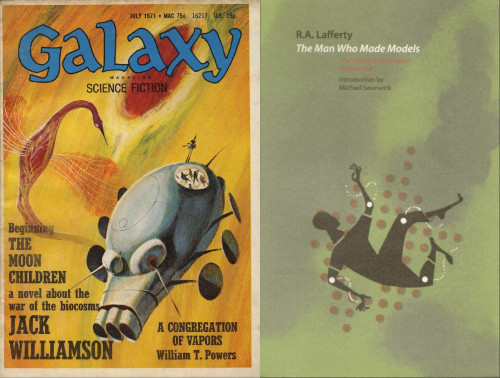
"All but the Words" first saw print in Galaxy and has reappeared in Lafferty collections like the 2014 The Man Who Made Models, the first volume of Centipede Press's Collected Short Fiction of R. A. Lafferty series.

"Dream" (1962)

This story began its publishing life in Galaxy as "Dreamworld," but with one little snip transitioned into "Dream," the title it has appeared under in Lafferty collections since.   

Here we have an entertaining but minor twist-ending story; you might call it a good filler story.  We meet an odd man who eats a monumentally huge breakfast at a diner each morning; the fact that he eats these huge breakfasts is dwelt upon comically, but I'm not sure that it actually affects the plot.  

The plot involves the fact that everyone in the world begins having the same horrifying, disgusting, dream every single night.  In the dream, everyone, including the dreamer, is a creature who enjoys symbiotic relationships with rodents that live in his digestive systems and insects that live on his hairy hide and lives in a world where it never stops raining green sewage.  The guy who eats huge breakfasts is one of the first to recognize he is having this dream, though his realization is preceded and triggered by that of a woman sitting at a nearby table, who describes the dream to a friend.  

Over a few weeks, more and more people report having the dream, leading to worldwide psychological crises.  After unsuccessfully trying to escape the nightmare by sleeping less, people can't help but sleep more, so that they are spending half their lives in the horror world of green rain.  Then a voice in the dream begins telling people that our blue sky world is a dream and it is the green rain world that is reality!  A charismatic individual takes to the airwaves to tell the people of the world that we must choose which world we want to live in.  The next day the dreams stop--but which world did people choose?

A success, but not as noteworthy as many other Lafferty stories.  One of the characters calls the green rain world Hell, and perhaps the subtext of the story is the Catholic belief that we choose whether we end up in Heaven or Hell, and that people are all too willing to choose Hell even though the possibility of Heaven is right there before them.  Can the voice in the Hell dream be the Devil?  The charismatic man on the TV Christ?  And the huge breakfasts a reminder of the sin of gluttony, a foreshadowing that the people of the world are going to make the wrong choice?

"The Transcendent Tigers" (1964)

"The Transcendent Tigers" is a straightforward and easy to understand little story, and I can't come up with anything particularly interesting to say about it.  (I was hoping I could whip out a reference to "Gerontion," in which Eliot writes "In the juvescence of the year/Came Christ the tiger" but, alas, there is no call for such a reference.)

Among a little girl's birthday gifts is a little red hat--nobody knows who gave it to her.  Suddenly she demonstrates high intelligence and other impressive abilities.  At about the same time, horrendous disasters begin striking American cities--it is as if needles two miles thick are plunging down from the sky and punching holes in the cities, causing death and destruction on a monumental scale.  In the middle of the story we meet some space aliens.  These super-powerful entities have a policy of awarding tremendous power to a single native of planets inhabited by lesser beings--after assessing the psychology of the natives and finding a suitable recipient, of course.  A new man is on the job and his first assignment was Earth, and he bungled the assignment after having trouble finding anybody on Earth among the elite worthy of the power--he gave the power, invested in the red hat, to the most self-confident person he could find.  In the final scene we find that the cataclysms visited upon American cities are the result of the girl in the red cap punching holes in a map of the United States with a needle.  As the story ends she is about to strike New York City and her friends are going to get a map of the world.

(Now I know the inspiration for the image of a planet with needles and pins stuck through it on the cover of my DAW edition of Strange Doings.)

The comedic superior-subordinate relationship between the two aliens, and the idea of an alien contacting a human and incompetently vesting him or her with some kind of responsibility on him that the human in turn handles with total incompetence, reminded me a little of Barry N. Malzberg's work, I guess Day of the Burning and Overlay are the ones coming to mind.


"World Abounding" (1971)

"World Abounding," which appeared in the year of my birth, is the only fiction promoted on the cover of the issue of F&SF in which it debuted.  (This issue of F&SF also includes Malzberg's "Causation.")  "World Abounding" does not appear to have been reprinted as often as most of the Lafferty stories we have been talking about, though the issue of the French edition of F&SF in which "World Abounding" appears has a drawing of a topless insect woman on the cover, so there's that.

"World Abounding," perhaps, illustrates the ancient wisdom that there is no need to fear death because, if you embrace the possibilities offered by life and the world, you can accomplish enough, you can do all the things that are truly worth doing. But Lafferty does give us readers reason to entertain additional or even contrary interpretations--"World Abounding" may be one of the many SF stories that tell you that utopias in which the easy life is handed to you are not paradises but hells.   

(In grad school I think I read, and I at least read about, John Bunyan's Grace Abounding, and it is possible the title of Lafferty's story is a reference to that, though I don't recall enough about the book to be able to speculate on influences or connections.  Yet again I am confronted by the fact that my poor parents wasted a lot of money on all that tuition.) 

World Abounding is the name given a human-habitable planet that numerous Earth expeditions have explored--mysteriously, all the expedition members who have returned from WA refuse to share details of their findings, to describe fully what happened to them there, though it couldn't have been so bad, as everybody who has visited WA has come back whole and healthy.

The current expedition, whose adventure this story relates, is made up of seven members, three married couples and the unmarried captain.  WA is a planet characterized by extreme fertility, extreme fecundity--plants grow before your very eyes!--and an infectious sense of joy--the food is delicious, the animals are playful, etc.  The planet's unique "vibe" has a major effect on the behavior of the expedition members; for example, WA's "rutting season" comes almost immediately upon the expedition's arrival and moves the three married couples to marathon bouts of enthusiastic sexual activity.  Meanwhile, the captain discovers under successive layers of relatively recently fallen volcanic ash some curious human bodies, even though the planet has no native human inhabitants.  These well-preserved corpses are seated comfortably at tables, as if these people were killed all together at once during a happy feast and did not struggle to escape the volcanic eruption of which they could not have been ignorant.  On close examination, the current expedition members find that these people bear resemblance to members of the previous expeditions, as if these dead people were those earlier explorers' siblings or children.  

Just a few days after those extended sessions of sexual gymnastics, the women of the expedition give birth--like everything on this planet, labor is painless and free of  complication.  The kids can speak as soon as they leave the womb, and can walk hours later!  Days later they are sexually mature and the married couples are presented with grandchildren!  One of the first WA generation and the captain fall in love and produce a child, and in a few weeks everybody on the planet looks about the same age, so fast do the descendants of the expedition members grow and age.

One of the themes of "World Abounding" is the idea that a third entity, after the two parents, is involved in the creation of a human child--the planet the child is conceived and born on.  Children born on Earth are marked and shaped by the Earth, and those born on World Abounding are radically different creatures than their Earthborn parents or grandparents.  Maybe we should see this as an allegory of the nature vs nurture debate, a dramatization of how environment plays a role in creating a person as well as genetics.  I am also reminded of the idea that man and wife are not the only parties to the institution of marriage, that society and God also play a role in the relationship, have influence on it and a stake in its success.   

Life passes very quickly for the people born on WA, but they cherish and enjoy to the fullest every moment, every event.  They make music, they eat delicious meals, they create beautiful sculptures.  The WA people share a sort of collective consciousness, so while one of these new short-lived people is relaxing in the arms of a lover she can also experience the mountain climbing of another of her generation--these WA people are even tapped into the experiences of local fauna, the birds in flight and the fish in the water.  Having, collectively at least, experienced all that can be experienced that is worth experiencing, those born on WA accept death at the end of a mere month's time with equanimity, even welcome it.  They sit at a banquet as the ash of the periodic volcanic eruption covers and kills them; the Earthborn watch from safety, though the captain has to be dragged away, wanting to die with his beloved, the daughter of two of his colleagues.

The captain presents a mystery to me.  While every other person who appears on screen in the story is made happy by World Abounding, embracing with enthusiasm all it has to offer and then accepting the deaths of the native-born at the end of the magical month, the captain is always suspicious, always skeptical, even scared, and he is unable to calmly accept the final fate of the WA-born.  (Note: it is suggested that some of the members of earlier expeditions also found World Abounding horrifying.)  Are we to see the captain as making some kind of self-destructive error, or could it be that the captain is the smart one, that we readers should also be suspicious of or even horrified by what goes on on World Abounding?  Is the happiness of people on World Abounding somehow illegitimate, a false happiness because it is too easy, something handed to people rather than something earned through hard work, the product of something akin to drug use (there is a lot of talk about a hormone present on the planet) and because the happiness of WA is a selfish dead end, seeing as the grandchildren of the Earthborn expedition members produce no children of their own?    

"The Transcendent Tigers" reminded me of Malzberg, and "World Abounding" is reminding me of Theodore Sturgeon and his utopian planets like those in "The Skills of Xandau" and "If All Men are Brothers Would You Let One Marry Your Sister?"  While I often feel like Sturgeon in his utopian stories is haranguing us, attacking our society and offering designs for a better society that are so impossible to put into practice that ol' Ted's stories are no more than sterile wish-fulfillment fantasies, Lafferty's story here offers advice an individual might actually be able to follow to make his or her life better, and he doesn't insult you or express contempt for ordinary people.  At the same time, the ambiguous role of the captain and the sort of bittersweet aspects of "World Abounding" make it more believable on an emotional level than Sturgeon's stark, black and white, "this one weird trick will make everybody immortal and happy" tales.

"World Abounding" is the most challenging of the stories we are reading today, but it also offers a lot to think about, so I have a better attitude about it than I did "Continued on Next Rock," the most difficult story covered in our last blog post.

**********
 
We are almost finished with Strange Doings--next time, three stories and then on to other adventures.  As a final note, I'll point out a little recurring theme I noticed in today's stories, a skepticism about the value of communication and the written word in particular.  I've already talked about how "All but the Words" seems to suggest communication can be overrated, and in both "The Transcendent Tigers" and "World Abounding" we have humans who receive special powers from alien entities or circumstances, and in both stories the people so affected have little interest in reading, as if it is a waste of time, an inefficient way of acquiring information.  Perhaps a counterintuitive tack for a writer to take, but in line with a pervasive theme of Lafferty's work, experts and academics who are always screwing up and having their assumptions and assessments shown to be wrong.

Thursday, March 13, 2025

R A Lafferty: "Camels and Dromedaries, Clem," "Continued on Next Rock," "Sodom and Gomorrah, Texas," and "The Man with the Speckled Eyes"

Some of the authors that today I would say are the "greatest" speculative fiction writers, or just my favorites, like Gene Wolfe, Jack Vance, and Barry N. Malzberg, I found underwhelming or even off-putting when I first read them; I wasn't on their wavelength, the text was just too opaque, too difficult, or the subject matter just wasn't to my taste.  If memory serves, my first Wolfe was There Are Doors and my first Malzberg was Galaxies, which I read as an adult, while my first Vance was Lyonesse, which I think I read as a teen; each of these novels was too odd or too hard for me to really enjoy.  But I was intrigued and later came back to these authors and on a second attempt quickly found works by them that really clicked with me, like Wolfe's Shadow of the Torturer and Vance's "Sial 25" and the first Cugel book, and went on to read large portions of their oeuvres.  Wolfe and Vance I mostly read before I started this blog, while I think the majority of my Malzberg reading has been during the period of this quixotic enterprise we call MPorcius Fiction Log.

Similarly, I wasn't necessarily crazy about the first few stories by R. A. Lafferty that I read, but I did get hooked, a process chronicled on social media, almost entirely on this blog.  I read "The World as Will and Wallpaper" before the inauguration of my reign of error here, but wrote about the story in the comments at Joachim Boaz's blog in 2011, judging it one of the better pieces in the anthology Future City.  In 2013 I read and blogged about "Narrow Valley," "For All the Poor Folks at Picketwire," "Nine Hundred Grandmothers," and "The Groaning Hinges of the World," and then started chopping away at the novels: The Devil is Dead, The Reefs of Earth, and Past Master.  For ten years Lafferty was a regular presence at this here blog.  In early 2023, I praised "And Name My Name" and "McGonigal's Worm" and then there followed a two-year Lafferty drought here at MPFL, broken just this week when we read "How They Gave it Back."   Let's make sure my reading that story was no flash in the pan and begin a series of Lafferty posts today.

I own a copy of the 1973 DAW paperback edition of the 1972 Lafferty collection Strange Doings, and my aim is to exhaust the possibilities presented by this volume.  I believe have already read five of the collection's sixteen stories, "Aloys," "Rainbird," "Once on Aranea," "The Ugly Sea," and "Incased in Ancient Rind."  We'll read the remaining eleven over three posts, tackling four stories today, "Camels and Dromedaries, Clem," "Continued on Next Rock," "Sodom and Gomorrah, Texas," and "The Man with the Speckled Eyes."

"Camels and Dromedaries, Clem" (1967)

This is a fun little story that bears such hallmarks of Lafferty's work as humor based on violence and gore and direct references to the Bible.  The story also perhaps raises issues of identity.  

A successful salesman, Clem, loses a tremendous amount of weight--like 100 pounds!--in the brief period of just a few days.  Then he discovers that he has a double, a man who looks just like him, who shares many, though not all, of his memories and personality traits.  Clem is out on the road when struck by this astonishing revelation, and decides to empty his bank accounts and take the money to New York City and lose himself among the masses, leaving his attractive and assertive wife Veronica behind with the other Clem.  (He quickly returns to his normal weight.)

Years go by, and New Yorker Clem through various means follows the life and career of the Clem back home and the lovely and capable Veronica.  Clem in the Big Apple meets other men who have suffered the bizarre fate of having been split into two, and is even exposed to theories that there is evidence in the New Testament of such phenomena having occurred in ancient times.  

Clem's wife tracks him down--the Clem she is with is like half a man, not the man she married.  Veronica puts her foot down--she wants the two Clems to reunite!  Is this possible?  Maybe if the Clems starve themselves, each lose 100 pounds, they will be rejoined into the full and complete Clem she loves?  Or maybe Veronica should try to split into two?  If she chows down and gains 100 pounds, maybe she'll split into two wives, rendering herself suitable for two husbands?  I'm afraid I must report that a grisly and tragic ending awaits the desperate Clems and the bold Veronica.  

I like it.  "Camels and Dromedaries, Clem" first fell under the eyes of readers in F&SF, and has reappeared in several places, both Lafferty collections and anthologies, including a volume of the long-running German series of "Best of F&SF" anthologies and a book of SF stories about weight edited by Isaac Asimov, George R. R. Martin and Martin H. Greenberg; a version of this latter anthology was published in Portuguese under the title Coma e emagreça com ficção científica.  A Brazilian horror blogger reviewed this anthology and gave it ten skulls (caveiras) out of ten!  If you can read Portuguese, you should check out that dude's blog--it looks pretty cool! 

"Continued on Next Rock" (1970)

This one is kind of long and repetitive, and all the important plot points seem to be merely implied or indicated obliquely, making it a challenging read; I read "Continued on Next Rock" twice, trying to get a handle on it.  I personally may have found it a little difficult to get a grip on "Continued on Next Rock" but it looks like it's a favorite of editors; after its debut in Orbit 7, Donald Wollheim and Terry Carr included it in their World's Best Science Fiction volume for 1971, it was reprinted in the 1971 Nebula award anthology, and you can also find it in The Best of R. A. Lafferty.  Damon Knight selected "Continued on Next Rock" for his Best Stories from Orbit Volumes 1-10; I have read a bunch of Lafferty Orbit stories, among them "Dorg," "When All the Lands Pour Out Again," "Interurban Queen," "One at a Time," and "The Hole on the Corner" and I think I enjoyed all of them more than I did "Continued on Next Rock."  (To be fair, Knight included two Lafferty stories in Best Stories from Orbit Volumes 1-10 and "The Hole on the Corner" was the other.)  My preference is perhaps in part because, as I alluded earlier, my simple mind insists on remaining concerned with subject matter--if I see two paintings with equally good color and composition and technique, and one depicts a beautiful woman or handsome man, and the other depicts a landscape or abstract geometric shapes, I am going to gravitate towards the human being every time.  The subject matter of "Continued on Next Rock" just doesn't grab me the way that of the other five Orbit stories mentioned above did. 

Alright, the plot, as far as I can understand it.  Four fully credentialed academics and a female undergrad set up camp at an archaeological site; they plan to dig a vertical geological feature (a "chimney") and the ancient man-made mound beside it.  Lafferty has named the undergrad Magdalen Mobley, maybe because Mary Magdalene was the first to find Christ's tomb to be empty?  Magdalen is irascible, bossy, dismissive of others, and endowed with psychic powers and with super strength--one of the earliest episodes in the story has her spotting a deer on the other side of a hill and ordering one of the men to shoot it; she then carries the 190 pound carcass back to camp by herself to save the men the trouble of constructing a makeshift sledge upon which to drag it.  Magdalen is not physically attractive, but all the men of the party desire her, and over the course of the story Magdalen rejects their advances with physical violence.  

As if by magic, another man joins the group, an Indian who also has special powers, Anteros Manypenny.  ("Anteros," Lafferty does not tell us until the last page of the story, is the name of a minor Greek deity, the brother of Eros--the wikipedia article on Anteros suggests he has a reputation for "avenging" victims of unrequited love.)  Magdalen seems to know this guy; a philosophical discourse by one of the professors on the similarity of geologic strata and the human mind triggers her complaint that while the Earth is always changing, it is always the same people showing up, an early indication that Magdalen and Anteros are immortals who are always bumping into each other.  Anteros can see artifacts in the rock before they are revealed, and dramatically demonstrates an ability to describe them precisely and predict exactly how many strokes of his digging tool it will take to unearth them.  Magdalen, who is always criticizing Anteros and downplaying his accomplishments, implies that Anteros put these artifacts there in the first place.

The expedition discovers many unexpected artifacts, pottery and projectile points for example, that are anachronistically buried in chronologically inappropriate strata.  By the end of the story the archaeologists are unearthing artifacts from the future.  Among these mindboggling finds are rocks inscribed with love poems in rare and even never-before-seen languages that the language expert of the group nevertheless manages to decipher (though some of the others accuse him of just making the poetry up himself.)  

The poems are among the numerous clues that suggest that for thousands of years Anteros has been courting Magdalen, trying to win her love by bragging about his riches (recall his surname, "Manypenny") and promising them to her and by writing these love poems.  One of the verses ("Once again you will be broken at the foot of the cliff....") seems to refer to the story of Meles and Timagoras, which you can read about at the wikipedia page on Anteros; it and other clues suggest Magdalen has been, and perhaps still is, suicidal, and that she has been rejecting Anteros all these centuries because she is incapable of giving love.

In the end of the story Anteros has, apparently, been turned to stone and Magdalen has jumped off the chimney to her death.  The four archaeologists' memories of these two otherworldly individuals and their astonishing feats quickly begin to fade.

This isn't a bad story, but I am not crazy about it, as I have already confided.  There is quite a bit of Native American lore, a topic I am not particularly keen on.  Every interesting incident happens three times (there are three stone-inscribed poems, Magdalen uses her special vision to spot prey animals three times, Magdalen violently rejects men's advances three times) so the story feels long and repetitive.  And you have to really make an effort to figure it out, and when I'd thought I'd figured it out it didn't seem like a big deal.  Most importantly, it is not as funny or as provocative as so many other Lafferty stories.

"Sodom and Gomorrah, Texas" (1962)

In contrast to "Continued on Next Rock," "Sodom and Gomorrah, Texas" is a brief and snappy little bit of entertainment, full of death and destruction played for laughs.

It is census time.  Impoverished Texan Manuel is hired by the local government to count the people in the desolate region where he lives, apparently the site of a meteor strike some centuries ago.  Perhaps because he is paid for each name (the local government wants to claim it holds sway over 10,000 inhabitants when there are really only like 7,000), Manuel decides that, after counting the ten "normal people" who live in this meteor-blasted wasteland (his employers nixed his idea of counting the badgers, foxes and wolves), he will count all "the little people."  These little people, apparently space aliens who bought the Earth under false pretenses from alien con men and hate us natives, resent Manuel's intrusion on their subterranean town.  They punish him, but Manuel doesn't learn his lesson--eager for his "two bits" per name, he steals the little people's own census files.  When the little people discover that the files have been sent to Washington D.C., they decide to punish the town the same way they punished a nearby human settlement a few hundred years ago--that was no meteor after all.

Sort of minor, but fun.  The tragic saga of Manuel and his mule Mula debuted in the same issue of Galaxy as Fritz Leiber's "The Creature from Cleveland Depths," which I can moderately recommend.  Our freunde over in Germania included "Sodom and Gomorrah, Texas" in an anthology, and you can also find it in the seventh volume of Centipede Press's The Collected Short Fiction of R. A. Lafferty, 2023's Mad Men.   


"The Man with the Speckled Eyes" (1964)

Here we have another brief and easy to understand bit of fun.  Six businessmen act as the gatekeepers of technological progress; all inventors come to one of these six wealthy men with their ideas, in search of financial support and the ability to manufacture and market their inventions.  In quick succession, four of these magnates vanish.  It becomes apparent that, right before their disappearances, each of those four guys all had meetings with a particular inventor.  We observe as the inventor in question meets his fifth of the tycoons.  The inventor is hawking an anti-grav device.  The magnates have been pitched many such devices, and they have never panned out, and this individual's presentation isn't very persuasive--he even admits his invention doesn't work reliably, but erratically.  Angered at his fifth rejection, he uses his prototype on businessman #5.  Some hours later, the tycoon falls up into the sky, scrambling to grab a tree in a desperate attempt to save himself (as depicted by Jack Gaughan on the cover of my copy of Strange Doings.  The reptiles and the pincushions must be from some other stories, the scaly beasts maybe from "Encased in Ancient Rind.")

"The Man with the Speckled Eyes" debuted in F&SF and it was reprinted in that German series of Best of F&SF stories; the Yugoslavian magazine Sirius also offered readers a translation of the story.

Is that Christopher Lee over there?

**********

"Continued on Next Rock" is sort of difficult, but the other three stories we read today are pleasant little straightforward diversions, though with a sort of horror-story edge.  All certainly worthwhile, though "Continued on Next Rock" offers the least bang for your buck (at least if you are simple caveman like myself.)

We'll have more Lafferty stories in our next episode.  Thanks for clicking all the links in this blogpost--I had to put them in myself because the USAID money I was paying the interns stopped coming in for some reason.