Friday, November 8, 2024

K Koja and B N Malzberg: "The High Ground," "Literary Lives" and "The Witches of Delight"

Here at MPorcius Fiction Log we are scouring the interwebs in search of collaborations between Barry N. Malzberg and Kathe Koja, and today we have three specimens of such collabs published in the good old days of the 1990s, one each from the years 1993 (Muslim radicals bomb the World Trade Center!), 1994 (Rwandan genocide!), and 1995 (cultists poison people on the Tokyo subway!)  These stories have, as far as I can tell, only been printed once, so maybe we have reason to fear these are below average productions from these widely-admired (by critics and genre lit professionals, at least) writers, but we won't know for sure until we've read them.  

"The High Ground" (1993)

This story appears in Temporary Walls, the souvenir book of the 1993 World Fantasy Convention, ; a book bearing the subtitle "An Anthology of Moral Fantasy inspired by John Gardner's On Moral Fiction."  Am I going to read On Moral Fiction (200 pages) in order to better understand this 13-page story?  No, but wikipedia offers a three-sentence summary that draws on Daniel Burt's The Chronology of American Literature that may allow us to cheat our way to a dim comprehension of Gardner's argument.

In this work, Gardner attacks what he sees as contemporary literature's lack of morality, which he calls the highest purpose of art and which he defines in the book. According to Gardner, morality is not an arbitrary social construct, but an eternal truth, taking on different forms but not essentially changing through the ages. He says that moral fiction "attempts to test human values, not for the purpose of preaching or peddling a particular ideology, but in a truly honest and open-minded effort to find out which best promotes human fulfillment."
Editors Robert Garcia and Greg Ketter suggest Gardner would have "loathed" "The High Ground;" well, let's see what we think.

"The High Ground" is a Socratic dialogue about morality, with allusions to Dante and the Holocaust and maybe other stuff that went over my head, a fairy tale didactic but frustratingly inconclusive.  There are horror images, but little by way of plot or character.  It seems possible that the point of the story is that life is meaningless and morality is mere opinion, but it is not impossible that the point of the story is that people who feel that morality is a mere opinion are the immoral ones and they will be consigned to hell.  

A bunch of fantasy-type characters are hanging out in the "woods of inconsequence;" among them are a wizard, a dwarf, a giant with an oozing sore, a deformed rodent, and an "enchanted virgin" with a stump where she has lost a hand.  The wizard tells the story of how he was given responsibility over a city of some thousands of people, and then was confronted by an evil sorcerer of invincible power--the evil magician demanded a hundred young people as his slaves, and should his demand not be met, promised to exterminate everyone in the city; the wizard had to make this horrible choice, and it scarred him and led him to believe morality is not real.  The dwarf offers the story of Paolo and Francesca; he had some kind of role in the story.  A young woman tells the story of how she was employed in a castle or manor house or something and she and the master fell in love but refrained from consummating their relationship because they didn't want to commit adultery, and were thus miserable.  The giant and an elf don't have their own stories but sometimes offer little comments that contribute to the debate.

The story restarts with the wizard again telling his story; presumably these characters are retelling their tales of woe and having their debates on the nature of morality again and again throughout eternity.

I'm going to have to give a thumbs down to "The High Ground," it feeling long, being kind of boring, and offering debates that just run in circles that stem from contrived and improbable stories.  Is this story attacking Gardner's insistence that morality is "an eternal truth" by offering theoretical situations in which people have no opportunity to behave morally?  It is not surprising that this ultimately sterile story has not been reprinted.  I read "The High Ground" it in a scan of Temporary Walls at the internet archive by following a link at isfdb; at time of writing there is something fishy with the file's name and it can be hard to find on your own, but if you click the isfdb link you will go right to it.

"Literary Lives" (1994)

"Literary Lives" has only appeared in Mike Resnick's Alternate Outlaws, a paperback with a cover illo chillingly depicting Elvis Presley as a bolshevist terrorist.  Recent events suggest that people don't really take seriously the political advice of celebrities like Cardy Bee and Meghan the Stallion or even Luke Skywalker and Han Solo, but if The King of Rock and Roll himself was on on the side of Moscow or Peking maybe today I'd be wielding a hoe on a collective farm or sitting in an office listening in on conversations via bugs and wire taps--scary.  

Resnick in his intro to "Literary Lives" tells us it is about Dorothy Parker and Ernest Hemingway, two people I know very little about, so I may not get a lot out of this story.  (I know "You might as well live" from Bryan Ferry and of course people talk about Hemingway all the time, so I have a vague sense of the conventional wisdom about him.)  Let's give it a try, anyway.

"Literary Lives" lives up to its title and is a pretty literary story with lots of stream of consciousness jazz and plots that are told largely through flashbacks.  I say "plots" because the story comes in two parts, each depicting a distinct alternate universe in which Dorothy Parker and Ernest Hemmingway share a disastrous sexual relationship and one murders the other.  (Spoiler alert!)  There is plenty of block quoted poetry, but whether it is Parker's real poetry or something Koja and Malzberg cooked up, I don't know.  I think we can call "Literary Lives" a feminist story--the two Dorothys' relationships with her father, husbands, and other men are prominently featured, the thoughts and careers of prostitutes are explored, and the text contains lines like "in this America nothing, but nothing, was as invisible as a sixty-year-old woman."  

Part 1 is set in the 1980s (Trump Tower is mentioned) and in this alternate universe an aging, overweight Dorothy Parker (wikipedia says she was born in 1893, but in this universe it seems she is 60) is a novelist and today is appearing on a New York-based TV talk show promoting her sixth novel set in Edwardian England.  (She abandoned poetry long ago.)  During the commercial breaks, she thinks back on her life, on her marriage to a failed womanizing poet (I guess alternate universe Ernest Hemmingway) who sired her two (now estranged) children and cheated on her so outrageously that Dorothy considered suicide and then contrived to murder hubby and one of his girlfriends.  After hubby's death, Dorothy began her career as a novelist.  The story ends with the novelist walking through New York, observing a multi-ethnic squad of street hookers.  

The Dorothy Parker of the second part of "Literary Lives" is herself a prostitute in the late Forties.  Her career as a writer in New York and Hollywood made her feel like a whore so she became an actual whore.  (As I type that it sounds pretty funny but as I was reading the story it felt perfectly natural.)  We saw this artist-as-whore theme in our last episode when reading Koja and Malzberg's "The Careful Geometry of Love."  This iteration of Parker is also an alcoholic, and we get a scene of her vomiting.  One thing this part of the story mentions again and again that was not brought up at all in the first part is the fact that Parker is Jewish.    

One of Parker's johns turns out to be Ernest Hemingway.  Papa bangs Dotty and then accuses her of making him impotent for three years back in the Twenties by laughing at the size of his penis--he says her laugh, her jokes about his member (she called it "she," a clever bit of emasculation that is probably illegal in Canada today and may well be here tomorrow) have haunted his dreams all through the Depression and the War.  He whips out a knife and stabs her repeatedly, his dialogue making explicit the way the knife is a phallic symbol and surrogate.

"Literary Lives" is well-written and the themes are sort of interesting, but it feels very long, and it bangs away at the same themes and ideas again and again.  And of course I expect there are all kinds of nuances that Parker and Hemmingway fans will appreciate that totally escaped my detection.  We'll call it acceptable.

"The Witches of Delight" (1995)

Here's the third of our unreprinted stories--we are digging deep today, friends!  The sole appearance of "The Witches of Delight" was in Mike Resnick and Martin H. Greenberg's anthology Witch Fantastic.

"The Witches of Delight" is another longish story that comes to us in two distinct parts.  In the first part we meet Joe Thompson, a writer who lives in the suburbs with his wife and two kids and commutes to the big city to work, attend art gallery openings and the like, and of course to cheat on his wife.  Thompson has been having dreams in which he has sex on an alien planet with a sort of witch queen, a beautiful woman clad in black who has long white legs, long white fingers, and small pointy breasts.  Also, Thompson's Dad is dying or recently died in the hospital.  The tale of Thompson, his father, and this Queen is kind of confusing, with us readers not quite sure which of the narrative's fragments are real and which are dreams or delusions.  There are images of the Queen coming to Thompson's Dad in the hospital and having sex with him while Joe watches, and of Dad's broken body littered throughout Thompson's suburban home.  Thompson meets the Queen in real life, at an art gallery where there is a new exhibition of photographs of a female model, and she takes him to her apartment to have sex with him.  She suggests she is an immortal sorceress who has ruled other planets and knows the future as well as the past, at some points declaring "I am history" and likening herself to figures like Medea, Sylvia Plath, Anne Boylen and Catherine the Great, at others saying "I am your future," but later claiming those assertions were lies and what she really is is "duty" and "honor."  It is all pretty inconclusive and contradictory.  I got the impression that Koja and Malzberg might be making some feminist point about how men use and fear women and haphazardly, for their own purposes, assign to women attributes and responsibilities, and how history is an endless repetitive tragedy because of men's ambitions and neuroses but men try to blame their actions and the resultant unhappiness on women.

The second half of the story concerns a love triangle.  We've got Horst, an immigrant, I suppose a Jew from the former communist East (the text refers to "the hard edges of the shtetl, the barley soup, the hard consonants of the grey regime slid[ing] from him") who came to America and began an affair with Anne, an art photographer.  They had tons of sex, but then Anne began photographing a new model, Margo, an extraordinarily good subject who becomes a muse for Anne, and a lover; Anne became cold to Horst in bed and otherwise.  (Anne is the photographer, and Margo the subject, of the exhibition where Thompson meets the witch Queen.)  Horst is so needful of Anne that he wants to surrender his masculinity so he can fit into the "sorority" that Anne and Margo comprise; he shaves his genitals and even offers to castrate himself.

The story ends mysteriously, with Anne presenting Horst some kind of revelation and asking him if he understands, but we readers can't know if he does understand and we certainly aren't given the means to understand ourselves.  The endings of the Thompson narrative and the Horst narrative exhibit many parallels, sharing words and phrases (for example, Koja and Malzberg use the word "history" a lot in both.)  What happens to the two men at the hands of their sex partners? 
Thompson lies there: beneath the witch of the worlds, queen of covenant, bitch of last and final consequence, in passage and at torment: subsumed by history, overtaken by time and content at last not to rise.
[Anne] leading him [Horst] to the space he must now occupy, the square of light which would from now on be his home. 
It isn't particularly clear--have they been murdered?  Trapped in some kind of limbo forever?  Victims of evil women?  Or criminals against the fair sex suffering a just punishment?

"The Witches of Delight" is well-written and entertaining with plenty of erotic and horrific images, and the personalities and motivations of the men in the story are clear and easy to understand, though the philosophical or ideological content of the story is a little hard to pin down.  I can give this one a thumbs up.

**********

"The High Ground" is a waste of time, but "Literary Lives" works and "The Witches of Delight" is a real success.  Maybe we'll continue our search for Koja/Malzberg collaborations in the near future here at MPorcius Fiction Log.

Thursday, November 7, 2024

Little Deaths: Barry N. Malzberg and Kathe Koja

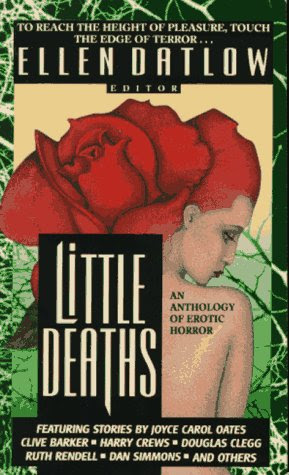
Valued commentor and popular blogger Marzaat recently reminded us, in the comments to a blog post of mine about some late '70s and early '80s stories by one of my faves, Barry N. Malzberg, of Kathe Koja and her collaborations with Malzberg.  I've enjoyed most of the Koja work I have read, so let's today check out some more Malzberg and Koja material.  At the risk of turning MPorcius Fiction Log into some kind of porn blog (after all, in September we read three erotic stories by Nancy Kilpatrick and in October we looked at the SF content in an issue of men's magazine Swank), let's read the stories produced by Malzberg and Koja for Ellen Datlow's Little Deaths, a 1994 anthology of "24 Tales of Horror and Sex."  This thing actually won a 1995 World Fantasy Award for Best Anthology, beating out Stephen Jones' Shadows Over Innsmouth, a book of Lovecraftian stories we've looked at here at MPorcius Fiction Log, and Poppy Z. Brite's anthology of erotic stories Love in Vein, another book we've sampled.  (Is MPorcius Fiction Log already a porn blog?)  Let's hope Malzberg and Koja's contributions were key in the decision to present that award to Datlow. 

"The Careful Geometry of Love" by Kathe Koja and Barry N. Malzberg  

Little Deaths first appeared in Great Britain, and when an American edition came out a year later it had a better cover but fewer stories; "The Careful Geometry of Love" was the only Koja or Malzberg contribution to survive the trip across the pond.  Damn--the SF world is ruthless!  Luckily you can get a British printing Little Deaths at ebay or do what I am doing, read a scan of a British edition at internet archive, world's greatest website.  (If you read Polish, you are in luck, as the only other place "The Careful Geometry of Love" has appeared is in the Polish magazine Fenix, in 1996.

"The Careful Geometry of Love" is well-written on a sentence by sentence basis and has good horror images and some provocative themes, but the plot is maybe a little slight and perhaps the characters could have been better presented when it comes to personality and motivation.

K & M's story is about an artsy photographer, David, and one of his clients, an attractive woman, Elaine.  Cleverly, the first few paragraphs of the story allow the reader to believe David is some kind of BDSM male prostitute or something, what with phrases like "you wouldn't believe, he had told her once, some of the things I have to do," and maybe Koja and Malzberg are suggesting that artistic people like themselves who make a living at their art feel like or actually are like whores.  Later in the story there is a hint that Koja and Malzberg want us to think that being a business person, a professional, means compromising principles, turning a blind eye to injustice:
I will ask no questions, he said, I'm a professional.  I run a studio, I'm a businessman.  He heard the sound of her laughter, strident and focused in a way he could not fathom....Oh yes, she said, all of you are professionals.  You are so serious....You ask no questions even when questions should be asked.
(Yes, this is one of the Malzberg stories with no quotation marks, or, I guess as the editors of Orion Books, HQ: London, would say, "inverted commas.")

Perhaps pushing this point, Elaine sells real estate, a profession commonly felt to be particularly ruthless and unsavory, like, say, selling cars, and we certainly witness Elaine using her charisma to manipulate people in the story, to get them to do things they do not initially want to do.  Elaine and David agree they don't really care about money, but enjoy the creative problem-solving nature of their jobs (though the authors give us reason to believe that David at least is lying about this, perhaps even lying to himself.)

Elaine pays David scads of dough not to photograph herself, but people she brings in, apparently her lovers, both men and women among them.  Usually these individuals are photographed naked, and Elaine stipulates that the photos be both beautiful and true-to-life--no retouching, no airbrushing.  At first she brings in only particularly attractive mean and women, but then she begins bringing in men who are strange, ugly, even deformed.

David falls in love with Elaine, so when she stops coming in he gets upset and calls her.  She again brings business to him--was her failure to contact him, in effect wait for him to call her, begging to see her again, a manipulative strategy--"playing hard to get?"--or her way of confirming that he was truly under her spell and willing to do things of a questionable nature?  The members of the new crop of subjects are all quite deformed, some of them being pretty improbable freaks; e. g., a clawed ape-man with four testicles and a woman with three breasts between her legs and a vaginal opening in her chest.  In the final scenes of the story Elaine for the first time disrobes and has herself photographed with her freakish lovers, and then the photographer joins the group, the story's final lines suggesting he became a photographer to play the role of observer and thus resist his urge to participate in life, but that Elaine has now persuaded him to become a participant, what he wanted all along.  Are we to suspect David is a freak himself, that he has joined Elaine's collection? 

Shortly before the climactic scene, Koja and Malzberg offer info about David's personality and life history, and I can't help but suspect the story would have better if we had learned this stuff earlier.  Anyway, David has kept a record of all his sexual encounters and has had sex with over 200 women.  I'm not quite sure what that adds to the story; David is not portrayed as a sex fiend or womanizer in the beginning or middle of the story, as far as I can remember.  Better integrated into the rest of the story is the revelation that "he had no inner life, none whatsoever; he lived only on the screen of his reflectivity"--perhaps we are meant to think David's psychology makes him as freakish as do the physical disorders of the other members of Elaine's collection.

I still think this story is good, but I feel like it is not as tight and satisfying as it could be, that all its components could mesh together more smoothly.

In her intro to "The Careful Geometry of Love," Datlow says Koja and Malzberg have collaborated on a novel.  I'm not seeing any evidence of this novel at isfdb--is there such a novel out there?  If any readers have any clues to this mystery please enlighten me!  

"Sinfonia Expansiva" by Barry N. Malzberg 

"Sinfonia Expansiva" was reprinted in the new Barry Malzberg collection Collecting Myself, put out by the good people at Stark House, who deserve your support for their endeavors in reprinting classic genre fiction.  They are actually having a sale this month--25% off, it says!--so go to their site and look over their long list of science fiction and detective novels and short story collections.

This story is a response to AIDS, or at least exploits the famous disease in an effort to make Barry's story of sexual frustration and incompatibility more "relevant" and more scary.  In Malzberg's typical somewhat oblique fashion we observe the thoughts of Samuel as he goes to bed with women but ends up failing to have sex with them in a way that is humiliating.  Sometimes Samuel expresses his unusual sexual desires to a woman and she rejects him; sometimes a woman reveals her unusual desires to him and he rejects her.  Malzberg doesn't let on what the peculiar tastes in question might be--his story is not an exploitative one, the appeal of which is descriptions of nasty fetishes, but more a rumination about how difficult sexual relationships are, how our desires can't be fulfilled unless we open up ourselves to others, reveal our secrets and make ourselves vulnerable, and how such opening up can expose one to soul-destroying rejections.  

Sam feels like a loser, he having bungled so many sexual encounters and, it seems, never won another person's sympathy or affection.  He comes to believe that he can never reveal his secrets to others.  He resorts (apparently--I don't think this is a dream or fantasy, but who knows with Malzberg?) to raping a woman.  The twist ending is that one of Samuel's secrets is that he is HIV-positive.  Has he just passed his disease on to an innocent stranger?

This story is OK, no big deal.  The AIDS angle is sort of a let down, to be honest--the theme of the psychological risk of opening yourself up is timeless and universal, and the introduction of AIDS weakens the power of that theme by putting the story squarely in a particular time period and focusing on the particular problems of a particular community.  And the mention of AIDS is the only element in the story that is that specific--Malzberg doesn't do anything beyond the mention of HIV to paint a compelling picture of a particular era or community, AIDS feels like it is just stuck in there, perhaps even gratuitously.   

"The Disquieting Muse" by Kathe Koja

Somebody in Poland was really into Koja, I guess, because "The Disquieting Muse" also appeared in an issue of Fenix with a quite good robotic spider cover.  The story would go on to be included in the 1998 Koja collection Extremities.

For most of its length "The Disquieting Muse" is like a piece of mainstream fiction, lacking both SF elements and the kind of unconventional narrative techniques and punctuation we see in typical Malzberg-involved stories ("The Disquieting Muse" has quotation marks.)  Jeremy works at a mental institution as an art therapist--he loves art, and majored in art as a student, but couldn't get a handle on the academic side and so was directed to this line of work.  He has sessions with small groups of mental cases, three at a time, and Koja talks about how horribly these patients smell and their other bizarre idiosyncrasies--one woman, Ruth, refuses to wear street clothes, for instance, and is naked under her medical gown.  Jeremy has turned out to be a good art therapist--the people whom he works with have "breakthroughs," and the shrinks appreciate, are grateful for, his accomplishments; Jeremy himself is more surprised at his own success than anybody.

Jeremy also has a girlfriend, Margaret, with whom he has an unfulfilling sexual relationship, he not being very good in bed; besides this shortcoming, there are hints that Jeremy is not very secure in his masculinity, has neuroses of his own, and is an incompetent artist--Jeremy is a loser.

Of today's three pieces "The Disquieting Muse" is the most sexually explicit and goes the furthest in the direction of being actually erotic with its descriptions of conventional sexual desire (e.g., Jeremy gets an erection after brushing against one of Ruth's big breasts) and more or less normal sexual activity (Margaret's cold white fingers on Jeremy's body) as well as weird fetishistic desires (does Jeremy enjoy the smells of unwashed maniacs?) and behavior (see below!)  

Ruth turns out to be a skilled draughtsman and painter, and she always creates violent erotic images--a dissected stallion's penis, a man performing cunnilingus on a headless woman's torso, a little girl masturbating with a broken baseball bat--and Jeremy becomes attracted to her--he even fetishistically sleeps with her disturbing but arousing drawings.  He thinks of Ruth while in bed with Margaret; he starts masturbating while looking at Ruth's art work; Ruth behaves in a way that breaks all social norms and seems calculated to seduce him.  Who is in power in this twisted and strange relationship--is Jeremy abusing Ruth, a person who is seriously ill, or is Ruth manipulating him with her sexuality--or magic powers?  In the final scene Jeremy either suffers a delusion or has revealed to him the astonishing supernatural reality of his life: Ruth is some kind of demon or witch who has used her magic to charm Jeremy and his life, to give him the luck that has made his career a success despite his lack of effort and ability.  By ejaculating on a picture Ruth drew of herself, Jeremy unwittingly summons the filthy undressed and unwashed woman to his home where she grabs his genitals and squeezes--does she kill him or merely enslave him?  In any case, his relationship with Margaret is over, the last sentence of the story pointing out that he no longer returns her calls.

This is the most substantial and easiest to digest of today's stories, and the most effective as an erotic piece and as a horror piece.  Thumbs up for "The Disquieting Muse."       

**********

These stories are all worth reading; maybe we'll hunt up some more Koja-Malzberg collabs and talk about them in future episodes of MPorcius Fiction Log.  In this space here I'll provide links to earlier Kathe Koja coverage here at MPorcius Fiction Log.


Friday, November 1, 2024

Alpha 4: T Disch, E Pangborn, and T Carr

In Omaha in 2015 I purchased, along with a stack of other paperbacks, Alpha 4, a 1973 anthology of "superb" stories that are "important to the genre."  The potential problem with reprinting old stories widely considered "excellent" and "important" is that serious SF fans will have already read them in other venues, so the back cover of Alpha 4 tries to appeal to new fans of SF, people who may be familiar with the Big Three of Arthur C. Clarke, Isaac Asimov and Robert A. Heinlein and with mainstream breakout success Ray Bradbury, but not yet with people like Thomas M. Disch, Damon Knight, Philip Jose Farmer and Brian W. Aldiss.  There were nine Alpha volumes in total, so maybe the pitch worked.

At this here blog we have already addressed a few of the stories that make an appearance in Alpha 4"Dio," AKA "The Dying Man," by Damon Knight, "Judas Danced" by Brian Aldiss, and "All Pieces of a River Shore" by R. A. Lafferty.  Today we'll assail three more of these allegedly excellent and important works, one each by Thomas Disch, Edgar Pangborn, and Terry Carr.

"Casablanca" by Thomas M. Disch (1967)

This is one of those stories I own in multiple books, it appearing in the 1971 hardcover Disch collection Fun with Your New Head--I own a 1972 paperback printing of that-- and the 1980 paperback Disch collection Fundamental Disch, a copy of which sits right there on the shelves of the MPorcius Library.  It kind of looks like "Casablanca" first saw print in the anthology Alfred Hitchcock Presents: Stories that Scared Even Me, which seems a little odd, all the other stories in that book being reprints.  In 1968 "Casablanca" would appear in Michael Moorcock's New Worlds, the famously influential and famously unprofitable flagship of the New Wave--the magazine's survival was only possible through subsidies from the British taxpayer and Moorcock himself, who sank into it cash he raised through the rapid composition and sale of paperback fantasy novels.

Thomas Disch is a smart guy and a good writer but also a bitter and snobbish sort of character and "Casablanca" is a derisive and even vindicative attack on the American people, in particular the Midwesterners among whom Disch was born.  The title is presumably an ironic reference to the famous film, which, like The Godfather, is one of those cultural icons I have never actually watched but which I feel like I know because people never stop talking about it.  Anyway, in the Bogart-Bergman movie, Americans in North Africa during a world war act admirably and achieve some kind of nobility, while in Disch's story Americans in North Africa during a world war act crassly and get totally humiliated.

An older married couple are on vacation in Morocco and Disch pokes fun at them for being unable to speak French, for trying to save money, for enjoying sugary treats, for being patriotic about the US of A and for being hostile to communism, exactly the kind of criticisms of provincial Yanks we'd expect from a New Yorker who spent a lot of time in England hobnobbing with other sophisticated smarty smarts.  While they are there in North Africa, the United States is destroyed by a nuclear attack and the couple is repeatedly humiliated by the locals because their travelers' checks and American money are no longer worth much of anything.  Eventually the wife disappears and the husband is robbed of his only means of getting out of Morocco; his incompetent efforts to find his wife prove fruitless and he is beaten up by a mob and robbed again following a tussle with a young thief.

(I don't know if people are still talking about "punching down," but "Casablanca" could be the subject of an entire discourse on the concept.  Is smart and educated Disch punching down at the ignorant tourists, or is he a homosexual punching up at breeders?  Are the Arab mobs punching down at a lone woman and a lone old man, or punching up at the white imperialist bourgeoisie?) 

Obviously you are going to enjoy this story if you hate America and relish the spectacle of seeing Americans humiliated by third worlders.  Silverberg in his little intro to "Casablanca" here in Alpha 4 bills the story as "comic and terrifying both at once, like most true nightmares," I guess trying to sell it not as a leftist wish fulfillment fantasy but as a horror story.  In some horror stories, horrible things happen to sympathetic people and you feel bad for them; in others, horrible things happen to people who have misbehaved and you feel justice has been served.  Disch in his story here seems to be conducting a sort of literary exercise in which directs the reader to feel the United States deserves to be annihilated and its expatriates laid low for their sins but leaves enough room for readers who don't share his snobbish anti-American opinions to be tricked into sympathizing with the tourists.  I can't say I am on the same page as Disch is here, but the story is thought-provoking and cleverly put together so I guess I have to admit it is good.

(A double-plus-super-anti-subversive subversive hot take on "Casablanca" might be that Disch is laying a trap for his fellow alienated sophisticates, seeing if he can get them to side with mass-murdering communists and Arab thieves against innocuous and ineffectual ordinary Americans.)

"Angel's Egg" by Edgar Pangborn (1951)

Here we have an at times tedious story that feels long and reminds me of the work of Theodore Sturgeon: the themes of love and of collective consciousness; the alien utopia that serves as a foil for our crummy human society; the argument that the cognitive elite should mold society for its own good regardless of the will of the plebians.    

"Angel's Egg" is almost 40 pages long here in Alpha 4 and comes to us as a series of documents in a file in the near future of a one-world government.  The wife of Cleveland McCarran, the "martyred first president" of that world government, donated these documents to some institution in 1994, and one component of the file is a letter sent to McCarran in 1951 when he was working at the FBI by a state police captain regarding an investigation of a Dr. David Bannerman, a biologist and school teacher.  ("Angel's Egg" is one of those stories that romanticizes teachers.)  The lion's share of the file consists of annotated excerpts from Bannerman's journal; these were attached to the 1951 letter and describe in sleep-inducing detail Bannerman's relationship with an alien who looks like a six-inch-tall woman covered in down and is equipped with dragonfly wings; Bannerman calls this doll-sized creature an "angel."

The angels hail from a planet ten light years away and their society is wise because it is 70 million years old.  In this oh-so-wise civilization the most honored of all professions is teacher (of course!) and these long-lived aliens spend many years being educated.  When the aliens sent an expedition to Earth it was only natural that one of their number hook up with a kindly Terran schoolteacher--Bannerman--whose goodness was confirmed by reading his brain--like so many aliens in SF stories of all types, from space opera to this kind of sappy utopianism, the angels are telepathic.  

Besides descriptions of how the little angel makes a little bed in a shoe box and having her around makes him the happiest man in the world, Bannerman fills his journal with summaries of his telepathic conversations with the alien, much of them about how her people's utopian society operates.  They no longer experience fear.  They no longer experience hate.  They have beautiful and intelligent cats who have outgrown the desire to torture their prey.  They have the capability to travel to every planet in the galaxy but are humble and have thus far kept themselves aloof and a secret from other life forms.  

The angel aliens have finally decided to help other intelligent species, and we humans are to be the beneficiaries of their wisdom--it is implied they will secretly program the minds of influential people so they will behave along the lines the angels think best.  (There is a scene in which Bannerman plays chess and the angel programs his mind to play a better game and Bannerman thinks he is coming up with these genius moves himself.)  But to provide us Earthers this help they must know as much about us as possible.  They can erase your brain and absorb the info themselves, but this process, which takes some considerable time, ends in death of the mind donor.  Bannerman, reflecting that the human race of 1951 appears to be on the brink of destroying the world, agrees to donate his mind to the angels for the good of his people.  Bannerman starts reliving his life, remembering every moment in detail, and then forgetting it; the process takes like a month, and then he dies.  

The file contains, and our story concludes with, a brief statement from the self-sacrificing Bannerman's  chess partner, a doctor, that provides clues that make it clear that Bannerman's journal tells the absolute truth, and that Bannerman's dead body shows no signs of distress, only contentment--it is the most well-ordered dead body the doc has ever seen.  ("Angel's Egg" is a story bubbling over with superlatives--doc also says Bannerman was the most stable human being he ever met.)  It is not quite as clear, but I guess we are supposed to think that McCarann's presidency and the world government are signs the angels are manipulating us to have a better society.  "Angel's Egg" is one of those SF stories like Arthur C Clarke's Childhood's End, Kate Wilhelm's The Killer Thing and the overrated film The Day the Earth Stood Still that expects us to welcome alien imperialism.  

(I often talk about how genre fiction is wish fulfillment fantasy, and maybe we should also consider this story as the wish fulfillment fantasy of a childless man who likes the idea of having a smart beautiful daughter.  Did Pangborn have children?  A skim of Wikipedia and The Encyclopedia of Science Fiction hasn't yielded any info on his family life.)

I found the first half or two-thirds of "Angel's Egg" pretty boring and annoying but by the final third or so, after the sappy preliminaries are done with and the chess partner is introduced into the story, I guess I fell into its groove and it got a little more interesting.  I guess we'll call it acceptable.

"Angel's Egg" debuted in Galaxy and appears to be Pangborn's first published SF tale.  Many of the prominent SF editors--Damon Knight, Groff Conklin, Martin H. Greenberg, Jack Dann, Gardner Dozois, and Edmund Crispin--have seen fit to serve up this slab of sentimentality to their readers.


"In His Image" by Terry Carr (1971)

Here is another of those stories in which robots who admire humans inherit the Earth and we readers are offered reason to believe humans are not in fact admirable.  There are a lot of these stories out there; I associate this theme with Clifford Simak, but we recently read just such a story by beloved bad boy Harlan Ellison.  Fortunately, Terry Carr here in "In His Image" takes a nuanced view on the matter of whether human beings are worthy of admiration.

It is like three centuries in the future.  In the period between the Nixon Administration and the time in which this story is set the human race developed human-like robots, built abstract sculptures the size of mountains, polluted the air severely, and then retreated into domed cities to escape the pollution that corroded the mountain sculptures and made the air almost unbreathable.  This story relates the search conducted by our narrator, a human-like robot, of the tallest building in a domed city for the last surviving human being!  Our narrator makes clear he admires humans because they are always striving to climb higher, both literally and metaphorically.  When he finds the last human being the man turns out to be a drunk who hates robots--when he isn't vomiting he is calling the robots mere machines no better than staplers or typewriters.  The faith of our narrator is not shaken--in fact, after the medical robots take off the last living human our narrator decides to emulate the human race, to embody our ambition, by figuring out how to climb one of the mountain sculptures.  His computer brain doesn't have enough data to mathematically calculate the probability of success in scaling the sculpture without falling, and this is one way in which he is able to emulate his creators, going on a dangerous adventure without any certainty of how it will turn out!

Of today's three stories this is the most conventional and comfortable, the easiest to read and the one with the least irritating (to me) message or theme.  I like it.

"In His Image" was the cover story of an issue of Amazing published in the year of my birth; the story is titled "In Man's Image" on the magazine's interior pages.  "In His Image" hasn't been reprinted nearly as often as "Casablanca" and "Angel's Egg," but, speak of the devil, it did appear in the third volume in the Harlan Ellison Discovery Series, the Carr collection The Light at the End of the Universe.  As I was copyediting this blog post I learned that the internet archive, world's greatest website, was back in action, and I was able to read Carr's intro to "In His Image" in The Light at the End of the Universe; Carr relates how Amazing editor Ted White acquired the Mike Hinge painting and asked Carr to write a story based around it and the result is this story

**********     

If you were inclined to think SF fans were misanthropic and pessimistic self-important snobs who hold normies in contempt and expect them to destroy themselves and maybe the world unless some elite group were to seize the reins from them, these stories would not disabuse you of this notion.  I'm not on board with a lot of what these stories have to say, but none of them are actually bad, though at times Pangborn's "Angel's Egg" comes close.  I am, however, skeptical that "In His Image," while a good story worthy of inclusion in an anthology, is "important."

Stay tuned for more short stories here at MPorcius Fiction Log.  

Sunday, October 27, 2024

1967 stories by C Kapp, R Zelazny, A Offutt and B Aldiss

Over the last five blog posts we've been reading from paperback anthologies I own.  Well, now we are six.  On the anthologies shelf of the MPorcius Library we find a copy of World's Best Science Fiction: Fourth Series, a 1970 reprint of World's Best Science Fiction: 1968 edited by Donald A. Wollheim and Terry Carr.  Back in 2020 I read four stories from the book, Samuel R. Delany's "Driftglass," Thomas Disch's "The Number You Have Reached," and R. A. Lafferty's "The Man Who Never Was" and "Thus We Frustrate Charlemagne," and earlier this year we read the included story by Larry Niven, "Handicap."  Let's read four more of the book's 16 stories today, those by Colin Kapp, Roger Zelazny, Andrew Offutt and Brian Aldiss.  

"Ambassador to Verdammt" by Colin Kapp   

In 2016 we blogged about Kapp's "The Cloudbuilders" and his novel Patterns of Chaos, and just last year we read his story "Enigma."  I don't actually remember anything about those three works, but I didn't condemn them in my blog posts about them so Kapp is still in my good books and hopefully today's engagement with a Kapp story won't do anything to change that.

In "Ambassador to Verdammt" we have a traditional SF story that I can mildly recommend, a tale that tries to give you that ol' sense of wonder, details super futuristic technology, valorizes the engineer and the scientist (including the psychologist!), describes crazy aliens and offers a sense of hope--conquering the stars will be tough and entail serious risks, and people don't always get along, but mankind us equal to the task and it is a task well worth accomplishing.  (If you read my last blog post you know this is the sort of thing I have kind of been looking for, and I guess it is no surprise I found it in Analog before I found it in Galaxy.)

A space naval officer, an engineer, is dispatched with a bunch of subordinates and many tons of equipment to a planet he thought had no native intelligent life with the job of setting up all the extensive and expensive apparatus to allow a hyperspace ship to land on the planet.  He is skeptical of the diplomats and scientists on the planet, thinking these civilians may have distracted the space navy from its real work in corrupt pursuit of their own personal benefit.  The "landing grid" he is in charge of erecting is to catch the ship carrying the new formal Ambassador, who is the son of the current head of administration of the tiny research station on the planet--if there are no intelligent aliens on the planet, why do they need an Ambassador?  Is the staff here just securing a plum no-show government job for the administrator's flesh and blood?

The administrator and the station's top head shrinker try to explain to the engineer that among the local life are intelligent beings whose physical make up and way of thinking are so alien that their existence at first went unrecognized.  Even now humans are totally incapable of comprehending these natives, and just trying to communicate with them runs the risk of driving you insane.  The shrink suspects the natives are having the same experience as the human visitors, trying and failing to understand the humans.  

The engineer hears the strange noises made by the aliens, sees the evidence that they are able to perform apparently impossible physical feats, and when he tries to look at them he can't even get a handle on what he is seeing.  A brave and determined guy, he plunges into the jungle in an effort to figure the natives out himself and almost goes insane.  Luckily the shrink brings him back from the brink of madness so he is able to finish the landing grid.  When the Ambassador arrives the engineer learns this is no Hunter Biden situation--the administrator's son is a mere infant, and is being brought to the planet on the theory that a baby who grows up in proximity to the natives will be able to fathom their ways, its brain not set in its ways like that of an adult human who was raised among only humans.  The natives have similarly left at the research station what looks like a crystal that seems to shift as you watch it and grows at  measurable rate--presumably this is a baby native who, like the administrator's son, will serve as a liaison between human and native, having come to maturity with a foot in both cultures.

After its debut in Analog its appearance in the many editions of World's Best Science Fiction: 1968, "Ambassador to Verdammt" had to wait until 2013 to appear again in print in the Kapp collection The Cloudbuilders and Other Marvels.   

(NB: I read "Ambassador to Verdammt" in a scan of the applicable issue of Analog because I don't want to wreck my copy of World's Best Science Fiction: Fourth Series, which is in quite good condition.)

In Germany, Wollheim and Carr's 1968 anthology was split into multiple volumes;
"Ambassador to Verdammt" was included in Science Fiction Stories 33.

"The Man Who Loved the Faioli" by Roger Zelazny

Back in 2014 I acquired a withdrawn library copy of a 2001 edition of the Zelazny collection The Doors of His Face, The Lamps of His Mouth with a cool Lebbeus Woods cover and I actually started reading it and put up three blog posts about it, uno, dos, tres, but I didn't get to "The Man Who Loved the Faioli," which is in the second half of the book.  So I own this oft-reprinted story in multiple books, and will read it in that 2001 volume, which is already in questionable condition.  "The Man Who Loved the Faioli" debuted in an issue of Galaxy with a fun Gray Morrow cover that is quite similar in spirit to, and shares some individual components with, Morrow's cover for Neil R. Jones' The Sunless Worldanother 1967 production.

"The Man Who Loved the Faioli" (pronounced like "ravioli"?...I love ravioli...) is written in a semi-poetical fairy-tale or fable-with-a-moral style and is set in a future of technology so advanced it is almost indistinguishable from magic to us poor 20th-century goofenheimers.  Here's a sample of the text that puts on full display the repetition, nature similes, and obvious romantic naming conventions that are giving me that fairyland vibe:
"I said 'hello, and don't cry,'" he said, and her voice was like the breezes he had forgotten through all the trees he had forgotten, with their moisture and their odors and their colors all brought back to him thus, "From where do you come, man?  You were not here a moment ago."

"From the Canyon of the Dead," he said.

"Let me touch your face," and he did, and she did.

"It is strange that I did not feel you approach."

"This is a strange world," he replied.
Anyway, the plot consists of John Auden (a reference to W. H. Auden?) encountering the most beautiful woman he has ever met and having sex with her.  Over the course of the brief story we learn the nature of both John Auden and the beautiful woman.  The Faioli are alien creatures I guess a little like vampires, though Zelazny doesn't use that word.  They can fly through space on their wings of light, and they come to men in the form of impossibly beautiful women.  They cannot see dead bodies, only living people.  A Faioli will spend a month with a man, giving him the best possible sexual experiences, and also serving as a dutiful spouse, cooking and massaging and so forth, then on the 31st day of the affair will suck his life out, killing him.  John Auden is the first ever man to have the upper hand over a Faioli, as he is, more or less, already dead.  You see, in this high tech future, almost nobody suffers diseases, but John Auden unluckily caught some malady nobody knew how to cure.  He didn't want to be put into suspended animation to wait for a cure, so instead died but technology allowed him to maintain consciousness and mobility, I guess as a sort of cyborg.  He took the job of caretaker of the planet to which are brought all the bodies of people, human and alien, who die throughout the galaxy by robots who dump them in the "Valley of Bones."

When the Faioli arrives she can't see John Auden and starts crying because she came to this planet for nothing.  John Auden, who has heard about the Faioli, sees how hot she is and decides he wants to have sex with her, so he pushes a button under his armpit that brings him back to life.  (This story doesn't make a hell of a lot of sense; it's just one arbitrary romantic thing after another.)  So they have sex and play house for 31 days, and when the time comes for the Faioli to suck his life out he explains to her his odd condition.  John Auden is willing to die, now that he has spent a month enjoying the best possible sexual relationship, but the Faioli has the curiosity this story attributes to women and she pushes his armpit button and he dies again, becoming invisible to her.  Once dead, John Auden has lost his interest in dying, and so doesn't bring himself back to life.  The Faioli cries, then flies off.  Zelazny ends the story with a cryptic moral: "life (and perhaps love also) is stronger than that which it contains, but never that which contains it."

Gender studies people may find a lot in "The Man Who Loved the Faioli" for them to put their hammers and tongs to work on; seeing as it is a story about women who suck your life out in exchange for sexual favors, a story that employs phrases like "...having taken the form of woman, or perhaps being woman all along, the Faioli who was called Sythia was curious..." and a story which offers a portrayal of the platonic ideal of a perfect marriage.  As for me, maybe I am in a cynical mood today, but the numerous nonsensical elements of the story and its fairy-tale or folk-tale style put me off, had me rolling my eyes.  I'll call this one barely acceptable instead of bad because its lack of appeal to me is more a matter of it not being my kind of thing than of Zelazny failing to achieve his goals--maybe "The Man Who Loved the Faioli" is a stellar example of what it Zelazny intended it to be?


"Population Implosion" by Andrew Offutt 

This is an idea story, with little by way of plot or character, written in a smart-alecky jocular style.  Our narrator is a doctor and one of the first people to figure out the alarming development facing the human race in the second half of the 20th century.  This is also one of the many SF stories that addresses the issue of overpopulation.

Old people start dying mysteriously, just all of a sudden keeling over without evidence of injury or illness.  Our narrator and an actuary realize the scope and evolving nature of the problem and our narrator is put on the team trying to figure out why these geezers are dying.  It seems that people that reach a certain advanced age all die spontaneously, and that age is getting lower all the time, so that there are no more 75-year-olds in the world, then no more 74-year-olds, etc.  Eventually it is realized that the human race is limited to approximately 5 billion people at a time, and, when a baby is born who tips the world pop over the edge, the oldest person in the world dies instantly.  There are worldwide efforts to limit birth, but the duplicitous Chinese Communist Party secretly initiates a crash breeding program, forcing people to have sex like crazy with the idea that they can thus increase China's already high percentage of world population and dominate the Earth, but the Westerners catch on and the West and USSR ally and then nuke China into oblivion.  

This mass death event only delays the problem briefly, and soon the maximum age is creeping down again.  As the story ends there is no hope in sight and the narrator proposes the theory that the being who created the universe made five billion souls at its start and that is why there can never be more than five billion people alive at any one time.

We'll call "Population Implosion" acceptable.  The satirical elements, largely aimed at politicians and government and other bureaucratic institutions, aren't actually funny but also are not offensively lame.  The story is a smooth read, thanks to the style and to the mystery--the reader is kept curious about what will happen next, what the explanation and solution will be--but those questions are not really resolved so "Population Implosion" isn't what I would call a particularly satisfying read.  We might think of the story as a wish-fulfilment fantasy that absolves readers from the need to worry about overpopulation and eases fear of death by telling you your soul is immortal.

"Population Implosion" debuted in an issue of If featuring an editorial by Frederik Pohl about the New Wave (he diplomatically praises people on either side of the supposed divide between Old and New Wavers) and illustrations by Vaughn Bode--comics fans may also be interested to see an ad for Wallace Wood's Witzend featuring a kid in a space suit.  (I read Offutt's story in a scan of the magazine.)  "Population Implosion" would go on to be included in a 1974 textbook meant to be inflicted on high school kids, As Tomorrow Becomes Today.  

As noted above, German readers were exposed to World's Best Science Fiction: 1968
in dribs and drabs, sections of the book appearing in translation across
multiple entries of the series  Science Fiction Stories; "The Man Who Loved the
Fialoni" and "Population Implosion" appeared in number 35

"Full Sun" by Brian Aldiss 

This story debuted in Damon Knight's Orbit  2 and would be reprinted in various books including Terry Carr's Creatures from Beyond and Bill Pronzini's Werewolf!  At time of writing I can't access any of these books at the internet archive so I am putting at risk the spine of my copy of World's Best Science Fiction: Fourth Series by reading "Full Sun" in there.  Please pray for that beautiful green wraparound Jack Gaughan cover, readers of faith!

Luckily, the risk incurred by reading this story in a physical book I bought with real money is commensurate to how good the story is--thumbs up for "Full Sun," a well-written story full of wild SF ideas and a plot that is one surprise after another.

It is millions of years in the future!  Mankind's relationship to machines and city life is such that almost no human ever leaves the cities, and so the space between the cities--each a paradise of pleasure for men and women--is uninhabited wilderness.  A tiny number of men do leave the cities, and our story concerns three such men.  We've got our main character, a man who, accompanied by a robot, is hunting a werewolf!  Werewolves are, the machines say, mankind's terrible enemies.  On the trail of one such monster, our hero meets another man, a sort of park ranger or forest conservator guy.  This guy lives outside the cities all the time, and has some harsh things ("social criticism") to say about the machines who have been running human life for millennia.  Our protagonist, who still admires the machines, isn't pleased to hear such politically incorrect talk.

Our hero finds reason to change his attitude, however.  He watches the TV news on his wrist phone; there's a new story about the machines' efforts to communicate with the machines who will rule the world of the far future, when the sun is a weak dwarf star.  Our hero realizes that no human beings seem to be alive in this dimly lit future.  Then he finds the timber officer has been killed, and a clue suggests he was killed by the robot and the robot tried to make it look like the werewolf slew him!  Are the werewolves the menace the machines have been claiming, or just rebels against the machine tyranny?  Our hero ends up in a desperate chase, the robot hunting him.  (One of the interesting changes in the story is how when it starts we are led to believe that the robot is a mere tool of the hunter, but later realize that the robot is the master capable of initiative and deception.)  As the story ends, the werewolf watches the cat and mouse game of robot and ordinary man--the werewolf is confident that his kind, the superhumans, will defeat the machines and inherit the Earth long after the machines have eliminated mundane humanity.

I like it.  


**********

A decent batch of stories, can't really complain.  Maybe we'll read more from World's Best Science Fiction: Fourth Series as we continue reading anthologies here at MPorcius Fiction Log.

Thursday, October 24, 2024

Third Galaxy Reader: T R Cogswell, F L Wallace, A Davidson, and L del Rey

There are people who will tell you that conquering outer space is a waste of time.  We at MPorcius Fiction Log beg to differ!  And today we are gambling that 1950s stories from H. L. Gold's Galaxy will agree with us and not the naysayers who want to tie us all down permanently to this big ol' rock that--admit it!--you are kind of getting sick of.

Years ago I purchased a bedraggled copy of Permabook M-4172, The Third Galaxy Reader, for 50 cents at the Second Story Books location in Washington D.C., the belly of the beast.  This book has crossed this great country of ours at least once, as a stamp indicating it was at one time on the shelves of Rodden's Bookshop in Long Beach, CA, indicates.  First printed in 1960, this paperback edition of the 1958 hardcover promises, right there in all-caps on its cover, stories about "the world of outer space" that are "soaring" and "exciting," not depressing or discouraging.  Let's investigate the contents of this book which is falling apart in my hands as I speak.

But first, I'll point out that I have already read many of the tales here in Third Galaxy Reader.  Who could forget Cordwainer Smith's "The Game of Rat and Dragon," which I read ten years ago?  Less memorable was "Volpla" by Wyman Guin which I also read in 2014.  Oh yeah, and then there's Evelyn E. Smith's "The Vilbar Party," "Time in the Round" by Fritz Leiber, "The Haunted Corpse" by Frederik Pohl, "Man in the Jar" by Damon Knight and "Honorable Opponent" by Clifford D. Simak, all of which I read in one fell swoop in 2019.  That's a lot of stories, but there are still some left for us to try on for size today: Theodore R. Cogswell's "Limiting Factor," F. L. Wallace's "End as a World," Avram Davidson's "Help! I Am Dr. Morris Goldpepper" and Lester del Rey's "Dead Ringer."  These titles don't exactly sound optimistic, but let's not give up before we've even started.  

"Limiting Factor" by Theodore R. Cogswell (1954) 

Here we have a story lacking in plot and character that relies for what little energy it has on weak jokes and a counterintuitive idea about a SF commonplace, homo superior.  Barely acceptable filler.

Jan and Ferdie (these feel like very Fifties names to me, but I guess that is because I think of Jan and Dean as a 1950s act, even though wikipedia is telling me their big hits were in the '60s) live in the near future.  They are among the secret minority that has psychic powers--they can communicate telepathically, fly, etc.  We see the theme of the story immediately when they talk about how taking an elevator or an air taxi is faster than using their mental powers to fly and using telepathy causes a head ache so calling somebody up on the phone is preferable.  The secret supermen and superwomen decide to leave the Earth to avoid the inevitable conflict between them and the mundanes, so Ferdie and Jan abandon their jobs and friends and families and are aboard the psychic-powered hyperspace ship when it takes off from its secret location on a mission to find a world for the super people to settle.  They discover a world inhabited by human beings who developed independently of Earth; these people are decadent and bored, their civilization is going nowhere.  At first the Terran superpeople think that these losers are mundanes abandoned by their own homo superior minority, and figure that homo superior members buoy and protect society; the belief that progress and prosperity on Earth is dependent on them, they decide to return home out of a feeling of responsibility to their fellow (if inferior) Earthers.  But then it comes to their attention that these do-nothing bores are the local homo superior, people who left their home world just like they just did!  There is a limit to human psychic powers, just like there is a limit to human muscle power--even the strongest man can't lift as much as a steam shovel, and similarly machines will soon be developed on Earth that can perform any feat a psychic superman can but far better.  The psykers of this dead-end civilization the Earthers have discovered thought, wrongly, their psychic powers would expand without limit, and brought with them no people able to build machines, and so they have stagnated.  The homo superiors of Earth return home and take their old jobs and reunite with family and friends, confident that their powers don't make them all that special and so there will be no race war.

Cogswell's basic idea is not bad, but the actual story lacks entertainment value--the story is mostly light-hearted dialogue and the characters are not there to inspire feeling in the audience, but just to air the idea.  "Limiting Factor" has resurfaced in mutant-oriented anthologies and Cogswell collections.


"End as a World" by F. L. Wallace (1955)

Here we have a gimmicky story the twist ending of which is based on what amounts to a pun.  "End as a World" has an optimistic hopeful message, which in theory might be uplifting or give you the warm fuzzies, but the lion's share of the story deceitfully tries to inspire in the reader the opposite emotions.  Thumbs down! 

Our narrator is a teenaged boy.  We see him interact with his mother and with various friends, including a black kid (a "Negro") whom we are told is better at sports than all the white kids.  Everybody in town is sort of anxious--everybody in the world is sort of anxious!  In front of the churches are signs saying "THIS IS THE DAY THE WORLD ENDS!"  At the predicted hour the townspeople gather to watch the sky--people all over the world are watching the sky!  The twist ending is that the human race is not going extinct, as the text has sort of duplicitously implied--the first ship that went to Mars is returning today and before landing the vessel will circumnavigate the globe and leave a condensation trail that everybody in the world can see.  If people are worried it is because something might go wrong with the ship.  The phrase "This is the day the world ends" is an oblique poetic way of saying "this is the day the human race takes its first steps out into the universe" or something.  The ship arrives safely on time and everybody rejoices and strangers kiss each other and so forth.

I hate this kind of trickery.

Martin H. Greenberg seems to have liked "End as a World"--he put it in at least two anthologies.


"Help! I Am Dr. Morris Goldpepper!" by Avram Davidson (1957)

Here we find a joke story about illegal immigration and welfare fraud.  Is Galaxy a humor magazine?

The setting of the story is a secret meeting of the leadership of the American Dental Association.  The assembled dentists have received a message from the most innovative dentist in the United States, inventor of superior dental prosthetics, Morris Goldpepper, who has been missing for some weeks.  Goldpepper, we learn, was a SF fan who made no secret of his ambition to be the dentist on the first space ship.  The message was found in a faulty dental plate by a dentist who worked on the mouth of an old--and odd--man, and is read to the assembled ADA big wigs and reproduced in the text of the story.

The message describes how Goldpepper was approached by an old man whose mouth and inner eyelids were blue.  This guy turned out to be an alien and invited Goldpepper to accompany him back to his homeworld via teleporter to help the aliens improve the state of their dental science, apparently lacking.  But it was all a trick!  These aliens naturally shed all their teeth as they reach adulthood and eat goops and slimes, and always look old to human eyes, even when in the prime of life.  They can more or less pass as (aged) Earthers if they put cosmetics on their blue skin and if they are provided false teeth.  Their scheme is to move to Earth, to California, the state which has the most generous welfare provisions, and live on the dole.  Goldpepper is enslaved, forced to make false teeth for these interstellar parasites!

As the story ends, the assembled ADA leadership discusses steps to deal with the aliens and rescue Goldpepper.

This story is competently executed, with Davidson giving Goldpepper a personality and writing style, and it is interesting to see a satire about illegal immigration and abuse of the welfare system, though I don't know enough about Davidson to know if he thinks generous social spending and unregulated immigration are a real problem or if he is just poking fun at people who consider them a problem.  Part of the satire of course is of SF itself, this story serving as a comic contrast to the huge number of SF stories in which aliens want to conquer the Earth; these aliens are merely small scale deadbeats.

We'll call it acceptable.  "Help! I Am Dr. Morris Goldpepper!" would be reprinted in Davidson collections and by Robert Silverberg in his anthology Infinite Jests: The Lighter Side of Science Fiction.


"Dead Ringer" by Lester del Rey (1956)

Here we have a decent horror story with a twist ending you can kind of see coming. 

Dane Phillips is a reporter and a veteran of the Pacific War who moves from newspaper to newspaper, repeatedly getting sacked.  During the war he saw a comrade get killed, only to meet him later and find him hale and hearty!  Since then, Dane has done some investigating and come to believe there live among us humans, undetected, space aliens who look human but are almost unkillable, capable of healing up after almost any injury.  When mangled in an explosion or a car wreck or something, some of these E.T.s have had to fake their own funerals--others have even had to escape from their coffins after being buried by ignorant native Terrans.  Dane keeps getting fired from newspapers because he keeps trying to get them to print the stories he writes with the aim of blowing the lid off this alien conspiracy and editors won't have it.  Dane has even been committed to a mental institution and escaped.

We observe some of Dane's sleuthing--digging up a grave!--during which he is captured by the men from the funny farm; he is dragged back to the loony bin where he overhears the shrinks' plans for him--since he has refused to abandon his beliefs in alien infiltration they are going to give him shock treatment in an effort to erase these obsessive thoughts!  This sounds like a fate worse than death, so Dane tries to commit suicide!  But when he slashes his throat the wound heals up lickety-split!  Dane himself is one of the aliens!

A fun little story.  Besides del Rey collections, "Dead Ringer" has been reprinted in some anthologies, including a 1966 German "Best of" Galaxy volume. 


**********    

Obviously, these were not the "soaring" stories about "the world of outer space" we were promised.  We'll put aside whether they are set in space or actually about life outside the Earth's atmosphere and consider if they are "soaring," which I am taking to mean uplifting, optimistic, hopeful, a vindication of life and humanity, etc.; I'm not going to allow any lawyerly bunkum about how these stories "soar the heights of terror and anxiety."

Wallace's "End as a World" comes the closest to soaring because at its climax we realize the people of Earth are united across national and ethnic boundaries in their hopes of conquering space and their joy at the first step of that heroic destiny being concluded successfully, but the story consists of a cheap trick and through most of it Wallace tries to make you sad.  Cogswell's "Limiting Factor" is optimistic about the future of the human race, suggesting high technology will open up wide vistas of freedom and damp down class and racial conflict, but it is too silly and jokey to be soaring.  Davidson's "Help! I Am Dr. Morris Goldpepper!" is not soaring but base and belittling, being full of jokes and having as its characters self-important goofballs who resent the relatively low esteem in which their profession is held and parasitic deadbeats who take advantage of others' credulity and generosity.  Del Rey's "Dead Ringer," while probably the most entertaining story, is not soaring but sordid--it is a blood-soaked horror story about infiltration, suicide, and a horrible revelation about one's own identity.

It seems Galaxy is not the place to look for validation of our belief that the human race should bend the universe to its will and colonize the galaxy.  Again we learn not to trust the text on the covers or jackets of SF books.

Look out for more stories from anthologies in the next exciting episode of MPorcius Fiction Log.