Sunday, November 18, 2018

He Owned the World by Charles Eric Maine

"What do you imagine will happen to me?"
She shook her head slowly.  "Even if I knew, I would not be permitted to say.  In time you will know everything, so do not be impatient.  Remember you are immortal, too." 
I have to admit that when I started reading Englishman Charles Eric Maine's 1960 novel He Owned the World I had what the kids call a WTF moment.  We just read the 1959 version of Edmond Hamilton's The Star of Life (the first version appeared in Startling Stories in 1947) in which a 20th-century astronaut on a mission to be the first to orbit the moon suffers a mishap so that he is lost in space for thousands of years and then wakes up from suspended animation and gets involved with the politics of the far future.  Well, Maine's book is also about a 20th-century astronaut who is on his way to becoming the first man to orbit the moon when his vessel suffers a malfunction and he is lost in space for thousands of years, only to wake up and find himself involved in future politics.  It is certainly an odd coincidence, but let's just shrug our shoulders, admit that there are lots of SF stories about people falling asleep and waking up in a strange future world, and move on with our lives.  (And by "lives" I mean our mission to read, digest, and assess all these old SF books and magazines!)

I purchased my torn and worn copy of the 1960 Avon paperback edition of He Owned the World in 2015 on a road trip through the Middle West.  It looks like I bought 10 novels, one anthology, and a magazine on this trip, and that I have now read about half of that material.*  Evidence that I am making progress in my life's work!  He Owned the World was printed in hardcover as well as paperback here in America in 1960, and saw multiple editions in Britain, Italy and Germany, so I guess we can call it a success.

Our hero in He Owned the World is British astronaut Robert Carson.  Like the guy in The Star of Life, when it is evident that he is lost in space, he commits suicide rather than wait for his supplies to run out.  Carson dies, but wakes up 8000 years later, revived by the medical science of the future.  Despite what I said about moving on with our lives, it is hard not to compare the similar plot elements of the first chapters of Maine's novel and Hamilton's.  Compared to Maine, Hamilton's The Star of Life is fast paced and gets to the point quickly; Maine includes lots of technical info about the damaged space ship and a metaphorical, surrealistic passage about the experience of waking up, alive, after centuries of being dead: "A purple glow trembled like aurora, then changed color, moving tranquilly through the rainbow of the spectrum....there were tentative sensations of feeling: tiny pinpricks of physical awareness like the impact of cosmic rays on exposed nerves...."

After a long convalescence, during most of which he is unconscious, a rehabilitated Carson learns where he is and what is going on.  Thousands of years ago there was an atomic war on Earth, and our home planet still hasn't quite recovered.  Before that cataclysmic war, Mars had been colonized by scientists, and, because the war didn't directly affect Mars, the red planet is now the leading polity in the solar system.  Among other technological advances, the Martians have achieved immortality--Carson himself is now immortal.  In turn, the Martians have abandoned sexual reproduction, but as a compensation, people's genitals (including the revived Carson's) are artificially enhanced to increase the pleasure of the sex act!

Carson is a very important man on Mars, and is assigned the best doctors and teachers to get him healthy and to acclimatize him to life in this future world.  He is even assigned as a house mate and bed partner the smartest and sexiest woman on Mars, Competence Cayne!  (These centuries-old Martians all have first names that reflect their professions or attributes; this woman's name I also suspect is some kind of Cain and Abel joke.)  It may sound like Carson has died and gone to heaven, but his relationship with Cayne causes some disturbance for our 20th-century astronaut.  The people of Mars in the 100th century are cold and intellectual, they feel no love and have contempt for emotions, and while Carson becomes emotionally attached to Cayne, she tells him "Love is an obsessive form of compulsion neurosis" and warns him, "There are surgical techniques in psychoneurology for curing conditions of emotional distortion."  Yikes!  When they part at the end of Cayne's three-week tour of duty as Carson intimate companion, our hero is a little depressed and lovesick.

There's still more bad news for those of us with 20th-century values and a little Earth patriotism when Carson begins to learn just what it is that makes him so important to these cold-blooded Martian brainiacs.  The red planet lacks many of the natural resources the Martians need, so they trade with Earth.  Two thousand years ago the war-ravaged Earth demanded prices the Martians didn't want to pay, so the Martians figured the logical way out of this impasse was to use their superior technology to build a space navy and conquer Earth!  Three interplanetary wars, decades of strife in space and on the Earth's surface, followed, and each conflict ended in stalemate, with the Earthlings unable to strike back at Mars, but Mars unable to overwhelm the tenacious Terran defense.  Earth and Mars have been in a Cold War for the dozen centuries since, only conducting that vital trade via intermediaries on Luna.

When Carson died back in the 20th century he was hailed as a hero and rich people set up a charitable institution to commemorate him and search for his lost rocket and his corpse.  Over the thousands of years of nuclear war, interplanetary war, and uneasy peace, the Carson Trust invested its funds wisely, so wisely that it became the most powerful institution on Earth.  The Trust not only came to own a majority of the property in the world, but all of Earth's governments became reliant upon its financing.  Now that Carson is back to life, because he is the beneficiary of the Trust, the Martian authorities believe that, legally, Carson "owns" the entire planet Earth.  I didn't find all this very convincing, but there it is.  While Maine strives to make so many of the little things in He Owned the World realistic, the outlandishness of this central plot element makes me suspect the novel is as much a satire of technocratic government, arrogant and unfeeling scientists, and general human shortcomings as it is a "thriller" (as it is called on the cover of the British 1961 hardcover edition.) 

The Martians are ready to launch their fourth war on Earth, and this time they will have an edge because Carson is going to be the figurehead leader of the invasion and of the rational and scientific colonial government they will set up once resistance is crushed.  The Martians figure many Earthlings will welcome the rule of their hero and the legal owner of the planet.  Carson is far from keen on playing this role, but it doesn't matter to the Martians whether Carson wants to participate in this scheme or not--beneath its utopian veneer of immortality and no-strings-attached sex, technocratic Mars is an authoritarian society.  Here is the theory of society of Mr. Mentor Jaff, head of the Martian Department of Co-ordination:
"This is the hundredth century, Mr. Carson, and not the twentieth.  The State is an entity in itself, and the government is the co-ordinating brain of the State, and individuals are merely the cells of a corporate body."     
Via a device implanted in Carson's ear (one many Martians, apparently, are issued), Jaff listens in on all of Carson's conversations and transmits to him "advice."  If Carson elects to ignore this "advice," Jaff, at the flick of a finger, can deliver to him a painful ultrasonic blast--this is the stick that complements the carrots the Mars government has been providing Carson, like his luxury apartment furnished with four nubile women. 

It is typical in SF for immortality to turn out to be a curse, rendering life boring or causing people to lose their humanity.  Here in He Owned the World the immortals treat mortals like children at best, and at worst as a natural resource to be manipulated and exploited or discarded as necessary.  The immortals claim that they are responsible stewards of the solar system, that the fact that they will live essentially forever means they have an incentive to make a better future; in contrast, they say, the mortals of Earth, who live less than a century, act irresponsibly and selfishly because they know they will not live long enough to suffer the long term consequences of their actions on the economy and the environment.  Thus it is just for them to run Earth without taking Earthmen's wishes into account and even kill millions of Earthlings if it facilitates Martian rule.

The second half of the 144-page book begins with Maine's description of the Martian conquest of the Moon and the attack on Earth--Carson spends these months on Mars, following the war's progress on TV.  When it appears (deceptively, as it turns out) the Martians have Earth under control, Carson and Jaff go down to the ruins of London for a propaganda ceremony, but the Earthlings launch a surprise attack and after an interlude among the mutants who live on the Earth's radioactive surface, Carson finds himself in the custody of the genetically normal Earthers who live in vast underground cities.  Carson's captors deactivate the transmitter in his ear so he is no longer subject to the control of Jaff, who managed to make it back to the Martian forces.

The Earth government spends a lot of time and energy trying to figure out if Carson is the real resurrected Robert Carson or some kind of Martian impostor, maybe an ordinary Martian man given all kinds of plastic surgery and hypnotism so he looks and even thinks how the real 20th-century Carson must have.  When they are satisfied he is the real deal they want him to act as a negotiator between the Earth and Mars, to end the war and get the invaders to leave.  The Earth people, who are not immortal, have values and attitudes closer to Carson's own (for example, while the pitiless Martian scientists want to exterminate the mutants because they are a genetic dead end, the subterranean Earthers provide the mutants what food and medical care they are able to spare) and he enthusiastically throws in his lot with them.  He negotiates a cease fire, but the amoral Martians use the cease fire as an opportunity to launch a sneak attack, massacring an entire subterranean Earth city's population and once again getting their mitts on Carson.

The final pages of the novel throw everything into doubt for Carson and for us readers.  Competence Cayne reappears, ostensibly to offer herself to Carson as a permanent companion, a bribe so he will do the bidding of the Martians.  But sotto voce she also claims to be part of an underground movement of Martians who want a less tyrannical government, and that Jaff himself is part of this movement.  When Jaff was saying all that stuff about the meaninglessness of the individual he was just playing a part, she claims, because he is monitored himself by those above him!  As the novel ends and Carson commits suicide a second time we cannot be certain about Carson's true identity or Jaff's or Cayne's true motives, and we have no idea what will happen to any of the hundredth century characters and societies; all we know is that Carson's resurrection (or creation) achieved nothing.       

He Owned the World is well-written and I enjoyed it (the surreal passage at the beginning is not representative of the text as a whole.)  While I am often unhappy with conspiracy stories and stories in which the main character is a puppet, Maine's novel also includes some of my favorite themes, like immortality, warfare, unhealthy sexual relationships, and skepticism of the State.  It is also interesting to see a SF book that is so hostile to scientists.  If you don't mind a book that argues that life is meaningless, that we can never attain reliable knowledge of anything, and that people with talent and experience use those assets to dominate and exploit their inferiors, I would certainly recommend He Owned the World to you.

**********

Imagination Science Fiction, April 1956: It includes a story by Edmond Hamilton which I liked and some politically incorrect cartoons

Genius Unlimited by John T. Phillifent: I declared it "pretty bad"

The 7th Annual Year's Best S-F edited by Judith Merril: I have read numerous stories from this, including a terrific story by Cordwainer Smith

Across Time by Donald Wollheim, writing as David Grinnell: I called it a "disappointment" and gave it a marginal negative review

Worlds of the Wall by C. C. MacApp: I said this was "acceptable" but today I remember nothing about it.  According to my blog post it features a giant otter and duck people.  Something for you fetishists?

The Diamond Contessa by Kenneth Bulmer: This thing is bizarre and self-indulgent, though I was feeling charitable when I blogged about it and didn't outright condemn it

Who Goes Here? by Bob Shaw: I somewhat grudgingly gave this joke story a positive review

Thursday, November 15, 2018

The Star of Life by Edmond Hamilton

He had risked death and he had died, almost, to win the freedom of the stars for men.  Not if he could help it was anyone going to abridge or limit that freedom.
There was a 50% off sale at Second Story
 Books, so I snagged this beauty for $1.50.
For my recent exercise in Malzbergian studies, the results of which appeared in my last blog post, I wanted copies of Harry Harrison's early 1970s anthologies Nova 1 and Nova 2.  I went to the vast and labyrinthine Second Story Books warehouse store in Rockville, MD to dig through boxes and shelves of SF paperbacks in the search for these two volumes, but came up empty.  This expedition was not a waste, however, as I laid eyes upon a dozen or so beautiful books I'd never seen before, and I even purchased one, the 1959 Crest paperback edition of Edmond Hamilton's The Star of Life.  This edition has a Richard Powers cover that features not only the characteristic Powers abstractions and weird buildings and spaceships, but human faces.  I very much admire Powers' depictions of the human form--check out his illustrations for Robert Heinlein's Number of the Beast and the cover of Fredric Brown's Star Shine  if you are only familiar with his more abstract work.

The Star of Life first appeared in 1947 in Startling Stories; isfdb has two distinct entries for the novel, one for the magazine version that went on to be included in Brian Aldiss's anthology Space Opera and one for the books that appeared in 1959--there was a hardcover as well as my paperback edition.  A quick look at the magazine version does suggest that the texts are substantially different.  My paperback is like 180 pages of text, and the version in Startling takes up like 55 or so pages, while, according to isfdb, only 15 pages of Space Opera is devoted to The Star of Life.  Maybe Aldiss only included an excerpt?  (isfdb clearly indicates that the contribution to Space Opera from Hamilton's wife, Leigh Brackett, is just an excerpt (from the MPorcius-approved The Sword of Rhiannon.))  Whatever the case, The Star of Life appears to have been liked by editors--the novel version was translated into French, German and Italian, and the version in Space Opera would appear in Croatian.

Let's see what one of Ohio's greatest SF writers and a particular fave of the MPorcius staff has in store for us this time.

Kirk Hammond took off from Earth in the middle of the Cold War in a three-stage rocket--he had been chosen to be the first man to see the dark side of the moon!  But the third stage of the rocket fired at the wrong time, and he found himself not about to swing around Luna and then back to Earth, but hurtling past the moon on a one-way trip to deep space!  As our story begins, Hammond makes a terrible decision: rather than wait long agonizing hours for his oxygen supply to run out, he commits suicide by cracking open the hatch and letting the cold of interplanetary space kill him!

But our man Kirk does not kick the bucket!  Instead he is flash frozen and preserved like those peas in your freezer your wife asked you to buy when you went to the store to stock up on Ovaltine!  Hammond wakes up when reentry into Earth's atmosphere heats up his little vessel and defrosts him!  How long has he been flying in a long comet-like orbit before one of his trips brought him within the loving embrace of Mother Terra's gravity?  A little over 10,000 years!

There is a long history of SF stories in which somebody sleeps for hundreds or thousands of years and then wakes up to confront a future world; this is apparently the plot of H. G. Wells's 1910 The Sleeper Awakes, which I have not read.  I have read a number of such stories over the course of this blog's career (immediatly coming to mind are Neil R. Jones's 1930s stories about Professor Jameson and the Zoromes, Hamilton's own "In the World's Dusk," Cordwainer Smith's 1957 "Mark Elf," and Clifford Simak's Cosmic Engineers) and I expect to read still more before I shuffle off this mortal coil.

Hammond lands on Earth, weak as a kitten, and is nursed back to health by a motley crew of weirdos living in an underground complex, hiding from dangerous enemies.  Hammond's new friends teach him their lingo and he learns all about life on Earth in the year 12094.  His rescuers call themselves the Hoomen, and are a multiethnic bunch whose members include people with blue or grey skins as well as people with classic skin colors like yours and mine.  Mankind conquered space and colonized planets that orbit other stars long ago--the blue and grey people are humans whose bodies, over many generations, evolved to suit their extraterrestrial environments.

But all is not well for humanity!  Around the year 10000 some humans exploring the Trifid Nebula discovered a means of attaining immortality and instead of sharing it with all the galaxy kept it to themselves!  For centuries now they have comprised a small elite of super-scientists known as the Vramen, and their long lives have enabled them to develop super weapons that have made them practically invincible.  These jokers control the entire galactic civilization, in particular maintaining a firm grip on all space travel to keep anybody else from going to that Trifid Nebula.  Most Hoomen have grudgingly accepted Vramen domination--though they keep immortality to themselves they have produced much technology that has made life better for everybody--but the group of people Hammond has fallen among are independent-minded types, a band of rebels!  Their leader is Jon Wilson, a man whose look of fanatic dedication to his cause reminds Hammond of pictures he has seen of John Brown!  (Wilson also has a pretty daughter named Iva who quickly develops a crush on our astronaut hero.)  Wilson's band of conspirators are secretly building an illegal star ship that won't have the mandated Vramen surveillance and control apparatus, and you already know where they want to fly that ship, don't you?  To the Trifid Nebula to snag that immortality for themselves and for all mankind!
"It's a suicide attempt, Hammond.  We all know it...But if we should succeed, we will have given all mankind indefinitely long life, freeing them forever from the tyranny of the Vramen and the vastly greater tyranny of time."
Despite the fact that Hammond's last space trip was a total disaster, he volunteers for this dangerous operation, seeing as, all his life, he has believed in human freedom and aspired to give the human race untrammeled access to the stars!  Another thing that sticks in his craw is the Vramen practice of using a ray projector device to control the minds of rebellious mortals--"He had an old-fashioned ingrained notion that a man's mind, and the freedom thereof, was an inviolable right."

Before the rebel star ship is completed there is a skirmish with the Vramen, and the rebels capture one of the arrogant elitists' top brainiacs--a gorgeous blue-eyed blonde named Thayn Marden!  The rebels are thrilled--this chick can guide them through the Trifid Nebula to the planet of immortality, Althar, warning them of any dangers on the way.  "You are children," Marden warns them, "You talk of things you do not know.  If you knew what really lies at Althar...."

The Star of Life includes large helpings of human drama and emotion.  Hamilton does a good job of describing Hammond's despair when he is in the doomed space capsule in the first chapter, the Hooman resentment of the Vramen, and the contempt the centuries-old Thayn Marden has for mortal humans, who are like ignorant children to her.  This is a space opera, but a space opera in which the author tries to get into the heads of people in futuristic and alien situations and portray their motives and feelings for us readers, and I think he succeeds in a way that is entertaining.  I have complained that SF novels I have read recently--Simak's Cosmic Engineers and Arthur Sellings's The Power of X--lacked human feeling, and Hamilton here shows us how much painting characters with believable relationships and emotions can help bring to life an alien milieu (how much respect would you accord a 30-year-old engineer if you had been studying physics and inventing machinery for 200 years? how would you feel if your child or spouse contracted a terminal illness and you knew there was a way to make your loved one immune from disease and a haughty smartypants was keeping it from you?) and make you care about a more or less traditional adventure plot.  The moment Thayn Marden stepped onstage I wanted to learn more about her and see what her relationship with Hammond would be like, and I was eager to find out what the hell was going on in that Trifid Nebula.

The presence of Marden spurs doubts in Hammond about the rebels, largely because the Hoomen conspirators are willing to use a high tech brain reading device to get information out of the Vramen genius, and the device threatens to damage her brain.  Marden, for her part, is eager to talk to Hammond, ostensibly to learn all about the 20th century.  Jealous, Iva Wilson warns Hammond about Marden: "The Vramen are loveless and childless, caring only for knowledge and power.  Don't be deceived by her beauty."  Despite this warning Marden exploits Hammond's attraction to her and tricks him into exposing the conspiracy so all the rebels end up arrested, on trial, and then sentenced to life on a penal planet orbiting Spica!  This mishap sours Hammond's relationship with the rebels, who consider him a traitor, but also gives him (and us readers) a chance to see mainstream Hooman society, its beautiful cities and its legal system and its star ships, and its uneasy relationship with the Vramen, who dominate the galactic society while disdaining to hold any official government positions.

Internment on the single planet of the Spica system marks the mid point of the novel.  Imprisonment there is not harsh--the prisoners all have nice houses and challenging productive work clearing away the native jungle with bulldozers.  Security is light because there's nowhere for the prisoners to go--the whole planet is their prison and they are hemmed in by the deadly jungle.  But it is rough for Hammond because all the other prisoners hate him--at one point they even leave him to die in the clutches of a native jungle monster!  He decides to get back in their good graces (and "make them eat crow") by leading an escape attempt; he has the guards contact Thayn Marden, who comes to Spica in response to Hammond's offer to help the Vramen in their historical researches (the 20th century lies within a gap in their historical knowledge resulting from the destruction of archives in an interplanetary war that broke out soon after man colonized Mars and Venus.)  Hammond catches Marden off-guard by professing love to her (there is a lesson here for all you ladies!) and knocks her out and deactivates the forcefield protecting the spaceport.  So Jon Wilson's crew, along with Hammond and Marden, blast off for the Trifid Nebula.

After a challenging trip through the Trifid Nebula the rebels land on Althar, where they find that the Vramen inhabit only a small fortified mountain base; the rest of the planet is in the hands of the Vramen-hating natives known as the Third Men.  Despite Marden's warnings about them, Wilson tries to make friends with these tall humanoids, and our cast ends up in their black cubic city of Vonn.  The Third Men, like the Vramen, are immortal--the source of immortality is radiation from Althar's sun.  Althar is odd in another way--it has no metal, which has kept the otherwise scientifically advanced Third Men from building space craft and nuclear reactors.  The ship Wilson's rebels have brought to Althar has been wrecked, but enough material from it has been salvaged to allow the Third Men to build all the nuclear reactors, super weapons and star ships anybody could ever need.  (Once they have a nuclear reactor they can just create metal.)

Wilson commits himself and his friends to full support of the Third Men, but when Hammond learns Wilson has handed over not only all that valuable material but also Thayen Marden to these mysterious characters, he finally admits to himself the thing all of us readers and all the other characters in the book have known since page 52--he is in love with Thayen Marden, the smartest, strongest, most beautiful woman he has ever met!  Hammond rescues Marden, and the two of them flee Vonn for the Vramen fortress.  Despite all the complaints we hear about women in magazines like Startling being ineffectual damsels in distress, it is Marden who does all the brain work involved in this escape and journey: she figures out how to outwit the Third Men's security robots, she pilots a jet aircraft, she thinks up the ruse by which they evade the pursuing Third Men aircraft, etc.  As the two lovers march through a moss forest to the fortress, their stolen aircraft a crumpled hulk sunk in a lake behind them, Marden reveals to Hammond the horrible truth about immortality and the origins of the Vramen, the Third Men, and the still more mysterious Fourth Men!   

As we have seen before, over his entire long career, Hamilton has been interested in radiation, mutation, and evolution.  The Third Men are the children of the Vramen, smarter and stronger still than their parents, thanks to changes to their parents' DNA wrought by the same radiation that made the Vramen immortal.  Unfortunately, the genetic changes to the Vramen also resulted in their children being amoral and ruthless, determined to conquer the universe.  And they won't be kind masters--they consider Hoomen to be nothing more than animals!   The Vramen have kept the Third Men bottled up on Althar--despite their superior abilities, the Third Men have been unable to take the Vramen fortress because they have lacked metal and atomics...the very things Wilson just gave them!  If something isn't done soon, the Third Men will take over the planet and build a space navy that will enslave the galaxy! 

The Third Men's children, the Fourth Men, are even more intelligent than their parents, and you will be relieved to hear that they have no worldly ambitions, and live in a hermit city where they live the life of the mind.  They are also sterile.  In the final pages of the novel Hammond has to go to their hermit city to ask them for help against their parents.  The Fourth Men use their astonishing mental powers to bring the Third Men to heel, but not before they have demolished the Vramen fortress with their super weapons, inflicting many casualties on their parents.  Among the casualties is beautiful genius Thayn Marden--the love of Hammond's life dies in his arms!

The Star of Life is a great space opera, for the reasons I have already enumerated and because Hamilton is a skilled professional writer: the pacing is good; there is a balance of violent or tense action scenes and more chatty scenes; the characters and settings are described enough to produce a memorable image and tone without overburdening the reader with excessive superfluous detail.

An Italian omnibus edition including
The Star of Life as well as two other novels
The novel also includes themes we see in SF all the time.  SF is full of minorities of superior people who are envied and resented by the normies--A. E. van Vogt's Slan are an early example, and the X-Men a more famous one.  Such people are better than the rest of us, so even though they contribute to our society they are subject to suspicion because they are different, envy for their superiority and fear of their power.  SF is also full of elitism, with many stories by the foremost practitioners in the field (Asimov, Heinlein, Sturgeon, etc.) about how the smarter people should manipulate the common man because the common man is too dumb to know what is good for him.  The Star of Life has both of these elements.  Early in the book Hammond is lead to believe that the Vramen are keeping the secret of immortality to themselves out of pure selfishness, but it turns out that these geniuses have been keeping it out of the hands of the masses because if everybody was immortal the human race would be on the road to cultural and biological sterility and finally extinction.  Marden asserts, and Hammond is moved to agree, that just explaining to people the dangers of immortality would not be enough, that the vast majority of people would selfishly seek immortality and say to hell with the future of the human race.

Minor themes of the novel include disappointment and doubt.  I appreciate serious adult themes like these in my adventure stories, and Hamilton deploys them well here.  Immortality is a disappointment, and the Vramen and the Third Men are disappointed in their offspring.  Hammond not only has doubts and changes his mind about the various characters he meets and the justice of the actions of both Wilson's rebels and the arrogant Vramen, but more than once he even doubts, Malzberg style, the wisdom of the space program for which he has devoted and risked his life:
"Was it such a good thing to conquer space?  We thought it would be, back in the Twentieth Century.  But was it?"  
A fun and satisfying space caper--once again I offer kudos to Edmond Hamilton and recommend one of his books to fans of classic SF adventure.  The Star of Life is the real deal.

**********


My copy of The Star of Life has five pages of ads at the back--none of these ads are for SF books.  But they are still kind of interesting.  In the coveted "If you liked this space opera about inter-mutant rivalry you'll want to read our novel about a teenaged girl who gets raped" spot is Lost Summer by Christopher Davis, which was admired by John Wain, whose idiosyncratic biography of Samuel Johnson I found interesting.  Then we have (at last in paperback) James Gould Cozzens's By Love Possessed, a best-selling and award-winning novel about a small town lawyer.  The wikipedia articles about By Love Possessed and Cozzens's relationship with the literati of his day are actually pretty interesting.


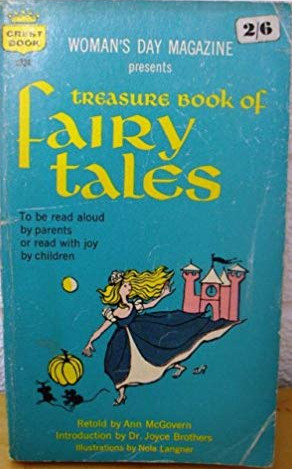
Next up is a book of fairy tales endorsed by Woman's Day magazine and introduced by Dr. Joyce Brothers; I was interested to learn that Woman's Day is still alive (and full of articles about the British royal family and Oprah, who I guess, in the absence of any notable female Kennedys, is sort of like America's Queen) but Brothers, who used to pop up on TV all the time in my youth, is dead.  The Bystander is, I think, a novel by a Texas-born Harvard prof about a young Frenchman who chases an older woman.  Finally we have the movie-tie in edition of Alan Le May's The Unforgiven, which I guess is about the relationship between white settlers and native Indians in the Southwest.

I was curious to see the cover of the movie-tie in edition of The Unforgiven, which apparently features a color photo of Burt Lancaster and Audrey Hepburn, but couldn't find one online, just a description.  Images of the sex novels are readily available, however; unfortunately they are not nearly as interesting or even as sexy as Powers's cover for The Star of Life.  Yet again, SF beats the mainstream!


Tuesday, November 13, 2018

Universe Day by Barry N. Malzberg

"How the hell can they expect to send men out to Mercury when they can't even control a simple situation down on Earth?"

Back in 2014 internet SF mastermind Joachim Boaz recommended to me (and to others!) Barry Malzberg's Universe Day, a paperback printed by Avon in 1971, the year of my birth, and published under Malzberg's transparent pseudonym K. M. O'Donnell.  (Check out Joachim's review!)  The cover of Universe Day is pretty good, and I feel a little guilty over the fact that I dropped mine one day and put a big gouge in it.  (I'm afraid I'm not as good a custodian of these artifacts of SF history as I should be.)

Universe Day is a fix-up novel, and the indispensable isfdb lists (some?) of the stories which form the basis of the novel:


I had reason to suspect that this isfdb list is incomplete because the publication page of Universe Day under the heading "Some of this material has appeared in substantially different form in:" lists Nova 2--Nova 2 (1972) includes the Malzberg story "Two Odysseys into the Center"--and Galaxy, with the date 1971--in the March issue of that year Malzberg's "Gehenna" appeared.


Curious to compare the initial short story versions of these tales to what they look like incorporated into the novel, alongside Universe Day I read the short stories upon which it was based!  Two of those listed at isfdb I have actually read and written about before; "Pacem Est" I read last year in my copy of In the Pocket and Other S-F Stories and "Elephants" I read in 2015 in my copy of Infinity Two.  "Making Titan" and "A Triptych" and "How I Take Their Measure" I read at the internet archive, and "Conquest" in my copy of the 1973 paperback printing of New Dimensions 1"Gehenna" I read back in 2013 in a library book, and also appears in In the Pocket and Other S-F Stories, and has no relationship to anything in Universe Day, so why Galaxy is listed in Universe Day I do not know, maybe there is a typo in there.  You can "borrow" scans of Nova 1 and Nova 2 from the internet archive, a somewhat cumbersome process of accounts and passwords and waitlists, and I tried this but got sick of waiting and so ordered the volumes through Amazon so I could read "Two Odysseys into the Center" and "Terminus Est" while I was still middle-aged.  To my surprise "Two Odysseys into the Center" has only the most tenuous thematic connection to Universe Day 

There is a lot more material here than in my usual blog posts which cover a single novel or three to five stories, so I am putting my findings "below the fold."  If you have any interest in the results of this research project in Malzbergian studies, click to read on!

Sunday, November 11, 2018

The Power of X by Arthur Sellings

It occurred to me that I was being maneuvered into this, as I had been maneuvered into the press conference, but I didn't care.
One of Blondie's first singles was originally titled "Sex Offender," but was released under the title of "X Offender."  So I have been wondering if a similar little sleight of hand might perhaps be going on with Arthur Sellings's 1968 novel The Power of X.  Earlier this year I received a copy of the 1970 Berkley paperback from Joachim Boaz, one of the many books in his large donation to the MPorcius Library.  This will be the ninth book I have read from that generous donation.

The year is 2018!  (In the book, too!)  Our narrator is a London art dealer who owns his own gallery, 34-year-old Max Afford (oh, the Dickensian names.)  This is the future, so people have videophones and Europe is united in a Federation with a President and a Senate and the British Royal family has decamped to the Bahamas.  Equally astounding is that technology has recently been developed that can duplicate anything, and the duplicates are identical to the original, impossible to distinguish from the "master."  The process takes a tremendous amount of energy, so it is not economical to duplicate hamburgers to feed the poor or even gold bars--it is unique items, like art masterpieces and prototypes of high tech devices that must be tested to destruction, that get duplicated.  The government has a monopoly on this technology and by selling the duplication service it makes a big profit, so big that taxes have been reduced!

The whole duplication process that Selling presents to us feels quite contrived.  Even the techs who operate the machine that does the duplicating don't know which of the items that comes out of the machine is the original, because while the doors are closed they move around or something.  Also, each object can only be duplicated nineteen times, and duplicates can't be duplicated, so only a maximum of twenty of any item can exist.  The boffins suggest that our universe is one of many stacked up like sheets of paper and the duplication process reaches into nearby universes to peel off those universes' iterations of the items being duplicated, and that the process can only reach nineteen other universes.

Our hero Max, while handling a Matisse (the start of this book is full of references to famous artists--wikipedia tells us that Sellings himself--real name: Arthur Gordon Ley--was an art dealer as well as an author and government scientist) discovers that he can distinguish between items that have been duplicated and those that have not simply by touching them, and can even tell if the item he is touching is the original or one of the dupes!

Months later, in 2019, Max has the opportunity to shake the hand of the popular President of Europe--when he does so he finds that the Prez is a dupe!

Hardcover first edition
Sellings's writing is smooth, and the first 50 or so pages of the book feel fresh because the idea is sort of new and it isn't every day I read about a dude who works at an art gallery, but then we get page after page of detective/conspiracy bilge.  We've got kidnappings, disguises, messages that have to be memorized and destroyed, people trying to shake tails by getting lost among the crowds at a major intersection, blah blah blah.  And we've got scenes of people sitting around discussing clues, looking through newspaper clippings, that sort of thing.  None of this mystery stuff is exciting or suspenseful because Sellings presents much of it for laughs, and because our narrator Max is not in charge of his own fate, but manipulated by others, primarily his wealthy and pushy aunt, Clarissa, who comes off like an aunt in a Wodehouse story.  There is also her buddy, Guy Burroughs, an oversized politician famous for being flamboyant who wears a pink bow tie and in his first appearance brings flowers--I guess his foppishness (and sexual orientation?) are supposed to be funny (his name is a joke--he is an expert on Africa) but all that flamboyant fop stuff is dropped quickly.

The aunt and the senator and Max, while sitting around, figure out the conspiracy.  I can take a detective story in which, Mickey Spillane style, the P. I. goes from apartment to apartment, seducing women and beating up thugs to find his clues, but a story about a guy relaxing in a restaurant and talking through the clues with his aunt and a clotheshorse politician is a drag.  (My mother and T. S. Eliot may go gaga over Agatha Christie and Sir Arthur Conan Doyle, but I find them almost unreadable.) 

In the final third of the 144-page novel Max and Burroughs sneak into the Presidential Palace (I think it is just the old Buckingham Palace, republicanized) because Burroughs is confident the President has not been killed, just replaced, and is imprisoned in the Palace.  (The point of replacing the Prez derives from the fact that the duplicates are not in fact identical to the original--duplicate living things are "confused, easily cowed, and lack initiative," so the dupe President is easily manipulated by a secret cabal.)  To accomplish this mission the art dealer and the senator disguise themselves as members of the working class* and use a "brontium-headed atomic boring machine" to dig a tunnel from a vacant building nearby to the bomb shelter under the palace--Burroughs assumes the Prez is imprisoned in the shelter.  And he is right!  Max and Burroughs liberate the real Prez and capture a member of the cabal.

*If I was being paid to say good things about The Power of X (and when I worked for the government I did actually write things I didn't believe for money) I would say the novel is about identity. 

The English dropped yet another bomb
on the Fatherland when The Power of X
was translated into German in 1972
In the last 20 pages of the novel the President disappears from a sealed room, and Selling inflicts upon us one of the standard forms of mystery fiction--the locked room mystery!  Burroughs even says, "I've heard of locked room mysteries, but this beats all of them!"  (Remember when we read that Fredric Brown locked room mystery about a ghoulish armadillo?)  Then Max and Burroughs and the rest watch a government broadcast on TV--the duplicate President starts giving a speech, and then disappears.  It turns out that the duplicates are not from other universes, but from future periods of time, and so only last a certain period of time (too boring to explain here.)  This deus ex machina resolution of the plot renders all the drama of the rescue of the president, and everything else in the book, pointless--even if Max and Burroughs had done nothing to oppose them, the cabal would have been foiled by the disappearance of the President and his dupe.

The Power of X is not good, and it is not good in many ways, from the total lack of human drama and human feeling, the overuse of boring mystery fiction cliches and absolutely unfunny jokes, to the fact that the hero is just a puppet and the plot is resolved by something outside the control of any character.

Bad!  (At least we've got that great Lehr cover!)

Thursday, November 1, 2018

Cosmic Engineers by Clifford Simak

"My Lord," said Gary, "think of it!  Imagination saving the people of another universe.  The imagination of a little third-rate race that hasn't even started really using its imagination yet."
"You are right," declared the Engineer, "and in the aeons to come that imagination will make your race the masters of the entire universe."
My copy
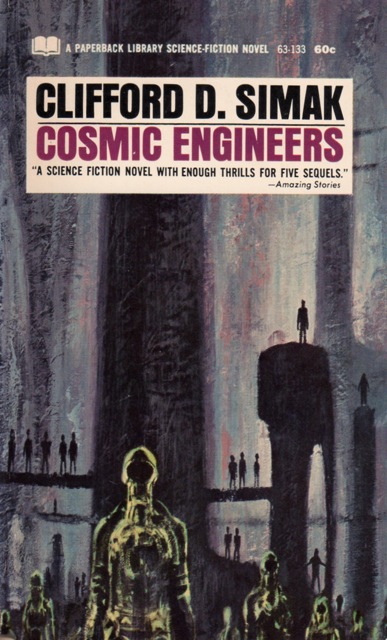
Recently I was in South Carolina to visit in-laws and the art museum in Columbia.  I stopped by Ed's Editions and found, way in the back, three cardboard boxes of paperback SF books that had yet to be priced.  There were many I already owned, many I wasn't interested in, and a few I'd read when I borrowed them from libraries.  But I found one with a fun Jack Gaughan cover that I was curious to read and willing to pay two dollars for--a 1964 edition from Paperback Library of Clifford Simak's Cosmic Engineers.  I have been kind of off Simak for a few years, but I recently read a good story by him, 1952's "The Fence," so it seems a good time to read some work by this SF Grandmaster who was important to me in my youth because the local library had a lot of his books.

Cosmic Engineers originally appeared as a serial in Astounding, spread across three issues in 1939.  (It looks like all three issues are available at the internet archive--I will resist the urge to check out the illustrations until I have finished reading this 1964 printing!)  In 1950 Gnome Press put out a hardcover edition (the Wikipedia page on Simak suggests this edition was somewhat expanded from the magazine version), and since then many paperback editions have been produced.  Here is a piece of work which has achieved market success, won a vote of confidence from SF fans who have voted for it with their hard-earned pay.  Let's hope I will enjoy it as much as they did.


It is the future, the year 6948!  Mankind has colonized the solar system!  Travelling from one planet to the next in their little ship, looking for scoops, are journalists Herb Harper and Gary Nelson.  (Remember, Simak worked as a journalist himself in the Midwest for decades.)  En route to Pluto they spot an odd-looking derelict and investigate.  Within the inert vessel lies Caroline Martin, a scientist from a thousand years ago, kept alive in suspended animation.  Gary revives her by following the instructions she left, and she joins the journalists in their ship.

Caroline wasn't asleep while she was in suspended animation--she was awake the entire time, like the hunter in Poul Anderson's 1951 "Duel on Syrtis."  So, she had 1,000 years to train her brain and develop new theories about the physical nature of space.  So, when on Pluto the boffins there tell Herb, Gary and Caroline that they have been receiving undecipherable psychic messages from outside the Milky Way, Caroline is able to decipher them and even respond to them.  Goody-Two-Shoes aliens (these are the Cosmic Engineers of the title) who have taken up the task of defending the universe are sending the messages, requesting help; it seems some threat from beyond the universe, from beyond space and time, has appeared and the C.E.s need help in dealing with it.  They send Caroline plans for a teleporter terminal, and she builds it and our cast of characters (now including some scientists from Pluto) fly their spaceship through a warp tunnel, reappearing almost instantaneously at the city of the Cosmic Engineers on a planet with three suns on the very edge of the universe, a city, we are told, that "would have put a thousand New Yorks to shame."

1950 hardcover
Here the protagonists meet the C.E.s, metal men who have high technology but lack imagination and creativity--they never invented painting and are amazed to discover the concept of painting in the humans' minds, and it is hinted that they are merely the artificial robots built millions of years ago by a now-extinct organic race.  The Cosmic Engineers explain the monumental challenge which has led them to summon the humans, as well as representatives from other alien races from throughout our universe.

Our universe is just one of many universes that floats around within the next level of reality, just like the Milky Way is but one of many galaxies floating around within our universe.  An alien universe is about to collide with ours, a very rare but natural occurrence that will cause a cataclysm--energy generated by the two universes touching will cause both universes to contract until they are reset and begin to expand anew.  The process of contraction will kill every living thing within the universe.  The Engineers need the help of more imaginative beings to figure out what to do about this impending collision that will total two universes and make traffic fatalities of all passengers.

As if this wasn't enough, there is a little complication.  It turns out that our galaxy isn't just home to nice people like you and me!  There is a collectivist and belligerent race in our universe, a society about as high tech and powerful as the C.E.s themselves, but instead of being goody goodies is devoted to taking over the universe.  These creeps, known as "The Hellhounds," have figured out a way for a small elite of their race to survive the cataclysm by shifting outside the universe just before the crash; after our universe has finished contracting they will be able to return to it and direct its new expansion to their specifications, dominating all the new life that develops.  The Hellhounds are more than willing to obstruct any efforts of the C.E.s to save our universe.
"For many millions of years they have been educated with the dream of universal conquest.  They have been so thoroughly propagandized with the philosophy that the state, the civilization, the race is everything...that the individual does not count at all...that there is not a single one of them who would not die to achieve that dream.  They glory in dying, glory in any sort of sacrifice that advances them even the slightest step toward their eventual goal."       
There are a lot of SF stories in which the human race is shown to be inferior to aliens, but in Cosmic Engineers Simak celebrates human heroism and ability and suggests that our people are equal or superior to any people in all the universes!  The C.E.s dismiss the representatives of all those other intelligent species, because only the thought processes of the Earth people are on the C.E. wavelength--only the human race is in a position to foil the Hellhounds and save the universe!

Caroline comes up with a way to create in the region between the universes new miniature universes.  These can, perhaps, be used to absorb and generate and direct energy on a cosmic scale--these miniature universes could perhaps be used to power, move, or destroy entire star systems and civilizations.  To really get this idea up and running, Caroline needs more info, and she needs it fast because the Hellhound space navy has just started its attack and the Cosmic Engineer space navy is hard pressed--it looks like the C.E. city might get destroyed before Caroline can finish building her universe-preserving devices!

The info sweet Caroline requires, the C.E.s suggest, could be found on the Earth of the future, so the metal men set up a warp tunnel through which Gary and Caroline's ship travels to the dying Earth of millions of years in the future.  (I lost track of why the C.E.s needed a terminal at both ends to facilitate travel between present Pluto and the C.E. city but don't need a terminal on future Earth to send our heroes there; maybe one of Caroline's many theories has been applied to improving the warp tunnel system?)

Only one man is left on future Earth, but luckily he has the info Caroline needs.  He also gives a speech about how great mankind has been.  There's always time for a pep talk, even when our universe is about to croak!  Gary and Caroline head back into the warp tunnel, but it has been diverted to a creepy planet and they are forced to land there.  A Hellhound vessel has also been diverted to this planet, and a scenario somewhat like that in Fredric Brown's famous 1944 story "Arena" ensues--a mysterious voice explains that it has contrived to put two humans and two Hellhounds on the same planet and deactivated their ships and weapons so they will fight a duel to the death with their bare hands and their wits!

(A quick look at the issues of Astounding at the internet archive suggests that this interlude was not part of the original 1939 version of Cosmic Engineers, but added in 1950, so if anybody was copying anybody, Simak was inspired by Brown.  This section does nothing to advance the plot and is resolved via deus ex machina, one of the less satisfying literary devices.  I keep discovering reasons to believe the magazine versions of Golden Age SF stories are better than the book versions.)

Gary and Caroline make a bow and arrows from odds and ends and Gary shoots down the two reptilian bipeds that are the first Hellhounds they have ever seen.  (Did the 1939 version not reveal the Hellhounds at all?  Even in this book version the Hellhounds are underdeveloped, with no speaking parts.)  The voice reveals itself to be the millions-of-years-old collective mind of a race which abandoned first machines and then individuality and physicality.  It has god-like power, but acts in a childish way, setting up this little fight for its own amusement and then stranding the winners on its uncomfortable planet.  (Isn't Star Trek full of these kinds of mischievous and mentally unstable deities?)  Luckily, it has a moment of sanity and during that lucid moment restores the humans' equipment and allows Gary and Caroline to escape to the C.E.s' world.

Back at the edge of the universe Caroline's system of manipulating the power of the region between universes is used to wipe out the Hellhound fleet.  (This reminded me a little of AKKA in Jack Williamson's 1934 The Legion of Space.)  Then her system is used to transport entire civilizations from the other universe to safety within ours (their universe was old and worn out anyway) and to destroy that old universe before it can crash into ours and cause it to contract.  Then we get a ten-page denouement in which the Cosmic Engineers explain their origin and the origin of the human race, as well as the human race's astonishing destiny.

I want to like Cosmic Engineers, but I have to grade it merely acceptable.  The thing lacks personality and emotion, the characters and the action are flat and boring--there is no tension, no fear, no thrills, things just plod forward.  The only character with any personality is Herb, "the dumpy little photographer" who serves only as superfluous and anemic comic relief, making the most feeble jokes possible and contributing zilch to the plot.  There need have been only two human characters, Gary and Caroline, and instead we get five.  Cosmic Engineers feels not like a fun space opera like something by Edmond Hamilton, but something grey and bland, like one of John W. Campbell's space operas in which indistinguishable eggheads build a better machine every few chapters until they build one powerful enough to end the story.  The novel's real "character" is the human race, which Simak presents in a hopeful and optimistic light, painting humanity as bold and adventurous and imaginative, conferring on us the distinctive attitudes of youth--all the alien races are depicted as old and tired, either hopelessly set in their ways or actually insane.

While not terribly entertaining, Cosmic Engineers is interesting for the student of SF.  Not only is it full of elements that we see in other SF works, as I have pointed out, but it contains elements characteristic of Simak's later, more mature work, like an Earth abandoned by the majority of the human race and robots who outlive their creators but maintain a dogged devotion to them.  And here's a list of three other things about Cosmic Engineers that struck me as noteworthy (I've been told that people on the internet love lists):
  1. Positive attitude about The Crusades:  Nowadays it is conventional to denounce the Crusades as racist imperialism, but Simak offers up the Crusades as a paradigmatic exemplum of mankind's courage and eagerness to make sacrifices and take risks; he repeatedly compares the efforts of Gary, Caroline and the rest of the human cast to the Crusades.  Simak was not an outlier in his day; for example, Eisenhower's memoir of his service in World War II was titled Crusade in Europe.        
  2. Female protagonist:  It is interesting, and counter to the stereotype of women in Golden Age SF being mere damsels in distress, that the lead scientist of the story is a woman, and that she saves not only our universe, but saves the people of another universe and actually creates universes.
  3. Pro-individualism/anti-government/anti-collectivist vibe:  Several times in this story we see demonstrated the superiority of the individual over the state or the collective, and witness people standing up to the government or the collective.  Caroline was imprisoned in that derelict because she had disobeyed the government, and she came up with the process of suspended animation all by herself.  The police come to stop our heroes from teleporting from Pluto to the edge of the universe, and Caroline and her friends don't even consider following the law and obeying the fuzz--one of the men actually cries out "No government is going to tell me what I can do and what I can't do."  The villainous Hellhounds, who hold that the individual is nothing and the collective everything, are obviously an allegory or caricature of Soviet Socialism and/or German National Socialism, while the god-like being that sets up the duel is a product of radical collectivism.
Cosmic Engineers is frustrating because if you told me there was a book about a space war in which a genius woman wakes up after a thousand years to prove herself the greatest scientist in the universe, a book that celebrates human achievement, focuses on the good side of the Crusades, and is for the individual and against the collective, I would have said, "That sounds awesome!"  But here it is, and it is lukewarm and bland because Simak fails to write the characters or action scenes with any feeling.  I am 100% on board with the spirit of Cosmic Engineers, but as a literary construction I cannot endorse its component parts nor the way they were put together.  Too bad.

**********

The last page of my edition of Cosmic Engineers is an ad for four Paperback Library SF titles, four titles that sound pretty good!  There's Eric Frank Russell's 1939 Sinister Barrier, which I would definitely like to read.  (Remember when I read The Best of Eric Frank Russell from cover to cover and learned that Russell was--according to Lester Del Rey, at least--SF icon John W. Campbell's favorite SF writer?)  Next on the list is A. E. van Vogt's The Book of Ptath, under its alternate title Two Hundred Million A.D.-- that was a good one!  Edmond Hamilton's Battle for the Stars I read and enjoyed back in 2012, long before this blog wriggled free from my grey matter to infest the world wide web.  The Roger Elwood anthology Alien Worlds has stories by Simak, Hamilton, Russell, Campbell, Poul Anderson and Robert Bloch that I would definitely read.  This might be the most attractive selection of books I have ever seen in a single ad!   


Saturday, October 27, 2018

Three stories by Poul Anderson from 1951

There's Chryseis on Pelias the erinye.  Anderson's
text actually mentions the precious stones
she wears in her hair.
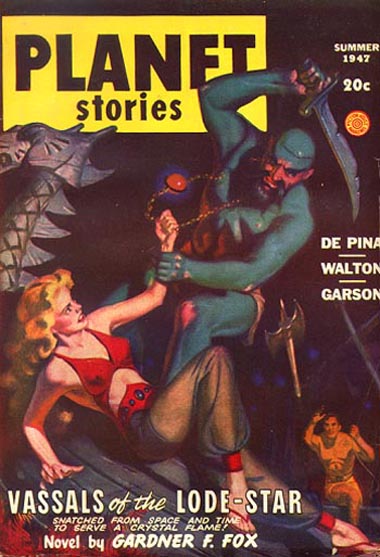
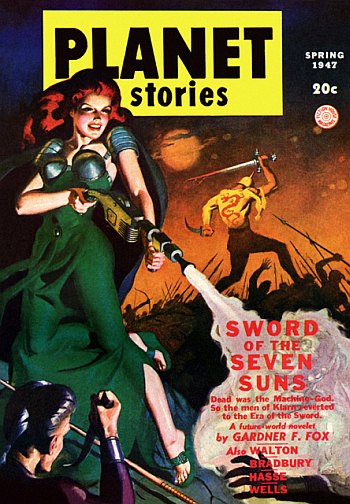
When people complain that SF from the past is sexist I think one of the things they have in mind may be the covers of Planet Stories--it seems that almost every one features some hot chick in trouble, or causing trouble for somebody else.  (The covers of Astounding from the same period present a stark contrast--I guess they are sexist because they rarely feature women on them at all, instead foregrounding technology, heroic men, and metaphorical tableaux.)

Another thing you'll see if you look at a bunch of covers of Planet Stories is Poul Anderson's name.  Let's check out three stories by Poul Anderson that appeared in 1951 issues of Planet Stories.  I think these stories are among Anderson's least well-known, but as my regular readers are well aware, I like reading things that have been largely forgotten or which have gotten a bad reputation.  I'll be experiencing all three of these tales of violence on other worlds on this very computer screen via the scans of the actual magazines in which they appeared that are freely available at the internet archive.

"Witch of the Demon Seas"

The January 1951 issue of Planet Stories actually includes two pieces by Anderson, the Dominic Flandry story "Tiger by the Tail" and the "novel" I'm reading today, "Witch of the Demon Seas," a cover story appearing under the pen name A. A. Craig.

"Witch of the Demon Seas" takes place on a planet where people live under a perpetually cloudy sky, fight with swords and bows, travel in sailing ships, live in castles and believe in magic (dismissed by some as mere "women's tricks.")  The surface of the planet is covered in oceans, and the many maritime kingdoms ("thallasocracies") are based on groups of islands, their economies based on seaborne trade and slave raiding.  The planet's human inhabitants come in many different ethnicities, including "blue-skinned savages" who serve as mercenaries in the armies of white kings.  One such white empire is Achaera, land of brunettes and the most powerful and extensive of the kingdoms.  The current king of Achaera is huge muscular Khroman.  As our story begins, Khroman's most dangerous enemy, huge muscular Corun the pirate, has just been captured.  Khroman's father, the previous king, conquered Corun's kingdom of blonde people, Conahur, and hanged Corun's father, the king of Conahur.  Ever since this conquest, Corun has been a fugitive and a pirate captain, attacking every Achaeran ship and town he can get his hands on.

King Khroman's top adviser is his father-in-law, Shorzon the sorcerer.  Khroman's wife died giving birth to their daughter, Chryseis.  Trained by her grandfather, Chryseis is reputed to be a powerful witch, and is also perhaps the most beautiful woman on the planet!  Anderson unleashes a lot of purple prose in this story, descriptions of landscapes and seascapes and the sky and how they make people feel, and we get elaborate descriptions of Chryseis's "chill sculptured beauty," "marble-white face," "eyes of dark flame," her clothes, her jewelry, her hair, etc.  Chryseis also has a tame monster by the name of Perias, a flying reptile of a species the characters call "erinyes" or just "devil-beasts"-- you can see witch-princess riding Perias on the cover of the magazine.  A pet monster, too?  This is like my dream girl!  Oh, wait, then there's the fact that she "ordered the flaying alive of a thousand Issarian prisoners and counselled some of the darkest intrigues in Achaera's bloody history."  Every rose has its thorn, I guess.

It turns out that Chryseis and Shorzon have bigger fish to fry than just maintaining the power and glory of Achaera.  The two magicians betray King Khroman, springing Corun the corsair from solitary after they have convinced him to join them on a quest that will shake the very foundations of this planet's whole civilization!  Chryseis is a real femme fatale, using her beauty as a carrot ("I like strong men") and her pet monster as a stick ("If you say no...Perias will rip your guts out.")   

Shorozon and Chryseis need Corun's guidance to get to the sea of the Xanthi, fish-people whose language lacks words for "fear" and "love" (but you better believe they have a word for "hate!")  Corun, besides being a first-class hunk and a cunning sailor, is one of the few people who has spoken to the Xanthi and lived to tell the tale, and so is a perfect addition to the crew of the wizard and witch's galley, which otherwise consists of blue men, "a cutthroat gang" whose "reckless courage was legendary."

Anderson's story totally lives up to the sex and violence reputation of Planet Stories--"Witch of the Demon Seas" fulfills the expectations set up by all those covers of beautiful girls facing or meting out horrible deaths. On the month-long voyage to the black castle of the Xanthi, Chryseis and Corun become lovers, and, in a fight against the Xanthi, we get to see Shorozon use his magic and Chryseis shoot her bow and ply her sword.  The sex-charged atmosphere, less-than-admirable characters and pervasive bloodshed reminded me of Leigh Brackett's work, which of course is a compliment!

Even though its full of dragons, sea serpents, witches and swordsmen, this is a science fiction story, not a fantasy.  What the characters seek is not a pile of treasure, but knowledge.  There's a scene in which Corun and another sea captain speculate about the possibility of using a chronometer and a sextant to determine a ship's position on the open sea (their world is too superstitious and low tech to accomplish these feats as of yet.)  All the magic is in fact telepathic hypnosis and illusion, as Corun learns when he does some espionage work, listening in on the negotiations between his girlfriend and her grandfather and the rulers of the scaly Xanthi, themselves formidable wizards.  Shorozon and Chryseis seek to join forces with the fish people and become as gods by enslaving the entire human race and using the masses of human brains as a source of psychic energy.  With their own minds amplified by those of thousands of slaves, S and C think that they and the Xanthi sorcerers can explore the universe beyond the clouds, riddle out the mysteries of nature, and achieve immortality!

When he realizes Chryseis is a megalomaniac who is going to screw over every human being in the world, Corun leads the blue-skinned sailors in a raid on the Xanthi arsenal, where he lights a fuse leading to a stockpile of the Xanthi secret weapon, "devil powder" (you and I would just call it "gun powder.")  The castle explodes during a running fight between the blue humans and the fish men--luckily enough blue people survive to man the galley.  Shorozon is decapitated in the fighting, while Chryseis and Perias escape into the jungle, pursed by a vengeful Corun.  Our hero kills Perias in a gory fight, gouging out one of the monster's eyes with his fingers--yuck!

With the monster dead, and Corun now immune to Chryseis's illusions, I was expecting the blonde muscle man to kill the witch in a cathartic Mickey Spillane-style ending.  I was disappointed to find Anderson was giving us a happily-ever-after ending--the death of her evil grandfather and her monstrous familiar broke the hypnotic spell Shorozon had put on Chryseis so many years ago, when she was just a little girl.  Chryseis was never really evil, she explains, she was just a pawn of her grandfather.  Now that the spell is broken her true (sweet) character is liberated, as is her sincere love for Corun.  As the story ends we are led to believe that Corun will marry Chryseis and eventually become the king of Archaera who unites Archaera and his native Conahur  on a basis of equality and brotherhood.

There is maybe too much blah blah blah about the luminescence on the waves and the smell of Chryseis's hair and all that, and I consider the happy ending that absolves Chryseis of all responsibility for her crimes a cop out*, but "Witch of the Demon Seas" is a pretty good sword fighting adventure story.  Robert Hoskins included "Witch of the Demon Seas" in his 1970 anthology Swords Against Tomorrow, and the Gene Szafran cover actually illustrates the story, depicting Shorozon's ship, a blue sailor, a fish man (with a face like a dog, unfortunately), and sexy sexy newlyweds Corun and Chryseis.

*Here's a question for all you feminists: which is more sexist, a story in which an evil woman uses her gorgeous body and superior intelligence to manipulate men in pursuit of becoming the world's greatest scientist and then gets killed by one of the men she manipulated, or a story in which a good woman is the pawn of a man who manipulates her to act against her goody goody nature and has to be liberated from this domination by yet another man?

"Duel on Syrtis"

"Duel on Syrtis" was printed in one of the most famous issues of Planet Stories, the one with Leigh Brackett's "Black Amazon of Mars" (one of the Stark stories) and A. E. van Vogt's "The Star Saint" (I reread this great story of a hunky superhero, told from the point of view of the "muggle" whom he cuckolds for the good of the community--ugh, even my thick skull is not impervious to that suffocatingly ubiquitous Harry Potter goop!)

In this story, Anderson portrays the human race as a bunch of jerks!  When mankind colonized Mars they enslaved the native Martians, who look like skinny four-foot tall owls, if you can imagine such a thing.    (There is a good illustration of a Martian on page 5 of the magazine.)  They also hunted them for sport!  Slaving and hunting Martians was recently outlawed, but successful interplanetary businessman and big game hunter Riordan hasn't bagged a Martian yet, and he goes to a secluded spot on the red planet where the authorities don't have everything locked up tight yet, to shoot himself an "owlie."

The Martian owlies are very challenging quarry because they are intelligent and psychically in tune with the flora and fauna of the desert landscape--bushes and rodents miles away can warn them of an Earthman's approach, and even attack the Earther.  The Martian Riordan has set his sights on is a particularly tough nut to crack.  Most Martians are now debased members of the urban lower class, but Kreega is one of the last wild Martians, living in an isolated ruin in the desert.  Something like 200 years old, Kreega was one of the greatest warriors of Mars, a witness of the arrival of the first Earthman and a veteran of many raids on the human colonists before the signing of the peace treaties and amnesties now in force. Along with a hunting dog and a hunting bird, Riordan sets out to hunt this wily and venerable Martian hermit.

Anderson gives us a good long action sequence, describing the several days of the hunt through the desert, the various weapons and traps and stratagems employed by the hunter and hunted.  In the end Kreega not only defeats Riordan but captures the Earthman's space ship, and we readers are led to believe that, like the Martians in Chad Oliver's 1952 "Final Exam," Kreega and his fellows are going to be able to copy the ship and weapons and build a military force with which to challenge Earth hegemony.  (More on this Anderson-Oliver connection below.)  Riordan himself is put into suspended animation, still conscious, so that he will be forced to lie inert for centuries, contemplating his defeat.

We see a lot of these stories in which cloddish Earthmen with their high technology are contrasted with aliens who are sensitive and/or artistic and/or live as one with the natural world; I guess all these stories are reflective of a sympathy for the peoples the world over whom Europeans conquered or otherwise dominated, as well as a fear of technology and concern about the environment.  For me, this noble savage stuff has worn thin, but the meat of this tale is the well-written chase, and I can strongly recommend "Duel on Syrtis" as an engaging adventure story, a quite successful entertainment.

"Duel on Syrtis" has reappeared in Anderson collections and a few anthologies, including 1975's The Best Of Planet Stories, edited by Leigh Brackett.  I will also note that, in the issue of Planet Stories that includes "Duel on Syrtis," there is a little one column autobiography by Anderson; among other things, Anderson says that a year spent in Washington, D.C. convinced him that it was not "a town fit to live in" and that his favorite contemporary author is Johannes V. Jensen (Anderson is really into being Scandinavian.)

"The Virgin of Valkarion"

The setting of "The Virgin of Valkarion" reminds one of the Mars of Edgar Rice Burroughs or Leigh Brackett--an old planet, thousands of years ago fertile and ruled by a glorious empire, now a desolate waste of dry sea beds and crumbling ruins.  Our hero is Alfric, a claymore-wielding barbarian who rides some kind of hoofed beast and has behind him a long career as bandit and mercenary general.  When he arrives at Valkarion, the capital of the last tiny remnant of that empire of long ago, two slaves marked in such a way that it is clear they are property of the priesthood try to ambush and murder him.  Why have they targeted him, a total stranger to the environs of Valkarion?

Alfric gets a room in a disreputable inn.  The room comes with what we now are calling a "sex worker," and what the introductory blurb of this story calls "a tavern bawd."  But this is no ordinary prostitute--she is one of the most beautiful women Alfric has ever seen, and she turns out to be exceptionally skilled in "the arts of love."  As that intro blurb told us (that intro is full of spoilers), she is also a Queen--the Empress of Valkarion!

Why are these strange things happening to Alfric?  Well, it all has to do with a prophecy and a major political crisis.  Not only is tonight important astrologically, but the Emperor is dying, and he has no heir.  The priesthood would like to take over the kingdom, but a prophecy from thousands of years ago (recorded in the "Book of the Sibyl") predicts that under just such circumstances an outsider will crown himself Emperor.  So the priests have been looking for a guy like Alfric (to murder) and the Empress likewise has been looking for a guy answering Alfric's description (to ally with.)  After their sex session, the Empress explains all this to Alfric, who is not unwilling to make himself Emperor, and then they get caught up in the open fighting between the agents of the Temple and those devoted to the Empress.  (If the traditionally anti-religious readers of SF haven't already gotten the message,  Anderson makes clear that the Empress would be a better ruler than the priests by pointing out that her financial policy features lower tax rates than that of previous administrations, and that the Temple tries to maintain a monopoly on knowledge of the high technology of the Empire's heyday, even executing those who read the old books and try to build the machinery described therein.)

Alfric and the Empress get captured, and the High Priest gives the Empress the opportunity to marry him, which would make him Emperor--if she refuses she will be gang raped by the Temple slaves and then burned at the stake.  She agrees, but, once untied, contrives to free Alfric, who kills the high priest.  The lovers escape the Temple, and lead the Imperial loyalists against the priests and their dupes, Anderson gives us several (too many) pages of tedious battle scenes.  The Empress herself wears armor and rides a beast and stabs people--I think we can say this story includes the much-sought-after "strong female protagonist."  The Temple and the Imperial Palace both get burned down in the fracas, but we readers are assured that Alfric and his lover will build a glorious new Empire and found a noble new dynasty.

This story is just OK.  I am tired of prophecy stories and the action scenes in this one are not particularly stirring and the characters are not very interesting.  "The Virgin of Valkarion" doesn't seem to have set the world on fire--I don't think it ever appeared in an Anderson collection.  It was translated into Portuguese, however, for inclusion in a 1965 anthology alongside pieces by H. G. Wells, Arthur C. Clarke, and other worthies.

The issue of Planet Stories that includes "The Virgin of Valkarion" also includes a letter from Chad Oliver, the anthropologist and SF writer whose "Final Exam" I just compared to Anderson's "Duel on Syrtis."  In the letter Oliver praises the active SF community of letter-writers, makes literary puns, and says that Anderson's "Duel on Syrtis" was "outstanding."  Maybe he really did lift the central idea of "Final Exam" from Anderson!  Oliver also, bizarrely, denounces the cover of the March '51 issue, a cover whose use of color I find striking and whose central figure I find mesmerizing.  Chad may have been a good anthropologist, but he was no art critic!

**********

Three worthwhile stories by Anderson, even if "The Virgin of Valkarion" is borderline, and I certainly enjoyed rereading van Vogt's "The Star Saint," while the Anderson autobiography and the letter from Chad Oliver both provide fun insights for us classic SF fans.  Those old magazines available at the internet archive are full of gems!