Friday, October 13, 2023

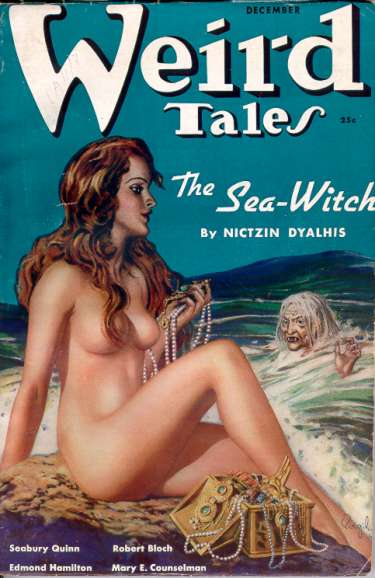
Weird Tales, Feb '38: Lovecraft & Lumley, Kuttner, Ball, Moretti

Back in January of 2021 I set myself the sacred duty of reading and blogging about at least one story from each of the 115 or so issues of Weird Tales published in the 1930s.  Great strides have been made in this quest; in fact, I have covered at least one story from each issue published from January 1930 to January 1938!  And I can prove it at the links below!

1930  1931  1932  1933  1934  1935  1936  1937  JAN 1938

Today we wrangle some stories from the February 1938 issue, including works by the premier Weird Tales writer, New England's Howard Phillips Lovecraft, and one of our favorite scribblers, Henry Kuttner, the young man from California.  And in the spirit of exploration which I like to think characterizes this journey, we'll read two stories by individuals we've never read before, one by Clifford Ball and one by M. G. Moretti.  I chose these two stories because I liked their titles, a perfectly legitimate means of discriminating, I'm sure you will agree.

"The Diary of Alonzo Typer" by H. P. Lovecraft and William Lumley 

"The Diary of Alonzo Typer" appears under William Lumley's name in Weird Tales, but it is one of the many stories which H. P. Lovecraft revised for others.  In the introductory matter to my copy of Arkham House's The Horror in the Museum and Other Revisions, scholar S. T. Joshi tells us he has seen Lumley's draft for this story as well as Lovecraft's revision, and HPL "preserved only the nucleus of the story...all the prose is his."  I am reading "The Diary of Alonzo Typer" in my hardcover edition of that collection, unlike the Kuttner, Ball and Moretti stories, which I am reading in the internet archive scan of the original 1938 magazine.

The title character of "The Diary of Alonzo Typer" is a specimen of the type of person we meet all the time here at MPorcius Fiction Log, the student of the occult who travels the world investigating weird phenomena.  Typer's diary takes up the lion's share of the story (like 16 pages in the edition I am reading), which the preceding frame (like three pages) tells us was discovered in the 1930s in a ruined 18th-century house near a mysterious circle of stones (a "cromlech" of "menhirs"); this long-abandoned house was home back in the 18th and 19th centuries to a family reputed to be deeply involved in witchcraft, the van der Heyls.

Typer's diary chronicles his 1908 exploration of the van der Heyl house, from which he finds that, once having entered, he cannot escape.  Lovecraft rehearses many of the themes and elements characteristic of his work, like degeneracy and miscegenation, the horror of learning one's own identity, and the reading of a pile of documents that reveal forbidden lore and esoteric history.  The portraits on the walls in the house indicate the van der Heyls had ophidian and swine-like features, suggesting they interbred with aliens, and the local villagers who supply Typer with food are described as "degraded idiots" of "singular hereditary strains."  In the house, Typer discovers such books as The Necronomicon as well as an elaborate drawing of a statue of Cthulhu or some similar monster, plus plenty of alien hieroglyphs.  Among other amazing tidbits, Typer learns about how millions of years ago the Earth was colonized by spacefaring Venusians.

What stands out to me as distinctive about "The Diary of Alonzo Typer" is how Typer sees many ghosts of long dead van der Heyls as well as visions or hallucinations of clawed alien monsters--I feel like this is a device Lovecraft doesn't regularly employ.    

Finally, on Walpurgis night, Typer, having put together all the many clues in the house and prepared his protective spells, unlocks the vault in the cellar behind which he has been hearing the slitherings of a titanic monster.  He also realizes that he is himself a van der Heyl, and has been fated to open the vault whether he wants to or not.

"The Diary of Alonzo Typer" is a decent slice of Yog-Sothery, though not as good as, say, "The Shadow Over Innsmouth," which deals with much the same themes and elements.  Besides a multitude of Lovecraft collections, the story has been anthologized by Peter Haining, Robert M. Price and Franklyn Searight. 

Way back in 2014 I read a sequel to "The Diary of Alonzo Typer" penned by Brian Lumley, and I didn't like it; at the link I say it had a good plot but was full of extraneous material.

"World's End" by Henry Kuttner

"World's End" is a time travel story that doesn't really hold together--in particular, the plot resolution didn't satisfy this reader.

Young Blake and his senior citizen colleague Norwood have spent seven years building a time machine, and today Blake is strapping on his vacuum suit and gathering together his books, binoculars, rifles and other essential equipment for his maiden voyage to the future!  He throws the bakelite switch and finds himself in the first of a series of bizarre locations tens of thousands of years in the future.  One such setting is a snowy plain from which he sees on the horizon a vast black form, like a wall or glacier or something, rushing towards him.

Blake is then transported to the lab of a man of the future, a dwarf with a huge head!  Future brainiac explains that centuries ago a meteor landed on Earth from which sprang an alien life form, a sort of black void, that has slowly been devouring the Earth.  By the time the people of Earth had developed a disintegrator ray effective against the monster it had reduced most of the Earth to an uninhabitable waste, and today there are only a few hundred human beings left alive.  With their disintegrator ray artillery they can hold off the black void, but the survivors are running out of fuel to power the ray projectors and so will soon succumb to extinction.

The big-brained dwarf is excited to learn of Blake's time machine; his people have teleporters (that is how he brought Blake here to the last little bit of inhabitable Earth) but have never developed time travel.  Future man says that if Blake can carry him and a pistol-sized disintegrator ray projector back in time to the moment the meteor carrying the black void first arrived on Earth, he can neutralize the menace and save the human race!

Future man boards the time machine and he and Blake try to go back in time, and we get our disappointing twist ending.  Blake reappears in his 20th-century lab, having totally forgotten his future adventures.  Norwood doesn't even realize Blake ever left--Blake reappeared the same moment he departed, as if throwing the bakelite lever did nothing.  It seems that the universe forbids that you travel backwards in time to a moment before your birth, and also prohibits retention of memories of events yet to happen, so Blake's trip has been fruitless--he has no recall of anything that occurred in the future, and we readers must assume the future man's effort to save the world of the far future was a failure.

I don't like the way time travel works in the story, but putting that aside, "World's End" suffers a bigger, literary, failing.  The fact that the scientists' seven years of work on the machine, and Blake's and the dwarf's adventures, yield absolutely zero result is pretty annoying--it makes reading the story feel like a waste of time.  We expect something to happen in a story, that the characters or their environment will change, and when that doesn't happen, it is frustrating.  I suppose that some will appreciate how Kuttner "subverts reader expectations" of an Edgar Rice Burroughs-style ending in which the hero who visits an alien milieu proves to be the savior of the sympathetic natives and the undoing of their enemies, but I have to say I found this subversion more irritating than refreshing.  

I'm going to grade "World's End" barely acceptable; I like the menace in the story, the future brainiac and the vacuum suit, and can forgive the problems with the time travel; my real gripe is with the resolution (or, perhaps I should say, lack thereof.)

"World's End" would not be reprinted until our 21st century, when the good people at both Haffner Press and Centipede Press put out huge Henry Kuttner collections within a year of each other.

"The Goddess Awakes" by Clifford Ball  

"The Goddess Awakes" is a sort of long (26 pages here in WT) and pedestrian Conan-style story.  Two thieves who have taken up careers as mercenary soldiers flee the battlefield upon which the army of which they were members has been routed and climb a mountain only to be captured by the women soldiers of a remote kingdom whose citizens are all women.  These women have a queen but she is dominated by a centuries-old wizard and his giant black panther; this creep has decreed, for generations, that the nation's men toil out of view, slaves whose minds are dulled to insensibility by drugs.  Our heroes get thrown unarmed into the arena with the panther, but the queen and one of the soldiers have fallen in love with them and toss them the weapons they need to defeat the Brobdingnagian feline.  Then the queen kills the wizard, the kingdom's men are freed and our heroes are acclaimed the new leaders of the country.    

Ball's basic plot outline (two hunks arrive in a nation of women under the thumb of an evil wizard and his monster and trigger a reassertion of the women's natural heterosexuality and the overthrow of the wiz and monster) is good but his execution is poor.  The text of a good Conan story focuses on heroic feats, creepy magic and scary monsters, building up a weird and/or horrible atmosphere and advancing a plot in which there are high stakes.  Unfortunately, Ball here in "The Goddess Awakes" expends a lot of ink on mildly humorous dialogue between the two main characters, so his story feels more like a light-hearted buddy movie than a tale of uncanny horror or thrilling sword-and-sorcery; his bargain-basement efforts to produce witty banter are distracting and undermine any possibility of fear or excitement.

(It is hard to successfully integrate sword-and-sorcery thrills and humor in an adventure story; the biggest success I can think of is Jack Vance's two Cugel books.)   

We are generously grading "The Goddess Awakes" barely tolerable.

"The Goddess Awakes" would see print again in 1976 in Lin Carter's anthology Realms of Wizardry (in his intro to the tale, Carter calls "The Goddess Awakes" "superbly rousing;" I beg to differ.)  The Weird Tales devotees at DMR books in 2018 published a volume containing all of Ball's stories under the title The Thief of Forthe.

"The Strangling Hands" by M. G. Moretti

Moretti only has one story listed at isfdb, and this story has never been reprinted--we are really peering into the dim corners today at MPorcius Fiction Log.

In our last episode we read a story by David H. Keller in which black Africans unleash a supernatural vengeance on a white man who mistreated them, and "The Strangling Hands," which is adorned with a good drawing of a witch doctor by fan favorite Virgil Finlay, has a similar theme.  

Our narrator is a professional writer who got scooped by an amateur writer!  You see, our guy was one of five men on a dangerous expedition in Africa, and everybody sorta kinda agreed he would chronicle the adventure and publish a book on it.  But narrator's best friend, also on the trip, published his own account as soon as they got back to New York, rendering narrator's book unsalable!  Hilarious!

The narrator hasn't spoken to his frenemy since, and some years have gone by, but out of the blue he hears from the guy, and grudgingly goes to see him.  It turns out that the other three men who accompanied them on the African expedition have died under mysterious circumstances.  One of the capers the five adventurers indulged in while on the Dark Continent was stealing the eye from a statue in a temple of Death, an institution whose regularly scheduled festivities include human sacrifice by strangulation.  The three men who have all turned up dead these last few months all had this eye in their possession (each having inherited it from the previous victim.)  Now the amateur writer has custody of the eye, and he tells our narrator that every night he sees the horrifying image of black hands creeping closer and closer to his white throat!  Obviously the priest of Death is performing decolonization activities via long distance magic!  The narrator of course thinks the deaths are just a coincidence and his backstabbing buddy is just lying, or maybe the target of an elaborate prank.

Still, he is persuaded to spend the night with his friend, a night of terror in which he learns the astonishing truth!

This is a good black magic story.  I groused that Clifford Ball rendered "The Goddess Awakes" a drag with his emphasis on totally lame jocular dialogue between his two main characters, but M. G. Moretti here does caustic dialogue between two buddies right--via their speech Moretti develops an interesting relationship between the two men, and the stuff they say, instead of seeming incongruous and distracting from the horror/adventure aspects of the story, actually helps build an atmosphere of tension and uncanny wonder.  

Thumbs up!  It is too bad there is only one Moretti story out there!  

"From Beyond" by H. P. Lovecraft (1934)

This February 1938 issue of Weird Tales reprints "From Beyond," one of H. P. Lovecraft's Dream Cycle stories, a piece which made its debut in 1934 in the fanzine The Fantasy Fan.  I am reading it in my copy of Dagon and Other Macabre Tales.

Short and to the point, this is an effective story.  Lovecraft adds interest to the tale by doing more than he usually does to develop his character's personalities and human relationships.

Our narrator has a fat and emotional friend who is conducting some crazy research leveraging his knowledge of both electronics and metaphysics.  The narrator warned him that this might be dangerous, and the researcher, a real sensitive sort, threw a fit and broke off their friendship.

Over two months later, fatso summons the narrator to his lab in his big attic.  Shockingly, this dude is now skinny and haggard, his hands trembling, his formerly clean shaven face covered in whiskers.  Even more shockingly, the mad scientist has plotted an elaborate revenge on the narrator, whom he says "discouraged me when I needed every drop of encouragement I could get...."  The complicated electrical machine he has finally completed generates radiation which revivifies vestigial and atrophied senses that we humans don't even realize we have; under the influence of the machine, people can "see" into and "listen" in on parallel worlds that coexist with our own--when the vengeful inventor turns the machine on, the narrator can sense all kinds of extradimensional monsters floating through the attic walls and even his own body.

The horrifying twist is that the radiation from the machine also enables some of the alien monsters to sense and interact with our own world!  In fact, the researcher's own servants have all vanished without trace, carried off or devoured by alien entities!  And the mad scientist gloats that the narrator is next!  Can the narrator escape?

Thumbs up!  Lovecraft can be long-winded and repetitive, and his stories often lack human feeling, so it is fun to see him producing in "From Beyond" a brisk and economical tale with a human relationship and an exciting personality at its center.  

Like most of Lovecraft's work, "From Beyond" has been reprinted a billion times, including in anthologies like Jack C. Wolf and Barbara H. Wolf's Ghosts, Castles and Victims: Tales of Gothic Horror and Xavier Aldana Reyes' Promethean Horrors: Classic Tales of Mad Science.

**********

A mixed bag, but the Lovecraft stories go to show that the man from Providence deserves his high reputation, and I really liked one-hit-wonder M. G. Moretti's "The Strangling Hands."  So, a satisfying step in our long march through the pages of the unique magazine.  We may return to this issue one day, as it contains (under a pen name) part of a werewolf serial by Manly Wade Wellman that has been reprinted multiple times and so perhaps is worth checking out.  Time will tell.     

Sunday, October 8, 2023

Weird Tales, Jan '38: Quick, Hamilton and Keller

In our last episode, we read a story from the 1937 December issue of Weird Tales by a woman we'd never read before, Mary Elizabeth Counselman, and it was pretty good.  So let's read another story by a female weirdie with whom we are unfamiliar, Dorothy Quick's "The Witch's Mark" from the 1938 January issue.  This January issue is something all you Virgil Finlay fans should definitely check out, as it features a hearty helping of handsome men, curvaceous ladies, and ferocious quadrupeds rendered in Finlay's classic style.  This issue also offers stories by Edmond Hamilton and David H. Keller which we'll read today as part of our tireless exploration of the magazine of the bizarre and unusual.

"The Witch's Mark" by Dorothy Quick

"The Witch's Mark" is the story of a love triangle.  We've got Shamus O'Brien, who has a nice Manhattan apartment and a healthy inheritance.  And we've got slender Trudy Rose of the piquant rounded face.  Shamus was planning to propose to Trudy at a house party up at the Rose family's Connecticut estate, but among the guests is Cecily Maltby, she of the red-gold hair, pale white skin and disturbingly red lips, and Cecily's melodious voice and beguiling perfume threaten to blast all thought of marrying Trudy right out of Shamus' mind!

Most of the text of "The Witch's Mark" follows Cecily's efforts to seduce Shamus, and he spends a lot of time in her arms, resisting her requests that he kiss her.  Cecily relates a story from ancient Ireland, the tale of a princess and a "farmer's lad" who fell in love; Cecily implies that Shamus is the reincarnation of that farm boy, and she is the princess, cursed by the Little People to search the Earth for Shamus for many centuries.  Suspecting Cecily is really a witch or vampire from Eastern Europe, Shamus wracks his big Irish noggin, struggling to access the ancestral memories that will tell him if Cecily's tale is the real deal or just a load of malarkey.  In the end, it is Trudy's love that saves Shamus from Cecily; we also learn everyone's true identity and the truth of the story of the princess, the farmer's lad, and the witch.

Acceptable.  It looks like "The Witch's Mark" has never been reprinted.  

"The House of Living Music" by Edmond Hamilton 

Hamilton is known for reusing plots, producing a somewhat repetitive series of stories about space battles early in his career and later many tales following a sort of Edgar Rice Burroughs template.  Hamilton also published many mad scientist stories, and "The House of Living Music" is in that vein.  It has a good gimmick, though, and feels fresh and I quite like it.

The narrator is a New York music critic.  He makes friends with a leading modern composer who is always experimenting, always striving to produce new music that describes real life, that captures the essence of reality and the world.  This genius, Harriman, has a sweet and beautiful daughter, Lina, and the narrator falls in love with her, and thinks she might return his feelings.  

As a youth, Harriman was a student of physics, and a promising one, and he starts haunting the university again, spending time in the physics lab.  Then he and Lina vanish.  The narrator's efforts to find them are fruitless, but a year later he receives a message from the radical composer, a summons to a remote house in rural Massachusetts.

Up in Mass, the narrator is introduced to Harriman's triumph--the composer has constructed a huge apparatus into which he can place an object, where powerful energies dissolve the object and transmute it into wonderful evocative music, music of clarity and beauty no man has ever before heard!  Harriman has recorded music that reflects the characteristic beauty of many flowers, trees, and small animals, works of unparalleled beauty and power!  This is the greatest artistic achievement of all time!  Hey, wait, where is Lina?

Hamilton ends the story effectively with a ferocious fight between two men driven to insanity, and a sad denouement as the narrator cherishes all that remains of Harriman's work of mad genius and of the beautiful Lina.

Thumbs up!  I like it, but it seems "The House of Living Music" has only ever been reprinted in Italian in a theme anthology of weird stories about music.  Thank Yog-Sothoth the internet archive is here to make this story accessible to us Hamilton fans for whom English is a first and only language.         

"Valley of Bones" by David H. Keller

This is a trifling little story, but not bad.

The narrator, a sensitive American who believes that animals have souls and deserve rights, is travelling in southern Africa.  He meets a Zulu who recognizes him--when both were students at Oxford, the narrator, of all the white men at Oxford, treated the black man most kindly.  Strangely, though they met decades ago and the narrator is in his late 50s, the Zulu appears quite young.

The Zulu tells the narrator the story of his youth.  He was a prince of a small remote tribe wealthy in gold.  A white hunter murdered the entire tribe to acquire their gold--the narrator's Oxford colleague was the sole survivor.

Today the white hunter has returned to the location of his genocidal crime to look for more treasure, he having spent all he stole so many years ago.  As the narrator and his Zulu friend watch, the bones of the tribe come to life to kill the hunter.

We have to wonder why two observers of the drama occupy almost all of the text of the story, why Keller developed their relationship and personalities instead of making the evil hunter the main character and developing his personality and depicting his horror.  Maybe Keller wanted a white character to serve as a foil for the hunter, as an example of a good white person who gets along with black people?

Acceptable.  "Valley of Bones" has reappeared in two small press Keller collections, 1978's pamphlet The Last Magician and 2010's Keller Memento from Ramble House.

********** 

These three stories are not as good as the last batch we read, but they are entertaining.  We've got another slate of 1930s stories from Weird Tales coming up in our next blog post, so cross your fingers in hopes they will be the best yet!     

Weird Tales Project: 1937


Exciting news from MPorcius Fiction Log's rural hideout!  We have now blogged about at least one story from all twelve issues of Weird Tales that bear a 1937 date!  Find below a list of all these stories, and convenient links to my typo-ridden and ideologically suspect examinations of each!  

If, in the future, another story from a 1937 issue of WT should come under our pitiless microscope, I will add it with a parenthetical note.

Lastly, before the actual list, here are links to blog posts much like this one, that commemorate our glorious mission to digest stories from every issue of Weird Tales printed in the years 1930 to 1939.

1930  1931 1932 1933  1934  1935  1936  ----  1938  1939  


January

H. P. Lovecraft:                                   "The Thing on the Doorstep"
Thorp McClusky:                                "The Woman in Room 607"
Duane W. Rimel and H. P. Lovecraft: "The Disinterment"
Henry Kuttner:                                    "The Eater of Souls"


February

Robert E. Howard:        "Dig Me No Grave"
Henry Kuttner:              "I, The Vampire"


March

Manly Wade Wellman: "The Werewolf Snarls"
Edmond Hamilton:       "The Seeds From Outside"
Robert Bloch:                "The Brood of Bubastis"    


April

Edmond Hamilton:                "Fessenden's Worlds"
Henry Kuttner:                      "We Are The Dead"
Robert Bloch:                        "The Mannikin"
Robert Bloch:                        "Fangs of Vengeance"
Thorp McClusky:                  "Black Gold" (added 6/12/2024)


May

Hazel Heald & H. P. Lovecraft: "The Horror in the Burying-Ground"
Jack Wiliamson:                        "The Mark of the Monster"
Henry Kuttner:                          "The Salem Horror"
August Derleth:                         "The Wind from the River"


June

Henry Kuttner & Robert Bloch: "The Black Kiss"
Frank Belknap Long:                  "The Ocean Leech"


July

Robert Bloch:   "The Creeper in the Crypt"


August

Henry Kuttner:              "The Jest of Droom-Avista"
Edmond Hamilton:        "World of the Dark Dwellers"
Manly Wade Wellman:  "The Terrible Parchment"
H. P. Lovecraft:             "The Statement of Randolph Carter"


September

Manly Wade Wellman:  "School for the Unspeakable" 
Clark Ashton Smith:      "The Death of Ilalotha"
August Derleth:              "McGovern's Obsession"
Edmond Hamilton:        "The Lake of Life"


October

David H. Keller:             "Tiger Cat"
H. P. Lovecraft:               "The Shunned House"
Manly Wade Wellman:    "Golgotha Dancers"
Howard Wandrei:            "Here Lies"


November

Robert Bloch:                               "The Secret of Sebek"
C. L. Moore & Henry Kuttner:     "Quest of the Starstone"
Henry Kuttner:                             "The Case of Herbert Thorp"
H. P. Lovecraft:                            "Hypnos"


December

Robert Bloch:                                "Fane of the Black Pharaoh"
Mary Elizabeth Counselman:        "The Black Stone Statue"
Edmond Hamilton:                        "Child of Atlantis"
Donald Wandrei:                            "Uneasy Lie the Drowned"   

Saturday, October 7, 2023

Weird Tales, Dec' '37: Counselman, Hamilton, and D Wandrei

Let's check out the December 1937 issue of beloved and influential speculative fiction magazine Weird Tales.  We've already read the story by Robert Bloch in this number of the magazine of the bizarre and unusual, "Fane of the Black Pharoah," but there are still stories by our pal Edmond Hamilton and cofounder of Arkham House Donald Wandrei to read.  Two stories seems a little light for a blog post, so let's read a story by an author new to us, Mary Elizabeth Counselman, a woman whose work was well-received by Weird Tales readers--her story "Three Marked Pennies" was the reader favorite from the August 1934 issue.  I do this with some trepidation because the wikipedia page on Counselman suggests her horror stories were meant to be funny instead of actually scary, but we'll give her a chance anyway.

"The Black Stone Statue" by Mary Elizabeth Counselman 

This is one of those stories in which the meat of the tale lies beneath layers of frame story.  The text of "The Black Stone Statue" comes to us in the form of a letter from an artist to the staff of a Boston art museum.  If you have ever met any artists, you will not be surprised to hear that the letter starts off with a lot of histrionic blather about being unappreciated, living in poverty, and contemplating suicide.  This guy even has what the kids call "imposter syndrome!"  Then the artist, a sculptor, tells the story of how he met an explorer in a New York flop house; the explorer then takes over the role of narrator.  

In a Brazilian jungle the explorer discovered an alien monster, a blob like a foot across, the touch of which turns anything to black stone.  Counselman describes the explorer's adventures in the jungle and return to America with the monster, and then the sculptor takes back the narrative, and we learn the crimes he has committed in pursuit of fame, the guilt he suffers, and his plans to destroy himself.

"The Black Stone Statue" is well-written and I like the plot, and if it is meant to be funny, the humor is subtle enough to not ruin the horror/adventure aspects of the tale.  Thumbs up!  Counselman has dozens of stories listed at isfdb; maybe I should read more of her work.

Donald Wollheim in 1952 reprinted "The Black Stone Statue" in his Avon Science Fiction Reader, and in 1964 it was included in the Counselman collection Half in Shadow.  In our own 21st century "The Black Stone Statue" has been included in anthologies of weird stories by women.


"Child of Atlantis" by Edmond Hamilton 

David and Christa Russell are newlyweds, on their honeymoon voyage aboard their yacht out of Bermuda.  As if by magic, the treacherous rocky coast of a forested island suddenly appears before them and they are shipwrecked!  The lovebirds are separated, and David meets a bunch of men who tell him that the island is rendered invisible by the immortal "Master" who inhabits the clifftop castle in the center of the island, and they and several score other castaways eke out a parlous existence in a makeshift village.  Periodically, the Master's hypnotic power draws a man into the castle, never to be seen again.  Also, any woman cast ashore on the cursed island becomes the property of the man strong enough to keep her!

David has to fight the "simian Irishman" Red O'Reilly, a gun runner, for Christa; beating O'Reilly earns David the redhead's respect.  David rallies the castaways and leads abortive efforts to escape the island and then to assault the castle, and he and Christa end up in the Master's throne room, where we learn what we already knew from the story's title and illustration--the Master is a robot built by the people of lost Atlantis thousands of years ago.  This renegade AI destroyed the civilization of its creators, but is no match for David--as the arrogant droid expires it sets in motion the sinking of its island, and David, Christa and a few castaways barely escape.

An entertaining little caper.  According to isfdb, "Child of Atlantis" would have to wait until 2021 to see print again, when the people at DMR books put out their Hamilton collection, The Avenger from Atlantis.

"Uneasy Lie the Drowned" by Donald Wandrei

This tale has reappeared in 1965 and 1997 Wandrei collections, as well as the 1997 anthology 100 Fiendish Little Frightmares.

"Uneasy Lie the Drowned" is a short piece, just four pages, consisting of well-rendered descriptions of the weather, the water, and an animated corpse that rises from a lake to attack a man in a canoe.  Morse was fated to fight to the death with LeRoy, but LeRoy died in an accident, drowning in a lake, before they even met.  But when Morse, alone in a canoe, paddles over LeRoy's final resting place, destiny asserts itself and as a storm breaks over the Minnesota lake, LeRoy and Morse have their fated deadly meeting.  

A good little horror story; I like it.  


**********

Three fun stories full of uncanny beings, violence, and death, each worth the time of the horror fan.

Stay tuned for more Weird Tales here at MPorcius Fiction Log, and, until then, keep away from the water!

Friday, October 6, 2023

Merril-approved 1956 stories: Kuttner & Moore, Lang, Leinster, L'Engle and McClintic

Here at MPorcius Fiction Log we are taking a curated (by unknown me) and guided (by critical darling Judith Merril) tour of the speculative fiction of 1956.  In 1957, Ms. Grossman published the second of her famed series of yearly "Best of" anthologies, SF: The Year's Greatest Science-Fiction and Fantasy Second Annual Volume, and included in its concluding pages a long alphabetical list of 1956 SF stories that she liked but which didn't quite make the final cut.  One of Merril's characteristic projects was trying to blur or erase the boundaries between genre and mainstream literature--or perhaps simply pointing out that such boundaries were already vague or even bogus--and so her list of 1956 Honorable Mentions includes stories not only from flagship SF periodicals like Astounding and If but stories from major mainstream magazines like Harper's Bazaar and The Atlantic as well as men's magazines like Playboy and Escapade.  I have been cherry picking stories from this long list, and have already blogged 30 of them, ranging from the letter A to the letter J, and today we ascend the heights of K, L and start on the "M"s.  

After typing all that stuff about Merril promoting stories from mainstream outlets, I was hoping to read the Calvin Kentfield story she included on her Honorable Mention list, "The Angel and the Sailor," but I couldn't easily find any copies of the issue of Harper's Bazaar (September 1956--an issue with a cover for all you foot fetishists!) or the collection (The Angel and the Sailor: A Novella and Nine Stories) in which it appears.  Rats.  I was however relieved to find a PDF of Winona McClintic's story from the November 1956 issue of The Atlantic, "A Heart of Furious Fancy."  McClintic's will be the final story we deal with today; before we get to it, we'll read "Rite of Passage" by two of our favorite people, Henry Kuttner and C. L. Moore; a story by a person new to our notice, Varley Lang, "Thereby Hangs;" "Exploration Team" by another person we read all the time, Murray Leinster; and famous author Madeleine L'Engle's "Poor Little Saturday."

(I will also note that Merril's Honorable Mention list includes a story from Playboy by Richard Matheson that we read in a different context, "A Flourish of Strumpets;" follow the link to the blog post in which I opine about it.)

Before we hump this episode's lengthy segment of our journey through 1956, here are links to my blog posts on those thirty 1956 Merril-approved stories we've already grappled with:

Abernathy and Aldiss
Anderson, Allen and Banks
Barrow, Beaumont and Blish
Bradbury, Bretnor, Budrys and Butler  
Carter, Clarke and Clifton 
Clingerman, Cogswell and Cohen
de Camp, deFord, Dickson and Doyle 

"Rite of Passage" by Henry Kuttner and C. L. Moore 

"Rite of Passage" made its debut in an issue of F&SF with one of Emsh's charming pretty girl covers, an issue full of stories by people we care about here at MPorcius Fiction Log: not only are Kuttner and Moore represented in its pages, but also Ray Bradbury, Richard Matheson and Poul Anderson.  The Matheson story, "Steel," is very famous, having been made into an episode of The Twilight Zone as well as a 21st-century film, and is the sort of thing I would pass on because I already know the plot, similarly the Anderson looks like a pun-filled broad satire of Robert E. Howard and his Conan character, the sort of thing I am likely to give a wide berth because I find puns and broad satires irritating.  Well, let's hope we can embrace "Rite of Passage" as well as Emsh's cover.

It is the future!  Government is weak and corrupt, and real power is held by the monopolistic corporashuns!  Each of the competing corps, also known as "clans," has two chief executives, a White President and a Black President.  In this future, most people believe in magic, and the Presidents are essentially witch doctors, White Presidents masters of healing and protective sorcery, and Black Presidents workers in black magic which inflicts illness on people, triggers accidents, even inflicts death by theft of the soul!  Our narrator is the Black President of the Communications Corporation, and he has a beef with one Jake Haliaia, a big Polynesian, a key member of the Food Corporation.  Black Presidents are forbidden to use their fell wizardry to pursue personal grudges, so our narrator has been waiting for somebody to come to him who has also been wronged by Haliaia with a request for a magical attack on Haliaia.  As the story begins, that day has finally come!

The course of the story follows the Black President as he bends the rules to kill Haliaia (who stole the narrator's wife) even though BP's client (whose inheritance was stolen by Haliaia) can't afford to pay for a murder, only an illness.  Kuttner and Moore bring to life this whole screwy world as well as the mind of the narrator as he performs and resists the magic he doesn't really believe in; one of the wrinkles of the story is that magic is not "real"--it leverages a sort of placebo effect that relies on the belief of those subjected to it, supplemented by dirty tricks and the witch doctors' training in psychological manipulation--and the narrator is one of the very few in this superstitious world who knows the truth.  Does the narrator's skepticism mean he will be immune from attack by other witch doctors who discover any of his various blasphemies or rule breaking?  What if Haliaia or the narrator's ex-wife is also a skeptic?  We also learn how society became so superstitious, how the narrator came to doubt the reality of magic, and why BP's wife left him for Haliaia.  

A solid story about psychology and human relationships; K & M weave together all the different elements with skill.  In her intro to the edition of Fury I own, Moore tells us that the basic theme of her writing has been "The most treacherous thing in life is love" while that of her husband's work was "Authority is dangerous and I will never submit to it" and she and Kuttner handle these powerful themes ably in "Rite of Passage."  An interesting component of the story is how education and social mores shape your mind--can you really believe 2+2=4, and can you actually act upon that belief, if everybody you know, and all the newspapers and TV shows, have been telling you all your life that 2+2=5?

Thumbs up!

"Rite of Passage" reappeared in the 1988 Asimov/Greenberg anthology printed by DAW, The Great SF Stories #18 (1956), and in a 21st-century collection put out by the good people at Haffner Press which has an intro by Robert Silverberg and an afterword by Frederik Pohl.


"Thereby Hangs..." by Varley Lang

Varley Lang has only two entries at isfdb, a 1955 story in If and this 1956 Astounding story.  "Thereby Hangs" is one of those classic-style SF stories in which a smart guy uses high technology and trickery to outwit his adversaries.  Unfortunately, it is pretty bland and boring, with no character, feeling or excitement.

It is the spacefaring future!  Human civilization has spread to many star systems.  A single company, C & S, has a monopoly on space travel, having recently forced their only rival, the people of planet Glencoe, out of the starship business, apparently by inflicting a plague on Glencoe.  The people of Glencoe fled their home planet, and were placed under quarantine, prevented from landing on any human inhabited planet.  So they had to search for a new planet, but the scouts of C & S tried to keep ahead of them, landing on and claiming any suitable planets before the Glencoeans could get to them--currently the Glecoeans are stuck on a barren rock with few natural resources.

After the author lays out this background, we get the main plot, which follows the two-man crew of one of the C & S scout ships as they investigate a world with lots of valuable natural resources.  On the planet they meet what is apparently a native, a man with a tail who says that he is the ambassador of the planet’s people.  The scouts never meet any other people on the planet, but off in the distance see evidence of the presence of other people.  The man with the tail succeeds in convincing them that his people have very advanced technology.  Eventually the scouts sign a treaty with the native, a treaty with terms pretty favorable to the natives, because it has been impressed upon the scouts how powerful the natives are.  Then comes the twist ending.  The man with a tail is a human, a Glencoean--the tail was just a high tech gadget, and the evidence in the distance of intelligent activity was in fact natural phenomena.  Thanks to the treaty the Glencoeans now have a resource rich planet and the right to trade with other planets, despite the efforts of C & S.

Besides being boring, most of the Glencoean tricks are hard to take seriously.  I have to give this story a thumbs down.  We must ask why Merril chose to recommend "Thereby Hangs...."  Maybe because of its anti-business vibe?  (After all, if we are to believe the article at wikipedia on the Futurians, Merril was a Trotskyist.)

"Exploration Team" by Murray Leinster 

Here’s another story from John W. Campbell, Jr.’s Astounding, a cover story, in fact.  Isfdb tells us it is a component of the series “Colonial Survey,” and it was a big hit, winning the Hugo for novelette and getting reprinted time and time again.

"Exploration Team" is vulnerable to the charge that it is too verbose, with long detailed descriptions of, for example, what the landing of a rocket ship looks like, alien flora, fauna, and scenery, and the marching formations of a para-military unit as it crosses hostile territory.  But rocket ships, alien monsters and Earthers traversing dangerous locales are classic SF elements, and I found Leinster’s treatment of them entertaining. The story also has philosophical themes: the bonds that can grow between men and beasts, the superiority of living things to machines and how reliance on machines can make people weak, and the need to stay true to your own nature.

The plot. Huyghens is the sole human on an illegal colony on planet Loren Two; his subordinates are genetically modified Kodak bears and a similarly enhanced bald eagle.  Loren Two is quarantined because of its dangerous animal life, and Huyghens lives in what amounts to a fortress with his bears and eagle.

To Huyghens’ surprise, a rocket boat lands on the planet, drops off a single man, and blasts off.  This man is Roane, an officer of the Colonial Survey, come to assess a legitimate colony consisting of a small number of men and a large force of robots that landed on Loren Two some time ago.  Presumably this colony was wiped out by the ferocious native wildlife; the ship that brough Roane couldn’t detect any sign of it, and Huyghens has never heard of it.

Huyghens jerry-rigs something out of his radio equipment and detects where the lost colony must be, and discovers evidence that some of its human members may still be alive.  So the two men, the four bears, and the eagle march two hundred miles over mountainous monster-infested terrain to effect a rescue.  Along the way we learn why Huyghens got involved in an illegal colonizing effort and how his relationship with the bears and eagle began, and we get a triumphant happy ending that sees the monsters wiped out, our heroes lauded, and their values vindicated.

A solid adventure story--thumbs up!  As noted, you can find it in a multitude of anthologies and Leinster collections.


"Poor Little Saturday" by Madeline L'Engle

Here, from an issue of Fantastic Universe with a cover by Hannes Bok, we have a story from the author of A Wrinkle in Time, a book I recall people talking about a lot when I was a kid in the Seventies and Eighties.

The text of "Poor Little Saturday" is the memoir of the strange relationship a man enjoyed with two female figures when he was a teenager growing up in the American South.  Stricken with malaria, the young narrator was often tormented by fevers, wracked by fits of shivering, and even subject to delusions.  On the outskirts of town sat an abandoned planation house, said to be haunted, with a grove of trees on its grounds, and the narrator would often lay in the ferns in the shade of this grove to get some relief from the ferocious Southern heat.  One day while lying thus he is approached by a pretty teenaged girl, who takes him into the house to meet a witch.  The witch cures the boy’s malaria, and befriends him, and for some months he visits the witch and the girl daily. L’Engle offers various weird and supernatural scenes (the witch dances with a skeleton, mixes potions in test tubes and retorts, introduces the kid to the camel she summoned from the Middle East to act as her steed and to offer her advice in Arabic and Hindustani, etc.) and insight into the character and identities of the girl (apparently the spirit of a 19th-century still-born baby, an evocation summoned by the witch of the young woman that baby might have grown to become) and the witch (who it seems has lived for many centuries and all over the world.)  These women are mercurial, selfish and amoral.  The girl in particular is prone to attacking the narrator with her teeth and nails should he anger or disobey her, so when she offers him a ring as a symbol of their love he has no choice but to accept it. Eventually the townspeople learn he has this ring, which is famous in local legend and worth a fortune, leading to a violent confrontation between the townsfolk and the witch that culminates in the departure of the witch from the plantation house and the dissolution of the ghost girl.

L’Engle has a smooth and comfortable style and her images are strong and clear, which makes this story a pleasant read, but I didn't find it quite satisfying.  The tone is perhaps a little uneven, the sinister parts and silly parts sitting uncomfortably next to each other, and I felt like the plot had loose ends.  My gripes here could be dismissed as a failure to appreciate the story's oh-so-literary ambiguity, but while I commend L'Engle's wise decision to leave ambiguous how we should feel about the witch and the girl, who on the one hand help the kid and suffer grievously in the climax, but on the other are callous and sometimes cruel and it seems in league with the devil, I argue that ambiguity in the plot and tone weaken the impact of the story, leaving frustrating doubts in the mind of the reader instead of the sort of sharp and deep impressions L'Engle succeeds in creating with her images.  

Despite my stated reservations, a good story worth reading.  "Poor Little Saturday" has reappeared in many anthologies of ghost and witch stories.


"A Heart of Furious Fancy" by Winona McClintic 

McClintic was a U. S. Navy veteran of World War II and the Korean War who published a bunch of stories and poems in The Atlantic and in SF magazines, mostly F&SF, between 1945 and 1960.  

This here is one of those stories in which the narrator has the paranoid delusion that the entire world is an elaborate fake put up to trick him or her; The Matrix and Truman Show films leverage this idea, and years ago we read a Heinlein story on this theme.  In "A Heart of Furious Fancy" the narrator is a woman grad student studying languages and literature; she thinks all the people she meets are actors reciting lines, all the rooms she enters hastily assembled sets full of props.  There is sort of a feminist angle to the story, which perhaps attracted Merril's approbation.

The narrator's insanity leads her to murder a man, and then, in the final paragraphs, commit suicide (or so I suspect.)  

A boring gimmick story--thumbs down.

**********

Another leg of our long journey through 1956 is now behind us.  Our friends Kuttner and Moore and  Leinster didn't let us down, and the famous L'Engle offered something worthwhile, but I can't get on board with Merril's decision to honor Lang and McClintic with spots on her list.  Three out of five is not so bad, though.

Thursday, September 28, 2023

MPorcius returns to the airwaves!

Munchie of the Munchie and The Bearman podcast invited me back to the show, and then contended manfully with technical issues and my penchant for interrupting and talking over people.  Amid the chaos he managed to draw out of me some of what I have learned about the "New Right” by listening to podcasts while running errands and doing housework, and to trigger from me a bitter complaint about Rod Serling’s The Twilight Zone.  Check out the broadcasts at the links below (and yes, a single episode was not enough to contain me!) 

The "New Right" Part I

The "New Right" Part II

Saturday, September 23, 2023

Songs of Bilitis by Pierre Louÿs

At an antique store, my eye was caught by a Dover edition with charming illustrations (somewhat ironically bursting with phallic imagery) by Willy Pogany of an English translation by Alvah C. Bessie of Pierre Louÿs' 1894 The Songs of Bilitis.  I was too cheap to spring for the book, but back home I did read (via the sorcery of the internet archive) translations of Louÿs' little work by Mitchell S. Buck and Mary Hanson Harrison.  The Songs of Bilitis are almost 150 prose poems, each shorter than half a page, that detail the sex life of a woman in Ancient Greece, or at least some 19th-century Frenchman's fantasy of what such a woman's sex life might be like.  The first of the prose poems is about how our heroine masturbates by rubbing her crotch against a tree limb--well, at least I think that is what is going on.

Trans: Mitchell S. Buck 

The poems describe Bilitis' various sexual relationships over the course of her life, including those with the man who fathers her child, but the famous thing about the book (if the cover of the Buck translation is any guide) is its depiction of Bilitis' lesbian affairs; a highlight (in the fifty-third poem) is Bilitis as groom at her wedding to the love of her life.

Buck again

But alas, Bilitis' little wife abandons her and we witness Bilitis' struggles to drown her sadness in the caresses of one girl after another.  Then she becomes a courtesan and a procurer, growing rich selling sex to men and throwing extravagant parties complete with jugglers and dancers at her big house.

from 133, trans. Mary Hanson Harrison

Finally, Bilitis grows old and dies; the last three poems in the book are the inscriptions on her tomb.

Louÿs' book is a pleasant diversion, perhaps valuable to students of literature about homosexuals (this book, though written by a man, was apparently embraced by activist lesbians) and to those interested in literary hoxes--like the guy behind Ossian, Louÿs wrote these little ditties about girls groping each others' breasts and bathing in the nude and shopping for a dildo and so forth and then tried to convince people he was merely translating ancient texts he had discovered.  Hilarious.