Monday, June 17, 2019

"Why Should I Stop?," "The Strength of Ten" and "The Mechanical Man" by Algis Budrys

If you have been following the exploits of the crew of MPorcius Fiction Log you know in the last few months we read two collections of 1950s Algis Budrys stories, Budrys' Inferno and The Unexpected Dimension.  Today let's read three Budrys stories which, after appearing in science fiction magazines in the year 1956, were never reprinted.  As I often do, I turned to that indispensable resource for those who would explore the pop culture of the mid-20th century on a budget, the internet archive, to read these tales which, it appears, the critics and editors weren't so crazy about.

"Why Should I Stop?"

This is a lame gimmicky story with superfluous recursive "meta" elements; it is no surprise that the people at Ballantine didn't include "Why Should I Stop?" in Budrys' Inferno or The Unexpected Dimension and that editors like Judith Merril and T. E. Dikty, who included other Budrys stories in their "Best of" anthologies covering 1956, didn't leap at the chance to reprint this one.

(Also, this magazine has annoying printer's errors, with several lines repeated in inappropriate spots.)

"Why Should I Stop?" appeared in Science Fiction Quarterly and is actually the cover story.  (Somebody should be fired for allowing those printing errors on the damned cover story!)  It is an epistolary story, a record of correspondence between Budrys and the editor of Science Fiction Quarterly, Robert A. W. Lowndes.  Budrys sends Lowndes two stories on the same theme and asks what Lowndes thinks of them--these stories are included in the text we readers are presented.

The first story within a story, "Thus, Conscience," is an episodic biography of a scientist who feels that people should moderate their vices, like smoking and drinking--drinking a little or smoking a little is fine, but many people overindulge, which causes social problems and health problems.  As an adult this joker makes a device which will project a wave across the world that will reduce people's inhibitions so they even further overindulge; the boffin's theory is that he will have people the world over overindulge for two days, and then turn off his machine, so that they see the potential damage of their addictions and then reform.  The twist ending to this story is that the waves from the machine lead to the strengthening of the scientist's own predilection to make and operate such machines so that he does not turn off the first machine and instead constructs more.

The second story within a story is "Moderator."  A bunch of scientists and military officers are on a space station while war rages on Earth below.  The peeps on the station have low morale--some are close to panic--because the station weapons are out of ammo and if the station's camouflage measures are not up to preventing detection they will be easy prey for the enemy.  One of the scientists devises a machine that transmits radiation that, he tells the station commander, will calm everybody down.  But the egghead is lying: in fact, the radiation is going to make everybody even more scared!  The scientist's plan is to turn the transmitter on for an hour and then off; when everybody sees how dangerous their panic has been, he reasons, they will calm down.  As with the other story, the scientist, when affected by the radiation himself, decides to not turn the machine off but instead to build duplicate machines.

The topic of the two stories is obsession and addiction and the joke pressed home in the epistolary segments at the end of "Why Should I Stop?" is that the Budrys character keeps sending the Lowndes character very similar stories and gets more angry and more paranoid as they get rejected.       

This story has philosophical and science content (there is lots of talk about people's reluctance to believe in their own mortality, and talk about the readings of "Chi curves" on people's EEGs) but it is boring besides being gimmicky and the joke is not funny and way too long to tell.  Thumbs down.

"The Strength of Ten"

No doubt you remember Tennyson's "Sir Galahad":
My strength is as the strength of ten,
Because my heart is pure.
(If memory serves, Bertie Wooster was apt to quote this couplet, or fragments thereof.)

"The Strength of Ten" stars a self-important scientist, Langley.  Langley is a real jerk.  He busts into the corporate offices of the firm for which he is working, shouldering past secretaries and jumping in line ahead of people with appointments so he can talk to a big wig, Conway.  Langley unleashes a big chunk of exposition to Conway for the benefit of us readers--this is stuff Conway should already know.  Their company copies onto tape the brains of human beings with special skills--say, jet pilots--and then puts the tape into a robot so it can pilot a jet as well as a human but has the advantage of lacking human physical needs and frailties.  Langley then tells Conway he wants to carefully edit tapes to remove hatred and greed and such negative human traits and thus create the first truly good man!  Such a noble man would be perfect for the first manned mission to Mars!  When Conway suggests some other scientist lead the project because Langley is busy, or that Langley be part of a team, Langley arrogantly insists only he is qualified to head the project, and refuses to countenance such interference.

Conway refuses to authorize the project.  Budrys presents us with a sort of ironical philosophical twist ending here, the wording of which I have to admit I found a little confusing.  Langley's arrogant behavior has somehow convinced Conway that the project of creating an artificial man without greed, jealousy etc., would be pointless and even dangerous, because such a man would lack ambition and thus not be interested in leading important projects and going on dangerous missions.

Barely acceptable.  "The Strength of Ten" was printed in Fantastic Universe.

"The Mechanical Man"

We just recently read Harlan Ellison's story "Blind Lightning" about a guy sacrificing himself to help primitive aliens.  "Blind Lightning" first was printed in Fantastic Universe, and in the same issue SF fans of 1956 would have found Algis Budrys's "The Mechanical Man," which on the cover is vaunted as "an exciting novelet."  Exciting or otherwise, it was never reprinted.  Let's see "The Mechanical Man" is a forgotten gem unfairly looked over by anthologists over the decades!

Presumably I am the millionth person to notice that
this Emsh robot from 1956 looks a lot like the
Hoth probe droid designed by Ralph McQuarrie for
1980's The Empire Strikes Back
It is the future!  North America is the least respected component of the world government (it looks like the world government was set up after communists took over of the world--shit!), and the space navy is the least senior of the Earth's military services, the branch least likely to get what it wants out of appropriations bills.  Marshal Yancey is a North American and the head of the space navy, so he has a lot to prove!  He's on the moon for the test of the space navy's armored suit--if the suit is a success it will make his career and assure his branch's position.

Yancey is at a ball where all the high-ranking officers and their wives are subtly probing each other psychologically and trying to undermine each other socially when there is news from the armored suit test site--a nuclear weapon has gone off and the site is wiped out!  But wait, the armored suit is OK!  In a bit of symbolism, the guy in the suit, Major Pollack, is a North American and, in order to show the resilience of the suit and of North Americans, he is told to walk alone cross the lunar surface for hours and hours instead of using the suit's rockets--his literal lonely walk to the main base is like Yancey's metaphorical lonely walk of a career.  But Pollack, exhausted, disobeys orders and uses the suit's rockets to get back to HQ.  Then, understanding that he will suffer some kind of terrible punishment for his insubordination, he refuses to get out of the impregnable suit!

(Barry Malzberg is a big booster of Budrys, as I noted a few blog posts ago, and Pollack's plight feels like the sort of thing that would happen to a Malzberg character.) 

Yancey holds an official inquiry at which he gives his most dangerous rival, Colonel-General Malke, the death penalty for negligence in handling the nuclear weapon that blew up the research station.  Then he convinces Malke's wife to help him get Pollack out of the impenetrable armored suit--her feminine wiles and cold heart, so recently used (without success) against Yancey, are now turned to exploiting Pollack's neuroses about women in an effort to get him to relinquish the womb-like interior of the battle armor.  If Yancey can't deliver the suit to Earth in eighteen hours he will be in trouble with the President!

Yancey apparently succeeds in his career objectives but the twist ending shows up his personal weaknesses and the failures of personal life.  Pollack is not a North American after all but a South African, and the thing Yancey and Pollack have in common is that they are "immature neurotics" who are seeking a "mother substitute" and both have fallen in love with Madame Malke and neither will ever have a chance of winning her.

A recurring theme in Budrys's work is the question of "what is a man?"  In "The Mechanical Man" we are asked if a real man is the man who follows orders and procedure under any circumstance, no matter how dangerous, no matter what the pressure, or the man who bucks the system when he thinks it wrong.  Does a real man prioritize his own honor, abstract justice, or the well-being of the collective when they appear to be in conflict?  Does a real man side with his proximate comrades (his family or ethnic group or cultural group) or with the greater whole (the empire or the revolution or the entire world) when they are in conflict?

This is interesting enough material, but the story itself is all dialogue and descriptions of guys wiping their faces and gritting their teeth and plucking at the piping on their sleeves and that sort of thing, tense conversations in which everybody is about to explode but strives to keep a stiff upper lip as they use complicated social customs and legalistic chicanery to outdo each other.  "The Mechanical Man" is one of those stories in which different elites all ostensibly in the same organization are all trying to sink each other's careers and give their own departments the upper hand over other departments, and these sorts of stories leave me cold.

We're calling this one acceptable.   

**********

These stories reflect the fact that Budrys is a smart guy who is interested in philosophical issues and psychology as well as hard science, and writes literary stories about human beings instead of just adventure capers full of monsters, sword fights and gun fights.  But these three stories are not particularly fun or entertaining, and they didn't inspire much emotion in this reader.  I'm going to have to agree with all those editors who passed on them when choosing what Budrys material to reprint.

Thursday, June 13, 2019

The Bright Phoenix by Harold Mead

...in the State, that brotherhood, all men were brothers and comrades, and all were utterly alone.
Here it is, the eleventh book I will read from the Joachim Boaz wing of the MPorcius Library, Harold Mead's The Bright Phoenix from 1955.  (Check out my blog post on the tenth, Enemy of my Enemy by Avram Davidson, for a list of the first ten and links to my blogposts about them.)  The Bright Phoenix first appeared between hardcovers in Great Britain; the copy Joachim donated to this quixotic endeavor of mine is a 1956 U.S. paperback, Ballantine 147.

The front cover of Ballantine 147 celebrates the discovery of Mead as "an exciting new talent," and the back compares him to highly respected and prolific British SF scribblers John Wyndham and Arthur C. Clarke.  Alas, poor Harold, isfdb knows him as a guy with only two credits.  Well, I remember when people thought I was going to amount to something, too--now look at me, trapped in a suburban Tartarus, living the dumb show life of a mere wraith, fighting with the landlord over a leak, the source of which his flunkies can't seem to trace, like my apartment is the lower Nile, the heroic towers of Manhattan and my fascinating and piratical life among them a taunting dream.  If it is any consolation, Harold, I slagged John Wyndham's Chrysalids as "thin gruel" and thought Clarke's Imperial Earth had too much romantic slosh about RMS Titanic and the Apollo moon landing.

Well, let's see if the boys in the ad department at Ballantine were on to something in their praise of Mead.  (Check out Joachim Boaz's review of The Bright Phoenix before or after breaking a trail David Livingstone-style through the tangled prose of my own assessment below.)

It is 120 years after a worldwide war demolished civilization.  Our story, related to us in the memoirs of one John Waterville, takes place in the only extant human city, the totalitarian State where government planning of every aspect of your life and total devotion to the government is said to be required to rebuild human civilization.  The government, for example, has veto power over people's sexual relationships, and women with acceptable genes who don't on their own find a man to impregnate them with the required punctuality are conscripted into the baby-producing demographic and impregnated by "State stallions" selected by the government for their above average DNA.  Children are seized from their mothers soon after birth and raised by the government--people in the State never know their parents or their kids.  Commissars called morality officers keep an eye on everybody, enforcing the rules.  Minor criminals and dissenters are "reconditioned," their minds largely erased so they obey all commands and perform menial labor or intricate repetitive operations (like driving a car or barbering) with a maximum of efficiency.  Major criminals are more radically changed in ways known only to the government's sawbones and head shrinkers.

Waterville is a member of the government elite, known as "the officers."  Specifically, he is an explorer, and as his memoir begins he has just returned to rigidly controlled civilization after leading an expedition to "the Island," a wilderness that has grown up around the ruins of the last civilization (our war-smashed civilization, dear reader!)  Despite himself, he finds the stratification and control that characterize life in the State unpleasant, even infuriating--every aspect of this regulated society, so many things he accepted and took for granted before he was sent on the expedition to the Island, now seem terribly wrong, terribly unjust.

One of Mead's primary themes in The Bright Phoenix is the way totalitarian government ruins family life and sexual life, especially how the government promotion of sex divorced from emotional attachment, government separation of women from their children, and the compulsory impregnation of so many women by "stallions," (so that their first sexual experiences are being raped by strangers they can't even see, thanks to a blindfold) damages women psychologically; Mead presents multiple minor women characters who demonstrate this.

While on the Island, Waterville missed women--in theory he could have had sex with one of the conditioned women who served the expedition as porters, but he does not relish sex with a mindless, emotionless zombie, and there are taboos against sex with the Reconditioned.  So, his first day back to the State, he meets a woman--one of the common masses known as "the workers"--at the public cafeteria where she is employed and they go to the local eugenics office and take out a Class A license (you can cohabit for two weeks, but no pregnancy has been authorized!)  By accident, or guided by his subconscious, Waterville has found himself a woman who is also increasingly skeptical of the State and of how it orders everybody's life.
"I oughtn't to have asked you to involve yourself with me.  I'm morally ill, I'm more and more sure of it."
..."Perhaps I'm ill, too," she said, and took my hand.
These two "morally ill" people, Waterville and Jenny, fall in love, but they can only spend two days together because Waterville is sent to the camp where a cadre of pioneers are preparing to move to the Island he so recently explored.  This colony is a pilot project, an experiment, the first step in the state's campaign to repopulate the devastated Earth.

Another theme Mead addresses in The Bright Phoenix is religion.  One of the arguments conservatives will fling at the commies and the hippies and modern Western man in general is that they have replaced worship of God with worship of the government or of man himself, and in this novel the government literally pressures the people into attending church services in which people sing songs to "Human Spirit," AKA "Spirit of Man, the one true guide."  Citizens are told that in their work (all work is assigned by the government) they are serving The Spirit in rebuilding civilization and preventing another cataclysmic war, an ethic which produces a heartless and lonely society:
...in the State people were too busy, too concerned with the Spirit, to let themselves be weakened by other people's cares.  If you are exclusively concerned with the future of man, there is not much place left for individuals.
In the camp Waterville becomes familiar with all the people he will be accompanying on the mission of colonizing the Island.  The effort will be lead by a small number of officers like himself and supported by 200 reconditioned zombie types, but the bulk of pioneers, 500, will be the capital-C Colonists, people specifically bred and trained to repopulate the blasted Earth, the very cream of the State's vigorous eugenics program.  The Colonists are all tall, strong, beautiful blondes with blue eyes.  These marvels of selective breeding are so perfect they disturb Waterville--they seem to lack humanity, and Mead/Waterville compares them to animals:
They moved with the litheness of animals, and like animals they never assumed a posture that was not graceful. 
(I thought this a weird thing to say, that animals are always graceful, but a few pages later Waterville is telling us how much he loves horses, how seeing horses is a delight; is this another example of the stereotypical Englishman's love of animals?)

One of the other officers is also a skeptic, and befriends Waterville.  This dude, Blackler, is the colony's doctor, which is a bit of good fortune, as the doctors of the State have an arsenal of truth drugs that they employ to seek out apostates like Waterville. 

Waterville spends months at the camp, working hard on preparations to launch the colony.  The novel enters horror territory when he gets one day's leave and returns to the city, hoping to spend one last day with Jenny before leaving the State forever for the Island.  He can't seem to find the woman, the love of his life, and then when it is time to go back to the camp he sees a final contingent of the Reconditioned being loaded into the van, and Jenny is among them!

At the head of a company of the zombies, Waterville and a small staff travel to the Island (via helicopter) to spend two months preparing a settlement for the Colonists.  Waterville spends the second month away from the settlement, with a small squad of zombies, scouting other parts of the Island.  These areas turn out to be inhabited by villagers with an organized, if primitive compared to the State, society, one with a more or less stable monarchical politics leavened by a Council of Elders, animal husbandry, wattle and daub houses, etc.  Their culture and religion, in particular their executions of criminals and battles with barbaric raiders from the north, present a marked contrast with that of the State; they are vibrant and individualistic and violent, and Waterville quickly comes to prefer their style of life to the superficially pacific but stultifying collectivism of the State.
...here in this rough community, where a man's hand defended his head, I could bear to live better than among my own people, whose very thoughts were organized against their own frailty; not by themselves, but by a thing outside of them, the State.
But after a month with his new friends (the happiest month in his life, he tells us) he has to return to the settlement to greet the newly arriving Colonists.

As the novel, which is not short (184 pages), has proceeded, from page 45 or so, two major developments have bubbling under the surface that explode in the final quarter or so of the book.  One concerns the Colonists.  Being perfect, the Colonists have contempt for the rest of humanity and some of the officers fear this budding master race is going to murder them and take over the State; once he has met and come to love the people of the Island village, Waterville fears the Colonists will destroy his new low tech friends.

The second evolving development regards the Reconditioned.  An increasing number of these zombie helots show signs of remembering the lives they lead before their "treatment," of their individuality reemerging; even back in the State more and more are going berserk or slacking in their duties, and this "problem" rapidly increases in frequency and severity on the Island.

The blonde giants and the officer who is to head the colony from now on arrive, and Waterville tries to keep the peace, fostering diplomatic relations and trade between the State colony and the village of the Islanders.  But the head officer, Schultz, has become decadent, pursuing power and luxury for himself in defiance of the State's ideology of collectivism and service to the Human Spirit, and the leader of the Colonists is angling for his job, he, like many of the Colonists, resents that a genetic inferior should be in command. 

A big theme of the novel I haven't mentioned much is the idea of violence.  In response to the war that destroyed civilization 120 year ago, the State preaches ceaselessly that violence is wrong, and everybody pretends that reconditioning people and conscripting women to be raped by the stallions isn't really violence.  On the Island, among his new friends, Waterville witnesses out-in-the-open violence in the form of barbarian raids and the punishment of criminals, and when the Reconditioned start slacking and disputes erupt between Colonists and Islanders, all members of the settlement, officers and Colonists, become witnesses to, and many become participants in--some eager participants--in violence.

In a rapid series of developments that I guess are supposed to remind you of the rise of Hitler, there is an apparent Islander or barbarian raid that burns down some of the colony's buildings and kills some people, giving the leader of the Colonists the opportunity to give an emphatic speech, overthrow Schultz, and arm the Colonists and lead an attack on the Islander village.  Westerville and some other officers escape, fighting guards as they do (and finding that violence brings them a thrill and a measure of satisfaction) and the Reconditioned on the Island, including Jenny, recover much of their memories and wills and rise up against the State authorities.  The fighting leads to personal tragedy and to total destruction of the colony, and the author and characters acknowledge the terrible truth of human evil.  But Westerville and many Islanders survive, and the book ends on a mysterious, hopeful note, that I expect is meant to remind readers of the birth of Jesus.

The Bright Phoenix is much better than I had expected it to be.  Competently and professionally written, almost never boring or unclear, with characters and relationships that are all distinct, believable and memorable, interesting topics and themes, and successful little bits of symbolism, the book is a success.  It is to be regretted that Mead has only two credits at isfdb instead of ten or twenty.

Monday, June 10, 2019

"Black Canaan," "Black Hound of Death," and "The Grisly Horror" by Robert E. Howard

Tarbandu's recent blog post about Spanish artist Sanjulian reminded me about my acquisition back in February of 1979's The Howard Collector, edited by Glenn Lord, for which Sanjulian provided the cover painting of an axe-wielding muscleman freeing a scantily clad woman from captivity in some dimly lit temple or other place of unspeakable deviltry.  The Howard Collector is a collection of documents that first appeared in the periodical The Howard Collector, including fiction, poetry, essays and correspondence by Robert E. Howard and writing about Howard by Howard's friends and fans like E. Hoffmann Price and Emil Petaja.

I saw The Howard Collector at 2nd Act Books in Charlottesville, Virginia, on a street where they have lots of fun bookstores, antique stores and restaurants.  (Charlottesville is a fun place to spend a day or two; my wife and I had great pizza at Lampo and saw beautiful Burne-Jones prints at Blue Whale Books.)  It looked like an interesting read, but I couldn't find any price marked on it, so I asked the guy working in there what it would cost.  Even though the door to the store had been unlocked and this guy had enthusiastically welcomed me in, he told me he couldn't sell any books today because the store was not open and the computers were not in operation.  I offered to pay cash, but he refused to accept it; eventually he just told me to take the book for free.  So I did.

As I had expected, The Howard Collector is a cool book, with plenty of interesting documents; Howard's father's letter to H. P. Lovecraft describing Howard's suicide is particularly memorable, as is Howard's own letter to Weird Tales editor Farnsworth Wright asking for some of the money Wright owed him for stories Wright had purchased long ago and already published, a sum totaling over $800!  In E. Hoffmann Price's June 25, 1936 letter to Lovecraft mourning the loss of Howard and describing the personality of Conan's creator, Price says that "his Conan series were really the dregs of his talent, not the tops."  So let's read three Howard stories set not in the Hyborian Age or Valusia or the limits of the Roman Empire, but in the swamps and pine forests of the American South!     

"Black Canaan" (1936)

Included in The Howard Collector is a 1931 essay by Howard called "Kelly the Conjure-Man," a brief description of what is  purported to be Arkansas folklore about a mysterious African-American hermit who arrived in the area 75 miles north east of Smackover shortly after the Civil War.  Six-foot tall Kelly lived alone in a pine forest by a creek for about a decade before vanishing; reputed to be a wizard, black people would venture to Kelly's cabin to receive protection from spells and cures made of powdered snake bone.  As time went by Kelly began to acquire a bad reputation, his sorcery being blamed for the mental disorders of insane blacks living in the area; Howard speculates that perhaps his disappearance in the late 1870s was a case of one of his victims achieving revenge on Kelly and hiding his body in the creek.

Regardless of how much this is "real" folklore and how much just Howard making stuff up, "Kelly the Conjure-Man" is a fun and evocative bit of writing, and Kelly would serve as the basis for the character at the center of the 1936 story "Black Canaan."  In a letter to August Derleth (also in The Howard Collector) Howard complains that editorial interference ruined the version of  "Black Canaan" that appears in Weird Tales.  It seems that Howard's preferred version is available in some recent publications, but these are not necessarily easy for your impecunious blogger to acquire, so I am going to give the 1936 Weird Tales version, available for free at the internet archive, a go.

Canaan is a triangular stretch of back-country in the American South, somewhat isolated by the three rivers that form its borders, "Black River," "Nigger Head Creek" and "Tularoosa Creek."  Canaanites are independent-minded and have little intercourse with outsiders, and Howard's tale is about some dangerous interlopers who try to revolutionize the place and make themselves its rulers!

Our narrator is Kirby Buckner.  Born and bred in Canaan; a major landowner there, Buckner is something of a community leader.  While in New Orleans, he learns by mysterious means of unspecified trouble back home, and hurries back to that swampy and pine forested country.  It is after midnight when he arrives in Canaan on horseback, and is accosted by a beautiful "quadroon" woman who emerges from the woods.  Buckner has never been attracted to a black woman before, but this girl has an animal magnetism that can "make a man blind and dizzy" as well as good English and facial features as "regular as a white woman's."  Buckner only barely resists her voluptuous charms.  Rejected, the woman sics three "gaunt black giants" on him; Buckner dispatches them with his percussion cap pistols and his Bowie knife.

When Buckner hooks up with the other white men of Canaan he learns that Saul Stark, a huge muscular black man with perfect English, has moved into Canaan and has quickly become a leader among the local blacks.  The black farm hands have not showed up for work, and are congregating in the black village of Goshen, while the blacks who live in the white town, Grimesville, have not been seen for days.  The leaders of the white community fear a black uprising is imminent.  A black spy, Tope Sorely, is captured, and he reveals that Saul Stark is a voodoo conjurer and has the local African-American population in fear of his sorcerous power--those who resisted him have suffered an unspecified but nightmarish fate!  Stark plans to lead the blacks in a campaign of murder that will exterminate the local white population and then be crowned king of Canaan!

While Buckner is off on his own investigating Stark's abandoned cabin, the quadroon girl reappears, and gloats that she has used some blood Buckner shed during his rumble with those "giants" to cast a spell on him.  Sure enough, after she has again vanished, he finds he is powerless to resist the urge to make his way through miles of swamp and through all kinds of scary creeks to where Stark is leading the Canaan blacks in a major voodoo ceremony.  The seductive girl plans to make the torture and murder of Buckner the climax of the ceremony, but the loyalty of one of Buckner's friends, Jim Braxton, who sacrifices himself (he gets killed by a monster who rises from a creek) foils the ceremony and saves Buckner's life.  The girl dies, and the failure of the ceremony shatters the local blacks' fear of and allegiance to Stark.  The horrible spell Stark worked on any black who resisted him is revealed--Stark turned these recalcitrants into aquatic monsters like the one who killed Braxton.  Stark's power broken, the monsters turn against him and Stark kills them with a revolver.  Out of bullets, Stark is attacked by Buckner, who kills him in a fierce hand-to-hand struggle; when the fight is over Buckner finds Tope Sorely, the spy who spilled the beans, halfway through the process of being transformed into one of those monster amphibians--Buckner puts him out of his misery.

The most striking thing about this story to a person reading it in 2019, of course, is how racist it is, in its surface details--the "n-word" is used with reckless abandon--and in its basic themes--blacks are inexplicable aliens, both childish and demonic, reminding us of the line from Kipling's "The White Man's Burden."  Blacks are repeatedly compared to animals, and the American blacks act irrationally while the smarter black invaders are wholly selfish and malevolent.  Blacks in "Black Canaan" show no camaraderie or fellow-feeling for each other, the manipulative interlopers cavalierly abusing and contemptuously exploiting the ignorant American blacks while the black masses, when trouble appears, betray their fellows or stampede right over them.  This is a marked contrast to the white society of Canaan, which Howard depicts as a united and organized democratic polity based on mutual respect and characterized by a willingness to look out for each other and take risks to ensure each other's safety.

A major theme of "Black Canaan" is the vast gulf that lies between the whites and blacks of Canaan--the whites have no idea what goes on in the black community, and there is no point in them even trying to understand what the blacks are up to.  Blacks have knowledge, and means of acquiring knowledge, which whites lack and cannot even comprehend.  This idea is nailed down on the story's first page.  Kirby Buckner first learns that something is up back home when an old black woman emerges from a crowd, utters to him a brief phrase, and then disappears among the teeming throngs of people on the streets of New Orleans.  How does she know what is going on back in Canaan, how did she know who Buckner was or where he was?  It is impossible for a white person to tell, and pointless to guess!
No need to seek confirmation; no need to inquire by what mysterious, black-folk way the word had come to her.  No need to inquire what obscure forces worked to unseal those wrinkled lips to a Black River man.  
When Buckner goes to investigate Saul Stark's cabin he senses that, in Stark's absence, it is inhabited by some inexplicable and invulnerable creature that will destroy Buckner should he open its door, a creature with which blacks are familiar but whites are wholly ignorant.
Man and the natural animals are not the only sentient beings that haunt this planet.  There are invisible Things--black spirits of the deep swamp and the slimes of the river beds--the negroes know of them....   
Opening the door to Stark's cabin, like trying to understand black people, would be fruitless and/or dangerous, and Buckner declines to do so.

"Black Canaan" is all about boundaries and divisions (the three rivers that separate Canaan from the rest of the world are mentioned repeatedly, for example.)  Some characters in the story live in the fuzzy border zones (the "liminal space" you might say if you were in grad school) between black and white (Saul Stark and the quadroon girl with their perfect English) or between land and water (the blacks Stark turned into amphibious monsters) and between the living and the dead.  The second time she meets Buckner, the quadroon girl tells him that she will perform the Dance of the Skull at the voodoo ceremony that evening, and that nothing, not even death, can stop her from doing so.  During their trip through the swamp, just before he gets pulled into a creek and strangled to death by one of the amphibian monsters, Buckner's friend Braxton shoots at the girl when she briefly appears amid some bushes.  She escapes, the shot apparently only a graze, but in the climax of the story, when she dances before Stark, the assembled blacks and a hidden Buckner at the voodoo ceremony, we realize she was hit right in the chest and is in fact dead, her corpse animated by magic and her powerful will to complete the Dance.

It goes without saying that these people who live in the border zone, who are neither fully black nor white, fully neither of the land or the water, or neither truly living nor fully dead, are a terrible danger to the natural order and must be destroyed to maintain peace, and the very fact of their existence hidden from the rest of humanity.  The last lines of "Black Canaan" reinforce the theme of white ignorance of black knowledge, and remind us of all those Lovecraft stories in which knowledge of the true nature of the universe drives people mad:
They [white people] will never know the shapes the black water of Tularoosa hides.  That is a secret I share with the cowed and terror-haunted black people of Goshen, and of it neither they nor I have ever spoken.     
This is a quite good Weird Tales-style adventure horror story if you are not totally repelled by its in-your-face racism; the story achieves its goals.  The magic scenes and monster scenes and fight scenes are all good, and Howard succeeds in setting a mood and in integrating peculiar elements of the culture of the American South (fear of black revolts, for example) with supernatural and monster story themes.  A little more might have been done with the characters; Saul Stark and the quadroon girl (this woman doesn't even get a name!) are interesting villains and the story may have benefited from them being fleshed out further, and I think the story certainly would have been improved if we knew more about Buckner's relationship with Jim Braxton, the man who sticks by Buckner in the face of terrible danger and in fact loses his life saving Buckner's.

"Black Canaan" has been reprinted many times, first in Skull-Face and Others in 1946 and later in a bunch of illustrated paperbacks that I vaguely recognize...maybe my brother has them.  I'd certainly be curious to see all those Jeff Jones and Ken Kelly illustrations.

"Black Hound of Death" (1936)

A black criminal, Tope Braxton (Howard insouciantly reuses names) has murdered Constable Joe Sorely and is loose in the "densely-timbered river country" the local blacks call "Egypt."  Our narrator, Kirby Garfield, ventures into Egypt on this dark night to warn East-coast transplant Richard Brent, who lives in a lonely cabin in the pine forest, of the danger.  Before he reaches Brent's place Garfield comes upon a dying black man who says he was assaulted by a white man, and then a mysterious figure grapples with Garfield and flees.  What is going on in this pitch dark forest?

We learn the backstory to this nightmarish adventure when Garfield hooks up with Brent, Brent's servant Ashley, and Brent's sexy niece Gloria, who has come to the woods from fabulous New York City in response to a telegram she had believed, erroneously, was sent by her uncle!  You see, five years ago Brent was on an expedition to Mongolia when his party was attacked by worshipers of Erlik!  (Wow, two Erlik appearances in a row on MPoricus Fiction Log!  This blog is full of surprises!)  Only two members of the expedition survived the initial attack, and Brent and the other American, Adam Grimm, were surrounded by the death-worshipers.  They had only one camel left to them, and so when night fell Brent knocked out Adam Grimm and rode the camel through enemy lines to safety.  Brent figured Grimm had been murdered by the Erlik cult, but, instead, they used their esoteric science to transform him into a werewolf!  Seven months ago Grimm came to New York, his transformation obscured by a crude disguise, intent on exacting revenge on Brent; Brent fled to a place where he thought he'd never be found, this secluded Southern pine wilderness.

Paranoid Brent thinks Garfield must be working for Grimm, and refuses him entry into his cabin.  While hanging around outside our narrator is slugged and tied up by "squat, apish" Tobe Braxton.  Howard gives us a whole long description of Braxton, who has "thick lips" and "wide, flat nostrils" and so forth--"He was like a shape from the abyss whence mankind crawled ages ago."  Braxton is working with the werewolf, who promised to help Braxton escape the authorities if he helps him kill the Brents.  (Who trusts a werewolf?)

Life in these pine forests is tough, with the men getting involved in feuds and fights all the time, so Garfield is up to the task of wrestling Braxton to the death.  Howard gives us a long gory fight scene here, one in which he belittles the value of finesse and intelligence and tells us that it is sheer strength and animal ferocity you need in a real fight.
I fought Tobe Braxton as the rivermen fight, as savages fight, as bull apes fight.  Breast to breast, muscle straining against muscle, iron fist crushing against hard skull, knee driven to groin, teeth slashing sinewy flesh, gouging, tearing, slashing.  
Having dispatched Braxton, Garfield returns to the cabin to find Ashley is dead, Brent is tied up with his clothes on, and Gloria is tied up with her clothes off.  Grimm the wolfman gives a speech in which he contrasts wimpy backstabbing citified Brent with stolid country boy Garfield, putting forward Howard's typical thesis that the barbaric life is better than the civilized life and the barbarian more noble than the decadent city boy.  The wolfman is about to flay Gloria alive with a skinning knife when Garfield shoots him to pieces through a window; the monster staggers to Brent and murders him (by biting his throat) as his final act.

"The Black Hound of Death," which I have to warn you is as racist as "Black Canaan," is a good horror thriller that voices Howard's usual theme of the superiority of primitivism to intellectualism in more than one way.  After first appearing in Weird Tales (I read the scan at the internet archive) it has been reprinted in a number of Howard collections; it inspired the title of the ninth volume of The Weird Works of Robert E. Howard.

"The Grisly Horror" (1935)

In some reprintings this one is titled "The Moon of Zambebwei," which is a somewhat more appropriate and less vague title.  Among other places, this one was printed in a 1971 issue of the Magazine of Horror.  I read the original Weird Tales version which is available at the internet archive.

In response to a telegram, Bristol McGrath rushes back from the West Coast to the pine woods where he grew up, to the mansion of his worst enemy, Richard Ballville!  On the nearly impassable road to the Ballville mansion he comes upon a prostrate form--it is Ahmed ibn Suleyman, Ballville's Arab servant, and he is dying from the torturing he recently received!

McGrath sneaks up to the mansion, looks in the window, sees that Ballville is being tortured by a "bestial black" (Howard compares the torturer to a frog.)  Among other atrocities, Ballville has suffered the burning onto his chest a strange sign--a sign that world traveler McGrath recognizes from his time in Africa!  The sign of Zambebwei!

McGrath leaps in and kills the torturer with the dagger he acquired and became expert with while in Afghanistan.  Dying Ballville tells McGrath a crazy story.  Three years ago he faked the death of Constance Brand, a woman they both loved, and kidnapped her and has held her in this house ever since.  Brand refused to marry him, so he called on the services of an African wizard, John de Albor.  (I guess wizardry is another job Americans won't do.)  Instead of using his powers to make the woman marry Ballville, de Albor, desiring her for himself, became leader of the blacks who work Ballville's land and made himself master of the estate!  Luckily, Ballville hid Brand from de Albor right before the takeover--she is in a secret cave on the other side of a swamp, a cave sealed by an iron door with a combination lock.  With his dying breaths Ballville tells McGrath the combination.

Ahmed's brother Ali arrives, seeking vengeance, and joins forces with McGrath.  McGrath and this second ibn Suleyman go to the secret cave, enter it, find blondetastic beauty Constance.  That is when the bogus Ali ibn Suleyman throws off his disguise and is revealed as the diabolical "octaroon" John de Albor!  He paralyzes McGrath and carries off our hero's dream girl.  De Albor wants her for himself, but the local blacks seize her and imprison the wizard--they want to sacrifice Brand to their new god, the god de Albor recently introduced to them.

McGrath recovers from the paralysis, liberates de Albor from his single guard, and the two of them agree to work together to rescue Constance Brand from the god of Zambebwei, which is a carnivorous gorilla with talons and fangs like a tiger's, a monster de Albor somehow brought to America from the jungles of Africa.
This thing was an affront to sanity; it belonged in the dust of oblivion with the dinosaur, the mastodon, and the saber-toothed tiger.         
De Albor of course betrays McGrath at the first opportunity.  Pushing Howard's themes of the triumph of the primitive over the intellectual, clever and unscrupulous de Albor keeps tricking the gullible McGrath, but McGrath's iron constitution allows him to shake off the effects of de Albor's drugs and blows to the noggin.

Like in a lot of fantasy fiction, even fantasy fiction by an immortal genius like Gene Wolfe (see The Wizard Knight), the hero of "The Grisly Horror" interrupts the sacrifice of a beautiful woman.  McGrath saves the day by shooting the man-eating ape in the head as it is about to devour his lady love--the god of Zambebwei goes berserk, killing de Albor and running riot among the blacks before expiring.  Now McGrath can make Constance Brand his wife!

Of these three stories "The Grisly Horror" is the weakest.  Howard fails to make the characters' motivations and actions believable and includes various elements that just feel silly.  The plot machinery that gets an African wizard and a man-eating gorilla to a secluded American mansion is way too clunky and contrived.  (If I had been Howard's editor, I'd have told him "Since you don't bother to take advantage of the peculiarities of the American South to lend an atmosphere to this story, why don't you set it in a British or French colony in Africa, which would make the presence of Arabs, witch doctors, carnivorous gorillas and pagan blacks a little more believable?  Such a setting would also allow you to exploit the fear of white people isolated in a nonwhite environment.")  A clumsy plot can be forgiven if a story offers some powerful, compelling scenes that thrill or chill you, but there are no scenes in "The Grisly Horror" that even come close to the quadroon scenes and the monster scenes in "Black Canaan" or Kirby Garfield's to-the-death wrestling match with Tope Braxton in "Black Beast of Death."  "The Grisly Horror" feels like a kind of half-assed job, especially since so many of its basic components would be used more successfully in "Black Canaan," published the following year. 

Barely acceptable.

**********

I might have my social media accounts suspended for recommending such unabashedly racist stories, but "Black Canaan" is a superior tale of horror and violence, and "Black Beast of Death" also has some good points.  I suggest that you won't miss anything if you skip "The Grisly Horror."

Whew!  That's enough Weird Tales for now.  We'll be tackling a science fiction novel in the next episode of MPorcius Fiction Log.

Friday, June 7, 2019

1947 Weird Tales by Edmond Hamilton, Theodore Sturgeon and Ray Bradbury

Let's thumb through the January 1947 issue of Weird Tales and read stories by MPorcius fave Edmond Hamilton and winners of the World Fantasy Award for Life Achievement Theodore Sturgeon and Ray Bradbury.

"The King of Shadows" by Edmond Hamilton

John Fallon and his best friend Rick Carnaby served together in World War II, flying supplies from India to China.  During the war, Rick crashed in the mountains, and, now that the war is over, John has come looking for his buddy, dead or alive!  John's native guides are afraid to enter the part of the mountains where he believes Rick crashed because they know it is inhabited by Erlik, the evil god of death!  John scoffs at these superstitious goofballs until he is kidnapped by a beautiful translucent flying woman and taken to a lost city for an audience with Erlik himself!

Of course, Erlik isn't a god and the throngs of dark translucent people inhabiting the lost city aren't ghosts--that would be silly!  The logical explanation is that Erlik is an alien, one of the leaders of the human race which originated elsewhere thousands of years ago and colonized the entire galaxy, tens of thousands of planets, of which Earth was only one.  When extragalactic aliens, collective creatures not of matter but of energy who were immune to human weapons, invaded the galaxy they enslaved one planetary population after another until only Earth was left!  Erlik, a genius scientist, figured out how to turn humans into immortal beings of pure energy who could fight the invaders on their own terms.  For centuries, Erlik and people he has turned into shadows have been flying out into space to wage war on the invaders, protecting Earth and building up their strength so they can liberate the rest of the galaxy.

Rick Carnaby, we learn, was fatally injured in his crash but Erlik saved his consciousness by transforming John's buddy into one of those shadow beings consisting of energy.  Now Rick regularly flies into space with the others to fight the hive mind invaders, and Erlik decrees that John must also be transformed into a space-war-fighting shadow man!

John isn't crazy about losing his material form, and Rick and Valain, the beautiful woman who first captured John (and who is falling in love with John), sympathize with him, and help John in an escape attempt.  Hamilton gives us a sort of lame deus ex machina ending--Erlik is able to thwart John's escape attempt, but then decides to let John go anyway, because the war for the galaxy is almost won and new recruits are not needed.  When the space war is over Erlik will figure out a way to turn Valain back into a mortal flesh creature so she can be John's wife.

This story is mediocre.  The Earth is saved and John gets the girl without having to take any risks or perform any impressive deeds; John is basically a spectator, and "The King of Shadows" is thus more like a description of an idea and a setting than an actual story with character development and a plot that generates tension and leads to a climax.  Too bad.

Hamilton scholars will recognize similarities between "The King of Shadows" and other Hamilton works.  The Valley of Creation, for example, which was published in 1948, takes place in the same part of world, and also stars a war veteran who discovers the alien origin of the human race.  In "King of Shadows" a guy figures out the truth behind some Turkic mythology, and in A Yank in Valhalla a guy figures out the scientific truth behind Norse mythology.   Outside the Universe, which was in Weird Tales in the '20s, is all about intergalactic war, and "Child of the Winds," in Weird Tales in the '30s, features superstitious Near Eastern natives and immaterial people and our hero falling in love with some weird woman he meets far from civilization.

"The King of Shadows" was reprinted only once in English, in the 1974 collection What's It Like Out There? and Other Stories.  (I wrote about the highly regarded title story of that collection back in 2017.)


"Cellmate" by Theodore Sturgeon

One of my favorite Sturgeon stories is "The Other Celia," which I read years ago in the 1978 DAW collection A Touch of Strange and reread today after reading "Cellmate."  Both stories are about people who have limited respect for the law encountering beings who are even more alienated from society, and both are well-written, smooth, vivid and absorbing, and just the right length.  I think "The Other Celia" is better, the protagonist more interesting and the weirdo he encounters more bizarre and original, but "Cellmate" is quite good.

A low level criminal, a strong and violent man accustomed to brief stretches in jail or prison, narrates "Cellmate."  He is doing a 60-day stretch when an odd man joins him in his cell.  This character, named Crawley, has a huge barrel chest but skinny limbs, and appears quite weak and lazy.  As the story proceeds, the narrator slowly learns what this freak is all about.  Crawley is, in fact, a pair of conjoined twins, the somewhat dimwitted man whom the world sees and, inside a sort of cavity in his chest with a hinged cover, his tiny genius brother!  The miniature brother has psychic powers that enable him to give orders that other people must obey, and our narrator is soon doing Crawley's bidding, in things small, like cleaning Crawley's meal tin and spending his precious cigarette money appeasing Crawley's sweet tooth, and large, like helping Crawley break out of the joint!

I remember complaining about how, in his famous story in John W. Campbell's Astounding, "Killdozer," Sturgeon wasted my time by describing all the little details of operating construction equipment.  In "The Other Celia" Sturgeon describes little details of being a snoop in a crappy boarding house and in "Cellmate" we get little details of being in a prison, but in these two stories all the details build up to create a mood and a memorable picture of a strange milieu, ol' Ted calibrating just right how much to tell us.

"Cellmate" was included in the 1953 collection E Pluribus Unicorn and in 1959 was reprinted in the magazine Satellite, in what they called their "Department of Lost Stories."


"The Handler" by Ray Bradbury

A British edition of Dark Carnival.
Also in Satellite's "Department of Lost Stories" we find Ray Bradbury's "The Handler."  This story was first printed in book form in Dark Carnival, a collection of Bradbury stories, and would also be included by Groff Conklin in BR-R-R-!, an anthology of horror tales, and scads of other collections and anthologies.  (Like "King of Shadows" and "Cellmate," I read "The Handler" in the internet archives's scan of the January 1947 issue of Weird Tales.)

Mr. Benedict owns the mortuary and cemetery in a small town.  Physically ugly, and shy and submissive by nature, Mr. Benedict has never been successful with women and has never been good at making friends.  He's one of those incels we keep hearing about!  Everyday the people in the town make little snide remarks to him, make little jokes about him, or just ignore him, like he is beneath them.  And every night, at work in his mortuary, he gets his revenge by mutilating the corpses brought to him!

Benedict's abuse of the cadavers takes the form of what he considers poetic justice.  For example, a racist white man's corpse is pumped full of ink so its skin color resembles that of the African-Americans he detested in life.  A woman who ate too many sweets has her brain removed and whipped cream put in its place.  A man with a handsome body who seduced many women is decapitated, to be buried without that chick magnet bod.  And so on and so on (Bradbury gives us plenty of examples.)

An old geezer subject to "spells and comas" is brought to the mortuary.  He wakes up, not being dead after all, and discovers the sorts of violations Benedict has been subjecting the townspeople's deceased loved ones to all these years.  Benedict murders him by pumping full of poison with a hypodermic needle, but before he expires this old coot cries out to the dead in the surrounding graveyard, begging them to exact revenge on Benedict and liberate the town from his abuses.  His cri de coeur is heard, and an army of corpses in various states of disrepair rise from their graves and tear Benedict to pieces and bury each part in a separate grave.

This story is just OK; it is a little silly and a little obvious.  I guess the interesting thing about it is that it is so misanthropic and cynical.  Obviously Benedict is a bad person--besides mutilating all these corpses, it is hinted that he murdered his own mother in an attempt to create a new life for himself way back when he was starting his career.  But most of the ordinary people in the town are also depicted as deplorables--snobs, racists, gossips, womanizers, bullies, etc.  Emotionally and ethically, the story is a little confusing--we can't really sympathize with Benedict, who is so wicked, but we can't really sympathize with the townspeople, either, they being a bunch of jerks.

The story's "social politics" might prove interesting grist for some feminist grad student's mill.  Bradbury is on the right side of the woke divide when Benedict harshly condemns the guy who "hated Jews and Negroes."  But Benedict (and, we may speculate, perhaps Bradbury) also levels at the fair sex many of the traditional criticisms of women, for example, that they are sluts easily seduced by a good looking guy, that they gossip all the time, and that they have a weakness for sweets.  The most shocking part of the story is probably how one "old maid" is buried along with body parts severed from an old man--it is implied that Benedict put a dead penis in her dead vagina.

Not Bradbury's best work.  A much better Bradbury story you might accuse of misogyny is "The Silent Towns," one of the stories included in The Martian Chronicles.  And "The October Game," which I was gushing about in our last episode as a perfect non-supernatural horror story, is a far superior tale about a frustrated nut playing around with dead body parts. 

**********

More Weird Tales in our next installment, if you can stand it!

Wednesday, June 5, 2019

Stories from the 25th Anniversary issue of Weird Tales: Hamilton, Bradbury, Bloch and Smith


In our last episode, in which I read Ted Sturgeon's "The Professor's Teddy Bear," I marveled at all the big names in the March 1948, 25th Anniversary, issue of Weird Tales, so I decided today to read stories by four of those big names, Edmond Hamilton, Ray Bradbury, Robert Bloch and Clark Ashton Smith.  (I read all of these stories in the scan of the issue at the internet archive.)

"The Might-Have-Been" by Edmond Hamilton

Manhattanite scientist Graham is depressed.  The skyscrapers and crowds of the big city depress him.  His expectation that another cataclysmic war could break out at any minute depresses him.  The fact that his wife died eight years ago and he is all alone depresses him.  So when he invents a machine which can project a ray that throws your mind out of this universe and into an alternate time line, maybe one where your wife is still alive and the world doesn't seem to be on the brink of war over Berlin, he jumps at the chance to visit those other possible worlds.
"The mind, you know, isn't material.  It's a web of electric force, an electric pattern that inhabits the brain but that can be torn away from the brain by the right force." 
Graham activates the machine and his consciousness is hurled from one time line to another; in each he rides as a passenger inside the brain of alternate versions of himself residing in alternate 1948 New Yorks.  In one the Renaissance never occurred and in 1948 there is still feudalism and people still wear mail and fight with swords.  In another Europeans and Asians never developed civilization, and the effete Mayans and the totalitarian militarist Aztecs are the highest cultures.  In a third, dinosaurs evolved into an intelligent species and reptile men who have built a high tech civilization have made primitive humans their slaves.  All three of these alternate Earths groan under  tyranny and are wracked by war, and every alternate Graham is on the losing side of these conflicts!

Back in our Earth in his own body Graham sees the light: life isn't easy for anybody and you have to learn to take the bad with the good and do the best you can in the circumstances in which you find yourself.

Anybody who has followed my blog here knows I am a big fan of Hamilton's, but I have to classify "The Might-Have-Been" as a weaker effort, even though I agree with the Stoic wisdom it is trying to sell Weird Tales readers.  Instead of a single strong horror or adventure narrative we get three mediocre little tales of action and terror that individually fail to generate tension (our Graham is just a spectator in these capers) or present a cathartic resolution (the alternate Grahams are not very successful in their aims.)  The Graham of our world does grow and change, and the best part of the story is the angsty beginning in which Graham broods about "the gaunt skyscrapers that seemed to huddle together under the somber winter night" and "the hordes of weary, pathetic, eager faces hurrying homeward in the cold and windy dusk..." but those parts of the story are a minority of the page count. 

Merely acceptable.  My opinion, that this is lesser Hamilton, seems to be the consensus one, as "The Might-Have-Been" has not been reprinted anyplace.

One of the many volumes in which "The October
Game" appears; I actually own one of these,
having paid 10¢ for it at a library sale
"The October Game" by Ray Bradbury

Bradbury has written more than his share of sappy and sentimental stories, and wholesome stories which tell you to be nice to immigrants and don't be a racist, and fantasy stories with likable Adams family weirdos.  But "The October Game" is a masterpiece of hardcore, no-holds-barred, realistic psychological and gore horror.  I read it years ago in some book or other and reread it in the scan of the March 1948 issue of Weird Tales for this blog post, and both times was thrilled by its macabre perfection--the broken-marriage-as-seen-from-the-inside beginning of the story is compelling, and the gruesome ending is mesmerizing and disturbing, even heartrending.

It is Halloween!  Mich Wilder has been unhappy for years.  During the springs and summers he can escape his misery for a little while, taking long walks, but the bitterly cold winters are so horrible he cannot take another.  Why is Mich so miserable?  He had wanted a son with his own dark looks, and forced his wife Louise, who was afraid of getting pregnant, scared of the risk of death associated with childbirth, into producing a child.  Instead of a dark boy, Louise gave birth to a girl as blonde and fair as Louise herself is!  That was eight years ago, eight long years of a loveless marriage.  Today Mich is going to end it.  Abandoning his wife and her blonde brat will not inflict enough pain on Louise.  Shooting Louise down with a pistol will not inflict enough pain on Louise.  To achieve his revenge, to inflict maximum pain on Louise, Mich comes up with a scheme so creative, so cruel, it shocked me the first time I read it and still managed to make me shiver in anticipation and groan at the terrible revelation this time out.

Excellent--five out of five dismembered children!


The first book to feature "Catnip"
"Catnip" by Robert Bloch

In November, December and January, I read a bunch of 1950s and 1960s stories by Robert Bloch; let's check in with Bloch and see what he contributed to this 25th anniversary issue of Weird Tales.  "Catnip" was included in 1977's The Best of Robert Bloch and 2000's The Prentice Hall Anthology of Science Fiction and Fantasy, so it must be good, right?

Ronnie Shires is a 14-year-old bully who smokes cigarettes and wants to be class president.  We witness him physically abuse a nerd and treat with utter contempt a girl who has a crush on him--that negging strategy we hear about must work because this chick does Ronnie's homework for him and canvasses for him among the other girls in his class--it looks like he will win election tomorrow!

To show how tough he is to some other boys, Ronnie bothers the black cat that lives with the reclusive old woman whom kids think is a witch.  Things escalate after the old bag yells at him and one evening he contemptuously throws a cigarette at her ramshackle old house and accidentally burns it to the ground while she is inside, killing her.  But the cat survives the conflagration, and, on the day of the class election, the feline chases Ronnie around town, keeping him from attending school so he can't be there for the election.  The story ends with a Bloch pun that has been foreshadowed multiple times throughout the story when the cat (apparently now inhabited by the witch's soul) jumps on Ronnie's face and tears out his tongue.

This story is just OK.  For one thing, puns undermine the tension I really want to see in a horror story.  And then there is the issue of our revolting protagonist.  When I wrote about Anthony Boucher's "They Bite," I noted that many horror stories have an unlikable protagonist, a bad person whose misdeeds lead them into contact with an even worse person or entity who destroys them.  This literary strategy turns what is ostensibly a horror story into a sort of morality tale in which, instead of (or in addition to) being horrified at the fate of the protagonist, we feel that justice has been served, that, in mysterious ways, the balance of the universe has been set to rights.  The man in "They Bite" was threatening our society's liberal institutions, and so when a mummy kills him, we are not so much horrified as relieved that the status quo has been preserved, even if by some outre means.  Similarly, readers of "Catnip" want to see Ronnie, who is a real piece of shit, lose the class election and suffer some sort of punishment for his cheating and bullying, his trespassing and manslaughter, and the witch's black cat foils Ronnie's electoral ambitions and metes out the punishment.

"They Bite" and "Catnip," while they have horror elements, are wish fulfillment fantasies in which supernatural agents help solve our problems for us.  They assure us that the universe is a sensible place where the evil are punished and their plans thwarted.  This is in contrast to Lovecraft stories in which the universe is shown to be totally inexplicable and absolutely callous, or Bradbury's "The October Game" in which an evil and/or insane person succeeds in murdering and torturing many innocent people.  To me, those are real horror stories, stories which, allegorically or realistically, explore the horror of our lives.


"The Master of the Crabs" by Clark Ashton Smith

The Abominations of Yondo (1960) was the
first book to include "The Master of the Crabs"
Back in my New York days I bought and read the 2002 Smith collection The Emperor of Dreams; where it is now, I am not sure, hopefully my brother has it back home in New Jersey, the greatest state in the union.  (In related news, I am kind of regretting not buying those cool Smith paperbacks I saw in a New Jersey antique mall back in August.)  Anyway, I like Smith, even if it has been years since I read anything by him.  The Emperor of Dreams includes over forty stories, but "The Master of the Crabs" is not one of them, so I believe this will be my first reading of this tale of Zothique, the fantasy land conceived by Smith.

The wizard Sarcand, whose father was a sorcerer and whose mother was a black cannibal, has discovered the fabled chart of Omvor the pirate!  This will guide him to the hiding place of the unique spellbooks and magical devices looted by Omvor hundreds of years ago!  But another wizard, Mior Lumivox, was able to look at the chart over Sarcand's shoulder by casting his ka out of his body by means of drinking the juice of the purple dedaim!  So when Sarcand sets out for the location of the treasure, the Island of Crabs, Mior Lumivox is right behind him!

Our narrator for this sword and sorcery caper is Mior Lumivox's apprentice, Manthar.  Mior Lumivox and Manthar sail after Sarcand, and on the island find him already in possession of the treasure.  Who will live and who will suffer a horrendous death as these two wizards battle for the invaluable artifacts secreted on the Island of Crabs?

This is a fun tale about ruthless amoral wizards with plenty of cool magic and gruesome bloodshed.  However, seeing as the villain is a biracial cannibal with his teeth filed into points, I wouldn't advise you recommend it to anybody who has influence over your employment status.  "The Master of the Crabs" just ain't woke!

**********

I'm still enjoying these old horror pieces--more 1940s Weird Tales in our next episode!

Tuesday, June 4, 2019

Three 1940s horror stories: Anthony Boucher, A. E. van Vogt and Theodore Sturgeon

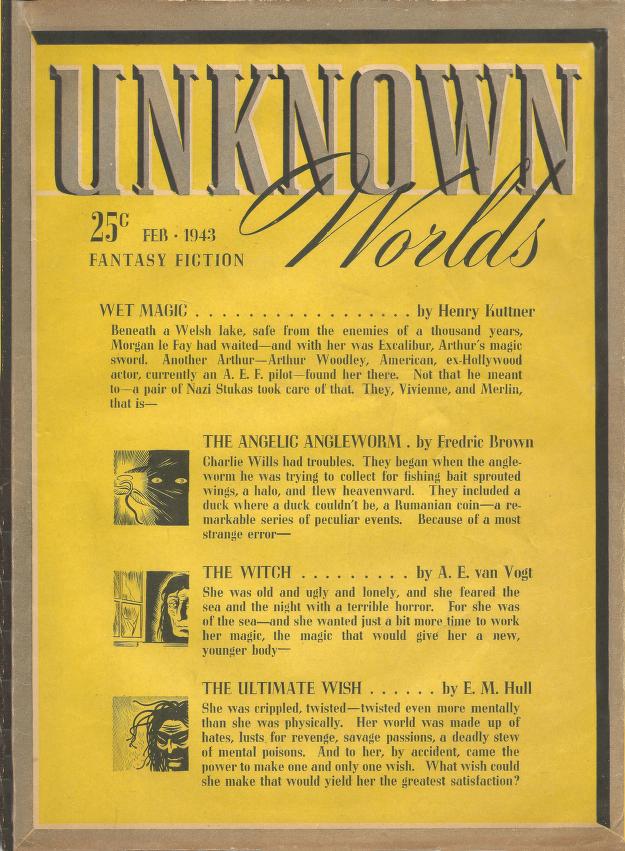
Flipping through the issue of Unknown with James H. Schmitz's "Greenface," a good monster story, I noticed the beautifully gruesome illustrations by Frank Kramer for Anthony Boucher's "They Bite."  A quick look at isfdb indicated that "They Bite" is a widely admired, extensively reprinted story, so I decided to read it, and, to round out a blog post, read two other 1940s horror tales by prominent SF writers, Theodore Sturgeon, whose name I was just bandying about in a blog post about Ballantine's 1960 SF line, and MPorcius fave A. E. van Vogt.

"They Bite" by Anthony Boucher (1943)

Among the many places "They Bite" has been reprinted are an issue of F&SF when Boucher was editing that magazine and the Boucher collection Far and Away which has a striking Powers cover.  I read "They Biite" online in the F&SF version because the scan was sharper than the scan of the 1943 version and thus easier on my 47-year old eyes.

Hugh Tallant is a kind of freelance spy, a guy who collects info and sells it to the highest bidder.  As our story begins he is in the desert of the American SouthWest, surreptitiously observing the goings on at a U.S. Army glider school and making detailed sketches of the latest aircraft developed by the military machine of the land of the free and the home of the brave.  Is Tallant going to sell these sketches to the henchmen of Hitler or Stalin?  Or does he have even bigger plans, of allying with a foreign totalitarian power and being given the job of dictator of North America?

We don't have to worry about Tallant selling us out to the commies or becoming the Fuhrer of a National Socialist USA.  Tallant is staying in a primitive adobe house that the locals of the tiny desert settlement call "the Carker place," and as he sits in a bar they tell him stories of how the place for centuries has been associated with white cannibals who learned magic from local Indians.  And sure enough, the climax of the story takes place on the dirt floor of the Carker place where Tallant must fight for his life against animated mummies only three or four feet tall, and we are led to believe he does not win the fight.

This is a decent horror story, with a good violent sequence at the end with some serious gore.  Before the gore is a well done build up constructed around rumors and old stories about degenerate whites and mysterious nonwhites, the kind of thing you might find in a Lovecraft story (in the same way that we learn that the government launched a raid to deal with the fishpeople of Innsmouth in "Shadow Over Innsmouth" we are told here in "They Bite" that the Army in the past has launched operations to wipe out the Carker cannibals.)  Tallant, like the protagonist of Henry Kuttner's "The Graveyard Rats" or any one of dozens of EC comics stories, is a totally unsympathetic jerk whose evil plans put him at the mercy of an even greater evil.  A skillfully put together example of time-tested horror conventions; I enjoyed it.


"The Witch" by A. E. van Vogt (1943)

Like Boucher's "They Bite," van Vogt's "The Witch" first appeared in John W. Campbell's Unknown and would be reprinted in the 1960 collection Zacherly's Vulture Stew.  (I'm guessing you know who Zacherly is.  Another story that showed up in Zacherly's Vulture Stew was Donald Wolheim's mummy story "Bones," which I read in 2014.)

"The Witch" is also included in the 1948 collection of van Vogt and E. Mayne Hull stories (Hull was our man Van's wife) entitled Out of the Unknown.  I own a 1969 paperback Powell edition of Out of the Unknown and it is interesting to see how van Vogt updated the story for book publication.  For example, the magazine version of "The Witch" takes place in 1942 and the protagonist goes to the "talkies" and reads a "war editorial" in the newspaper.  In the version in Out of the Unknown it is 1948 and the hero goes to the "movies" and that newspaper article is an "anti-communist editorial."

(There are also embarrassing printer's errors in the version in the paperback I own, like one entire paragraph being printed twice, and another paragraph actually missing.  Sad!)

A year ago, Craig Marson's decrepit old great-grandmother, Mother Quigley, came to live with him and his wife Joanna in their cliff-side home.  Little does Marson know that this wretched old bag is a sorceress who has achieved longevity by periodically shifting her consciousness into the body of a lovely young woman and she has her sights on the "slim, lithe, strong body" of his wife!  As our story begins the "first new moon after the summer solstice," the time when Mother Quigley can take over Joanna's hot young bod, is only nine days away!

Marson receives a letter in the mail from one of Mother Quigley's creditors that suggests that the woman living with him is some kind of impostor.  As the nine days pass, Mother Quigley keeps trying to make preparations for casting her soul-shifting spell while Marson keeps uncovering clues suggesting something fishy is going on and trying to convince Joanna that the weird old crone should be sent to the "Old Folks Home" tout suite--when that ploy fails Marson considers murderously drastic measures!  In the end (and I hope all you people who claim Golden Age SF was irredeemably sexist are listening) it is Joanna who uses logic to figure out how to save herself from the witch's machinations. 

1948 hardcover edition
I like stories in which people fight for immortality by any means necessary and switch brains or souls from body to body (remember how much I loved Edmond Hamilton's "The Avenger from Atlantis"?), and I enjoyed "The Witch."  I cannot deny that van Vogt probably has the worst writing style of any writer I actually like, but it doesn't cripple the story--in fact, I think it adds a layer of strangeness and confusion to a story (like most of van Vogt's work) which is intended to be dream-like and mind-boggling.  Throughout the story, Marson, confronted by the reality of a witch in the 20th century, is, "struck dumb" or suffers having "his thought[s] twisted crazily" or fears he is suffering hallucinations, while the witch herself, driven half mad with desire for Joanna's body and fear that Marson will prevent the soul transfer, at one point has a "flare of hope that...nearly wrecked her brain" and is always burning with rage or shaking with fear or wriggling with ecstatic glee--van Vogt's tortured prose forces the reader to endure an inkling of the disordered mental states suffered by these characters.

Thumbs up for "The Witch!"

"The Professor's Teddy-Bear" by Theodore Sturgeon (1948)

"The Professor's Teddy-Bear" first appeared in the 25th anniversary issue of Weird Tales, which is full of stories by major SF figures like Ray Bradbury, Robert Bloch, and Edmond Hamilton.  There's even a poem by H. P. Lovecraft!  This looks like a great issue!  Sturgeon's contribution would go on to be included in the Sturgeon collection E Pluribus Unicorn and various anthologies of stories about monsters and The Devil.  I read a scan of the original Weird Tales appearance.

"The Professor's Teddy-Bear" is a surreal piece of work, short and a little disturbing.  A child of four years, Jeremy, has a toy teddy bear which is a demon.  The demon talks to him when he is alone in bed, helps Jeremy cast his mind into his own future.  Jeremy will be a college professor who lectures on Greek philosophy, and four-year-old Jeremy recites the lectures to the demon--the demon derives sustenance from hearing these lectures in a bizarre and you might say disgusting fashion.

Jeremy can not only witness his own future, but manipulate it in esoteric ways.  Guided by the demon, Jeremy, with the power of his mind, causes deadly accidents to occur to people his future self sees, e.g., making a girl's roller skates fail so she falls under the wheels of a moving truck, or making a man trip and fall into a deep hole at a construction site.  Little Jeremy and the demon consider these accidents to be very amusing.

Switching back and forth between Jeremy's corrupted childhood and his lonely career as a middle-aged professor, Sturgeon describes the influence each period exercises on the other as well as the evolution of Jeremy's relationship with the demon and his attitude towards his strange powers.

"The Professor's Teddy-Bear" feels original, and is quite effective.

**********

Three entertaining horror tales--Boucher's is sort of traditional but very well done, Sturgeon's is novel, and van Vogt's is characteristic of its author.  This was so fun I think we'll read more 1940s weird horror stories in the next episode of MPorcius Fiction Log.