Tuesday, January 17, 2023

War with the Gizmos by Murray Leinster

Telephones hummed; short-waves flickered through darkness.  A voice said authoritatively that it was a Gizmo, meaning a radar blip with no known cause except a belief that it was an area of extra-high ionization in the air.  But it was the great-grandfather of all Gizmos. 

Avid followers of the endless quest that is MPorcius Fiction Log are likely aware that we have read quite a number of stories by Murray Leinster in the last few years.  Here’s a list of some 1930s stories by Leinster I have blogged about with links to my scribblings about them:

With that advertising behind us, now to the main event, a novel by Leinster that was printed over 20 years after all those stories were presented to readers of Weird Tales, Collier's and Astounding, 1958’s War with the Gizmos.  My copy of the 35 cent Gold Medal edition has a terrific Richard Powers cover with beautiful colors and queer mysterious shapes.  The same year it appeared in this form, a version of the novel was published in Satellite Science Fiction as “The Strange Invasion,” which you can read for free at the internet archive.  After reading my paperback I took a look at a page of the scan of the magazine and found it substantially different than the book version.  War with the Gizmos/"The Strange Invasion" was something of a success, appearing in multiple European editions.

I'd always used "gizmos" as a sort of synonym for "gadgets," but Leinster quickly informs us that "gizmo" is the slang term applied by radar operators and pilots to blips on a radar screen which do not correspond to any visual phenomena and are presumed to be caused by something invisible and harmless, like "excess ionization of the air."  The basic conceit of Leinster's novel is that at least some of these blips are living creatures made entirely of transparent gas, predators who suffocate their prey by covering their mouths and nostrils and suffocating them, and then feed off the gases produced by putrefaction of the corpse.  War with the Gizmos chronicles the story of how in the middle of the 20th century the gizmos suddenly grew in number and began attacking human beings on a large scale.

War with the Gizmos is sort of reminiscent of those science fiction disaster stories like Edmond Hamilton's "The Polar Doom" or Donald Wandrei's "The Blinding Shadow" that read  like popular histories from the future that offer a narrative of a large-scale cataclysmic event of the past and are characterized by journalistic detachment and the integration of a wealth of brief illustrative episodes from a variety of locations.  War with the Gizmos is also an example of the SF story that provides explanations for elements of ancient literature and religion, like C. L. Moore's famous "Shambleau," which explains the source material of the story of Medusa the Gorgon, and Hamilton's A Yank in Valhalla, in which we learn the origin of Norse mythology.  The Gizmos, you see, inspired the human belief in ghosts, demons and pagan gods, as well as such superstitious traditions as the use of herbs against evil spirits by West African witch doctors and the use of garlic to ward off vampires--strong smells of these sorts are actually of some value in deterring attack from Gizmos.

While we do witness Gizmo activity from all over the United States, most of Leinster's text concerns three people who meet in the mountains of western Virginia: Dick Lane, a journalist who writes for the outdoorsman's magazine Forest and Field; Professor Ann Warren, a woman biologist of mature age known for her eccentric theories; and the prof's pretty niece, Carol.  Lane is investigating the mysterious deaths of animals in the area when he runs into Warren and Carol, who are doing field work and have noticed some of the same weird phenomena as Lane.  Lane is one of the first humans attacked by the Gizmos, and soon he and the women are confined to Warren's trailer, besieged by the invisible monsters.  The Gizmos capture them briefly, but our heroes learn how to fight the monsters and escape, and then travel towards civilization, striving to reach either Washington where Warren has academic colleagues or a pharmaceutical company in New Jersey that employs a friend of Lane's; as they travel they fight Gizmos they encounter and try to raise awareness of the peril faced by the still unsuspecting human race and possible defensive measures.  These three educated middle-class types are brave and competent, but their party is joined by a fourth, the working-class man Burke, who serves as a foil for them; Burke suffers delusions of grandeur, is stricken with fear and commits blunders, earning the contempt and derision of the three heroes.

One of the themes of the novel is the inability of people, including (and maybe especially) scientists, to accept and assimilate new information.  People refuse to believe in the reality of murderous gas creatures, instead suspecting a disease is causing the mysterious deaths and imposing quarantine measures; at the same time vocal minorities blame the Soviet Union or alien invaders when a massive radar blip appears over Chicago right before an episode of mass death among livestock in the Windy City.  A man whom Lane rescues from a Gizmo is positive his near-suffocation was not the result of a monster attack but of a heart attack and insists on seeing a doctor.  Warren is enraged when her academic colleagues ignore her theories and when a newspaper interview of her is given a skeptical headline.  Eventually, though, our heroes get evidence of the truth through to the authorities, who, with the  info Land and Warren provide, develop means to defeat the Gizmo menace; as the story ends we learn Lane and Carol will get engaged.  

War with the Gizmos is mediocre filler.  The basic concepts and plot are serviceable, but Leinster's writing is weak.  For one thing, the prose style reminded me of that of a book intended for juveniles.  Worse, the characters lack personality and the action scenes and chase scenes, of which there are many, felt long and laborious.  Quite a bit of text is devoted to debates among the four main characters: are the gizmos animals who act on instinct or intelligent beings who are pursuing a grand strategy and developing tactics in response to changing human tactics?  Are the gizmos terrestrial or alien in origin?  These debates feel divorced from the drama of the war because they are academic--the human response to the gizmos is not affected by how intelligent the gizmos are or what planet they hail from.  Neither these debates nor the actual fighting and chases spark any emotion, any thrills or suspense, merely a mild curiosity.

Not embarrassingly bad, but not memorable, either.

Saturday, January 14, 2023

Robert Bloch: "The Show Must Go On," "Daybroke," "Show Biz," "The Masterpiece," and "Dig That Crazy Grave!"

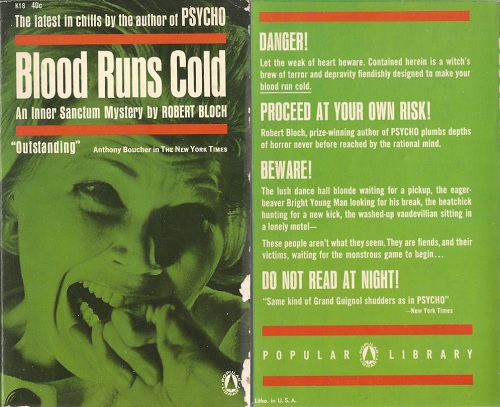
At the Antiques Crossroads antiques mall in Hagerstown, MD, I purchased for five bucks a somewhat brittle copy of the 1963 paperback edition of Robert Bloch's Blood Runs Cold, a collection of 17 stories.  I like the green cover, but the main reason I was willing to spring for it is that I doubted some of the stories were readily available at the internet archive.  

Blood Runs Cold was first printed in 1961 as a hardcover in the Simon & Schuster Inner Sanctum Mystery series, and "Inner Sanctum Mystery," as well as a blurb from Anthony Boucher and a reference to Psycho, appears on the cover of my copy.  On the first page of the volume, under the hint that the book is full of nasty sex, is a fun warning, the publisher disclaiming all responsibility for shocks readers may suffer!  

We'll be reading the contents of Blood Runs Cold here at MPorcius Fiction Log over three blog posts.  We've actually already read in other venues three of the stories that the collection reprints: "The Cure" (I said it was competent but marred by a pun ending) and "I Like Blondes" (I called it silly) in Playboy, and "Word of Honor" in The Playboy Book of Science Fiction and Fantasy (I judged it "Acceptable.")  That leaves fourteen tales from detective magazines, SF magazines, and men's magazines for us to investigate, and we will grapple with five of them today.

"The Show Must Go On" (1960)

"The Show Must Go On" made its debut in Mike Shayne Mystery Magazine, in an issue with a good cover with a bold composition and strong use of color.   

It is intermission!  An actor goes to the bar by the theatre--a drink will help him prepare for the big role he is to play after intermission.  A man confronts the actor, jabbing a gun into his stomach and claiming the actor impregnated his daughter!  The angry father comes to think the actor is mentally ill, and decides not to pull the trigger.  The actor hurries off to the theatre, and we get our groan-inducing trick ending--the actor is John Wilkes Booth and the tough role he is about to play is that of murderer of President Lincoln! 

(Bloch of course is fascinated by famous murderers of the past, like Lizzie Borden--see "Lizzie Borden Took an Axe..."--and Jack the Ripper--see "The Hungry Eye.")   

I was particularly disappointed by the gimmicky ending because Bloch did a good job with the confrontation with the angry father and with the portrayal of a love 'em and leave 'em cad of an actor--the enraged man's daughter is named "Livvie" and the callous Booth actually calls her "Lizzie," having banged so many chicks he can't even remember all of them, which I thought was pretty funny.

I'll call this acceptable filler.  I don't know enough about Booth and the assassination of Lincoln to know how much of this story is based on the truth and how much Bloch just made up--did Booth really take a drink at a bar before the attack?  Was there a real Livvie?  Maybe people who have read Lincoln biographies would have known from early on what was going on, but I was surprised on the last page, as I didn't spot any clues as to time period or location or anything.

"Daybroke" (1958)

"Daybroke" made its debut in the one and only issue of Star Science Fiction, a magazine edited by Frederik Pohl and which was blessed to have as art director Richard Powers.  I wrote a few lines about Star Science Fiction when we talked about one of its stories, Brian Aldiss's "Judas Dance."  Pohl liked "Daybroke" enough that he included it in Star of Stars, the book showcasing the stories he felt best from the Star anthologies and this lone magazine issue, as well as in The Science Fiction Roll of Honor.

It is easy to see why Fred Pohl, alumnus of the Young Communist League, would like "Daybroke": it is an attack on America's corrupt consumer society!  (We've seen Bloch's attacks on our society before; "The Funnel of God" is perhaps the most memorable.)  A rich guy has set up a bunker sheathed in lead in a mountain overlooking an unnamed American city.  He stays there alone because he fears nuclear war.  Sure enough, the war comes!  The city below is hit!  Our protagonist then dons his special armored suit and goes out to explore the devastation.  Bloch details all the things he sees as he passes through the countryside, the suburbs, and then into the city, where there are surviving civilians looting and surviving servicemen guarding an official building, in which sits a general, who expresses satisfaction that the United States has won the war. 

There isn't much plot to "Daybroke;" mostly the story is a list of the dead people and destroyed property the protagonist sees and the attendant easy symbolism--e.g., the breaking of statues of Hope, Faith and Charity have revealed them to be hollow--and Bloch's implied or just explicitly stated complaints about the citizenry of these United States: we care more about cars than each other, more about sports than the high arts, more about celebrities than our own spouses, and on and on.  We also have to endure Bloch's wordplay; e.g., when the armored survivor looks upon the ruined vehicles on a highway, we get three car puns--sample: "The Dodges no longer dodged"--and three alliterative car phrases--sample: "bodies of Buicks."  An artist was killed while painting, and we are told his remains are spread on a canvas "as though the artist had finally succeeded in putting something of himself into his picture...."  Bloch stretches our credulity by having the effects of the bombing be whatever facilitates the creation of his symbolical tableaus; some people are decapitated by the blast, others are reduced to ooze, others are frozen standing in place, still others have their clothes stripped off so they are naked.  

Tedious and lame red meat for those who have contempt for the American people and think the US is no better than the Soviet Union, though maybe even they will feel Bloch's pathetic jokes undermine his "message."   


"Show Biz" (1959)

Another lame story expressing Bloch's complaints about American society, but whereas "Daybroke" had many complaints and many jokes, "Show Biz" has one complaint and one joke!  

The head of a PR firm meets with a college professor after the latter's repeated requests for a clandestine meeting.  Prof tells PR man that he has devised a blueprint for a scheme by which Hollywood and Madison Avenue types can use professional actors, cinema and advertising techniques, and psychological manipulation to take over America and then the world.  The PR exec murders the prof because his firm has already been doing just that and they don't want any competition. 

Lame filler. 

This banal criticism of the American voter debuted in Ellery Queen Mystery Magazine and Cynthia Mason and Charles Ardai saw fit to include it in Future Crime, even though it doesn't really feel like it fits the criteria of a mystery or a depiction of the future.


"The Masterpiece" (1960)

This is the story from which the first page of the book gets its come-on line, "She lay naked on the bed," though the actual text of "The Masterpiece" has "She lay naked upon the bed...."  This is actually an entertaining crime story: no dumb jokes, little social criticism, short and to the point.

An old guy who lives in poverty in Argentina explains to us the tragic tale of his life.  He was an artist in Paris with a super sexy girlfriend.  Girlfriend had some shortcomings, some weaknesses, like a weak heart and an irrational fear of insects.  Oh, yeah, and she also loved money, and cheated on the narrator with a fat rich guy, Max, and eventually ran away with the obese moneybags.  The narrator achieved his vengeance by sneaking up on the young lady as she lay naked awaiting her wealthy lover and binding her.  Then he poured a box of spiders on her!  The girl died of fright because she saw on the spiders' bodies the red hourglass of the black widow!  The twist ending--our narrator painted those hourglasses on the little spiders, which were in fact harmless to humans! 

A possible problem with the story is posed by the fact that Wikipedia doesn't list France as a native habitat of black widows.  Oops!  Another thing about the story perhaps worth noting is that it suggests Bloch hates modern abstract art; the narrator painted portraits and other realistic canvases and despises Max for following fashion and collecting abstract painting.  (Bloch hints that he disdains abstract art in "Daybroke" as well.)     

After its debut in a copy of Rogue with a somewhat repellent cover, "The Masterpiece" was included by Josh Pacter in his anthology Top Horror, which it seems was published three times without Pacter's name appearing on the cover.


"Dig That Crazy Grave!" (1957)

Oh no, a story the very title of which is a weak joke!  Well, this is the longest story we'll be reading today, so maybe it provides Bloch the space to develop real characters and a real plot and not just lame jokes and some tired criticisms of society.  

“Dig That Crazy Grave!” is about jazz!  We’ve read quite a few stories about jazz recently, and they often include crazy metaphors and surreal images that struggle to convey to readers how really good jazz makes you feel.  Bloch steps up to the plate and takes swings like this one:

…dreams, when the statues come alive and move, and the great hands from the sky reach down and pluck at your entrails like a bass….

We also get the suggestion from the story's main character, a college professor, that the face of the leader of the story's jazz band as he bangs the drums, a “face that was almost blank with inner concentration,” bears the same expression he has seen on “the faces of women during ecstasy.”  Bloch likens listening to good jazz to having sex, the band “playing the audience like an instrument,” making the audience “moan the long moan of the cat on the oh-so-cool tin roof.” 

This might make jazz sound awesome, but Bloch has come not to praise jazz, but to bury it!  The college prof is writing a book on the sociological aspects of jazz—how jazz musicians and fans are a distinct self-selected subculture with their own lingo and so on—and he takes his girlfriend Dorothy on a date to see JoJo Jones and his band.  Dorothy is a jazz skeptic—she sees that the jazz musicians are phonies, their outfits and slang just a sham to appeal to the public.  But soon JoJo has won Dorothy over to the cause of jazz, and she is sitting on the stage every night as his band performs, “letting the crowd pour over onto” her.  Dorothy herself becomes artificial and phony and sexually licentious, wearing tons of make up and a dress that reveals plenty of cleavage and growing her fingernails into long painted talons.

Dorothy also joins the band in smoking pot (Bloch employs some slang for smoking marijuana that I haven’t heard before, like “taking a charge.”)  When the prof now hears jazz he realizes it is “noise, an animal bleating, savage and senseless,” a magic spell used by the sorcerer to control his worshipers, and sees the jazz musicians as being like vampires as they feed on the energy of the audience.  The musicians shoot Dorothy full of “H,” hoping to give her more energy upon which to feed, but she can’t handle the drug and dies.  The prof finds Dorothy’s body and the jazzmen decide they have to kill him as well to hide the disaster from the police.

I think “Dig That Crazy Grave!” is pretty good.  The structure and pacing and all that are good, and the idea of seductive weirdos stealing your girlfriend is an effective basis for a story.  Bloch’s social criticism here—jazz and drugs are low forms of entertainment that appeal to the basest parts of us and are quite dangerous—may be out of tune with our times and a little hypocritical coming from a writer who makes his money appealing to readers’ lust for sex and blood, but Bloch actually illustrates and explores these ideas and integrates them into a story in which characters have a narrative arc and change over time—he doesn’t just give us a long laundry list of banal gripes like he does in “Funnel of God” and “Daybroke.”  I also have to admit that I sympathize with Bloch’s hostility to artifice and phoniness—I myself find cosmetics and long painted nails disgusting and depressing.  Finally, let me note that while I often complain about Bloch’s wordplay, in this story the puns and slang are put into the mouths of the characters, mostly the villains, and add to the atmosphere and buttress the themes of the tale instead of detracting from them.

"Dig That Crazy Grave!" debuted in Ellery Queen's Mystery Magazine, where we see Bloch's name on the sexalicious woman-in-peril cover. I may have liked it, but it looks like its attacks on jazz, drugs, and cosmetics (which one might see as veiled attacks on the personalities and contributions to our culture of women and black people, though all the story's characters are white) didn’t appeal to editors; according to isfdb, “Dig That Crazy Grave!” has not appeared in any other Bloch collection and has never been anthologized.

**********

Five characteristic Bloch stories, two of which I liked.  Not a stellar ratio, but if we measure by page count it looks a little better.  We'll tackle more tales from Blood Runs Cold soon, but first, a SF novel from the 1950s.       

Wednesday, January 11, 2023

Algorithm by Jean Mark Gawron

Would the assassin strike as per instructions?  If, as some seemed to think, he was a mathematical entity, an alternate syntax, an indeterminate component in a suddenly altered system, then he would.  Do you understand, Guillemet?  No, Guillemet did not understand, but understanding was not called for.

I purchased 1978's Algorithm, a novel by Jean Mark Gawron, for a pittance partly because I liked the cover illustration, which brought to mind those lines from "Helpless Dancer," "And in the battle on the streets/You fight computers and receipts," and because of the blurb from Samuel R. Delany, an interesting character and an important member of the SF community--though it seems not important enough for the goofballs at Berkley to make sure his name was spelled correctly on the cover of this book dedicated to him by his pal Gawron!  Embarrassing!

(Remember when we read some of Delany's porn--wow, that was really something.  More respectable and impressive as literature was Triton, but it had its own share of illegal-at-time-of-printing sex, didn't it?) 

Well, whether we have Pete Townshend or "Chip" Delany to credit for embarking on this adventure, let's hop to it and read Algorithm, a 211-page novel by a guy who is, apparently, an expert on Eastern languages and computers.

It is the spacefaring future, and Earth is a minor component of an interstellar civilization, a little place the economy of which relies largely on tourism from offworlders and has practically no police or government.  A couple of decades ago a powerful Federation of seven worlds more prosperous and influential than Earth sent a ship full of mercenaries to take over Earth, but the effort was an abortive failure and some of the surviving mercenaries settled down on this big blue marble after their employers abandoned them.  Our protagonist is one of these immigrants, Danton, a black man with ugly teeth.  Danton is a major celebrity, a writer whose verse and fiction are astoundingly popular, and the idol of the black leather clad motorcycle riding subculture of hipsters called Proets.

Danton is at the center of a mysterious intrigue like something out of a Batman story.  The media has received from an unknown party a somewhat cryptic message apparently indicating that there is an assassin on Earth, and that he will slay one of the twenty-five people whose portrait photos accompany the mysterious message.  The message hints that the people of Earth may choose who of the twenty-five will be killed.  Two of the twenty-five people pictured are famous celebrities, one of them Danton, the other a fabulously wealthy businesswoman, the Wunderdamen.  The Wunderdamen owns an artificial island out in the Atlantic, twenty miles from New York City, named Monotony; Monotony is a sort of amusement park and tourist trap with the worlds' finest brothel as well as performance space for the Proets, and most of the novel takes place on the island.

The assassin story dominates the news cycle and public attention, as well as the attention of the world's creative elite.  Everybody speculates on the assassin's identity, when, how and who he will strike; some are not even sure he is real at all, and  many suspect the assassin, hoax or not, is a ploy by the Federation to offer an excuse or pretext for another attempt to conquer Earth.  Dozens of attention-seekers who are suffering mental illnesses come forward claiming to be the assassin.  All the Proets write poems and plays about the mysterious assassin, and the Wunderdamen declares a Carnival on Monotony dedicated to the theme of the assassin--many of the characters spend most of the book dressed in wacky costumes, attending the Carnival festivities.

The Wunderdamen's chief of security, a woman nearly seven feet tall named Guillemet, is selected as the lead figure of the Carnival, like the queen or the grand marshal or whatever, but with the title of "victim."  Guillemet is probably the second or third most important character in Algorithm, after Danton and the Wunderdamen, and she has to do the actual risky work involved in the Wunderdamen and Danton's scheme to figure out if the assassin is real, and command the effort to ambush him if he is. 

Algorithm has many additional characters, all of them suspects and potential victims, and most of them get killed.  Gawron gives each of these characters, most of them creative types, a distinct look and a mysterious backstory, but doesn't give them particularly interesting things to do; mostly they make allegedly witty remarks, philosophize, and strike poses--they certainly don't exhibit emotion in a compelling or entertaining way; mostly they are sad or tired, not in a tragic way that moves the reader, but in the performative way of mopey art school kids.  The characters also lack compelling relationships with each other--they are all standoffish and distant, too-cool-for-school, meaning they have weak motivations that inspire little interest in the reader.  Among these flashy but ultimately flat secondary characters are a man whose skin is as reflective as a mirror and who walks around naked, attracting attention but not engaging much with others; a young poet early in his career who also works as a prostitute at the Wunderdamen's brothel; and a TV news anchor who is also a juggler who will whip out his balls and start juggling in order to get attention or just kill time.  Perhaps the most well-rounded and interesting character in Algorithm is an apparently intelligent and conscious computer.  The computer can't open its eyes wide or hold its head in its hands to express surprise or misery the way the human characters can, so, in its efforts to emulate humanity, it includes in its lengthy stretches of dialogue stage directions describing such actions, Gawron drawing attention to the performative nature of all his characters' emotions.

(Another sign of the characters' essential artificiality comes when a minor character remarks that the Proets are always seen hanging around their motorcycles, but never riding them.)     

As the novel proceeds many of the characters get killed, people's theories of who the assassin is and what he will do are proven wrong, and we get fragmentary descriptions of the life and theories of Novak, a scientist whose sex and sexual orientation Gawron deliberately keeps mysterious for much of the book, the individual who revolutionized human life and made space travel possible by "bridging" the "strange gap between microsystems" (exemplified by the electron, the movements of which are unpredictable) and "macrosystems" (exemplified by billiard balls on a pool table, whose movements can be predicted.)  There are a few fight scenes and chase scenes and scenes of suspense in which a character holds a gun on another character and we don't know what is going to happen, but these scenes are kind of hard to follow and not very exciting, in part because we don't care if any of these bland and fake characters gets killed.  The characters use logic and math and science and technology to try to solve the problem presented by the assassin, and figure out other related mysteries, like how the mercenaries got defeated by a planet with no regular government, but without success.  Algorithm is a record of a long series of failures, a long tale of futility, and the fact that so few conclusions are reached make it a frustrating and unsatisfying read. 

In the final chapter the Wunderdamen has long talks featuring digressions about the nature of communication with the all-seeing computer she putatively owns and we get hints of what is really going on, the true nature of Novak, and how responsible this sad and lonely machine is for whatever is going on. 

"How is it we speak?  How is it that language touches home?  How can we understand one another, as you have promised, when I have never walked in spring rain, pined after an ephebe, or snorted cocaine?"

The last chapter of the novel's five also features a final public performance which includes a metaphorical resurrection, and more characters, including the sad computer, being killed.  Then the Wunderdamen leaves Earth, apparently to negotiate the surrender of Earth to the Federation.  At the bottom of the last page we see the dates "Paris '73/New York '76," I guess Gawron reminding those of us languishing in the countryside among the cows and goats that he is living it up in major world cities among all the smarty smarts.

A big theme of Algorithm is our inability to really understand our environment and our universe, our inability to acquire reliable knowledge and experience certainty, and there are many examples of characters who can't tell their dreams from reality, can't distinguish lies and the truth, mistake a person for another person, hear voices but can't recognize the speaker or discern the words, conceal their identities and histories, and so on.  Near the very start of the novel Danton has to navigate through a building built by a famous master architect who has integrated into the building energy fields that alter light so that it is hard to distinguish right from left, rendering the building a labyrinth, and that is just the first of multiple scenes of people trying to make their way through mazes.  Much of the novel's text is made up of long speeches and lengthy stretches of allegedly clever dialogue, and much of it illustrates or expounds on this theme of unreliable knowledge and total ignorance.  We get from Danton in the first chapter this academic jabber:

"Novak's Equations have laid bare our logical systems and called forth from them new truths.  They have shown us that a grammar is a grammar only when traced through the framework of its home system.  Failure to recognize a change of system leads to apprehension by an old and inadequate grammar, to systematically produced nonsense."

Later, one of the mental cases who claims to be the assassin relates his experience with his therapist:

"She said that the madness was signaling something here, not in anything I said, but in the method I was using, that in this method was something of the way the madness worked to maintain my certainties of things which were not at all certain--by making certainty a constantly shifting mood."

Still later, he says

"But how do you know that that monster doesn't exist when you aren't even sure what the Juggler means by a monster?"

Algorithm is also about cultural production, about the creation of art and the transmission of curated information.  There are many oblique references to literature and pop culture: a woman's big pet dog is called the Questing Beast; the conscious computer diagnoses itself as healthy because it can still sing "Daisy," and later uses the word "kimosabe;" in its final speech the computer refers to Frankenstein and Pinocchio.  Many of the characters are artists or creators or patrons of one sort or another, and we have many scenes depicting in detail movies the characters watch, photographs they look at, poetry readings they attend, dance performances they witness, the workings of what amount to high tech art installations, and so forth.  I am going to go out on a limb and say that Gawron doesn't mean for us to like these works of art or be impressed by them.  As if Gawron is teasing us, multiple times his characters, after the author has inflicted upon us a long speech or a long description of some artistic production, express their boredom or weariness.  I think maybe Gawron means to suggest that all these performances are not a reflection of vitality but of its opposite, decadence.

A central support of my theory is the dialogue of a diplomat from off world.  He condemns the Earth  characters' response to the message from the assassin, saying that Earthers aren't taking the problem of the assassin, as they are all the problems facing Earth, seriously; instead, the people of Earth are treating the apparent appearance of as assassin as just another spectacle and as raw material for their derivative art works.  The diplomat points out how partygoers didn't rush to help a fellow reveler who fell off a rafter and cracked his skull, and calls Earth people "a race of watchers" and accuses the Proets and those who hang around them of being "passive observers in an affair that should deeply concern you...."  He expands his analysis, saying that Earth is in the midst of a media age in which the ability to experience events at a distance through mediating art forms has atrophied people's ability to respond to events directly and authentically.  An addiction to fictional depictions and long distance recordings of, say, war and violence, has left people unable to respond appropriately to real war and real violence, and a society of such people will be unable to deal with challenges and will thus fail.

So, I'm interpreting Algorithm as a comment on or satire of the kind of creative people Gawron, a college professor, is presumably very familiar with, and of our society of TV watchers and magazine readers as a whole--the omnipresence of art and media has left us unable to deal with real problems, problems which, ironically, are the very topics of our fiction and the very source material of our media--we watch lots of fiction and news reports on the TV about war and politics and crime, but this perhaps paradoxically makes us less able to deal with the real problems of maintaining order and defending our freedoms internationally and domestically.

Gawron's themes are not bad, but, seeing as this book is mostly conversations between hipsters and very lengthy descriptions of hoighty-toighty avant garde performances, it feels long and slow.  (Delany's claim on the cover that it is a "breakneck chase" is mindboggling...perhaps Delany is playing with the book's themes, offering a totally misleading assessment in a nod to the book's theme of how difficult it is to acquire accurate information.)  I've already expressed my unhappiness with the action scenes and with the characters.  Algorithm may be a smart book by a smart guy who has a lot of knowledge, but reading it was a chore rather than a pleasure, and in the end I hadn't gained any kind of insight or experienced any sort of catharsis as a reward for grinding through its 211 pages.  Maybe if I was as intelligent and as well-read as Samuel R. Delany I would have enjoyed it, but MPorcius Fiction Log has to give to Algorithm a thumbs down.

Sunday, January 8, 2023

Strange Stories, Oct '39: G & R Cummings, R Bloch, A Derleth, M W Wellman and C Jacobi

The good people who put out Startling Stories and Thrilling Wonder Stories had another arrow in their quiver in the years 1939-1941, during that period tempting the magazine-reading public with thirteen issues of Strange Stories.  Let's surf on over to the internet archive and check out the October 1939 number, which features five pieces by people, most of them Weird Tales regulars, with whom we at MPorcius Fiction Log have some familiarity.

"The Cult of the Dead" by Gabrielle and Ray Cummings 

Remember August 2018, when I read eleven short stories and three novels by Ray Cummings?  Wow, we've had some real adventures at this blog, haven't we?  Here are links so you can effortlessly relive those happy days!

"Perfume of Dark Desire," "When the Werewolf Howls," "Corpses from Canvas," "Forked Horror," and "I Am the Tiger Girl" 

"Arton's Metal," "The Thought-Woman," and "Personality Plus"  

"Magnus' Disintegrator," "Almost Human" and "Aerita of the Light Country" 

Tama of the Light Country

Tama, Princess of Mercury

A Brand New World

That's enough advertising for today--let's get to the matter at hand, "The Cult of the Dead," which appears in Strange Stories under the pen name Gabriel Wilson, which I am told is a pseudonym applied to works on which Ray Cummings and his second wife, Gabrielle Wilson, collaborated.

This story takes place during the American occupation of Haiti.  Our narrator lives at his villa in Haiti, and is friends with a local physician, Dr. Bané, a highly respected black man who is not personally involved in necromancy or voodoo or other occult phenomena, but is very familiar with such practices, which are prevalent across the troubled island nation.  The narrator's nephew, Harry, a journalist, comes from New York for an extended visit, intent on learning all about the religion and sorcery of Haiti and getting a scoop that will make his career.  His uncle and that kindly doctor warn him not to get mixed up in esoteric local customs, as it could be dangerous, but they also feed his fascination.  The narrator has a huge library of occult books which Harry devours, and Dr. Bané tells the young newshound some thrilling accounts of magic in Haiti.  For example, the story of a woman whose father was murdered, who wore as a talisman a severed human hand; when her father's killer came after her, the hand defended her, slaying the assassin and securing justice.  

After absorbing all this second-hand knowledge, Harry sets out to get some firsthand experience, dyeing his skin black and donning native garb and sneaking into a necromantic ritual attended by a hundred Haitians and presided over by a guy in smoked goggles and a top hat.  When the narrator learns of this he rushes over to the ceremony, recognizing the danger Harry is in, and the cultists, knowing the narrator is a friend of Dr. Bané, take the unprecedented step of allowing a white man to attend their ceremony.

While the narrator watches, his reckless nephew snaps a photo with a flash bulb, disrupting the ceremony, and one of the severed hands that is part and parcel of this necromantic ritual strangles Harry to death.  (How many times do I have to tell people not to leave New York?)  The narrator can't do much to help Harry because, in the middle of the excitement, his malaria acts up.  

"The Cult of the Dead" has the kind of standard plot that will work in the hands of a skilled and conscientious writer, but I have to give it a thumbs down because the story is poorly written.  Many sentences are clumsy, words are used in unconventional ways, and there are what I consider punctuation errors.  In my career on the fringes of academia I have had to copyedit and proofread many rough drafts by more or less competent writers as well as many assignments by students for whom English is a second language, and reading "The Cult of the Dead" was like reading one of those things--I was rewriting every second or third sentence in my head, which is not something I enjoy doing for free.  If the Cummings had revised this thing, or an editor at Strange Stories had rolled up his sleeves and done some real work on it, I would have probably judged it acceptable or marginally good, but as it stands I cannot give it a passing grade.

"The Cult of the Dead" does not seem to have ever been reprinted.

"He Waits Beneath the Sea" by Robert Bloch

This one appears under the pseudonym Tarleton Fiske, a pen name used by Bloch on quite a few occasions.  it would be nearly sixty years before "He Waits Beneath the Sea" would be reprinted under its author's true name, in Arkham House's 1998 Flowers from the Moon and Other Lunacies.

Bloch starts his story with a little joke I guess directed at science fiction fans.  A young scientist kisses his girlfriend, and we are told it is a scientific kiss, conducted with expertise and efficiency.  I expected this jape to presage a series of such jokes, but there aren't any more, and in fact the story that follows is quite gruesome; I am entertaining a theory that this little bit of humor hints at a theme of the story that Bloch didn't really flesh out, an argument that a full person and a full life require passion and feeling as well as logic and intelligence.

Ames is the scientist, and I guess his young lady, Jean, is also a scientist, or at least a hanger on of scientists; the two lovers are aboard the submarine of a scientific expedition headed by Jean's scientist uncle, taking a break from scientific work to make out in the privacy of an otherwise untenanted chamber.  The sub is resting on the ocean floor, but as our hero and heroine are sucking face it inexplicably descends radically and erratically, somehow drawn down into an unexpected fissure.  When the boat finally comes to rest, Ames opens the chamber door to find the rest of the sub has been totally wrecked, all their comrades presumably killed; even more strangely, Ames can smell fresh air and see light coming through the holes in the hull!

"He Who Waits Beneath the Sea" is kind of like one of those Edmond Hamilton or Henry Kuttner adventures in which a guy is transported to some weird place where he ends up fighting with a sword.  Ames and Jean find that the incapacitated research sub is shipwrecked in an underground world beneath the waves; littering the floors of all the caverns and tunnels they explore are the corpses of sailors, men from all periods of history and representing all races.  From the body of a Roman soldier Ames picks up a sword, its edge still keen after over a thousand years, which is lucky for him and Jean, because some of the many corpses laying around spring to life and attack them!  In this tale of horror Bloch offers readers many grotesque images, and we are treated here to descriptions of slimy headless bodies grappling with our heroes and being hacked to pieces by the horrified surface dwellers.

Some of Bloch's descriptions could get him into deep doo doo today.  Ames and Jean's most fearsome assailant is the animated corpse of a large naked black man whose legs were lost at some point in his tragic history.  This menacing figure, whose "snarling African face" is also described as a "bestial countenance," propels himself on his "ape-like arms" and snatches Jean, and then, when Ames strikes him with the Roman sword, drops the woman to start strangling Ames.  The resourceful Jean picks up the sword and decapitates the cadaver of color.  (There is the idea abroad that women in old pulp magazines who aren't femmes fatale are all damsels in distress that need to be saved by men, but Jean saves Ames more than once in this story--she is right there in the thick of things, wielding a sword and operating machinery as need be.)  Ames comes back from the brink of unconsciousness as the hands around his throat relax, but the African's head speaks to them, foreshadowing later developments in the story.

Eventually, Ames and Jean meet the last survivor of an advanced civilization that throve far below the Earth's surface for millions of years; a few thousand years ago this race evolved into bodiless beings of pure intelligence!  These beings of pure energy, having lost all connection to the material world, became decadent and forgot all the science knowledge and engineering techniques they had amassed, with the exception of the wisest among their number, this particular individual whom Ames and Jean have met.  After all his fellows had expired, during the heyday of Atlantis, this sole survivor began the long term project of figuring out how to animate the dead bodies of sailors and then forming from them an army and navy with which to conquer the surface world.  His zombie slaves have built a fleet of submarines and for the last few hundred years the bodiless being has been waiting for the fortuitous arrival of an undamaged human body into which to pour his own consciousness.  Such a body has finally arrived--that of the young and healthy Jean!

Overcoming various obstacles, including a fight with the animated corpse of Jean's uncle, Ames and Jean destroy the energy being and escape in one of its submarines, saving themselves and the surface world that you and I call home.

I like the plot of "He Waits Beneath the Sea" and the gore is effective, but this story has problems similar to those in the Cummings' "The Cult of the Dead," poor sentences and errors which some revising or editing could have fixed.  One example is that the ancient intelligence laughs at Ames when the scientist threatens him, and then remarks that he has never laughed before, because a being of pure intelligence has no emotions.  The problem with this is that the decapitated head of the legless black giant laughed at them a few pages ago, right before the ancient intelligence explained that it animated the dead bodies by injecting a small part of its intelligence into them.  A similar niggling issue is that the energy entity explains that it uses a powerful magnet to draw ships down into the fissure, but most of the dead sailors we see are from wooden ships.  

Bloch's story has fewer such problems than the Cummings', however, and the plot and action are more entertaining, so I'm grading this one OK.  

(A side note.  A scan of Flowers from the Moon and Other Lunacies is available at the internet archive, world's greatest website, and I looked at the text there of "He Waits Beneath the Sea" to see if there had been any obvious revisions; specifically, I checked to see if "ape-like arms" and "bestial countenance" were still there.  They were there alright, but there was a change that caught my eye.  Where the scan of Strange Stories has "the iciness of death," the scan of the 1998 collection has "the leiness of death," presumably some kind of OCR error.  For shame, Arkham House!)   

"A Message for His Majesty" by August Derleth   

I don't know much of anything about King Louis XI of France, but this story suggests he was on a quest to unify France and one of his strategies for achieving this goal was to torture opponents by imprisoning them in cages which were specially constructed so that those within them could neither stand, nor sit, nor lie down, but must hold their bodies in terribly uncomfortable positions.  Derleth's simple story depicts some noble whom Louis has had on his $#!7 list for months brazenly coming to the court and being thrown into one of these cages.  Somehow, despite the cage's cunning design, the noble is able to rest comfortably.  Louis orders the aristocrat be executed, but the executioners report that the man vanished before they could do the job.  Then comes the obvious twist ending as a  messenger arrives with the news that the noble died two days ago--the man the king and his court saw was a ghost!

Acceptable filler, competent but forgettable.

"A Message for His Majesty" would be reprinted seventy years after its appearance in Strange Stories with the publication of the Derleth collection The Sleepers and Other Wakeful Things, a copy of which sold last year for $500.00, a fact I discovered while looking for a sharper image of its cover.  I guess the weird is a good long term investment.

"Half Bull" by Manly Wade Wellman

This tale takes place in the Old West, I guess prior to the Civil War.  A prologue tells of an Indian cairn and the local custom of adding a stone to it as one passes, and then the main body of the story describes the origin of the cairn and custom.

Twenty-two-year-old Philip Matlock is a hunter armed with a Hawken rifle (though the text here calls it a "Hawkens rifle") travelling through Cheyenne territory.  Game has been scarce, and he is hungry, so when he sees some teepees he does what most white men would not do--he approaches the Cheyenne, as he is fond of Indians and can speak the tongues of the Cheyenne and Pawnee.  Soon he is sharing a meal with the Cheyenne, and Wellman says a lot of complimentary but perhaps stereotyped things about the Indians, that they are brave and stoic and so forth.  We also learn that among the tribe is also a beautiful young woman.

The Cheyenne are hungry and expect to starve soon; they explain that a monster has driven away the local game and they can't get anyplace where there might be food because the monster scared off their horses.  This monster is like the front half of a buffalo, a sort of two-legged demon.  The dauntless Cheyenne are less distressed over the likelihood of dying of hunger than they are of the fact that if they die near the Half Bull the monster will devour their souls before their souls can get to "the Shining Lodge."  

Matlock declares he will destroy this monster, and the second half of the story details his efforts, eventually successful, to do so, and how this fight between good and evil spawned that cairn and the custom of passersby tossing a rock on it.

This is an entertaining story, Wellman doing a good job with the action scenes as well as offering a vivid portrait of the Indians, the white man who admires them, the monster from native folklore and the environment in which these three entities meet.  Wellman's Old West and its inhabitants feel real, and this story is the best we are reading today.

While Wellman portrays the Cheyenne as admirable, his story conforms to the sort of pro-imperialist model we see in, for example, Edgar Rice Burroughs' work, in which Tarzan and John Carter are white men who are not only better savages than the noble savages they encounter and naturally become the savages' leaders, but teach said savages a better way to live.  Matlock embodies what critics might call a "white savior" trope; as heroic as the natives are, it is the Christian white man who solves their problem for them, and the power of Jesus Christ, whom Matlock teaches the Indians about, plays a role in the defeat of the monster.

You can find "Half Bull" in 2003's Sin's Doorway and Other Ominous Entrances.

"Spawn of Blackness" by Carl Jacobi

"Spawn of Blackness" is the dead name of the story that would be titled "Study in Darkness" when it was reprinted in such Jacobi collections as Arkham House's Revelations in Black, Panther's The Tomb From Beyond, which has a brilliant violence-against-women cover by Les Edwards, and the recent Mive and Others, edited by the prolific S. T. Joshi.

Stephen Fay is a scientist and inventor, working on a theory that the seven notes of music correspond to seven colors and a projector that can shine appropriate colors in conjunction with a piece of music.  He lives in a big old house in the city with his beautiful niece Jane Barron and his lab assistant, Italian immigrant Corelli.  Our narrator, Fay's friend and physician Dr. James Haxton, receives a desperate phone call from Fay one evening--Fay needs medical attention!

At the Fay household, Haxton finds that his friend has some terrible flesh wounds--Fay says a giant rat inflicted the bloody injuries!  The rat looked a lot like a creepy wooden artifact Fay has in his office, a crudely carved rat the size of a paperweight, the product of some Polynesians who live on a remote island and worship the rat!  Fay purchased this thing on a trip to the Middle East in an Arab shop because it "caught his eye."  Niece Jane found the thing so hideous that she insisted it not be within her view, but covered with a black cloth.    

Haxton hangs around the old house, and has a chance to talk to Corelli, the Italian.  I have remarked a number of times at this blog that Italians in these early 20th-century weird stories often play the role of the exotic other (see my blog post which covers Frank Belknap Long's "Grab Bags Are Dangerous"), people who are superstitious and/or have esoteric knowledge WASPs don't have, and Corelli fits this mold.  Corelli has a theory that the colors black and white closely correspond with evil and good.

Jacobi's somewhat convoluted story follows Haxton as he figures out what is up and instructs Fay in how to use his color projector to resolve the plot.  Jacobi and Haxton wait to the end of the story to explain everything.  Basically, Corelli asked Fay if he could marry Jane, and Fay dismissed the very idea as ridiculous.  This "injured his Latin pride," as Haxton puts it, and so Corelli plotted a means of achieving his revenge and at the same time proving his theory.  Black, of course, is the absence of color, the absence of light--an item appears black because it absorbs light; light of course is a form of energy.  Corelli recognized that the rat carving was a fetish item from a temple of devil worshippers, and so must be charged with evil Satanic energy.  The black cloth put over it would absorb some of that evil energy.  Corelli took the cloth, put it in a wooden frame and attached this, as a sort of lens, to Fay's light projector.  When the projector was activated it (somehow) made material the Satanic energy in the cloth, bringing into being the murderous giant rat!  Corelli painted the door to Jane's bedroom with reflective paint that would protect her from the monster, but Fay and Corelli himself were left unprotected, and in the end of the story Corelli is himself slain by the supersized rat.  Fay and Haxton use the projector, set to emit bright pure white light, to defeat the rat monster.

I kind of like this one, with all its wacky theories and devices and a spurned lover as the instigation of the plot.


**********     

As a group, these stories are pretty entertaining, with crazy monsters and plenty of gore.  And if we want to play college professor, we can see that they serve to illustrate the ways weird and horror authors writing in English for an Anglophone audience make use of the exotic other.  We've got the noble and sympathetic Native Americans of Manly Wade Wellman's tale, a people who have a rich culture of their own but who need the white man's help and would certainly benefit from exposure to the Gospel.  Carl Jacobi illustrates the hot-bloodedness of Italians--they are quick to fall in love and quick to turn to sneaky violence to achieve vengeance if their desires are obstructed; these Mediterraneans also seem to have knowledge of the supernatural which the more rational Northern European lacks.  There's the Cummings' treatment of the blacks of Haiti, who have an inexplicable and dangerous sorcery which white people probably should steer clear of.  We see Robert Bloch just brazenly use the strategy of likening him to an animal to make a physically powerful black man even more scary.  And, least starkly, we have August Derleth's tale of torture in medieval France, perhaps a reflection of how American and British people typically see the arrogant and self-important frog- and snail-eating fancy boys of Gaul as heirs to a long history of cruel tyranny and violent radicalism symbolized best by their most famous invention, the guillotine.

The 1930s weird may be under our skin, but we'll be taking a break from the topic to read a 1970s science fiction novel that, I suspect, will be about computers in the next exciting installment of MPorcius Fiction Log.

Wednesday, January 4, 2023

Machine by Barry N. Malzberg

"I had no business getting involved with you.  My feelings are right.  You're a little operator and on top of that, you're a two-timer.  You just go from one thing to the next and the only way you'll ever stop is when you get too old or die.  Then you'll stop moving around.  Until then you'll just ne a tinhorn."

Santa Claus, in the guise of my wife, gifted me a stack of four books put out by Stark House, each reprinting two novels by Barry N. Malzberg, one of the MPorcius Fiction Log's particular faves.  Let's start with Machine, which first appeared in 1969 under the title Do It To Me, credited to Mel Johnson, a pseudonym affixed to sex novels penned by Barry in the late Sixties and sold under such titles as Nympho Nurse, The Sadist, The Box, Chained and Campus Doll.  

The narrator of this relatively brief novel (its seven chapters total like 62 pages in this 2021 edition) is Mike Jennings, a sort of loser who can't ever seem to finish what he has started and who treats women shabbily.  The story Jennings relates to us takes place in 1956, when Jennings was 37 years old.  In his twenties, Jennings had a two-year marriage with a woman, Charlotte, who had fantastic breasts but who bored him otherwise; it seems their marriage collapsed when his fascination with her tremendous rack began to wane, in part because she was a poor performer in bed, merely laying there.  After failing at unspecified, perhaps illegal or immoral, business ventures in New York City, Jennings in '56 invested all his meagre resources, supplemented via loans, to open a pinball parlor in the college town of Syracuse.  (Syracuse comes in for a lot of abuse in this novel as a place where there is nothing to do and which people are eager to leave.)  Jennings is a poor businessman, not even keeping the parlor open on a regular schedule, disappointing paying customers so he can, for example, spend time with a college girl, Sandra, with whom he has a casual sexual relationship.  Even more threatening to the parlor's long term health is the fact that pinball machines are considered immoral by many in authority; in the 1940s the government of NYC famously shut down all the pinball establishments and smashed the machines, and Jennings fears such a crackdown may occur in Syracuse.  He has an underworld contact, a grossly obese man named Howells who has nebulously defined connections, and by paying protection money to this somewhat menacing character Jennings hopes to protect his business from government meddling.

The plot of Machine concerns three items: 1) Jennings' relationship with Sandra--are these two sick of each other after three sexual encounters (after all, they have nothing in common), or will they try to build a lasting relationship?  2) Jennings' relationship with Charlotte--all of a sudden his ex-wife comes back into Jennings' life and he and we readers wonder: is she nosing around because she thinks she can get her hands on some of that sweet pinball money, or does she want to take a second shot at building a lasting relationship with Jennings, and does Jennings?  3) The pinball parlor--can it survive?

Malzberg offers glimmers of hope in each of these plot threads before showing us Jennings' chances of a rewarding life going down in flames.  The Sandra narrative is the least interesting of the three.  More entertaining is the pinball business.  After emphatically telling Jennings that the local government has no objection to pinball, the very next day Howells of the three chins shows up at the parlor with the news that all the signs Jennings has been seeing suggesting that the days of pinball in Syracuse are numbered were indeed prophetic; the orotund organized crime figure warns Jennings to get all the money out of the machines ASAP because the fuzz could seize the machines any minute.  Howells also demonstrates that he has Jennings' number, having intuited that our narrator is a loser whose heart was never really in building a successful business.  (All through the novel Jennings demonstrates a wishywashiness, an inability to be decisive which has him bouncing to and fro, like a pinball, his course directed by external forces.)

The funniest scene in the novel follows that in which the cops arrive to cart the ten pinball machines away to the dump for destruction.  Jennings feels somehow responsible for these machines and wants to witness their final moments, and the laugh out loud scene is a pathetic car chase in which Jennings struggles to coax his unreliable automobile into action so he can catch up to the police van carrying the impounded machines and get to the dump in time to attend their execution.  Unfortunately, the actual scene of the destruction is a little too over-the-top, too surreal in an otherwise pretty realistic novel, with the cops shooting the machines with their service weapons before stomping them with their boots and finally hacking them with an axe.  Jennings' interpretation of the symbolism of the destruction--that each of us has an axe inside himself which works to destroy all he tries to accomplish--is clumsy.  

Jennings' relationship with Charlotte is the most effective of the three plot threads, plausible and sad, a believable portrayal of people in early middle age desperate to get their lives straightened out and of course doomed to fail.  Jennings thinks of Charlotte as no more than a pair of breasts, and Malzberg suggests that all men have treated Charlotte that way, all her life, indicting all men or at least all American men of treating women as sex objects.  Charlotte, it seems, has not come to Syracuse looking to get her mitts on her ex-husband's money, but with the sincere hope of building a fulfilling relationship with Jennings after ten years of unhappiness spent with other men and at various jobs.  Jennings finds himself open to the idea, and for a moment it almost looks like Charlotte's hopes might be realized; Jennings, by ignoring her breasts and instead focusing on other parts of her body and striving to please her, provides Charlotte the first sexual encounter of her life that she can truly enjoy.  This event occurs at the end of the sixth chapter, serving as a kind of climax, and it almost looks like maybe these two are going to live happily ever after, but in the denouement that is the half-page of the seventh and final chapter we are brusquely informed that it all fell apart.  

Do It To Me was marketed as a sex novel, and many pages of Machine are devoted to the sex act, and the sex here is actually not as sad or disgusting as sex often is in Malzberg books--Sandra and Charlotte find Jennings a skilled lover, and our hero actually manages to achieve orgasm three times in one day.  The novel's sex scenes do have fetishistic elements to them: there is some rough behavior as Sandra and Charlotte put up resistance that Jennings overcomes and which may be largely or entirely token in nature, and Jennings admits to us his desires to inflict pain on the women.  And of course there is the obsessive focus on the women's breasts.  

In his writing, Malzberg often expresses the opinion that technology is becoming our master, and in his 2020 afterword to Machine here in the Stark House edition he deploys the couplet, "You don't play the machines.  The machines play you."  (Italics in original.)  Of course the presence of pinball machines in the novel offers him a chance to push this idea, and pinball machines do play a role here in Machine that betting on horse races does in some of Malzberg's other novels: in the same way we think we can control our lives by weighing odds, making predictions, and making decisions, but in fact the course of our lives is either totally random or controlled by larger forces exterior to us, such that we have no control over our own destinies, players of pinball succeed or fail due to randomness or because the machines are rigged or because of the selfish or arbitrary dictates of machine owners and government flunkies.

However, I think Barry's anti-technology theme here in Machine is working at cross purposes with some of the novel's other themes and so comes across as muted, something you might not see if you weren't already familiar with Malzberg's hobbyhorses.  Early on, Jennings thinks about pinball while having sex with Sandra, and Sandra complains that he thinks about the machines more than he thinks about her; these scenes suggest the novel's argument is that technology and capitalism serve to distract men from love and human relationships and thus prevent people from achieving happiness.  But this theme is undermined when we see that Jennings in fact is not very focused on his business at all, and is actually easily distracted from work by his sex partners, and his revelation at the dump that we all have an axe inside us which works against us.  Malzberg also doesn't devote much time and energy demonstrating how pinball negatively affects people; the idea that the government is corrupt and its anti-pinball campaign is driven by a brutish lust for destruction rather than a concern for the morals of minors comes across much more powerfully.  

Its failure to strongly advance its apparent theme suggests Machine was written and edited in a rush, and there are irksome problems with the text that bolster this suspicion.  When we first are introduced to Sandra we are told she is 19, but later we are told she is 21.  We are told Jennings' three-month career as a pinball parlor manager took place in 1956, but when he talks to an indifferent Sandra about the government destruction of pinball machines in New York in the Forties, he says they took place "twenty years ago."  Sandra claims she doesn't know who anti-pinball crusader LaGuardia is, but then she uses his first name before Jennings utters it.  Tsk, tsk.

So, a merely adequate Malzberg production, though the car chase is good, the relationships work and the sex scenes are actually sort of sexy.  I entertain hopes that one or more of the other Malzberg books contained in these Stark House double editions will reach the heights of Underlay, The Horizontal Woman, and Everything Happened to Susan.

Monday, January 2, 2023

Weird Tales, November 1937: Henry Kuttner, C. L. Moore and H. P. Lovecraft

Back in May of 2021, we sampled the contents of the November 1937 issue of Farnsworth Wright's magazine of the bizarre and unusual, Weird Tales, when we read Psycho-scribe Robert Bloch's story "The Secret of Sebek."  Today let's investigate some of the other attractions that lie behind Margaret Brundage's enticing Yellow Peril/BDSM cover, stories to the count of three by Henry Kuttner, C. L. Moore, and H. P. Lovecraft.

"Quest of the Starstone" by C. L. Moore and Henry Kuttner (1937)

Many times we have seen Jirel of Joiry, medieval robber baroness, and Northwest Smith, interplanetary criminal, travel between dimensions to get involved in a psychic battle of wills.  Here we go again!

The first section of "Quest of the Starstone," in verse and in prose, tells us how Jirel and her little army besieges and eventually busts into the castle of the evil wizard Franga to steal the Starstone, a fiery jewel said to bring its owner luck.  Franga vows revenge and escapes through a magical portal.

Then the scene shifts several million miles and several centuries to a boozehall on Mars where Northwest Smith and his Venusian buddy Yural are hitting the sauce.  Smith is getting homesick for Earth, and sings "The Green Hills of Earth" to himself.  Then Franga appears through a magical portal and hires Smith to steal the Starstone back for him!  (Yural tags along.)

On Earth in the year 1500 Franga teaches Smith how to activate his portal sorcery, and Smith enters Castle Joiry to meet Jirel.  We hear many times how Smith has steel-colored eyes and Jirel has yellow eyes.  Passing through one of Franga's portals, Smith, Jirel and Yural end up in a gray featureless wasteland where the wizard awaits them.  Smith decides to betray Franga and not seize the Starstone from Jirel, so Franga teleports away, thinking to wait for the three to get hungry and thirsty in this dimension where there is no food or drink.

With their heat ray pistols the men repel an attack by the animated corpses of alien dog people.  Then Fraga attacks, I guess having forgotten his whole idea of waiting for the three to get weak from hunger and thirst.  (Of all people, you'd think a wizard would have some patience.)  Franga binds Smith and Yural with his sorcery and tortures them in a way that doesn't physically harm them in an effort to break their will.  But Smith's will is unbreakable, and the space criminal actually manages to shatter the Starstone, freeing the magical being that has been trapped within it.  This being grants the wish of Jirel, Smith and Yural to be back "home," which sends Jirel to Joiry and the spacefaring outlaws back to that bar on Mars, where they wonder if it was all a dream.

This story, perhaps because of Kuttner's input, is unlike many Jirel and Smith stories in that it moves at a brisk pace and has some action, which is good.  Unfortunately, the ending is a little hard to take--Franga and Jirel are standing close enough to the bound Smith that Smith can kick the Starstone out of Jirel's hand as she is handing it to the wizard.  Couldn't Moore and Kuttner have come up with something better than this?  I guess the real plot of the story, the real narrative, is how Jirel, who tortures people all the time, comes to feel for Smith when he gets tortured, so much so that she is willing to give up the Starstone, and how Smith, a dangerous criminal who robs people all the time, comes to feel for Jirel and turns his back on an employer rather than rob Jirel, but, come on, the action and adventure portion of the story could be a little better thought out. 

The rules governing the Starstone are also kind of contrived and silly; the Starstone will lose its good luck properties if you just steal it; you have to win it in battle or receive it from its current owner who gives it to you freely.  So, it seems, Franga can't just murder Jirel with his magic and take the stone, that won't count as "in battle," but he can torture Smith until Jirel feels so bad for Smith she gives the stone to Franga, because somehow that counts as "freely" handing it over.  But couldn't Franga have just tortured Jirel or threatened to set fire to her castle or something until she gave the Starstone to him "freely?"  Also, nobody in the story seems to derive much luck from owning the Starstone--Franga's castle is taken by Jirel's army while he owns the stone, and while Jirel owns the stone she is lured into another dimension where she is "convinced" to give up the stone.

OK, I guess.

Besides the expected Jirel and Smith collections, you can find "Quest of the Starstone" in anthologies of fantasy stories by Lin Carter and Joachim Korber, even though the story features lots of ray gun action which would have, I would have thought, disqualified it as a characteristic fantasy tale.


"The Case of Herbert Thorp" by Henry Kuttner (1937)

Here we have a tale that would not be reprinted until the 21st century, when in 2011 Centipede Press offered their 300-dollar volume of Kuttner stories and in 2016 Haffner Press published their second volume of Kuttner stories, available for the low low price of  $45.00.  

"The Case of Herbert Thorp" is a silly joke story; I guess you might call it a recursive or meta inside joke, seeing as it is set in the milieu if pulp magazine production and refers obliquely to Clark Ashton Smith and to C. L. Moore.  

Herbert Thorp is the editor of a fantasy magazine, and in the first scene he is rejecting a story from a weird little fat guy who has come by the office.  Fatso's story relates how a man is inducted into a band of hideous ghouls, who magically spirit him away to their world of greyness, then send him back to Earth to capture his own brother and bring said brother back through the magic portal so the ghouls can feast upon his flesh.  The protagonist eats his brother's hand and arm, and steals his brother's ring and slips it on his own finger.

Thorp says the story is unbelievable and so he won't print it.  Then he falls asleep and dreams he is living out the story shorty tried to sell him.  But wait!  Thorp's secretary finds him dead at his desk with a new ring on his finger!  And Thorp's brother came in earlier and is now nowhere to be found!  I guess it wasn't a dream after all!  

Silly filler, barely acceptable, and I am being generous because I like the description of the ghouls.  


"Hypnos" by H. P. Lovecraft (1923)

The Weird Story Reprint for this November '37 issue of Weird Tales is H. P. Lovecraft's "Hypnos," which was first printed in 1923 in The National Amateur and made its first appearance in an oversized anniversary issue of Weird Tales in the summer of 1924.  We've actually already read a story that appears in that anniversary issue, Lovecraft's collaboration with C. M. Eddy, Jr., "The Loved Dead."  I am reading "Hypnos" in my Corrected Ninth Printing of Dagon and Other Macabre Tales. 

Our narrator is an English sculptor, a loner who has never had a friend and has always wondered about the alien realms one can only access in dreams--not the ordinary dreams of ordinary people, but the kinds of dreams a creative man of imagination only has once or twice in a lifetime.

One day the narrator meets an odd character, a man of great beauty with big mesmerizing eyes--just by looking at those eyes the sculptor realizes that this man is going to be the only friend he will ever have, and that he will guide him to those mysterious realms accessible only while asleep!  They live together, take drugs together, and explore other dimensions in their drug-induced sleep, universes the narrator can't describe to us because the languages of Earth have no words meet to the task of describing them, because the minds of humans can't really comprehend them!  Always the man with the strange eyes explores a little ahead of the sculptor, crosses barriers between dimensions before him, sees further than can the artist.  

Then disaster strikes!  The narrator's mysterious friend penetrates to a realm where he, apparently, arouses the attention of a malevolent entity!  He tells the sculptor that they must cease their questing--they must stop sleeping altogether insofar as it is possible!  For two years they use drugs and frequent wild night spots in a desperate effort to keep their sleep down to one or two hours a night!  But eventually the mystery man falls into a deep sleep, and the narrator goes into a kind of frenzied fit that attracts the neighbors and the authorities, and then comes our twist ending that suggests that maybe there never was any friend, maybe our narrator is truly insane and the friend was just an hallucination, a personification of the narrator's ideal vision of himself!  

Here is where I tell you the thing you already know, that Lovecraft deserves his high reputation and this is a very good story.  In "Hypnos" we have a work of weird fiction that is actually weird and not just a gory horror tale or a rousing adventure caper, one that is just the right length, is perfectly paced, has a very effective twist ending, and skillfully employs an unreliable narrator who has a very believable psychology.  Recommended.

"Hypnos" appears in translation in a number of European publications,
including anthologies produced in Belgium and in Russia 

**********

We'll be returning to the November 1937 issue of Weird Tales, as it contains an episode of a serial by Edmond Hamilton, but first we'll be yet again exploring the work of the Sage of Teaneck, Barry N. Malzberg!