Wednesday, May 8, 2024

Harry Harrison: "The Ghoul Squad," "Toy Shop" and "You Men of Violence"

German editions of Prime Number

Here at MPorcius Fiction Log we are reading a British paperback edition of Prime Number, a collection of stories by Harry Harrison first printed in the period 1962-70.  Sometimes I like Harrison's stories, but ofttimes I don't, so this is like gambling.  Gambling is fun, right?

"The Ghoul Squad" (1969)

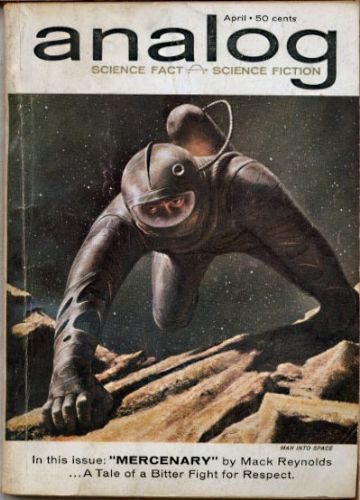
It looks like this story first appeared in print in Four for the Future, an anthology edited by Harrison himself that has a cover that reminds me of what I heard about that movie I never saw called The Human Centipede.  Four for the Future is a theme anthology that presents stories by four authors, Harrison, Brian Aldiss, Poul Anderson and James Blish, on two themes, "sacrifice" and "redemption."  (Maybe I'll read this anthology in the future; it seems kind of interesting.)  Later that same year "The Ghoul Squad" appeared in John W. Campbell, Jr.'s  Analog, and a note in Four for the Future recognizing that Conde Nast owned the copyright to "The Ghoul Squad" suggests the story was sold to Analog back in '68.

The first part of "The Ghoul Squad" takes place in the late 1970s.  A police patrolman is at the scene of an automobile accident.  We learn that the federal government has passed a law and created an agency so that trained medical professionals arrive quickly at every accident to seize dead bodies so their still usable parts can be collected and put in storage for use in transplants.  Some people object to this practice; they call the new federal agency "The Ghoul Squad" and wear medallions that indicate they do not want their bodies turned into spare parts, and the federal agents are bound by law to not harvest from these people.  The patrolman is one of those objectors.

The second part of the story takes place in 1999; that patrolman is now sheriff of his county, and he is locally famous for how much he hates the feds who harvest human parts from accidents.  A huge cruise liner hovercraft that regularly carries tourists over the land of the American South and the sea in the Caribbean suffers a catastrophic malfunction while crossing the main character's county; there are many casualties and some fatalities.  The sheriff rushes out to help organize the emergency response effort.  He tries to obstruct the Ghoul Squad detachment sent to the site of the disaster, and gets into an argument with some state troopers--the law, after all, is on the side of the Ghouls.  The sheriff has a heart attack, because he has refused to get a replacement for the weak heart he was born with.  As he dies, we learn why he is so averse to transplants, and then we get the twist--the sheriff, in his hurry to get to the site of the hover liner disaster, forgot to put on his medallion, so his organs will be harvested by the feds.

This story is merely competent, lacking in drama and human feeling.  Harrison tries to be fair to everybody, not going out of his way to paint the sheriff as a ridiculous religious fanatic nor the Feds as cold-hearted and heavy-handed utilitarians, but perhaps this evenhandedness is one reason the story feels a little flat.

"Toy Shop" (1962)

Here we have another Analog story, one that was selected by Judith Merril for inclusion in her famous Year's Best anthology series.  

This is one of those SF stories that justifies and even glamorizes a small minority of brainiacs tricking and manipulating the populace; there are a lot of SF stories like this, the Foundation stories and The Moon is a Harsh Mistress being among them, and they always rub me the wrong way--I don't doubt that Harry Harrison, John W. Campbell, Jr., Judith Merril, Isaac Asimov and Robert Heinlein are smarter than the average person, but seeing them indulge their fantasies of humiliating ordinary people and/or leading them by the nose for their own good I find embarrassing and even repellant.  A little humility and generosity on the part of those with special skills or resources is to be preferred to showboating, arrogance, and a flaunting of superiority, especially when that arrogance is expressed in self-serving wish-fulfillment fantasies.

"Toy Shop" is particularly irritating as it is a waste of time with its convoluted and totally unconvincing plot.

Most of Harrison's story consists of a long and detailed description of guys demonstrating the use of a toy rocket ship.  This is a fraud, presented as a magic trick--during his act the salesperson says the toy is able to fly due to the exploitation of magnetic waves, but he later reveals that the ship is suspended from a string attached to the ceiling and moves because he holds the other end of the string.  

The twist is that while it is a string that lifts the toy rocket, the toy actually does contain a device that has anti-grav properties and reduces the weight of the toy rocket.  If the battery-operated anti-grav device is not switched on the rocket is too heavy for the string to lift and the string will break.  The makers of the toy rocket, the inventors of the anti-grav device, were unable to get people interested in their invention because everybody is so close-minded and rigid in their thinking; their current plan is to sell the toys to adult hobbyists in hopes one of these nerds will stumble on the anti-grav properties of the toy and then improve the device and eventually mass-produce anti-grav equipment; the inventors will reap a financial benefit because they have patents on the device.

The plot is not credible, and I don't enjoy the elitist theme of how the masses and the establishment are dopes so the true cognitive elite have to trick them if society is to progress, so thumbs down to "Toy Shop."   

"You Men of Violence" (1967)

This is a decent adventure story that is also a pacifist/vegetarian wish fulfillment story in which violence doesn't accomplish goals but instead backfires on the violent so that some day the meek will inherit the galaxy.  

A huge powerful man, Raver, is an expert in electronics.  He has been arrested for his activism on the part of the Pacifist Party on his planet and has been sent to work in the slave mines on a wilderness planet where many different entities have mines; one of the mines is the property of people from a planet where the Pacifist Party is in power.  Raver tricks the captain of the slave ship into beating him up, creating a distraction so he can steal the electronic components he needs to escape his cell and make his way across the barren airless landscape to the Pacifist Party mine--he'll be safe if he can get there because the Pacifists' planet is a more powerful planet than the slave planet and the slavers can't risk attacking them.  In the course of his escape the Pacifist hulk/genius repeatedly outwits and outfights his pursuers while being careful to never actually physically harm them--he's a pacifist, after all.  In a final showdown with the smartest and most resourceful of his pursuers, Raver tries to convince his pursuer to join the Pacifist Party; multiple times he warns this officer that "he who lives by the sword dies by it," that the killer kills himself.  The officer remains loyal to the slave power and by pulling the trigger of his rifle manifests the pacifist's metaphor--the pacifist has sabotaged the rifle and it kills the officer, not Raver.

"You Men of Violence" is vulnerable to many criticisms.  The plot elements are pretty contrived, with every little factor set up by the author so things will work out in a way that supports the pacifist line he is selling; but of course adventure stories are often contrived and unbelievable, with everything falling the hero's way in a way that challenges the reader's ability to suspend disbelief.  I often complain about stories that denounce human violence and I often complain about utopian stories (Theodore Sturgeon comes to mind here with stories like "The Skills of Xandadu.")  But Harrison's attack on humanity in "You Men of Violence" is more convincing and more palatable than most; he doesn't come up with an unbelievable race of alien goody-two-shoes or robots to serve as a foil for humanity and suggest that we'd be better off if we were conquered or replaced by these flawless cardboard characters--Harrison here is more hopeful and less misanthropic, suggesting that humanity can evolve genetically or culturally to overcome its addiction to violence.  And Harrison's utopia is more believable and less simple-minded than most and seems to be produced via hard work and not something cheap like the magic belt Sturgeon introduces in "The Skills of Xanadu."

Most importantly, "You Men of Violence" is actually a good adventure story, well-written and well-paced, a story that doesn't just propagandize or hector you, but entertains with suspense and excitement.  So I can give a moderate recommendation to "You Men of Violence."       

"You Men of Violence" debuted in the same issue of Galaxy as Kris Neville's "Ballenger's People," which we read back in 2015.  The story would be reprinted in 50 in 50.

**********

As with our last look at Prime Number, we've got one good story out of three, though "The Ghoul Squad" isn't exactly bad.  We'll be reading more 1960s stories by Harrison as we continue our exploration of this collection in the near future, but first a foray into the 1950s.

Tuesday, May 7, 2024

Harry Harrison: "The Greatest Car in the World," "The Final Battle" and "The Powers of Observation"

Today we are surfing on over to the internet archive to read three stories from the 1983 printing of the 1970 Harry Harrison collection Prime Number, which has a great Peter Elson cover that looks like it belongs on Starship Troopers.  Some of these stories might be broad satires or lame jokes--the titles sound pretty sarcastic, after all--but Harrison is actually good at writing adventure stories, so maybe we'll get some thrills and chills as well as tired and boring attacks on religion or consumerism or American jingoism or environmental degradation or overpopulation or whatever.  (I'm actually not immune to Harrison's humor, as evidenced by my laughing at "The Fairly Civil Service" just a few days ago, so maybe these stories will wangle some laughs out of me whether I want them to or not.)   

"Mute Milton" (1966)

We read the first story in Prime Number back in 2018, a story about a black genius who could save the world but was murdered by a racist cop and member of the KKK.  I called it "heavy-handed" and likened it to a "homily for a child."      

"The Greatest Car in the World" (1966)

This is, I guess, a spoof on melodramas and the romanticization of the automobile and also an attack on modern mass-production techniques and American culture.

An American automobile enthusiast comes to the castle in which lives an aged Italian master craftsman and car designer, Bellini.  The old guy is in a wheelchair and his sexy granddaughter and his butler try to keep the Yankee away because the doctors have told grandpa that he must have no excitement.  Our guy gets through to gramps anyway, and the two hit it off over a shared love of automobiles.  The American tells the absurd story of how Bellini inspired his own love of cars.  The Yankee's father loved cars and came to Europe to see a car race in which one of Bellini's cars was in an accident caused by the driver of a competing vehicle--a flying radiator cap from the Bellini hit Dad in the noggin and Dad brought it home to America and displayed it prominently in the house, where it fired our hero's imagination.  

Bellini shows his visitor a car he has hand built, a one-of-a-kind prototype full of amazing innovations from the brakes to the motor to the battery to the beautiful shape of the body.  It is the most lovely, most efficient, most agile, most everything car in the world!  Bellini's last act is to give the car to our hero so he can reproduce it and share Bellini's genius with the world.

The central joke of the story, beyond the silly mock-melodrama plot, which is buttressed by ridiculous metaphors ("holding his note disdainfully by the edge, as though it were a soiled Kleenex") and goofy exaggerations ("Zero to one hundred miles an hour took four seconds because he was not yet used to the divine machine and was hesitant with the gas") is the twist ending, which isn't foreshadowed and sort of comes out of nowhere.  Our American protagonist, who says he worships Bellini and in whom Bellini on his death bed has put his trust, is going to betray Bellini--American capitalism is too greedy and American taste is too vulgar for Americans to appreciate or manufacture this super duper car--the car the protagonist will produce in Bellini's name will be a shoddy and cheap imitation no different than the mass-produced lowest-common-denominator junk already coming off the line in Detroit.  

Thumbs down.  "The Greatest Car in the World" debuted in the same issue of Michael Moorcock's New Worlds that featured Charles Platt's The Garbage World (we read the book version back in 2019) and a cover girl fashioned by Keith Roberts upon whom I have had an enduring crush.  Besides in Prime Number, "The Greatest Car in the World" has been reprinted in the 1979 anthology Car Sinister and the 2001 Harrison collection 50 in 50.

"The Final Battle" (1970)  

This is an eye-rollingly lame short-short, two pages.  The narrator says he lives in the era after a cataclysmic war, and that as a kid his father would often tell the story of that terrible war.  The text leads you to believe that this is a futuristic tale about life after some history-defining war between the liberal West and the socialist East, but then comes the punchline which I guess the author hopes is profound: Dad says that the last war was ended by the use of a terrible capital-"U" Ultimate capital-"W" Weapon that has made war too horrible to contemplate, so that mankind must now live in peace--that weapon is the bow!  The narrator and his father are cave men!  Presumably Harrison is telling us that mankind has always been monstrously violent and will never get better so we should expect to be nuked any day now!  O, will man never learn the folly of war?!?!1!11  

This pretentious waste of time debuted here in Prime Number, and Isaac Asimov and/or Martin H. Greenberg liked it enough to include it in their Microcosmic Tales collection of short-shorts, and a 1989 calendar that offered readers a short-short for each month. 

"The Powers of Observation" (1968)

It seems like my fears that Prime Number is chock a block with dreadful joke stories are being realized...but wait, perhaps here we have a glimmer of hope.  "The Powers of Observation" first appeared in John W. Campbell, Jr.'s Analog, in the same issue as the first installment of the James H. Schmitz serial "The Tuvela" (we read the book version of "The Tuvela," Demon Breed, back in 2020.)  Can we count on towering figure Campbell, who has a reputation as a guy who thought science fiction should portray man as a problem-solving animal capable of ferreting out the universe's secrets and thereby dominating that universe and as a right-winger who would say any provocative thing to shake people up, to ensure that Harrison isn't foisting another groaner on us?  Campbell didn't just think of "The Powers of Observation" as filler--he included it in Analog 8.  (It also showed up in a "Best of" Analog volume fourteen years after Campbell's death.)

The narrator of "The Powers of Observation" is an American spy in Yugoslavia who demonstrates the virtues we expect to find in a character in Astounding/Analog--he overcomes obstacles through his vast knowledge, through careful attention to detail, and through quick thinking, like the platonic ideal of the scientist or engineer.  The narrator's knowledge and skill are so exemplary, even over the top, that I have to suspect Harrison is sort of poking fun at tales of supercompetent heroes, but it is gentle fun and the story still has some of the thrills of a good action-espionage tale, and the twist ending makes the super spy's super abilities and super memory more believable.

The story includes good action scenes, including a compelling car chase which includes lots of local color (did Harrison drive in Yugoslavia himself or lift these details from a book?), and other stuff you expect in a spy story, like, you know, bribing foreigners and getting betrayed by foreigners.  Then we have the twist ending.  From the beginning we readers have suspected the Soviet agent the narrator is pursuing is a robot.  But in the final scenes we learn the triumphant American narrator is also a robot!  Harrison draws similarities between the space race and the robot race between the West and East, and gives a pithy summary and assessment of the differences between Soviet and American design strategies.

This is a fun story, displaying Harrison's ability to produce an adventure story with humor elements that don't render the story silly and undermine the action-suspense elements.  Thumbs up!

**********

"The Powers of Observation" saved this blog post from being a litany of distaste and derision, and has convinced me to keep reading Prime Number.  Stay tuned for more 1960s Harry Harrison short stories.

Monday, May 6, 2024

Larry Niven: "Neutron Star," "A Relic of the Empire," and "At the Core"

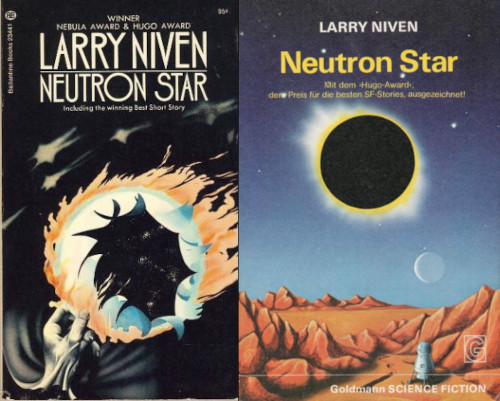
In our last episode, we read Larry Niven's 1967 story "Handicap" and I liked it so much I was inspired to read a few more of Niven's Known Space stories published in the same general time period.  So today let's read three 1966 stories by Niven, the first three tales in Neutron Star, a 1968 collection that would be reprinted time and again in many languages.  All three of these stories debuted in Frederik Pohl's If, but I'm going to read them in a scan of a paperback edition of the collection.

"Neutron Star" 

Having won a Hugo and appearing in three or four anthologies credited to Isaac Asimov, there is no denying that "Neutron Star" was embraced by the SF community.  I have to admit to being a little bewildered by the science in this very science-heavy story  and finding my confusion diminishes my enjoyment of it.

His employer having gone under, a skilled pilot is unemployed and deep in debt, so he accepts a dangerous job when it is offered him by one of the manipulative puppeteer people who figure so prominently in the Known Space stories.  Recently, a couple of human scientists investigated a neutron star, and were mysteriously killed in the process of their investigation.  Our narrator is provided a ship constructed to his own specifications by the puppeteers and repeats the dead scientists' mission.  He figures out what killed them, and how to survive, and reaps a rich reward.

This story is well constructed and the characters and their relationships and all that are fine, but "Neutron Star" leaves me somewhat unsatisfied because I am having trouble comprehending all at once the multiple strange phenomena resultant from flying a space ship impervious to most (but not all) radiation and equipped with automatic course-correcting rockets close to a neutron star as well as really grasping the solution to the locked room mystery of what killed the two scientists and almost kills the narrator.  The danger seems to be that tidal forces pull one half of the ship one way and the other half in the opposite direction and this can throw occupants against a bulkhead at dangerous velocity, and that the narrator figured out how to secure himself in the exact center of the ship where the tidal forces are balanced, and thus avoid the death that befell his predecessors, but I don't really grok why an dhow this is the case and the way the different clues and different factors run in circles in my mind when I make an attempt to really "get" it is uncomfortable.  

If I was as smart as the Hugo voters of 1968 who apparently ate this stuff up I'd probably give the story a thumbs up, but I can't pretend the story is really working for me and I thus have to give it an "acceptable" rating.

"A Relic of the Empire"

This one was chosen to represent the Known Space series in a 1980 anthology of sample stories from many famous SF series.  It also was reprinted in a 2020 anthology of space pirate stories.

"A Relic of the Empire," like a lot of these Known Space stories apparently, revolves around the influence of the cowardly puppeteers and the long extinct Slavers, and humans' pursuit of money.  A lone human scientist who has suffered a lifelong fear of poverty is investigating plants on an uninhabited planet, plants of a species created by the Slavers via genetic engineering many millions of years ago.  He hopes to secure his financial health by writing a book about the Slavers and their Empire.

A space ship lands and the 15 or 20 men aboard it take the scientist captive.  These desperate characters are on the run from the law; they have learned the location of the puppeteer homeworld, and their ship is full of cash looted from puppeteer ships--in most star systems, piracy is impossible because of the presence of security forces, but the cowardly puppeteers don't fight, so are easy prey within their own system.  Back in human occupied regions, they have to find a place to hide.

The leader of the pirates describes his adventures to the scientist, and the scientist then takes advantage of the pirates' ignorance of the plants he is studying to destroy them.  Niven came up with interesting animal life forms in "Handicap," and here he has conceived of an interesting plant, one which is an organic rocket--it propagates itself across the surface of planets, and even throughout the galaxy, by taking off and exploding, spreading seeds hither and yon.  The scientist tricks the pirates into detonating these plants, killing them and making his fortune.  Niven does a good job of making the reader both a little suspicious of the scientist and a little sympathetic to the pirate leader, adding depth and tension to the tale.

I like "A Relic of the Empire" unreservedly; the pace, characters, style, and SF elements all work quite well.  It is a good representative of the Known Space series.

"At the Core"

The star of "At the Core" is the same pilot who investigated the neutron star in "Neutron Star."  This guy loves to spend money, and like four years after that risky operation we see him taking on another dangerous job for the puppeteers.

The area of space familiar to the human race, the puppeteers, and the kzin is on the edge of the Milky Way and like 60 light years across.  The galactic core is thousands and thousands of light years distant, and it would take current craft like three centuries to get there.  The puppeteers have invented a huge ship with huge hyperdrive engines that, they claim, can get to the galactic core in like 25 days, and they hire the narrator to make this test run, a publicity stunt to drum up interest among other intelligent species in the project of developing still better ships--this ship they just invented is stuffed full of engines, and has no room for cargo or passengers, just a pilot, so it is not useful for trade or colonization or anything else profitable.

As the narrator approaches the core he discovers something mind-blowing--the core of the Milky Way galaxy is exploding, a chain reaction of supernovae that is generating a wave of radiation that will exterminate all life it touches.  This wave of radiation will reach Known Space in 20,000 years.  This discovery initially means little to short-term thinkers like most humans, but the puppeteers, long-term thinkers, are shaken.  They immediately retool their entire society to focus single-mindedly on building a fleet of ships to escape the Milky Way, meaning they stop trading with other races, which causes a major stock market crash and economic downturn in all of Known Space.

Pretty good; Niven describes the technology stuff, the journey to the core, and the sight of the core entertainingly, and the twist ending is good, philosophical and with a touch of the old sensawunda.  

Among the numerous places "At the Core" was reprinted are If editor Frederik Pohl's The Second If Reader and a Dutch magazine where Niven's tale sat beside A. E. Van Vogt's "Fulfillment," a story we read some time ago and quite liked.


**********

Three engaging stories full of high technology and strange aliens that offer interesting glimpses of Niven's history of the future.  We'll read more from Neutron Star soon. 


Sunday, May 5, 2024

Galaxy, Dec 1967: P Anderson, L Niven and H Harrison

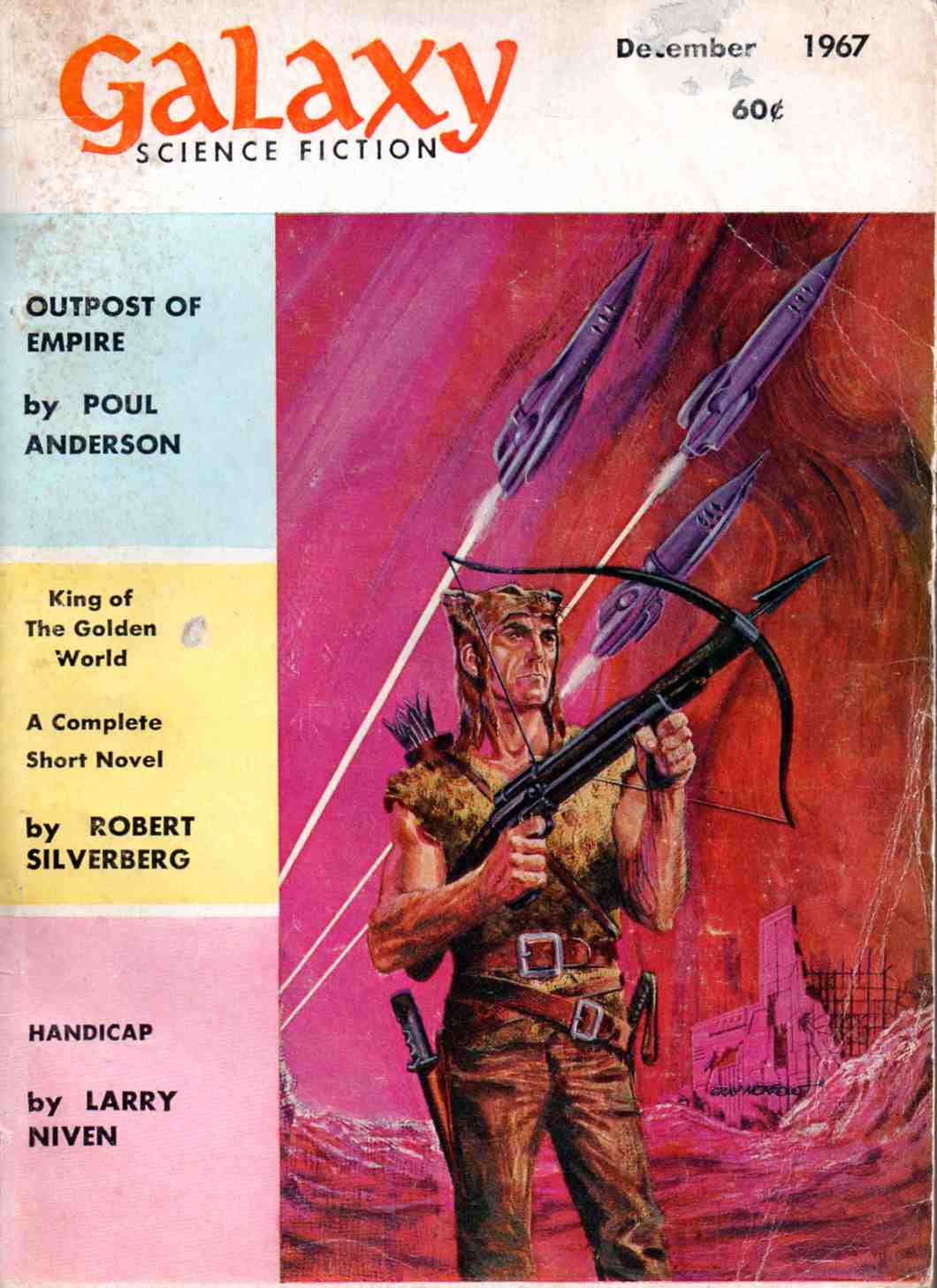
In a recent blockbuster episode of MPorcius Fiction Log we read a story by Robert Silverberg from the December 1967 issue of Galaxy, edited by Frederik Pohl, and noted that it also contained a story by Fritz Leiber (which we read last year) and stories by Poul Anderson and Larry Niven which had yet to be subjected to the MPorcius spotlight.  Let's read those stories today, and to round out the blog post, throw in the story by Harry Harrison, even though I fear it is a joke story.

But first, a quick glance at Pohl's editorial and Algis Budrys' book column.  Pohl praises the recently deceased Hugo Gernsback and brags about Hugos recently won by If and by Jack Vance and Jack Gaughan for work that appeared in Galaxy.  Budrys takes the occasion of the publication of a new edition of In Search of Wonder and of the second Orbit anthology to talk a lot about Damon Knight.  Knight is usually discussed in worshipful terms, so it is interesting to hear Budrys' criticisms of the man.  Budrys also savages some poor bastard Joe Ross for his anthology Best of Amazing, not only attacking Ross' selections but the man's command of English grammar.  Ouch!  On the other hand, Budrys likes the stories in The Playboy Book of Science Fiction and Fantasy, though he finds the arrogance and self-importance of the Playboy staff repellent and has something condemnatory but oblique to say about Arthur C. Clarke's relationship with Playboy which I am not getting.  Budrys comes off as pretty harsh in this column. 

"Outpost of Empire" by Poul Anderson    

In May of last year one of my well-informed readers told us that many scans of magazines at the internet archive have had their Poul Anderson stories removed and suggested we look to luminist.org for complete scans of these magazines.  Sure enough, today we are reading a pdf of Galaxy's December 1967 issue from luminist.org because "Outpost of Empire" is missing from the internet archive scan of the issue.

"Outpost of Empire" takes place on planet Freehold, a world on the very edge of the Terran space empire of 100,000 planets.  Freehold was colonized by humans several hundred years ago, but for reasons Anderson describes at some length, has remained sparsely populated and has limited intercourse with the rest of the Empire.  Today Freehold is in trouble, as a minority of bird-like aliens whose ancestors immigrated to the colony as well as renegade humans who live like semi-nomadic barbarians are rising up against the urban populace that is loyal to Terra, and the Empire has so many problems it doesn't have many resources to spare to pacify Freehold.  The main character of the story is a Terran xenologist, charged by the Imperial government with collecting information on the mess Freehold is in and who had to make his way to Freehold as a passenger on private commercial space ships.

Besides following the xenologist as he talks with various people about the astronomy and geography and history of Freehold, Anderson's narrative follows two leaders of the barbarian humans who live in the forests of Freehold.  Anderson spends almost no time describing the inhabitants of the nine cities on Freehold who are loyal to Terra--it is the barbarians whom he seeks to render sympathetic and interesting.  These forest people, in fact, are more like a violent strain of hippies than actual barbarians.  Over the centuries of human habitation of Freehold, many people have abandoned the nine cities for a host of reasons, and these renegades have built a whole civilization that is largely a secret from the city dwellers.  The forest people live closely with nature, and their complex culture is based largely on specialized breeding of various plants and animals--plants and animals take the place in their society that machines have in ours.  Quite a few of the forest people have actually been educated off Freehold, unbeknownst to the cities and the Empire, and have an extensive trade relationship with the bird-people, and so the tree-huggers know far more about the Empire than the Empire knows about them, and while they hate machines, they can use high tech devices if they feel the need.  The renegades have still another secret advantage over the city peeps: a significant number of their women have special powers--some can control atmospheric humidity and generate camouflaging fog, some can temporarily alter their body chemistry so they are briefly super strong, and still others can control the release of their pheromones and thusly seduce men and make them do anything they want--even betray their comrades! 

Even though they don't have many blasters, by using war beasts and the women's special powers the human renegades are able to capture one of the nine cities by storm.  They order the city evacuated and then use captured nukes to obliterate the place.  The xenologist was in this city at the time and is taken captive by the forest people.  Recognizing his Terran origin and social status as a college professor, the two renegade leaders keep him close at hand, thinking that if they can open his eyes to the virtues of their tree-hugging way of life he will help them negotiate some kind of settlement with the Empire.  The xenologist comes to sympathize with these characters; after all, the city folk have been racist to the bird-people and have been trying to despoil the environment, and, incidentally, one of the two rebel leaders is a beautiful and sexually available woman!

A Terran Imperial space cruiser lands and the forest people's war animals and the witch powers prove up to the task of capturing it.  They proceed to order the eight surviving cities evacuated and then use the cruiser's weapons to raze them.  The xenologist then acts as a go-between in the negotiations between the Empire and the forest people, and eventually the Empire recognizes the rule of the tree huggers over Freehold and compensates the city folk for their losses and resettles them on some other planet.       

Though "Outpost of Empire" has sex and violence elements, it is mostly a story of ideas that are conveyed through the characters' conversations and private thoughts.  Anderson comes up with a pretty complicated history for Freehold that fits into the larger history of Terran expansion into space that is described in all the many Van Rjin and Flandry and Falkayn stories, and he comes up with a whole culture and all sorts of organic-based technologies and witch-powers for the Freehold renegades, and we learn all about it.  This is all mildly interesting and entertaining, and impressive I guess on an intellectual level, but not really emotionally engaging.  One problem that I in particular had that maybe other people won't is that I found it hard to sympathize with the forest-dwelling renegades over the city folk--I don't want to live in a forest like a nomadic savage hanging around with beasts, I want to live in a downtown apartment on a bustling street and hang at the library and the art museum, and to me it felt more like a tragedy that nine centuries-old cities full of art and architecture and memories got annihilated and their populations dehoused than that some tree somewhere got chopped down.       

The French edition of Galaxy printed "Outpost of Empire" as a two-part serial in 1972.  Otherwise, the story has reappeared in three different Anderson collections, The Long Night, Captain Flandry: Defender of the Terran Empire, and Question and Answer.  Gray Morrow fans should check out the US magazine version, as it features four full-page action-oriented illustrations by Morrow.  


"Handicap" by Larry Niven 

It looks like this one appears as "The Handicapped" in the oft-reprinted collection Neutron Star.  It is just "Handicap" here in Galaxy and in the various editions of Donald Wollheim and Terry Carr's World's Best Science Fiction: 1968.  

"Handicap" is well-done traditional science fiction that glorifies science, technological innovation, and the risk-taking businessman and describes lots of weird alien species and futuristic technology in a convincing and fun way.  

The narrator of the story is the youngest in a long line of businessmen who design and manufacture prosthetic devices that serve as hands for intelligent beings who lack hands; the canonical example are Earth dolphins, which in Niven's Known Space setting are an intelligent species.  (Like Anderson's "Outpost of Empire," Niven's "Handicap" is a component of the author's elaborate future history of a galactic civilization, the "Known Space" series, and is full of little references to this broader universe.)  The narrator has a hunch that the strange immobile creatures of planet Down known as grogs are, secretly,  just such a species and thus a market opportunity, and the story relates his investigations.  The twist of the plot is that the grog race is psychic, and has been manipulating the human colonists on Down in order to keep its intelligence and powers a secret, and has similarly manipulated the narrator in order to pave the way for a business deal with him.

Classic science fiction stories like this often portray paradigm shifts and strive to impart a sense of wonder in the reader in their conclusions, and Niven does both.  A business relationship and personal friendships between humans and grogs revolutionizes grog life, the ecosystem and economy of Down, and political life on the human space empire, all for the better, and the last line of the story holds out the possibility that in the vastness of space, humanity is likely to meet even more amazing alien beings.  Niven also adds a little touch of Lovecraftian cosmic horror to this generally sunny story, I think.  We are told that in ancient times the galaxy was ruled by a race of slavers who used psychic powers and genetic engineering to dominate all other races; one of the intelligent species who are the narrator's customers are the product of this slaver race and are somewhat reminiscent of H. P. Lovecraft's shoggoths.  The grogs are the degenerated descendants of the slavers (racial degradation and devolution are of course typical Lovecraftian themes) and the narrator recognizes the possibility that the grogs could take over Down and maybe all of human civilization and humans would never know it.

Thumbs up!  Above I compared Niven's Known Space project to Anderson's Technic History, but in terms of style and tone the men's writing is quite different, Niven's style feeling smooth and sprightly compared to Anderson's sometimes laborious prose.  And while I stressed above the note of cosmic horror, the tone of the story is light and optimistic, with camaraderie and fellowship being pervasive themes and all parties benefiting in the end, a contrast to the sense of tragedy we get from Anderson.  

In the two years between publication of these two editions Niven got a promotion
and Roger Zelazny suffered a demotion; SF is a tough business!

"The Fairly Civil Service" by Harry Harrison

As a kid I enjoyed Harrison's broad satire Bill the Galactic Hero and the humorous Stainless Steel Rat adventure stories; my appreciation of this kind of thing has waned in my adulthood, but let's give "The Fairly Civil Service" a shot anyway.

It is the socialistic bureaucratized future in which the government tells you where to live and whether you can have children!  Our protagonist is a postal clerk, and as we watch he has to deal with a stream of irrational, irate, demanding, and even dangerous customers.  The customers are way over the top slapstick caricatures, like an old woman who needs help filling out the forms that are a prerequisite to her receiving her pension and she rants and raves, threatening to kill herself then and there if she doesn't get the help she needs, a stick up man, and a young woman who tries to use sex appeal to get the clerk to bend the rules for her.  At the end of the story, as has been foreshadowed, we learn this ordeal is not exactly real, but a simulated post office experience--the main character is wearing a hypno helmet and sitting for an exam (for the twelfth time in as many years) to see if he is qualified to be a postal clerk.

This is sort of a filler story, but it moves quickly and I did laugh at the old woman's shrieking and at her gushing blood when she followed through on her suicide threats, so I guess I have to give it a thumbs up.  Some stories, like Anderson's "Outpost of Empire," deserve more respect than they inspire pleasure, and other stories, like "The Fairly Civil Service," demand little respect but trigger enjoyment even against the will of the reader.  

"The Fairly Civil Service" has been anthologized in some foreign publications and has reappeared in Harrison collections like Prime Number under the title "A Civil Service Servant."  


**********

All three of these stories are pretty entertaining; we have to congratulate Fred Pohl and everybody involved for producing here a pretty satisfying issue of Galaxy.  I have to admit that all three of these tales have me thinking I should read more stories from the period by Anderson, Niven and Harrison; it seems that The Long Night, Neutron Star and Prime Number are all available at internet archive, so maybe we will make that happen.

Thursday, May 2, 2024

Richard Matheson: "The Edge," "The Creeping Terror," "Death Ship," and "The Distributor"

In our last episode we finished up a collection of stories by Robert Silverberg, Dimension Thirteen, and today we finish up a collection of stories by Richard Matheson, Shock!  Back in 2015, at the very dawn of time, we read "Legion of Plotters" and said it was good.  In 2016, as life began to stir, we read "Dance of the Dead" and judged it OK.  In 2018, as man began to use tools, we read "The Splendid Source" and denounced it as a waste of time.  On April 11 of this year, the high modern age, we read "The Children of Noah," "Lemmings," and "Long Distance Call," awarding Matheson two pluses and a minus.  A week later, as society drifted into decadence, we read "Mantage," "One for the Books" and "The Holiday Man," declaring one good, one bad and one merely acceptable.  

That leaves us today, as civilization collapses all around us, with four stories to go, and Matheson at a score of 1 (four pluses, two neutrals and three negatives.)  Matheson is ahead of the game, but a run of bad luck could still find him deep underwater.  Well, let's dig these stories up at the internet archive and make our final determinations.

"The Edge" (1958)

This is a sort of obvious story, and Matheson knows it is obvious, and so does one of those "meta" "recursive" things in which the character in the story remarks to himself that "this thing that is happening to me is like the things that happen in SF magazines all the time."  It is competent, though, so I'm giving it a passing score.  

An executive who lives on Long Island and commutes daily to his Manhattan office is stressed out.  He goes to a restaurant he has never been to before in hopes of relaxing but a stranger joins him unbidden.  This stranger acts like he knows the executive, and he even knows about the exec's college career and military service, where he lives and works, the name of his wife.  The stranger seems to think the harried executive graduated a semester earlier than he really did, however.

Eventually, after a lot of conversation, the protagonist comes to suspect that he has entered a parallel universe much like his own, much like people do in the SF magazines he used to read.  His suspicions are confirmed when he gets home and his wife greets him familiarly but then answers the  phone to find on the other end a man who also claims to be her husband!

"The Edge" debuted in F&SF.  People interested in Matheson's career might find Anthony Boucher's intro to the story of value as Boucher praises Matheson not only effusively but also with some specificity: "Born of Man and Woman" was the second best first story Boucher ever read, and Matheson's speech at a convention (Boucher is not specific, but I think it was the ninth Westercon) was "the most intelligent and moving speech I have ever listened to from a guest of honor--a candid discussion of commercialism and artistic integrity."  "The Edge" has been reprinted many times in many languages.

"The Creeping Terror" AKA "A Touch of Grapefruit" (1959)

isfdb suggests this story made its initial appearance in Frederik Pohl's fifth Star anthology, where it was called "A Touch of Grapefruit."  (Maybe a pun on the phrase attributed to the Corsican Ogre?)  I'm reading it in the 1982 anthology Science Fiction A to Z: A Dictionary of Great Science Fiction Themes, where it appears under the theme "Cities" and the title "A Touch of Grapefruit" but a footnote announces "This was first published under the title The Creeping Terror."  I don't know what is going on here, if somebody someplace made a mistake or if the version of the story in Shock (1961) was revised and the version in Science Fiction A to Z is that 1961 revised version but was printed under the original 1959 title.

This is an annoying joke story in the form of an academic paper, full of joke footnotes, a satire of the powerful influence of the culture of California, specifically Los Angeles, on the rest of the United States, and I guess maybe of the rapid growth in population and geographic size of L.A. in the first half or so of the 20th century.  Citing many sources and offering numerous block quotes, the writer describes how citrus trees sprung up fully grown in the Midwest, how smog spread east to skies all over the nation, and how people all over America began to dress skimpily and became fascinated with show business, automobiles, and going to the beach.  The Northeastern states resist this creeping Californification, to limited effect.

An irritating waste of time.  Thumbs down, but I will admit that this might, perhaps, be a useful document for historians of Los Angeles, a sort of window into public perceptions of the city we call La La La Land; it is perhaps noteworthy that Matheson spent his youth in New Jersey and New York, and Pohl was also a New Yorker.

See, I don't always cherry pick the good covers to post on the blog

"Death Ship" (1953)

"Death Ship" was made into an episode of The Twilight Zone which I don't remember seeing, though I probably did.  The story is well-written, but the ending is a little disappointing.

Matheson draws the story out with lots of visual and psychological details, but the plot is simple.  Three men crew a ship that is exploring the galaxy for habitable planets.  Intelligent alien life has never been discovered, so the men are very excited to see what is likely a space ship on the surface of a planet.  At close range, sadly, it turns out to be a crashed ship, totally wrecked, and, closer still, to be an Earth ship.  Inside, they realize that the crashed ship is their own--the cockpit is occupied by their own dead bodies!

The men come up with various theories as to what is going on.  Could it be they are seeing their own future, that they are doomed to die in a crash?  Are they in some alternate universe?  Is the crashed vessel and its disturbing contents some kind of illusion conjured up by aliens who hope to scare them off?

All those theories are sort of interesting science fiction ideas, but it seems that Matheson's answer to the question of what the hell is going on is a supernatural one--the last sentence of the story, a line of dialogue uttered by one of the characters, refers to "the Flying Dutchman," and I guess we are expected to think the ship crashed and the men were killed and they--and the ship--are ghosts.

I don't find ghosts very interesting, and a ghost ship makes even less sense than a ghost person (if you believe in an immortal soul you can say the ghost is a soul divorced from its body, but who thinks a rocket ship has an immortal soul?) and ghosts feel out of place in a story that you are led to believe is "realistic" science fiction.  

(Thinking back to "Lemmings" and "Long Distance Call," a theme in Matheson's work seems to be that life is inexplicable chaos; Matheson comes up with disturbing horror scenarios and feels no need to supply a plausible explanation for why the terrible thing is happening, or any explanation at all, even suggesting that a lack of explanation makes the story more scary.  Personally, I like explanations; maybe I'm one of those "positivists.")   

"Death Ship" debuted in an issue of Fantastic Story which reprints 1940s stories by Leigh Brackett and by Henry Kuttner that I think I have never read.  Maybe I'll read them soon.  "Death Ship" has been reprinted many times in Matheson collections as well as anthologies, some with a time travel theme.  (Wait, do Harry Turtledove, Martin H. Greenberg and the Vandermeers think this is a time travel story and not a ghost story?  Are there different versions of this story with different endings floating around like the different versions of David Gerrold's Yesterday's Children / Starhunt?)  

"The Distributor" (1958)

isfdb calls "The Distributor" "non-genre," and it appeared first in Playboy.  We've actually already read a story from this issue of our most prestigious skin rag, the groaningly lame "Hickory, Dickory, Kerouac" by Richard Gehman, one of Judith Merril's favorite stories (she included it in her SF: Best of the Best anthology.)  Speaking of favorite stories, "The Distributor" is the favorite horror story of F. Paul Wilson, a famous and important guy I know very little about--Wilson introduces "The Distributor" in the 2000 anthology My Favorite Horror Story.  Besides scads of Matheson collections, you can also find "The Distributor" in one of those Alfred Hitchcock branded anthologies and Playboy anthologies

"The Distributor" is an emotionlessly retailed catalog of more or less realistic misdemeanors and atrocities set in a suburb; the motivations of the perpetrator of the crimes is mysterious, and I am not sure what the point of the story is, other than to remind us of how vulnerable we all are to clever evil people and to reiterate the standard criticisms of suburbanites, that they are racist and hypocritical and houseproud and overly suspicious of each other and whatever.

A guy moves into a suburban neighborhood and launches a carefully orchestrated one-man campaign to sow dissension, trigger suicide and instigate murder among the inhabitants, a campaign consisting of a mind-numbing number of concurrent and sometimes complex operations.  He sabotages a guy's garden and makes it look like someone else did it.  He drugs a woman and rapes her.  He drugs a woman and takes nude photos of her for use in blackmail.  He shoots a dog and makes it look like a kid did it.  He has pornographic materials mailed to some Christian.  He makes a woman suspect her husband is cheating on her.  He shocks a woman with a weak heart so she has a heart attack.  He paints a racial slur on one guy's house, makes a bigot think his neighbor is an African-American who has been passing for white.  When a woman suspects he is the source of all the recent trouble he wins her sympathy by claiming he is a Holocaust survivor.  And on and on.  Having ruined the lives of everybody in the neighborhood, he leaves; the story has no real climax or resolution, no emotional highs and lows, it is just a straight line from point A to point B.

Stories about crime often seek to entertain the reader by providing a cathartic narrative that culminates in the achievement of justice.  We witness people misbehaving, and then witness them being punished, and are relieved to see justice done and order restored.  Crime stories that seek to be "sophisticated" or shocking or subversive will flip the script a little, will suggest that it is society that is unjust and portray the criminal as the hero, as the one who is satisfying justice by breaking the rules and punishing the corrupt establishment, but such a story is still essentially about righting wrongs.  "The Distributor" doesn't provide that catharsis or sense of justice--the perpetrator of the crimes is never punished, and (at least some of) the suburbanites who get killed or otherwise injured don't seem bad enough to deserve the horrible "punishment" they suffer.

Crime stories often seek to entertain by thrilling the reader, by manipulating his emotions with scenes of suspense born of uncertainty--will the victim survive the attack? will the detective sneaking around the villains' lair be discovered? will help arrive in time? who is the killer?--and disgusting or titillating scenes of sex and violence.  Matheson does a little of that here, with the scene in which the distributor throws somebody of his trail with his Dachau story, and with the scenes of the protagonist sexually abusing women, but most parts of the story, and even these scenes for the most part, are told in a cold-blooded manner that does little to excite the reader, and as for all the many schemes of the main character, we always assume they will work like clockwork, and they do, so there is no suspense.

In "Death Ship" we saw Matheson present a science-fiction scenario and several more or less believable explanations for the scenario and then reject those explanations in favor of a supernatural explanation that was an homage to a centuries-old ghost story; "Death Ship" is perhaps a story about SF stories, an effort on Matheson's part to undermine the science focus of so many traditional SF stories, to argue that "science can't explain everything, you nerds" (the last paragraph of the story does actually include a sarcastic reference to "progress.")  Maybe you think that is clever and profound, and maybe you think that is lazy, that Matheson just stole the plot of the Flying Dutchman story and then prettied up his rewrite with some effective psychological scenes and science-fiction images.

Similarly, perhaps "The Distributor" is a comment on crime stories.  As he dismissed the speculative science elements of a traditional science fiction story in "Death Ship," maybe in "The Distributor" Matheson is dismissing the traditional core elements of the crime story--suspense and justice--to either point out how vacuous they are, or, out of sheer laziness so he can focus on the mechanical aspects of the crime story, coming up with complex crimes that would be difficult for people to escape or to solve.  (I am resisting the idea that the distributor is the Devil, which would be as lame as having the ship in "Death Ship" be The Flying Dutchman.) 

Alright, having drafted the above, let's consult two secondary sources and see why I am all wrong about "The Distributor."  A scan of My Favorite Horror Story is available at the internet archive, so I read F. Paul Wilson's one and a half page intro.  Unfortunately, this is mostly Wilson's literary autobiography; of "The Distributor" he just says it "blew him away" and he will never forget it.  I'm sure Matheson liked hearing that, but it doesn't help me any.

I own a copy of Matheson's Collected Stories: Volume Two (2005) and "The Distributor" is in there, so I read the author's afterword to the tale.  Matheson says he worked very hard on this one, and I can believe that--there are many characters and many moving parts and they all interact logically, even if they add up to very little emotionally.  Matheson suggests that the point of his story is the banality of evil, how evil is not necessarily loud and flashy but can sneak up on you, how evil is inexplicable; Matheson tells us he deliberately made the distributor's motivations and origin a mystery, that the villain in the story doesn't represent the Devil or anything like that.  Most interestingly, Matheson says he based the distributor on Brother Theodore, whom he knew, and that the actor described in detail to Matheson his ordeal in Dachau.  Before I moved to New York, I was a devoted fan of David Letterman and saw Brother Theodore multiple times on Late Night, and today I think of him for the first time in like 30 years.

**********

Earlier I made a big deal out of tallying a score for Shock! and now I am regretting it because I am having trouble scoring "Death Ship" and "The Distributor."  As I have been saying, I am unhappy with the ending of "Death Ship," but Matheson does a good job with the science fiction trappings and the psychological stuff, so I'll give "Death Ship" a plus.  "The Distributor" is the worse story--flat, monotonous, lacking in motivation, character, suspense and with a point that is mysterious or just annoying--but I can't say it is bad because it does seem very purposeful and it did force me to think about it, so I'll give it a neutral passing vote.  So, if Matheson came in with a +1 today, then suffered a loss with "The Creeping Terror" AKA "Touch of Grapefruit," but then earned a plus with "Death Ship," I guess we end up above water at +1 and can recommend Shock! as a collection.

Will we be reading Shock 3 someday?  (We've already got Shock 2 under our belts.)  It could happen!  But not this week.

(Maybe now I can stop singing "Shock the Monkey" to myself.)

Tuesday, April 30, 2024

Robert Silverberg: "By the Seawall," "Bride Ninety-One," and "The King of the Golden River"

Welcome back to the settler-colonialist project that is MPorcius Fiction Log.  We've been exploring, expropriating, exploiting and explicating (to the best of our limited abilities) 2004 Grand Master of SF Robert Silverberg's 1969 collection Dimension 13, reading the stories reprinted therein in their original magazine versions, and today we finish up with three stories from 1967, the year of the Six-Day War, The Piper at the Gates of Dawn, and the growth of the United States population to 200 million.  Before we attack these three pieces, here we present links to the ten stories we've already grappled with (and, I hope, brought to earth.)


"By the Seawall" (1967)

Remember when I told you that "Dark Companion" and "Halfway House" had good settings and good characters but were a bit lacking in the story department?  Well, the same description might apply to "By the Seawall," but this story is more entertaining and more satisfying.

The ocean is teeming with huge ravenous monsters of every type--fish, reptile, crustacean, you name it.  These creatures like nothing more than to come ashore and eat people by the dozen.  (This is some far future Earth, I guess.)  So, a century ago, a towering sea wall was built to keep the monsters away.  Our protagonist is an android, a being more or less genetically similar to a man, but grown in a vat and designed to be more resistant to boredom as well as stronger and faster than the general run of all-natural sex-produced humans like you and me.  Such synthetic men have the job of patrolling the seawall, monitoring the condition of the wall and keeping an eye out for any monsters who might somehow figure out how to overcome the wall and its attendant electric and toxic defense mechanisms.

Our hero is doing this job as usual when he witnesses a human commit suicide by diving off the seawall (his fall eased by an anti-grav device) and swimming out to be devoured by one of the giant sea monsters.  This turns out to be the first in an epidemic of such suicides that grips the human race, and the androids are hard pressed to deal with it.  Nobody can really figure out why the suicides are taking place--maybe the human race can't bear to be separated from its ancestral home, the source of all life?  When the protagonist arrests a woman who is trying to kill herself, he asks her about her motivations, and she says she wants to "belong" to the sea and insists that, as a "machine," he could not understand.  Soon after, the android, perhaps shaken by his failure to prevent suicides, perhaps seeking knowledge of what it is like to be truly human, dives into the ocean himself to be eaten.

"By the Seawall" is better than "Dark Companion" and "Halfway House" because of the striking images Silverberg conjures up of the wall and the monsters, and because the ending is more conclusive, more satisfying, even though we don't find out why the humans--and now androids!--are feeding themselves to monsters, and the problem presented to the main character is not solved.  The issues the story addresses--the mystery of human psychology and sociology and the question of what kind of relationship natural and artificial humans might have--are compelling.   

Thumbs up for "By the Seawall."  After its debut in If, the story would reappear in several European publications as well as Dimension 13.


"Bride Ninety-One" (1967)

This is a wacky story, I guess partly intended to shock the reader and partly intended to make him laugh with its matter-of-fact first-person account of a society whose social mores are radically divergent from the mid-20th-century conventional.  These kinds of stories lack human drama and feeling, and I am not crazy about them, but "Bride Ninety-One" is competently told, so I'm calling it acceptable.

It is the future, and a civilization made up of many different intelligent space-faring species stretches across the galaxy.  For these people, sex and marriage has been totally divorced from reproduction, and marriages last only six months, and it is normal for people to marry dozens of times, and to marry outside their species.  

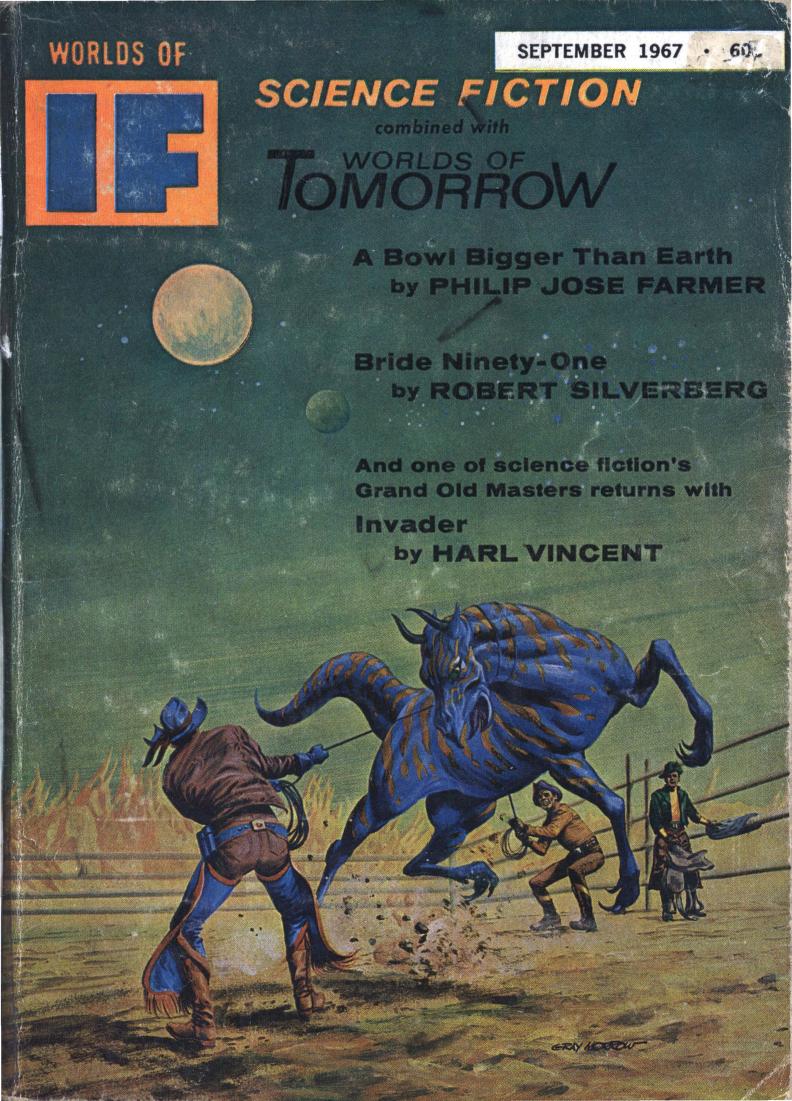
The narrator, a human, has just started his 91st marriage, to a slender being with petals, flexible limbs and an "ingestion slot" equipped with needle-like teeth.  The story recounts their six-month marriage, which faces various crises because the needle-toothed alien wants to have a traditional Terran marriage, but her ideas of what constitutes a traditional Terran marriage is flawed, being based on historical novels she has read.  For example, she thinks human males always cheat on their wives, so when the narrator passes up an opportunity to bang some other woman, needle-teeth is broken-hearted.  Similarly, needle-teeth saves the day by pacifying a rogue beast at a rodeo after all the men have fled in terror from the berserk monster and has to be told that in a Terran relationship it is the man's job to protect the woman, not vice versa.  (The prelude to this scene is depicted on the cover of the issue of If in which "Bride Ninety-One" debuted, but Gray Morrow didn't try to depict the bride, suggesting a lamentable lack of ambition or perhaps a failure to actually read the story--maybe Fred Pohl or Judy-Lynn Benjamin just told Morrow over the phone to "draw some cowboys with an alien bucking bronco.")

(Maybe I need to point out that the narrator insists he loves the little lady and that the two of them have sex often, the narrator does not hesitate to kiss his wife's needle-filled "ingestion slot.")  

Marrying the same person twice is taboo, but, at the end of the story, needle-teeth wants to marry the narrator again.  He agrees when she explains that the marriage will be totally different, as this marriage will follow the customs of her race.  The narrator has his human teeth removed and needle teeth implanted, and learns that he will be married not only to this individual, but all her many sisters.     

This studied bit of bizarrerie debuted in If and seems to have been a hit among European editors--"Bride Ninety-One" has been translated into five languages, according to isfdb.  Karel Thole took a stab at depicting the bride on the cover of the issue of Urania in which the story appeared--as I have remarked before, Thole's work indicates he actually read the stories he illustrated.


"The King of the Golden River" (1967)

"The King of the Golden River" made its first appearance as "The King of the Golden World" in Galaxy.  We've already read a story from this issue of Galaxy, Fritz Leiber's "The Black Corridor," and one presumes the day will come when we read the Poul Anderson and Larry Niven stories from the issue, "Outpost of Empire" and "Handicap."  As "The King of the Golden River" the story would resurface in various Silverberg collections, and in 1969 translations appeared in the French edition of Galaxy as well as issue of Urania devoted to Silverberg and Kit Reed.

Here we have another story about a human who has sexual relations with an alien.  Elena, a Terran, is on an alien planet, living among nudist monkey-people on a volcanic island.  She is sleeping with the chief (if you are going to bang aliens, might as well shoot for the top, right?) and the very first scene of the story involves Elena, naked of course (when in Rome...), hanging around with a crowd of native kids, observing the smoking and burbling of an active volcanic crater, and how one of the kids, nine years old, keeps touching her thigh with his six-fingered hand--Elena wonders if he just being friendly, or if this constitutes erotic groping. 

Silverberg must have read a book about volcanoes, because he spends a significant amount of time describing the different ejecta that come out of the crater as the eruption approaches, smoke, ash, pumice, cinders, lightning bolts, etc.  Elena keeps asking the chief why everyone isn't evacuating, as it looks like when it comes the river of lava will run right through his villages, totally destroying them.  Eventually the big cheese gives her an answer, and we have our twist ending--every five generations the volcano erupts, and the villagers eagerly embrace the event, all but a select few of them welcoming death.  The chief and the priesthood have selected who will survive, and the elect depart to a safe distance--the chief and the clergy are not among them.  As an alien, Elena will be permitted to flee, but Elena decides to put her money where her mouth is, so to speak--she has been trying to join this community of hairless monkey-people, to become one of them, and getting killed with her husband is a way for her to prove to herself that she is sincere.  (As in "By the Seawall" and "Journey's End" the protagonist gets killed in the course of exploring or asserting his or her identity.)    

I am guessing "The King of the Golden World" is not only Silverberg's opportunity to teach us about the behavior of volcanoes, but to express his own (or appeal to readers') fears of overpopulation and attachment to the theory of the noble savage.  RE: Overpopulation, we are told that on Earth births are highly regulated and children are scarce and that Elena was initially disturbed by the hordes of children among the natives.  RE: Noble savage, Silverberg certainly paints the monkey-people in the best possible light--they are graceful and the chief is "unhurried" and "confident, a true king" who is "hailed by all."  Maybe Silverberg thinks we'd all be happier if we wore no clothes, were less sexually repressed, had admirable leaders we obeyed, and were so committed to the environment that we committed mass suicide every century or so.

It is dimly possible that this story is a subtle dig at hippies and the like who rebel against Western middle-class society and romanticize the ways of primitive foreigners without recognizing the unhealthy or dangerous aspects if those non-Western societies, but "The King of the Golden World" seems very earnest and I doubt it.  

Either way, I'm judging "The King of the Golden World" acceptable.    

Left: Phillipe Druillet    Right: Karel Thole

**********
 
Alright, another of our projects is behind us.  Taken as a whole, the thirteen stories in Dimension Thirteen are not bad, though there are some clunkers in there, and the acceptable and good stories share a similar tone and structure.  We get an interesting setting and some science material about future medical developments or volcanoes or teleporters or how to build a giant wall to keep out monsters, and then what feels like an abbreviated plot with a downbeat ending in which the protagonist fails to overcome the plot obstacle, or does so at tremendous cost--people tend to die at the end of these stories, and a lot of them feature suicide.  Like half of the stories prominently feature sex between humans and nonhumans, or some other form of odd and potentially repulsive sex.  The stories in this collection are not meant to cheer but to disturb or shock the reader.  

There will be more Silverberg in our future, but first we'll explore some 1950s short stories.