Friday, February 2, 2024

Nightmares from Fritz Leiber, Richard Matheson and Ramsey Campbell

Here at MPorcius Fiction Log we are reading from the 1993 anthology To Sleep, Perchance to Dream... Nightmare edited by Stefan R. Dziemianowicz, Robert Weinberg and Martin H. Greenberg.  Today we'll sample nightmares penned by Fritz Leiber, inventor of Fafhrd and the Grey Mouser; the man behind Vincent Price's best movie as well as Steven Spielberg's best movie, Richard Matheson; and Ramsey Campbell, a guy I don't actually know much about, though I think I have read fifteen or sixteen stories by him over the course of this blog's tumultuous tenure.  

"The Dreams of Albert Moreland" by Fritz Leiber (1945)

Here we have a story that takes seriously a theme we have seen Barry Malzberg use more than once in a ridiculous context.  "The Dreams of Albert Moreland" is also a story I can recommend with enthusiasm--in it Leiber marries Lovecraftian themes to real human drama via the medium of a strong and efficient writing style.

Our narrator is a guy living in a Manhattan boarding house during the early phases of World War II.  He has befriended another resident of the boarding house, Albert Moreland, a man who makes a bare living out of playing chess at an arcade; he plays customers, and they need only pay the arcade if they lose, which they generally do, as Moreland is a genius at the game and could be a famous master if he had any ambition.

Moreland tells the narrator that every night he has a vivid dream in which he is playing a game somewhat like chess, but far more complex, with a board of some 500 varicolored squares and pieces bizarrely stylized and universally repulsive, apparently representations of architecture and life forms with little in common with any to be found in real life, at least on Earth.  The dream fills him with a dreadful sense of anxiety and responsibility, as if the fate of the world or the universe might hinge on whether or not he will win the game, somehow it seems his and his unseen opponent's moves might be correlated with the events of the ongoing war in Europe.  

The game continues night after night, getting more and more tense, Moreland's health declining day by day, until we get the shocking cosmic horror final scene.

This is a very good story--Leiber does a terrific job with all the descriptions of the alien pieces and of the narrator's and the chess player's emotional and psychological states, offering well-crafted physical descriptions as well as evocative metaphors.  Leiber also does a good job depicting elements of big city life.  The structure and pacing of the tale are also great; things move forward, the tension escalating, at just the right speed, and the story is the perfect length.  

Lovecraft fans and Malzberg fans alike should certainly check out "The Dreams of Albert Moreland"--Leiber handles the themes and topics we expect to find in the work of the man from Providence and the sage of Teaneck in a way that is more accessible and more mature than often do those masters themselves.

"The Dreams of Albert Moreland" would be included in the Leiber collection Night's Black Agents and has been anthologized several times; strange to say for such an effective story, it first appeared not in one of the famous SF magazines but in the fanzine The Acolyte (though I think that the story may have been extensively revised for book publication.)  


"Lover, When You're Near Me" by Richard Matheson (1952)

Here we have a story about how women's thoughts and lives revolve around love, the expression of love and the winning of a man's love, and how men fear women's power over them, fear sex and find the typical smothering and nagging of women a distraction and an obstacle to their work and other interests.  "Lover, When You're Near Me" is also one of those SF stories that reminds me of W. Somerset Maugham's short fiction about Britons on the far reaches of the Empire administering lonely stations far from any other white people and having character-revealing and character-altering interactions with the natives over whom they have been given authority.

Lindell is an employee of a big firm that trades with primitive aliens all over the galaxy.  The company has stations managed by lone Earthmen on various planets, and today Lindell is dropped off on the planet of the Gnee for a sixth-month stint running the trading post there.  Lindell knows something must be odd about this planet because the tours of duty on most planets are much longer than sixth months--somehow the Gnee or their world must stress out Earthers, though it is clear the place and the natives are not actually physically dangerous.  In some ways "Lover, When You're Near Me" is structured as a detective story, with Lindell gradually figuring out, in part by poring over documents, what is so strange and dangerous about the planet.

The meat of the story is Lindell's relationship with the native woman who is his cook and housekeeper.  Gnee men are stupid, but Gnee women, Lindell quickly learns, are clever telepaths who dominate their men.  Lindell's housekeeper uses her telepathy to trick him into christening her "Lover," and then she uses means both conventional--like cooking him delicious meals and giving him flowers and expressing tender concern about his every move and utterance--and unconventional--like controlling his dreams with her telepathy--to get him to welcome her into his bed.  Because the Gnee are disgustingly ugly this is a nightmarish horror for Lindell, and her efforts to seduce him push him to the limits of his sanity and make it hard for him to focus on his job; his six-month term elapses mere hours--maybe minutes!--before he was about to resort to murder and/or suicide.  Lindell makes it home to Earth alive but can never forget his terrible experience.

It is easy to see "Lover, When You're Near Me" as an allegory for how men are oppressed by overbearing and manipulative women whose oppression is difficult to resist because it takes the form of expressions of and a yearning for love, but there are reasons to see it also--or instead--as an attack on how men treat women and how imperial powers treat "natives."  By looking at the records of previous station managers, Lindell realizes that Lover acts the way she does because the very first station administrator from Earth seduced her, giving her the name "Lover" and warping her mind so that she desired Earthmen--contact with the white man has polluted the peaceful natives!  It is also significant how peaceful the natives really are, and that Lover isn't a Shambleau-like vampire or whatever, the only reason Lover's pursuit of Lindell is horrifying is that she looks like a monster--presumably, if Lover looked like Marilyn Monroe or Sophia Loren, Lindell would welcome her attentions and this would be a story about a paradise and not a horror story; is Matheson commenting on how shallow men are?

"Lover, When You're Near Me" isn't bad but I am going to question the critical acumen of Everett F. Bleiler and T. E. Dikty, who put it in their anthology The Best Science Fiction Stories: 1953 and of Galaxy editor H. L. Gold, who put it in The Second Galaxy Reader of Science Fiction.  Personally, I judge the story to be merely acceptable.  I like the themes, and the plotting and pacing are fine, but at times Matheson's tale feels clumsily overwritten.  The biggest examples of this are Matheson's lengthy poetic descriptions of the landings and launchings of the rocket ships--these descriptions don't add anything to the story because "Lover, When You're Near Me" isn't about technology or travel, but about love and sex and ugliness, so that scenes aiming to get an emotional reaction from the reader with a description of a rocket ship landing are just a distraction, and even worse they aren't very good, being more confusing and boring than vivid or evocative.  

"Lover, When You're Near Me," the title of which has a comma in some printings and no comma in others, debuted in Galaxy; among the Matheson collections in which it can be found are Born of Man and Woman and its abridged version, Third from the Sun.

"The Depths" by Ramsey Campbell (1982)

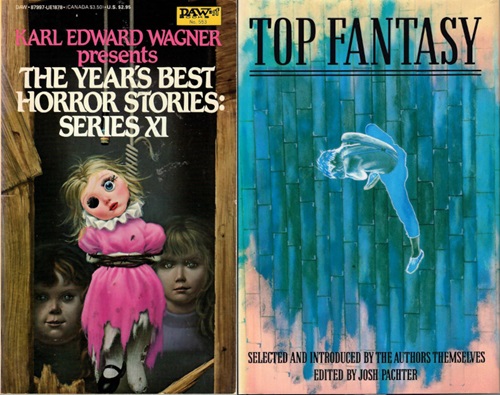
It looks like "The Depths" made its premiere appearance in the collection Dark Companions.  Karl Edward Wagner liked it, including it in The Year's Best Horror Stories: Series XI and it seems Campbell himself was proud of it, as it appeared in Top Fantasy, an anthology of stories "selected and introduced by the authors themselves."  In 2010, Allyson Bird and Joel Lane reprinted it in their collection Never Again: Weird Fiction Against Racism and Fascism, so maybe we need to scrawl our pronouns on our name tags and steel ourselves for a 17-page diversity training.  (I may be forced to plead guilty to the charge that I "worship the written word"--the fifth (pink) element of white supremacy), but nobody who has read this typo-ridden blog would think of convicting me of the first pillar of white supremacy, "perfectionism.")

Well, I guess we need not have worried about being subjected to some kind of diversity lecture by Campbell; there are no references to race in "The Depths" that I could detect, and if it is an anti-fascist story, it isn't obnoxious, or even obvious, about it.  What "The Depths" is is one of those works of genre fiction that, as do so many TV crime dramas and tabloid newspapers, denounces those who make a living producing exploitative sex and violence content while itself being just such a piece of content, full of gore and perversity, serving as an example of the very thing it seems to be attacking. 

Our main character is Miles, a crime novelist popular enough that he gets interviewed for the TV.  In the start of the story he is renting a house in which a previous resident killed his wife with a knife, carving her up so she was "unrecognizable as a human being" and then committing suicide; Miles is staying in the house hoping to get inspiration for his next book.  Local people are unfriendly to him, thinking him some kind of sadist (at least some vandal paints the word "sadist" on the gate.)  

Maybe because the house is haunted or something, Miles starts having terrible dreams of horrific crimes, among them the cooking of a live baby in a microwave.  The story takes its time, shoveling at the reader many sentences about birds and trees doing their thing, trains clattering by and citizens walking around, but eventually Miles and we readers come to realize that the terror dreams Miles is having come true--in fact, Britain is suddenly in the midst of a record-breaking wave of violent crime!  The public begins demanding the reinstatement of the death penalty for murder!  (Maybe it is the common people's demand for law and order that led Bird and Lane to think "The Depths" appropriate for their themed anthology.)  If Miles writes down the content of a dream quickly enough, the crime it presages does not occur, but the dreams are coming fast and furious and Miles' feverish writing of them obviously interferes with the writing his agent and publisher are expecting from him (we get scenes with both these individuals.)

One of the themes of "The Depths" is the idea that the taste of the reading public is in decline, or at least changing, and that this is a reflection of societal change and/or decline.  The publisher guy says to Miles "I think the public is outgrowing fantasy, now that we're well and truly in the scientific age.  People want to feel informed."  Publisher guy urges Miles to pen material based on research into real crimes.  He also shows Miles the cover of a new magazine that he calls "the last gasp of fantasy," a painting of a woman "being simultaneously mutilated and raped."  Miles later sells his records of his horrendous dreams to this magazines.

The climax of the story suggests that Miles is a scapegoat, that all of the sins of Britain or the world have been loaded on to him, and his final dream turns out to be a prediction of his own torture and murder, which he does not realize until it is too late for him to write it down and prevent its coming to pass.

The central gimmicks (crime writer is somehow assigned responsibility for the criminal nature of his decaying society as well as the whole thing with his dreams and his writing being connected to real-life crimes) are not bad and the outline of the plot is alright, but the execution of "The Depths" obscures the virtues of the story's foundations and makes it hard to enjoy the story.  "The Depths" is kind of hard to read; for one thing, it is full of extraneous details and scenes which I suppose are intended to create a mood but which, for me at least, are so much chaff that just bulks up the story unprofitably and interferes with the reader's comprehension and enjoyment of the plot and themes.  (Leiber's "The Dreams of Albert Moreland" is a useful contrast to Campbell's "The Depths"--Leiber includes lots of details but each paints a vivid picture and adds to the atmosphere of the story.)  I also found that Campbell's transitions between, on the one hand, metaphors and Miles' dreams and visions, and on the other, what was happening in the real life of the story, were a little confusing, so that "The Depths" was not a smooth read.  The level of work required of the reader leaves him little energy left over for human feeling, and it is not like Campbell's themes of social decline and the writer suffering writer's block are so novel that they can on their own hold the readers' interest.

Gotta give this one a marginal thumbs down.
**********

The Leiber is a winner, but the Matheson earns no more than a pass and the Campbell, sadly, a failing grade.  Hopefully our next and final batch of stories from To Sleep, Perchance to Dream... Nightmare will live up to the standard set by Leiber.

Wednesday, January 31, 2024

Nightmare stories by B. Stoker, H. B. Cave, D. Wandrei and N. S. Bond

In the last thrilling episode of MPorcius Fiction Log we talked about a story by Edmond Hamilton from a 1938 issue of Weird Tales that would be reprinted in the 1993 anthology edited by Stefan R. Dziemianowicz, Martin H. Greenberg and Robert Weinberg entitled To Sleep, Perchance to Dream... Nightmare.  This volume is available for us cheapos at the internet archive, so let's borrow it and check out some more stories that won the favor of Messrs. D, G and W. 

We've actually already read a bunch of things Dziemianowicz and company selected for To Sleep, Perchance to Dream... Nightmare, and here are the linkerinos to prove it:

"The Black Stone" by Robert E. Howard     
"Ubbo-Sathla" by Clark Ashton Smith
"Scarlet Dream" by C. L. Moore
"The Dreams in the Witch-House" by H. P. Lovecraft 
"The Isle of the Sleeper" by Edmond Hamilton
"The Unspeakable Betrothal" by Robert Bloch  
"Perchance to Dream" by Charles Beaumont

(Does anybody ever click these links?  The interns are always bitching about how long it takes them to copy and paste these links sections together, and I assure them that they are doing God's work, but maybe their time would be better spent out in the yard pulling weeds and stomping on spotted lanternflies or something.  Hell, probably my time would be better spent doing such things.)

At like 500 pages, To Sleep, Perchance to Dream... Nightmare is full of stories new to me that look like they are worth reading, and today we'll explore four of them, tales by the inventor of the immortal Count Dracula, Bram Stoker; a guy I suspect is overrated, Hugh B. Cave; intimate associate of H. P. Lovecraft and August Derleth, Donald Wandrei; and finally a guy I think I have only ever read one story by, but who has a long list of published SF stories, Nelson S. Bond.

"A Dream of Red Hands" by Bram Stoker (1894)

Like everybody, I love Dracula, and I actually think about Dracula all the time, having read it multiple times.  I can still remember sitting in the New York Public Library periodical room as a grad student, reading Dracula when I was supposed to be absorbing some bloodless, impotent and sleep-inducing academic garbage from some sterile mind-numbing scholarly journal.  My poor parents, tricked by my standardized test scores into thinking I was some kind of genius, financed my residence in Manhattan, where, instead of laying the foundations of a career in academia, I spent my time playing vanilla Angband, sitting by the river watching ships and birds go by, and eating the world's finest pizza, bagels and hot dogs.  Time well spent!

(We read a short story by Stoker, "The Judge's House," back in 2021 when we talked about the March 1935 issue of Weird Tales.)

Here in "A Dream of Red Hands" we have a Christian story of redemption.  Stoker's narrator is a gentleman and a writer who develops a friendship with a kind and generous working man who lives alone in a hut on the moor.  One day the narrator comes calling to find the worker quite ill.  The sick man says he can't sleep because God is punishing him with a terrible dream!  Eventually the narrator learns the dream and its genesis.  Years ago the worker was in love with some chick, and some scoundrel of a gentleman seduced her and ruined her life, and, in a sort of fit triggered by the rascal speaking disparagingly of the woman he had taken advantage of, the worker killed the gentleman and hid the body.  Now the worker knows he is barred from heaven; in the dream that has been plaguing him, angels keep him from entering paradise because his bloody hands make filthy the white raiment worn by those permitted to pass through the pearly gates.

The narrator assures the man that God is merciful and if he truly repents and does good deeds he will, after all, be permitted to enter heaven.  The murderer moves away, and years later, by coincidence, the narrator is close to the scene when the worker sacrifices himself to save a fellow worker during an industrial accident.  The narrator sees the murderer's corpse; the circumstances of the accident have bleached the man's hands white, and the narrator is sure the man has been forgiven by God.

A well-written story, and one ripe for class and gender analysis at the hands of historians and social scientists for its depiction of Victorian attitudes about class (among other things, we see one gentleman outrageously abuse members of the working class and another act as a wise guide to them) and religion.

It looks like "A Dream of Red Hands" made its debut in the weekly newspaper The Sketch and has seen book publication in the oft-reprinted collection Dracula's Guest and other Stoker collections.


"The Watcher in the Green Room" by Hugh B. Cave (1933) 

It looks like I've read nine stories by Cave over the course of this blog's hideous life.  (JFC with the links again.)  


Of these nine stories I only gave two positive reviews, but only one received a clear cut condemnation; running the numbers shows Cave's record to be better than I recalled; I guess my recollection is still dominated by my bad experience with a late novel of Cave's which I read before this blog sprang from my pate like Athena from the head of Zeus.  We'll see how today's Cave story, "The Watcher in the Green Room," which made its debut in an issue of Weird Tales with a Margaret Brundage BDSM cover and a Conan story with a good setting and good villains, affects my opinion of Cave's body of work. 

Well, on the first page of the story I am reminded that I don't like Cave's writing style; in this story he tries to be fancy and elaborate but sentences like this one end ups being clunky:
"He stood staring, apparently unaware that the hour was midnight and that the rain which had fallen steadily since early evening had made of him a drenched, disheveled street-walker."
(Rain doesn't make you a street-walker, for one thing, and how would this guy's lack of awareness of the time be made apparent to others by the fact that he is staring?  Is it abnormal to stare at certain times of the day?  Are there certain behaviors we expect of people at midnight?  Cave would be better off just straightforwardly telling us what he wants us to know instead of adding in superfluous phrases and concepts.)

On the other hand, the plot of "The Watcher in the Green Room" is not bad, and there are some good images.  Our "plump, stumpy" protagonist, Anthony Kolitt, lives in a city in an upstairs apartment--through the window over his bed comes green light from a neon sign on a nearby roof; this green light illuminates and casts shadows from Kolitt's oversized bureau, which we quickly learn is where Kollit has hidden the body of the complaining wife he murdered five days ago.  He thinks of the bureau, and/or the shadows it casts at night, as a "beast" which has swallowed up his annoying spouse and even as a friend.

The narrative describes Kollit's psychological state as he plots to escape the apartment with the body and has to deal with visits from his concerned neighbors--he told them that his wife left him and they are worried about his heavy drinking.  Most of these neighbors Cave makes ethnic stereotypes, I guess some kind of reflection of life in the melting pots/glorious mosaics that are American cities (perhaps a  sarcastic or derisive one--I don't know much about Cave, but we know that his more famous Lovecraft was no fan of ethnic diversity.)  The most significant neighbor is a "Latin" "psychopathist" whom it is hinted may be a homosexual.  This guy, Bellini, foreshadows the story's gory climax by cautioning Kollit not to imagine that the bureau is an animal, as one's imagination, he warns, can bring to life dangerous monsters.

Also noteworthy are slight "meta" elements of "The Watcher in the Green Room"; Kolitt goes out and sees a movie about a wizard or mad scientist who summons a monster which destroys him, Kollit listens to a scary drama on the radio and reads a "weird detective" story.  This consumption of genre fiction, in concert with the effects of booze and Kollit's fears of being found out by the cops, energizes his imagination to summon his own doom.

IMHO, Cave messes up the ending of the story a little.  We know from early on that Mrs. Kolitt's body is in the bureau, so the real shock ending is that a monster appears, eats half of Kolitt and then climbs out Kollit's window.  But instead of making this incredible event the focus of the final scene, Cave extends the story further to include a scene of Bellini and the cops discovering the wife's dismembered corpse, and the story's final line is "It is his wife," as if this is a shocking revelation, when it is not at all a surprise to us readers.  (If I was Cave's editor, I would have told him to make the Bellini-and-police  scene a foreword, so the story would end with the discovery of Kollit's half-eaten body and the trail of green slime leading out the window.)  

I'll call this one acceptable.  "The Watcher in the Green Room" would go on to be included in Cave collections as well as Christine Campbell Thomson's 1934 hardcover anthology Terror by Night and a 1952 issue of Donald Wollheim's Avon Fantasy Reader.        

You might know "The Witch from Hell's Kitchen" as "The House of Arabu"

"The Lady in Gray" by Donald Wandrei (1933)

The records suggest I have read 23 stories (kaboom!) by Donald Wandrei, and I may be courting a labor dispute here, but, hey, behold these links!


Look at all those upwards-facing arrows!  I guess I'm a big Wandrei fan!  Figures don't lie!  

Whereas I found Cave's "The Watcher in the Green Room" poorly written but supplied with a good plot, I'm afraid "The Lady in Gray" is well-written, with many terrific images, but has a slight plot.  

The narrator tells us he is about to commit suicide.  He relates how all his life he has had terrible terrible dreams, and how he has tried a multitude of drugs and therapies and consulted shrinks all over America and Europe in an effort to free himself from these nightmares, to no avail.  Wandrei does a good job succinctly summarizing these dreams--with a minimum of verbiage, he summons up exciting, vivid visions.  (It is noteworthy that Cthulhu and other Lovecraftian staples figure in the dreams--I guess this story is set in the "Cthulhu Mythos.")  

The narrator fell in love with and became engaged to a woman with a gray personality and gray eyes named Miriam (you know, like Felix's adorable girlfriend, who always seems so much more suitable a life partner than the somewhat annoying Gloria.)  Miriam was killed in a plane crash the day before their wedding was to be held, and then the narrator started having dreams about her in which he and she travel in impossible ways to horrible alien environments, even interacting with a sort of monstrous slug or worm.  When the narrator awakes he is greeted by physical evidence that these dreams have been in some sense real, that he really has been to slimy seas and met a huge disgusting worm with a sort of face.  Upon awakening from the most recent of these dreams, the narrator found Miriam's animated corpse sitting beside his bed, which triggers his determination to slay himself.  I guess he and Miriam will now spend eternity together, exploring the universe via esoteric means.

I guess in the end I'm giving this one a marginal "good" grade, seeing as it is full of so many good sentences and striking images.  I kind of wish more was going on, however, or that whatever is going ono was more clear to my dim understanding.    

"The Lady in Gray" first saw print in an issue of Weird Tales with one of my favorite Brundage covers; a masterpiece of Yellow Peril drama with better composition and use of color that Brundage's average.  The story would go on to be included in, among other places, the Donald Wandrei collection The Eye and the Finger and Ramsey Campbell's Uncanny Banquet.


"Prescience" by Nelson S. Bond (1941)

I think of Bond, Nelson S. Bond, when people offhandedly assert that before such and such a date SF lacked strong female characters, because, during World War II, Bond published a series of three stories starring an admirable woman who is leader of her tribe in a post-apocalyptic America; I read one of these stories, "Magic City," an Astounding cover story, back in the early days of this here blog.  "Magic City" is in fact the only Bond story I've ever read--until today, when we read a Bond tale from John W. Campbell, Jr.'s other famous and important magazine, Unknown. "Prescience" debuted alongside Kuttner and Moore's "A Gnome There Was," and would be reprinted in an anthology collecting "the greatest stories" from Unknown.

Dr. Barton, psychiatrist, is having a case of the Mondays!  He is sick of his job, sick of dealing with neurotics all day, every day.  "They're fools--the whole lot of them!" he vents to his nurse.  You see, Barton knows that all neuroses stem from fear--specifically, fear of the afterlife, and that this is foolishness, because there is no need to fear the afterlife.

At the end of the day, a working-class woman comes to see Dr. Barton; nearly all of Barton's patients are middle-class, and in his tirade to his nurse he even made the claim that "the laboring classes of our race," like "'backward' or 'pagan' people" rarely suffer neuroses because they have no fear of the afterlife, so this housekeeper, Mrs. Williams, is an unusual case.  Williams tells the shrink that she often has prescient dreams, that during the course of her days she often realizes that the quite ordinary event she is living through is proceeding exactly as something experienced in a recent dream.  As the events are occurring in real life, she can't change her course of action, but feels compelled to do precisely what she did in the predictive dream. 

Barton doesn't take this woman too seriously, thinking she is just experiencing the very common phenomenon of deja vu.  However, he decides to conduct a little experiment on Williams, feeling free to take unusual measures with her because she lacks social standing and the ability to damage his reputation.  He hypnotizes her, making her think she is asleep, and she has one of her prescient dreams, and in her trance describes it to him.  The dream, however, presages no quotidian event, but a devastating fire at the house where she works.  As she describes climbing out onto the fire escape, Barton orders her to return into the burning house, insisting the fire is a mere illusion and harmless.  Under his hypnotic influence, Williams, in her dream, climbs back into the burning building and chillingly describes the agony of burning to death and then the behavior of the demons and the damned in Hell!  

Barton finds Williams' description of death and the afterlife curious, but unimportant.  He releases the woman from her trance; as usual, she remembers none of what she dreamed.  Barton sends her home, figuring he has cured her.  But the next day he reads a story in the newspaper--Williams has died in a house fire!  Witnesses report seeing her escape the conflagration and then climb back into the burning house to be killed!  Barton realizes that Hell is real and he goes insane!

This is a pretty good story; maybe Bond deserves more screen time here at MPorcius Fiction Log.


**********

It looks like Dziemianowicz, Weinberg and Greenberg made good selections for this anthology, performing a service for their clients at Barnes & Noble and SF fans everywhere.  We'll read more stories from To Sleep, Perchance to Dream... Nightmare soon.

(But before we part, one final link!  To the trailer for the mediocre 1968 giallo Nude... si muore, a movie that is pretty disappointing as a whole, but has a good sex-and-violence opening and perhaps my favorite giallo vocal theme, a fast-paced song (perhaps inspired by the theme of the Batman TV show) with English lyrics all about nightmares.  I highly recommend the first five minutes of Nude... si muore, but after the opening credits have rolled it's a whole lotta zzzzzzzzzz....) 

Sunday, January 28, 2024

Weird Tales, May 1938: Robert E. Howard, Edmond Hamilton & J. Wesley Rosenquest

Our exploration of Weird Tales continues, today with the May 1938 number.  This issue of "The No. 1 Magazine of Bizarre and Unusual Stories" prints installments of serials by two authors I like, Henry Kuttner and Jack Williamson, but on this occasion we'll limit ourselves to a famous story by Texan Robert E. Howard which I read decades ago, a piece by our pal Edmond Hamilton of Ohio, where I lived for a couple of years, and a tale by some guy I never heard of who only has two fiction credits at isfdb, J. Wesley Rosenquest.

"Pigeons from Hell" by Robert E. Howard

Steven Tompkins, in his introduction to the 2005 Howard collection The Black Stranger and Other American Tales, calls "Pigeons from Hell" "one of the finest American horror stories," and it has been reprinted in a host of anthologies in numerous languages.  I read the story ages ago, and as I recall was a little underwhelmed by it, considering its high reputation.  But maybe I'll appreciate it more now that I am older and have feels like an uncountable number of weird stories under my belt.

Two New Englanders, buddies since childhood, are driving around the American South on a vacation.  In a remote region they get off the treacherous poorly-maintained road to sleep in an abandoned mansion, and there experience a night of eerie horror and gruesome death!  One of the men survives, just barely, rescued in a nick of time by the local sheriff who just happens to be in the area, a brave and resourceful man who throws around the "n-word" with abandon.  The sheriff connects the clues the New Englander provides with some local legend, and then consults an ancient black man--a voodoo priest who has made a pact with an ophidian African god--and finally resolves the plot by returning to the mansion with the New Englander to destroy the monster and reveal the twist ending.

Despite what I thought when I first read it, "Pigeons from Hell" is a great story--five out of five brain-smeared hatchets!  Howard stuffs every paragraph with compelling and entertaining material and we readers are subjected to zero fluff or filler.  The plot, which under all the sickening gore and black magic fireworks has the structure of a detective story, is solid--scenes follow one another logically and people's actions are believable, so the narrative draws you in and carries you along unflaggingly, unencumbered by any dull spots or rough patches that threaten your suspension of disbelief.  Both the supernatural content and the human dimension are well-handled; Howard's descriptions of the many horror images as well as of the surviving New Englander's wretched emotional state are sharp and powerful.  I found particularly effective Howard's description of the experience of being a victim of hypnotism.

As we all have heard a hundred times, Howard tried to imbue his writing with a sense of history, and "Pigeons from Hell" is chock full of pointed references to American history--Tompkins is quite right to consider this a very American story.  All the numerous characters' personalities and motivations reflect racial and regional stereotypes and grow out of the tragic and violent relationships between the European colonists who conquered the New World and the native Indians they met and the black Africans they dragged to the new civilization they founded there.  Whether we regard Howard's sketches of archetypal New Englanders, white Southerners, and African-Americans to be insightful or merely extravagant racist caricatures, they are engaging and serve to add life and credibility to the story.    

A major theme of "Pigeons from Hell," like Howard's "Black Canaan," which we read in 2019, is that black people have special knowledge and a peculiar connection to the supernatural.  Says the sheriff:  

"We're up against something that takes more than white man's sense.  The black people know more than we do about some things."

But while blacks are certainly "the other" in the story, it is not like "Pigeons from Hell" presents white people in a universally positive light.  The sheriff assumes the killer monster he is hunting is a living-dead "mulatto" woman, but in the end he finds that, in fact, the supernatural menace is a cruel white woman who has been warped by her relationships with black people and assumed some of the very worst characteristics of (Howard's pulp fiction vision of ) African culture.  Howard's story suggests that relationships between the races are inherently destructive and degrading, causing immense suffering and bringing out the worst in participants of both races.  

As the identity of the villains suggests, "Pigeons from Hell" not only offers readers a surfeit of race-based material, but plenty of sex- and gender-related content as well, with numerous female characters who suffer and/or commit all manner of crimes and mayhem.  Also noteworthy, and this is hinted by the story's title, is the role of animals in "Pigeons from Hell": birds, reptiles, and other beasts appear in the story as striking symbols as well as concrete agents of the supernatural.      

An entertaining and well-wrought classic with the ability to disturb 21st-century readers in a variety of ways.  Recommended to all readers, whether you be of the thrill-seeking or academic bent.

"The Isle of the Sleeper" by Edmond Hamilton

"The Isle of the Sleeper" might be considered one of the prolific Hamilton's more popular stories; in 1951 Farnsworth Wright's successor as editor Dorothy McIlwraith reprinted it in Weird Tales, and it would also resurface in Leo Margulies' 1961 anthology The Ghoul Keepers and a 1993 anthology edited by Stefan R. Dziemianowicz, Martin H. Greenberg and Robert Weinberg entitled To Sleep, Perchance to Dream... Nightmare.  

Hamilton wrote tons of stories about guys who end up in another world and get involved with a princess and her wars, and we have read a lot of them here at MPorcius Fiction Log.  "The Isle of the Sleeper" bears some similarity to those Princess of Mars-style stories, but has a twist and a note of sadness to it that is likely what caught the eye of editors.  The gimmick Hamilton uses here is not unlike that employed by Ambrose Bierce in "Occurrence at Owl Creek Bridge" and William Golding in Pincher Martin, but adapted for a speculative fiction audience.  

Garrison is the sole survivor of the sinking of a ship on the Pacific, and he is near death when his life raft runs aground on a forested island teeming with animals.  He finds not only life-preserving food and water but a beautiful seventeen-year-old girl!  They fall in love and enjoy several happy days together.

The girl insists that the island, the flora and fauna of which Garrison finds are unusual for these climes, is the product of a man's dream--she even leads Garrison to the couch of the sleeping man.  She implores our hero to refrain from waking The Sleeper--if the man awakes, she is sure, the island, including Garrison and herself, will vanish.  Garrison thinks this is nonsense, of course, but, as the days pass, odd events render her theory more and more plausible.  New geographical features and new island inhabitants appear, including monstrous beast-men whom the girl declares must be the product of the Sleeper's bad dreams.  Garrison and his beloved are taken captive by the beast-men, and our desperate heroes decide that annihilation would be preferable to whatever torture the savages have in store for them, so they wake the Sleeper.  Garrison witnesses the island and everything else around him disappear, and then wakes up to find that he is the Sleeper, that he is shipwrecked on a barren rock.  He is rescued, but sadly doubts that he will ever find a woman he can love as much as the girl birthed from his own subconscious; the last lines of the story also suggest that some unique property of the rock actually did give material form to Garrison's dream girl and the lush ever-changing island of his dreams.

A mildly good filler story, competently executed.

"The Secret of the Vault" by J. Wesley Rosenquest

isfdb indicates that "The Secret of the Vault" was adapted for a segment of Rod Serling's TV show Night Gallery; a look at imdb reveals that the segment aired in 1972 and was entitled "You Can Come Up Now, Mrs. Millikan."  Presumably Serling read the story in Peter Haining's 1968 anthology Legends for the Dark, which has a fun human sacrifice cover, though I suppose he might have owned or had access to a collection of old issues of Weird Tales.  I have to say that it is hard to believe that the memorable components of the story could be profitably reproduced on the small screen.

Our narrator is the youngest member of a large and wealthy family whose deceased predecessors are interred in a vault beneath the family mansion.  The first part of the story is given over to effective descriptions of the narrator's childhood fears of the vault, into which his elders regularly descend to pray for their dead loved ones.  Then the narrator indulges in odd speculations about the life force or soul, and about the character of death.  Is a human's soul like a fire that radiates energy, a force that colors and influences the world around him or her?  Is the division between life and death as sharp and clear as we generally believe, or does the life force in fact only gradually leak out of those bodies we consider dead, a proportion of it lingering long after the physical form we are sure is inert has been buried?

Then comes the plot.  The narrator's Aunt Helena was remarkably healthy and energetic, and it was a surprise to the narrator when she suddenly expired, leaving behind only two survivors of the once populous family, our protagonist and Helena's husband, Henry.  Whereas in his childhood the narrator felt the vault emanate a black gloom, now, presumably illuminated by Helena's powerful life force, the underground crypt radiates a warm vitality.  Uncle Henry goes down into the vault every day, the narrator assumes to pray beside his wife's tomb--that is until, drawn by some whim or force, the narrator intrudes for the first time into his uncle's forbidden library!  Therein he discovers dozens of books he would not have expected a Christian to be familiar with, books on the necromancy of remote tribes, books of spells for raising the dead!  The narrator's fears are confirmed when he finds Henry's diary, which Unc has been keeping up to date with descriptions of his activities since his wife's death--even more shockingly, the diary indicates that Henry convinced Helena to commit suicide so she could serve as the subject of his necromantic experiments!

The ending of the story is a little mysterious.  The narrator goes down into the family burial vault for the first (and last) time of his life, and sees the pentagram and candles and necromantic apparatus, and witnesses Helena's body return to animate life, upon which sight he flees the family house forever.  Whether Helena and Henry are satisfied with the experiment and Helena is a healthy immortal, or Helena is instead some kind of monster, perhaps a vengeful one, is not made clear.       

Not bad, but I would have liked a more transparent conclusion; the reader (at least this reader) receives mixed messages from "The Secret of the Vault."  Has Henry performed a miracle to be celebrated or committed a sin for which he will be punished?  Is Helena a victim or beneficiary?  Will this amazing event change the world or remain a secret forever?        

**********  

The Hamilton and Rosenquest stories are entertaining, but it is Howard's "Pigeons from Hell" that stands out as a classic of the genre.  A good issue of Weird Tales, and one I expect to return to for the Kuttner and Williamson serials.

More Weird Tales in our future--stay tuned!

Tuesday, January 23, 2024

Clark Ashton Smith: "The Tomb-Spawn," "The Black Abbot of Puthuum," and "Necromancy in Naat"

As you know, Bob, we here at MPorcius Fiction Log have been spending a lot of our time reading stories from 1930s issues of seminal speculative fiction magazine Weird Tales.  But some worthwhile stories have slipped through the cracks, including tales by one of the finest of the Weirdies, Californian poet Clark Ashton Smith.  In our last blog post, about a 1938 issue of Weird Tales, we read "The Garden of Adompha," one of Clark Ashton Smith's Zothique stories.  Let's read three more tales of wizardly goings-on in the environs of Zothique, grisly tales of horror that debuted in Weird Tales in the mid-Thirties but which for whatever reason I have skipped in the course of my quixotic quest to read at least one story from every 1930s issue of the great magazine of the bizarre and unusual. 

(NB: I am reading today's stories in scans of the original magazines in which they debuted; versions closer to Smith's original vision, based on Smith's manuscripts and free of editorial alterations, are available in the 21st century collections edited by Scott Connors and Ron Hilger.)

"The Tomb-Spawn" (1934)

This is a good sword-and-sorcery horror story with great images and metaphors.  

Milab and Marabac are brothers, jewel merchants who travel across the desert from town to town with a caravan.  In the first part of "The Tomb-Spawn" they are entertained by a storyteller.  This guy relates a legend of nigh-forgotten times, when a sorcerer king tamed a monster from the stars, confining it in an underground vault and feeding it young women and young men; in return, the monster provided the monarch knowledge of other worlds as well as valuable advice.  When the monster died the wizard king cast protective spells upon its tomb, and when he himself expired, his servants carried out his wish to be buried with the monster.  The storyteller tells Milab and Marabac that the location of the city in which this drama took place is lost to history.

In the second part of the story, M & M's caravan is ambushed by half-human cannibals; by luck, M & M escape with their lives, but with neither their wares nor sorely needed supplies.  Pursued by the cannibals, the jewel merchants flee across the desert, hungry and thirsty, and come to a mysterious ruined city which we readers of course recognize as the city of the long dead wizard king and his pet space monster.  The third part of the story relates the horrific encounter of the merchants with the living dead amalgam of the sorcerer and alien creature--who will survive?

I like it.  "The Garden of Adompha" had outré bestial and necrophiliac sex as one of its themes, and the physical combining of individuals of different species as another, and Smith includes these same themes, the former subtly, the latter explicitly, here in "The Tomb-Spawn."  Yuck!  You can find "The Tomb-Spawn" in various Smith collections, including 1964's Tales of Science and Sorcery and the 1989 French translation of that collection, Morthylla.


"The Black Abbot of Puthuum" (1936)

Here we have an entertaining sword and sorcery adventure.

Cushara the pike man and Zobal the archer are two of King Hoaraph's most trusted and most experienced soldiers, so when the King hears of a beautiful girl in some distant outlying province and assigns an obese eunuch to go out there to buy the girl for his harem, he sends Cushara and Zobal along to serve as an escort--after all, between the capital and that province is a wasteland reputedly inhabited by giant goblins and haunted by demons.  

The trio secures the beautiful girl, with whom both Cushara and Zobal fall in love.  On the way home the party is confronted by an inexplicable black cloud; the cloud drives them across the desert to the residence of Ujuk, a "negro monk" of "immense girth and tallness" with "deeply slanted" eyes, "purple blubbery lips," and finger nails and toe nails that are three-inch long talons.  While the girl and eunuch sleep in the monastery, and Cushara stands guard over them, Zobal is drawn to the monastery's catacombs by a mysterious voice!  Down in the crypt, what appears to be a corpse addresses the archer.  This tortured being is the father of Ujuk!  A thousand years ago, this black wizard monk, a worshipper of the maiden goddess Ojhal and abbot of this very monastery, Puthuum.  After living celibate for centuries, he was seduced by a she-devil who then gave birth to his monstrous child, Ujuk.  For abandoning his vow, Ojhal cursed him to suffer eternal life as a decaying corpse, his sorcerous powers of vision making him an eternal witness to the crimes of his half-demon son Ujuk, devourer of men and rapist of women!  

The cursed abbot implores Zobal to put him out of his misery, and explains how he can perform both this act of mercy and put an end to the evil career of the diabolical Ujuk.  Smith does a good job with the scenes of sorcery and violence that follow.  The eunuch is killed in the fracas, but so is Ujuk, and Cushara, Zobal, and the girl survive--the woman even narrowly preserves her virginity from Ujuk!  Cushara and Zobal decide to abandon their mission of bringing the woman to King Hoaraph, and in the twist ending the fighting men draw lots (Ujuk's talons) to determine which of them will possess her, but she scoffs at this procedure and chooses one of the them of her own free will.  You go, girl.        

Among the collections in which "The Black Abbott of Puthuum" would reappear are Genius Loci and Other Tales (1948) and its two-volume 1987 French translation, Le dieu carnivore.      


"Necromancy in Naat" (1936)

Here we have a story that has reappeared in sword and sorcery anthologies edited by Michael Parry (in 1977 under the pen name Eric Pendragon) and D. M. Ritzlin (in 2020.) 

As in life, in Smith stories the pursuit of women is an endless source of trouble, and "Necromancy in Naat" relates the climactic adventure of Yadar, nomad prince, who has been searching the world for his fiancé, who months ago was captured by raiders along with other women of his tribe while Yadar and the other men of the tribe were out hunting.  Yadar is pursuing vague rumors as a passenger on a merchant ship when the vessel is blown off course and finds itself captive of an infamous and irresistible ocean current, the Black River, that is said to lead to the island of Naat, home of necromancers and their undead servants.

The ship runs aground on breakers on the coast of Naat and is totally destroyed.  Yadar is the only survivor, thanks to an adept swimmer, an undead woman who brings him safely to shore--this animated corpse turns out to be none other than Yadar's lost fiancé!  A ship carrying her met the same fate as that upon which Yadar was a passenger, and her drowned body was brought back to a terrible half life by three of the fell sorcerers who lord it over this island and their staff of the living dead.

In the house of the three necromancers--a father and two sons, all incredibly old--the nomad prince learns why he was spared death.  Tribes of black cannibals live on the other side of the island, and Yadar is forced to watch as one of these savages, a particularly robust specimen held in captivity by the wizards, is entirely drained of blood by a slinky weasel-like monster that emerges from a hole in the floor.  This disgusting rodent is the senior necromancer's familiar, and Yadar is made aware that he will be on the menu come the creature's next monthly meal!    

His ability to fight or escape inhibited by hypnotic spells, Yadar spends weeks on the island, hanging around his beloved, though her flesh is cold, her eyes are dull, she does not breathe, and her speech consists merely of repeating stuff Yadar or the necromancers, who employ her as a pearl diver, say to her.  As the end of the month approaches, the two sons enlist Yadar in a scheme to murder their father, of whose centuries-long rule they have tired.  They promise Yadar a ship and a crew of undead sailors should the desperate venture come off--the nomad prince will also be permitted to take away the animated corpse of his fiancé (they add to these inducements the suggestion that, if she does not get off the isle, decrepit old Dad will use Yadar's beloved as a sex toy.)  

The sneak attack on the senior necromancer miscarries and Smith regales the reader with a long gruesome description of the horrible fight of the brothers and Yadar against the eldritch patriarch and his vampiric familiar that will thrill lovers of gore.  Yadar is killed, but the surviving son raises him from the dead, and Yadar and his beloved spend eternity together as dim-witted animated corpses, toiling on the island of necromancers.

Good--Parry and Ritzlin were right to republish this memorable and striking piece of work.


**********

Three stories about the regrettable cheating of death, sickening body modification and disgusting sexual relationships that move at a brisk pace and are full of striking images, horrendous violence and clever sentences; here we have proof that Clark Ashton Smith really is the master of the weird that everybody is always telling you he is.  Conventional wisdom confirmed!

Monday, January 22, 2024

Weird Tales, April 1938: Jacobi, Smith, and Farley

Way back in 2014 I read three stories about mummies, including Psycho-scribe Robert Bloch's "The Eyes of the Mummy."  Bloch's tale made its debut in the April 1938 issue of the famous magazine edited by Farnsworth Wright, Weird Tales, a magazine close to the hearts of the staff here at MPorcius Fiction Log.  Ten years on, let's continue our exploration of this issue of the Unique Magazine, reading three more stories that lurk behind its sex-and-death Virgil Finlay cover, two by men whose work we have been reading for ages, Carl Jacobi and Clark Ashton Smith, and one by a guy who has never before fallen beneath the MPorcius microscope, Ralph Milne Farley.

"The Devil Deals" by Carl Jacobi

First, it's links time!  Here find links to all my blog posts about Carl Jacobi stories (arrows indicate if I thought the story good or bad; mediocre or merely acceptable stories get no arrow):

With four stories I condemned and only three I actually liked, it looks like Jacobi is running a deficit here at the First National Bank of MPorcius.  But today we give him a chance to break even.

"The Devil Deals" is a competent filler story.  Basically, in foggy London a globe-trotting professional gambler has been having an affair with the hot wife of some Spanish dude.  The Spaniard lays a trap for the gambler using his unusual deck of cards, a deck the suits of which are snakes and harpies and the joker a skull, a deck which he hints may be the oldest deck of cards in existence.  The cards have an hypnotic effect on the gambler, eventually ushering him to his destruction--are the cards cursed, or are their apparently supernatural effects merely the product of the trickery of the man the gambler has been cuckolding working to exploit his addiction to risk? 

Seeing as this story is merely acceptable, Jacobi is still in the hole here at MPorcius Fiction Log.

"The Devil Deals" would be republished under the title "The King and the Knave" in various Jacobi collections.   

"The Garden of Adompha" by Clark Ashton Smith

Here we have the cover story of this issue of Weird Tales, one of Clark Ashton Smith's Zothique stories; we've read a bunch of these already.  Good grief, more links!  (No arrows this time--trust all content from Clark Ashton Smith!)

Smith is a good writer, and in "The Gardens of Adompha" he develops a striking setting and atmosphere; the undertone of bestiality and necrophilia adds a little zing to the story.  The plot is a little slight, though.

Adompha is the debased king of the decadent people of the island of Sator.  Many a night, when the citizens of the capitol city of Sator lie in their accustomed drugged sleep, Adompha will retire behind a magically barred door, to his garden.  Only the king and his wizard Dwerulas can open this door and enter the singular garden, which is sheltered under a metal roof so no ray of sunlight may fall upon it.  Inside this vault hovers a ball of fire, a miniature sun summoned by Dwerulas from Hell, and below it squirm the tangle of animalistic plants Dwerulas has grown from Hell-born seeds.  Dwerulas has employed his fell sorcery to graft to the stems, stalks and trunks of this weird foliage the body parts of people the King has had murdered, and these human heads, eyes, hands, breasts and (Smith implies) genitals still live, drawing sustenance from the alien plants to which they are attached.

The latest human addition to Adompha's garden is to be the king's favorite mistress, Thuloneah, a woman whom the king remarks was expertly skilled in using her hands in the arts of love.  Adompha directs the wizard Dwerulas, a man whose skin has been blackened and whose bones have been twisted by age, to sever Thuloneah's talented hands and graft them onto a tree.  Then, on a whim, perhaps triggered by the impression that Dwerulas is sexually attracted to Thuloneah's limp body, even as blood oozes from the stumps at her wrists, Adompha attacks the magician from behind, crushing his skull and propelling him and Thuloneah down into the grave the wizard has prepared for the doomed girl.

The next time the king visits his garden he suffers a terrible revenge apparently orchestrated by the souls of his murdered wizard and mistress: while Thuloneah's masterful hands caress Adompha, the body parts of the monarch's other victims rip him to shreds.

"The Garden of Adompha" has been reprinted many times in Smith collections and horror anthologies (nota bene: I read it, like all three of today's stories, in a scan of the April 1938 issue of Weird Tales available at the internet archive.)  

"The House of Ecstasy" by Ralph Milne Farley

Farley seems to have been a pretty successful SF writer, with many short stories published and a fair share of reprints; "The House of Ecstasy." for example, has reappeared in anthologies of weird, science fiction, and suspense stories.  Maybe I'll enjoy this tale and Farley will join the list of writers I regularly read.

Like Smith's "Garden of Adompha," Farley's "The House of Ecstasy" appeals to readers' interest in fetishistic sex.  It is also one of those stories that uses the second-person gimmick--this story is about you, the reader, and purports to revive the memory of some terrible adventure which you have forgotten about.

The narrative reminds you in detail about that recent night you went out for a walk and were tricked into calling at a nondescript brownstone much like its neighbors.  This was the home of a hunchbacked dwarf, a "toad-like" man with "yellow skin" and "claw-like hands."  This little creep is a master hypnotist and he explained that "my poor crumpled body cannot thrill to the pleasures of the flesh, except vicariously," so he imprisoned you in a cell with a beautiful woman with olive skin and a "perfect figure" so he could watch the two of you make out!  After you fell in love with the woman, kissed her and promised to rescue her, you were freed, but not before being hypnotized into forgetting the whole insane caper.  Farley has triggered your memory of your love and your duty to liberate her, but you'll never be able to find that brownstone in this city chock full of identical brownstones.

This is an entertaining little thing.  I probably will read more Farley.

Both Smith's "Garden of Adompha" and Farley's "House of Ecstasy" appear
in Sadoul's third volume of selections from Weird Tales, alongside Henry 
Kuttner's "Shadow on the Screen"
and C. L. Moore and Forrest J. 
Ackerman's "Nymph of Darkness"

**********

A respectable crop of stories, especially if you've got a thing for nonwhite dwarves abusing beautiful women.  If you are looking for more 1930s perversity and gore, keep coming back to MPoricus Fiction Log, as we'll be reading more Weird Tales in the coming weeks.

Monday, January 15, 2024

Howard Waldrop: "The Ugly Chickens," "Mary Margaret Road-Grader" and "Save a Place in the Lifeboat for Me"

Just recently I read my first ever Howard Waldrop story when I took a look at a 1979 issue of Pat Cadigan's magazine Shayol.  In the comments to my Shayol blogpost, Lastyear recommended Waldrop's "The Ugly Chickens," so today we'll read that award-winning story via the sorcery of the internet archive, world's finest website, which has a scan of the 1986 Waldrop collection Howard Who?  Looking at the table of contents, I have decided to also read "Mary Margaret Road-Grader," which I am guessing is a feminist story about a woman construction worker, and "Save a Place in the Lifeboat for Me," which I am guessing is an environmentalist story about how a small elite are going to escape Mother Earth after we humans have ruined it with our strip mining and fossil fuel burning.  

Every story in Howard Who? is preceded by an introduction from the author, and I am going to resist the urge to read these intros before I read the stories so I can go in cold and interpret and assess each story without any clues or prejudices.  (I'll read the intros after.)   

"The Ugly Chickens" (1980)

"The Ugly Chickens" won a Nebula and a World Fantasy Award, and has been reprinted many times since its debut in Terry Carr's Universe 10, including in the 1999 volume My Favorite Science Fiction Story, in which it was Harry Turtledove who declared it his favorite.  Everybody loves this thing!

Well, it is easy to see why "The Ugly Chicken" has broad appeal.  It stars a scientist, and includes a science lecture, written in the same jocular tone of the entire piece (the jokes didn't actually make me laugh, but they weren't irritatingly bad, either.)  Waldrop stuff the tale with references high brow (e.g., Walker Evans and Pachelbel's Canon in D) and topical (e.g., "Hee Haw" and Billy Carter.)  The plot structure is like that of a detective story or a Lovecraftian tale and the tone is pessimistic and ironic, dwelling on poverty, futility, and death.  There is that air of elitism we find in so much SF and I guess appeals to many SF readers: the narrator is a smart guy devoted to the truth--just like the reader, of course!--and all the other people in the story are stupid and/or some kind of fame-chaser or money-grubber oblivious to the life of the mind and the perils facing the ecology.

Our narrator is a young ornithologist, a grad student with a particular interest in endangered and extinct birds, a man who actually has dream-like visions of dodos dancing with Dutch royalty.  (The dreamy vision sequence is the worst part of the story.)  By chance, a clue that dodos were brought to America in the 18th century and bred by a family in the South up into the 20th century falls into his lap.  The story relates how the narrator travels around the backwoods of Mississippi and then around the world, interviewing people of various social strata and examining documents, trying to figure out what happened to these domesticated dodos with the hope some are still to be found alive; the text is punctuated by the aforementioned lectures (about the history of the dodo) and, as the narrator unravels them, episodes in the history of the American family that cultivated the strange foreign birds.

"The Ugly Chickens" is a pretty effective story, and people into 1970s pessimism will like it even more than I did.  Thumbs up!  

Having drafted the above, I then read Waldrop's intro, which is about the process by which he wrote "The Ugly Chickens" and got it published; like the story itself, we might characterize the intro's style and content as braggadocio camouflaged behind pessimism and self-deprecation.   


"Mary Margaret Road-Grader" (1976)

This one made its debut in Damon Knight's Orbit 18 and was chosen by Gardner Dozois as one of the best stories of the year; eighteen years after its first appearance, Kim Stanley Robinson selected it for inclusion in Future Primitive: The New Ecotopias.

This is a jokey story about a post-apocalyptic future in which the protagonists, I guess Native Americans, pursue a nomadic lifestyle that is a sort of caricature of the traditional culture of Plains Indians. These tribes raid each other as well as "white settlements" in order to steal automobiles, tractors, and other motorized machines, and meet regularly at big "Ceremonies" where they smoke dope, dance, and engage in tractor-pulling contests.  License plates are used for currency.  As in so many SF stories, a major theme of "Mary Margaret Road-Grader" is paradigm shift, and this motorized Indian civilization is in the midst of change; as no new machines are being built, the stock of cars, trucks etc., is diminishing, and the tribes are relying more and more on horses.  Society is changing in other ways, too, women getting more sexually provocative, for example.

Our narrator is Billy-Bob Chevrolet; other characters have names like "Freddy-in-the-Hollow," "Elmo John Deere" and "Simon Red Bulldozer."  Billy-Bob is a prominent member of this barbaric society; over the course of the story he is called upon to adjudicate disputes between two feuding groups, for example.  The plot of the story concerns an event that triggers radical social change ("At noon, everybody's life changed forever"): the appearance at one of the Ceremonies of a headstrong woman, the most beautiful woman Billy-Bob has ever seen, Mary Margaret Road-Grader.  Early in the story Waldrop showed us that women in this society are confined to such roles as whore and member of a big man's harem, but MMRG insists on being treated as a man, demanding to be allowed to enter a tractor pull; her demands lead to women being allowed into Councils and other social and political functions, and the narrator is instrumental in ushering in this social change.

The last third or so of the story describes the tractor pull in which Mary Margaret Road-Grader proves the equal of the best of the pullers because she has a machine which is particularly large and in particularly good condition.  ("No one had seen one in years, except maybe as piles of rust on the roadside.")  She might have won it all, but a disgruntled misogynist shoots at her during a close contest; Billy-Bob saves MMRG (and she later becomes his wife), but the bloodshed hastens still more social change--seeing them as too dangerous, the Indians cease holding the Ceremonies and the focus of their economy evolves away from the raiding of motorized vehicles and towards trade. 

Waldrop does a good job with the pacing and the action scenes, and deals with the intellectual material in an engagingly ambiguous way.  Is "Mary Margaret Road-Grader" a celebration of women's liberation and societal progress?  Maybe, but our narrator Billy-Bob, even though he bears some responsibility for the evolution of his society into something less violent and more inclusive of women, makes clear in the end of the story that he thinks that the changes, on the whole, have been for the worse.  And Mary Margaret's success is founded on less-than-admirable stereotypical female tactics (deceit and exploitation of her sexual attractiveness.)  And what about Waldrop's depiction of the lifestyle of the tribes?  To what extent does he expect us to admire their violent sexist society?  "Mary Margaret Road-Grader" reminds us of a tension we see in progressive thought: at the same time people on the left demand social and political equality, many of them also glamourize non-Western societies in which women have far less equality than in the Western societies progressives are always condemning. 

Thumbs up for a well-constructed story which plays with ideas in a provocative way.

In his intro, Waldrop describes how "Mary Margaret Road-Grader" came to him in a flash while listening to Simon and Garfunkel, and talks a little about his career and his relationship with Damon Knight; he also suggests that the best story of 1976 was Jake Saunders' "Back to the Stone Age;" Waldrop thinks Saunders' story should have won the Nebula in '77.  (In the event, Charles L. Grant took the prize for "A Crowd of Shadows," which I blogged about back in 2014.)  


"Save a Place in the Lifeboat for Me" (1976)

This one first appeared in Nickelodeon, a fanzine that was noted for its nude centerfolds and which lasted two issues.  It is easy to see why "Ugly Chickens" and "Mary Margaret Road-Grader" debuted in prestigious hard cover original anthologies and "Save a Place in the Lifeboat for Me" first saw publication in a zine with a centerfold featuring two dudes I never heard of--it is a painfully labored and gimmicky joke story, a pastiche of old comedy films like those of the Marx Brothers, Abbott and Costello and Laurel and Hardy, and a spoof of and homage to late 1950s rock and roll.

Much of the text of the 16-page story consists of Waldrop's (admittedly convincing--Waldrop is obviously very familiar with this material and clearly worked hard on this story) efforts to reproduce in print Marx Brothers' dialogue ("Whatsa matter us?") and Laurel and Hardy/Abbott and Costello slapstick ("The car roared past, whipping their hats off...They bent to pick them up and bumped heads.")  I love Laurel and Hardy and Abbott and Costello, but reading a literal textual interpretation of their routines is nothing like watching their performances, and gets tedious pretty quickly.  (The Marx Brothers I am not that keen on in any case.)

Anyway, the plot revolves around the fact that the three comedy teams have to get to a snowbound Iowa in time to stop a travelling tour of popular musicians--caricatures of the Big Bopper, Richie Valens, and Buddy Holly--from getting on a doomed airplane.  It is implied that the comedians have been sent on this mission by God or Fate.

Gotta give this lame derivative gag story a big thumbs down.  I find cheap, lazy and annoying that humor that consists of just rehashing some other work (like the parody fairy tales you see in the Bullwinkle show or EC comics, or when Homer Simpson is the Prisoner or the South Park kids star in a Dickens adaptation), anyway, and "Save a Place in the Lifeboat for Me" isn't funny or interesting, and if Waldrop is trying to pull the old heartstrings by referring to the tragic death of the young musicians, he fails because the whole story is so silly and boring.

In his intro to the story, Waldrop talks about his career and the process of writing and selling "Save a Place in the Lifeboat for Me" and reminds us that for people his age (Waldrop was born in 1946) the plane crash that killed the Big Bopper, Richie Valens, and Buddy Holly is as moving and memorable as the moon landing and the murder of JFK.

In our own 21st century, "Save a Place in the Lifeboat for Me" would reemerge in The Mammoth Book of Extreme Fantasy. 

**********

"The Ugly Chickens" and "Mary Margaret Road-Grader" are good science fiction stories that have humor as one component, but are carried to success by effective pacing and plotting and well-written scenes and the employment of traditional SF elements like paradigm shifts and speculations about science and the future--the humor doesn't get in the way of the story's literary virtues or SF themes.  But "Save a Place in the Lifeboat for Me" consists almost entirely of repetitive derivative material, the same goop again and again just piled up so it leaves no room for anything else, anything truly affecting or interesting, making the story a tedious slog and undermining any pathos the story of young ambitious people tragically dying in an accident might have had.

Maybe I'm ending this blog post on a sour note, but two out of three isn't bad, so it is possible that we'll read more Waldrop in the future.