Saturday, October 6, 2018

Herovit's World by Barry N. Malzberg

"God, how I hate science fiction.  I hate everything about it.  I hate the people who write it and the people who edit it, and don't forget the idiots who read it.  And the word rates and the conventions and what people say to you if you are married to someone who writes this crap."
"It's an honorable field.  It foretold the splitting of the atom and the moon landing."
"Like hell it did."
In his 1976 introduction to The Best of A. E. van Vogt, Barry Malzberg compares himself to van Vogt, arguing that both of them are sui generis, writers who, while members of the science fiction community, must be judged by different standards than their contemporaries in the same field.  When I read this back in 2017 I was thrilled, because I had long enjoyed Malzberg and van Vogt, who are of course very different people in so many ways, in the same way, as wacky characters with wacky ideas who present their ideas in odd and distinctive ways, whose work is challenging because it can be difficult to grasp, difficult to grasp because it ignores some of the traditional structures and forms of fiction, especially genre fiction.  I was also interested to read Malzberg's apparently sincere and obviously well-thought-out* appreciation of van Vogt because I had got the idea that Malzberg's 1973 novel Herovit's World was some kind of attack on van Vogt.

*Malzberg's intro to The Best of A. E. van Vogt is a stark contrast to his intro to The Best of Mack Reynolds, which is an opaque metaphor which talks about Reynolds' actual work hardly at all.  Not every van Vogt fan shares my view, however: van Vogt expert Isaac Walwyn, who runs the very fun, very informative, Ischi.net website, considers Malzberg's intro to The Best of A. E. van Vogt to be "full of back-handed compliments."  

Well, today we read Herovit's World.  I own the 1974 Pocket Books paperback with the brilliantly strange Charles Moll cover.  I love the typewriter with an eye and the male nude in the crucifixion pose (writers, like most creative people, are totally full of themselves!)  The barren landscape of the background, and the strange font and odd colors serve to heighten the sense that this book, and the people and environment it describes, are otherworldly, bizarre, queer.  (As you can see below, quite a few editions of Herovit's World have good covers.)  On the back we have extravagant praise for Malzberg and this work in particular from Harlan Ellison and from the award-winning fanzine The Alien Critic, which would later change its name to Science Fiction Review and which I first learned about early this year.  Ellison's back cover blurb praises Herovit's World for "destroying SF cliches," while the quote from his review in F&SF on the front cover (and Robert Silverberg's blurb on the book's first page) tell us this book is "important."

To get myself in the mood for attacks on van Vogt and SF cliches, before starting Herovit's World I read the original 1948 version of "The Rull," available at the internet archive--in The Best of A. E. van Vogt Malzberg tells us that "The Rull" is "a largely ignored story in its own time and a forgotten one now, [that] has tremendous power, and may be the best single piece that van Vogt has ever written."  I'd read "The Rull" before, but in revised versions, like the version that appears in the fix-up novel The War Against the Rull, and as I have found in the case of other van Vogt stories, the original of version of "The Rull" is better than the revisions.  Suffice to say that "The Rull" is a terrific story, full of tension, violence, and high stakes, with a weird setting, an alien villain and many new pieces of technology, and it is a story that romanticizes (fetishizes?) science, engineering, quick thinking and intelligence, a sort of Platonic exemplar of Golden Age SF--it also reflects van Vogt's particular concerns in its preoccupation with psychology and "the unconscious mind."

(I also reread Malzberg's "Vidi Vici Veni," a good reminder of how hilarious and outrageous Malzberg can be.  No matter what Herovit's World is like, Barry will always be close to my heart!)

From the first page of Herovit's World we are firmly in familiar Malzberg territory, with present tense narration of the humiliating trials of a Manhattanite protagonist who has a disastrous social life and sundry sexual problems.  Jonathan Herovit is a successful SF writer, with almost one hundred novels and hundreds of stories to his credit, including the dozens of books in the Mack Miller of the Survey Team Series.  Long ago, before his first sale, Herovit's mentor, editor of Tremendous Stories John Steele, told Herovit that his name had "too much of a New-Yorkish type of ring" and so his many books and stories appear under the pen name "Kirk Poland."  This hint that the SF community is anti-Semitic is only one of the many charges Malzberg levels at the creators and readers of SF in this novel; Malzberg is openly hostile and drearily dismissive of SF, root and branch, in Herovit's World, suggesting SF readers are sexually impotent "disturbed adolescents" who don't know a good sentence from a bad one, portraying SF writers as faithless, lecherous alcoholics, and calling the whole SF field "infantile."  Herovit's pseudonym is perhaps also a reference to anti-Semitism, a sort of Polish joke (under the name of "Poland" Herovit writes books full of nonsense and grammatical errors) and a reflection of Jewish resentment of Poles--metaphorically, "Poland" is stealing credit for Herovit's hard work!  Malzberg does creative things with names in this novel; for example, Herovit's agent is Morton Mackenzie, known as "Mack," so that Herovit's most famous character has the same name as his agent, and editor John Steele (presumably based on John W. Campbell, Jr.) has a first name that is practically the same as Herovit's.


Even though Herovit has a dim view of the fictional people Mack Miller and Kirk Poland ("he wishes that he could meet old Mack so that he, Jonathan Herovit, could kill him") they also serve as alter egos, wish fulfillment role models, of Herovit's; when Herovit faces obstacles, like when his wife Janice refuses to have sex with him or, in a laugh-out-loud passage, fellow SF writer Mitchell Wilk comes into Herovit's home office and looks at the draft on his typewriter and says "Why, this is the worst thing I have ever seen," Herovit inwardly fumes:
Mack Miller would not have put up with this shit.  Mack Miller would not have to stand in his own office, his own control room, and listen to some balding, bearded fool of a washed-up hack bait him and then start teasing.  Mack would have seized a weapon a long time ago and cleared out the invader. 
Herovit even has a sharp image of Kirk Poland ("a picture of ease and confidence") in his head, and has conversations with Kirk Poland in visions and dreams.  Some of these conversations have a homoerotic character, with Poland, for example, smoothly trying to talk his way into Herovit's bedroom while Herovit tries to sleep (Janice is in the kitchen staring at the TV):
"Come on, let me in; let's discuss this.  Let's talk things over reasonably.  You've been waiting a long, long time for this; now we can have it out man to man.  You'll like it, you really will...."
Herovit is thirty-seven, and his wife Janice, a person who hates SF but whom Herovit met at a SF convention over ten years ago, is thirty-five, and they have a six-month-old daughter, Natalie.  Janice is no prize.  One of the more chilling aspects of the novel is Janice's treatment of their daughter, whom she calls "the bitch" and "the thing."  ("Outside, Natalie begins to cry, Janice to swear at her.  Midmorning, the usual.")  Feminists will perhaps find more chilling still the scene in which Herovit has sex with Janice against her will.
"You're hurting me, Jonathan," she says--at least using his proper name, which is a start.  "You've got to stop hurting me now, please, now, please," but it is impossible to stop and how well she must know it.
Herovit is no prize himself!  Besides the marital rape, we know Herovit cheats on Janice, having unsatisfactory one night stands with female SF fans he meets at conventions.  Malzberg's characters are unambiguously unheroic; in the same way that Herovit's shady business dealings and poor writing at least in part justify the criticisms lebeled at him by people like Mackenzie the agent and Wilk the two-faced friend, Herovit's treatment of women doesn't do anything to refute Janice's ferocious feminist harangues about how men treat women as housekeepers and only pay attention to them when they want sex.


Malzberg's work is not particularly plot driven, but let's look at Herovit's World's plot.  As the novel begins, Herovit is having trouble meeting his obligations on his first contract with a major publisher, finding himself unable to write the latest Mack Miller adventure.  He already has been paid, and the book is quite overdue, and failure to deliver in mere days could jeopardize his relationship with Mackenzie and his access to this important new market.  Then Herovit is visited by his old friend  Mitchell Wilk, who hasn't written fiction in years because he somehow got a job as a professor at a college even though he himself never finished high school, much less college.  Wilk's college is offering a course in science fiction and he invites Herovit to attend a seminar, even promising him a $100 honorarium!  But it is not the hundred bucks that really attracts Herovit, but the news that college girls are easy!
"...the truly important thing is that the ass on campus, the ass is fantastic.  Nowadays they call it cunt, Jonathan....Do you know that they like to fuck?  I mean, they really like it!"
 ...the thought of the ass that likes to fuck, like the remote strains of departed music, touches Herovit...."That's what I read," he says hoarsely, "in the newsmagazines and like that."  
"And it's true.  For once the media haven't lied to us!"  
On the brink of these new professional and social opportunities, Herovit's inability to finish the required novel and deal with his wife become just too much for him, and he accepts the insistent offer that the vision of Kirk Poland has been making him--Herovit surrenders control of his life to his alter ego, his "less New-Yorkish," "all-American" pseudonym.  As so many Malzberg protagonists do, Herovit has gone insane.

This cover is beautiful, but the man is too
handsome for the material--Herovit should be
haggard, unkempt, ugly...this dude is like
some kind of gorgeous male model, fresh from
the salon!
To get the hang of Herovit's body, Kirk takes a walk around the Upper West Side.  Early in the book while walking the streets Herovit was robbed by a beggar, but Kirk proves he is a master of the streets when he confronts and intimidates a reckless taxi driver.  Kirk then patronizes a prostitute--to test out the equipment he will soon be using on Janice, whom he believes will be more tractable after "a couple of fucks like she used to have."  (That morning Herovit had proven unable to perform satisfactorily with Janice when she initiated sexual activity.)  Back home Kirk calls up Mackenzie and humiliates the agent, insisting that he doesn't need "Mack" and is withdrawing from that contract with that big new client--Kirk even tears up the 50-odd pages of that latest Mack Miller adventure that Wilk so severely condemned--Kirk knows Wilk was right.

From his filthy home office (Malzberg's long description of this office and its contents is a great scene) Kirk goes to the bedroom to begin his program of using sex to resolve Herovit's marital issues--he is too late!  Herovit's failure in bed that morning was the last straw, and Janice is packing up all her things, determined to leave her husband.  Janice is actually a more interesting character than most of the flat characters we get in Malzberg's work.  She halfheartedly tries to convince Kirk to take Natalie off her hands, but Natalie's father isn't very interested in the infant, either.  Janice, in the course of denouncing the SF field and every person connected with it, reveals that she was hanging out with SF people back in her twenties because there were so few women involved with SF that even an ugly girl like her could get a lot of dates, which she liked, "even if I was mostly going out with losers."

Janice leaves and the next day, after a dream sequence, Wilk and a young female SF fan, a woman Herovit had sex with at a convention recently, come by, ostensibly to condole with Herovit.  This visit collapses into acrimony, and in the final pages of the novel Mack Miller appears and takes over Herovit's body.  Miller's solution to every problem over the course of his career in the Survey has been violence, and he punches Wilk, then runs out on to the streets of Manhattan, where he attacks innocent strangers and then is killed when he blunders into automobile traffic.  (This ending reminded me of Nabokov's The Enchanter, but the similarity must be a coincidence, as The Enchanter did not appear in English until the 1980s.)

Barry's name may not be on the
cover of this 382-page volume,
but isfdb assures me that Herovit's World
appears within entire.
Herovit's World is only barely a SF story.  A lot of science fiction, of course, speculates about the future or alternate conditions: what will government or war or sex be like in the future, and/or in an alien environment with different technology or cultural values?  Herovit's World isn't like that at all--it has more in common with books like those of Henry Miller or Charles Bukowski or Somerset Maugham, those semi-autobiographical novels and stories that describe the difficult life of a writer or artist and his difficult relationships with women.  I'm not complaining; I love all those books, and I love reading the biographies of men like Samuel Johnson, James Boswell, Ezra Pound, T. S. Eliot, and Wyndham Lewis.  Judged as a novel of that type, Herovit's World is a big success--it is funny, well-written, and includes a genuinely affecting character in Janice (Herovit himself is too insane and too similar to other Malzberg protagonists to be surprising or truly moving.)  The plot sort of peters out a little at the end rather than building to a big climax, but it still works.

Herovit's World is a success as a novel of literary life, but it says "Science Fiction" on the back cover and all four of the blurbs are from SF sources, so let's assess Herovit's World as a novel about SF and figure out if it has something to say about SF that is valuable.

First, let's consider the idea that the novel is "important."  I think we can forgive people like Silverberg and Ellison for thinking that Herovit's World is important because it is more or less about them, professional writers in the SF field with what people years ago might have called "girl troubles," a sort of Uncle Tom's Cabin or A Day in the Life of Ivan Denisovich of the SF world, an expose of a world of corruption and injustice!  (Though, of course, Ellison and Silverberg made serious money and won wide acclaim in that world, and Herovit admits that his problems are his own doing, more the author of his own fate than a victim, unlike a black slave in 19th-century America or a prisoner in the Soviet Union.)

Second, let's look at Herovit's World as a roman a clef; what does Malzberg claim or imply about specific real life SF figures?  Joachim Boaz in his review of Herovit's World foregrounds Malzberg's satire of A. E. van Vogt, and, excepting Herovit--an exaggeration of Malzberg himself--our favorite Canadian is the most recognizable figure in the book, even though his appearance only takes up a few pages in a flashback to a meeting of a short-lived SF writer's professional society (a "guild.")  Under the name V. V. Vivaldi, van Vogt appears as a drunk who has not written lately because of his involvement in a goofy religion, but who speaks extravagantly of the superiority of SF to other forms of literature.  "Science fiction...is a way of life, a way of thinking, a new and important means of dealing with the universe."  I don't think van Vogt was actually a drunk, but Malzberg portrays every SF writer as a drunk in this book, so why should van Vogt be portrayed any differently?  And of course van Vogt did get deeply involved in Dianetics, though he rejected the later evolution of L. Ron Hubbard's project, Scientology, a distinction van Vogt, who has no interest in religion or mysticism, makes very strongly in interviews (see Charles Platt's interview with van Vogt in Dreammakers), but a distinction which Van's legions of detractors (Joachim among them!) ignore.  Interestingly, instead of portraying van Vogt as a controversial figure (van Vogt's work was famously attacked by Damon Knight in 1945 and has had many detractors since), Malzberg has all the guild members siding with Vivaldi against Herovit when a dispute between them erupts.  I think the fairest stroke of Malzberg's impressionistic sketch of van Vogt is in portraying Van's confidence in SF--in this novel he talks quite like an uncharitable paraphrase of how he writes in nonfiction parts of The Best of A. E. van Vogt, in which he says stuff like: "the individual who repeatedly exposes himself to the reading of science fiction will eventually change his brain.  For the better."  Perhaps Malzberg means this to be ironic (Malzberg portrays SF as trash, so to have a guy extolling its virtues like this is ridiculous) but I actually find van Vogt's conviction and dedication charming.

After van Vogt, the most obvious representative (non-Malzberg) figure is John Steele as John W. Campbell Jr., who like Vivaldi is revered by the masses of SF fans and pros that make up the background characters of Herovit's World.  (Janice was chair of the Bronx Honor John Steele Society when Herovit met her.)  Steele's helping Herovit come up with a less Jewish-sounding pseudonym rings true, as Campbell did help people like van Vogt and Heinlein come up with pseudonyms, and he did take possible prejudices of his readers into account when making editorial decisions, for example, not printing Samuel L. Delany's Nova, which Campbell himself liked, because he thought his readers would not want to read about a black protagonist.

Herovit recalls a Mack Miller Survey Team story written in 1961 or so:
In 1961 the best way to sell to Tremendous was to cobble up a good justification of slavery and send it off the Steele with a sincere covering letter saying that you were trying to think the unthinkable through. 
Were there really lots of stories in Analog about slavery in the early 1960s, or is this just a sort of take on Campbell's dismissive views of blacks and defense of segregation and his oft-attested willingness to buy any story about psychic powers?   The 1961 story Herovit wrote for Steele was about the "cunning little Survey Team" brainwashing some aliens so they would rebel against their overlords and become the Survey Team's slaves--could this be a reference to the elitism of so many major SF works (Asimov, Heinlein and Sturgeon all advocate smart people manipulating the masses in the Foundation stories, The Moon is a Harsh Mistress, and "Slow Sculpture," all three of which won Hugos.)

Could Mitchell Wilk, the guy without a high school diploma who becomes a college professor, perhaps be based upon high school drop out (and SF Grand Master) Frederik Pohl?   

The description of that specific Mack Miller story and my speculation it is a spoof of the elitism of SF raises the topic of Malzberg's presentation of actual SF texts in Herovit's World.  What "SF cliches," as Ellison puts it, does Malzberg "destroy?" Are there specific authors' bodies of work or individual works he is satirizing?  One of the odd things about Malzberg--and I think Ellison is somewhat guilty of this as well--is that he will often moan that SF is horrible, but he always praises individual writers, even famously controversial writers who often serve as critics' punching bags, like L Ron Hubbard and van Vogt and Heinlein and Mark Clifton.  (The exception is Lovecraft, whom Malzberg slagged in the 1989 story "O Thou Last and Greatest!" though Malzberg wasn't even bold enough to use Lovecraft's name in that story, instead describing him with a contemptuous reference to the Rhode Islander's face--easy for a handsome devil like Malzberg to do, I suppose.)

Malzberg provides something like seven or eight pages from Mack Miller novels for us to examine.  The Mack Miller stories bear very little resemblance to either van Vogt's or Malzberg's own SF work, even though Herovit's life seems loosely based on Malzberg's own.  Herovit says that he doesn't know much about psychology or write about sex, that his "focus [is] on the hard sciences," and of course we know that both Malzberg and van Vogt have among their main themes psychology and the mind, and that Malzberg writes about sex all the time.  Neither man has a long series of SF novels about the same heroic character.  (Though Malzberg did write the 14-volume Executioner-style paperback series "The Lone Wolf" between 1973 and '75.)  What Herovit is writing seems to resemble the work of E. E. "Doc" Smith and Edmond Hamilton, both of whom contributed numerous volumes to long-running series about teams of super soldier/scientists who, like Mack Miller, battle hostile aliens, the former the Lensman series and the latter the Captain Future novels.  Ellison in his review of Herovit's World links Herovit to Smith, but without using Smith's name.

I guess Malzberg's general criticism is that SF of the Lensman-style makes people appear simple and life a series of triumphs when in fact people are complicated and life is a tragedy.  Lensman-type heroes are too successful, they handle problems too easily, and they don't have any emotional or psychological issues.  In his review Ellison tells us SF has to mature and join mainstream literature, ascribes to Malzberg the belief that SF has to try to follow William Faulkner's prescription that fiction should be about "the human heart in conflict with itself," and that is the sort of stuff Herovit hoped to write (he has a "long novel of Army life... all blocked out in his head") and I guess Malzberg hoped to write as well.

I don't take this kind of criticism very seriously, as it is like complaining that an apple isn't an orange, when oranges are freely available.  If you want all that human heart stuff, it isn't hard to pick up a volume of Proust and let alone that paperback of Spacehounds of IPC.  It also ignores the fact that different writers have different objectives, and people's life experiences are diverse.  John W. Campbell, Jr. told Malzberg (see Malzberg's 1980 essay "John W. Campbell: June 8, 1910 to July 11, 1971") that science fiction was about success, about heroes, about the human ability to solve problems and figure stuff out, and of course sometimes people in real life really do solve problems and achieve success.  I don't think that a literature that celebrates humanity's achievements and ability to overcome obstacles is illegitimate, and I don't think that straightforward entertainment is illegitimate either. I also think that you see plenty of human heart stuff in the SF field, not only in post-New Wave era work by people like Thomas Disch and Gene Wolfe* who are obviously strongly influenced by "serious" literature, but even during the Golden Age from, say, Kuttner and Moore--"Vintage Season" is a good example.   

*In the same column in which he praises Herovit's World and our pal Barry to the skies, Ellison also reviews a pile of new anthologies and in the course of discussing them lists who he thinks the eight top writers in SF in 1974 are--Disch is #4 and Wolfe is #7.

On a more specific level, Malzberg portrays Mack Miller as a shoot-first-ask-questions-later kind of guy who blasts a lot of aliens (though as we have seen he does turn some into servants or slaves.)  Is this caricature a fair portrayal of the Smith/Hamilton type of space adventure story?  Obviously there is a lot of war and violence in those space operas, just like in literature and entertainment in general, and obviously people enjoy it.  But is the implicit charge of xenophobia fair?  If you actually read Smith and Hamilton, as well as Heinlein and Burroughs and van Vogt (as Malzberg and Ellison certainly have), you'll see that the human polities form alliances with many alien races and that individual humans make friends with individual aliens all the time.  "The Rull" actually ends with the human race about to enter a peace treaty with the Rull.  SF is full of war, but it is also full of trade and diplomacy and camaraderie, just like real life.  This is a weak criticism!

(Malzberg and Ellison in the texts I am discussing today do not make the sort of standard allegations you hear from Christians, pinkos and other busybodies that violent entertainment creates a violent society or that pop culture makes people too individualistic or too consumerist or too conformist or whatever, even though in other contexts, like a film column in the January 1991 F&SF, Ellison argues that violent films cause street crime.)

Even though Ellison implies that Herovit's World "immolates" a long list of SF cliches, I am hard pressed to find many more SF cliches in the novel than that SF heroes are "too" competent and shoot lots of bad guys and manipulate people.  In the novel Malzberg notes that heroes like Mack Miller don't have sex, something Ellison makes a big deal about in his review, using the phrase "sexless heroes," and Ellison adds that they don't use the toilet.  Does every story have to have a relationship angle?  And how many stories would be improved by periodic updates on the characters' bowel movements?  I'm afraid Malzberg's attack on SF is not as comprehensive or as devastating as Ellison (in his back cover blurb) makes it out to be.

Silverberg and Ellison oversell Herovit's World, but I still loved it; it is hilarious and fascinating, on every page you find some gem of a joke or phrase.  And Malzberg doesn't oversell "The Rull."  Two masterpieces of their respective subgenres, and top examples of what their respective authors are trying to accomplish--I highly recommend both to people interested in the history of SF or just enjoyable reads.

Sunday, September 30, 2018

Ultimatum in 2050 A.D. by Jack Sharkey

"You mean--you believe all that, Lloyd?" she said.  "I used to have great respect for your sanity, but-- This thing about no hospitals, about bumping off the Kinsmen to keep the population level down--it's crazy, Lloyd.  Look, your father's one jump from the Presidency.  Has he ever, in all the years of your life, even hinted such a thing to you?"
Here at MPorcius Fiction Log we are still looking for great SF adventures, a quest begun after a long period of reading short stories, most of which were not very adventurous.  In our last episode we found a great adventure by SF pioneer Edmond Hamilton, 1958's "The Starcombers."  Today we're crossing our fingers and reading Jack Sharkey's Ultimatum in 2050 A.D., which appears as half of 1965's Ace Double M-117.  The cover of Ultimatum in 2050 A.D. by famed illustrator John Schoenherr depicts robots or tanks or robotic tanks carrying off slender young ladies--sounds like an adventure to me!

My copy of M-117 is shelved in the Joachim Boaz Wing of the MPorcius Library, it being one of the 21 pounds of books donated to me in July of this year by internet SF luminary and model of generosity Joachim Boaz.  As anybody who has asked me for my social security number, phone number, or street address can tell you, I am bad at remembering numbers, but I believe this will be the eighth book Joachim sent me that I have read.

Ultimatum in 2050 A.D. first appeared in Amazing Stories in 1963 under the title The Programmed People.  I have to admit that this title sounds less like an adventure and more like a luddite tract or a satire of conformity.  I will be forging ahead, however, and you can come along for the ride for free--the magazine version is available at the internet archive.  (I like the illustrations by Emsh.)

Lloyd Bodger is a "Kinsman," one of the citizens of the Hive, a domed city run on totalitarian lines where attendance at religious services and voting in the regular plebiscites is mandatory—if you fail to meet these obligations you get “hospitalized for readjustment.”  With ten million inhabitants the Hive is overcrowded and it is almost impossible for every person to get into a voting booth on plebiscite day during the brief time period in which each person is allowed to vote. In the first chapter of our story Lloyd is at the back of the line at a voting booth and he fears that he will miss a third vote this period and thus be sent to the hospital! Desperate, he asks the attractive woman in front of him if he can cut in front of her in line. She does him a solid, and he gets his vote in on time. Then he realizes that she is the fugitive he has heard about, the woman the Goons are looking for! On a whim, and out of gratitude, he helps the girl get past the Goons who are checking everybody as they leave the Temple/polling place.

(The Goons are the eight-foot tall wheeled robot cops we saw on the cover.)

The girl, Andra Corby, reveals that she is a member of the anti-Hive movement. She tells Lloyd that that whole hospital bit is a scam--when they "send you to the hospital for readjustment" they kill you!  Andra exposes lots of other government lies as well, like that there are other Hives and this Hive is at war with some of those other Hives--Andra assures Lloyd that this dome city is the last human community on Earth and that the death penalty is administered so liberally because the government has to keep the population below ten million—the Hive's machinery and infrastructure can handle no more. Lloyd finds all this a little hard to swallow--as he reveals to Andra, he is the son of the Hive’s number two man, Lloyd Bodger Senior, the Secondary Speakster, a religious authority second only to the Prime Speakster and President, Fredric Stanton. The position of Secondary Speakster is hereditary, so if he keeps his nose clean Lloyd will one day himself be the number two man in the Hive!

While Lloyd Junior is our hero, Sharkey presents plenty of scenes in which he does not appear and other characters take center stage.  In scenes featuring Lloyd Senior and President Stanton we learn that everything Andra says is true—there are no hospitals; the "hospital" is a crematorium that recycles people into valuable "raw materials!" Dad even has to keep his chronic illness a secret from everybody, including Stanton, because people who are ill or injured are not treated but incinerated!

Rounding out our cast are Grace, Lloyd’s fiance, whom Lloyd chose at random from a list of suitable partners compiled by the government’s computer, and Andra’s fiance, Bob. (For males, marriage before the 25th birthday is compulsory.)  They also get scenes of their own—Grace is sad because she has fallen in love with Lloyd but he is only marrying her in deference to the law, and Bob is sad when his fellow anti-Hivers inform him that Andra is hiding out in Lloyd's apartment, which he thinks means she has either been captured or is in fact a government spy.  One of Bob’s fellow rebels even considers hiring a sniper to kill Andra!  (This is one of the discordant notes in the book--this is a society that is locked up tight, where the government is in charge of all production and it is illegal to go outside at night and in which everybody must carry ID that can be tracked at all times and people get executed for the smallest of offenses, like voting "con" in a referendum for which the government wants a "pro" vote, so it seems unlikely that there could be a thriving black market in assassination services.)

Jack Gaughan's rendition of a Goon asking for a dude's ID; looks a little big
Having introduced all the characters, Sharkey then has them all converge in Grace's apartment where we get dramatic revelations and changes of heart, with Grace and Lloyd joining the rebels and Bob betraying the rebels to help the Hive government.  (We later learn that all along Bob was a government spy who had infiltrated the anti-Hiver movement.)  There are the scenes we get so often in fiction of people being held at gunpoint, getting tied up, and then escaping.  There are also disguises--Andra and Bob are in the broadcast media industry, and so already know Stanton (who plays himself in propaganda films) and have access to a motorized prop Goon they can drive around in.  (The prop lacks the death ray guns and force field generators that make a real Goon so formidable, however.) 

By page 78 (Ultimatum in 2050 A.D. takes up 120 pages in this Ace edition) Lloyd and Andra have made their way to the underground facility where rests the computer that manages all the mechanical and technical aspects of the Hive, including the ten thousand Goons.  Lloyd puts on a headset and interrogates the computer, and a history of the Hive is transmitted to his brain.  Part Two of the novel, 20 pages, consists of this history.  I can't say I was happy to be abandoning all the characters and relationships I had spent 78 pages familiarizing myself with.

This picture of a Goon is pretty cool,
but in the story two adult men hide in the
prop Goon, so maybe this one is too small
While Part One of Ultimatum in 2050 A.D. had been played very straight, Part Two is ironic and full of little jokes, a limp satire of American politics.  Sharkey methodically and jocularly describes all the farcical political events and far-fetched technological developments that led to the milieu in which the Lloyds and their fellows live.  I'm suggesting this is a satire because all the politicians act like selfish creeps or ridiculous fools, but I can't really tell if Sharkey has strong beliefs about the topics he brings up, like direct democracy, socialized medicine, and public education; it seems like he is just using them as building blocks to construct his outlandish plot.  The satire here also seems totally disconnected from the rather straightforward Parts One and Three.

Part Three, the last 20 pages of the novel, brusquely resolves the plot, with Stanton, Lloyd Senior, Bob and the computer getting destroyed in melodramatic fashion and Lloyd falling in love with Grace and the Hive inhabitants being freed to explore and colonize the outside world.

Ultimatum in 2050 A.D. is on the dividing line of barely acceptable and poor.  Part One is not bad, but all the good will and interest Part One had developed were evaporated by the shift in tone and topic of Part Two, and Part Three couldn't revive my flagging commitment to the material, even though its individual scenes of people exploding and being thrown in incinerators and struggling with seizures are OK.

A look at Sharkey's list of publications at isfdb suggests that humor really is more his line than adventure--he wrote an Addams Family* novel and a cover story for Fantastic called "It's Magic, You Dope!," and a little googling around suggests he wrote scores of comedy plays that are performed by amateur theatrical groups.  I don't think I will be reading anything else by Jack Sharkey soon, if ever.   

*In case you were wondering, in the same way I think the moody and well-cast The Black Hole is better than the tiresome Tron, I think the charming and well-cast Munsters is better than the dull Addams Family.

Friday, September 28, 2018

1956 Adventures from Edmond Hamilton, Harlan Ellison, and Randall Garrett & Robert Silverberg

My last eleven blog posts have been about anthologized science fiction short stories, and I have had my fill of joke stories and stories denouncing American mass culture for a while.  Remember when you were a kid and you saw the 1977 Star Wars movie for the first time, and it was just two hours of guys shooting monsters and space Nazis, like a child's amalgam of King Kong, the raid on St. Nazaire and The Battle of Britain, a confection composed of a maximum proportion of violence, a helping of horror and a minimum of jokes and preachiness?  Remember how awesome that was?  Where might we look if we wanted to recreate that experience?

Well, I own a copy of the first issue of Science Fiction Adventures, a magazine which endured from late 1956 to 1958 and produced twelve issues, and that seems like a decent place to start.  The cover depicts a uniformed alien shooting down a woman, and is emblazoned with the words "3 Complete New Action Novels."  The first "action novel" is by Edmond Hamilton, husband of Leigh Brackett and an MPorcius fave about whose work I have written many times.  The other two action novels are the work of Randall Garrett and Robert Silverberg, presented under pseudonyms.  When we open to the contents page we see that a "Bonus Short Story" by Harlan Ellison has also been included.  Today I am reading this baby cover to cover--you can read it yourself for free at the internet archive.

"The Starcombers" by Edmond Hamilton
It made him wonder why they fought to live at all.  It made him wonder why anybody did.
A flotilla of four starships are searching the planets of a burned-out black star for salvage.  They discover the ancient foundations of a long-decayed city, and begin to dismantle them so they can bring the alien metal and plastic back to human space to sell.  But things on this planet ain't quite that simple!

The surface of this planet may be airless and dead, but deep down in a seventy-mile-wide cleft eerily lit by volcanic activity, some atmosphere lingers, and so do some native inhabitants: short humanoids, the last members of a dying race, and the giant monsters against which they must struggle!  The natives have fine vacuum suits, and powerful energy hand guns and energy artillery, but are very short on food, and the humans hope to trade with the natives, food supplies for technology.  But when one of the four human vessels goes down in the cleft to make the trade, during an attack by the ravenous dinosaur-sized monsters, the natives double cross the humans, killing some and capturing others.  Only one of the men remains free, Sam Fletcher, and he has to decide if he will try to flee to the surface or try to rescue his fellows from the ancient half-ruined fortified city in which they are being held.

Hamilton generates a grim and tense atmosphere in this story.  First of all, Hamilton presents the whole idea of searching the galaxy for ruins to salvage as sordid, like jackals and vultures picking the bones of superior creatures, and even the practice of trade as little more than swindlers trying to take advantage of each other.  While a guy in a Poul Anderson story might look out into space and think of all the opportunities for interstellar trade and how interstellar relations can make people's lives better, Sam looks at the stars and wonders "why men had ever bothered to struggle their way out to the stars...this was all the struggle came to in the end, sordid money-making...."

Adding to this story's air of cynicism and pessimism is that fact that all the characters are pretty sketchy--it's like reading about a criminal gang!  The leader of the four-ship squadron is greedy corner-cutting Harry Axe, who is accompanied by his second wife, Lucy, an ill-tempered wench who flirts with all the men in the company and bitterly insults any who resist her charms.  The aforementioned Sam Fletcher, a drunk who pilots the company's scout ship, is one of those who rejects Lucy's advances; Fletcher is also under Harry's thumb because he (Sam) lacks a license to work as a spaceman and would be an unemployed wretch were it not for Harry and his rule-bending ways.

A woman scorned, Lucy has been spreading the rumor that Sam has a thing for her, has been trying to steal her from Harry.  So, when Axe has been captured by the natives, Sam can't just jump in his ship and fly back to the surface where Lucy and the rest of the flotilla wait--people will assume Sam has murdered Harry and probably prosecute some lynch mob justice on Sam!  Instead he has to venture into the ruined city in search of his fellows.  While he is sneaking around among the ruins some natives from a rival city state, having learned that the locals have found a new source of precious food, launch an attack and a ray cannon artillery duel erupts. 

The confusion of the battle allows Sam to liberate one of his captured comrades, from whom he learns that Harry Axe, that greedy jerk, is now in league with the desperately ruthless aliens!  Axe heads for the landed ship with six of the little aliens, but Sam and his comrade beat them there and ambush them, wiping out the six natives in a barrage of energy gun fire and taking their traitorous leader into custody.  The story ends with a not very convincing change of attitude on the part of Sam--the natives of this nameless planet of a dead star remained on their dying world only to face inevitable decline and extinction, presenting an object lesson that proves that the human race's course of exploring the universe, no matter how risky or sordid it is, is the wiser course.

This is an entertaining, exciting adventure story, even if I can't endorse its skepticism of exploration and trade.  It includes ray guns, space suits, space ships, hostile aliens, monsters, disastrous sexual relationships, existential despair, so many of my favorite things.  There isn't a hell of a lot of science, and it is essentially a lost race story, so maybe "The Starcombers" will appeal most to fans of Edgar Rice Burroughs and Robert Howard; I am myself a fan of ERB and Howard, and I am giving this one a big thumbs up.

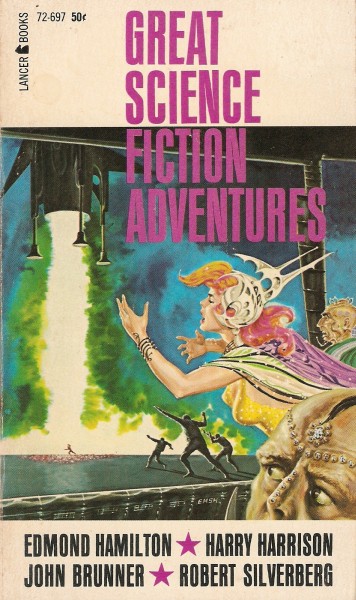
"The Starcombers" would reappear in 1958 in the British edition of Science Fiction Adventures with a different illustration of a redheaded woman dressed in white getting shot (or having a seizure or something.)  In the 1960s the story was included in multiple editions of a paperback anthology entitled Great Science Fiction Adventures.

Editor's Space by Larry T. Shaw

Page 50 of the magazine is devoted to a message from the editor of Science Fiction Adventures, Larry T. Shaw.  Shaw complains that SF isn't as fun as it used to be, that too many stories are "long-winded and one-sided arguments about psychology, sociology and culture" and tells us that Science Fiction Adventures is here to feed our need for entertaining SF.  This sounds like a complaint about the New Wave but it came seven years before Michael Moorcock took over New Worlds! 

"Secret of the Green Invaders" by Randall Garrett and Robert Silverberg (as by Robert Randall)

In his intro to this story, Shaw just comes right out and says the authors are Silverberg and Garrett.  I don't think I've ever read anything by Garrett before, though I recognize the name.

As I read "Secret of the Green Invaders" I wondered if I was supposed to be reminded of Palestine, which has been ruled by a succession of foreign empires--the Romans, Crusaders, Ottomans, and the British among many others--over many centuries.  As the story begins it is the year 3035 and Earth has been ruled by the furry green Khoomish for seven years.  The leader of the small human resistance movement, Orvid Kemron, has been captured and is dragged before the Khoomish officer in charge of Earth.  Then we get a flashback in which we learn that in the 21st century there was a nuclear war which left Earth in shambles and an easy conquest by the reptilian Sslesor.  The Sslesor were benevolent rulers who managed our affairs for a thousand or so years.  But some men were more interested in freedom and independence than bland good government!  In 3027 these rebels, led by Joslyn Carter, planted a nuclear bomb in the Sslesor headquarters, but just before they detonated it the Sslesor announced they were leaving the Earth!

The Sslesor had been defeated in a war by the Vrenk, and as part of the peace treaty they were surrendering Earth to the Vrenk.  When representatives of the Vrenk arrived they announced a hands-off policy and immediately departed, leaving the people of the Earth to their own devices.  Carter tried to set up an Earth government, but nobody respected his authority and the world collapsed into hundreds of tiny antagonistic fiefdoms.

The climax of this story is when it is revealed to Orvid Kemron that the Khoomish are not aliens at all but Carter and his comrades in disguise.  Carter realized that a thousand years of alien rule had left humans conditioned to regard rule by aliens as natural.  When the "Khoomish" appeared, over 99% of humans welcomed them and started behaving again.  As the story ends we know that Carter and Kemron will be collaborating on a thirty-year plan of conditioning the human race to accept human rule by playacting out a fake tyranny and a fake rebellion that will inspire a human desire for independence and confer legitimacy on Kemron.

"The Secret of the Green Invaders" is solidly within the SF tradition of a guy using his noggin instead of his brawn or weapons to resolve the plot, and the SF tradition of smart committed elites manipulating the ignorant masses.  The idea of getting humanity to unite by tricking them into thinking an alien invasion is underway is another recurring idea in SF.

This story is also kind of boring.  In contrast to Hamilton's compelling "The Starcombers," there is no human feeling here, no excitement, no vivid images; "The Secret of the Green Invaders" is dry and feels gimmicky.  Hamilton, like a craftsman, worked assiduously to create a setting and a cast of characters and a plot that generated an atmosphere, a mood, while Silverberg and Garrett just came up with a basic idea and then rudely hammered together a utilitarian skeletal framework to support it.  By no stretch can you call this an "adventure" or "action novel."  Thumbs down.   

"Secret of the Green Invaders" was reprinted in the U.K. edition of Science Fiction Adventures but seems to have been neglected since.

"Battle for the Thousand Suns" by Randall Garrett and Robert Silverberg (as by Calvin Knox and David Gordon)

After the plodding "The Secret of the Green Invaders" I embark on this story with low expectations.  Even though Shaw was upfront about the true authors of "Secret of the Green Invaders," in his little intro here he pretends that Calvin Knox and David Gordon are real people, apologizing to Gordon because his name was accidentally left off the cover.

Fifteen years ago Dane Regan fled the isolated Empire of the Hundred Kings, a star cluster of ten thousand stars and a thousand habitable planets, in fear for his life from King Gwyll of Jillane, most powerful of the hundred kings and the murderer of Regan's family.  For most of those fifteen years Regan has been training to become an expert fighting man in the Milky Way galaxy so he can get his revenge, and the time for revenge approaches as Regan returns to Jillane!

The societies of the Hundred Kings are feudal in nature, with a nobility, a merchant class and then the peasants.  This feudal structure is the result of a rare mutation.  A small number of people out in this cluster are born with psychic powers that can kill or stun non-psykers in an instant.  Those psykers who can kill are members of the royalty, those who can only stun, the lower members of the aristocracy.  Our hero Regan is the rightful King of Jillane and at the start of the story it is hinted that he has extra special psychic powers.

Travelling incognito as a passenger on a merchant ship from the Milky Way, Regan's plan is to join the Jillane military and work his way up the ranks until he is close enough to the reclusive hunchback King Gwyll to work his vengeance.  The first thing Regan does on Jillane is mug a merchant and steal his clothes so he won't be treated like a peasant.  (In general, writers look down on business people and, besides often portraying business as some kind of sin, they also enjoy depicting business people being abused.)  The second thing is buy a sword.  The third thing is go to the recruiting center and get in a brawl with non-commissioned officers and then a sword duel with a commissioned officer in order to prove how good a fighter he is.  He is commissioned a lieutenant.

Over the course of a year Regan becomes a hero by leading the Jillane space fleet to victory in a space naval battle (the various Kings are always fighting each other, something Regan's father hoped to be able to stop) and engages in another duel, killing his man.  The rise of Regan, who is ostensibly an outsider from the Milky Way, makes many native Jillanians jealous, and Regan is warned he will eventually be assassinated.  So he uses his psychic powers (hypnosis and illusion) to fake his own death and then leaves the planet.

Two years later the Emperor of the Hundred Kings dies; this is an elective lifetime office for which the hundred kings are the electors, and Gwyll is expected to win the election to the Imperial throne.  A week before the election Regan returns to Jillane, disguised as a prince from a bogus empire he claims is on the other side of the Milky Way.  He spends time with Gwyll's daughter, winning her affection.  Gwyll is duly elected, and at the coronation Regan exposes the fact that Gwyll isn't really a royal-class psyker--his hunchback is not a real malady, but a cover for a machine he wears behind his shoulders that artificially strengthens his psychic ability so he appears to be of the royal class.  Regan kills Gwyll and is immediately crowned king of Jillane.  We are lead to assume that the kings who just elected Gwyll emperor a few days ago will soon be electing the guy who just killed Gwyll to replace Gwyll.

"Battle for the Thousand Suns" is actually an adventure story and an "action novel" full of violence and death.  Unfortunately it is also a clunky piece of work, with no interesting characters (Gwyll gets almost zero screen time) and a somewhat frustrating plot--we watch Regan pursue his Plan A for many pages until he just abandons it to activate Plan B, which works after a few pages.  (The authors try to pass off the structure of their plot as a sort of demonstration that bold plans can be preferable to methodical plans.)  Many scenes just seem to be thrown in there to fill up pages, like the seduction of Gwyll's daughter.  Also, Regan kind of acts like a jerk--kicking an innocent waiter is one thing that comes to mind.

"Battle for the Thousand Suns" feels like something thrown together at the last minute to round out the magazine, unlike Hamilton's contribution, which feels like something that was created with care.  I have to give this thing a marginal thumbs down; it feels like filler.  The curious thing about it is that it faintly reminds me in its most surface elements of Jack Vance's Demon Princes novels, and, somewhat more strongly, of Silverberg's lucrative but mind-numbingly lame Lord Valentine's Castle, in which a boring dude goes on a boring journey of several hundred pages in order to retake his throne.

I believe this is the only appearance of "Battle for the Thousand Suns."

I recognize the Ray Harryhausen space suit
from Earth vs the Flying Saucers,
Robbie from Forbidden Planet, and the
female robot from Metropolis, but what is the
second figure from the left?  [UPDATE: 
April 20, 2019: In the comments below
Dennis identifies the mystery robot!]

"Hadj" by Harlan Ellison

"Hadj" has appeared in the Ellison collection sometimes titled Ellison Wonderland and sometimes titled Earthman, Go Home!, and in collections of short-shorts.  It is only four pages here.

It is the future Earth of world government!  Super powerful aliens--the "Masters of the Universe"--send a message to Earth to request that a single representative be sent to their homeworld; the message includes instructions on how to build the hyperspace ship necessary.  Earth computers choose an old retired businessman--the businessman is of course some kind of evil schemer who will be looking for ways that Earth can outwit the current masters and make the human race the new Masters of the Universe.  A Muslim pilots the ship that takes the businessman to the Masters' homeworld; when the Muslim compares the trip to the pilgrimage to Mecca the businessman tells him that this not a pilgrimage, that Earthmen are just as good, if not better, than these aliens.

The Earthers' ship enters the atmosphere of the alien planet, and they request directions from the local air traffic control.  The last lines of the story are the directions: "Please go around to the service entrance."  This is a disposable joke story that doesn't even make sense--the aliens ask for a representative, then, when he comes, treat him like a delivery boy, even though they didn't ask him to deliver anything?  Did they just ask us for a representative and give us the secret of hyperdrive so they could insult us?  Did Ellison write this one in fifteen minutes and then neglect to revise it?

**********

After Ellison's forgettable gag story there is a full page ad for a subscription to Science Fiction Adventures that tells you $3.50 for 12 issues is a bargain because the 36 novels you will get are sure to be published as expensive hardcovers--10 cents for such a novel will be a steal.  This is a little amusing and a little sad because, as we have seen, of today's three novels, two never saw book publication and the lead story has only ever appeared in paperback.

The final two pages of the magazine are a sort of bulletin board meant to facilitate interaction between SF fans.  The first item is about Stan and Ellen Crouch, who want to meet people interested in their innovative system of spelling, "Representative Spelling."  The second item promotes the Science & Fiction Critics Club, of Boston, and includes an aside about propeller beanies.  The third item promotes Stellar, a fanzine put out by Larry Stark and our friend Ted White, that included fiction about SF fans.

**********

Hamilton's "The Starcombers" is alone worth the price I paid for this magazine (I think I got it in a lot of 18 magazines for which I paid $45.00), the rest of the stories are just mediocre filler at best.

We'll be hunting for more adventures in the pages of SF publications from the mid-20th century in the next installment of MPorcius Fiction Log.
     

Monday, September 24, 2018

Stories from Playboy by Matheson, Beaumont, Clarke and Niven

Back in 2016 I purchased the 1971 paperback anthology Last Train to Limbo at a church sale in Fort Wayne, Indiana.  (I get around!)  This volume of stories that were originally published in Playboy includes several stories I have already read in other books, like William F. Nolan's "Papa's Planet," Arthur C. Clarke's "Dial 'F' for Frankenstein," (zoinks, this must be the story that Fredric Brown's "Answer" reminded me of a little while ago) and Fredric Brown's "Puppet Show."  But between its covers are a number of stories by authors who interest me which I have yet to read, and today we'll cover four that span the middle of the 1950s to the dawn of the 1970s.

"The Splendid Source" by Richard Matheson (1956)

This is a joke story, a spoof (I guess) of detective fiction and those SF stories in which a conspiracy of supermen who run the world behind the scenes is uncovered.  A somewhat silly rich guy becomes obsessed with finding out who writes all the dirty jokes men tell each other, and he travels all over the country, talking to bartenders and bellboys and salesmen, listening to dirty jokes and trying to figure out where they came from.  He eventually is ushered in to the secret headquarters of the centuries-old secret society of men who write the dirty jokes that are circulated by word of mouth around the world.

This story is a waste of time; it is like 20 damn pages long and my eyes were glazing over as I tried to read it.  Maybe I should note that, like an orange soda that contains no juice, this story about dirty jokes contains no dirty jokes, but just reminds you of them.  There are jokes, but they are tame.  For example, we get a list of the protagonist's earlier quixotic cultural ventures, like his unfinished contrarian books The Slums: A Positive View and Horatio Alger: Misunderstood Satirist.  Those two titles are the best jokes in the entire story, and appear on its fourth and fifth pages.     

"The Splendid Source" was reprinted in F&SF in 1957 and has since appeared in anthologies of humorous stories and in Matheson collections.  It is included in my copy of Collected Stories: Volume Two, and in the little commentary there after the story Matheson tells us that he wrote a sequel in which the hero gets into the adult film business but, for some reason, Playboy didn't buy it.

Whoa, looks familiar
"The Monster Show" by Charles Beaumont (1956)

"The Monster Show" appeared in the same issue of Playboy as Matheson's "The Splendid Source," and was also reprinted in F&SF.  

This is another joke story and another attack on television and consumerism.  I'm tripping over a lot of these lately.  Do I read SF to hear bad jokes and endless moaning from snobby smarty-pantses about how the average person is a TV-worshiping knuckledragger?  I'm suffering an acute shortage of tense stories in which a guy in a space suit uses his engineering knowledge to fight a robot!

In "The Monster Show," Beaumont takes us behind the scenes of the TV business in the consumerist future of 1976 where the TV execs use wacky slang and take drugs to endure the pressure of trying to get high ratings.  After two pages I was turning back to the table of contents to see how long this thing was--sweet relief, only eight pages.  Anyway, the bulk of this story consists of a conversation between TV execs in which one guy describes an evening's programming to another, the biggest evening of programming of all time!  The jokes Beaumont serves up consist of the kinds of exaggeration gags a dim 3rd-grader could compose--"We begin with a two-hour commercial roundup, advertising the products of our fifty-seven sponsors," and funny name jokes--one of the fifty-seven sponsors is "Chewey-Flakes."   The twist ending is that this special evening of programming is an alien plot--one of the execs is an alien spy and the night's TV shows will be putting everyone on Earth asleep so we won't be able to resist the alien invasion.  Did a child write this?

"The Monster Show" has been reprinted in Beaumont collections, and not many other places.


"The Food of the Gods" by Arthur C. Clarke (1964)

This story comes to us as an historical document, the six-page transcript of a speech given to Congress several hundred years in the future!  From this document we learn that, in the 21st century, scientists figured out how to synthesize food of all sorts from rocks and water!  Any food, from broccoli to hamburger, can be identically duplicated in a lab and mass-produced in a factory, which ends hunger and puts farms and ranches out of business.  Most people in the future depicted in this story don't even know their ancestors ate dead animals, and being appraised of this fact makes some of the Congressmen at the hearing physically ill!

The shock ending of the story comes when the person giving the speech, a spokesman for a food manufacturer, reveals that he is before Congress to complain that one of his firm's competitors is playing dirty pool.  The new food they have introduced, which is universally popular and is putting all the other food manufacturers out of business, is a duplicate of human flesh!

I'm going to call this one acceptable--it is sort of interesting and not boring or irritating, and the jokes are inoffensive.  It has been reprinted many times in Clarke collections, not much elsewhere.

 
"Leviathan!" by Larry Niven (1970)

According to isfdb "Leviathan!" is the second in a series of six or seven stories about a character named Svetz.  On the cover of a Niven collection that includes many of the Svetz stories we are told Svetz is a "Time Retrieval Expert."  The Dean Ellis cover of this collection has a pretty sincere and "sensawunda" vibe, so maybe Niven is going to break us out of our humor story rut.

In the Clarke story it is so far in the future that even the educated have forgotten that people used to eat meat from dead animals, which is hard to believe, because classic literature that the college professors of the future will read, like Virgil's Aeneid and Proust's In Search of Lost Time, include references to people slaughtering beasts and cooking them up and eating them up.  (Who could forget that scene of Francoise and the killing of the chicken?)  Well, in "Leviathan!" the people of 1,000 years in the future, when the world is ruled from the UN palace, don't have any records or knowledge of what a gila monster or a sperm whale look like.  So when the ruler of the world, the UN secretary general, wants a gila monster and a sperm whale for his zoo, and Svetz goes back in time to find them, he has no idea what precisely he is looking for!

This story focuses on the sperm whale; at the start of the story the UN apparatus already has a forty-foot fire-breathing dragon in custody which everybody calls a gila monster.  Svetz takes a sort of aircraft back in time to the mid-nineteenth century and flies over the Atlantic, hunting for a whale.  His equipment first detects a sea serpent, and Svetz, at the controls of the anti-grave devices and stun rays at his disposal, struggles with the tremendous monster, which we are told is four times the size of a sperm whale.  In the end of the story we get a literary joke (after vanquishing the serpent Svetz captures Moby Dick and brings the albino cetacean back to the future) and a hint that the reason Svetz keeps finding dragons and sea serpents and other fantastical beasts when he goes back in time is that the time machine itself is fucking up the universe.

Another joke story, but not bad.

"Leviathan!" has reappeared in Niven collections and in anthologies of time travel stories and sea serpent stories.  (Some of these anthologies get pretty specific.)


**********

Four joke stories, though the ones that integrated a little science into the drollery were not repellent.  I am going to be stacking the deck in an effort of avoid joke stories in our next episode, however!

Sunday, September 23, 2018

1961 stories from Julian F. Grow, Reginald Bretnor, Robert F. Young and Fredric Brown

I've talked about how much I like my copy of Judith Merril's seventh edition of The Year's Best S-F before, the book's size and shape and fonts and illustrations.  And I've written about a bunch of the stories it presents, including the Fritz Leiber, Cordwainer Smith and John Wyndham pieces and the selections by Rome, Bone, Feiffer, Glaser and Russell as well as, in a different book, the story by Mack Reynolds. Today let's delve further into this volume for which I paid 35 cents in Davenport, Iowa and look at stories by Julian F. Grow, Reginald Bretnor, Robert F. Young, and Fredric Brown.  (I have gotten a lot of mileage out of those 35 cents!)  All four of these tales were first published in 1961.

"The Fastest Gun Dead" by Julian F. Grow

Grow has only seven credits at isfdb, and five of them, including "The Fastest Gun Dead," are in the "Dr. Hiram Pertwee series."  The story at hand today is the first in this series, and appeared in If.

A humorous story that is played more or less straight and has technology at its core, I'm calling this one marginally good, a little better than "acceptable."

Our narrator for "The Fastest Gun Dead" is the aforementioned Hiram Pertwee, a physician in the Wild West.  Our hero is Jacob Niedelmeier, who moves to the little western town in which the tale is set from New Jersey, the greatest state in the union!  Why would anyone leave the Garden State for the land of six-guns and scalpings?  Well, our man Jake has come to make his fortune prospecting gold.  Unfortunately, as Doc Pertwee tells us, Jake is a "boob" and a "ninny" who finds no gold and gets a job as a store clerk.

Years go by, and one day Jake, out on a walk in the hills, stumbles on a skeleton...of a space alien!  The alien was armed with a laser pistol, a weapon that detects the brainwaves of those who would seek to kill the bearer, and aims and shoots all by itself!  By carrying this self-directed weapon around, and talking like the big man he actually is not, Jake becomes the best gunfighter in the territory, killing many tough galoots with funny names like "Fat Charlie Ticknor" and "Redmeat Carson."

The weakest element in the story is how Jake's career as top gunslinger comes to an end.  I guess the pistol's brainwave detectors can only detect aggressive thoughts in the left side of a brain, so when a left-handed cowboy tries to kill Jake the space gun doesn't work.  I wish Grow had come up with something better with which to end his story, as "The Fastest Gun Dead" cruises along very smoothly all the way to the last page and then hits this pothole and one of the wheels flies right off into the ditch.  Perhaps because of this problem the story has not been anthologized outside of Merril's anthology here and its British equivalent, which is somewhat confusingly entitled Best of Sci-Fi Two. 

"All the Tea In China" by Reginald Bretnor

In her little intro to the story, Merril praises Bretnor for being one of the members of the respectable intellectual elite and literary mainstream, like Anthony Boucher, who has been working to improve the reputation of SF; Merril tells us that until recently "s-f reading was something almost everybody did, and practically nobody talked about."  (The relationship of SF to mainstream culture is one of Merril's themes throughout these intros.)

"All the Tea In China," from F&SF, is a kind of shaggy dog story, a bunch of meandering details that add up to little, in the form of a piece of rural folklore.  When, as a poor New England farm boy, our narrator's grandmother caught him blackmailing another kid, she scares him straight by telling him the story of one of his no-good great-great-uncles, a Jonas.  Jonas was a successful man of business but had few friends because he was malicious and made much of his money by blackmailing people.  A series of events involving a shipment of goods from the Far East and Jonas's attempts to strong arm a woman into marrying him lead to Jonas negotiating with Satan himself.  The narrator and Jonas both commonly utter the cliche "not for all the tea in China," and the climax of this story is when Satan offers Jonas "all the tea in China" in heavy wooden chests.  When Jonas accepts the deal the multitude of chests falls from the sky and crushes Jonas.

I can't recommend this thing.  The final joke is lame and doesn't have any connection to the story's theme that you shouldn't blackmail people.  Endorsing my dim view of it, no editor has anthologized it since Merril did.

"The Dandelion Girl" by Robert F. Young

Here is a story that first appeared in a mainstream publication, The Saturday Evening Post, complete with a Norman Rockwell cover celebrating diversity.  When we last saw Young he was lamenting America's automobile and TV-obsessed culture; let's see what he sold to what was once one of America's most influential publications.

The title of "The Dandelion Girl" immediately made me think of the hyacinth girl from T. S. Eliot's The Waste Land, but the first line of this story name checks Edna St. Vincent Millay.  Forty-four-year-old Mark is on a vacation in the woods without his wife (she has jury duty!) when, on a hill with a picturesque view,  he encounters a beautiful woman of twenty-one with "dandelion hair" who reminds him of Millay.  Young tries to get a poetic vibe going in the story's first paragraphs, telling us about the autumn leaves ("burning gently with the first pale fires of fall") and the wind in Mark's face and all that.  We also get to hear again and again about Mark smoking his pipe and how his hands are trembling or tingling, depending on what Young is trying to convey.  After his first meeting with Julie we learn that one of Mark's favorite poems is Millay's "Afternoon on a Hill."  (Go ahead and read it--it is very short.)

The woman, Julie, claims to be from the future when all these woods are part of a huge city.  Her father invented a time machine and she comes back to this hill every day.  Mark and Julie meet on the hill over three successive days, talking about Bishop Berkeley and Einsteinian relativity, and Mark falls in love with her.  Julie fails to appear for two days, and when she reappears tells him her father has died.  Also, she doesn't know how to maintain her father's illegal unlicensed private time machine and it probably only has enough juice for one more trip and maybe not even that!  The last thing she says to Mark is that she loves him.

Anyway, Julie doesn't appear again, and Mark is depressed and starts neglecting his wife.  Then a few weeks later he finds a clue and realizes that his wife is Julie, that she must have used her last time trip to go back to the 1930s when he was her age so she could meet him and marry him.  Somehow Mark didn't recognize his own wife's face or voice or personality because she was twenty years younger, even though he knew her when she was that age.

I have to give this thing a thumbs down; it is sappy, overwritten, and tries too hard to appeal to an educated mainstream audience with all that extraneous Millay and Berkeley and Einstein business, and the idea of a guy not remembering what his wife looked like or sounded like when he met her 20 years ago has me rolling my eyes.  If you'll allow me to put on my feminist hat, I'll tell you that "The Dandelion Girl" appeals to the desire of the typical man to have sex with a woman half his age, and to the common man's lament that his wife doesn't look like she did when he met her--the problem with this aspect of the story from an entertainment point of view is that Mark is absolved of all guilt for having these anti-social thoughts, so the story has no tension or edge, there is no meaningful interpersonal conflict or interior psychological conflict, none of the risk or nastiness which makes stories of sexual impropriety compelling.   

Despite my groans, people, foreigners in particular, seem to like this story, and it has appeared in Young collections (including as the title story of a Japanese Young collection) and anthologies of stories about time travel.


"Nightmare in Time" by Fredric Brown

You guessed it, another teeny tiny story from Brown.  This one is the teeniest, taking up just like a third of a page!  "Nightmare in Time" first appeared in a men's magazine, Dude ("the magazine devoted to pleasure"), I guess a sort of Playboy knock off.  At time of writing, the internet archive provides free access to three issues of Dude from the late '50s; these offer pictures of topless young ladies, off-color cartoons, and fiction, including stories from people we have talked about a little here at the blog, Harlan Ellison and Michael Shaara.

Anyway, this story is something akin to a palindrome, the few dozen words that make up the tale's first half being repeated in reverse order to create the second half; Brown does this to simulate the operation of a machine that can make time run backwards.  I don't appreciate these kinds of technical tricks. 

"Nightmare in Time" has appeared in many places and in many languages, often under the title "The End."


**********

Not the best batch of stories, but it's all part of our SF education.  More SF short stories in our next episode!

Saturday, September 22, 2018

1955 stories by Arthur C. Clarke, Charles Beaumont, and Richard Matheson

1955 was a big year for culture!  Vladimir Nabokov's Lolita was first published in 1955, the first McDonald's opened in 1955, and Elvis Presley made his (local) television debut in 1955.  Was 1955 as big a year for SF as for literary fiction, gastronomy, and music?  Here at MPorcius Fiction Log we have been looking at SF which Anthony Boucher considered among the best of 1955 and included in 1956's The Best from Fantasy and Science Fiction: Fifth Series.  (I own a 1968 printing of the paperback edition.)  In our last episode we looked at three joke stories; today we look at three stories that Boucher, in his spoily intros, tells us he finds "moving" or "pointed."

"This Earth of Majesty" by Arthur C. Clarke

The story printed in The Best from Fantasy and Science Fiction: Fifth Series under the title "This Earth of Majesty" appeared in F&SF under a big question mark!  You see, the magazine was running a $200 contest to see which reader could come up with the best title!  (See the contest rules and MPorcius Fiction Log's 63-year-late entry below!)  According to isfdb, "This Earth of Majesty" was the name Clarke used, while the winner of the contest came up with "Refugee."  When the story was printed in the British magazine New Worlds in 1957 it was titled "Royal Prerogative."

It is the nearish future, when mankind has colonized Mars and Venus and ships carry cargoes between Earth and those worlds.  Rockets have just recently been replaced with ships propelled by "Field Compensation Drive generators" and a space port has been set up in England, not far from Stonehenge.  (England had no suitable sites from which rockets could take off, being too densely populated.)

Captain Saunders is a Texan in command of a space ship about to carry cargo from England to Mars; both members of his two-man crew are British.  The Prince of Wales comes to visit the ship after it lands; Prince Henry is a space buff and knows all about space ships and the history of space travel but has never been on a real space voyage because the government thinks it too risky.  Clarke here takes the line that being a member of the royal family is more a burdensome responsibility than a privilege, that the position is constricting and going to all those openings of schools and lame parties is soul-drainingly boring.  "This Earth of Majesty" is a sort of patriotic pro-Albion story; when Saunders visits London we are told that the Underground is "still the best transport system in the world," for example, and the story has the famous "this sceptred isle" quote from Shakespeare as its epigraph ("this Earth of majesty" is a phrase from this quote.)

The plot of this story is sort of obvious--American Saunders tosses aside his republican sentiments and quickly develops a soft spot for the prince, so when his crew finagle things behind his back so that the prince can stow away on the trip to Mars, he doesn't mind.  People who have it in for the English and fierce adherents to democratic ideals will groan!

Acceptable sappy filler.  Maybe an interesting historical document as a presentation of an Englishman's view of what Britain and the US are all about, or maybe the image of Britain a particular Englishman wanted to project to Americans.

My idea for the title is a nod to William IV.  Cross your fingers because I could use those 200 bucks.


"The Vanishing American" by Charles Beaumont

This story is about a 47-year-old who failed in his ambitions to become a college professor.  Wait, I’m 47 years old!  And...well, at least this guy still lives in the big city!  Count your blessings, bro!

Mr. Minchell works in an office at an adding machine.  His colleagues hardly ever talk to him--they hardly even look at him!  At home are his wife who never stops complaining and his kid who watches TV and never reads books—Minchell can’t identify with that little brat!  When he was a kid he read Edgar Rice Burroughs and L. Frank Baum!

On his 47th birthday Minchell looks in the mirror and realizes that the metaphorical process of vanishing has culminated in the literal condition of becoming invisible--nobody can see him! Shocking, a fate not unlike death...but perhaps also liberating?  When he wasn’t following the adventures of Tarzan or Dorothy and the Scarecrow, as a kid Minchell fantasized that the huge lion statue in front of the library was a mighty beast lying in wait, a creature that only he, young Minchell, could ride.  Now that nobody can see him Minchell decides to fulfill his childhood dream and climb up on the lion.  The act of living one of his dreams cures his invisibility—children and an adult man who himself was a dreamer in his youth see Minchell up there and cheer him.

Acceptable sappy filler. The St. Louis Post-Dispatch, you'll recall, accused Boucher of having a “love of the precious;” maybe this is the kind of thing that august publication was warning us about?

“The Vanishing American” has been reprinted many times. To me it felt like the story of an individual guy’s problems, but I’m an individualistic sort; in fact the story’s title suggests Beaumont meant Minchell to represent “Everyman” and the city in the story, though at times it feels like the greatest city in the world and the tomb of my hopes and dreams, is a sort of "Everytown, USA,"* and so I guess Beaumont is casting Minchell's unsatisfying job and unsatisfying family life as a universal problem, perhaps the result of something wrong with the larger culture of the United States.  Serious anthologists putting together serious tomes (for sale in bulk to government schools, one presumes) took that ball and ran with it, including “The Vanishing American” in such books as 1975's Social Problems through Science Fiction and 1976's The City 2000 A.D.: Urban Life Through Science Fiction. (What are the chances that today’s college professors would assign their victims--I mean students--a book that suggests a nagging wife is a social problem?  And are the editors of The City 2000 A.D. using “urban life” as a synonym for “modern life?”  I’m sure there are plenty of people in farm country and suburbia who failed to achieve their dreams and are alienated from their irritating spouses and dimwitted offspring.)

If crummy wives and TV-obsessed brats are your cup of tea, check out Robert F. Young's 1957 story "Thirty Days Had September," discussed just days ago here at MPorcius Fiction Log.

*The subway Minchell rides and the huge lion before the library are of course reminiscent of New York City, but Beaumont never names the town and while there are two white lions before the NYPL at Fifth and 42nd, where in a different phase of my life I spent many hours, the lion in this tale is black and solitary.  I personally think Beaumont made an artistic mistake in leaving his story bereft of a sense of place by setting it in some vague neverland.  The best thing about Damon Knight's "You're Another," which also appears in this anthology and which I was slagging in our last episode, is the real New York locations.      


"Pattern for Survival" by Richard Matheson

I'm wishing I could tell you that the author of "Duel" and "Prey" was going to break this streak of sappiness we're going through, but I cannot; this brief tale, while not bad, is pretty sappy.

The story begins with a fragment in italics, the end of a SF love story in which the happy lovers look across their beautiful glittering city of mirrored towers.  Then we follow the love story's writer as he seals up this manuscript and takes it to the mail box, then the mail man (I know, "mail carrier") as he takes the manuscript from the mail box, then the editor at the magazine as he reads the manuscript, etc.  There are hints that something weird is going on, for example, the fact that the story is written in the morning and the magazine featuring it is published that very afternoon, and there there are all the references to the decrepitude of the magazine's offices and damage to the streets.  By the end of the story we realize that there has been a nuclear war and the writer is the last man on Earth and, in his despair, he is playacting all the roles of writer, postal worker, editor, newsagent, et al.

This story is not bad, and it is less than four pages long so it doesn't waste you time, but I'm kind of sick of these sentimental stories.  "Pattern for Survival" has not been anthologized much in English, but has appeared in many Matheson collections, including Collected Stories: Volume Two, a withdrawn library copy of which I own.  Collected Stories: Volume Two includes comments by Matheson himself after each story, and, contra Boucher and me, who took "Pattern for Survival" seriously as a portrait of a man whose mind has been destroyed by a cataclysm, Matheson says it is a "humor story" and a gentle satire of Robert Sheckley whom, Matheson suggests, would get his stories published under even the worst possible conditions!  "Pattern for Survival" has also been included in several European publications.


**********

These stories are all fine; I guess I am just too cynical and jaded or simply not in the mood for this kind of sentimentality.  I wish I would come across more stories like Walter M. Miller, Jr.'s "I Made You," to be honest.

More SF stories from the MPorcius Library's anthology shelf in our next installment!