Friday, November 18, 2022

Frank Belknap Long: "The Thought Materializer," "In the Lair of the Space Monsters," and "The Dark Beasts"

I recently spent some time looking up references to Frank Belknap Long in the correspondence of H. P. Lovecraft in my copies of Hippocampus Press's Letters of H. P. Lovecraft Volume 7, Letters to Robert Bloch and Others and Volume 9, Letters to F. Lee Baldwin, Duane W. Rimel, and Nils Frome, as well as Essential Solitude: The Letters of H. P. Lovecraft and August Derleth: 1932-1937.  I came upon mentions of Long stories I hadn't yet read, and decided today to read three that have evocative titles, "The Thought Materializer," "In the Lair of the Space Monsters" and "The Dark Beasts."

"The Thought Materializer" (1930) 

In an April 24, 1935 letter to William F. Anger, Lovecraft writes about Hugo Gernsback's reputation for failing to pay writers for their stories, saying that "Hugo the Rat" never paid Frank Belknap Long for his story in the Spring 1930 issue of Science Wonder Quarterly, "The Thought Materializer."  Let's see what Gernsback got for free.

A scientist invites his friend over to test his latest invention on him.  Of course he does!  The inventor has developed a device that you strap around your head and chest and which amplifies the "vibrations" that are your thoughts.  The idea is that this device will amplify psychosomatic effects.  The example the scientist gives to his remarkably accommodating pal is that, if he thinks about hanging around on a sunny beach, he will get a sunburn, even though he is here in an apartment.  The scientist straps the thing to his friend and warns him multiple times to not think of anything really dangerous, like knives or tigers or car crashes or airplane crashes.  Then he directs his biddy to imagine he has burned his finger.  Ouch!  The man's finger is truly damaged, the skin blackened!  The device works!

The phone rings--the scientist is expecting a call from a potential investor, so he leaves the room to take this perhaps career-making call.  He doesn't turn off the machine or unstrap his friend because that would waste electricity--he's only going to be gone three minutes, he says.  While he is gone his hapless subject falls asleep and dreams he is attacked by a monster--in response to his buddy's screams the scientist rushes back to find his friend's clothes torn and his flesh mauled!  

America's most gullible man is patched up and after two weeks or so is good as new.  Meanwhile, America's worst friend has destroyed the device he invented.  When these two pals get back together the inventor laments that he will always wonder what would have happened if he had strapped the device on some animal--for some reason he is fascinated by the idea of strapping the thing on a snake and thereby inferring what a snake dreams about.

This is an amateurish sort of story with odd word choices and plot holes (how would a psychosomatic effect damage your clothes?)  The title doesn't even match the content--I expected the device to make physical matter appear.  Barely acceptable.  I am not giving it a thumbs down because it made me smile--it is entertaining, with its crazy sitcom plot, like if Lucy Ricardo was a mad scientist and got Ethel Mertz to be her guinea pig.  "The Thought Materializer" is accompanied by a drawing of a mustachioed young Long, and a little editor's intro that briefly describes (with no dates or locations or names or citations of sources) how some young girl suffered oozing stigmata, I guess in order to make this wacky story more convincing and bring it more in line with the Gernsbackian mission of teaching people science (it is alleged that stigmata are a phenomenon "recognized by science" and that medical records abound with testimony to the reality of such cases.)

"The Thought Materializer" has never been reprinted, as far as I can tell.  Here at MPorcius Fiction Log we are into unearthing the "deep cuts!"    

"In the Lair of the Space Monsters" (1932)

In a late August 1932 letter to August Derleth, Lovecraft talks about how Long resented Strange Tales editor Harry Bates' cuts to his story "In the Lair of the Space Monsters," contrasting Long with Hugh B. Cave, who apparently had a more business-like tolerance of editorial alterations to his work.  A major theme of Lovecraft's correspondence is that he is an artist and doesn't write for money or to please anybody, and he is always lamenting that other writers, from Edmond Hamilton to C. L. Moore to Long and many others, are at risk of squandering their talent and becoming hacks.   

Jim Harvey and Frank Taylor are buddies serving on a submarine.  The boat collides with something and takes on water and sinks deep, much of the hull collapsing in on itself.  Long describes in detail Harvey's experiences and his psychological state as he struggles to survive in the wrecked vessel and finds many of his comrades dead, and Taylor unconscious.

The boat comes to rest, and tentacles like those of an octopus, but 15 or 20 feet long and ending in claws, reach through a hole in the sub's hull and pull out the dead bodies as well as the still living Harvey and Taylor.  The sub has apparently travelled through a vent or hole and been cast ashore in a subterranean world that lies under the Pacific, and the crew, dead and living, collected by hairy brutish men with flat noses whose lower extremities are eight tentacles!

The octopus-men carry the corpses and the captives across a desolate cratered landscape to a forest of soft flexible trees inhabited by big drooling reptiles.  Throughout the story, paragraph after paragraph, Long endeavors to horrify and disgust the reader., and one memorable volley in the long barrage of gross stuff is when foul-smelling reptile drool lands on Harvey.  Beyond the forest is a cavern, and when the octopus-men carry their captives through a low-ceilinged tunnel a stalactite cuts open Harvey's forehead and blood runs down his face and into his mouth.  Inside the cavern are many chambers full of human bones, among them remains of clothing identifiable as those of sailors.  

Harvey and Taylor are glued to a wall with a substance much like spider webbing that the octopus-men vomit up onto them.  Then the same webbing is used to seal the chamber they are in.  There is a big egg case in the chamber with them, and it bursts open and hundreds of larval octopus men, each just eight inches long, crawl over to the sailors and start eating them alive!  Harvey goes insane and his maniacal laughter, somehow, scares the larva and they flee precipitously, chewing a hole through the sealed doorway.  The larva having chewed away most of the webbing holding Harvey and Taylor captive, they manage to break free and escape the cavern.

Then, somehow, the pair and the submarine end up on the beach of an island.  They theorize that the sub didn't sink down into a subterranean world after all, but was in fact pushed by a tidal wave into and through a point where our dimension impinges upon another dimension.  This must happen to Earth ships periodically--not only were there all those human bones, but the "Oriental" sailor who rescues them says that many strange events have been related about this island.

This is a sort of shaggy dog story in which the characters don't do anything, just observe a list of weird sights and suffer a series of horrible torments.  Why Long chose to include both the subterranean world idea and the alien dimension idea, I don't know; it is almost like he was making up the story as he went and realized that he didn't know how to get Harvey and Taylor back to the surface, so changed gears.  We'll call this one barely acceptable, as all the disgusting mishaps the sailors are subjected to are sort of fun.          

"In the Lair of the Space Monsters" was reprinted by Robert A. Lowndes in his Magazine of Horror in 1971.  The story also reappears in an 800-page volume of Long's work published this very year edited by S. T. Joshi which has a handsome photo of Long on its cover.  (People used to wear nice clothes around!)

"The Dark Beasts" (1934)

In a number of letters, Lovecraft praises "The Dark Beasts," a good example being a letter to F. Lee Baldwin dated May 16, 1934, in which Lovecraft calls the story "among his [Long's] very best."  Dare we hope this piece, which debuted in the magazine Marvel Tales, which isfdb tells us was "saddle-stapled" and included a major printing error, will be better than "The Thought Materializer" and "In the Lair of the Space Monsters?"

Well, "The Dark Beasts" is certainly better than the other two stories we are talking about today, but I wouldn't call it "good"--I'll call it "OK."  The style is better, like maybe Long revised it and somebody edited it; the dialogue, for example, feels more like real human speech and conveys personality, and the plot feels like it was outlined before hand and not just made up as the author was going along.

"The Dark Beasts" is the weird tale of a small family living off in the wilderness, near a dark sinister wood.  We first meet the youngest member of the family, eighteen-year-old Peter, who "has the mind of a child."  He is near the scary wood, by a creek, and has found a dead frog with a wire noose around its neck.

The middle section of the story, which takes up most of the page count, consists largely of dialogue between Ma and Pa, and some background that comes to us in the form of Peter's musings.  We learn the tragic history of this dysfunctional family out of chronological order, you know, for dramatic effect, but I'll just list it in order here.  Peter's grandfather made some kind of deal with the monsters who live in the wood.  (The nature of the deal is hard for me to understand--it is explained in the words of the developmentally disabled Peter, so maybe he doesn't understand it either.  It sounds like the dark things gave Grandpa immortality, and, in return, they were to be permitted to rest in Grandpa's grave with him when he died, which of course makes zero sense.)  Grandpa left the area and has never come back to fulfill his half of the deal, and so the monsters ("the dark things") cursed the family.  (When he was eight Peter saw one of the "things" talking to grandpa--it was a short bipedal monster with a body like a bear's and a head like a giant snake's!)  Peter's father Jim also had dealings with the things.  Jim died and Ma remarried; Pa is Peter's stepfather.

The dark things have, apparently, got ordinary animals to side with them against the cursed family, and worked magic against their farm, making the crops fail and the cows "dry up."  Ma and Pa disagree about the frogs--Peter's stepfather is certain the frogs are the front rank of the enemy offensive, that their croaking is black magic, but Ma thinks the frogs are their only allies, that their croakings are warnings.  She is dismayed to hear that today Pa killed all the frogs by tying wires around their necks.  As with the bargain, the role of the frogs in the story is hard to really understand; why would they protect the family, and why would Pa kill them by tying a wire noose round them instead of just clubbing them or shooting them?  Why doesn't Long explain this stuff better?  Is Long alluding to traditional folklore about frogs that I have never heard before? 

That night the things use their mental powers to convince Peter to open his window; a swarm of frogs and a snake-bear climb in.  When the authorities arrive in response to reports of a fire they find the house burned down, Ma and Peter's bodies torn to pieces, and Pa's body intact, a wire noose around its neck.  Also significant is a report from a witness who saw an odd short figure running from the house, carrying a lit torch.    

I read "The Dark Beasts" in the internet archive scan of 1975's The Early Long.  The story has been reprinted in several other Long collections, and one of those Barnes and Noble anthologies, 100 Fiendish Little Frightmares.  

**********

These stories aren't that great, which is no surprise, as I often find Long's work underwhelming.  My interest in the weird keeps me coming back, though.  

More horror stories in the next episode of MPorcius Fiction Log.

**********

It has been a long time since I have recommended a transgressive and politically incorrect manga about the challenging emotional lives of Japanese schoolgirls.  (And I have to say with sorrow that some of the ones I have recommended in the past have since lost steam as they shifted their focus from characters and plot threads that were hilarious and adorable and even heart-moving to figures and situations that are just plain boring.)  But today I am recommending Henjo by Yoshiru Konogi, which is laugh-out-loud funny and always surprising (at least up to chapter 45, which is where I am.)  Check it out but maybe don't let anybody see you doing so--it can be our little secret.

Wednesday, November 16, 2022

Richard Matheson's Shock II: Part Three

Just three stories to go in Shock II, the Richard Matheson collection we are reading here at MPorcius Fiction Log.  With ten stories behind us, our grading sheet records eight stories that deserve passing grades (two or three of which pass with distinction) and two failures.  Maybe these last three tales "from the dark side of the imagination," which take up like 75 pages, will raise Matheson's average for this semester.

"Crickets" (1960)

"Crickets" first hopped into view in the pages of Shock, a magazine that produced three issues.  This is my chance to tell you I always find Jack Davis's work uninteresting and uninspiring.  Davis' productions generate no emotion because they are so obviously a joke--the representations of monsters or gore elicit no fear or disgust, the depictions of men or women arouse no affection, admiration or desire, because every single Jack Davis image is like a caricature, a goof or a mockery that lacks a single shred of genuine feeling and puts distance between the viewer and the topic or theme presented, a distance that neuters any energy inherent in the subject so depicted.  Davis' style perhaps makes sense for broad satire and juvenile jokes based on puns about current events, but is totally inappropriate for any kind of adventure or horror story, so I find him an odd choice to do the covers of Shock, if we assume the stories in the magazine are sincere efforts to thrill or unnerve readers.     

Back to "Crickets."  A couple are on vacation by a lake.  They meet a fellow guest, a man who tells them that the crickets' songs are messages, something akin to Morse Code.  This weirdo has cracked the code, and explains that the crickets are calling out the names of the dead, that the crickets are controlled by the dead.  Why the dead find it worthwhile to transmit their names to the living in a form totally incomprehensible is not explained. 

Anyway, this guy, the next day, accosts the couple again, saying that the crickets have started singing his name, and he is scared.  The couple think he is a nut, but, of course, late at night they hear him scream and hurry to his room to find him dying, covered in hundreds of bloody cricket-bites.  His last words are an indication that the crickets are now chirping out one letter at a time the names of the couple.  Time to stock up on Deep Woods Off.

Like several of the stories in Shock II, "Crickets" is just an idea that is not deeply explored and does not make a lot of sense.  It is not even internally consistent--are the dead broadcasting their own names or the names of those they are going to slay?  Why would they do both?  Why do they feel the need to kill the people who know what they are doing?  The idea of cricket song as a means of communication is not bad, but it would work better in a sword and sorcery setting where a vampire or wizard was using the crickets to command his legions or something like that.

Acceptable filler.  "Crickets" has appeared in a few anthologies including Michael Sissons' In the Dead of Night, where you can also find Ray Bradbury's famous "Small Assassin." 


"Mute" (1962)     

Insidious evil lurks within every one of us!  Well, at least that is what is alleged by the text on the cover of The Fiend in You, the paperback anthology edited by Charles Beaumont in which "Mute" first saw print.  The Fiend in You also features Robert Bloch's "Lucy Comes to Stay," which I have already read, and stories by Fritz Leiber and Ray Bradbury and Beaumont himself I would be interested in reading, all behind a solid Richard Powers cover.

"Mute" starts with brief mysterious scenes of a German (uh oh) professor (uh oh again) arriving in small town America to look for some people, immigrants to the land of the free and the home of the brave who are involved in some kind of unspecified experiment.

The main body of the longish story begins with a remote house burning down, killing two of the people that professor is looking for, the parents of a seven-year-old boy; the boy survives.  The boy's name is Paal, but he can't even say his own name--his parents refused to send him to school, he cannot say a single word nor understand a word of English or any other language.  We readers learn that Paal is some kind of psyker who can read minds, but that this ability is jammed if people around him talk.  His parents never spoke to him, but transmitted info and carried on conversations with him via telepathy--telepathy, Matheson suggests, is a rich and evocative method of communication, besides which mere words are dead husks, sterile and inert.  (It is always remarkable to see a professional writer attacking language and the written word, his very stock in trade--we saw this with John Wyndham in Re-Birth AKA The Chrysalids, you will recall.)

The sheriff of the small town decides Paal will stay with him and his wife until they figure out who should get custody of the boy.  From the post office he acquires some letters sent to Paal's parents by correspondents of theirs in Europe; he writes out letters about the tragedy that has orphaned Paal to the return addresses on the envelopes, hoping to get in touch with Paal's relatives.  But the sheriff's wife is already crazy about Paal and wants to keep him--you see, she and the sheriff lost their own son, who was drowned, and Paal  is an attractive replacement!  So, she intercepts the letters and destroys them. 

They send Paal to school, which is a living hell for him, as all the chatter of the kids oppresses his brain, and the mind of the school teacher, a miserable old maiden lady whose status as a virgin Matheson reminds us of again and again, is a vision of horror for Paal.  (The kind of people who administer the famous Bertholt test are going to want to throw "Mute" into the fire after those letters because the happiness of women in the story is totally reliant on their relationships with men.)  The virgin teacher senses that Paal has some kind of psychic powers, because she herself has psychic powers, and considers them a terrible burden, and tries various--ruthless!--strategies to cripple Paal's psychic powers and turn him into a normal boy.

On the very day that German professor arrives at the sheriff's house, Paal's defenses crumble and he starts talking--his comprehension of and now participation in language puts an end to his telepathic powers.  The German prof's project exploring the theory that humans are all naturally telepathic but this ability was short circuited by the invention of language is ruined.  The professor admits to himself that perhaps this is for the best--Paal's birth parents didn't really love him, just thought of him as a particularly sympathetic guinea pig, while the sheriff's wife truly loves Paal and maybe love and human happiness are more important than expanding the reach of science.

Pretty good--the tale excites real human feeling and Matheson does a good job of trying to convey to the reader the experience of being a telepath and of being one or another type of unhappy woman.  The characters, like the plot, exhibit a realistic moral ambiguity--they do things that are clearly wrong but which they think are justifiable because they serve what they consider (perhaps selfishly) to be higher goals, and we readers may be persuaded to agree.  Thumbs up for "Mute." 

Besides in numerous Matheson collections, "Mute" has been reprinted in a few anthologies, including a Twilight Zone anthology on which Matheson actually gets credit as one of three editors--it turns out "Mute" was turned into an episode of the TV show, one which I have totally forgotten.


"From Shadowed Places" (1960)

Dr. Jennings' daughter Patricia is engaged to a rich guy with a beautiful Manhattan apartment.  This dude, Peter Lang, is a big game hunter who goes on safaris.  The doctor gets a desperate phone call from Patricia--Lang is terribly ill!  Jennings finds the apartment a shambles, Lang naked, Patricia desperately preventing him from killing himself.  For months Lang has had seizures and pains, and they are now so severe he wants to die.  Several specialists have examined the man, could find nothing medically wrong with him--of course they couldn't, because his agony is the product of black magic!

At Columbia, Patricia had a friend, Lurice Howell, a black woman who did field work in Africa.  Patricia calls up Dr. Howell, now an anthropology professor, and she comes over to save the day.  When she was abroad she became close with a woman witch doctor and this adept taught Howell all her secrets--in fact, Howell got so integrated into the magic-using community over there that she herself suffered the same kind of curse Lang is now going through--she feels his pain!  Howell performs a ritual to free Lang of the curse inflicted on him by a Zulu sorcerer, and Matheson pushes the lengthy magic scene to the limit.  Howell performs the ritual naked, and we hear all about how her "voluptuous" breasts move as she dances.  As part of the ritual Lang has to give Howell payment--he gives her a ring Patricia gifted to him!  The climax of the spell is when Howell straddles Lang and he ejaculates the curse into her!  All while Lang's fiancĂ© and future father-in-law watch!  Howell, somehow, shrugs off the curse after writhing around a bit.  (This is the weak part of the story.)

After Matheson has spent the entire story exploiting white people's fears of and fascinations with black people's sexuality and their supposed closer relationship with nature (as well as titillating us with depictions of womanly jealousy and scenes of voyeuristic and BDSM fetishism) on the final pages he administers the medicine that goes with our heaping spoonful of (brown) sugar--Howell quotes a poem by Countee Cullen and suggests she took on this arduous task in hopes of building a bridge between the races.

This is a pretty good black magic story and there is obviously a lot of race/sexuality/gender stuff to chew on.  I'm glad I could finish up Shock II on a story that is provocative and full of human emotion and feels like it was rigorously crafted and not just a half-baked throwaway based on a kooky idea.

"From Shadowed Places" debuted in the all-star 11th anniversary issue of F&SF, and would be reprinted in anthologies on the theme of black magic as well as many Matheson collections.


**********

Alright, thirteen stories, four or five that are good and only two that are actually bad.  I found that it got off to a slow start, but Shock II is definitely worth checking out.

Tuesday, November 15, 2022

Richard Matheson's Shock II: Part Two

I wouldn't say I was thrilled with the four stories from Shock II that we read last time we convened, but let's read four more pieces from the  a 1964 collection of Richard Matheson tales that our British friends may know as Shock 2 and see how they strike us.  After all, the back cover promises that the book contains "some of the most extraordinary excursions into the realm of the unknown ever thought or written;" maybe they put that good stuff in the middle of the book, you know, like a rich creamy filling. 

"The Man Who Made the World" (1954)

This short little piece looks like the dialogue from a play, six pages of "DOCTOR J: How old are you?" and "SMITH: Forty-seven."  There are also parenthetical stage directions in italics: "(He sits.)"  Can't you just see it?  

A short dude comes to the office of Doctor Janishefsky.  Dude, who is named Smith, claims he made the world five years ago, filling the brains of his creations--us--with false memories of the past, filling the world with minerals and fossils and books that support the illusion that the universe is very old, etc.  Smith is worried that if he dies the world will end.  The doctor scoffs and when Smith leaves the office he is hit by a motor vehicle and killed.  The world vanishes, except for the doctor and Smith, who, I guess, are God and his son or gods or aliens or something.

Bad gimmicky filler.  This rotten egg was first laid in an issue of Imagination with a sparkling cover and has been reprinted in numerous Matheson collections, including 2005's Collected Stories: Volume 2, which I own.  I dug out my copy of Collected Stories: Volume 2 and found that in an afterword to the story Matheson admits "The Man Who Made the World" is no good, calling it "almost a non-story" and like "something that a fifteen-year-old would write" and that it probably wouldn't have been published if Matheson wasn't already a name writer.


"Graveyard Shift" (1960)

"Graveyard Shift" made its debut in the very first issue of Ed McBain's Mystery Book, a magazine that endured for three issues.  There it is titled "The Faces."  A very helpful 2010 blogpost at the BareBones E-Zine strongly suggests that the story was probably retitled "Graveyard Shift" in error, and that Matheson prefers the title "Day of Reckoning."      

This is an effective, disturbing story, with personality, a well-structured plot, striking and horrible images, real human feeling and actual characters.  Thumbs up!

"Graveyard Shift" is told in three letters.  First, a letter from a guy who went into a remote house to deliver an official government notice to a reclusive woman.  He finds the woman dead--murdered!--and her child totally insane, so disturbed he cannot eat, vomiting up food forced upon him!  The guy decides he can't leave the insane kid so he sends this message by sticking it in a dog's collar!

Letter number two was penned by a second man and is addressed to the brother of the murder victim.  This epistle describes the kid's extraordinary behavior, and provides clues as to what drove the tyke mad.  It seems his mother went to the trouble of studying psychology in order to learn how to make her own son a basket case who could barely function, whose health is compromised by an inability to nourish himself.  One of her diabolical methods was to paint a multitude of menacing faces in glow-in-the-dark paint on the walls and ceiling of the kid's room.  

The final letter is from the brother of the murder victim, explaining why a woman might commit such an atrocity--she was pathologically jealous and hated her own son because he took drew her husband's attention away from her.  After her husband died saving the kid from drowning, she went to live away from society with him so she could wreak a horrendous revenge on their innocent offspring!

This story is far and away the best in the book thus far.  Marvin Kaye included the tale under this lame title in an anthology, Masterpieces of Terror and the Supernatural, and it has also been reprinted in Matheson collections under the more appropriate title "Day of Reckoning." 


"The Likeness of Julie" (1962)     

(Remember Just Say Julie?  That was really something, wasn't it?)

I read and blogged about this one back in 2019 when we looked at an anthology of "provocative horror."  This is actually a decent story--maybe they really did put the good ones in the middle!

Left: Back of my copy   Right: Cover of a Mexican edition 

"Lazarus II" (1953)

In preparation for reading "Lazarus II," I read the King James versions of chapter 16 of Luke and chapter 11 of John so I would be up to speed on people named Lazarus in the Bible and their stories of death and resurrection.
  
As Matheson's story begins, a man wakes up in a robot body.  We learn that he is a 28-year-old who committed suicide by slashing his wrists, and who can blame him--he was a sociology professor and couldn't face another semester!  As he rails against his father, the scientist who has brought him back to life in a mechanical body, we learn the root causes of his act of self-murder--the domineering and smothering mother who kept him from moving to New York to become a writer and from marrying the woman he loved.  Mom badgered and nagged Dad into bringing the reluctant sociologist back to life, but by the end of the story it looks like Dad is finally going to rebel against Mom.  (Better late than never?)

"Lazarus II" raises the question of to what extent you are your mind and to what extent you are your body--if your brain or personality was put into a different body--or a machine!--how much would having different physical characteristics change your character?  (Jack Vance also talked about this in that story we recently read, "Chateau d'if" AKA "New Bodies for Old.")  Matheson in an icky way connects this to another theme of the story, the hints that Mom is sexually attracted to her son--she demanded that her son be brought back to life because she thought she loved him, but finds that now that he doesn't have his handsome body, but instead looks like a tin can with claws, that she doesn't love him anymore.  

Two of my favorite themes--brain/soul transplants and the disastrous sexual relationship--in a story that exhibits real human drama and offers characters that feel absolutely real (tyrannical wife, browbeaten husband and kid who wants to live in New York)--thumbs up!  This story and "Graveyard Shift" AKA "Day of Reckoning" make you think the bad mother is a recurring theme in Matheson's best work, and I am here for it! 

"Lazarus II" first shuddered to disturbing life in an issue of Fantastic Story that I am having trouble finding at the internet archive, which is too bad, because this issue has illustrations by Virgil Finlay that I don't know that I have seen before.  The story has of course been reprinted in multiple Matheson collections; in addition, Peter Haining selected it for his anthology The Monster Makers. 


"Big Surprise" (1959)

We just recently read a 1931 story by science fiction Grandmaster Jack Williamson that inspired a Wonder Stories reader contest, and "Big Surprise," when it debuted in Ellery Queen's Mystery Magazine as "What Was In the Box?" was the occasion of a similar contest.  But whereas Wonder Stories printed the letters of winning readers, according to the aforementioned Bare Bonez E-Zine blog post, the winners of this 1959 contest were never recognized in the pages of EQMM.  For shame!

This story is well-written and I liked it all the way to the end, but the end is both too obvious and too nonsensical to satisfy.  

An old man, for years, has leaned on his fence and beckoned to the local boys as they walk by on their way home from school.  Most kids avoid this creepy freak, but every so often a boy will talk to him, and so everybody in town knows that the old man's MO is to ask the kids if they want a surprise, and tell them that the surprise is buried and must be dug up.  But over all these years no kid has actually dug for the surprise.

This story is about a kid who has the perseverance to actually follow the old man's directions to go to such and such a place and then face such and such a direction and walk so many paces and then dig ten feet down to find the surprise.  After he gets ten feet down he finds a big box, and opens it--the old man sits up and says "Surprise!"  (It seems that the original story did not reveal the box's contents and readers with a hankering for 25 smackers were to suggest what was in there.  Matheson added the ending when the story appeared in book form.) 

I guess the old man is a vampire who uses his vampire powers to get to his coffin that is buried under ten feet of earth.  But since this story originally appeared in a magazine that, I thought, didn't include the supernatural, maybe we are supposed to think this old weirdo has dug a tunnel to the box.  Does he hang around there all the time?  Or does he just watch to see if kids are digging (something no kids have done for years) and then crawl into the box when he does?  This doesn't make a lot of sense, especially when we recall that the kid opened the box by knocking off a latch with his shovel--if the old freak isn't a vampire, isn't he running the risk of getting his head bashed in?

Acceptable.  People seem to like "Big Surprise;" it has appeared in a number of anthologies and was even turned into an episode of Rod Serling's Night Gallery.    

**********

Well, two of these stories are legitimately good, so we have some good news and can hope we'll get some good stories when we finish up Shock II in the next exciting episode of MPorcius Fiction Log. 

Sunday, November 13, 2022

Richard Matheson's Shock II: Part One

On Richard Matheson's isfdb page we see listed a series consisting of four collections, each with "shock" in its title.  On a recent visit to our nation's capital, I purchased a copy of the second volume of the Shock series, Shock II, Dell 7829, at Second Story Books on Dupont Circle.  Shock II offers "Thirteen Tales to Haunt the Imagination" originally published in the period 1952-62 and we here at MPorcius Fiction Log are going to cover them all, in the order they appear in the book, over the course of three blog posts.  Episode one of this journey will bring us to page 71 of the 192 page paperback; we'll be reading four pieces, and skipping one, "No Such Thing as a Vampire," which we blogged about back in 2020 when I read a selection of stories from Martin H. Greenberg's 1997 anthology Vampires: The Greatest Stories.

"A Flourish of Strumpets" (1956)

As the title of the story perhaps suggested to you, "A Flourish of Strumpets" first appeared in the pages of Playboy, our most pretentious skin rag!  You can find it in a bunch of Matheson collections and a 1990s anthology of fiction from Playboy.

This is a gimmicky filler story.  Prostitutes start coming to the doors of suburban homes in the evening, offering their wares like door-to-door salesmen.  They are "representatives" of a big concern called "the Exchange."  Our protagonist and his wife are mortified, disgusted, enraged, and call the police.  When the police do nothing, they call the FBI.  The Feds don't do anything either.  Meanwhile, our hero's colleagues at work don't see anything wrong with this new firm and its innovative business model.

I guess this story is supposed to be funny, and many of the jokes revolve around the euphemisms Matheson comes up with to both describe women's breasts ("She absorbed blouse-enhancing air") and the main character's sexual excitement each night as he answers the door to find a different beautiful woman offering to have sex with him ("...birds with heated wings buffeted at his face.")  These metaphors are pretty bad.

The point of the story, I guess, is that every man is corruptible, will cheat on his wife if he can figure out a way to do it.  Maybe a leftist would interpret the story as being about how advertisers can create demand for products people don't actually want if they just keep banging away at potential customers day after day, and how the government can easily be persuaded by business interests to give them free rein.  Anyway, Matheson somewhat obliquely indicates that the main character has succumbed and started seeing the Exchange's whores without his wife knowing.  Tempting women no longer ring the door bell each evening.  The twist ending is that now that the Exchange has won the protagonist as a client, they start sending attractive men over to try to badger his wife into becoming a customer of the services they offer women.

Acceptable, I guess.

"Brother to the Machine" (1952)

This baby debuted in If, and then was reprinted in 1965's Invasion of the Robots, one of those anthologies credited to Roger Elwood but in fact put together by Sam Moskowitz, as well as a bunch of Matheson collections.

It is the war-torn totalitarian future!  Our main character is in something of a daze, wandering the streets, and we see that there are security cameras on every corner, police aircraft patrolling overhead, newspaper headlines reporting on inflation and newspaper editorials expressing support for the extermination of the Martians, and in  shop windows Venusian slaves for sale.  Everybody on the street, human or robot, is working, as the government forces every able-bodied person to have a job, but our hero is not working--he has fled his job developing super weapons.  He tries to commit suicide, but this is illegal and the cops spot him and take up pursuit.  He flees to a park, tries to kill himself by jumping in a pool.  Our twist ending is that he is a robot.

Acceptable, I suppose.


"Descent"
(1954)

Another story from If, and our second fun astronaut in outer space cover of the day, but a literal one, whereas, I think, the earlier one is somehow symbolic or represents an illusion.    

I am pretty sure I've read "Descent" before, in that period before the mold spores burst and this blog propagated across the interwebs; as I have mentioned before I own a withdrawn library copy of the Matheson collection Collected Stories: Volume 2 and "Descent" appears there so that is probably where I read it.

Our six or seven characters live out in California.  Tomorrow there will be a nuclear war, a war which has been long scheduled, so everybody has had time to prepare.  The government has set up vast underground shelters, entire underground cities, that will house the population.  This story follows our characters as they look at the sunset and sadly reflect they will never see one again, play their records for the last time, lament they can't bring more books underground with them, grapple with the decision of whether to die like men on the surface or live like worms underground, and so on.

OK.  It looks like this one has never been anthologized.

"Deadline" (1959)

"Deadline" was first published in an issue of Rogue bearing a more artistically sophisticated cover than you usually see on these softcore porno magazines, and has been anthologized numerous times.

Our protagonist is a doctor whose wife is pregnant.  During a New Year's party he is called away to tend to an old geezer who is confident he is about to die, even though his land lady says he was up and about earlier in the day as if nothing was wrong.

Old geez tells a wild story.  He was born exactly one year ago and has been aging two years every week.  He says that every year somebody is born at midnight as the year turns and lives out that year and dies precisely as the year ends--this is the source of the conventional idea of the new year being represented as a baby and the passing year as an old dude with a scythe.

Sure enough, the guy expires at midnight.  When the doc gets back home he learns that his wife gave birth at exactly midnight.  Dun dun DUN....

I think I have to give this story a thumbs down, as its central gimmick is too dumb.  


**********

I think of myself as a guy who likes Matheson--I like "Prey" and "Blood Son" and I Am Legend, and of course I like the movies Duel (1971) and The Last Man on Earth (1964).  But these stories here are not so great.  Each one is built around a gimmicky idea that may or may not make any sense, and serves merely to present the idea competently--the stories lack the singular writing style or any human feeling, personality, or atmosphere that might make them truly entertaining or compelling.  Each story lives or dies based on its gimmick; most of them live, but not one of them thrives.

"A Flourish of Strumpets" is the best of the four stories under discussion as its gimmick at least seems plausible and it offers some kind of (cynical) point of view and is trying to say something about society and human nature; it also tries to make you laugh with its weak jokes.  "Brother to the Machine" also has a plausible foundation and a sort of misanthropic point of view, but is less novel (there are plenty of "humans are evil imperialists" and "holy crap, he's a robot!" stories out there) and less engaging.  The idea behind "Descent" doesn't make much rational sense (the attack that is going to devastate the United States is on a public schedule?) but it at least makes symbolic or abstract sense as an effort to represent rational fears of nuclear attack from the Soviet Union (not that the USSR is named in the story--these old SF stories that depict nuclear war often don't identify the enemy, I guess because so many members of the SF community were communist sympathizers who thought the USSR better than, or no worse than, the United States and would object to any depiction of Soviet misbehavior.)  "Deadline," though editors liked it, is the worst of the lot as its gimmick is stupid and it has absolutely nothing to say about life or the government or anything at all.

Wow, disappointing.  Let's hope there are some legitimately good stories in the next batch of tales from Shock II.         

Saturday, November 12, 2022

Startling Stories, Mar '46: H Kuttner, C L Moore, F B Long and J Williamson

We've been reading quite a lot of Thrilling Wonder Stories lately.  Having just read a Henry Kuttner story in Thrilling Wonder which I considered a ponderous dud, let's try a Kuttner piece in TWS's sister publication, Startling Stories, one that comes highly recommended.  In 1988 James Cawthorn and Michael Moorcock published a book called Fantasy: The 100 Best Books, and one of the books that made the list (apparently primarily the product of Cawthorn, not Moorcock) was Kuttner's The Valley of the Flame, which debuted in Startling's March 1946 issue.  We see a second Kuttner story in the same issue of Startling, this one co-written with Kuttner's wife, C. L. Moore of Northwest Smith fame, as well as stories by Frank Belknap Long and Jack Williamson; let's check out all four tales.

"The Valley of the Flame" by Henry Kuttner (as by Keith Hammond) (1946)

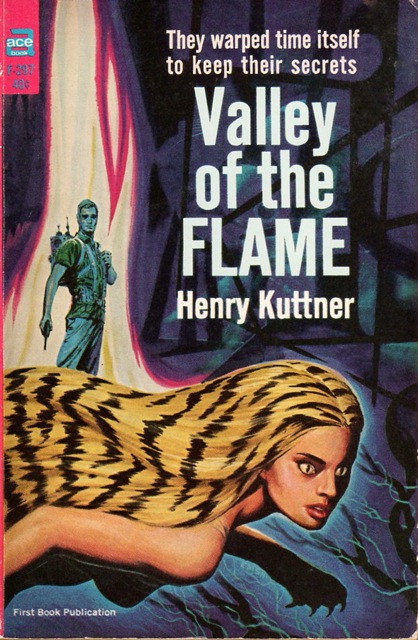
Valley of the Flame appeared in book form in 1964 under Kuttner's real name; nota bene, we are reading the 1946 magazine version here, which takes up like 47 pages.

Brian Raft is a doctor and a scientist, currently in the Amazon, running a clinic and investigating possible treatments for malaria--maybe the lore of the local Indians holds a clue to a remedy superior to quinine.  Helping him at the clinic is a Welsh biologist who has lived in these jungles for thirty years, Dan Craddock.  In "A God Named Kroo" and in "The Crystal Circe," Kutner presented us with modern Celts who kept in touch with their ancient heritage, and in Craddock he gives us another one.  This dude is always telling romantic stories about Welsh history or about Welsh ghosts, singing Welsh songs, etc.  At some point he must have suffered some terrible mishap, because his hands are terribly mutilated, though he can still manipulate any tool or medical instrument he must--and he can still lift a bottle of booze to his lips!

Two white men, apparently sick, come to the clinic from upriver, one a pilot, the other a graceful and mysterious figure.  Hanging from the pilot's neck is a strange artifact, a thing like a lens; when Raft looks into it he briefly sees a moving image of the face of a beautiful woman whose features suggest she is of an ethnicity he has never encountered in all his travels around the world.  The graceful man, Pereira, is also quite odd.  When Raft examines him, he finds this guy's body temperature, blood chemistry, heart beat and even skeletal structure to be quite unusual, and he wonders if this guy is some kind of mutant.

Pereira sneaks away, taking Craddock, apparently hypnotized, with him, as well as the lens that the pilot wore--the pilot moans that the lens contains his soul and he will die without it, and sure enough, it isn't long before he keels over.  Raft and a bunch of natives head off in pursuit of Pereira; it is a long journey, and Raft wakes up one morning to find the Indians gone, they having abandoned him or perhaps been picked off by jungle predators in the night.  Raft soldiers on alone, following the trail of Pereira day after day, but is he driven by his concern for Craddock or his hopes that he will have a chance to meet the gorgeous girl of the lens?   

At the end of the trail is a tunnel fashioned from a forcefield that leads Raft through a cavern to a hidden valley, where he meets the woman of the lens, Janissa, and catches up to Pereira.  He quickly realizes what we readers have already guessed--the people of this valley are of a race descended not from the noble ape like you and me, but from the selfish, sadistic, solipsistic, and sinister feline!  Yet again we SF fans have come face to face with cat people!

(Earle Bergey on the cover of Startling just paints Janissa as a conventional redhead with an unflattering facial expression, but on the Ace book version Ed Emshwiller comes through with a depiction of her that reflects some elements of Kuttner's description, like the tiger-striped hair.)

As is customary in these stories in which a guy finds himself in a strange kingdom where people fight with swords, our hero gets mixed up in their crazy politics and joins the side of the beautiful princess. Pereira and Janissa, we eventually learn, are the hidden valley's "Guardians," each the hereditary leader of one of the two subordinate royal families of the cat race.  These two don't really see eye to eye; Pereira has the upper hand and takes Raft captive.  Pereira's mail-clad soldiers take their prisoner on a long march through a forest of trees five miles high, each tree as thick as a city block and supporting its own ecosystem among whose populations are numbered mobile carnivorous vines, herbivorous arboreal crocodilians, and giant leech-like sap-sucking parasites.  Raft notices that time seems to flow slowly here in the valley--the sun crawls across the sky, when you drop things they drift softly to the ground, and a river moves sluggishly, as if its waters were thick and viscous. At the end of the march is a castle where resides the king of all the cat people, Darum, hereditary leader of the senior royal family of the cat people.

Darum is reputed to be insane, and he certainly has a bizarre relationship with a femme fatale known as Yrann.  The most beautiful woman in the kingdom but faithless and promiscuous, Yrann dallied with and betrayed Darum, but the king subdued her and now she reclines before his throne, wearing a veil and playing a musical instrument with which she conveys meaning the way R2-D2 communicates via beeps and whistles.  You see, her divinely lovely body may be perfectly intact, but behind that veil her face is a hideous mass of scarred flesh!

Pereira told his soldiers that Raft was Craddock, and in his interview with Darum, Raft tries to convince the mad king that he is in fact not Craddock.  Pereira and Darum are at odds, it seems, and Craddock is the bone of contention.  After his royal interview, Raft is visited by Janissa, who scales the castle walls to get into the room in which Raft is imprisoned so she can talk to him in secret.  We get a lot of exposition from her, and then, just like at the office when they put one of your colleagues who decided he couldn't make the big meeting because his kid has a softball game or something on speaker, she telepathically contacts Craddock via her lens so that the Welshman, Pereira's prisoner, can add further exposition of his own.

Long ago a meteor landed in this valley, which was then inhabited by a technologically advanced race who built all the castles the cat people today inhabit; colloquially, the cat people call this meteor "the Flame" and sort of think of it as an erratic life-giving god. The meteor's radiation has a powerful effect on the metabolism of life forms, and the nature of the effect is liable to fluctuate--after a long period of having a beneficial influence, the radiation became malignant.  The high-tech ancients studied how to regulate the radiation, but were worried about committing a blunder and making the radiation even more dangerous and procrastinated, delaying putting their plans in to action until it was too late--the radiation mutated their offspring into a bunch of wretched and disgusting monsters, physically weak and mentally deficient.  (You can see these aggressive but impotent freakazoids on the cover of the magazine.)

Thirty years ago Craddock stumbled on the valley and the ancients' notes, and somehow manipulated the Flame (wrecking his hands and burning up those documents--oops!--in the process), causing it to accelerate the metabolism of lifeforms in the valley to an astonishing rate--this is why time seems to flow slowly here.  In the thirty years since then, life in the valley has been through millions of generations, enough for the local jaguars to evolve into an intelligent bipedal race.  But today the Flame's radiation is again turning toxic, threatening to turn the cat people into pathetic freaks in a few generations; Pereira brought Craddock back to the valley in hopes he could fix the Flame.  Craddock doesn't really remember what he did to alter the meteor thirty years ago, but the cat people know that everything you see is stored in your brain, even if you can't consciously recall it, and Pereira has the technology to get that data out of Craddock's noggin.

The dispute between Darum and Pereira has to do with the fact that Pereira wants to get right to fixing the Flame, but according to tradition such a big decision has to be made by the king, not a Guardian, and such a risky move as tinkering with their life-giving and life-destroying god probably shouldn't be jumped into precipitously.  As a traditionalist, Janissa is siding with Darum.

After all this exposition, Janissa climbs back down the castle wall, leaving our hero in prison.  Luckily another woman comes along to free Raft--the mute musician with the mangled phiz, Yrann!  Yrann gives Raft a dagger and tries to get him to murder Darum.  Raft refuses and escapes, hurries off to rescue Craddock from Pereira.  Pereira has taken Craddock to a special part of the valley known as the Garden of Kharn; whereas the part of the valley with the five-mile high trees has a clear uncluttered floor between tree trunks, the Garden is a thick jungle of many different plants and creatures that share a collective consciousness.  The Garden tries to use its telepathy to seduce Raft into joining up and being integrated into the collective, but Raft resists, finds Pereira and Craddock, drives off Pereira, who has already drawn the info he needs from Craddock's brain and has no need to stick around and fight the two surface people. 

Back in Darum's castle, Raft and Craddock and the cat people technicians and scientists labor to get the same info out of Craddock's grey matter, and then build a machine to regulate the meteor's radiation based on his subconscious memories of those old documents.  To build it they have to use metals that cannot be found in the valley any longer--luckily these elements are present in sufficient amounts in stuff Raft brought from the surface, like his firearms.  This means that Pereira can't possibly build a similar device that will work, so when Janissa detects via telepathy that Pereira is on his way to the Flame, our heroes have to rush to stop him.  After a scene in which Yrann tries to kill Darum and she and the mad king both end up dead, we get the final scenes of fighting as Raft, Janissa and Craddock battle their way through the degenerate descendants of the ancients and then grapple with Periera in the crater of the Flame.  Craddock dies from fluctuations in the Flame as he integrates pieces from the machine he made with Raft (broken in all the fighting) with Periera's insufficient device and saves the valley.  Then Raft and Janissa express their love for each other and leave for a life together in our world, even though Kuttner had earlier brought up the fact that it is unlikely a union such as theirs could produce offspring.

I liked "Valley of the Flame" but I think it has a real problem: the individual elements are all cool, but they don't necessarily fit together smoothly.  The five-mile high trees are fun, but they don't have anything to do with the plot.  The Garden of Kharn is cool, but why did Pereira go there?  Janissa climbing the wall of the castle is a good adventure scene, but why did she risk her life to come see Raft when she knows she can't free him--just to give him a history lesson?  In the first two or three pages of the story we hear all about how Craddock is Welsh and incessantly talks about Welsh stuff, but then we never hear about it again.  Kuttner makes a big deal out of Yrann leading Raft to the treasure room where he retrieves the pilot's revolver and makes sure to keep the revolver in a waterproof pocket when he has to hide underwater, but Raft never actually shoots the revolver.  A number of times Kuttner hints that Raft is going to figure out what to do to resolve the plot by considering how people descended from cats differ from people descended from apes, but it never actually happens.  All in all, this feels like a story that could have used some more revising and polishing to make it feel more like a unified whole in which all the characters' actions make intuitive sense and serve the main plot and not just a collection of neato stuff jumbled together.

(We'll ignore such questions about the nature of the story's science as, "is it physically possible for your heart to beat a million times as fast as normal?")

Patriotic ad from page 6 of March 1946 issue of Startling Stories

"Shadow Over Venus" by Frank Belknap Long (1946)

Frank Belknap Long was a dedicated poet (H. P. Lovecraft and R. H. Barlow spent much of the summer of 1935 in a cabin working at a printing press, producing a collection of Long's poetry, The Goblin Tower, as a surprise for Long*) and "Shadow Over Venus" has a verse epigraph, a "Venusian folk chant" about a caged creature called the Gule who "knows why sorrow dogs our footsteps/And destroys the work of our hands."

*See HPL's January 18, 1936 letter to  F. Lee Baldwin.

It is the 22nd Century!  One of Earth's greatest explorers has been missing in the jungles of Venus for five years!  But today he finally emerges from the forest with a thick notebook of data and a bunch of native bearers who are lugging a caged specimen and climbs aboard the rescue ship.  Moments after boarding the space ship he falls over, deathly ill!

A swarm of venomous insects flies into the ship and almost kills everybody.  Somebody figures out that one of the native bearers, an unlettered savage, sneaked into the engine room and tinkered with some complex equipment so that it would vibrate at just the right pitch and frequency to attract that deadly insect attack.  The captain of the ship figures out what is going on--the specimen, a Gule, may look like a dumb beast but is in fact a being with intelligence far greater than not only the primitive native tribesmen but greater than Earth humans!  It can read and influence our human minds and easily work the natives like puppets!  The Venusian folk chant we read earlier is a clue that the Gules have for ages used their telepathic powers to stunt the cultural growth of the Venusian tribes.  The captain and his right hand man manage to take off and throw the monster out an airlock--the Gule can only influence one human at a time, so by working together in relay the two spacemen can get the cage out of the ship and into the void.

This is merely acceptable; the style isn't very good, and Long's effort to include a superfluous love story is lame.  "Shadow Over Venus" is a filler story, and has never been reprinted.

"Twelve Hours to Live!" by Jack Williamson (1931)

This is a reprint of a story from a 1931 issue of Wonder Stories.  Bizarrely, the cover of this issue of Startling attributes "Twelve Hours to Live!" to Clark Ashton Smith.   Proofreading is hard!  To assuage readers' possible annoyance at having paid for a rerun, the good people at Startling make a big production of saying they are inducting "Twelve Hours to Live!" into their Scientifiction Hall of Fame and performing a "service to the science fiction devotees of today and tomorrow" by giving this "science fiction gem of yesterday" some "new permanence."

Captain David Grant and his wife Nell are newlyweds!  He is commanding a space liner full of cargo and passengers through the inner solar system when they are accosted by the famous space pirate The Black Hawk!  Via heliograph, The Black Hawk demands their surrender.  Grant opens fire with the liner's meagre battery of ray projectors, but the liner's armaments are quickly silenced by the broadsides of the pirate ship.  The liner is boarded by space boats and captured after a bloody shoot out.

The Black Hawk is a sadist who makes Grant watch as one of his crew is murdered by exposure to mold spores from the third moon of Neptune--these old space operas by Williamson and his friend Edmond Hamilton often include scenes of terrible torture, and Williamson describes in some detail this poor bastard's cries of agony, prayers for help, how the mold propagates throughout his body and tendrils grow out of his nose and eyes, etc.

The Black Hawk then sets Grant down on an isolated island on Venus.  On the island with him are two large chests.  The Black Hawk tells him that one chest contains Nell, drugged unconscious but unharmed, and twelve hours worth of air, plus a supply of food and water and a radio to call for help.  The other contains the deadly mold spoors he saw in action on the pirate ship, which will infect him immediately if they are freed.  The story ends without revealing to us which chest Grant opens.

If you look at the original version of "Twelve Hours to Live!" in the August 1931 issue of Wonder Stories, you will find not only a drawing of Williamson wearing very fashionable spectacles and a cool coiffure, but the announcement of a contest--25 bucks for the best letter explaining how to choose the correct chest (and 15 for the second best and 10 for the third)!  The November issue reports that 1722 people sent in letters with ideas, and reproduces the three winning letters.    

This is a gruesomely fun story, a good example of the science lectures ("The fungi, you know, are a group of thallophytic plants...."), naval battles and horror scenes that characterize these old space operas, and I particularly liked the heliograph.

"Twelve Hours to Live!" would be reprinted in the 1975 collection The Early Williamson.   In ancillary autobiographical matter Williamson tells us he stole the idea for the story from Frank R. Stockton's "The Lady or the Tiger?"  I bought a copy of the Spring 1976 issue of Starwind at the same Ohio antique mall where I got my copy of Future Day, and it includes an interview of Williamson by Darrell Schweitzer in which Williamson says that it was Isaac Asimov who convinced Doubleday to put out The Early Williamson.  Isaac Asimov: good deed doer!

"The Dark Angel" by Henry Kuttner and C. L. Moore (1946)

"The Dark Angel" appears here in Startling under Henry Kuttner's name; isfdb credits it to Kuttner and Moore.  It seems to have been a success--Judith Merril included it in 1950's Shot in the Dark, an anthology of stories that are "out of this world" and "a different kind of mystery thrill," and it has reappeared in multiple Kuttner and Moore collections and SF magazines, including an issue of Science Fiction Monthly where it is accompanied by an essay entitled "Modern Masters of Science Fiction 12: Henry Kuttner and C.L. Moore."

"The Dark Angel" is a tale of homo superior; I feel like Kuttner and Moore have addressed this topic multiple times already...looking at the archives I see 1944's "When the Bough Breaks" and "The Children's Hour" coming up; 1946's "Absalom" is another.

"The Dark Angel" has a frame story--a guy looks for and finds a guy in a bar who is drinking to forget, because Guy #1 thinks Guy #2 can explain to him a crazy thing he just saw at the Metropolitan Opera.  Guy #2 tells his tale of woe and terror.

Seventeen years ago Guy #2, Tim Hathaway, was a professional in his early forties, with a wife five years younger than he, Joanna.  They had no kids but they had a Pekingese.  (I guess the commies never convinced us to call these inbred little monsters "Bejingese."  Maybe someday soon.)  Joanna began exhibiting unusual abilities, like superstrength when they were involved in a car accident.  Tim caught her playing with a doll, making it walk around and dance with telekinesis.  Joanna explained that her father was some kind of scientist who spent time at a meteor site (Kuttner and Startling editor Sam Merwin, Jr. are really hitting the radioactive meteors hard this issue) and it must have altered his genes so that she is the vanguard of the race or species that will supersede us poor mundanes, her mutant powers only now manifesting themselves--in her youth she was in a sort of larval form, camouflaged to appear like one of us homo sapiens losers!  Joanna told Tim that she couldn't really love him any more, she can only see him as she sees the Pekingese, as a member of an inferior species!  She also says a lot of bunk about how the new race will be ruled by logic, not emotion, and this will give them the ability conquer the world.  

Joanna disappeared, but Tim, as the years went by, watched the newspapers, clipping all the stories about scientific breakthroughs by women, whom he figures are Joanna in disguise.  Seventeen years after she left him Joanna came back into his life; looking like she was twenty-five, telling him she might live to be a thousand, but is unhappy, lonely because she has never met a fellow homo superior, and has failed to develop a means of irradiating people in the way her father was irradiated; maybe she will be the first and last member of her species.

After she had explained this and enumerated to Tim some of her amazing powers she realized a drunk bum had been in the nearby bushes, listening, so she killed him with her psychic powers to protect her identity.  "I'm one woman against a whole world now.  Forget him.  His life was worthless."  

Tim decided that his wife was a threat to all humanity and that he had to go all Brutus on her to save the world.  With her amazing powers Joanna could do almost anything now, fulfill all her dreams, so she was singing a role in Faust at the Met!  Tim brought a pistol to the performance and made to shoot her down, but after drawing and aiming he didn't have the nerve to kill her and fled.  That was this very evening.  Our twist ending is that Guy #1 is a male homo superior, and now that he has the confirmation he wanted he kills Tim with his mental powers and goes off to find Joanna and with her sire a race of superbeings who are going to make us their slaves!  (It's a Hobson's choice between whether we'd prefer having these logic-chopping butchers ruling us or the ones in Peking--I mean Beijing!)

A good story.  As I have told you a hundred times, the disastrous sexual relationship is one of my favorite themes, and I also find the theme that power is corrupting, that people with superior abilities are liable to use those abilities to abuse others, compelling.  "The Dark Angel" is a great choice by Science Fiction Monthly to pair with their essay on Kuttner and Moore not only because it is well-structured and paced and has vivid images and all that, but because it illustrates something fundamental about K & M that Moore talks about in the intro to the 1975 Magnum paperback edition of Fury:

Yesterday I reread Fury for the first time in many years, and I'm not surprised, but interested, to see in it the two recurring themes which emerge quite explicitly in nearly everything we wrote.  Hank's basic statement was something like, "Authority is dangerous and I will never submit to it."  Mine was, "The most treacherous thing in life is love."


**********

"The Dark Angel" is obviously the best story here, the one that is the most polished and economical and most closely addresses our ordinary real life concerns ("my marriage is in trouble because my spouse thinks he/she is better than me!" and "powerful people think I'm worthless and will exploit or kill me out of hand!"), but while the others have problems (the problem with the Williamson is that it is a gimmick that lacks a proper climax and resolution), they each have fun elements and are valuable specimens of the pulp SF of their eras from famous names who have received all kinds of accolades and had tons of influence.  A good issue of Startling!