Tuesday, January 14, 2014

Love Among the Chickens by P. G. Wodehouse


First published in 1906, Love Among the Chickens marks the first appearance of Stanley Featherstonehaugh Ukridge, the entrepreneur and con man.  Wodehouse, thinking the book contained some bad writing and was "dated," revised it in 1921.  This week I read a free e-book version of this 1921 revision, using the iBooks application on my iPhone. 

Love Among the Chickens takes place during that period of Ukridge's life when he is married to Millie, the girl with the big round eyes.  Ukridge's latest scheme is to move to the country, to a house he can rent for free, and raise chickens and sell eggs.  He knows nothing about farming or raising animals, but he does not let that discourage him.  He enlists the help of old friend and minor novelist Jeremy Garnet, who knows perhaps even less about chickens.  Garnet finds London in the summer tiresome, and thinks he might be better able to write in the country, so agrees to join Ukridge on this business enterprise.

Garnet, who is the book's first person narrator, is actually the main character of the book.  On the train to Ukridge's farm he meets a beautiful girl, and he is happy to find she lives in the same seaside town where Ukridge is setting up his quixotic enterprise.  The girl lives with her father, a short tempered Irish college professor, and disaster strikes when Ukridge, who speaks carelessly, offends the father.  To get back in the professor's good graces Garnet hatches an ill-considered scheme of his own; he bribes the man who rows the professor's boat so that he will upset the boat, providing Garnet the opportunity to rescue the professor from drowning.  At first this scheme bears fruit, and Garnet and the professor are buddies again, but then the boatman, become a laughing stock in the town, spills the beans to save his reputation.

Love Among the Chickens is a pleasant light entertainment, but lacks much of the appeal of the famous Jeeves and Wooster stories I've been reading for decades and the Ukridge stories I read earlier this month.  Compared to Wodehouse's later work, Love Among the Chickens feels long-winded and conventional.  There are descriptions of sunsets and scenery, and even sincere love scenes in which the hero declares his love and asks for his beloved's hand in marriage.  The two plots of the book (Garnet's courtship of the girl and Ukridge's doomed chicken farm) don't mesh together well, and they both get totally independent (and long) scenes in which they are anti-climactically resolved.  The love plot resolution is OK (Garnet lets the prof beat him at golf), but the chicken farm plot ends in a disappointing deus ex machina (Millie's aunt pays off Ukridge's creditors after said creditors seize and destroy the farm.)  The farm plot is resolved long after the love story is put aside, so the book ends on a low note.

The other Wodehouse work with which I am familiar is much leaner, and faintly subversive.  Every paragraph is dedicated to making you laugh or quickly advancing the plot, while the main characters act selfishly, callously, antisocially, driven by irrational passions and fears, always trying to escape their obligations.  Relationships, between men and women, between aunts and nephews, and between friends, are always difficult and exploitative.  It is true that Ukridge and Garnet in this novel act stupidly and take advantage of people, and there are funny parts, but Love Among the Chickens lacks a certain edge, the love elements seem totally sincere, and there is too much superfluous material about how lovely the ocean is.

A nice diversion and an interesting specimen of Wodehouse's early work, but the things I love about Wodehouse are only present here in embryonic form.  For Wodehouse completists only.

Monday, January 13, 2014

Past Master by R. A. Lafferty

As I admitted in the comments to my blog post about Utopia, the main reason I read Thomas More’s famous work at this time was as preparation for reading R. A. Lafferty’s first published novel, Past Master, which I purchased in late November along with some other Lafferty paperbacks.

The back cover of my copy of Past Master, the 1968 Ace Science Fiction Special, includes lengthy and detailed praise for the novel from people much smarter and more successful than I am.  Praise for Lafferty and this book, we are told, is unanimous! Dare I buck the trend? Luckily, I need not dare; the book is good!  Almost every page of Past Master confronts the reader with a bewildering mystery, a strange oddity or a striking image, and I enjoyed it.  The praise is still unanimous!

It is the 26th century. Humanity has colonized several planets, but by far the most populous and prominent, in fact overshadowing Earth, is Astrobe. The novel begins in a building on Astrobe that is under attack by “mechanical killers” with “ogre faces.” Taking cover inside the building are three men, the three leaders of Astrobe: Cosmos Kingmaker, the wealthiest man on Astrobe, Peter Procter, the luckiest, and Fabian Foreman, the smartest. Each of these three men believes he is the true ruler, and is manipulating the other two.

The mechanical killers have come to destroy Foreman; their mind scanners can detect doubts about "the Astrobe Dream," the ruling ideology of the planet, and Foreman is going through a period of skepticism about how things on Astrobe are run.  He knows a secret way out of the building, but before he flees the three leaders most come to an important decision. Astrobe, described by Kingmaker as “the last chance of mankind,” is in jeopardy, and a man must be found who can lead Astrobe out of these troubles, or at least serve as the public face of the ruling clique as they strive to solve the crisis. It is decided to send an agent back to Earth and back through time to enlist a great man from history for this task, and the man they settle on is Thomas More, the English lawyer and Catholic saint, opponent of the Protestant Reformation and author of Utopia.

The agent is a man called Paul, a man experienced in dealing with danger, who is pursued by the same types of mechanical killers that are after Foreman.  He fights and connives his way to a space ship and to Earth, which is 1.5 parsecs away. In one month the Hopp-Equation Drive on Paul's ship can propel a space ship 1.5 parsecs, a distance it takes light five years to cross, but such travel has unnerving side effects. For one thing, travelers are subject to “reversals;” during the voyage men become women, right-handers become left-handers. Space travelers also experience as much psychic activity in that one month as they would normally experience in five years.  This manifests itself in thousands of vivid dreams, one following after the other.  These dreams can be symbolic and even precognitive.

Lafferty’s version of Thomas More is a charming character who, when brought forward in time one thousand years, embraces tobacco and mystery and science fiction novels, and asks Paul if the fishing is good on Astrobe. He tells Paul that he has been visited by time travelers before, and expresses dismay that so many people have seen Utopia as a blueprint for an ideal civilization when in fact he meant it as a satire and a warning of the kind of sick society he feared would result if trends he detected in early 16th century Europe were allowed to continue.

After landing on Astrobe Paul and More fight their way through their mysterious enemies, aided by equally bizarre allies, to safety.  More is enthusiastically welcomed by the ruling class of Astrobe and begins to investigate the mysteries presented by the planet to him and by the novel to the reader.  Life is easy in the well-organized cities of Astrobe, where poverty and illness have been eliminated, along with individuality. (The Astrobe Dream holds that a society is like a body, and all the citizens have to work together the way all the cells of a body work together.  Following this analogy, an individual is like a cancer.) What exactly is the crisis that is threatening Astrobe?  Is it the high suicide rate?  The fact that a large proportion of the population has lost faith in the ideology of Astrobe and gone to live in reeking unhealthy slums or wild feral areas where they are in danger from ravenous monsters?  Or is it Ouden, a sentient celestial nothingness worshipped as a god by the artificial people of Astrobe, who wishes to extend his dominion to include the natural old-fashioned humans?

The climax of the novel comes when More, performing the duties of a rubberstamp president, refuses to rubberstamp a single piece of legislation, one outlawing belief in God.  More is sentenced to death, and his public execution inspires an upsurge of feeling among the citizens of the perfect cities and an attack by an army from the slums.  Lafferty compares the death of Thomas More in the year 2535 with such epoch-marking incidents as the fall of the Roman Republic, the Protestant Reformation, the discovery of America, and the birth of Jesus.  A new age is dawning, an old world is dying and a new world being born.  Whether this new age will be better than the old Lafferty does not say, but he says we can and should hope.

This is a dense novel, full of strange characters with weird powers and mysterious agendas, dreadful fights, and allusions to religious and political topics, and sprinkled with bizarre dreams and tall tales.  More himself, rather than some stalwart exemplar, is a complex, shifting figure whose faith in Christianity comes and goes, and whose allegiance and objectives change back and forth.  Lafferty is no doubt opposed to the atheistic and tyrannical Astrobe dream, but admits that the idea of a perfectly planned, perfectly easy life can be very attractive, so seductive that a man as wise as More might fall for it.  But a life that is too easy is not worth living; the people of Astrobe are committing suicide by the millions and abandoning in droves the perfectly organized cities because a life without challenge or struggle is not a life at all.

Lafferty doesn't use words like "socialism" or "collectivism" or "communism," but I still think it is fair to see the book as, in part, a (hostile) commentary on socialism and an expansive welfare state.  Lafferty employs one of the traditional criticisms of socialism, that it requires a brutally repressive enforcement apparatus that polices people's very thoughts, but I think it is interesting that he abandons one of the other traditional attacks on socialism, that the lack of property and price signals would lead to inefficiencies and poverty.  Instead, Lafferty suggests that even if socialism succeeds on its own terms and produces plenty for all, that it is inhuman and soul destroying.  Multitudes of people on Astrobe freely choose to work dangerous jobs in a polluted slum rather than live a life of total ease and absolute comfort in the shining cities.

Machines and artificial people (Lafferty never says "robots") are very important to the novel.  It is these machines, which can do all the boring or dangerous jobs as well as read and even manipulate minds, which make the efficient Astrobe economy and oppressive Astrobe police state possible.  The sympathy More feels for the Astrobe Dream is partly or wholly due to psychic probes, sent by the nihilistic leaders of the artificial people, which put thoughts into More's head as well as words into his mouth.  (When More is aware of these probes he calls them "snakes.")  Past Master may be as much a criticism of technology as it is of government intervention into private and economic life; when men become too reliant on soulless machines, Lafferty suggests, men lose their souls and become mere machines themselves.

Compared to the other Lafferty novels I have read, The Devil is Dead and The Reefs of Earth, Past Master, in plot and style, is a little more in line with those of a conventional science fiction novel; there are well-realized and sympathetic characters, the presentation of futuristic technologies and societies, and a plot arc full of twists that generates suspense and ends with a climactic paradigm shift.  Past Master has fewer silly jokes, though there are some good ones.  Past Master is probably more "user friendly" than The Devil is Dead and Reefs of Earth, though it still is distinctly a Lafferty work, often folksy in tone and with numerous references to life after death, which seems to be something Lafferty is very interested in.  (We are reminded more than once that More himself died a thousand years before his adventure on Astrobe, there is a scene in which hundreds of skulls in niches on a crypt wall respond to the approach of an immortal woman, and there is a character called Adam whom we are told has died many times.)

Highly recommended to fans of literary science fiction and to classic SF fans curious to read something new and different but made up of so many of those classic SF elements we all love, like space travel, time travel, oppressive governments, telepathy, robots, aliens, monsters and wars.      

*******

If you are interested in Lafferty and SF that is a little off the beaten path you should definitely check out valued commenter Kevin's great blog, Yet Another Lafferty Blog.  Envy his Lafferty collection!

Thursday, January 9, 2014

Utopia by Thomas More

Way back in my Rutgers days I was supposed to read Utopia by Thomas More in a class on Tudor England taught by Professor Maurice Lee. I must have had some video games to play or something, because I didn't read it. Maybe I was painting some Games Workshop tanks and artillery that week? Anyway, this week I downloaded an electronic version of Utopia and completed the assignment, less than 25 years behind schedule.  I didn't let you down after all, Prof Lee!

More starts off his book, presented to the world in 1516, with a first person narrative about his diplomatic mission to the Continent.  In the Low Countries he meets a wise and well-traveled man. At a friendly meal this traveler, Raphael Hythloday, starts criticizing the English and French ruling classes and their governing policies. Thieves, he claims, are driven to crime by hunger, hunger caused by the policies of the rich, and so hanging thieves is immoral and counterproductive. The nobility and their hangers on are idle and greedy. The French government is damned for maintaining a standing army, and the English upper class denounced for the “enclosure movement” we talked about ad nauseum in college, whereby farm land held in common was turned into private pasture for sheep, leading to increased efficiency and the dislocation of many rural people. Everybody, rich and poor, spends too much money on fancy clothes, on gambling, and in taverns and “infamous houses,” writes More, the guy who wore a hair shirt and thought flagellating himself was a good way to spend his down time.

So, More has a lot of gripes about the powers that be (who doesn’t, buddy?) and even ordinary people who want to relax with a little sex, booze, dice and cards. But does he have solutions? Well, he does; or at least he acts like he does.  Hythloday relates how thieves are dealt with among the Polylerits, a fictional autonomous bunch of people in Persia - thieves become slaves to the public, forced to wear distinguishing marks and follow complex rules that keep them from fleeing or fomenting revolution. More is so impressed by this idea that he proclaims Hythloday a genius and urges him to become a royal adviser, but Hythloday declares that his ideas are too radical to be welcomed by courts and kings.

Hythloday then drops his bombshell. There is no hope, he tells More, of a just and prosperous society until property has been abolished and equality enforced, as it has been in a wonderful land he visited and spent five years in, Utopia. More (the character) makes the obvious objection to collectivism: that with no prospect of reward, people will not work. Hythloday tells More that if he will spare him some time, he will explain in detail how things work in Utopia, a country with no money, no property, and a happy populace. Seeing as there are no video games yet, and Games Workshop has yet to be founded, More has time to listen to Hythloday's description. So begins the discourse on the fantasy land which gives its name to More's book and has been applied to the entire literary genre of exemplary ideal societies.

Utopia has a scientifically planned economy, with experts keeping track of how much food needs to be grown and what quantities of other resources are required and directing who is to produce them and where they are to be sent. These experts draft people to work in the fields, whether they want to or no, and everybody has to work on the farm for at least two years. The government determines what professions people can pursue, and directs people to those professions the experts feel are in need of more practioners.

Every little detail of life has been planned out and is under government control. The island of Utopia has 54 towns, and they all are built on the same plan. In fact, even the houses and streets all look exactly the same. People are assigned where to live; if your family has lots of children some will be assigned to a family which has few children; if your city has lots of people some will be sent to a city where some disaster has lowered the population. Everyone wears the same clothes, and fashions never change. The government makes sure you spend an appropriate number of hours a day working, an appropriate number of hours sleeping, and a healthy number of hours at wholesome recreation. If you want to go visit some other town, you have to ask permission from a government agent, and since there is no money, while in that town you have to pay your way by working. No one is allowed to be idle or waste time and resources on things like making nice clothes of different colors or designing or constructing different styles of architecture.

Order is maintained in Utopia by compelling all men to live in full view where there is no opportunity to form political parties; there is no privacy (doors are not locked) and no such places as taverns or brothels. Government magistrates are forbidden to talk about politics in private; such a crime is punished with death. Lesser crimes, like leaving your town without permission, get you tossed into slavery.

The Utopians have no money, and Hythloday argues at the end of the book that most crime would cease if money were abolished. The Utopians have such contempt for gold and silver that they use these metals to make chamber pots, as well as chains for their slaves. Pearls and diamonds are worn only by children. For fun everybody reads and attends lectures; More tells us that the Utopians find gambling and hunting totally uninteresting, even disgusting - all necessary butchering and hunting is done by slaves.

More's vision of Utopia is so extreme and repellant that we have to wonder how seriously he is promoting Utopia as a model of a just and efficient society, and how much his image of a totalitarian state with no property and no money is in fact some kind of satire. (In the last paragraph of the book More muddies the waters and leaves us with a puzzle when he says he endorses some but not all of the policies and beliefs of the Utopians, without specifying which. Tricky!)

How much sense does it make for a guy to criticize how real life governments abuse power, and then propose a government with far greater power? How much sense does it make for More to decry the way rural people are forced off the land in the interest of efficiency by rich sheep farmers, and then argue that it would be great if the government, in the interest of efficiency, told you where to live and what work to do and if and when and for how long you could take a trip to the next town? Maybe More is attacking English government policies by exaggerating them and showing how terrible they would be if more universally applied?

On the other hand, I suppose it is not hard to believe that More, a successful lawyer and politician and a well-read and pious intellectual who thought it was just fine to burn heretical books and heretical people, would like the idea of smart industrious ascetic guys like himself organizing everything and enforcing their own prejudices, making the lazy work, the vain abandon their fancy clothes and jewels, and the vicious put down their dice and cards and pick up improving books. More probably looked at the world, which is full of wars and crimes and poverty and famine, and figured he, or a cadre of people like him, could do a better job of running things. More also didn't have the benefit we have of 20th century examples of countries where policies abolishing property and planning the economy were put into practice.

Can I recommend Utopia, even though I am emphatically opposed to Utopia?  It's not exactly a thrill ride or a page turner, but if you are interested in politics, economics, religion, and European history, as I am (in my own haphazard and lazy way), it certainly is worth a little of your time.  The book provides a view into another world, that of early 16th century Europe, and addresses important contentious issues, like the role of the state and relations between social classes, that have been at the center of Western civilization for thousands of years and are still at the center of political and social debates in our day.

Wednesday, January 8, 2014

Podkayne of Mars by Robert Heinlein

As readers of my thrilling Twitter feed will already be aware, I recently purchased an Avon paperback of Robert Heinlein's 1963 novel, Podkayne of Mars.  This is the fifth printing of this paperback, from 1968, and the cover contains some pretty hilarious blurbification, declaring Heinlein "The Now Generation's favorite author" and so forth.  Theodore Sturgeon of "Killdozer" fame says Podkayne of Mars is a slam-bang of believable adventure and the publisher's gush tells us the book embodies "Heinlein's challenging new concepts of morality and social organization."  Sounds pretty good!  Let's hope the boys in the PR department and good ol' Ted Sturgeon are not lying to us!

Podkayne of Mars is the journal of Podkayne Fries, a teenage human girl growing up on Mars.  It is some centuries in the future, and Mars and Venus have been colonized by the Earth and are currently independent states.  Podkayne is from a pretty successful family; her Uncle Tom is a senator, her mother is an engineer who designs and manages colossal public works projects (like turning Deimos into a space port) and her father is an historian.

Of course it is risky for a man to write in first person as a woman, and Heinlein pulls some things which I guess some women might find offensive.  Poddy manipulates men with her feminine wiles, takes male sexism into account instead of challenging it ("...it is a mistake for a girl to beat a male at any contest of strength..." - page 50), and spends quite a bit of time talking about babies and changing diapers.  At the start of the book Poddy aspires to be a space pilot and space ship captain and is saying the kinds of things feminists say all the time, like "It's not easy for a girl to get accepted for pilot training; she has to be about four times as good as a male candidate..." (page 53) but later on (page 114) her views evolve, and she is enthusiastically endorsing marriage and thinking maybe she would rather run the nursery on a space ship than sit in the captain's chair.  And of course readers hoping for a strong female hero might be disappointed that in the end it is not Poddy who saves the day but her little brother.  And then there is that speech on the last page about how women's most important work is in raising children.

The plot:  Poddy, her brother Clark, a sort of 11-year-old anti-social genius, and Uncle Tom, senator of the Republic of Mars, go on a trip to Venus.

There is a lot of description of space travel - on page 27 Poddy leaves Mars and she doesn't set foot on Venus until page 85.  The ship endures a radiation storm.  We learn all about social life on the ship, how the ship smells, what sort of people travel on such ships, etc.  I'm always interested in speculations about space travel, and enjoy this sort of thing.    

Venus is controlled by a corporation and its wealth and decadence are contrasted with the stolid republican virtues of Mars: women on Venus wear lots more cosmetics than do Mars women, the 3D TV on Venus has lots of sex, and while on Mars everybody supports free enterprise, on Venus capitalism is taken to extremes which shock Poddy, with loud, garish, 3D advertising assailing you everywhere you go.  The characters spend lots of time in a casino; I guess we are supposed to think of the Venus colony as being like Las Vegas.  Poddy doesn't drink booze or gamble, though Clark, a math whiz, turns out to be a skilled gambler.  Heinlein's attitude about the Venus colonial culture he has devised is ambiguous; Poddy thinks it horrible, but wise Uncle Tom expresses equivocal praise, and one character Heinlein intends us to admire opts to live on Venus instead of Mars, arguing there is more opportunity there.   

The novel touches on immigration policy when it talks about Mars history.  When Earth was run by a bunch of commies the commissars sent criminals to Mars; most of these were apparently decent people, political opponents of the regime.  Later, I guess when the the commies lost power over Earth, only the finest human specimens were sent to Mars.  Finally, after Mars won independence in a revolutionary war against Earth, its immigration policies were liberalized - but immigrants still have to pass health and IQ tests and pay big fees to move to Mars.     

While Heinlein did not consider it one, in many ways Podkayne of Mars is like one of his famous juveniles; a young person goes on a trip and has adventures, and this gives Heinlein a chance to describe space travel and the different cultures he has developed, and to give little lessons and lectures that express his points of view.  The lessons in this one cover some topics we've seen in other Heinlein books; racism is bad, and the captain of a ship is like a benevolent dictator, for example.  Uncle Tom lectures that "politics" isn't so bad (page 30) because it is better than naked violence, and a woman lectures that women should be understanding of male lust and flattered when men try to seduce them (page 113.)  Poddy advises us to say "thank you" to service staff when we travel.  A few of them may raise an eyebrow, but I didn't find these lessons and lectures offensively preachy or distractingly long-winded; Heinlein doesn't over do it here as he did in the lamentable Number of the Beast some seventeen years later.

The "slam-bang of adventure" Ted Sturgeon enthuses over on the back cover doesn't get going until the last 50 pages or so of this 159 page book.  Adolescent card sharp Clark is kidnapped - is his disappearance linked to the fact that he outwitted some terrorists who hired him to bring a time bomb aboard the Mars-to-Venus ship?  Or to the fact that Uncle Tom is on a secret diplomatic mission, trying to build a Venus Corporation - Mars Republic alliance against Earth imperialism?  When they try to find the little mastermind Uncle Tom and Poddy are captured by a criminal and her native Venerian henchmen - the criminal has been hired to convince Uncle Tom to betray Mars by torturing Poddy and Clark!

Clark figures out how to escape, then fights and kills the criminal human and the two native creeps.  Clark has saved Mars!  Then Poddy almost gets killed saving the life of an alien baby! (Wikipedia tells us that Heinlein killed Poddy off in his original version, but the publisher made him change it.  Having Poddy die is obviously far better drama.  Curse you, publishers!)

I think Podkayne of Mars is a pretty good book.  I like Heinlein's writing style, and I like all the space travel stuff.  And I think Heinlein does a good job tackling the two big philosophical themes of the book: the nature of liberty, and gender roles.  I have already mentioned the way Heinlein contrasts Martian republicanism and Venerian freewheeling license; this is a good way to talk about the tension between freedom and responsibility.  In addition, in the last few pages of the book Clark, the 11-year-old genius, utters some pithy libertarian philosophy: "Anything that is moral for a group to do is moral for one person to do."  Here we have a thought-provoking statement which does much to undermine conventional views of government.

In this post feminist age, Heinlein's contention that it is more important for women to raise children than to build bridges and space stations is probably more shocking than his anti-government rhetoric, but whereas in attacking the very basis of government Heinlein is a radical, in supporting traditional gender roles we have to see Heinlein as acting the conservative or reactionary.  Whether or not Heinlein's case for traditional gender roles is convincing, I think Podkayne as a character, and her evolution, are very believable; we shouldn't be surprised that Poddy sacrifices herself to save an alien baby, because all through the novel we have been seeing her care for babies and opposing racism and class snobbery.  We expect the title character of a book to be the hero, and after so many years of Buffy and Xena style movies and TV shows and video games we expect to see women shooting and stabbing the bad guys, so maybe it is surprising to us when Poddy cracks under the pressure and it is her little brother who kills all the villains.  But if we abandon those preconceptions and just consider the characters of Poddy and Clarke which Heinlein developed over the 130 odd pages before they get captured we see that how they behave after being captured makes perfect sense. 

So, does Podkayne of Mars live up to the overheated blurbs on its front and back covers?  That women should focus on being mothers instead of engineers doesn't sound like a "challenging new concept of morality and social organization," though the stark libertarianism of "anything that is moral for a group to do is moral for one person to do" perhaps does.  Does a single two-page fight scene render the novel "a slam-bang of adventure"?  Looks like a borderline case; maybe we can let the blurb writers off with a stern warning this time.

Monday, January 6, 2014

Five more Ukridge stories by P. G. Wodehouse


I recently read five stories featuring Stanley Featherstone Ukridge found in the collection The Most of Wodehouse. I enjoyed them enough that, when I visited the Southern branch of the Des Moines Public Library on the weekend, I took the time to check through their Wodehouse holdings, looking for more Ukrdige pieces. I found five I had not yet read spread over two collections; these collections, the eagle-eyed reader will note, are considered by the Des Moines Library to be “classics.” Here in Iowa when we read stories about incompetent English goofballs stealing cow creamers, lying to their aunts, and avoiding marriage, we read them with pride!

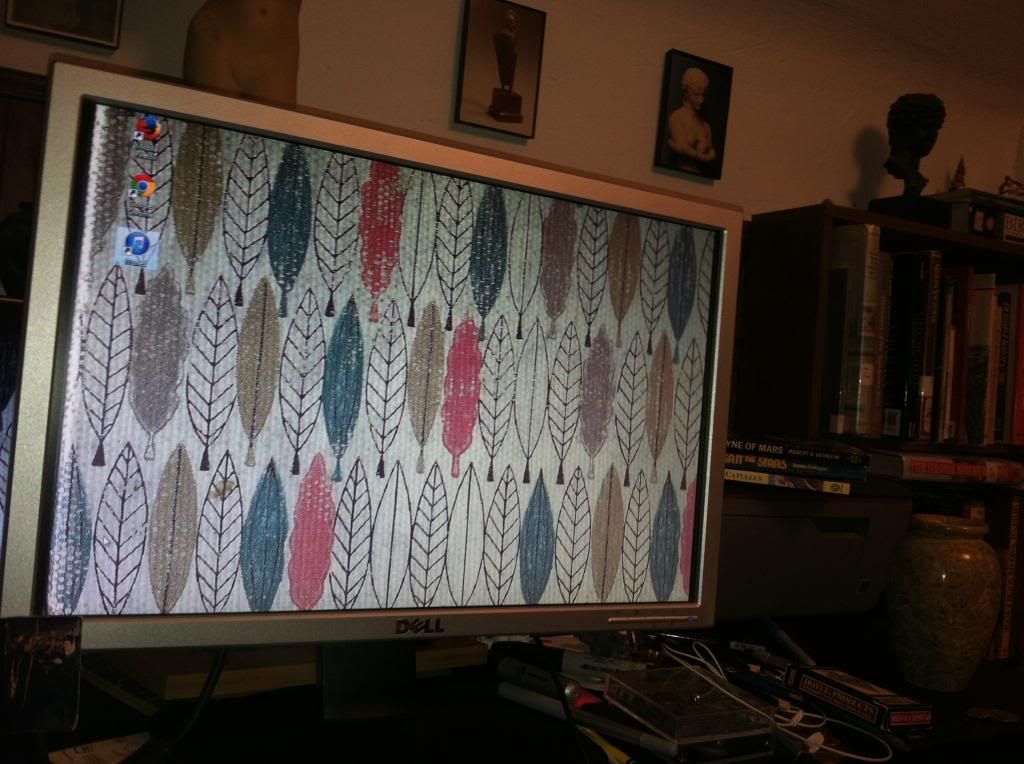
Four of the stories appear in an old 1946 volume, Nothing But Wodehouse, edited by Ogden Nash. “Ogden Nash” is one of those famous names that I recognize, but know nothing about. I promise to google him when I am done with this blog entry. The stamp on the inside cover of this book indicates that it was rebound in October of 1964 by HNM; HNM, which stands for Hertzberg New-Method (that, I googled already), selected a mesmerizing mid-century modern cover design consisting of stylized leaves.  Or maybe trees.  Either way, looks perfect as Windows Wallpaper!


“First Aid for Dora” (1923): Again we encounter Ukridge’s Aunt Julia and her six Pekingese. This story takes place during one of those periods when Ukridge is living with her in her fine home in Wimbledon. We learn that Aunt Julia is a successful and popular novelist. “Your aunt writes novels?” asks Corky, our narrator. “The world’s worst, laddie, the world’s worst,” Ukridge replies. Aunt Julia has taken on a secretary, a young woman named Dora, to type her “rotten” and “beastly” novels, and Ukridge has taken a liking to her. In a stereotypical Wodehousian plot development, the police catch Ukridge and Dora when they are trying to climb in an upper story window of Aunt Julia’s house at 4:00 AM after a night out on the town, for which occasion Ukridge stole Corky’s best suit. Dora is fired in the ensuing uproar, and a guilt-ridden Ukridge seeks Corky’s help in getting Dora’s job back.

The resolution and final scenes of this one felt a little weak, not as surprising or funny as I had expected. It just wasn’t climactic, perhaps because the adventure of Dora was not over.

“Ukridge Sees Her Through” (1923): Corky and Ukridge having failed to convince Aunt Julia to rehire Dora, Ukridge uses his connections to get Dora an interest in a small business. To seal the deal, Ukridge, who can’t afford to feed or clothe himself, has to raise one hundred pounds in sixty days!  After his first stab at the problem (acting as a real estate broker to a drunken Canadian) he makes the money by selling seven hundred counterfeit tickets to a dance being held by Aunt Julia's snobby club of writers, a club which has only one hundred members.

This story includes a bit of slang I had never before encountered: the use of the word "o'goblins" for "pounds [money]."  Not just a classic, but educational!  Wikipedia indicates that this usage is a shortened form of "Jimmy O'Goblins."  The story also refers to "Battling Billson," a character from Ukridge stories I have not been able to get my hands on yet.

No Wedding Bells for Him (1923):  This is a good one.  Ukridge is pursued all over London by an irate creditor - he has to move from one address to another, like Saddam Hussein fleeing justice after the invasion of Iraq!  And that is not his only problem.  Ukridge fools a decent religious family into thinking he is rich so that he can drop in on them and eat for free.  But the joke is on him when he is caught holding the overweight daughter's hand, and quickly finds himself engaged to this woman, whom he describes as "beastly" and whom Corky considers "something of a blister."  How to escape these two menaces?

"No Wedding Bell for Him" is very funny, and the different plot threads all dovetail together very well in the finale.  Our man P. G. was firing on all cylinders when he penned this one.

Ukridge Rounds a Nasty Corner (1924):  In this story Ukridge has fallen in love with a Millie, a young woman with "round eyes exactly like a Persian kitten's," according to Corky.  For reasons unfathomable, Millie returns Ukridge's love, but the aunt with whom she lives, the widow of a colonial administrator who spent his career governing "various insanitary outposts," must also be won over.  The wooing process involves kidnapping a parrot, sending a fraudulent telegram, surviving a dangerous encounter with Ukridge's Aunt Julia, and liberal use of the snake oil Ukridge has been selling, Peppo, known for its slogan, "It bucks you up."

Though not as perfect as "No Wedding Bells for Him," this is a good story and I laughed quite a bit.

"Ukridge Starts a Bank Account" (1967):  This story first appeared in Playboy's July 1967 issue, along with a novel by Evan Hunter (AKA Ed McBain and Richard Marsten) and a short story by Henry Slesar.  The centerfold girl was Heather Ryan, who shows off her pet ocelot.

I read "Ukridge Starts a Bank Account" in the 1967 collection Plum Pie.


After not seeing Ukridge for some months, Corky bumps into him on the street.  Ukridge appears to have struck it rich; he even buys Corky lunch.  During lunch he relates to Corky the tale of how he came by his current affluence - he's been selling antique furniture!  "For mark you, Corky, though you and I wouldn't be seen dead in a ditch with the average antique, there are squads of half-wits who value them highly--showing, I often say, that it takes all sorts to make a world."  One of those half-wits turns out to be Ukridge's Aunt Julia, who has reason to believe the furniture her nephew is selling was recently stolen from her home.

Oddly enough, the beautiful Millie of the Persian kitten eyes is not mentioned in this story.  Ukridge even opines, "Women have their merits, of course, but if you are to live the good life, you don't want them around the home."  Perhaps this story, through written 40 years after "Ukridge Rounds a Nasty Corner," takes place earlier in Ukridge's career.

*******

So, four solid stories and one very fine one.  And an excuse to say "ocelot."  Next stop on the Wodehouse express: the 1921 version of Love Among the Chickens, the Stanley Featherstone Ukridge novel.

Sunday, January 5, 2014

The Reefs of Earth by R. A. Lafferty

This 1968 novel, like the other Lafferty works I have read, is unconventional, a bizarre fable or fairy tale full of silly jokes that disregards believability, character development, pacing, and other typical literary concerns. The book is punctuated by brief tall tales told by the characters and includes numerous references to some of Lafferty’s particular interests, Christian theology and Native American Indian history and lore. Lafferty also takes swipes at government welfare and agricultural policies and government inefficiency and corruption in general; it is notable that Reefs of Earth was a preliminary nominee for the 1984 Prometheus Award Hall of Fame for Best Classic Libertarian SF Novel.

I read the 1977 Berkley Medallion paperback, with the Richard Powers cover. The last four pages contain advertising for the works of Robert Howard, Poul Anderson, Robert Heinlein and Frank Herbert, including a listing for the 1978 Dune Calendar by John Schoenherr.

Reefs of Earth is the story of the Dulanty family, four adults and seven children (or, perhaps more accurately, six children and one ghost child) who are members of the alien race known as the Puca. The Dulantys were sent to Earth to scout around, learn Earth culture, and perhaps solve the problem presented by Earth. Earth, we are told repeatedly, is the meanest, scariest, stupidest planet in the universe, and most of the human characters act as evidence for these assertions. Exceptions are made for some humans, including American Indians, a priest, and the writer of The Gospel According to Luke. The bulk of the novel takes place in and around the small rural town of Lost Haven, site of a coal mine and a commercial fishery.  Lost Haven is run by three murderously corrupt men: Coalfactor Stutgard, his right hand man Crocker, and lawyer and politician Mandrake Marshall.

The Puca can pass for human, but most look odd - we are told their features resemble those of goblins, ogres, or kobolds. The alienness of their appearance waxes and wanes depending on their mood or health. The Puca have great power; their Bagarthach verses, when recited, can (among other things) bring inanimate objects to life and kill humans. Lafferty includes many of these four line poems in the text, and it seems that he wrote them to be intentionally bad, for humor value.

Despite their superiority to humans, the Puca have a very difficult time on Earth, being susceptible to “Earth Allergy.” This malady, to which the adults are particularly vulnerable, leads to weakness and death, and during its course it causes terrible psychological damage; Puca afflicted with Earth Allergy may sour on life, become unwilling to forgive trifles, and even begin to fear death as humans do.  Healthy Puca understand, of course, that death is simply the passage to a new and exciting period of existence.  As in The Devil is Dead, in this Lafferty novel there are numerous references to life after death.

The four adult Puca are incapacitated early in the story, due to death, illness, and incarceration by the authorities on trumped-up charges. The seven children set off on their own to avoid being scooped up by the welfare system. They buy the town drunk’s raft with a stolen bottle of whisky, and, accompanied by the drunk’s goat, set sail on the ambitious mission they have set themselves: the mission of exterminating all human life on Earth.

The Puca children, despite their best efforts, never actually manage to kill anyone, though they do cause lots of property damage and are pursued by the authorities. Indians (some alive, some dead) help the children evade capture. Meanwhile, the two male adult Puca, also aided by Indians, contend with Stutgard, Crocker and Marshall. There is a jailbreak, a blistering chase, and a violent showdown, and in the end all of the adult Puca, as well as Stutgard, Crocker, and Marshall, are dead. The six children (the ghost child has vanished), have been matured by their adventure, and when they sail away from the newly liberated Lost Haven, they are still intent on fixing the Earth, but have decided to try to do so without killing all of mankind.

What to say about such an odd piece of work? It is entertaining, and its inherent strangeness makes it engaging and novel, so I can recommend it, but as far as ideas, plot, or characters (the most well-realized and interesting character is Mandrake Marshall, the lead villain) are concerned, there is not much going on. Maybe I am missing some allusions to the Bible or to Irish or Indian folklore, and there is more going on than I realize. So, a recommendation, but a conditional one.

Thursday, January 2, 2014

Five Stanley Featherstonehaugh Ukridge stories by P. G. Wodehouse

Like a lot of people, I love the stories about Bertie Wooster and his valet Jeeves written by P. G. Wodehouse. In the period of my life when I read a lot of those political magazines, like National Review, New Republic, Weekly Standard, etc., there seemed to be an article every few months in which some political commentator would wax enthusiastic about Wodehouse. Once while standing on a New York City bus reading a collection of Jeeves novels a total stranger accosted me in order to brag that he was friends with Christopher Hitchens and alert me to the fact that Hitchens had proclaimed Code of the Woosters the best Jeeves novel. Classic science fiction fans will likely be aware that Jack Vance admired Wodehouse, and may have detected Wodehousian elements in Vance’s work.

Of course, over his long and prolific career Wodehouse wrote many stories that have little or nothing to do with Bertie Wooster or Jeeves. Even though I had been reading the Jeeves stories since my late teens in the 1980s I had never sampled any of Wodehouse’s non-Jeeves work until this week.

Not long ago, at the Des Moines Central Library book sale, I purchased for mere pennies a heavily worn and stained copy of a 1960 hardcover edition of a collection of Wodehouse stories entitled The Most of P. G. Wodehouse. Two days ago, essentially at random, I selected the section of the book containing five stories about Stanley Featherstonehaugh Ukridge. Altogether, these stories, the first two of which were unleashed upon the world in 1924, and the last three in 1940, take up fewer than 70 pages.

Stanley Featherstone Ukridge is an upper middle class goofball who attended fine schools until he was expelled and took up a life of travelling on the cheap, sponging off friends and relatives, and pursuing doomed get- rich-quick schemes and minor confidence scams. His friend, the narrator of the tales, is somewhat more responsible than Ukridge; while he also periodically faces financial difficulties, say, after a bad day at the track, he did manage to graduate from Cambridge and is in a position to help Ukridge when his chum is in dire need of clothes or a little money to tide him over.

The style of the stories includes many of the elements we all love from the Jeeves stories. Ukbridge often employs wacky slang, calling his friends “old horse,” for example, and crying out, “Upon my Sam!” in dismay or shock every page or so. The narrator slings the Biblical quotes and classical allusions with gusto, amusingly applying them to sordid or mundane situations and giving us a view into a collective culture based not on the adventures of the Simpsons, Seinfeld and Skywalker, but those of Cicero, Moses and Apollo. Neither Ukridge nor the narrator seem to have living parents, but Ukridge has a sinister Aunt Julia whom he periodically takes advantage of or must strive to appease.

The stories:

"Ukridge’s Dog College": The first Ukridge story, in which we are introduced to Ukridge. In this one Ukridge tries to settle down and keep house with rich Aunt Julia. They do not get along, so Ukridge leaves, taking with him his aunt’s six dogs, his mind full of the idea of training the dogs to do tricks and then selling them to the theatrical industry. This plan falls through when the aunt catches up with him, but not before Ukridge has used the dogs in a con that bamboozles his landlord out of more than 26 pounds.

I’m no economist, but I think stealing 26 British pounds in 1924 would be like stealing over a thousand US dollars today, maybe close to $2000. As the narrator says, “There had always been something about Ukridge that dulled the moral sense” (page 262).

An entertaining story.

"Ukridge’s Accident Syndicate": This tale revolves around a bizarre advertising practice I had never heard of before: British periodicals providing accident insurance to subscribers. When a friend of Ukridge informs him that he received five pounds from The Weekly Cyclist after falling off his bike and spraining his ankle, Ukridge comes up with a plan. He convinces his friends to pool their limited funds, choose one of their number by lot, then buy many newspaper and magazine subscriptions in his name; when the lucky member of the syndicate meets an “accident” they will split the money. Of course, the young man person who draws the short straw turns out to be quite reluctant to get into a painful accident, much to the dismay of Ukridge and the narrator, who take steps to resolve this problem.

This one made me laugh quite a bit; my favorite of the five.

"A Bit of Luck for Mabel": The narrator of this story is given a name, “Corky,” and narrates only a brief frame; almost the entire story is a first person narrative from Ukridge himself. The plot of this one is good; Ukridge is in love, but must compete for the young lady’s attentions with a wealthy hero, a baronet with a commission in the Coldstream Guards. Having little money, Ukridge resorts to various thieveries and subterfuges to finance his courtship, to the detriment of all the people in the story who try to help him or treat him kindly.

I enjoyed this story, and the joke in the last line is quite clever, but the style is different from the two 1924 stories, the wacky slang and learned allusions not being much in evidence, which was a little disappointing.

"Buttercup Day": London is full of pretty girls who accost pedestrians and ask for money for charities; those who donate are given a little paper “flag” to wear in their buttonholes to show how generous they are. Ukridge hits upon the idea of hiring a pretty girl to sell flags that are for the benefit of his favorite charity – himself. With the money he makes he hopes to open up a “cat ranch” in America where he will breed cats and sell their skins for 30 cents a skin. (To feed the cats he plans to first start a rat ranch next door. The rats, of course, will be fed what is left of the skinned cats.) Aunt Julia makes an appearance in this story and suffers a terrible loss to professional conmen who put Ukridge’s amateur con to shame.

A good story.

"Ukridge and the Old Stepper": As with the Mabel story, this one is a tale of doomed love told by Ukridge himself with only slight participation from Corky. This is probably the weakest of the five stories, with the least interesting plot and the fewest laughs, though it does provide a little piece of insight into relations among the far flung members of the British Empire. Ukridge relates how a mysterious step-uncle from Australia tries to help him win the heart of a young woman named Myrtle by providing gifts for the girl and by furnishing Ukridge’s current domicile. During a birthday party for Myrtle the owners of these items, which the step-uncle has stolen, appear, ruining Ukridge’s romance; Myrtle and her family have never seen the step-uncle, and think Ukridge himself is the thief. When the step-uncle does appear, after the party has broken up, he expresses surprise at the fuss people “in the old country” make over “a little scrounging,” which he avers is normal practice in Australia. “What’s mine is yours and what’s yours is mine – that’s our motto out there” (page 330).

**********

These five stories were all entertaining; I’m certainly happy to have sampled some non-Jeeves Wodehouse. There are over a dozen more Ukridge stories, and I look forward to reading them in the future.