Monday, June 6, 2022

Backwoods Teaser by Gil Brewer

Harker wanted to say something, but he couldn't.  He was still carrying on a bitter battle within himself., knowing full well he would lose, but battling anyway.  He loved Zoe.  He knew this.  He didn't know what to do, because so far as he could figure it, he loved Tildy too, and how could you comfortably love two women living in the same house in this day and age without something awful happening?

Recently the wife and I went to Oakland, MD to visit the antique stores and thrift stores there and, perhaps infected by the zeitgeist, I spent a lot of money on stuff I can't really afford, like a reproduction of Demetre Chiparus's sculpture Thais and a gigundo 1977 children's puzzle depicting dinosaurs (rawr.)  One thing I bought that was actually within my means was a bedraggled copy of Gil Brewer's 1960 novel Backwoods Teaser that smells as bad as it looks.  Copies of this work, which features a cover by Robert McGinnis, are on Amazon and ebay for 70 or more dollars, but my copy, which is an absolute wreck, only cost me one buck.

Back when they first started coming out, I read some of those Hard Case Crime reprints, including Brewer's The Vengeful Virgin.  I liked The Vengeful Virgin well enough, so let's give this one a spin.  I fear this warped, brittle and dog-eared volume is going to fall apart as I read it, but, unlike The Vengeful Virgin, Backwoods Teaser is not at the internet archive.  

Harker Brauns, the owner of a general store in his mid-thirties, lives with his wife Zoe on a Florida riverbank in the now half-empty mansion his great-grandfather built.  The Brauns family has fallen pretty far in the world, but ownership of the big house and the store mean that Harker is still one of the most important people in this remote little town.

Zoe is attractive, but she isn't very interested in sex, it seems, perhaps thinking they can't afford any children, and generally repels the horny Harker's advances, no matter how ardent.  Harker spends quite a bit of time hanging around on the porch, looking at the river, recalling the beautiful girl in a blue bathing suit he saw playing down there five years ago; this girl brazenly showed off her body to him, and Harker has never forgotten her.  Big, strong and handsome, Brauns had a lot of women when he was young and lived as a drifter, wandering the country before his father died and left him the store and semi-decrepit mansion, and he hasn't exactly been faithful to Zoe, but he is haunted by the memory of this girl in the blue bathing suit, the sexiest woman he has ever seen.

Harker is drinking huge gulps of whiskey, trying to medicate his obsession with the girl in the blue bathing suit, when Zoe's 16-year-old niece Tildy arrives.  Tildy's mother murdered Tildy's good-for-nothing father with a shotgun, and so she'll be staying with Harker and Zoe for a while.  The first time Harker sees Tildy she is clad in a bikini, and she is so beautiful and so reminiscent of the girl in the blue bathing suit that Harker thinks he is dreaming and jumps up to chase her!  He blames the booze on his behavior after he comes to his senses.

Things proceed more or less as you would expect, with the curvaceous Tildy prancing around in tight clothes, driving the men of the town crazy and scandalizing the town women.  Harker lusts after her, unable to think of anything besides her body, and she eggs Harker on, thinking he has the money that can finance the big city life she covets--besides, she is pretty horny herself.  Immediately after they have sex the first time, Tildy starts insisting Harker divorce Zoe, sell the store and the old mansion, and travel the country with her, showing her all the big cities.  Harker is at wit's end, crazy with an insatiable desire for Tildy's body, guilt ridden over his betrayal of Zoe, and constitutionally unable to sever his ties with his family's mansion and store--he can't satisfy all three of these powerful and conflicting psychological drives, and feels he is plunging headlong into disaster.  Unable to resolve his conundrum, he seeks oblivion in whiskey and in feverish couplings with Tildy.  

Harker returns home from the store one day to find that Tildy has brought the issue to a crisis--she is covered in dirt and blood and says she has killed Zoe and buried the body in the swamp!

Tense hours follow as Harker and Tildy clean up the blood in the kitchen, hide the murder weapon and Tildy's bloody dress, and forge a note from Zoe explaining she was just going on a little vacation.  Then the tense days as people in the town start wondering where Zoe has gone and the corrupt and vulgar sheriff--who wants a piece of Tildy himself--starts investigating.  Tildy keeps badgering Harker to sell his property and run away with her, and introduces to him new pages from her erotic repertoire, performing a striptease for him (and eventually the sheriff!) and finally suggesting they go out into the swamp so he can fuck her while she lays on Zoe's shallow grave!

This particularly macabre suggestion breaks Harker's addiction to Tildy.  I was expecting some kind of explosive and tragic finale to follow, with Tildy slaying Harker or vice versa and then a suicide or maybe a deadly showdown with the police.  Instead, Brewer gives us a cop out of an ending--Zoe returns from vacation, safe and sound!  Zoe simply sneaked away because she knew Harker was banging Tildy and wanted to give her husband time to get his Tildy craving out of his system!  Tildy faked the murder and hid Zoe's note (and used it as the basis for the note she and Harker forged) in hopes it would spur Harker to sell his property and leave town with her in tow.  Zoe forgives Harker his adultery and they send Tildy to live with some other relative and commit themselves to revivifying their marriage, to having children and building a better life together.

I thought Backwoods Teaser was going to be a crime novel about how surrendering to your lusts and abandoning your duty to your wife will lead you to a cataclysm, and it feels that way for like 110 pages of its 20 pages, but then it turns out to be a wish fulfillment fantasy in which a guy has a hot wife who is reluctant to have sex, so has hot sex on the side with another hot chick (a sixteen-year-old at that!) and then his wife not only forgives him, but is more interested in sex than before!  Harker has his cake and eats it too, breaking all the rules (including the rules against being an accessory to murder!) to bang the girl of his dreams until he is satiated, which, instead of earning him a terrible punishment, puts him on the road to achieving the middle-class dream of owning a successful business and coming home every day to his loving wife and a big house full of kids! 

The ending of Backwoods Teaser is pretty disappointing and frustrating, but let's ignore the conclusion and assess the book based on those first 110 pages.  Brewer offers an effective depiction of sexual obsession and sexual frustration; the numerous long and salacious descriptions of women's bodies and the portrayals of Harker's frenzied psychological state--his lust, his guilt, his fear--are compelling and entertaining.  This is exploitation stuff (and every page is an affront to au courant 2022 sensibilities), but Brewer is an able writer and there is nothing shoddy or lazy about his work here, and he keeps the novel short--straightforward and direct, with no filler or fat, it doesn't get monotonous.  The ending is a major let down (you might even call the book a tease!), but if we just consider 90% of the text, it deserves a thumbs up.  As a whole, still acceptable.  

**********

The last page of my copy of Backwoods Teaser is an ad for other Gold Medal Books of a salacious nature, novels--and even a "collection of case histories"--about sexually active teenagers and corrupt professionals and businessmen.  One of them is by famous comic book creator Gardner F. Fox.  Maybe you recall that in 2015 we read his science fiction novel Escape Across the Cosmos and that in 2018 we read his sword and sorcery novel Kothar and the Wizard Slayer; it seems he also had a hand in the sleazy thriller game.  All you Gardner F. Fox completists out there don't have to wait until you stumble on a copy of Witness This Woman in a thrift store, as you can read a scan for free online at the Gardner Francis Fox Library at the link.     


Sunday, June 5, 2022

The Wailing Asteroid by Murray Leinster

"The question," observed Burke, "isn't whether it makes sense, but whether it's fact.  According to the last word from Earth, they're still insisting that the ship's drive is against all reason.  But we're here.  And speaking of reason, would the average person look at this place and say blandly, 'Ah, yes!  A fortress in space.  To be sure!'  Would they?  Is this place reasonable?"
I can't remember specifically purchasing Avon T-483, The Wailing Asteroid by Murray Leinster, and was actually sort of surprised when I came upon it while searching my shelves for my copy of The Best of Fritz Leiber.  I must have bought it because I liked the Richard Powers cover.  Avon actually put some effort into also making the back cover and the title page appealing, so I conceived the whim of rewarding their work by actually reading this book, printed in 1960 and reprinted in a variety of languages over the decades since.  

Joe Burke is a successful young engineer, the owner of his own R&D consulting firm.  But Joe has never felt quite right, never felt that he was like other people.  Since he was a kid he has had a recurring dream: a vision of a landscape with two moons accompanied by an unmelodic series of flute-like musical notes, a vision in which he carries a strange pistol and is on a mission to rescue a woman.  Are these dreams signs he is insane, or telepathic, or not fully human?  His uneasiness about himself and the identity of the woman in the dream has kept Joe from proposing to his childhood friend and sweetheart, Sandy Lund, but on the very day he decides to overcome his worries and pop the question he is interrupted by a news flash, the biggest news of the century!

A message has arrived from outer space!  The message is repeated, again and again, always the same, an unmelodic series of musical notes.  The message is played on the radio, and Joe recognizes it as the very same odd flutings he hears in his recurring dream!

While scientists the world over are scrambling to figure out where the message comes from, Joe is working feverishly around the clock in his lab; now that he knows the dream is not the result of some mental illness but must be information from some source external to himself, he puts his expertise to work trying to recreate the weapon from the dream.  He works out the atomic principles that power the weapon, scientific laws heretofore unknown to human science, and succeeds in producing a working prototype of the weapon!  Meanwhile, astronomers have pinpointed the asteroid from which the messages are being transmitted, and the governments of both the Soviet Union and the United States have announced their intentions to send manned expeditions to investigate, though the arrival of these missions at the target is months away.   

The Wailing Asteroid includes a lot science and engineering, and we get pretty detailed descriptions of Burke's inventive and investigatory endeavors.  That pistol operates by aligning the motion of atoms within a substance--these atoms are normally moving independently--thus converting heat energy into kinetic energy... at least that is what I think Leinster is saying.  Anyway, Burke scales up the mechanism of the pistol to create a space drive.  Holmes, a yacht builder, and Keller, an electronics whiz, help Burke build a space ship, while Sandy and her sister Pam handle all the clerical and financial aspects.  (21st-century readers will perhaps not like the way Leinster handles gender roles in this 1960 novel; the women are more concerned with their relationships--Sandy's with Joe Burke and Pam's with Holmes--than any science stuff, and while they do contribute to the achievements of the three engineers, they are also very emotional, scared or nervous or whatever.)  

Besides his hard science speculations, Leinster offers speculations on how the public and politicians might respond to the prospect of meeting aliens, and, as perhaps we expect from this sort of classic-style SF story, the man on the street and the people he has voted into office in Washington or who lord it over him from Moscow don't respond as admirably as do engineering types like Burke, Holmes and Keller.  The public panics, fearing contact with aliens will mean the subjugation or extermination of the human race, and there is hysterical fear over the possibility that alien spies already live among us.  The government investigates any person at all connected to anything to do with space, Burke among them, and halfway through the novel, to escape arrest, our five heroes have to take off in their not-quite-complete and quite untested space ship.  After dodging USAF anti-aircraft missiles, they head for the asteroid belt and the source of the undecipherable messages.

The second half of the book consists of our heroes exploring the asteroid, which is an abandoned space fortress, and learning the cosmic history of the human race, its current peril, and how to save our civilization--they also learn the source of Joe Burke's dream.  They discover all this in dribs and drabs, out of order, and then piece it together, but I'll just tell you spoiler-lovers out there the gist of it in logical, chronological, order.

In brief, millions of years ago humans had a space empire that would periodically suffer attack from mysterious aliens; thousands of years would pass between attacks, and each attack would feature different tactics and weapons systems.  This fortress on the periphery of the human empire was supplied and garrisoned via teleporter from some place many light years away.  In the centuries following the last attack, the empire grew decadent and stopped sending sufficient supplies to the fortress, so the garrison began sending parties via space boats to the Earth to hunt mammoths for food and so on; eventually the empire collapsed altogether or moved to another region of the galaxy, and the garrison deserted the fortress and moved to Earth permanently.  Before leaving they set up a computer system to watch for another alien attack and warn them if another was imminent--then they could return to the fort to resist the invasion.  Over the centuries these colonists, our ancestors, regressed into barbarism, totally forgetting their history.  But the computers on the fortress continued to work, and in the 20th century, when approaching aliens were detected, sent out the automatic alert to Earth.

For books, our space faring ancestors had little cubes that transmit info directly to your brain via a helmet interface, and Joe and company find many such cubes on the fortress that serve as histories and instruction manuals for the fortress's equipment and weapons.  These cubes are fragile and liable to leak radiation even when not in a helmet, and if you sleep near one the info will seep into your brain as a dream.  Burke had that dream as a kid because a relative acquired one of the cubes brought to Earth during the era of the mastodon and gave it to little Joey.  It is theorized that the cubes brought to Earth are entertainment cubes, fiction, but the way that Burke's dream essentially comes true makes me wonder if Leinster might have had some kind of time travel gag in mind.        

The Wailing Asteroid is a decent science-oriented SF novel, the type of SF tale in which you don't find yourself musing, "Hmm, is this a reference to T. S. Eliot?" but instead wondering, "Maybe I should go to wikipedia and find out what these 'busbars' they keep talking about really are."  Leinster's pace is deliberate rather than brisk, and the novel is blandly intellectually diverting rather than emotionally compelling.  There is little human feeling or excitement--Leinster spends very few pages on fighting and many many pages on figuring stuff out--but the text is never irritating and only rarely boring.  All the technology stuff, the drives and weapons and so forth, that Leinster comes up with are fun and feel sort of fresh--he doesn't just offer the rockets and laser beams we see all the time, but stuff like artificial gravity wells that can tear our planet apart and countermeasures that convert that gravity into radiation and direct it back at the source.  I was always curious about what was going to come next, even if I had no emotional investment in who got killed and who married who in the end.  I really wasn't sure if the heroes would stop the alien attack and save Earth or give up Earth as a lost cause (Leinster portrays governments and the common people in a negative enough light to make this palatable) and use the teleporter to explore the galaxy and maybe find the current civilization of the fortress's builders.  So, I'm giving The Wailing Asteroid a moderate recommendation.    

**********

In the last year and a half or so I've read several Murray Leinster stories from old SF magazines like Weird Tales and Astounding.  If you have a hankering for more MPorcius Fiction Log commentary that spoils the vast oeuvre of Murray Leinster, just consult the links below.   

Wednesday, June 1, 2022

Fritz Leiber: "The Ship Sails at Midnight," "The Enchanted Forest" and "Coming Attraction"

Years ago, at a central Iowa library sale, I bought a 1979 paperback printing of 1974's The Best of Fritz Leiber.  Today let's read three stories from its pages, all of them first published in 1950.

"The Ship Sails at Midnight" 

This story is about a "gang" of selfish hipster slackers who have just finished college and are hanging out in the college town, living off their parents, not brave enough to strike out on their own and pursue the careers among the creative class they envisage for themselves.  There's the narrator, a would-be writer; a female friend who is a mediocre sculptor; a guy who is a physicist; and a guy with a philosophy degree.  A new waitress appears at the local diner.  This blonde is amazingly gorgeous, and we know she is a telepathic alien immediately, because the story started off with discussion of local UFO sightings, and she divines one of the gang's orders without him having spoken it aloud.

The story describes how the four slackers' relationships with this blondalicious bombshell improve them as people and allows them to break out of their ruts, out of their mediocrity, and start carving out worthwhile careers in the arts or sciences.  Besides apparently having some kind of subconscious effect, this waitress asks good questions that inspire new ideas and opens up a wider world to the gang by telling them anecdotes about life and introducing them to people at the diner they would otherwise have ignored.  Her beauty inspires the sculptor and writer to push the boundaries of their abilities in their chosen fields.  The waitress also has some kind of sexual relationship with the narrator, but insists he keep it a secret from the others.

"The Ship Sails at Midnight" is one of the many SF stories in which good aliens (or robots, or elves if we include the fantasy subcategory of SF) act as a foil for humanity, serve as a contrast that shows how crummy the homo sapiens of Sol Three really are.  Six months or so after they met her, another disguised alien appears and tells the waitress--an explorer or academic or something--that their ship is leaving tonight--at midnight!--and she has to choose whether she wants to spend the rest of her life among these people whom he considers barbarians.  The waitress admits she loves the four slackers, and the whole human race, and decides to stay.  But then the four members of the gang all realize they have all been enjoying a secret erotic relationship with the waitress, and become terribly jealous.  The most hotheaded of the gang goes a little bonkers and shoots the waitress down.  Luckily this is before midnight, so her fellow aliens can take the waitress's body back to the stars.

Should we see this story as advocacy of a "free love" or anti-monogamy ethic?  Should we see the waitress from the stars as a Christ figure?  I generally find these tendentious anti-human stories kind of hard to take, and this one is particularly manipulative, its argument made entirely (and not exactly successfully, in my case at least) on the emotional level instead of on any kind of rational level.  It also feels long, with Leiber making it clear immediately that the woman is an alien and is going to act like a muse and inspiration to the four members of the gang, and then wasting our time presenting lots of superfluous clues she is an alien and describing the process of inspiring the four jerks at unnecessary length.  I'll say "The Ship Sails at Midnight" is merely acceptable.

After first appearing in Fantastic Adventures, "The Ship Sails at Midnight" has been reprinted in many Leiber collections, including several in foreign translation. 


"The Enchanted Forest"

"The Enchanted Forest," which debuted in Astounding, is set in a future milieu of FTL drives in which a million planets have been brought within human civilization and millions of others are within reach of travelers.  It appears that most everybody in this vast interstellar society is obedient, maybe even timid, but  that on one planet lived a billion people who were brave, reckless even, people who relished danger and novelty and did not feel bound by rules.  These people, the Wild Ones, were considered trouble by mainstream society and were recently wiped out--only one Wild One escaped the bombing of the Wild Ones' home world, and he is Elven, our main character.

Elven's small ship has crash-landed on a planet and been rendered inoperative.  The wreck rests in the middle of a dense forest of poisonous thorns that Leiber compares to the thorns in the story of Sleeping Beauty.  Elven carves a tunnel through the monstrous writhing vines with his ultrasonic ray gun and discovers a tiny settlement of four people who have no idea that there is a world beyond the impenetrable venomous forest.  Clues indicate they were raised by robots, and, in fact, these poor bastards wish they had wheels instead of feet and metal instead of flesh!

Halfway through the story we learn that the government annihilated the Wild Ones because they were working on a physics experiment--creating all new universes--and it was feared such new universes might destroy the current universe.  It is also revealed that Elven carries with him in the form of a tiny capsule or tablet the genetic seed or germ of every one of the recently exterminated one billion Wild Ones.  If Elven can find a large population of suitable mammals--humans, or cows, or something like them--he can impregnate them with clones of his people and bring to life a close simulacrum of his lost culture.

In search of such a population, he fights his way through the forest.  He comes to another settlement with four people, identical to the first group, and then another.  Each group responds to his unexpected arrival differently, some welcoming, others so hostile that a gory fight ensues.  Elven goes insane and he loses the tablet that holds the key to the resurrection of Wild One society.

The end-story reveal indicates that, by amazingly bad luck, of all those millions of planets, Elven landed on one that is a secret government laboratory, upon which there are a hundred almost identical settlements of four almost identical people, clones.  The government is trying to figure out what factors affect people's attitudes about strangers, and each settlement's members received slightly different educations or resides in a subtly different environment; these minor differences account for the diversity of responses displayed by those subjects we received an unexpected visit from Elven.  In the closing lines of the story, government officials wonder about the justice of experimenting on human subjects in this way--are they really any better than the Wild Ones?

"The Enchanted Forest" has more drama and excitement, more compelling images and interesting science, than "The Ship Sails at Midnight," and I also like the ambiguity of the piece--at first we think Elven the hero and the Wild Ones victims of oppression, but as the story progresses we are presented evidence that things may not be quite that simple.  One problem with the story is how Elven goes insane.  Leiber suggests that Elven loses his mind because the fairy tale atmosphere of the planet, something suggestive a government cop said to him about "fate conspiring against him," and the fact that he seems to be meeting the same people over and over again, even after he has killed them, has shattered his core convictions, those of an atheist materialist, and made him accept the supernatural.  This isn't quite believable, because Elven is himself very familiar with cloning technology, so should immediately wonder if the people he is running into are clones.

Despite this reservation, I can give this one a thumbs up.  

"The Enchanted Forest" has been reprinted many times in Leiber collections, anthologies, and foreign magazines.


"Coming Attraction" 

In "The Ship Sails at Midnight," Leiber presented us with a goody goody alien to show us how terrible humans are; in "Coming Attraction," Leiber offers us a goody goody Englishman to show us how terrible Americans are!   

It is the crime-ridden NYC of the future!  A limited nuclear war may have left the United Kingdom unscathed, but Manhattan, while still a bustling world city full of business and entertainment, is marred by craters and radioactive hot spots, and New Yorkers wear films that they regularly check to see if they have been exposed to dangerous levels of radiation.  The Cold War is still on, with the United States and the Soviet Union racing to build fortresses on the Moon, and our British narrator is in the Big Apple working on a trade deal, British electronics destined for use in the U.S. space program for American where.  This upstanding English gent finds that the Cold War has driven the American people to perversion and neurosis!

Immediately after the atomic bomb detonations, Americans wore protective armor against the radiation, and this started a fashion trend that is now general of women wearing masks, even though the full armor has been discarded.  The concealment of the female face has become a powerful social norm--in fact, more women walk around baring their breasts than their faces, and when a woman's mask slips, people look away, embarrassed!  This mask situation is related to a change in the relations between the sexes--women are scared of men and scared of sex.  It is so hard for men to get a date that newer model TVs come equipped with a slot into which you slide your hand--a mechanism inside makes you feel like you are holding the hand of the woman on the screen!  A prominent form of entertainment is wrestling between tall strong women and small quick men, and detective fiction now typically features murderous female criminals.

The plot of "Coming Attraction" concerns how our English narrator rescues an American woman on the street from criminals, and she then seeks his help escaping these insane United States to relatively sane England.  He finds her attractive (even though he can't see her face) and imagines some romance may be in his future.  But it turns out she is just as perverted and grotesque and untrustworthy as every other American!

You know I find these stories in which it is suggested that the United States is no better than the U.S.S.R. annoying, but "Coming Attraction" is undeniably good.  It is quite well-written, with great images and really compelling speculations and extrapolations on the possible psychological and sociological effects of the conflict between the liberal West (or in this story just the United States, as it seems like Europe has, somehow, divorced itself from the conflict) and the communist East and effective pacing which render every paragraph interesting and entertaining.  "Coming Attraction" also showcases Leiber's fascination with unconventional, perhaps taboo sex, though, unlike in so many later stories in which Fafhrd and the Gray Mouser rape women and girls seventeen and younger are treated as sex objects, in this 1950 story Fritz acts like he finds the idea of violent sex reprehensible.  Don't worry, Fritz; we won't rat you out.  

"Coming Attraction" has been very popular with editors and since its debut in Galaxy it has appeared in many anthologies with words like "Master," "Masterpiece," "Best," "Great" and "Hall of Fame" in their titles.  Adding together the subset of SF people who are communist sympathizers with the subset of SF people interested in out of the ordinary sex probably yields a majority of the SF community.

**********

I found a lot to criticize about these stories, but two of them are actually good, and the third isn't quite a failure.  Fritz delivers the goods this time.

I'm putting this 40-odd-year-old paperback back on the shelf; next time we'll be talking about a paperback over 60 years old.

Monday, May 30, 2022

James E. Gunn: "The Unhappy Man," "The Naked Sky," and "Name Your Pleasure"

"Induced delusions," the Hedonist said heavily.  "The Council has perfected the sensies.  Now, they're realies.  The Council is going to make the Earth one hundred per cent happy." 
I recently spotted in the wild, at an antiques mall, Bantam A2219, the 1961 paperback printing of James Gunn's novel The Joy Makers, the back cover text of which asks the provocative question, "why be miserable?"  The price asked for this volume was too steep for me, but I was definitely intrigued by the book's promise to make my skin tingle and my mind rattle with its descriptions of pleasures.  (Was there any chance James Gunn could give Kazuto Okada a run for his money?)  The publication page of the paperback listed three 1955 stories which apparently served as its basis, and I decided to read them in scans of the magazines in which they appeared, available for free to all of us who seeking mind-rattling pleasures on the cheap.  I am reading the three stories, "The Unhappy Man," "The Naked Sky," and "Name Your Pleasure" not in publication order but in the order they are listed on that 1961 publication page. 

   
Spoiler alert: Despite this back cover text, The Joy Makers isn't about wild sex; it is about
 to what extent we should have an individualistic society in which we run our own lives,
 or the converse, a collectivist society in which we let high-tech experts run our lives for us

"The Unhappy Man" (1955)

"The Unhappy Man" made its debut in Fantastic Universe and was never reprinted on its own.  

Josh Hunt is an overworked business executive, the kind of guy who scrutinizes the paper over breakfast, has a shouting match with the union rep before lunch, gets through the day by having his sexalicious blonde secretary "order a bicarbonate," and at night brings paperwork home, where he ignores his wife and his kids and eases the agony of his ulcer by drinking lots of booze.  A new business starts advertising in Josh's town--Hedonics, Inc., a firm that promises to make people happy.  Josh signs up for a trial of their service and on his first visit to the Hedonics office the Hedonics people's fire-and-forget medical technology automatically cures him of all his physical ailments in mere seconds.  They promise to cure all of his psychological issues in mere minutes on his next visit tomorrow, and, if he signs a long term contract, over the succeeding weeks to cure every problem he has in his life!  The Hedonics people's techniques enable them to gauge your personality with such exactitude that they can tell you exactly what to do with your life to achieve happiness, like what job to take, whether you should get married and have children, etc.  

Josh smells a rat and while everybody in town signs long term contracts with Hedonics, Inc.--surrendering all their property and future earnings to the Big H in return for having computers solve all their physical, mental, career and life problems--Josh tries to resist and undermine Hedonics, Inc, which he imagines will soon have its tentacles in everybody's life and more or less rule the world.  But Josh is defeated--Hedonics, Inc. actually succeeds in making all of its clients happy, and the government is full of Hedonics clients who have no interest in contesting Big H's grip on society.    

I feel like there are plenty of SF stories that feature a new business appearing out of nowhere and throwing society for a loop--maybe this is a reflection of the way that life in our market society is forever changing thanks to the arrival of new products and services, some of them revolutionary like the automobile, the TV and the internet.  A. E. van Vogt's Weapon Shops of Isher stories and Jack Williamson's Humanoids story, "With Folded Hands," are famous classics of this subgenre.  In the Isher stories, the Weapons Shops represent a welcome counterbalance against corrupt and overweening government, while Williamson's Humanoids promise to make your life easy and safe, but are soon controlling every second of your life, leeching it of all meaning by removing all risk and challenge.  I had expected Hedonics, Inc. to be a scam, and for Gunn to endorse the idea that life isn't satisfying if somebody else is telling you what to do, but in the end it seems like Hedonics is on the level and everybody is happy except for Josh.  "The Unhappy Man" thus comes across as an attack on our individualistic society in which people are expected to work hard and run their own lives and a celebration of how technology allied to altruism (all Hedonics, Inc. employees have passed a psychology test that proves they are altruists) can make practically all of us happy if we submit to the rule of experts.  Oddly, the editor's introduction to "The Unhappy Man" suggests that Hedonics, Inc. is the villain of the story, but this is not how the actual text is reading to me--it seems Josh is the villain for trying to stand in the way of progress and he is punished for his sin of skepticism by being kept out of the promised land.

This story is acceptable; it is a utopian idea story, a sort of wish fulfillment fable for people who hate rough and tumble capitalism and dream that somebody will solve their problems for them, not the sort of SF story I generally favor, a story of realistic speculation or a human drama with compelling characters or an exciting action adventure story.  But if you think submitting to the will of eggheads and their infallible machinery can create heaven on Earth, maybe you'll like it more than I did.      

"The Naked Sky" (1955)

For its appearance in Startling Stories, "The Naked Sky" was adorned with some great drawings of women and monsters by Virgil Finlay that I don't think I have ever seen before.  I strongly recommend that you illustration fans out there check them out. 

"The Naked Sky" is more adventure-oriented than "The Unhappy Man;" the opening scene is about a Terran on Venus trying to capture a mysterious alien who is disguised as a human and can move at 200km/h.  This scene is followed by exposition about how mankind is terraforming Venus; in fifty or so years the surface of Venus will be comfortable enough that the three million human colonists on that second planet from our sun will be movin' on up out of their underground city and on to a surface much like Earth's.

These colonists haven't heard from the mother world in some fifty years.  Now that the colony is in danger from these camouflaged aliens, it is decided that somebody should go to Earth and see what is up--maybe Terra can offer some aid.  As on Earth when the first colonists left it, the society on Venus is run on hedonic lines, with happiness the first and foremost goal, and so D'glas, who doesn't enjoy his job driving a combine on the surface, is chosen for the mission.  (Their hedonic training enables most of the colonists to relish the boring labor of terraforming Venus, but while he has had the same education as everybody else, D'glas is something of a skeptic and a dissident and not quite in tune with the whole hedonic program.)

On Earth, D'glas, accustomed to living in an underground city and working under thick cloud cover, finds the wide blue sky of Terra unnerving, especially after the stress of the long lonely space flight.  He finds that while the city around Earth's space port is deserted, everything is obviously being cleaned and maintained; the automatic amenities--moving sidewalks, vending machines, arcade games--are still operating smoothly.  Gunn spends a lot of time describing D'glas's explorations of the abandoned facilities, playing the arcade games and using the vending machines and so forth.  Finally he meets a man who promises to take the Venusian to "the Council" who will answer his questions.

The trip to the Council is via an open car subway train, one that, I suppose in keeping with the hedonic philosophy of fun fun fun, is built to function as a roller coaster.  Not only does it have the radical ascents and drops of a roller coaster, but, after the big dive, holograms or hypno illusions of fire, seductive women and sinister monsters simulate a descent into Hell--these are the women and monsters Finlay chose as the subjects of his engrossing title page illustration.  (Wisely, Finlay in his drawing offers no clue that D'glas is on a roller coaster and the women and demons are mere illusions.)  D'glas's guide offers philosophical and psychological commentary about our need for sin and guilt and how you can't appreciate something without having also experienced its opposite.  (In related news, D'glas appreciates Venus more after seeing what is going on on Earth.)

Soon after climbing off the coaster at their destination, a young woman comes out of nowhere to throw a rock at D'glas's Virgil; the "man" collapses after a hit to the noggin, and D'glas sees wires through the hole of his "wound"--this guy was a robot, a robot fragile enough that a rock thrown by a young woman can penetrate its artificial skull and render it totally inoperative.      

Gunn's decision to have the woman attack with a rock is an inexplicable one, because when D'glas catches up to this hit-and-run assailant he discovers she has an entire arsenal of firearms and explosives carefully organized in the corner of a ruined library that is her lonely home.  Susan claims to be the last real human being left on Earth, and after she has used an X-ray to assure herself D'glas is also human they fall in love--even though their hedonic training has counselled them to avoid making their happiness hostage to another--and have sex.

D'glas gets his mind back on his mission and sneaks away from Susan to investigate this Council he's been hearing about.  He discovers that almost the entirety of Earth's human population of five billion are now nearly immortal dreamers, floating in chambers full of amniotic fluid, fed via an umbilical cord while hypno devices fill their minds with super realistic dreams of happiness.  (The idea that the logical conclusion of hedonism--or maybe just the wrong kind of hedonism--is to reduce people to babies was foreshadowed in the start of the story when it is brought to our attention that one of the leaders of the Venus colony always has a pacifier in his mouth.)

Captured by robots, D'glas is taken to the telepathic main computer which replaced the human Council that once ruled the Earth and has inherited its title.  D'glas and the master computer have a philosophical discussion about what constitutes happiness, the meaning of life, and so forth.  The computer claims to be following the mission it was programmed to pursue--make people happy--in the most efficient way possible, but D'glas maintains that a life of easy happiness imposed from without, for people and for a society, is no life at all--true happiness comes from within and is the product of accomplishment, of facing risk and overcoming obstacles to achieve goals.  The computer also confirms that the "aliens" that have been appearing on Venus are its scouts, that it is extending to Venus its mission of guaranteeing 100% human happiness by turning everybody into what amounts to a powerless dreaming fetus.

The Council tries to break the resistance of D'glas and Susan, to addict them to its happy hypnotic illusions, but D'glas is a tough nut to crack--he can always tell he's in what we might now call "the Matrix," no matter how awesome the dream fed into his brain.  He realizes that anger somehow disrupts the effect of the computer's telepathic powers and tells this to Susan, and they both preserve their free will, flummox the computer with a tough question ("Are you happy?"), make their way to its control room, and reprogram it in such a way that is rendered inert (by ordering it to make itself happy, so that it gives itself pacifying dreams.)  Making the computer turn inward in this way consigns to death most of the five billion living fetus-like in those fluid chambers, but, as he and Susan fly off to Venus, D'glas presumably tells himself those people were just clumps of cells and caring for them would interfere with his career of terraforming Venus and paving the way for human conquest of the universe.

Yes, in classic SF fashion, we get a sense of wonder ending--humanity having successfully resisted the temptations of a misguided version of hedonics, the philosophy of hedonics rightly understood will foster the human race's exploration of the entire galaxy. 

"The Naked Sky" is kind of slow and tedious.  Gunn spends way too much time describing the automated vending machines and amusements and the roller coaster ride in the first half of the story, and then the seductive dreams in the second half.  We know these things are just diversions and digressions that will have no effect on the plot or on D'glas, so devoting page after page to them is a waste of our time.  The characters and the physical fights are not particularly interesting or exciting either.  As for the philosophical and psychological discussions, they are not offensively bad--I don't think I really disagree with them--but they are banal, and I didn't feel like they had any passion or any particularly novel or clever arguments behind them, so they are not engaging.  In fact, I consider the story's message to be a little muddled--are we supposed to think hedonics is good or bad?  I guess we are supposed to think the science of hedonics is awesome but the people of Venus have taken it a little too far and the Council computer on Earth has taken it way too far; the message of moderation may be wise, but it is not very exciting.

(If we consider "The Unhappy Man" and "The Naked Sky" together as a unit, which makes sense as they ended up being components of the same novel, maybe we can make Gunn's argument a little more compelling, at least for you college-educated types.  Perhaps Josh's bourgeois capitalist world of individualism in which everybody works so hard they lose their families and have to drink a lot of bicarbs and whiskey and sodas to function is the thesis, and the tyrannical collectivist world of extreme Hedonism in which people revert to infancy or the womb is the antithesis, and the interstellar community D'glas and Susan will help create will be a stable and enduring synthesis with a balance of individualism and elite intervention and planning.)

Its action-adventure elements, intellectual elements and literary elements all being sort of mediocre, "The Naked Sky" is merely acceptable, a long filler story.  Thank God Virgil Finlay was there to give Startling's readers their 25 cents' worth.      

Renamed "The Joy Ride," "The Naked Sky" was included in a 1975 Gunn collection entitled The End of the Dreams.  "The Naked Sky" is a much more poetic title, but "The Joy Ride" actually suits the story's plot and themes.

"Name Your Pleasure" (1955)

The events of this story take place after those chronicled in "The Unhappy Man" and before those described in  "The Naked Sky;" the Hedonist Council took over the world a few decades ago, and the colonization of Venus has just begun.  Our main character is a local hedonist potentate, the dictator of a "ward" of 1,000 people; such men abandon their names and just go by "The Hedonist of Ward 482" or whatever.  Employing the technology first described in "The Unhappy Man," and his hedonic training, he acts as doctor, psychiatrist, priest, teacher, and top cop to those 1,000 people.  Unhappiness is illegal, and those who are unhappy receive treatment of varying levels of intrusiveness--a woman unhappy because she can't get a man receives plastic surgery and fashion advice, while the really hard cases, like a violent man, get lobotomized.  The Hedonist decides who can marry, who can have kids, even what sort of fiction can be written--no sad stories allowed!  The Hedonist isn't permitted to marry or have children himself--he has to focus on the happiness of his 1,000 dependents.  But don't feel too bad for this guy--he has sex with plenty of unmarried young women in the course of training them for marriage!

In fact, the main plot of "Name Your Pleasure" has a lot to do with his relationship with the latest of these women he is training, Beth.  Despite hedonic prohibitions on becoming emotionally attached to individuals, he is kind of sweet on this girl who is 33 years younger than he is, and it makes him a little uneasy to cut off their relationship now the time has come for her to marry.  After a dozen or so pages that introduce us to the Hedonist and the Earth he inhabits, the action-adventure plot gets going.  The Hedonist is called to meet with the ruling Hedonist Council in their skyscraper HQ, and when he hails a helicab he is amazed to see who it is at the controls--Beth, who is too young to rent an aircraft!  Beth, it turns out, is some kind of rebel and an adept at deception, forgery and even fighting!  And spying!  Beth shares some crucial inside information--the Council has it in for our hero!  She urges the Hedonist to skip his appointment, but he goes anyway.

At the meeting, the Hedonist realizes his career is over.  The Council has perfected a hypno system that gives people superrealistic dreams--now people can be made 100% happy without ever leaving their rooms, as we saw in "The Naked Sky."  The Hedonist opposes imposition of such a system, just as in the past he has opposed the Council's sale of neo-heroin and use of the "sensies"--he thinks that happiness isn't something the government can just give to you, but something you have to achieve for yourself, that the government should limit itself to guiding people in their own quest to win happiness, not just give them happiness via drugs or induced delusions.  An obstacle to imposition of the new policy, the Council is determined to neutralize him.  So, he escapes the skyscraper by climbing out the window of the bathroom, and is saved from lobotomization by the Council or death from a fall of twenty-nine stories by the opportune arrival of Beth in her helicopter.  ("Name Your Pleasure" has the strong resourceful woman we are all supposed to be looking for in our fiction, but I guess it doesn't pass the Bolshoi Test because Beth devotes her abilities to preserving the man she loves.) 

Beth flies them to the ruins of the old city, where there is a crater from a nuclear weapon detonation, the space port, and the Strip, a sort of red light district with gambling and erotic entertainments.  (The crater is visible on the cover of Thrilling Wonder--the explosion in the sky is their chopper, which Beth sent back to New City on automatic control, where it was shot down by the government.)  The Hedonist ends up going to a bunch of places D'glas goes to in "The Naked Sky"--I thought those scenes in "The Naked Sky" long and superfluous filler, but I guess Gunn meant them to serve to tie the stories together.

Taking advantage of the semi-anonymity of the Strip (people wear concealing masks like at Carnival), the Hedonist tries to contact other ward rulers to enlist them in a plan of working within the political and legal system to stop the Council's radical hypno illusion agenda and preserve the status quo.  But his experience mirrors that of Josh in "The Unhappy Man" when that businessman tried to stop Hedonism, Inc. forty or whatever years ago: the politicians are already in full support of the Council's projected reforms, and the other ward leaders, he learns, are all too scared or too worn out to resist the Council.  The sad fact the Hedonist must face is that the classic hedonism he believes in is not a sustainable system--it turns out that our hero is the best Hedonist in the world, the only one who really believes in classic hedonism and practices it!  His colleagues at the top of all the other wards are cracking under the stress of being responsible for the happiness of 1,000 people, and welcome giving up their jobs and having their charges hypno-anesthetized--hell, they welcome being hypno-anesthetized themselves, according to one old chum from hedonism college, Lira, who has been a neo-heroine addict for years.  (Under collectivist dictatorial hedonism the middle classes are suffering the same fate Josh suffered under individualistic liberal capitalism!)    
With no way to stop the Council's radical reforms, reforms that the Hedonist feels are going to install a perverted and sterile form of hedonism, he agrees to join the effort to colonize Venus.  You see, the Underground of which Beth is a member busts out of jail people who have been sentenced by the Council to severely invasive therapies, and these enemies of the state are shipped offworld to become colonists on Venus or other planets or moons--the Council turns a blind eye to this, glad to have people incompatible with its plans off the planet and chary of getting into some kind of shooting war with the Underground, which has lots of money because it owns the profitable Strip.  As the story ends the Hedonist takes up his name again, Morgan, and he and Beth fly to Venus, where we are to assume they live a life of happiness based on the satisfaction of doing the hard work of terraforming Venus, and where, we know from "The Naked Sky" if we read it before reading "Name Your Pleasure," Morgan will become an intellectual leader of the colony and pen the book that will help D'glas overcome the master computer that is going to replace the Council.

"Name Your Pleasure" is quite a bit better than "The Unhappy Man" and "The Naked Sky."  It is more focused and direct--Gunn's points are more clearly made, both the attack on our 20th-century individualistic society and the argument that true happiness does not come from external shortcuts like drugs and induced dreams.  Hedonism's philosophy and techniques are better explained and more interesting.  Less encumbered by fat and filler than "The Naked Sky," the plot moves more quickly and satisfyingly.  The characters and human drama are also better--Morgan the Hedonist and Beth have sympathetic human motivations and reactions to their environment and situations, and the Hedonist evolves as a character in ways people in the other two stories do not as he realizes the government and philosophy he has served faithfully for so long is terribly flawed and falls in love with Beth.  Morgan's escape from the Council's skyscraper with Beth's help is actually a good action scene, complete with fun high tech devices.  Unlike "The Unhappy Man" and "The Naked Sky," which are merely tolerable, I can actually recommend "Name Your Pleasure." 

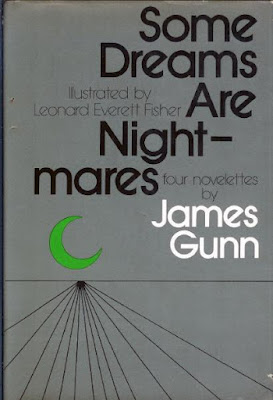
"Name Your Pleasure" would be reprinted in the 1974 collection Some Dreams are Nightmares under the title "The Hedonist."  This book announces on its cover that it is illustrated by Leonard Everett Fisher like that is a big selling point, but when I looked at the scan of the book at the internet archive I was surprised to find that the interior illos are as sterile and lame as the one on the cover.  

**********

In 1984 a hardcover edition of The Joy Makers was published as the second volume of Crown Publishers' Classics of Modern Science Fiction series, and a scan of this book is also to be found at the internet archive. For publication as a novel, the three stories' titles were dropped and "The Unhappy Man" became Part One, "Name Your Pleasure" Part Two, and "The Naked Sky" Part Three. Buttressing the novel's philosophical pretensions, each of the 28 chapters now has an epigraph from a famous intellectual or writer like Samuel Johnson, Charles Dickens, H. G. Wells, Shakespeare, etc.; in magazine form only "The Naked Sky" had these sorts of epigraphs.

I skimmed much of the book.  Significantly, The Joy Makers does not feel like a fix-up, a bunch of stories that originally were totally distinct and were forced together--to their detriment in many cases--to form an episodic novel like so many A. E. van Vogt novels; the three tales are more like entries in a future history that were always meant to be published together and they actually work better when they appear in concert than individually.  

I didn't see any major changes to the text of the story--some typos had been fixed, and some new ones introduced.  I did find a new paragraph had been added to "Name Your Pleasure," but it wasn't a big deal, and when Morgan dons a mask in the Strip that makes him look like a drooling imbecile, and his old school chum has on a mask depicting a scared man, Gunn refers to them as "the Idiot" and "Fear" instead of the "The Hedonist" and "Lira," I guess trying to make any symbolism more obvious.

Significantly, The Joy Makers does not feel like a fix-up, a bunch of stories that originally were totally distinct and were forced together--to their detriment in many cases--to form an episodic novel like so many A. E. van Vogt novels; the three tales are more like entries in a future history that were always meant to be published together and actually work better when they appear in concert than individually.

Seeing as the stories are almost identical to their magazine appearances, the hardcover book's ancillary material actually provided me more to chew on than did its presentation of Gunn's texts.  

In his Foreword, Isaac Asimov explains the rationale behind the series: because magazines and paperbacks are so fragile, some great SF works, especially ones that are, Asimov says, "too good to be immediately popular" because of their subtlety, risk falling into oblivion.  The Classics of Modern Science Fiction series aims to preserve in hardcover just such classics, selected by George Zebrowski and Martin H. Greenberg, that were undervalued when they initially appeared.  Asimov doesn't name any authors or books in this foreword--I think the same Foreword appeared in all ten books in the series.

In his Introduction, George Zebrowski, however, names names.  He numbers James E. Gunn among a group of SF writers that includes William Tenn, Robert Sheckley, Algis Budrys and Chad Oliver, men he says have bodies of work comparable to those of Isaac Asimov, Arthur C. Clarke, Robert A. Heinlein, Ray Bradbury and Frank Herbert but who have not achieved the popularity of those iconic figures.  

I'm not really familiar with Herbert and Tenn, so I'll put them to the side, but it seems obvious why Asimov and Clarke the science geniuses and Heinlein and Bradbury, who have distinctive and pleasing writing styles as well as points of view about human life that suggest people are capable of great things as well as dreadful things, are more popular than Sheckley, Budrys and Oliver, who, in my opinion, don't exactly have winning writing styles and who, in my experience, single-mindedly bang away at the same unappealing, somewhat misanthropic, themes again and again. 

Zebrowski doesn't exactly contradict my assessment, but certainly puts a rosier spin on things by theorizing that Gunn, Tenn, Sheckley, Budrys and Oliver's relative lack of fame is due partly because their work makes use of irony and offers an "incisive, often comic, view of humanity," and the general public doesn't appreciate irony and misses the point.  (Yeah, that's the ticket, people prefer Robert Heinlein and Ray Bradbury to Robert Sheckely and Chad Oliver because people are dumb!)  Zebrowski then quotes the many accolades from critics that The Joy Makers has received over the years, tells us it is "delicious," and predicts that our own society will face the dilemma depicted in the novel, of having to choose between real life and immersive artificial entertainment.

I don't think that The Joy Makers is "delicious," by any means; I think it is just OK.  But Asimov's invocation of subtlety and Zebrowski's of irony made me wonder about how "The Unhappy Man" and "Name Your Pleasure," viewed in isolation from "The Naked Sky" as they were in magazine form, certainly seem to be advocating that you surrender your property and autonomy to experts who have been selected for altruism and are equipped with advanced technology--maybe they are in fact a satire of people who advocate such ideas?  

Well, either way, the stories that are the component parts of The Joy Makers are acceptable examples of the SF that is about ideas instead of adventure or human drama (Zebrowski dismisses such SF as being "naively heroic" and "sentimental" and directed at "adolescents."  Ouch!)

**********

More SF stories from the 1950s next time...if there is a next time!

Monday, May 23, 2022

Honey for the Bears by Anthony Burgess

'Coming over here with all those bourgeois clothes to sell, but too much concerned with your sexuality, dig, to really get down to a bit of hard work and sell them.  And boasting last night about having a big capitalist shop full of silver and jewels back in England.  Everybody was like disgusted.'

'Not everybody would understand what I was saying.'

'Oh, you got down to speaking Russian pretty good by the time you were trying to tear the clothes off of people.'

It feels like an eternity since I last worked on this ol' blog o' mine, social obligations and the quest for money taking up my time and keeping me from my true calling of reading crazy stories and spoiling them for others.  But today MPorcius Fiction Log is back!  With a mainstream novel I believe worthy of the attention of all readers interested in the Cold War or in sexual orientation and sexual identity, which, judging from what I am hearing on the news, should be just about everybody! 

Our last blog post was about a Fritz Leiber collection on the theme that "man is wolf to man," and within it we noticed an ad for books by Anthony Burgess, the famous British writer responsible for A Clockwork Orange.  One such book was Honey for the Bears, a 1963 novel.  Advertising works, and I was duly inspired to read Honey for the Bears, and settled on a scan available at the internet archive of a 1978 Norton hardcover edition.  

With the sole exception of a chapter which consists of the text of a letter, Honey for the Bears is written in the third-person and our main character, Paul Hussey, is always on screen.  Hussey is an English antiques dealer and an RAF veteran of the Second World War; it was during the war he met his American wife, Belinda.  During his war service, Paul was close to a fellow airman, Robert, whose aircraft was shot down by the Germans and who endured an ordeal in the ocean from which he never truly recovered.  Some years after the war, after both men had married, Paul and Robert reconnected and the two couples became very friendly, spending much time together; they even, it seems, engaged in what amounts to what people call "wife-swapping" or "swinging."  Robert died recently, apparently of a heart attack brought on by lingering effects of his war injuries, throwing Robert's wife, Sandra, into a financial crisis.

Robert, an aficionado of Russian culture and a fluent speaker of Russian, had a risky way of making money.  Robert would buy cheap synthetic dresses by the hundreds and then smuggle them into the Soviet Union, selling them wholesale to a man in Leningrad who would then retail them on the black market.  Robert's untimely demise came after buying one consignment of "twenty dozen" dresses but before departing for the Eastern Bloc, leaving these dresses on Sandra's hands.  Sandra convinced Paul and Belinda to secretly carry the dresses, in violation of Soviet law, to Russia to sell them to that black marketeer, and the couple set off on a Soviet passenger ship with the idea that their trip to Khrushchev's USSR, shortly after the flight of Yuri Gagarin, would be like a holiday.  As the novel begins, they are aboard ship, bound for Leningrad, and things are already going haywire, as Belinda has contracted a mysterious and painful rash and the ships' Soviet doctor doesn't have any penicillin with which to treat her: 

'...it [penicillin] is an English medicine.  But we are on a Soviet ship and it is right we use Soviet medicines.'

This woman blames Belinda's illness on the poor food available in Great Britain, and assures Paul that they will eat better in the USSR.

For most of the novel Belinda and Paul are separated, she in a Leningrad hospital where the medical staff psychoanalyzes her (I don't think we ever learn what that rash was all about), he out on the streets, desperately trying to avoid arrest by the authorities, who have already seized Robert's Russian associate and are pretty sure Paul is equally guilty of "bringing in capitalist goods in order to sell them and thus upset the Soviet economy."  Equally important as the plot threads concerning Belinda's health and Paul's liberty are the many mysteries about Paul and Belinda, the dead Robert and the absent Sandra, that unfold as the novel progresses.   

There are several interesting recurring themes in Honey for the Bears.  A big one, of course, is the Cold War, and Burgess offers a peculiarly English or British or maybe European view of the struggle between the liberal democracies of the West and communist totalitarianism of the East.  Burgess portrays the Soviet Union as poor and dirty, the communist system as inefficient and inhuman and its officials as incompetent and inhumane; Western supporters of the USSR are shown to be, at best, a bunch of dopes--among Paul and Belinda's fellow passengers are a leftist British "lecturer" (I guess this is equivalent to an American assistant professor) and her posse of students, jerks who slavishly parrot the propaganda from Moscow.  But all you commies and Russophiles out there will be relieved to hear that Burgess has many arrows in his quiver and a lot more to say about the Cold War than that.  For one thing, he stresses continuities between Tsarist (as he spells it) and post-Revolutionary Russia.  More interestingly still, Paul repeatedly notices similarities between the Russian people and the working-class English people among whom he grew up.  (Paul, though now a middle-class shop owner interested in serious literature, was born into a working-class family, and did not attend university.)  Again and again a Russian's appearance reminds him of a relative of his own he knew in his youth, and Paul quickly comes to like the ordinary Russian people, no matter what atrocities the Soviet authorities inflict on him.  The ordinary people of Russia and England are essentially, Burgess seems to be suggesting, the same. 

Belinda being American, and the fact that Paul meets other expatriate Yanks in Leningrad, gives Burgess a ready platform to present opinions of the United States, and he sets up a sort of parallelism between the land of the free and the home of the brave and the Evil Empire, with Paul saying stuff like "You Americans and Russians are all the same.  You promise things and you don't keep your promises.  You just can't be trusted, that's what it is."  (Again the idea that people separated by geographic, political and ethnic boundaries are essentially the same.)  How seriously we should take Paul's assessments is an open question; for one thing, Paul is portrayed as not only a loser but also as an aggressor himself.  It seems possible that Paul's attitude is meant as much to portray the psychological effect on Great Britain of being demoted from world leader to junior partner as it is to reflect reality; it is absurd to think that two nations as different culturally, economically, politically as were the USA and the USSR in the early Sixties are "the same," but from the point of view of an exhausted Britain the similarities of the two superpowers, both (apparently at least) vigorous and expanding their might and influence, perhaps their similarities are more notable than their differences.  

Having raised the idea that Paul is a loser and an aggressor brings us to another of Honey for the Bear's big themes: sex, and in particular homosexuality and sexual ambiguity.  Homosexuality is mentioned on the first page when a minor character, Madox, opines that, in the same way homosexuals aren't homosexuals all the time, say when they are asleep or on the toilet, communists can't be communists all the time.  Burgess's novel is full of mysteries--some of which are resolved, and others of which go unsolved--and they all seem to revolve around sexual identity and sexual orientation.  For example, Paul is unable to identify the sex of another secondary character introduced on page one, an irascible trouble-making oldster in a wheelchair whom Paul dubs "Dr. Tiresias," a reference to Greek myth and of course T. S. Eliot's The Waste Land, of which Burgess was a devoted fan.  We never learn this mysterious figure's sex or name; Madox, this individual's assistant, just calls his employer "the Doc."

We gradually learn as the novel progresses how unusual Paul's and Belinda's sexual lives have been.  Paul is less interested in sex than is Belinda, and it turns out that Paul and Robert had a brief homosexual fling; the woman doctor treating Belinda in the hospital claims that one of Belinda's problems is that Paul is gay and is thus does not really lover her and is unable to satisfy her.  At the apartment of a young left-wing American (who claims to want to help Paul but betrays him to the Soviet authorities), Paul gets terribly drunk and sexually assaults a series of men.

At the start of the novel, Belinda expresses bitterness, even hatred of Sandra, claiming she probably murdered Robert.  At first Paul simply thinks this is because (as he suspects) all women really hate each other, and later he wonders if it is jealously that has raised her ire--maybe Belinda suspects Paul of preferring Sandra to his own wife, or maybe Belinda preferred Robert over Paul and envies the time Sandra spent with the now forever lost Robert.  Eventually Paul realizes that Belinda and Sandra were lesbian lovers.

Paul is something of a screw up, and is repeatedly portrayed as impotent and emasculated.  For example, in a bicycle accident years ago he lost his four lower front teeth, and wears a little denture in that space.  Well, the Soviet customs agent who fails to confiscate the 240 contraband dresses or Paul's copy of the forbidden Doctor Zhivago seizes the tube of adhesive Paul uses to secure this denture, saying it is a narcotic, and throughout the middle section of the novel the thing threatens to fall out, despite Paul's efforts to jam it in place with cotton and little pieces of wood (ouch!); it is finally lost when Soviet police beat up poor Paul (ouch again!)  Paul physically forces himself on a woman who shows contempt for him and when she has finally succumbed to his desires he finds himself unable to maintain an erection, inspiring her to laugh at him.

(The sexual transgressions don't end there--we learn that Belinda was raped by her father--a professor of English--and that the young Paul was aroused by the smell of his mother.  Yikes!)

Burgess combines two of his themes--the alleged similarity of the United States and the Soviet Union and Paul's impotence--in a scene in which Paul is interrogated by the police; this scene strongly suggests Paul is meant to represent a Britain/Western Europe that is psychologically scarred by the World Wars and feels hopeless and impotent in a world in which it lies trapped between two revolutionary superpowers characterized by boundless ambition, one that transforms the world with market capitalism and the other that seeks to do so with totalitarian socialism.

'You are very optimistic in the West, that must be admitted.  You look forward to a future.'

'No,' said Paul, 'not a future.  At least not in Europe.  America's different, of course, but America's really only a kind of Russia.  You've no idea how pleasant it is not to have any future.  It's like having a totally efficient contraceptive.'  

'Or like being impotent,' said Zverkov.  Paul blushed.  

In the last quarter of Honey for the Bears, Belinda leaves Paul for the lesbian doctor who has been psychoanalyzing her, following her to her ancestral home in the Crimea on the coast of the Sea of Azov.  Belinda leaves Paul a letter that constitutes the entire text of a chapter and gives Burgess a chance to parody both Americans and English people by depicting an American view of England.  Perhaps the most memorable sally in the letter is Belinda's idea that a life of relative freedom and wealth has made Love with a capital "L" almost disappear in Britain and America, because so many substitutes for Love are easily available; in Russia, by contrast, Love flourishes, because Love is all the people of the USSR have amid their many enduing hardships. 

Dr. Tiresias returns to the narrative--it is revealed this mysterious character is a smuggler who brings contraband to the Soviet Union secreted in his or her wheelchair.  Because Belinda is staying behind, Paul has an extra passport and an extra place on the ship upon which he will be leaving the worker's paradise; the Doc arranges for a young Russian man wanted by the authorities who has long been in hiding to take Belinda's place on the ship.  Is this guy really the feeble-minded but physically massive son of a dissident musician who was Robert's favorite composer?  Or just a violent criminal who has aided Dr. Tiresias in his or her smuggling and will rat out the Doc if the ruthless Soviet cops get their hands on him?      

In keeping with the novel's themes of gender-bending and of ludicrous incompetence and failure, this joker is very badly disguised as a woman, and he and Paul are caught by the crew of the ship en route to Helsinki.  In port in Finland the two Soviet police officers who beat up Paul come back into his life, tasked with taking him and the cross-dressing fugitive back to Leningrad.  In an inversion of the shipboard events at the start of the story, in which a communist English academic and her mob of leftist students maligned Paul, Paul and his slow-witted companion are rescued by a Russophobic British lecturer who leads a squad of hefty English football fans in disrupting the transfer of the captives to the shore.  

The story ends on a hopeful note as Paul accepts his homosexuality and reflects that small countries like Finland and England have a role to play in the world now dominated by the Americans and the Soviet communists: the job of preserving the beautiful high culture of the past from the market efficiency of the USA and the gruesome totalitarianism of the Soviet Union.  Maybe we should see Honey For the Bears as a warning from a conservative about the dangers to happiness, love and freedom posed by both the market and the state.

As I have chronicled, Honey for the Bears addresses all sorts of interesting topics and is full of allusions and references to art, music and literature (I have limited myself to a mention of Eliot, but Shakespeare and Tolstoy and others are in there.)  The novel is also cleverly structured and written; everything fits together in a satisfying way--the way passionate lecturers, a female useful idiot and then a male historian who oddly has it in for Russians because of things he read in his research on Richard Chancellor, bookend the story is one example.  At the same time, Paul's saga is kind of sad and sometimes disgusting, and in many ways, including morally, it is ambiguous--none of the characters is very likable or admirable, for example.  So, it is not exactly a fun or light read. 

Thumbs up from me, but be forewarned, though it is marketed as a comedy, Honey for the Bears is no joy ride, people!

**********

It's back to science fiction stories for our next episode, oh my brothers.  Stay tuned!