Thursday, February 17, 2022

Jungle Tales of Tarzan by Edgar Rice Burroughs

My Ballantine paperback copies of Jungle Tales of Tarzan (I have a Richard Powers one and a Neal Adams one) try to pass off the book as a novel, but, in fact, its twelve chapters are all short stories that appeared in the magazine Blue Book in 1916 and 1917.  (To see the covers of the issues of Blue Book in which these twelve tales made their debuts, follow this link to ERBzine; the cover illustrations don't show Lord Greystoke or jungle beasts or anything like that, but ladies in what you might call the Charles Gibson/Harrison Fisher mold.)

The stories in Jungle Tales of Tarzan take place in Tarzan's youth, before he has met any white people; wikipedia tells us that Tarzan aficionado extraordinaire Philip José Farmer calculates that most or all of the stories in the book are set in 1907 and 1908.  A running theme of the stories is Tarzan's need for companionship and his developing relationships with the other inhabitants of the jungle.  In the first chapter, "Tarzan's First Love," Tarzan reaches puberty and falls in love with Teeka, the prettiest female ape, and is jealous over her relationship with Taug, one of the bigger and tougher apes with whom Tarzan has grown up.  When members of a local black tribe, a bunch of cannibals lead by chief Mbonga who relatively recently moved to the area, in flight from the tyranny and oppression of the Belgians, captures Taug, Tarzan is at first happy to see his rival disposed of.  But then realizes that he is not truly compatible with Teeka or any of his hairy compatriots, and decides to rescue Taug.  Later, in "The Fight for the Balu," Tarzan is fascinated by Taug and Teeka's baby, and has a chance to rescue the little tyke from a great cat; Tarzan also rescues Teeka from a rogue male ape from another tribe in "The Battle for Teeka."  Taug becomes Tarzan's best friend in his tribe and a powerful advocate and ally.

In "The Lion" Tarzan is saved by his little friend Manu, the monkey.  In "The Capture of Tarzan," we learn about the developing friendship of our hero with Tantor the elephant; Tarzan saves the pachyderm from a trap set for him by hunters of Mbonga's tribe, and when those hunters capture Tarzan instead and are all set to sacrifice him, the elephant comes to his rescue.

Mbonga's tribe plays a role in many of the stories in Jungle Tales of Tarzan, the native Africans acting as a foil for white Englishman Tarzan (Burroughs suggests that stereotypical English traits like "a love of fair play" and "orderliness" have been passed to Tarzan via heredity) and as an opportunity for Tarzan to demonstrate his maturation.  (As in so much fiction in English, black people are present in the narrative to show us how good or how bad the white characters are.)  Throughout most of the book, Tarzan, who hates the blacks because they slew his adoptive ape mother (whom he still thinks his true mother), and who anyway thinks of himself and the African tribesmen as jungle beasts (though Tarzan tends to think of himself as the greatest of the beasts), without a second thought kills Mbonga's people when he runs into them, to help his animal friends or because he wants to steal from them or just for sport.  Tarzan is a practical joker who, when he finds the tribesmen have baited a trap for a lion with a goat, will free the goat (and kill it and eat it raw) and then capture one of Mbonga's people and put him in the trap in the goat's place so the lion will kill the man and his comrades will find their comrade's mauled body when they come to check the trap the next day.

Over the course of the book, Tarzan's feelings about the members of Mbonga's tribe and his behavior towards them evolves to a certain extent.  Tarzan so enjoys playing with Taug and Teeka's baby, so envies the bond he sees between parents and children, that in "Tarzan and the Black Boy" he tries to acquire a child of his own--by abducting Tibo, a ten-year-old boy of Mbonga's tribe.  Burroughs pulls no punches when showing how bad an idea this is--the poor kid is constantly crying because he misses his mother and out of fear--among other terrors Tarzan subjects him to, the apes who are Tarzan's adoptive tribe try to kill Tibo.  Because he refuses to eat bugs and other creepy things that Tarzan and the apes eat regularly, Tibo becomes horribly emaciated.  Eventually good luck lands the boy back with his mother, Momaya.

"Tarzan and the Black Boy" is one of the more straightforwardly racist portions of Tarzan saga I have read so far; you can of course argue that the whole idea of Tarzan is racist (an English aristocrat goes to Africa and proves he's better than Africans at everything on their home turf, even without the benefit of firearms and the other apparatus of modern industrial Britain), but in "Tarzan and the Black Boy" Burroughs just comes right out and says that blacks are inferior to whites in addition to showing it.  Burroughs also describes at length Momaya's body modifications, like the wooden skewer through her nose, her filed teeth, her tattoos, and some kind of metal ornament that pulls down her lower lip and perpetually exposes her lower teeth.  Burroughs assures us that her fellow blacks find her beautiful, but to us readers she would be hideous.  Tibo, we are told is "handsome"..."for a black."  Ouch.  Burroughs also tells us that "the spirit of barter is strong in the breasts of the blacks;" I don't know that I have heard this stereotype before--in fact, I have heard that black people, or maybe just African-Americans, are reluctant to haggle.

Despite all the condescending, belittling and prejudiced things Burroughs has to say about black people, he makes the kidnapped boy and his bereaved mother, the victims of Tarzan's selfish misbehavior, sympathetic and even admirable characters.  In keeping with his theme of a parent's love for her children, Burroughs describes how Momaya risks many dangers in her efforts to get her son back.  One of these dangers is consulting a hermit witch doctor said to be more powerful than the witch doctor of Mbonga's tribe.  This witch doctor, named Bukawai, is an effective villain, a highlight of Jungle Tales of Tarzan.  Bukawai has as companions two hyenas, and suffers from a disease, I guess leprosy, that has lead to much of his face falling off.  Gross!  The adventure of Bukawai that begins in "Tarzan and the Black Boy" continues in "The Witch-Doctor Seeks Vengeance" and "The End of Bukawai."  Momaya gets her son back by luck, before Bukawai has cast his spell and before he has been paid his fee by Momaya, and he feels cheated, so he kidnaps Tibo and ransoms him; eventually Tarzan rescues Tibo and metes out a terrible justice to the witch-doctor.

The least interesting and entertaining chapter of Jungle Tales of Tarzan is
"The Nightmare," in which Tarzan dreams of being carried off by a 
huge bird; for some reason both J. Allen St. John and Richard Powers thought
that chapter most appropriate for illustration

In "The God of Tarzan," Lord Greystoke begins to learn empathy and mercy, staying his hand when he has Mbonga himself at his mercy.  In the final chapter of the book, Tarzan encounters a black man whose courage he admires, and he dissuades the apes of his tribe from slaying him.  

I haven't mentioned it before, because I know these blog posts are already too long, but in the last two Tarzan novels I read, The Son of Tarzan and Tarzan and the Jewels of Opar, Burroughs talks about religion in a way that is interesting, and this is still more the case here in Jungle Tales of Tarzan.  In those novels, Burroughs, as narrator, as well as Tarzan the character, voiced conventional ideas about religion, like that God created the world and that the bad will be punished in the afterlife, though perhaps God may show mercy on those who have misbehaved here on Earth.  Here in the Jungle Tales, Burroughs continues to endorse conventional views of God.  Tarzan, studying the books found in his dead parent's cabin, comes to wonder about God, and comes to believe that it is God who has created all the good things in the jungle, the flowers and trees and so forth, and that it is God who gives people the inclination and the courage to do the right thing, like protecting a baby or showing mercy to a helpless enemy when it might be safer or more profitable to do the wrong thing.  Burroughs does however end his chapter on Tarzan's search for God on a somewhat discordant note, as the ape-man wonders who created the vile and disgusting snake.     

While accepting the idea of a divine creator, Burroughs does appear in the Jungle Tales to attack organized religion, and not just among weirdos like those in Opar and primitives like Mbonga's cannibals.  The witch doctors in the book are selfish scammers, their religion a way of exploiting their fellows, and Mbonga is in cahoots with his tribe's priest, who shares with him a cut of the wealth  extracted from the credulous commoners.  In "Tarzan and the Black Boy," Burroughs jocularly calls this corrupt relationship between witch doctor and chief  "the age-old alliance that exists between church and state," suggesting his portrayal of African cannibals whose teeth are filed is, in part, a satire of Western elites.

Burroughs has a smooth, comfortable writing style, and this book is very readable and quite entertaining.  The stories are not just an endless series of scenes in which a naked dude kills animals and people in hand-to-hand combat; while, yeah, we do get plenty of that, Burroughs also really tries to get into the heads, to depict the psychologies, of the inhabitants of his fantasy version of early-twentieth century Africa, and he succeeds in making all these characters compelling.  I've mentioned a bunch of interesting figures already, and I'll point out one last memorable minor character: a monkey who likes to watch gory fights and so tries to get apes to fight each other.

When I wrote about Tarzan and the Jewels of Opar, I said it was hard to identify with paragons like Tarzan and his wife Jane, and so I identified more with the villains, La of Opar and the renegade Belgian officer Werper, people who were driven by ordinary emotions like loneliness, lust, greed and fear, and who committed all kinds of blunders and misdeeds.  One of the strengths of Jungle Tales of Tarzan is that it is easy to identify with a young Tarzan's loneliness and efforts to learn about the world, while the dumb and insensitive things he does make him feel very human.  

Thumbs up for Jungle Tales of Tarzan!  

Thursday, February 10, 2022

C. L. Moore: "The Bright Illusion," "Tryst in Time" and "Greater Than Gods"

It has been over a month since we've read anything from one of the 1930s magazines that for a while there were our primary diet here at MPorcius Fiction Log.  I guess our last Thirties magazine foray was when we read three stories from Astounding about risk-taking scientists by Donald Wandrei.  Oh, wait, the Vice-President for Equity Excellence here at MPorcius Fiction Log is speaking up, telling me that it has been two months since we read anything by a menstruator!  That was in early December, when we read Leigh Brackett's mainstream thriller An Eye for an Eye and three Northwest Smith stories by C. L. Moore.     

So, now is an opportune time to read three stories by Catherine L. Moore that appeared in Astounding in the 1930s, two that were printed in the R. Orlin Tremaine years and one from the famous editorship of John W. Campbell, Jr.  All three of these stories would be included in 1975's The Best of C. L. Moore, so we have every reason to hope that these stories are good, and every reason to believe that they are important artifacts in the history of SF.

"The Bright Illusion" (1934)

Nobody can agree on what exactly "science fiction" is.  In a 1976 interview for the fanzine Chacal, which you can read at the internet archive, Moore admits that "I don't think that I ever wrote science fiction--hard science fiction.  Everything I did was fantasy...."  But in his 1975 introduction to The Best of C. L. Moore, editor Lester del Rey says, "Many of Moore's early stories appeared in Weird Tales, though they were basically science fiction."  Not only do they disagree on the classification of Moore's stories, but you can see by the hedging they do (Moore adds "hard science fiction" and del Rey modifies "science fiction" with a "basically") that they are not confident in their own definitions of what constitutes science fiction.  Is a Northwest Smith story a fantasy because it is about a guy who gets seduced by a witch with inexplicable powers and there is little or no speculation about the effects of future technology and increased knowledge on people and society?  Or is it a science fiction story because the witch is from another planet and she is foiled not by getting her head chopped off with a sword but by being burned with a ray pistol?  I'm afraid these discussions quickly reach the point where they are a meaningless waste of time, though I think these quotes from Moore and del Rey suggest that, in some circles, science fiction is held to be more prestigious than mere fantasy--Moore is being modest, while del Rey is talking her up, selling her to a perhaps skeptical audience of people who like hard science fiction.

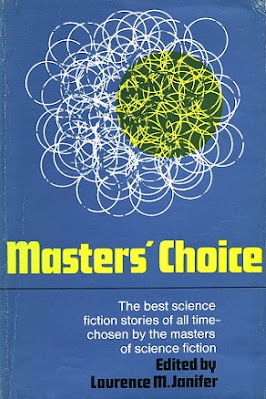
Anyway, in that intro, del Rey talks about how when Laurence Janifer (whom he calls "Larry") was putting together his anthology Master's Choice, del Rey suggested three stories to him, one of which was "Bright Illusion," and Janifer ("Larry" to his friends, apparently) was thrilled by it.

"The Bright Illusion" is one of those stories that tries to blow your mind, to give you a sense of wonder about the vast alienness of the universe, to remind you how little about the universe you can really understand.  But at the same time it endorses some of the oldest, most cherished and least believable concepts in human history--the soul, the afterlife, and the power of love to conquer all!  

Our dude Dixon is lost in the desert without any water--he's had it!  But wait, what is that ahead?  A huge glowing dome of light?  With dead bodies around it?  A soldier of the French Foreign Legion?  An Arab?  A young white explorer in a pith helmet?  What killed them?  It must have been this giant bubble of light!  Oh no, it is sucking Dixon in!  Is it going to kill Dixon as well?

The bubble is an alien super-being, a sort of god from another universe where the atoms are arranged differently, there are different colors, etc.  It wants to conquer the planet of some other equally incomprehensible alien god.  The bubble came to our universe and our planet seeking a champion--because a human's atoms are arranged differently than the matter of the universe from which the bubble came, it thinks a human could sneak undetected into the temple of the god it wishes to supplant.  All those corpses out there are people the bubble examined and decided were not up to the task of being its champion, but Dixon fits the bill!  As we expect of one of these old SF stories, Dixon communicates with this alien bubble being via telepathy, and Moore writes many paragraphs describing the way it feels to have "washing through him" the "all-penetrating waves" that examine him, then communicate with him, then fill him with knowledge.  

In a flash the bubble and Dixon are above the planet the bubble wants to conquer, a world consisting of one huge city of buildings and bridges that obey a different geometry than any Earth city, inhabited by people like boneless serpents with one eye, people whose means of acquiring nourishment and of reproducing are incomprehensible to the human mind!  It strains Dixon's sanity to even look at this planet of impossible colors and mad physics--how can his Terran body interact it and his Terran mind survive conversation with its inhabitants?  The bubble solves all these problems!  It casts a shell of illusion around Dixon--to the enemy he will appear to be one of them, and to him they will appear human, their language English, their buildings like the classical architecture of Earth.

You'll remember that many of Moore's Northwest Smith stories are about a human getting mixed up in some kind of sexual relationship with an alien monster.  Well, what do you think the very first thing Dixon does when he gets to the temple of the local god he is supposed to overthrow and the very first cyclops snakezoid he meets appears to him as the hottest girl he has ever seen, and he appears to her as the most beautiful one-eyed vermiformian she has ever seen?  They start making out!  Dixon tells himself that what looks like a beautiful woman is in fact "a sinuous, faceless thing, a creeping horror with the tints of an incredible spectrum," but she is irresistible!  He is forced to ask himself, "Good Heaven, could it be possible for a man to fall in love with an hallucination?"

But Dixon and the worm creature are not just being made horny by surface appearances--they are truly in love!  They are soulmates from different universes!  Moore's story accepts the existence of the soul and of life after death, and following the fight between the bubble-being and the god native to this planet, Dixon and the worm creature commit suicide because they are certain that their souls, freed from their incompatible physical bodies, can be together in a third universe, the universe of the afterlife!

I have some gripes with this story's technique--it is too long and wordy and repetitive--and of course I don't believe in the soul or the afterlife or that it makes any sense that a human man might fall in love with a being of another species of incomprehensible sex from another universe with different laws of physics.  But Moore sells the plot and themes--the story is totally crazy and surprising in a good way because it is at the same time internally consistent and totally sincere; the second half of the story won me over, almost against my will.

Thumbs up for "The Bright Illusion"--del Rey and Larry are right, this is a winner.  And del Rey and Janifer aren't alone in singling it out--it seems that Moore herself chose it for the 1984 anthology Analog: Writer's Choice, Volume II.  I will have to keep an eye out for this anthology at the used bookstores, as it, apparently, includes author's intros to each story and I am curious what Moore had to say about it.      

"Tryst in Time" (1936)

Eric Rosner is one of these guys who travels the world on the cheap as an adventurer, stowing away aboard research ships, fighting as a mercenary in China, living as a bandit among the Tatars.  But at age thirty he is bored with life!  He has been everywhere!  He has done everything!  So when he meets a physicist who claims to have invented a one-way time machine, Rosner leaps at the chance to travel to some other period of history.

Burnishing her science fiction bona fides, Moore has this nerd give a little lecture on inertia and Newton's laws; the way his time travel device operates is that it anchors its subject to the "bedrock" of inertia that lies behind or beneath the universe, so that "time flows past" the subject and so ends up in a different time.  This method is totally random, because time doesn't move in a straight line, but it swirls and eddies, so you might go backwards or you might go forwards--you have absolutely no control of when you will reappear.

For some reason Moore feels the need to address, and dismiss, some of the traditional concerns about time travel.  The boffin assures Rosner that 1) he can't run into an older or younger self because the universe does not allow an item to exist in multiple iterations in the same time period and 2) he can't change history because the universe consists of multiple, I guess infinite, time streams; from each decision point a million futures branch off and our acts of free will don't change a time stream, they just determine which time stream we are living in.  If Rosner goes back to 1800 and murders Nelson and Wellington he may now live in a world in which France conquers Europe but the world he left behind, the world the nerd still inhabits, will not have had its history changed--by paving the way for the Corsican Ogre to tyrannize the world Rosner would not be changing the course of the ship of time, but rather switching trains in the railway station of time.

(You can forget that entire previous paragraph I just typed because none of those issues play any role in Rosner's actual time travel adventure.)

Rosner straps on the back pack that is the time machine and flicks the switches and starts popping in and out of different periods of history, real ones like ancient Rome (the arena!) and Elizabethan England (a London street scene!) and fictional Lovecraft/Howard ones where a high-tech race of super humans, perhaps of  extraterrestrial origin, live in cyclopean ruined cities and are warred upon by the brutish ape-men who are our ancestors.  In many of these time periods Rosner sees or actually meets a beautiful pale girl with blue eyes; this chick is arrogant and aristocratic, characterized by an iron will; in one of the lost city settings she commits suicide with a ray gun rather than let the missing-link people molest her.  In the 16th-century she is being burned at the stake as a witch and Rosner puts her out of her misery by shooting her.  In another fantasy setting Rosner rescues the woman from short little gnome-like people who are going to sacrifice her to their god.

Rosner and this proud and stubborn woman are soulmates, destined to unite in an immortal love!  Each time Rosner meets one of her incarnations, she is more familiar with him; this makes no sense, because sometimes Rosner encounters her in the prehistoric past, sometimes in the far future, and Moore admits that it doesn't make any sense, and just blows it off as one of the many mysteries of the universe.

Finally, the star-crossed lovers meet in a dimension of total darkness.  She now fully recognizes their relationship.  They hold hands and, I guess, spend eternity together in the afterlife, or something. 

"Tryst in Time" is not very good.  The early section of the story, with the physicist, is too long, and the time travel section is repetitive.  Moore expends a lot of ink explaining a bunch of time travel stuff that has no application to the main part of the story, and then makes no effort to explain the inexplicable fact that Rosner always appears near an incarnation of this woman and she somehow recognizes him because a future version of herself has met him.  The plot is resolved not by any of the character's actions or decisions or personality traits--fate has determined they be together, they don't have to achieve anything or overcome any obstacles to succeed, just wait until the train comes to the final stop.

"Tryst in Time" has a somewhat similar theme to that of "The Bright Illusion"--two souls, imbedded in bodies separated by conventionally unbridgeable gulfs, are fated to be lovers--but whereas the 1934 story had memorable images and some really "out there" concepts and the characters had to make some decisions, this story's images are banal (how many witch burnings and virgin sacrifices have we seen?) and the characters don't do anything.

Gotta give this one a thumbs down.

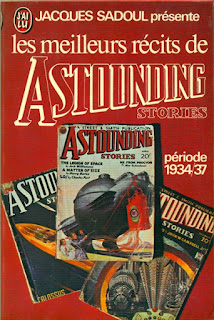
The merciless staff of the MPorcius Fiction Log may be condemning "Tryst in Time," but Jacques Sadoul liked it, including it in a 1974 French anthology of stories from the F. Orlin Tremaine era of Astounding.  Vive le difference!  Isaac Asimov, Martin H. Greenberg and Charles G. Waugh are also on team "Tryst in Time," selecting it for their 1989 anthology of occult stories.

"Greater Than Gods" (1939)

Here's another story that received the Isaac Asimov seal of approval: "Greater Than Gods" was included in the volume of the Great Science Fiction Stories anthology series that covers 1939, a book which was first published in 1979 and has been published in a variety of forms with a myriad of different covers.    
 
The Time: July 7, 2240.

The Place: Science City, "which houses the greatest scientists in the world."

The Man: Dr. William Cory of Biology House.

His Work: Figuring out how to predetermine the sex of babies in the womb so there will never be a society-destabilizing imbalance between the sexes.

His Problem: He can't decide which of his girlfriends to propose to, Dr. Marta Mayhew of Chemistry House, or normie non-scientist Sallie Carlisle.

Cory's pal, Charles Ashley of Telepathy House, comes by to shoot the shit.  He gives one of those lectures about how time is a bunch of decision points with branches blah blah blah, and says if Cory could somehow look into the future and compare the branch in which he marries Mayhew to the branch in which he marries Carlisle, his decision would be easy.

On Cory's desk are holograms of each of his marriage prospects.  After Ashley leaves, the hologram of Sallie Carlisle suddenly changes--it becomes the image of a young woman with some of Cory's features and some of Sallie's--this kid is sending her ancestor a telepathic message from thousands of years in the future!  She tells Cory that when he married Sallie, Sallie was such a party girl that he had no time for his work on sex-determination and a sex imbalance occurred, with women outnumbering men, so that women took over the world and created a utopia in which there was no war, no work, no hunger, and no cities--a pastoral Eden!      
   
Over the course of this blog's turbulent life we have read many stories* which tell us that utopias where you don't have to work  lead to decadence, that humanity needs challenge and struggle to thrive, and "Greater Than Gods" is another one!  When Cory hears that marrying Sallie will lead to a feminist utopia of peace and indolence he is horrified that he might be responsible for such a catastrophe!  


Then a similar message comes through from the hologram of Marta Mayhew, from a male descendent of Cory and Marta's.  In the future in which Marta becomes his wife, she enthusiastically supports him in his work and pushes him to release it to the public before adequate testing has been done.  Mankind embraces the ability to predetermine the sex of babies.  However, after almost universal adoption of the Cory technique a side effect becomes apparent--children whose sex has been determined by the Cory method are slavishly obedient!  The creation of a whole generation of yes-men gives an ambitious general the opportunity to turn America into a collectivist totalitarian dictatorship that conquers the world and then the solar system, creating an interplanetary empire of sternly disciplined conformists who are always spying on each other and are never happy or relaxed!  Another catastrophe!

There is a long--too long--section of the story in which the representatives of each future try to convince Cory that their future is the one he should choose.  Then Cory cuts the Gordian knot by proposing not to scientist Marta, and not to party girl Sallie, but to his assistant, Miss Brown!  The feminist hippie future and the military tyranny futures both wink out of existence and we are to presume that Cory develops his sex control technique and works the bugs out of it before gifting it to the world so we can colonize the solar system without becoming a bunch of goose-stepping stool pigeons.

I don't want to say that "Greater Than Gods" is bad.  The ideas and themes it addresses are fine, but some of those ideas and themes don't feel fresh to me in 2022, though maybe they would have felt new to people in 1939.  Worse, the story is too long, and is so contrived and gimmicky that it feels more like a fable than a story with credible characters that can generate genuine emotion in the reader.  I'll say it is acceptable. 

(On a side note, I am confident the story qualifies as "real" science fiction, despite Moore's modest assertion in 1976, because it is about the effect on society of technological change, even if the actual plot mechanisms of the story have to resort to religious explanations--it is a Cosmic Mind with a capital "P" Plan that allows Cory a chance to see possible futures.)

**********

Three stories about love relationships operating in a universe in which greater powers--Fate or gods--of varying beneficence guide us humans on the matter of who is a suitable mate.  In two of them those powers bring together two people from alien backgrounds, while in the third the inexplicable power instead gives a man the information he needs to make the right choice of partner.  In the first two stories love conquers all, but in the third we see love as a secondary consideration which must bend to the needs of society.  I think in two of these stories, though they appear in Astounding, we can see a topic that commonly shows up in Weird Tales: connections across the generations of people with their ancestors and descendants.  And in all three we see a characteristic of Moore's early work I often complain about--long-windedness.  Not only does she write long paragraphs, but she has a penchant for presenting the same information again and again and the same sorts of scenes again and again, both within a story and across different stories.     

It feels good to get back to the 1930s, but in our next episode we'll be returning to the jungles of the turn of the century with our hero, Tarzan!

Tuesday, February 8, 2022

Castle to Castle by Louis-Ferdinand Celine

I was a little shaken...in fact, I'd had a rotten shock!...that's right, a shock...the whole of Europe on my ass...yes, the whole of Europe...plus my friends...my family...all competing to see who could grab more away from me...not leaving me time to say booo...my eyes!...my nose!...my fountain pen...the ferocity of Europe!...the Nazis were no lovebirds, but don't tell me about the sweet gentleness of Europe...

For some reason I got the itch to read another book by Céline, the anti-Semitic French World War I veteran, physician, innovative novelist and Nazi sympathizer.  I guess I sort of forgot how long and somewhat tedious much of Death on the Installment Plan had been, while over time all the funny and interesting bits loomed larger in my mind.  So I tracked down the 1968 Ralph Manheim translation of 1957's Castle to Castle at the internet archive and read it on my phone and laptop. 

Castle to Castle is even less plot-driven than Death on the Installment Plan and feels even more like the rambling complaints of a bitter old man interspersed with his stories of his trials and sufferings during and just after the end of the Second World War.  The structure and form are conversational, the text appearing much like Céline's side of a conversation or interview taking place in the second half of the 1950s--one topic of conversation is this very book, which is in the process of being written.   

Céline and his wife, the dancer Lili, live in a rural area near Paris where the author has started up a medical practice; as chronicled in Death on the Installment Plan, as a child at the turn of the century, little Ferdinand and his parents would hawk lace and make deliveries of antiques in this very neighborhood.  Céline complains bitterly about his poverty.  When it looked like the Allies were going to overthrow the German occupation and the Vichy government in 1944, Céline, famed as a racist and anti-Semite and closely associated with Vichy regime, fled the country and in his absence his belongings, including many manuscripts, were stolen by criminals or seized by the government.  His books don't sell, and Céline accuses his publishers of hiding his books in cellars and hoarding his stolen manuscripts, waiting for him to die so they can make a killing when his writings rise in value upon his demise.  He declares he will foil them by outliving them, and has extended fantasies about the deaths of both his "friends" and his enemies, vividly--and repetitively--imagining them on Charon's boat, where Charon beats them with an oar so brutally that their eyes hang out of their sockets.

As for his medical practice, Céline also has few patients, maybe because of his reputation as a collaborator, maybe because he is barely presentable.  Céline writes quite a bit about social status and status markers in the first quarter or so of Castle to Castle, and suggests people have no interest in his medical services because, for example, he wears old clothes and is seen to carry his own trash to the curb.  In particular, he talks about how automobiles are a sign of status, and how one reason nobody respects him is that he can't afford one, and has to walk everywhere--people expect a doctor to have a car, and the fact that he lacks one marks him as a loser.  

(Celine loves boats and ships, and becomes entranced by watching harbor activities, but he hates automobiles, and delivers a long angry rant about them.)

The picture of post-war France, and Europe broadly, painted by Céline early in the novel is one of a place wracked by crime and threatened by violence; there are many references to the tumultuous current events of 1950s France and larger Europe: the development of the H-bomb, the Suez crisis, the Poujadists, the Hungarian Revolution, the fellaghas--there is no explanation or context for these references, Céline presumably assuming readers know all about them, as presumably readers would have when the book was published in 1957; we current readers luckily have google and wikipedia to get us up to speed on any of these capers and controversies with which we might not already be familiar.  Céline, reviled in public and accused (apparently unjustly) of selling military secrets to the Germans, fears for his life and for the security of his wife. In the interest of defense, he and his wife own a pack of vicious dogs which irritates the neighbors and presents a threat to Céline's few patients. (Céline, fulfilling one of those stereotypes of misanthropes, loves animals, and in this 1950s period has a whole menagerie, including a hedgehog.)  

Around the 90-page mark (the edition of Castle to Castle at the internet archive is like 360 pages, but, unlike the densely massive wall-of-text of Death on the Installment Plan, there are separate, though unnumbered, chapters here in Castle to Castle and the blank space in between them cuts down the word count a little) we get our first of several surreal sequences, probably the most surreal.  Céline is on a house call at night--you know, so his enemies can't see him--and has a hallucination, perhaps connected to a relapse of the malaria that he has carried with him since his days in Africa in 1917.  Always fascinated by the river and watercraft, he spots one of the excursion boats on the Seine that caters to tourists--bizarrely it is on the move at night, and he can see it despite the dark; the reason: the tour boat has been commandeered by Charon and is ferrying the dead!  From it disembark some deceased friends of Céline's, fellow collaborators including Emile, a guy who fought with the Legion of French Volunteers Against Bolshevism and was lynched by a vengeful mob after his return home to France, and the actor Robert Le Vigan, who like Céline spent some time in prison thanks to his collaborationist activities and after his release went to Latin America.   

After this we get some anecdotes about Céline's interment in a Danish prison after the war, where he worked in the cancer ward, having been assigned the job of alerting the staff when a patient died and helping them cart the corpse away. 

Before he was in Denmark, while the war was in its closing stages, Céline spent time in Germany, in the town of Sigmaringen, to which the Vichy government and other collaborators had fled. The over one thousand pro-Axis French people there (one of Céline's little jokes, one that he uses again and again, is that he knows exactly how many collaborators were at Sigmaringen, 1,142) were provided by the Germans quarters in and around an old castle which Céline describes as labyrinthine and decrepit and full of old paintings and furniture.  The collaborators do not live in comfort: they are menaced by the ever present possibility of an Allied air raid, terrified by the approaching Free French Army--in particular the famously brutal Senegalese troops--and are not impressed by German hospitality; Céline talks at length about the quantity and quality of the food provided the French refugees.  What I am thinking of as the main part of Castle to Castle is the series of absurd and surreal anecdotes and character sketches set in Sigmaringen that takes up like two-thirds of the book.  As I guess I have already complained, this novel is weak on plot, and these anecdotes don't build up to anything--there is no climax or resolution, these episodes are basically self-contained, and the book just ends all of a sudden.

One of my favorite anecdotes is about how, even though every third or fourth page Céline is telling us that the sky is full of British and American bombers and the Luftwaffe has no means whatsoever to interfere with them, and that everybody in Sigmaringen is quaking in his or her boots because the merciless black soldiers of the Free French Army are going to strike at any moment, some pro-German Frenchies in the castle or its environs are still confident of an Axis victory.  One batch of people sits around plotting the future government of France, who will get what post, who will be executed, even what sort of statues will be erected in Paris after the war is over and the Western Allies and the Soviets have been vanquished.  One guy has developed a modern and efficient means of executing people, and spends his time training a squad of executioners in his technique because he wants to be ready to get to work at once exterminating all the Frenchmen who tried to sell France out to the English, the Americans and the Commies upon the reconquest of France by the Wehrmacht--he has calculated that it will take three months to liquidate everybody on the list of 150,000 traitors. 

One of the first surreal scenes in Sigmaringen has the leader of Vichy France, Phillipe Petain, responding to an R.A.F. attack with total sangfroid, saving the collaborators from death from British bombs and machine gun fire so they can risk the death penalty in front of a French court after the war.  In a somewhat similar scene, another prominent figure of the Vichy government, Pierre Laval, prevents a riot in a train station where an international cast of soldiers, female locals and Frenchwomen forced to work in Germany are having a sort of orgy.  I have no idea to what extent Céline, by portraying the most famous people convicted of betraying France as heroic lifesavers, as the dei ex machina of absurdist scenes of terrible danger, is sincerely expressing admiration for Petain and Laval, reminding people that Petain and Laval were widely admired before World War II, or just trying to offend his own critics and public opinion at large.

Another surreal scene in Sigmaringen centers not on physical violence and danger but on scatology.  Céline, his wife and their pet cat are housed in a hotel, in a room across the hall from the toilet.  Céline, who is long-winded and repetitive, describes at great length how everybody in the entire town comes to use this toilet, so that there is a long line of people in the hall at all hours, right in front of Céline's door; many people can't hold it long enough (we are told German food has a laxative effect) so the floor is covered in human waste that seeps under Céline's door so he and his wife and any visitors have to wade through it:

...the hallway was a geyser!...and our room!...a waterfall down the stairs!...the devil take the hindmost!...catch-as-catch-can in shit!

(We can see, as in Death on the Installment Plan, Céline's characteristically pervasive ellipses and extensive employment of cliched phrases like "devil take the hindmost" and "catch-as-catch-can.") 

In Castle to Castle we see more of the racism for which Céline is famous than we did in Death on the Installment Plan; allied to this is a belief in biological determinism and physiognomy or morphopsychology.  Céline, in an anecdote about a police commissioner caught trying to cross the border, he having been betrayed by a smuggler or "runner" he had hired to guide him, asserts that you can tell just by looking at some people that they are untrustworthy:

...falling into a trap like that...even an ingenious trap! oh, oh, he [the doomed police commissioner] must know a thing or two about those things! it's his job! he had only to look at the mugs on those "border runners"!  Those faces...the treachery, the villainy, the degeneracy, the stigmata!...regular carnival masks!...nature goes to the trouble of putting masks like that on people! and it doesn't wise you up...that's your hard luck!

Céline features some characters who are of mixed parentage, the children of one parent from Western Europe and one from Eastern Europe or the Middle East, and warns us that such "hybrids" who can move within multiple cultures are dangerous ("cross-breeding is full of peril.")  He uses the dreaded word that we are all afraid to say--the word we are all afraid to type!--the career-ending "n-word," to refer to the Senegalese, as well as "coon"--did French people in the 1940s and 1950s really use this term for black people?  (Reading this book and Death on the Installment Plan, I sometimes wondered if Manheim might be introducing inappropriate Americanisms or Anglicisms into the translation.)      

As with Death on the Installment Plan, I like Castle to Castle more now that I have finished it than I did while I was reading it.  This is especially the case with this one because Céline finishes the novel with two particularly interesting episodes, one in which he rides a dilapidated train to Berlin and back as a member of a French delegation to the funeral of a Vichy official who died under mysterious circumstances while in German custody--this episode has some of the most engaging images in the novel--and the other a surprisingly emotionally affecting anecdote about one of Celine's 1950s patients.

So, the book is long and repetitive and can be hard to follow unless you are constantly looking up stuff in the footnotes and on wikipedia, but there are good parts in there--funny jokes, memorable images, World War II trivia, surprising turns of phrase.  Céline wrote two more novels about his adventures after fleeing France, North and Rigadoon, and I will probably get around to reading those as well.

Wednesday, February 2, 2022

Tarzan and the Jewels of Opar by Edgar Rice Burroughs

Followers of my thrilling twitter feed who have photographic memories will recall that in 2019 my brother back home in New Jersey, greatest state in the union, sent me all the Edgar Rice Burroughs books he had accumulated since I left home, along with all those I had acquired in my Garden State youth, and that in 2015 I purchased a stack of Tarzan paperbacks at an Iowa antique mall.  So I have two Ballantine printings of Tarzan and the Jewels of Opar, one from the 1970s with a Neal Adams cover and one from the '60s with a Richard Powers cover.  These texts of these books seem to have been printed from the same plates, so presumably they will have all the same typos, so I guess it doesn't matter which one I read.  I'd be curious to see the 1963 Ace edition with the Frank Frazetta cover; maybe I should keep my eye out for it at Wonder Book.

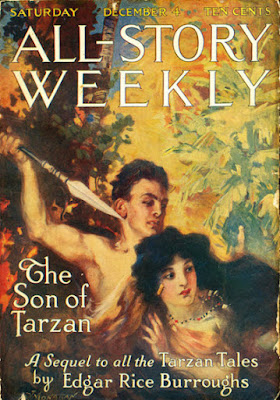
Tarzan and the Jewels of Opar was first exposed to the public in 1916, as a five-part serial in All-Story Weekly magazine, and of course has been reprinted many times in many forms.  Check out the commendably enthusiastic and charmingly amateurish cover illustration to the 1943 Romanian translation,  apparently published while the nations of the novel's author and main character were at war with Romania, below. 

Belgian army officer Albert Werper has psychological problems.  He has a tendency to, when under stress, act impulsively, to break the rules most of us just follow as a matter of course.  Rules like, "Don't kill your co-workers for no reason."  In the Congo one day, bitter over having been sent to Africa as punishment for an infraction back in his beloved Brussels, jungle life getting on his nerves, he just murders another officer, blasting him in the chest with his revolver without any provocation.  Good grief!  Werper flees into the jungle, murdering a black soldier on his way out.  

In the jungle, Werper is captured by Achmet Zek, one of the most notorious slavers and poachers in the area, and he joins Zek's band of marauders.  After Werper has aided Zek in numerous crimes, the Arab invites Werper to be his partner in in a desperate scheme to get rich--gthe kidnapping Jane Clayton, Lady Greystoke!  The Arab figures they'll ransom the wife of Tarzan or, failing that, sell to some Muslim ("Moslem" here in Tarzan and the Jewels of Opar) potentate to be the crowning glory of his harem.  So, Werper, in disguise as a French big game hunter, pays a call on Tarzan at the vast African Greystoke estate.  Eavesdropping on the Lord and Lady, Werper learns that one of the Greystoke business ventures has gone belly up, and so Tarzan is going to return to the lost city of Opar to seize some gold--this is how Tarzan got rich in the first place back in the second Tarzan book, The Return of Tarzan.  When Tarzan marches off to Opar at the head of a party of his loyal retainers, the brave and resourceful Waziri, Werper follows them.

The subterranean treasure store of Opar is accessible by a secret passage that lets out some distance from the ruined city; after seeing Tarzan go in and out of the place Werper creeps in there himself.  A cave-in traps the Belgian in there, as well as knocking Tarzan out and separating him from the Waziri.  Werper's only means of egress is through the other end of the passage, into the ruined city, where live the degenerate race of hideous male Oparians and their beautiful female leader, La the high priestess.  Opar was a colony of Atlantis, and La and her crooked people the descendants of Atlanteans crossbred with the sort of highly intelligent apes who raised Tarzan.  They worship the sun, and Werper is seized and about to be sacrificed to old Sol when the ceremony is interrupted by a lion attack.  (Lions are always attacking people in these Tarzan books.)  The Oparians flee from the great cat, except for La, who faints where she stands over Werper, sacrificial knife, an artifact of Atlantis of great religious significance to the Oparians, in hand.  Tarzan arrives just at the moment the lion is about to charge Werper and La; Lord Greystoke is suffering amnesia from a blow to the skull suffered in the cave-in--he doesn't remember where he is or even that he is married!  Fortunately, one of the things he does remember is how to kill a lion.  (Not fortunate for the lion, I guess.)

La is a sort of avatar or caricature of men's hopes, fears, and cynical assessments related to women.  Startlingly beautiful, she is also irrational and erratic; one minute she is tender and vulnerable, driven by love and desire, and willing to lay down her life for the one she loves, but the next minute she is furious and despotic, eager to avenge perceived slights by shedding blood.  She is duty bound to produce a high priestess to succeed her as ruler of the Oparians, but the Oparian men are so hideously ugly she does not relish the prospect.  She fell in love with the hunktastic Tarzan, the first outsider she had ever seen, back in Book 2, and now when he reappears in her life in Book 5 she hopes he has come back to accept her desperate love.  Tarzan, even though he doesn't remember Jane, blows La off and he and Werper fight their way out of the city into the jungle.  La regroups her crooked and stunted people and, with some apes to act as guides and trackers, pursues the two men.  Not only is La driven by love of Tarzan, and a desire to murder him for scorning her, but Werper has her sacred knife!

Burroughs' narrative switches among the various cast members, chronicling their adventures; there's Werper, Tarzan, La, Jane, and Mugambi, the African to whom Tarzan entrusted authority over the rest of the Waziri who are back at the estate.  Mugambi is intelligent and a ferocious fighter, and has spent time with Tarzan in London, so, like his employer, has a foot in both the savage world of the jungle and the sophisticated milieu of London.  Achmet Zek's band of Arab and black bandits attacks the Greystoke estate, and though Jane with a rifle and the noble Waziri with archery slay many of the attackers, eventually the Waziri are wiped out and Jane dragged off--the looted Greystoke estate burns behind them.  Mugambi, left for dead by the raiders, recovers consciousness and follows them, hoping to rescue Jane and get his revenge.   

Werper sneaks away from the amnesiac Tarzan, swiping from a sleeping Lord Greystone a pouch of priceless jewels our hero pocketed while lost in the labyrinth below Opar.  The Belgian ne'er-do-well reaches Achmet Zek's village just after Jane has been imprisoned there and just before Mugambi sneaks in.  Werper stupidly lets Zek see the pouch of jewels and is forced to flee for fear Zek will murder him for this treasure.  The same evening that Werper escapes, Jane, on her own steam, herself escapes--Mugambi busts into Jane's place of confinement in hopes of rescuing her only to find her gone. 

La and her army of twisted freaks catch up to Tarzan and she again begs him to love her, and he again refuses.  An elephant attack interrupts the ceremony in which Tarzan is about to be sacrificed to the sun god, and Tarzan generously rescues La from the pachyderm--the elephant, normally Tarzan's best friend, is running amok because it is mating season, like he's a Vulcan or something.  I guess Burroughs is setting up a parallel between La and the elephant here, reminding us that lust can drive us all batty.  

Tarzan sends the Oparians back to their lost city, then, pursuing Werper, sees Jane and decides to seize her to be his mate.  (Wasn't there a story recently in the media about some guy with Alzheimer's who had forgotten his wife but fell in love with her when she came to visit him in the old folks' home and so they got married again?)  But our hero gets distracted and an ape, who also desires Jane, captures and carries her off.  Before this ape has a chance to consummate his relationship with Jane, a lion attacks and kills it.  Meanwhile, Werper eludes capture by Zek after getting himself a horse--the horse belonged to an Arab but at an opportune (for the Belgian) moment one of the lions who are constantly attacking people in Burroughs' fantasy version of Africa unhorsed the Arab, leaving the horse for Werper to mount.  (Burroughs uses lion attacks as a deus ex machina numerous times in this book.)  Werper also meets a force of Abyssians, and manages to get these guys to fight Zek's band.  In an exciting showdown, Werper kills Zek, and then the Belgian captures poor Jane through guile (throughout the novel Lady Greystoke gets captured and escapes only to get captured again and again.)

Werper forges an insincere alliance with Zek's lieutenant, Mohammed Beyd, now in charge of the remnants of Zek's band of raiders, but both of the men conceive an irresistible lust for Jane and fight over her--to the death!  It is Werper who comes out of this scrape alive, and the decency of Jane Clayton, who hasn't yet realized how crooked the manipulative Werper is, works a change in him and he abandons his project of raping her and helps her escape the Muslim band.  These two get separated, and Jane gets captured by the Abyssinians, who think to take her back to their emperor, and Tarzan finally catches up to Werper.  Werper helps Tarzan regain his memory, and then a Belgian force, which has been chasing Werper for ages, captures both of them.  Apes answer Tarzan's call and rescue the two men, while yet another lion attack disrupts the Abyssinian camp not far off, facilitating Werper's escape from Tarzan and Tarzan's rescue of Jane.  Like Jane, the pouch of jewels has passed among divers hands, but Werper ends up with them, only to die of unknown causes off screen; on the last page of the book, months later, after their African estate has been rebuilt, Tarzan and Jane find Werper's skeleton and the pouch of jewels.

Tarzan and the Jewels of Opar is a wild and fun adventure story.  I liked the villains in the book; La, whom I have already described, is great, and I found Werper, who is driven by readily comprehensible desires and fears and suffers mental instabilities, easier to identify with Tarzan, who is not only fearless and invincible but eats bugs and raw meat and casually rejects the sexalicious La.  Lord Greystoke is a man of iron!  I was kind of rooting for Werper as he pursued his foul and convoluted designs and navigated, via deception and disguise, his perilous relationships with formidable white, black and Arab opponents, and as he again and again quaked in fear when exposed to danger only to survive yet another brush with death thanks to dumb luck.  Of course I wasn't rooting for him to accomplish his schemes of murdering Tarzan or raping Jane or anything like that, but I was hoping he'd live to scheme another day and I certainly didn't feel bad when he shot down Achmet Zek and then Mohammed Beyd or when he got away with the jewels.  One of the things Burroughs brings to Tarzan and the Jewels of Opar with Werper, as well as with Mugambi, is suspense--we know Tarzan isn't going to get killed and we know Jane isn't going to be sold into sex slvery, but Tarzan's friends and enemies get killed all the time, so we don't know if Mugambi or Werper is going to make it to the last page of the book, inspiring our curiosity to find out what happens next and keeping us reading.    

The chases and fights in Tarzan and the Jewels of Opar are good, and I enjoyed Burroughs' extravagant descriptions of Tarzan's attitudes and proclivities during his bout of amnesia, when he reverts to beast mode, and his amazing abilities (e. g., Burroughs explains in detail how he can follow a trail two days old); I also liked the melodramatic speeches people would sometimes deliver:

"Dog of a Christian," he whispered, "look upon this knife in the hands of Mohammed Beyd!  Look well, unbeliever, for it is the last thing in life that you shall see or feel.  With it Mohammed Beyd will cut out your black heart,  If you have a God pray to him now--in a minute more you shall be dead...." 

I guess if you can't embrace the spirit of the thing you might find the endless lion attacks and the convoluted plot in which Jane, a bag of jewels and a pile of gold bars (which I haven't even mentioned) change hands again and again exasperating, but I totally dug it.  Thumbs up for Tarzan and the Jewels of Opar.  I've got my fingers crossed that La, High Priestess of Opar, will appear in future Tarzan books along with a villain as effective as the lamented Werper. 

Sunday, January 30, 2022

The Son of Tarzan by Edgar Rice Burroughs

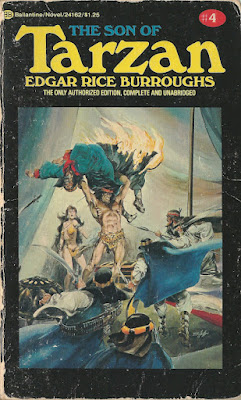
It has been like seven years since I last read a Tarzan novel by Edgar Rice Burroughs--it was The Beasts of Tarzan--though recerntly I have been reading some 1930s Hal Foster Tarzan comics and some 1970s Joe Kubert Tarzan comics, and in the interim I read some of Burroughs' non-Tarzan novels: The Cave Girl and The Cave Man, The Moon Maid, The Moon Men, and The Red Hawk.  Today I return to Lord Greystoke, with the fourth Tarzan novel, The Son of TarzanThe Son of Tarzan made its debut in All-Story Weekly, serialized across six issues of the magazine printed in December 1915 and January 1916, and has since been reprinted numerous times.  I am reading a Ballantine printing with a Neal Adams cover; touted as "The Only Authorized Edition, Complete And Unabridged," it is full of typos and printing errors--shame on you, Ballantine!

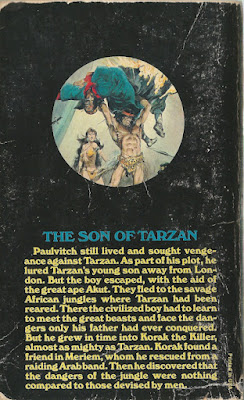
One of Tarzan's enemies in the second Tarzan book, The Return of Tarzan, and the third, The Beasts of Tarzan, was Russian freelance spy Alexis Paulvitch.  In the first chapter of  The Son of Tarzan we learn that, after fleeing from the invincible Lord Greystoke in The Beasts of Tarzan, Paulvitch was captured by a tribe of cannibals who tortured and otherwise mistreated him for ten years, an ordeal with changed his looks beyond recognition and damaged his psyche.  After escaping his tormentors Paulvitch meets Akut, a friendly ape, once a comrade of Tarzan's.  Akut accompanies Paulvitch to England--the Russian does not realize, but we readers do, that Akut is looking for his old friend--and Paulvitch's most dangerous enemy,--Tarzan.  In London Paulvitch makes money by having Akut perform in a music hall.

At the Greystoke town house we observe Lord Greystoke, Jane, and their son, Jack.  Mom and Dad have kept from Jack the truth of his father's wild youth, Jane fearing that her son, who like her husband is exceptionally smart and strong, will feel the same itch her husband perpetually experiences--the urge to throw off his clothes along with all the encumbrances of civilization and risk his life in the jungle.  In one of the crazy coincidences that fill to bursting the Tarzan books, or an instance of Lamarckian inheritance, Jack is indeed fascinated by accounts of primitive tribes, wild animals and European explorations of Africa, and when he hears about the performing ape he ignores his mother's wishes and takes in the show.  Because he looks so much like his father, Akut immediately befriends Jack, to the boy's delight, and when Jack's father is reunited with his old anthropoid buddy there is no way to keep Dad's exciting childhood from the kid.

Paulvitch harbors a grudge against the Greystoke family and tries to murder Jack, but gets killed by Akut.  Tarzan tries to have Akut sent back to Africa and Jack sent to a boarding school, but Jack is an insubordinate little rascal and, disguising Akut as a grandmother suffering some kind of social anxiety disorder--he hides "her" face with a lot of veils--accompanies the ape aboard a steamship in a private cabin.  Almost immediately after they touch land on Akut's home continent, an American criminal tries to rob them and Akut, who is running up a real kill count, slays this crook.  Rather than face a lynch mob or murder trial far from home, Jack impulsively decides to abandon civilization and take up life in the jungle with his ape friend.

In Chapter 5 (The Son of Tarzan has 26 chapters), Burroughs introduces us to a some new characters.  One is Meriem, a ten-year-old French girl who three years ago was kidnapped by an Arab sheik kn own to all as "The Sheik," a bandit who sought vengeance on Meriem's father, an officer of the Foreign Legion who had brought to justice one of the Sheik's felonious relatives.  Burroughs does not pull any punches in this book--the Sheik beats Meriem so much, and the "filthy" and "toothless" "old black hag" who is her nurse tortures her so much, that Meriem tells her little dolly that she wishes she was dead!  Damn!  There is a reward offered to anybody who can return Meriem to her farther, and when two Swedish poachers, cruel criminals themselves, spot Meriem while trying to work a business deal with the Sheik, they begin nursing a hope of getting hold of the girl and collecting the reward.

Jack and Akut march across plains and through forests for months, the ape teaching the English boy how to survive in the wild, and he takes to it readily, relishing a life of danger and violence.  Among many exploits, we witness him ambush a black warrior and murder him with his teeth!  Damn!  Having stolen that poor bastard's weapons, Jack learns how to use them and use them he does, on various beasts as well as additional African tribesmen.  Jack fully inhabits the moniker Akut bestows on him, "Korak," which means 'killer" in the language of the apes--he lives just as a forest carnivore loves, feeling no more guilt over killing an African warrior to steal his arrows than a crocodile feels guilt for killing a zebra for lunch.

Over a year after landing in Africa, Korak stumbles upon the village where live Meriem and the man she thinks her father, the cruel Sheik.  He rescues the little French girl from a beating and she joins Korak and Akut as a devotee of the tree-dwelling, beast-killing, ape-speaking jungle life; years go by and Meriem becomes nearly as good at jumping and climbing and tracking and killing as Korak.  She grows into a beautiful young woman and Korak falls in love with her.  She still sees him as an older brother, however.    

Burroughs' novel is full of fighting and diplomacy among a host of different parties: tribes of apes, tribes of black villagers, tribes of baboons, the evil Sheik and his followers, the evil Swedes and their browbeaten black "boys," and others still; many people get captured and then escape captivity, either thanks to their own pluck and ingenuity or the efforts of rescuers.  This is all pretty entertaining; among the highlights are Korak leading an army of baboons in an assault on a black village and Korak riding an elephant into the camp of one of the Swedes.  The villainous Swede suffers some rough justice when the elephant recognizes him as the guy who slew his mate years ago.

Burroughs uses the same plot devices again and again.  Many times throughout the novel, which is a hefty 222 pages, one character recognizes another who was important in his or her life many years ago, while the second individual does not recognize the first, leading to all kinds of melodramatic situations.  Another oft-used plot device sees somebody, usually but not always Tarzan or Korak, by chance, stumbling upon a situation in which some person is about to get tortured or killed and delivering this vulnerable individual from a terrible fate.  

Halfway through the novel, Tarzan, dressed in European fashion--complete with pith helmet and at the head of a party of his African employees, arrives, by chance, just in time to save a captive Meriem, who has been separated from Korak, from being raped by one of the Swedes.  Tarzan brings Meriam, who doesn't know Lord Greystoke is Korak's father, just as Tarzan doesn't know this Korak guy she keeps talking about is his son, to stay with him and Jane and their retainers and their pack of dogs and all that at his African estate.

Months go by, during which Meriem at the Greystroke estate and Korak hanging around with baboons and elephants, each think the other dead.  A visiting English gentleman finds Meriem irresistible, but he can't marry someone of such a lower social class, so he schemes to bring her to London and make a kept woman of her.  The Swedish would-be rapist, whom Tarzan spared, arrives in disguise, (he shaved his beard) and insinuates himself onto the estate.  He manipulates the English gentleman, hijacking the cad's project of carrying away Meriem to facilitate his similar designs.  The Englishman is transformed over the course of all the betrayals, chases, captures, escapes and bloody fights that ensue--the true and honorable love for Meriem that blossoms within his breast, and the dreadful hardships he endures, like getting stabbed by a black guy and shot by a Swede and then shot again by an Arab, spur him to grow from a selfish, snobby and cowardly bounder into a generous and brave man.  Of course, those hardships also kill him, but dying a good man is better than living as a scoundrel, right? 

The circuitous narrative of death, destruction, love and friendship that is The Son of Tarzan ends with joyous and tearful reunions as Tarzan and Jane see their son for the first time in years, and then Meriem in London is reunited with her French father, who we learn is a prince, making Meriem a princess!  Like so many Burroughs protagonists, Korak has married a princess!   

If 2014's MPorcius is to be believed, I was a little disappointed in Tarzan #3, The Beasts of Tarzan.  But 2022's MPorcius is keen on #4, The Son of Tarzan.  There is a ton of effective violence and animal action, but also quite a lot about the psychology and relationships of the characters--Burroughs depicts loneliness, lust, a passion for vengeance, guilt (or lack thereof), the tension that you feel when you want to live your life a certain way but that lifestyle puts a barrier between you and the people you love, and it all works.  The Son of Tarzan is a big success.    

So, thumbs up for this classic adventure story.  And on to Tarzan #5, Tarzan and the Jewels of Opar!   

Thursday, January 27, 2022

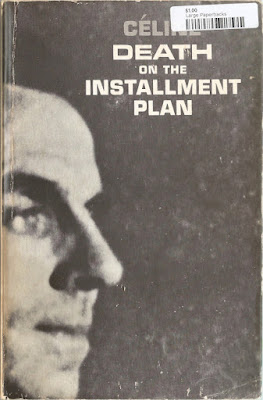
Death on the Installment Plan by Louis-Ferdinand Céline

I began to realize that my mother would always regard me as an unfeeling child, a selfish monster, a little brute, capricious, scatterbrained…They had tried everything, done everything they could…it was really no use.  There’d never be any help for my disastrous, innate, incorrigible propensities…She could only face the facts, my father had been perfectly right…

Years ago, during my New York days, I read Céline’s Journey to the End of the Night. I can’t remember much about it and can’t say I enjoyed it very much; I think maybe I took Céline’s attacks on America too seriously and they got my back up—maybe I had a softer skin then.  Despite this past experience, when I saw a fat (600 pages!) paperback edition of the man’s Death on the Installment Plan, translated by Ralph Manheim and published by New Directions, going for one dollar at a West Virginia antique mall, I decided to buy it.  The back cover of this copy says it is the sixth edition and that this translation is copywritten 1966 and first appeared as a New Directions Paperbook in 1971.  According to wikipedia the novel first appeared in 1936. 

I started Death on the Installment Plan while on a road trip to the Middle West where reside many of my in-laws, and finished it back at HQ; it took me kind of a long time to finish it partly because I was busy and distracted and partly because after 300 pages or so I got a little tired of it--the plot of the novel doesn't really pull you along, it is a series of anecdotes, all of which have sort of the same tone and achieve the same effects and make the same points, and it sort of got a little stale.

Death on the Installment Plan is a sort of fictionalized memoir written in a breathless style, consisting of short, pithy sentences separated by thousands of ellipses.  Exactly why there are ellipses in every paragraph, and how much this reflects the original French, I do not know.  The text includes many cliches and colloquialisms as well as lots of slang, adding to the feeling given by the short direct sentences and all those ellipses that the book is the transcription of the rambling monologue of some old and bitter man instead of an actual written literary artifact that has been carefully polished.  A good example of Céline's (or the translator's) use of stock phrases and cliched metaphors comes on page 464 when a woman delivers a speech full of ellipses denouncing her husband; her philippic incorporates, in the space of less than half a page, "He's coming apart at the seams," "He doesn't know where the next nickel is coming from," "I know the score," "He won't get away with it," "He'd better watch his step," and "I won't stand for it."  For long stretches I found Céline's style engaging and appreciated its economy and the way it sounded like real ordinary people (who are excited or angry) talking, but a steady diet of it began to wear on me.

The first 40 or so pages depict the novel’s present, in which an adult Ferdinand is a doctor working at a clinic in Paris, constantly in some kind of trouble with his colleagues and superiors; he does his writing on the side.  This portion of the book I found sort of vague and confusing, and much of it consists of a surrealistic dream sequence and tiresome digressions in which Ferdinand tells other characters fantasy stories about a King Krogold.  But then we flashback to the turn of the century, to Ferdinand's childhood, and this section I found vivid and compelling.  

The young Ferdinand lives on a dirty and smelly Parisian street, a covered passage, a sort of shopping arcade with apartments over the shops that is covered by a glass roof that keeps off the rain but also keeps in smells and heat.  Ferdinand is the only child of a man who works at an insurance company by day and on his off hours makes deliveries for the shop run by his wife, who sells antiques and lace articles.  Death on the Installment Plan is a long series of anecdotes and vignettes, all of which are disgusting and depressing, depicting life as a war of all against all and expressing the narrator's misanthropy and self-loathing.  Almost all the characters, the narrator not least of all, are pathetic (e.g., mom has a bad leg and limps constantly) and/or callous or even cruel (there are a multitude of scenes of domestic violence and sexual exploitation), and the incidents described generally conclude with people sobbing, vomiting, or being injured in some way.  The climax of the novel is a suicide and a long description of the challenging effort to deal with the shattered body.  Everyone is desperate, living on the edge of physical and/or financial destruction, taking desperate risks to make a little money and then seeing their enterprises come to disaster.  Father is always in fear of getting fired, the shop never sells enough to make a real profit, and little Ferdinand is so frazzled and put upon that he doesn’t have time to wipe his ass properly and so never stops smelling of shit.

I had a depraved nature…It was inexplicable…There wasn’t a speck or straw of honor in me…I was rotten through and through…repulsive, degenerate!  I was unfeeling, I had no future…I was as dry as a salt herring…I was a hard-hearted debauchee…a dungheap…full of sullen rancor…I was life’s disillusionment…I was grief itself.

The episodic novel's central plot, such as it is, consists of Ferdinand’s parents and uncle trying to find a place in the world for the smelly boy, get him a job in another shop or apprentice him to some artisan or something.  Bad luck, the ruthlessness and cruelty of others, and the narrator’s own questionable character conspire to render their early efforts a fiasco.  Along the way, little Ferdinand has grotesque sexual experiences with adult women and ugly girls closer to his own age, as well as homoerotic experiences with boys his age.    

At the same time that all this is pretty disgusting, it is often also pretty funny.  Céline describes everyone’s problems and their reactions to defeat—their rage and agony--in a hyperbolic fashion which is quite amusing.  Maybe I am cold-hearted, but the over-the-top nature of many passages transforms the tragedies they retail into extravagant farcical hilarity.

I had the best position in the football game, I kept goal…that gave me a chance to meditate…I didn’t like to be disturbed, I let almost everything through…When the whistle blew, the brats flung themselves into the battle, they plowed through the muck till their ankles cracked, they charged at the ball, full steam into the clay, they plastered themselves with it, their eyes were full of it, their whole heads were covered…When the game was over, our little angels were nothing but molded garbage, staggering hunks of clay…with big wads of pigeon shit sticking to them.  The muddier they were, the shittier, the more hermetically sealed, the happier they felt…They were wild with joy under their crusts of ice, welded into their clay helmets.  
Around page 200, Ferdinand having blown all his job opportunities in Paris, is sent to a school for boys in England, his relatives thinking that knowledge of English will be a skill that can open up to him new job opportunities in the City of Lights.  For me, Ferdinand’s time at the English school is a highlight of the novel, as Céline satirizes the English weather and the English mania for sport and presents some crazy English characters: the ugly schoolmaster and his beautiful wife; a horny student who can’t get enough of Ferdinand’s cock and semen (this kid enjoys pretending to be a dog!); and a retarded student who has to be watched like a hawk lest he eat inanimate objects or walk off a cliff or into traffic due to his horrible eyesight (at night they keep this moron in a cage!)  Ferdinand is bigger and older than his English classmates and physically dominates them; he also steadfastly refuses to cooperate with the schoolmaster—Ferdinand acts like a mute, declining to speak for weeks, even months, at a stretch.  He stops going to class and instead spends all his time with the schoolmaster’s wife, helping her chaperone the imbecile (sometimes Ferdinand jerks him, you know, to calm him down) and run errands in the town, where Ferdinand takes the opportunity to shoplift from all the stores.  Our hero is crazy with lust for the schoolmaster’s wife, but when she hints at the possibility of indulging his desires, Ferdinand, a thorough-going misogynist, doesn’t take advantage of her openness—women, he is sure, are all vampiric backstabbing liars, and instead he dreams about her while that horny canine of a student jerks him and sucks him off.

It wasn’t easy to resist…The harder it was for me, the stronger I became…She wasn’t going to soften me, the bloodsucker, even if she were a hundred times as pretty.

After the English episode, halfway through the novel, Ferdinand returns to Paris, where he severs relations with his parents after a ferocious hand-to-hand fight with his father.  An uncle takes him in and gets him a sort of internship with one of the smartest men in France, a science writer who not only edits a magazine that caters to inventors and writes books that explain scientific and engineering concepts to lay people, but flies his own hydrogen and methane balloon and drives experimental race cars.  Death on the Installment Plan is full of hyperbole and this character, who has written hundreds of books and throws around all kinds of scientific terminology, is like a comic figure from an early science fiction story, a genius in every field of science and engineering when it comes to theory but a physical klutz who can't drive a single nail without harming himself.  The second half of Céline's novel is all about Ferdinand's relti0nship with this guy, and over its 275 pages we learn how vice-ridden, mercenary and corrupt this genius really is, eventually meet his masculine, pipe-smoking, domineering wife and then witness all his publishing, scientific and financial projects come to absolute disaster.  It is his suicide and its gruesome and lachrymose aftermath that brings the novel to a close. 

For me, Death on the Installment Plan is too long and unvaried in tone and theme.  After four hundred pages or so the novelty of its fever pitch, of the characters' long shrieking tirades full of self pity and outrage, wears thin.  I probably would have enjoyed it more if it had come to me as two or three separate books--one on life among the shops of the covered passage, one on the school in England, one on life with the science writer--and I had taken a break of months or years between each book.        

I have to provide a trigger warning for my readers who were born in the 21st century or who were born in the 20th century but have embraced the current values of all right-thinking people who don’t want to lose their social media accounts.  Céline uses the dreaded “n-word” and calls Chinese people “Chinks” and says crummy things about women, and he doesn’t explicitly condemn men’s striking of women.  Céline is famous for being a Jew-hater and a sympathizer with fascism and Naziism, but that sort of thing is essentially under the surface here.   

Lefties (as well as anti-capitalism right-wingers) might appreciate Death on the Installment Plan as a stark portrait of life in the market economy, a dramatization of the ceaseless pressure in a market society to please customers and employers, to adapt to changing market conditions.  Ferdinand’s parents’ small shop suffers from competition with large stores and their fortunes are tied to unpredictable changes in taste—they are in real trouble when lace goes out of style or when the hats they purchased in bulk similarly lose popularity and become unsalable.  Céline satirizes the ideas of progress of the middle-class people of the industrial democracies, portraying changes in technology as a challenge or a trap rather than a boon or benefit—the narrator’s father struggles, with limited success, to learn how to use a typewriter, and the science writer's balloon is dangerous and out of control and his racecars even more so--one of them mysteriously explodes, blowing a female admirer to bits.  The second half of the book portrays inventors as well as investors in new technology as grasping maniacs who destroy themselves and everybody around them.  A disgruntled mob of inventors, readers of the magazine the science writer and Ferdinand publish, destroys the office of the magazine, forcing our heroes to move to the country, where they experiment, disastrously, with using radiation to increase crop yields.  And as the novel's title (Mort a credit en francais) suggests, buying things on credit and going into debt and being pursued by those to whom one owes money are recurring themes of the book.  If you hate Elon Musk, Jeff Bezos, and your credit card company, maybe this book is for you. 

I've told you it is too long and kind of wears out its welcome with its monotony, but I will still recommend Death on the Installment Plan to people who enjoy down-and-out narratives in the voices of creative types who act like jerks and describe their struggles to find and keep ordinary jobs, complain about their poverty and detail their sexual experiences, like those of Henry Miller and Charles Bukowski.  Much of it is pretty funny and it provides a window on life and attitudes of the past.  And Céline is supposed to be important (the article at this link ranks him alongside Proust and Joyce) and he was in the news last year, sixty years after his death, so you can tell yourself reading this thing is educational.