Monday, July 10, 2023

Merril-approved 1956 SF stories by R A Hart, F Herbert & R F Jones

The Sage of Teaneck, the great Barry N. Malzberg, tells us* that Judith Merril "irreversibly damaged" science fiction in the course of her "campaign to destroy science fiction" by "tearing down the walls" between SF and mainstream literature.  If we take seriously this charge from our emotional pal Barry, we must see the 1957 book SF: The Year's Greatest Science-Fiction and Fantasy: Second Annual Volume as an early salvo in Merril's disruptive campaign.  We here at MPoricus Fiction Log have been using the long alphabetical list of Honorable Mentions at the end of SF: The Year's Greatest Science-Fiction and Fantasy: Second Annual Volume as a sort of guide to the SF of 1956, cherry-picking from it stories that pique our interest and hunting them down online. 

*In a 2016 essay that appeared in Galaxy's Edge.

The last leg of our journey through 1956 with Merril as our pathfinder saw us reading stories by authors whose names begin with a "G," so today we reach the "H"s.  This batch is fertile ground for exploring Merril's propensity to look beyond the category SF magazines like Astounding and Galaxy for "great" SF, seeing as two of the stories, those by Richard Harper and Robert A. Hart, appeared in men's magazines.  Alas, I can't find the text of Harper's "The Pugilist," which debuted in Nugget, anywhere online.  The issue of Dude that first brought Hart's "The Automatic Gentleman" before the eyes of the world is thankfully available at the internet archive.  Rounding out Merril's three "H"s is Frank Herbert's "The Nothing" which we will also tackle.

Two stories is a little slim for a blog post (not that I haven't done that), so let's also take a look at the two "J"s (there are no "I"s.)  One of these is "A Little Magic" by one of those authors people are always telling you you have to like, Shirley Jackson, but I can't seem to find a text of this story, which first appeared in Woman's Home Companion, online.  (Maybe I just don't know how to use the internet properly.)  We'll just assume "A Little Magic" is a work of genius that heartbreakingly illuminates the manifold contradictions of the life of women under the patriarchy and move on with our lives.  The other "J" who won Merril's approval is Raymond F. Jones, whose story "The Non-Statistical Man" appears on the Honorable Mentions list and is easily available even to us internet neophytes.

"The Automatic Gentleman" by Robert A. Hart

This is a sort of obvious story, a forgettable trifle, but competently written.  The narrator is a successful  businessman (he owns a Chevrolet dealership) married to a woman thirteen years his junior.  He keeps her content by buying appliances that makes her housework easier--washing machine, electric mixer, etc.  Of course, she is never satisfied for long, so when mechanical servants go on the market, he buys her one of those.  The robot looks just like a handsome young man, a college student, in fact, and flawlessly performs all the work from mowing the lawn to cooking the dinner.

The robot doesn't just look like an educated person--it has educated tastes!  It hates game shows and Ed Sullivan and likes modern drama!  It beats the narrator at Scrabble, quadrupling his score!  Soon his wife is more attracted to the robot than to her husband, and both husband and wife begin to wonder if there is another "job" around the house it can perform flawlessly, if you know what I mean!  But their marriage is saved when the high class robot rejects the vulgar wife's advances.

This feels like a filler story, and, seeing as in Dude it is nestled among fiction by big name writers like Michael Shaara, Erskine Caldwell and Tennessee Williams and photos of topless ladies, I guess it sort of is filler.  Merril's choice of it is thus a little odd; maybe the sex joke element of the story lent "The Automatic Gentleman" value in Merril's eyes (one of the standard complaints of New Wave boosters--and Merril is perhaps New Wave Booster Numero Uno--is that SF didn't deal enough with sex.)  And maybe she liked the story's suggestion, however jocular, that technology might pose problems to human relationships.  

"The Nothing" by Frank Herbert

"The Nothing," by Frank "Dune" Herbert, is reminding me of Robert Heinlein's 1957 "The Menace From Earth."  Both are written in the voice of an intelligent and independent-minded young woman, both are full of little jokes, and both have plots centered around the start of a committed love relationship but serve as vehicles for the description of a strange future society (in Heinlein's case, a society located on the Moon.) 

(After drafting this blog post I reread "The Menace From Earth" and it is as good as I remember it being.  Thumbs up!)

Due to the effects of radiation almost everybody in Herbert's future world has some kind of psychic power.  Some people can teleport, some can read minds, others can see the future, etc.  Our narrator is an attractive young woman who can start fires with her mind.  She meets a man in a bar and is led to believe that they are destined to marry--it turns out that she has been selected by a sort of political activist (the man's father) to produce children with his son as part of his effort to preserve society.  You see, the human race is reverting to the mean (as people who know about math say), and fewer and fewer people are being born who have psychic powers--in fact, the man our narrator is to marry is one of the "nothings" who lacks a psychic ability.  Society is under threat of collapse because the ubiquity of psykers has lead to civilization abandoning technology, and now the entire societal infrastructure is reliant on mental powers--for example, almost nobody knows how to maintain automobiles or aircraft because there are so many people who can teleport you.  The narrator's soon-to-be-father-in-law is a leader in the secret movement to revive technological facility and--to buy time for sufficient technological education--prolong the prevalence of psykers through eugenic breeding; this guy has studied the narrator's genetic code and determined she is the perfect match for her son.

Perhaps too light-hearted at times, this story feels a little slight, almost like a joke story, but it is not bad; I suppose I can mildly recommend it.  I haven't actually read Dune, but it is my understanding that the milieu of the famous novel is one in which computers are outlawed, so maybe we should see "The Nothing" as addressing a theme that would later appear in Herbert's blockbuster, that of people getting by without technology.

"The Nothing" would be reprinted in a few anthologies and Herbert collections following its debut in Fantastic Universe.

"The Non-Statistical Man" by Raymond F. Jones

"The Non-Statistical Man," which would go on to be the title story of a 1968 Jones collection, debuted in the same issue of Science Fiction Stories that includes another Merril pick, Algis Budrys' "With a Dime on Top of It," of which I opined in my blog post about it that "it is not conventionally satisfying."  

Jones' "The Non-Statistical Man" is promoted in the pages of Science Fiction Stories as a novel, and isfdb categorizes it as a novella; either way, that means it is long, around 80 pages in its magazine appearance.  And it feels long, as the pace is sort of slow, sex and violence are largely absent, and much of the text consists of dialogue and lectures on speculative history and science.

Like Herbert's "The Nothing," Jones' story is about paradigm shifts and the way different attitudes towards science and technology can radically change society, and about a small cadre of superior people who are trying to guide society to a better place.  These are common fixtures of classic SF we have seen many times.

The main character of "The Non-Statistical Man" is the head statistician at an insurance company on the East coast, Charles Bascomb.  Bascomb loves numbers and math (one of Jones' little jokes is to say Bascomb is fascinated by figures--in particular the Arabic kind, not just the kind most men find fascinating) and believes that it is through statistics that we can understand the universe and improve our position within it.  His wife Sarah kind of gets on his nerves with her reliance on hunches and "feelings" that reflect intuition.

One day some unusual anomalies in the records come to his attention--in a few towns, many people who just recently took out insurance have made totally legitimate claims and received the payments to which they are entitled; the volume of these short term payouts far exceeds that of other towns and of these towns in the past.  Bascomb investigates, and makes little progress until he takes advantage of one of his wife's hunches.  And then what he finds astonishes him and shakes his view of mankind and the universe!

All the people who bought insurance and then profited from that decision almost immediately made their purchasing decision based on a hunch, on intuition!  And one other thing connects these insurance customers--they all attended public New Age self-help lectures by a retired college professor, Magruder.  Bascomb meets Magruder, who explains to our hero his wild and crazy theory.  Human beings have innate powers of intuition that could potentially make our lives far more safe and comfortable if we unleashed them--currently these powers are suppressed by fears of being ridiculed by conventional logical men like Bascomb. 

Magruder makes a complex argument that perhaps is meant to appeal to the libertarians who are disproportionately represented among the ranks of SF fans.  All the apparatus of modern civilization, like government and the insurance industry and theories of logic, are meant to collectivize risk, to even out risk among the population and over time; this obviously limits our individual freedom, but at the same time provides a measure of safety, at least in the aggregate.  (Limiting everybody to a slow speed on the highway costs all drivers some liberty and some time, but in return a small number of people who would otherwise suffer in accidents benefit greatly.)  Magruder claims that if we unleash our intuition we can all look after ourselves and throw off all this stifling collectivism.  (We could all drive at whatever speed we felt like most of the time, only slowing down when our intuition warned us an accident was likely.)  And Magruder knows how to unleash everybodies' intuition--by easing their fears of ridicule from society through the administration of drugs!  Engaging in a practice that probably wouldn't have passed muster with the people who monitor the ethics of research on human subjects at his university, Magruder has been prescribing these anti-anxiety drugs to people who attend his lectures, saying they are merely vitamins; it is those who have taken these drugs who have been purchasing insurance from Bascomb's firm based on hunches, hunches that have proven to be quite prescient.

To me, Magruder's revelation felt like a climax, but unfortunately this lecture comes only half way through the story and Jones has like forty more pages of less interesting stuff for us to wade through, the saga of Chuck Bascomb's evolution from intuition skeptic to leader in the intuition movement.  First, Bascomb refuses to accept Magruder's ideas and with the help of a newspaper man works to undermine the professor's campaign, Bascomb seeing Magruder as a threat to our very civilization.  Then we witness Chuck's own experience of gaining super intuition himself--after taking Magruder's pills (his wife plays a role in getting him to take them) he can tell just by looking at strangers on the street the risks they are facing (a woman with a small as-yet-undiagnosed tumor; a man considering a risky business deal) and how to mitigate them (go to the doctor right away; don't sign that contract.)

Bascomb now knows Magruder's ideas are true, but thinks that Magruder is spreading the gospel in the wrong way, in a way that is underhanded and threatens society, and decides to explain to people the good news in an honest way that won't put our civilization at risk.  This is a disaster--here at this blog I have regularly pointed out how elitist so many SF stories are, how they portray the common people as a mob of dolts whom the cognitive elite are perfectly justified in manipulating for their own good, and Jones takes that tack here in "The Non-Statistical Man."  When Bascomb tries to explain intuition logically to people (instead of wrapping the idea up in a lot of goofy pseudo-Oriental mysticism as Magruder has been) and demonstrate its use, he is branded a commie and a child molester and he and his family are run out of town by a violent mob.  Using intuition to guide them, the Bascombs escape to a town where Magruder and his earliest disciples are in charge, a town of people wholly committed to intuition whose citizens have destroyed all their TV sets, intuitively understanding how bad TV is for you.  After another lecture from the professor, Bascomb becomes Magruder's right hand man in the long term campaign to rework our society so we have more safety and more liberty, and are less beholden to technology, logic, one-size-fits-all rules, and hierarchy.

"The Non-Statistical Man" is certainly noteworthy as a 1956 science fiction story which is essentially attacking science, math, logic and technology that at the same time appeals to the various demographics of the SF community (above, I highlighted the story's appeal to libertarians, but Jones also tries to push the buttons of left-liberals by having Bascomb use his intuition to figure out that some immigrant convicted of a heinous crime is in fact innocent and by having Bascomb's enemies be over-the-top McCarthyite Red-baiters and sex-hating prudes.)  Besides all this stuff, Merril may also have liked how a woman is proven right in the end and is instrumental to the salutary resolution of the plot.  Jones' style is OK--not great, but not bad; my main criticism is that the story is too long and nothing is surprising or strange after the middle section.    

We'll call this one acceptable.

The collection The Non-Statistical Man has been published in various forms in 
multiple languages; it looks like the Romanian edition has a cover by H. R. Giger.

**********

None of these stories is bad, so I guess we can't fault Merril for promoting them, even though I am not in love with them.  By coincidence, they seem to share a theme, a theme embraced by one of the few people willing to express skepticism about the universally-praised Judith Merril, Barry N. Malzberg himself--the human race's uneasy relationship with technology.

**********

Stay tuned for more SF from 1956--but first, more weird stories from the 1930s here at MPorcius Fiction Log. 

Abernathy and Aldiss
Anderson, Allen and Banks
Barrow, Beaumont and Blish
Bradbury, Bretnor, Budrys and Butler  
Carter, Clarke and Clifton 
Clingerman, Cogswell and Cohen
de Camp, deFord, Dickson and Doyle 

Sunday, July 2, 2023

Tales of the Cthulhu Mythos by C A Smith, A Derleth & J V Shea

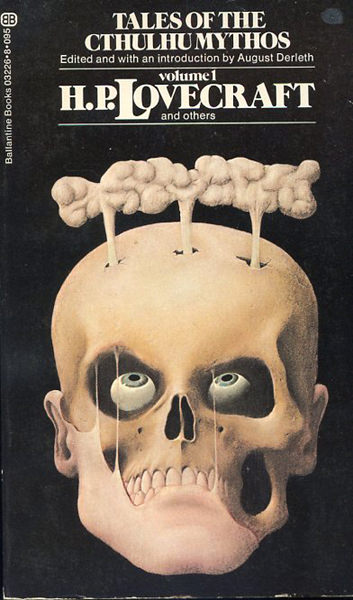
In the last thrilling episode of MPorcius Fiction Log we read Henry Kuttner's "The Salem Horror," a solid Lovecraftian witch story.  In 1969, over thirty years after it debuted in Weird Tales, August Derleth included "The Salem Horror" in his anthology Tales of the Cthulhu Mythos.  In the 1970s, Ballantine Books reprinted the long anthology in two paperback volumes; "The Salem Horror" was included in the first volume.  There is a scan of this first volume at the internet archive; let's surf on over there and read from it a few more stories Derleth saw fit to reprint in his 1969 book.

(But first, we note that Ballantine's Tales of the Cthulhu Mythos Volume 1 reprints several stories I have already blogged about: Clark Ashton-Smith's "Ubbo-Sathla," Robert E. Howard's "The Black Stone," and Frank Belknap Long's "The Hounds of Tindalos" and "The Space-Eaters.")

"The Return of the Sorcerer" by Clark Ashton Smith (1931)

"The Return of the Sorcerer" made its debut in an issue of Strange Tales with a fun snakeman cover.  I may groan whenever I encounter yet another a cat person in SF, but I am thrilled every time a snake person slithers into view.  (For example, I adore Chris Achilleos' cover for the 1985 Fighting Fantasy Gamebook Temple of Terror.)

There's no serpent person in "The Return of the Sorcerer," but it is still a good story I can recommend without reservation.  Our narrator is an impecunious scholar who is relieved when he gets a job for which he is qualified by his knowledge of Arabic.  The position is as live-in assistant to some old weirdo with an old house full of goofy stuff like a stuffed crocodile and an ape's skeleton, as well as all manner of chemical apparatus--our hero finds it all sort of disturbing, but he needs money, and I guess most of us know what that's like, so shouldn't be surprised he takes the job anyway.

The narrator's job primarily consists of translating passages from the Necronomicon; his employer's Arabic isn't so hot, so this old coot has been using a Latin translation, but that edition lacks passages of significance to this guy, sections about how a wizard might raise himself from the dead--no matter his condition--to accomplish a deeply-desired goal, and methods available to rival wizards to forestall such necromancy.  In short order it comes out that the narrator's employer had a twin brother, both men were sorcerers, and the hero's new boss murdered his twin and has every reason to expect that his victim mangled body is going to reassemble itself and seek vengeance.  

Less poetic than a lot of Smith's work, this is a quite good straightforward horror story about evil magic and the living dead.  A classic, "The Return of the Sorcerer" has been reprinted innumerable times in many Smith collections and various anthologies.


"The Dweller in Darkness" by August Derleth (1944)

We weren't happy with the story by Derleth we read for our last blog post, but we haven't given up on the chronicler of Sac Prairie and co-founder of Arkham House.  In fact, today he has two opportunities to impress us!  The first is this 1944 story, "The Dweller in Darkness," which debuted in an issue of Weird Tales that also includes Ray Bradbury's "The Jar" and a story by Hannes Bok illustrated by the author himself.  Besides appearing in the many editions of Tales of the Cthulhu Mythos, Robert M. Price included "The Dweller in Darkness" in his 1997 anthology of stories about Nyarlathotep.

"The Dweller in Darkness" in its form is a sort of standard issue Lovecraftian story set in Derleth's native Wisconsin.  The narrator rehearses old stories and legends about a forest said to have "an aura of evil," describing such historical incidents as a missionary disappearing in the forest centuries ago and loggers being mysteriously murdered there a few decades ago and producing newspaper stories and personal correspondence as evidence of these and additional more recent weird phenomena.  Then the narrator relates the tale of how he and another college professor headed up to this haunted forest to investigate the disappearance of one of their colleagues, a folklorist who went there pursuing his research.  As if three college professors wasn't enough for one story, there is a long interlude in which the two adventurers take a break from the woods to go consult a fourth academic.   

Derleth not only apes Lovecraft's plots, but also expends way too many column inches referring directly to Lovecraft stories.  He namechecks not only many of Lovecraft's deities but also his fictional locales,  Innsmouth, Dunwich, Leng, Kadath, etc.  Maybe readers in 1944 enjoyed this sort of fan service, seeing it as an inside joke or a secret handshake or something, but I found it kind of tedious.  Even more silly is how Lovecraft and Arkham House exist within the story, and the main characters not only contact Miskatonic U. to have photostats of The Necronomicon sent to them, but reach out to Arkham House and buy a copy of The Outsider and Others, which was published five years before "The Dweller in Darkness" appeared in WT; I suppose its mention in the story amounts to clever (or obtrusive) promotion of the never-quite-profitable Arkham House enterprise of which Derleth was the head.

Where Derleth departs from the model of Lovecraft is in trying to marry subversive Lovecraftian pessimism and materialism with more conventional mainstream religious (there is good and evil and they are at war and good can triumph) and liberal scientific (we can figure out the universe and use that knowledge to improve our lives) thinking.  The narrator and his comrade set out for the abandoned lodge on the lake on the edge of the haunted forest with the conviction that 
we were going like two dwarfed Davids to face an adversary greater than any Goliath, an adversary invisible and unknown, who bore no name and was shrouded on legend and fear, a dweller not only of the darkness of the wood but in that greater darkness which the mind of man has sought to explore since his dawn.
The characters in the story devote a lot of time to working on a taxonomy of the various Lovecraftian deities, trying to figure out which of the four elements--earth, air, fire and water--Yog-Sothoth, Shub-Niggurath, Nyarlathotep and the rest of the crew are each associated with.  These sorts of efforts to categorize phenomena, to put everything in the universe into a box, are a hallmark of modern rational thinking, but I'm doubtful it matches the atmosphere and themes of much of Lovecraft's body of work, which suggests the universe is an inexplicable chaos.

The strongest part of Derleth's "The Dweller in Darkness" is the eerie sonic phenomena our heroes encounter--a sound of wind when there is no wind, and mysterious alien music--and the scene in which the heroes finally see the faceless monster appear from outer space accompanied by its musical lackeys isn't bad.  I also like one of the few characters who isn't a college professor, a "half-breed" alcoholic, a "dark-skinned" and "ill-kempt" man with a "more or less primitive mind" who has already seen the alien entity that is responsible for the deaths and disappearances and seems to enjoy knowing something the academics don't: "from time to time [he] grinned or snickered as at some secret joke."  

Through application of firewater and threats our heroes get the half-Indian, half-white, boozehound to cough up some valuable info about the monster, and then they receive a desperate message from the missing folklorist--now a veteran space traveler seeing as he is now the captive pet of one of the malignant aliens--which provides them the method of summoning some friendlier alien beings who can neutralize the monster, who turns out to be Nyarlathotep.  Nyarlathotep himself arrives at the lodge, disguised as the lost folklorist, on a sort of recon mission and raid, assessing how much our heroes know about what is going on and stealing all their notes and evidence.  Nyarlathotep then sics his minions on the college profs, but the narrator's pal calls in the alien cavalry--fire beings--just in time to save their lives.

I'm judging "The Dweller in Darkness" acceptable, even though if I had been editing Weird Tales I would have cut the fourth college professor and the passages connecting the Mythos gods to the four elements and pruned by at least half the references to Lovecraft and his work--brief allusions are more effective than banging the drum again and again by listing HPL's whole catalog.  To make up the page count, if this was deemed necessary, I would have suggested Derleth expand the role and personality of the drunken half-Indian, who could have been a compelling villain or hero or victim whose motives and character are mysterious until a pivotal moment--is he a fervent worshipper of the aliens?  Their wretchedly put-upon or hypnotized slave?  Perhaps he's a bitter and resentful manipulator hoping to use the aliens to get revenge on the white man, or a heart sick and terrified soul desperately trying to keep interfering pale faces away from the area for fear they will inspire the monster's wrath?  Perhaps the text could develop a parallel between the man's unhealthy addiction to alcohol and his risky relationship to the aliens.


"Beyond the Threshold" by August Derleth (1941)

Like "The Dweller in Darkness," this story debuted in Weird Tales, was included by Derleth himself in Tales of the Cthulhu Mythos, and was selected by Richard M. Price for a Chaosium anthology dedicated to a specific Lovecraftian deity, this time Ithaqua.  Also like "The Dweller in Darkness," it is set in the woods of Wisconsin; when Frank McSherry, Jr., Charles G. Waugh, and Martin H. Greenburg were choosing stories for their 1985 anthology A Treasury of American Horror Stories, they chose "Beyond the Threshold" to represent the Badger State.

(Those of you stalking MPorcius Fiction Log will recall that in 2019 I attacked Barry Malzberg's Iowa story from A Treasury of American Horror Stories but in 2017 heaped praise on the Oklahoma story therein by H. P. Lovecraft and Zealia Bishop.)  

As I read "Beyond the Threshold," it felt more and more like an alternate version of "The Dweller in Darkness," the same themes and concepts and even images being key to both stories, published three years apart.  Both indulge in the somewhat silly conceit that Lovecraft's work is nonfiction and both associate each of the Lovecraftian deities with one of the four elements, and both include mysterious alien flute music and both feature a sound of wind when there is no wind.  I think "Beyond the Threshold" is a notch better than the later story, being briefer and having better human drama--the relationships between the characters are more compelling and while in "The Dweller in Darkness" the human characters are sort of just spectators with weak motivations and undeveloped psychologies, in "Beyond the Threshold" there is a character who actively drives the narrative and who has a sort of exciting motivation.  This earlier story also has a more satisfyingly Lovecraftian downbeat ending.

The plot.  Our narrator is a librarian at good ol' Miskatonic U. and so is familiar with Lovecraft's work and with all those crazy old books like The Necronomicon.  The narrator is summoned to his grandfather's place in the woods of Wisconsin by his cousin, who lives with the narrator's grandpa.  Gramps is a former world traveler and a fearless adventurer, as have been several of the narrator's ancestors, including a great-uncle who was a seafarer who resided in Innsmouth!  Drawing on his own experiences in places like Leng and consultation of that great-uncle's papers, Gramps has figured out that his house in the Wisconsin woods includes a doorway and on the other side is one of the Lovecraftian alien monster gods--and Gramps wants to open this door and see what things are like on the other side!

In the climax Gramps summons this story's monster, Ithaqua the Wind Walker (I like Derleth's idea of the sound of wind with no wind and of the creepy music, but it is lame to use the idea for two different deities) and is sucked away into the secret doorway; in the denouement the narrator and his cuz are presented with the evidence that makes clear the horrible fate Grandpa suffered for his curiosity.

Besides the aforementioned anthologies, "Beyond the Threshold" would be included in a Swedish anthology, 5 Ruggiga Rysare, which I am mentioning because I like its cover.  Fans of Ithaqua should be aware that Brian Lumley had the cover story of an issue of F&SF with a story about the Wind Walker; I blogged about that story back in 2016.  


"The Haunter of the Graveyard" by J. Vernon Shea (1969)

I guess this story was original to Tales of the Cthulhu Mythos.  Shea only has seven fiction credits at isfdb, but he seems to have been a very active speculative fiction fan, corresponding with Lovecraft, Derleth and Smith and producing a voluminous quantity of fanzines.  "The Haunter of the Graveyard" is well-written, with good images and atmosphere and a main character with personality, but its plot is a little slight and it is perhaps too "meta."

Elmer Harrod hosts a TV program that shows cheesy old horror movies; he dresses up in a variety of costumes and provides sarcastic commentary on the films as they run.  Harrod lives in a strange old Victorian house in a rundown part of town, next to a cemetery that is no longer maintained, it lacking space for any new burials and those buried within being so long dead almost nobody comes to visit their graves.  Sometimes children or young lovers or antiquarians come to explore the place, but it is so creepy they rarely return, and the cemetery is shunned by the birds and other small animals whom one would expect to infest its densely packed trees and high grasses.  Eccentric Harrod, however, enjoys taking walks in the graveyard and hanging around in there to read horror stories, finding the atmosphere of the place renders even mediocre tales quite effective.

Harrod has vivid dreams that guide him in the discovery of a secret door within his house that leads to an elaborate system of passages that lie under the cemetery.  He becomes more and more involved with the cemetery, even enlisting film students from good ol' Miskatonic U to shoot clips of him within the necropolis for use on his show--the graveyard's creepy atmosphere gives these clips a preternatural power.  But Harrod has perhaps overstepped his bounds and offended the secret inhabitants of the graveyard, for one night within it he suffers a terrible fate.

This one is pretty good--better than the two Derleth stories we read today.  Maybe I'll track down some of Shea's other stories.

**********

My path is unpredictable, but I may well read from Volume 2 of the two-volume edition of Tales of the Cthulhu Mythos, in the future.           

Saturday, June 24, 2023

Weird Tales May '37: Jack Williamson, Henry Kuttner and August Derleth

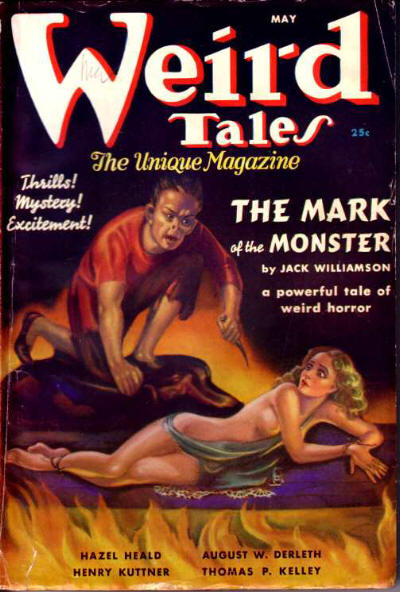
Back in 2017 I read H. P. Lovecraft and Hazel Heald's "The Horror in the Burying-Ground," which I panned as a "clunker" overburdened by a surfeit of characters.  This disappointment debuted in the May 1937 issue of Weird Tales, alongside stories by science fiction Grandmaster Jack Williamson, Barry Malzberg's hero Henry Kuttner, and founder of Arkham House August Derleth.  Let's read those three tales today in hopes of temporarily slaking our unquenchable thirst for thrills, mystery and excitement.

"The Mark of the Monster" by Jack Williamson

This is a somewhat exploitative piece full of extravagant prose, Williamson describing at length but with verve everything from people's scary eyes and hideous skin to the aura of fear that hangs over every building and every tree in the little town of Creston.  Our narrator, Claiborne Coe, has spent seven years in the Far East making enough money to marry the violet-eyed girl he's had his heart set on for ages, Valyne Kirk, and today he returns to Creston, where they grew up and where she awaits him.  Clay finds Creston and its inhabitants very sinister and forbidding, and perhaps he shouldn't be surprised, because the letter in his pocket from his adoptive father discourages him from returning, even hinting there is something wrong with the narrator and he should keep away from Valyne for her own good!

"Heed this warning--you must sense its truth, like a cold serpent coiled around your heart!"

Our narrator, orphaned at an early age and then raised by a doctor and his wife, had an odd and unnerving childhood.  Take the local bully, Jud Geer, the butcher's son--this low-IQ creep would pull gags like tying up smaller kids with pig entrails.  And then there was that time six-year-old Clay felt an irresistible urge to go to a certain place in the woods--his compulsion lead him to a ring of megaliths, at the center of which was a blood-stained altar!  Clay's personality is a little strange, at least in one particular: he has a ferocious, uncontrollable temper, and if provoked he will throw horrible fits which he can't remember after they have passed; during his long sojourn in the Orient he was once attacked by knife-wielding "Mecanese," and in a red frenzy, out of his mind, he slew them--when he came out of this violent fit, Clay was astonished to see what he had done to his assailants.  

When Clay lays eyes on Valyne for the first time in seven yeas she is being sexually harassed by that bully, the butcher's son, and our guy Clay goes into his frenzy and knocks Jud's teeth out.  Then the two lovebirds head to the Doc's house, where Valyne has been staying since her mother died.  There the Doc expounds upon his dark hints about Clay's heritage and emphatic pleas that his adoptive son never marry--Doc tells Clay that the Coes for generations were Satan-worshipping wizards, and Clay's grandfather tied Clay's mother--naked!--to that altar where she was raped by a demon Gramps summoned!  Clay is a product of that hellish union, a half-demon!  What's more, Clay has a noseless twin brother, a monster who subsists on blood; this monster is locked up in the basement and is brought a bucket of blood on the regular by Jud Geer!

Williamson's story approaches a climax when Clay's demonic twin busts out of his prison, grabs Valyne, and carries her off to the altar to rape her.  Clay outfights the would-be rapist, and then we get our precipitous let-down of a twist ending--it is all a hoax!  Clay has no twin brother--the demon is Jud in disguise!  This elaborate masquerade is a component of a plot to drive Clay to commit suicide masterminded by his adoptive father who is angling to inherit the money Clay made in Asia.

The Lovecraftian business about Clay being the descendent of a demon said to have been "summoned out of space," as well as the heavy horror atmospherics about Creston and all the edgy references to rape, were so sincere and so effective that I was surprised and disappointed by the mundane and deflating ending.  Many old pulp stories end in this lame Scooby-Doo fashion, but often I don't see it coming and find myself bitterly let down, even though I suppose I am sympathetic to the "lesson" of such narratives (that the supernatural is not real and people who claim it is are fools or shysters.)  One of the particular problems with the "it was all a hoax!" ending here in "The Mark of the Monster" is that it renders Clay's violent frenzies and his youthful discovery of the altar somewhat incongruous.  I'm also not a fan of the "let's drive this person crazy" plot device which we see so often. 

So, what kind of grade can I give a nineteen-page story I was enjoying for seventeen pages until it totally let me down?  I guess we're going with "acceptable."

"The Mark of the Monster" was not reprinted in English until the 21st century, when it appeared in Haffner Press's 2002 Spider Island, the fourth volume of their series The Collected Stories of Jack Williamson.  Three years later, Richard M. Price included it in his anthology Tales Out of Dunwich.   


"The Salem Horror"
by Henry Kuttner

isfdb informs us that this is the first of the two Michael Leigh stories; we read the second Leigh tale, "The Black Kiss," which Kuttner co-authored with Psycho-scribe Robert Bloch, back in 2019.  (In my blog post at the link I say that Leigh is only a minor character in the story and in fact superfluous.)  As for today's topic, "The Salem Horror," I am pretty sure I read this story in the Nineties in some anthology or other, but I don't remember anything about it.

Having reread it, I can tell you that "The Salem Horror" is a prime slice of Yog-Sothery and recommend it to fans of horror and the weird with some enthusiasm.  Kuttner does a good job with the images of the monsters, the secret rooms and sorcerous paraphernalia, and with the construction of an atmosphere.  The plot is sort of typical, but Kuttner builds an entertaining story around it.

Carson is a successful writer of light popular novels, but he needs quiet to write, and so rents a house in Salem--a house he learns was once the home of a witch who was seized by the local people and buried with a stake in her heart because her body resisted burning.  In this creepy house he follows a rat to the basement--the rodent leads him to a secret door that opens into a room with elaborate markings on the floor and queer writing on the walls.  This subterranean chamber is very quiet, so Carson furnishes it with a desk and starts writing down there.  Strange, horrible, things start happening in Salem, and when occultist Michael Leigh appears he explains that the secret room is one of those few spots on the Earth that acts as a sort of bridge to other universes, and via this otherworldly channel the witch is manipulating Carson, working him like a puppet without his knowledge--at night he is fulfilling the requirements to raise the undead sorcerous from her grave so she can pursue a campaign of revenge against Salem and summon to Earth a horrible monster god that takes the form of a huge black amoeba that can move at astonishing speed.  Should Carson believe this goop?  If Leigh's claims are true, will Carson survive, and can Leigh neutralize this diabolical threat to the people of Salem?

Kuttner sent an early version of "The Salem Horror" to H. P. Lovecraft, who responded with a long letter to Kuttner describing Salem, which the young Californian Kuttner had never seen.  This March 12, 1936 letter, complete with Lovecraft's drawings of three typical examples of Salem architecture and six representative types of Salem gravestones, can be found in Volume 10 of Hippocampus Press's Letters of H. P. Lovecraft, Letters to C. L. Moore and Others, edited by David E. Schulz and S. T. Joshi.  Kuttner seems to have integrated lots of Lovecraft's info into the version of the story that was printed in Weird Tales, including his reference to the "slum inhabited by Polish immigrants--mill workers."  Weird stories set in the mysterious East or the Third World or some such locale often feature natives whom the Northern European protagonist considers to be superstitious goofballs, but who it turns out actually have insight into supernatural phenomena at which the explorers from Western civilization scoff at their peril.  Weird stories set in the First World often feature some minority demographic community in this same role, and in "The Salem Horror" it is working-class Polish immigrants who occupy this slot.

"The Salem Horror" is quite good, and was a big success, seeing print in quite a number of anthologies.  

"The Wind from the River" by August Derleth

My scattershot reading about Derleth and of Derleth's correspondence with Lovecraft has left me with a good impression of him as a person who worked hard and had a lot of energy and was helpful to people and so forth, but lots of his writing is just plain shoddy, and "The Wind from the River" is one example of this lamentable fact.  This story feels like a draft that needs to be tightened up, that would benefit greatly from some editing and polishing to make sure all the sentences actually add value--and not just length--to the story.  Williamson and Kuttner in their stories discussed above use lots of adjectives and offer long descriptions, but these flights always serve the purpose of the story, creating a mood of fear or painting a disturbing image.  But Derleth in "The Wind from the River" just throws all kinds of metaphorical phrases and boring descriptions at you that don't seem to further the story's goals:
The district attorney was shown into the long hall just as Leocadie came down the stairs, her presence engulfing him.
It is never made clear what this "engulfing" means--it is not like the DA is psychologically dominated by Leocadie or is consumed with a fascination with her--just the opposite, for the sentence that ends the paragraph that starts with the sentence above is:
And there he immediately began, speaking rapidly, for he was obviously in a hurry, as Leocadie saw by his frequent glances at his wrist watch.
In fact, this entire scene with the district attorney--who never reappears--is a waste of time and should have been excised entirely.

The plot.  Three rich people--sisters Leocadie and Lavinia and their nephew Walter, the son of their dearly departed sister--live in a big house by a river; until recently Walter's stepbrother Arthur resided with them, but he was found drowned in the river, apparently a suicide.  The main thread of the story concerns Leocadie discovering evidence that Arthur was murdered, why, and by whom; at the same time both of the sisters--and their servant--independently sight Arthur's ghost.  We also get a lot of talk about the weather--wind off the river, fog rising from the river, a lightning storm--and the ghost's appearances are correlated with these meteorological phenomena.  In the end the ghost of Arthur draws the killer--Lavinia, who had terminated short their love affair against Arthur's wishes--to the river where she is destroyed.

The basic plot outline and its main elements--a young man has an affair with his dead stepmother's sister and when she tires of him he gets aggressive so she drowns him and then his ghost gets revenge on her--are good.  But Derleth's technique in relating this plot is quite poor.  Also, Derleth employs two reasonably good gimmicks when he should have just stuck with one instead of trying to cram them together into one story, as they work at cross purposes with each other.  I have already hinted at the first gimmick--the ghost of Arthur has taken on aspects of the water in which he was slain, and rides the fog up to the house, leaves a trail of dampness wherever he goes, and brings his murderer to the river to kill her.  Derleth's other gimmick is that Arthur is proud of his long yellow hair and his ghost strangles his step-aunt with strands of this hair.  Arthur's pride in his hair is underdeveloped so the use of the hair to kill Lavinia comes as sort of a surprise at the end, not having been foreshadowed sufficiently, and the hair theme serves to undermine the water theme--shouldn't the ghost drown Lavinia the way Lavinia drowned Arthur?, and if he can strangle people with his hair, couldn't he do have done that up at the house? 

(Yet another problem is that Leocadie somehow sees some of the ghost's activities in her dreams--this third gimmick is also totally unnecessary and diminishes the power of the main gimmick.)
  
Gotta give this one a thumbs down, though I can easily imagine giving it a thumbs up if Derleth and Weird Tales editor Farnsworth Wright had put in some hours revising it, cutting superfluous passages and concepts.
      
"The Wind from the River" can be found in such Derleth collections as Someone in the Dark (first edition 1941) and L'amulette tibetaine (1985). 

**********

It feels good to get back to the weird, so, more weird material in the next episode of MPorcius Fiction Log!

Monday, June 19, 2023

Merril-Approved 1956 Stories: Galouye, Garrett, Grimm & Gunn

Here at MPorcius Fiction Log we are exploring critically-acclaimed SF stories from 1956, and the critic doing the acclaiming is none other than Judith Merril.  In the back of her 1957 anthology SF: The Year's Greatest Science Fiction and Fantasy: Second Annual Volume, Merril included an alphabetical list of honorable mentions; we have been going through this list, picking out stories to read, and today is G-Day, so we've got stories by Daniel Galouye, Randall Garrett, "Christopher Grimm" and James Gunn.

(For the curious, I'll put links to the earlier installments of this series at the bottom of this post.)

"The Pliable" by Daniel Galouye 

"The Pliable" debuted in an issue of F&SF edited by Anthony Boucher and containing stories by Henry Kuttner and C. L. Moore, Poul Anderson, Richard Matheson and Ray Bradbury--wow, a big issue.  We'll have to bookmark this one!  There's nothing wrong with that Emsh cover, either.  Looking at isfdb, it seems foreigners liked "The Pliable" more than Americans did; at least there are no reprints in publications in English listed among the nine European reprints.  Well, let's see what this Yankee thinks of this "short novelet" of over twenty pages.

In his intro, Boucher likens "The Pliable" to Agatha Christie's famous Ten Little Don't Use That Word, and it is also reminiscent of those 1930s classics by (respectively) John W. Campbell and A.  E van Vogt, "Who Goes There?" and "Black Destroyer" in that it is about a small isolated group who introduce an alien into their company and must resolve the deadly challenge it unexpectedly poses.  

The space ship in "The Pliable" has a multi-species crew made up of humans, a Centauran and a Vegan, and they have by chance discovered a primitive life form, a kind of blob or giant amoeba (like a foot across when a sphere) that responds to their brain transmissions--the members of the space crew can sculpt it like clay with their minds, and make it move around like a puppet with their thoughts.  This discovery will make them all rich if they can stake a claim to it and then market the beasts across the galaxy.

The Vegan fashions a biped out of the blob, puts a knife in its hand, and makes it perform a traditional Vegan saber dance.  The little marionette stabs another crew member in the chest, slaying him, and the crew and we readers strive to figure out which crewman directed the blob to commit the foul deed, or consider the alternative explanation that the blob has more intelligence than they bargained for and killed the spaceman of its own free will.  More murders follow and the dwindling number of survivors try all kinds of logical schemes and indulge in all manner of prejudices in their frantic efforts to stop the killings and figure out who is responsible.  The twist ending is that the monster isn't susceptible only to conscious control, but can also be influenced by the subconscious!  A spaceman who subconsciously is animated by greed or fear could be unknowingly directing the blob to destroy his shipmates even if he isn't really so unscrupulous as too intentionally seek his comrades' deaths.

This story is pretty entertaining--I even found the dream sequence compelling and appropriate, which is noteworthy because usually I find dream sequences irritating and gratuitous--and it does raise questions of moral culpability, so I enjoyed it.  At the same time, it is a little annoying that we were all expected to strain our brains keeping track of clues and following all the Rube Goldberg logic puzzles when they all turned out to be moot because the killer wasn't consciously committing his crimes.

"Stroke of Genius" by Randall Garrett    

I have been avoiding Garrett for years because I somehow got the idea he writes joke stories or leftist satires or absurdist farces or something--I can't recall how I took this belief on board, but it has been strong enough to keep me giving his work a serious look.  (I guess it didn't help when in 2018 I read two filler stories from a 1956 magazine that Garrett cowrote with Robert Silverberg and thought them weak.)  Well, let's try on for size the two 1956 Garrett stories Merril thought were praiseworthy and see if I have been harboring an irrational prejudice against Garrett all these years.

Waldos figure in this story, and editor Larry T. Shaw includes a note that reminds us that Robert Heinlein conceived of and named the waldo in his 1942 story of that name.  I get the impression it is fashionable nowadays to claim science fiction never predicts anything, but if you read old magazines you find actual science fiction writers and editors are aways going on about how science fiction is predictive, and Shaw in his note says the waldo "proves yet again that science fiction can make accurate predictions."  If you learn about the past from secondary sources you are likely to get a very different picture of what was going on and what people thought than if you learn about the past from primary sources.            

Like Galouye's "The Pliable," "Stroke of Genius" is something of a murder mystery.  Our tale is set in the space-faring future; Earth has founded colonies on quite a few extrasolar planets, but can only check in on them every five years or so, and a bunch of them in one area have been found to have failed.  The fact that the failures are clustered geographically (spatially?) suggests that hostile aliens are at work, that the human race is in an interstellar war!  The Space Force quickly develops a new energy weapon with which to arm their space warships, and sends Major Stratford over to a high tech manufacturer to talk about having them mass produce this ordnance, and Stratford unwittingly steps into the middle of a tense human drama!

You see, this engineer Crayley is in his thirties and is the number two executive at the manufacturer.  He had hopes of soon taking over from the boss, famous genius Klythe, when the sixty-year-old retired.  But Klythe is so valuable that the government authorized him to undergo The Big Gamble, a rejuvenation treatment that might wreck your body but also has a significant chance of restoring your corpus to its condition when you were twenty-five!  The rarely-administered treatment worked like a charm on the K-man, and now Crayley will likely never succeed Klythe to become head of the factory because Klythe is effectively younger than Crayley while having thirty years more experience under his belt than our boy Craycray!

After all the introductions and the scene setting and the lecture on waldos, the plot kicks into gear as Crayley plots to murder Klythe.  Garrett does a good job of making the working of the factory and the waldos interesting, and of giving us insight into both Klythe and Crayley's psychology--the psychologies of the two engineers is firmly integrated into the commission of the crime and its detection by the authorities.  Crayley sabotages the production of the first of the new weapons, causing an explosion that kills five people, including Klythe.  Crayley is immediately anointed Acting Director.  Will the government investigation team discover his atrocious crime?  

An entertaining crime story.  Thumbs up!  "Stroke of Genius" debuted in an issue of Infinity with another fun Emsh cover and stories by Damon Knight and Harlan Ellison I will probably read some day, plus Knight's laudatory reviews of novels by Heinlein, Arthur C. Clarke, and Gordon R. Dickson.  Merril and I both enjoyed "Stroke of Genius," but it doesn't look like it ever reappeared in an anthology or collection.  

"Suite Mentale" by Randall Garrett

Here's another story that was ignored after it was printed; "Suite Mentale" would not reappear until our own 21st century, and even then only by small outfits dedicated to e-publishing.

Well, having read it, I can see why "Suite Mentale" never spread beyond the pages of Robert W. Lowndes' Future; it is sort of boring, its structure lacking a build up and climax, its characters and their actions lacking in drama, personality, and excitement.  One of the problems is that we don't witness the protagonist as he performs the actions that make up the bulk of the story's plot, nor do we hear him narrate the plot--instead we learn the story in out of chronological order fragments through the dialogue of other characters.  This limits immediacy and undercuts any possible suspense and also impedes the reader's ability to identify with or care about the protagonist.  Another problem is the way the speculative lectures about psychology and time travel with which Garrett lards his tale weigh it down. 

Even though I am considering the structure of Garret's story a failure, Garrett seems to have organized his tale with care and deliberation--each of the five chapters of this twelve-page story is named after one of the components (I guess educated people call these "movements") of a long piece of classical music like a symphony or suite--the first chapter is "Overture--Adagio Mistirioso" and another is "Scherzo--Presto," to provide some examples.  "Suite Mentale" is an ambitious story, it seems, but I'm an uncultured slob who knows almost nothing about classical music so this is all lost on me.    

The plot concerns a guy, Paul Wendell, who has developed telepathic powers.  We all have latent psychic powers, Wendell realizes, and he is confident that he can teach most anybody how to unlock their own psychic abilities.  He teaches eight men how to read minds and the like, and gets a meeting with the President of the United States and lets the big guy know all about his work.

The Prez is not thrilled by the news Wendell brings him.  On a philosophical, long term level, he fears that if everybody can read everybody else's mind that society will collapse, and uses a game-playing metaphor to express his worry.  Today we are all playing poker--we all keep a lot about ourselves and our thoughts secret from other people.  If we all are aware of what everybody else is thinking, enjoy access to each other's memories, we will all be playing chess, which the President thinks is a disaster for some reason; I'm not sure the President/Garrett employed this metaphor or explained the Prez's worries particularly well.  On a short term, practical, level, the President is worried that the nine psykers must have all sorts of knowledge that would compromise the security of the United States if our enemies were to capture any one of them and beat the info out of him.  So the President strives to keep an eye on these nine telepaths and come up with some excuse to lock them up.

The President is relieved when the eight disciples all go insane and one of them, in his insanity, shoots Wendell in the head.  Now they can all be locked away--for their own good even!--in various medical institutions.  Surgery preserves Wendell's life, but to those around him the genius appears to be little more than a vegetable--he can't move much, or talk, and is only barely capable of swallowing the food nurses hand feed him.  (I think maybe intravenous feeding hadn't been introduced yet when the story was written.)  The reality is that Wendell is fully alive in his brain, but is suffering total sensory deprivation and can only maintain his sanity by replaying all of his memories over and over again and intricately studying every moment of his past life.  He does this for many years.

The plot is resolved when Wendell dies after figuring out why his disciples went insane and telepathically curing them and injecting into their brains all his own memories, so that, in a sense, he is still alive as a copy in the brains of eight other dudes.  Released from the funny farm, one of these eight goes to visit the President, who is now retired.  He convinces the President, whom Wendell considers a great man, to join the group of psykers and use his status and ability as an elder statesman to help engineer a smooth transition to the now inevitable psychic civilization.

I want to like this story because it is ambitious and unconventional and has big ideas, but it just isn't well told and lacks entertainment value.  Thumbs down, I'm afraid.

"Bodyguard" by "Christopher Grimm" (H. L. Gold, probably)

I read this story in the 1990s when I bought a hardcover copy of the 1960 anthology Bodyguard and Four Other Short Novels From Galaxy at a used book store, but I don't remember much of anything about it.  According to isfdb, there is some controversy over whether Gold actually wrote the story, with some claiming that Evelyn E. Smith is the real author.  For this blog post I will read "Bodyguard" in the scan of the magazine in which it made its debut rather than dig my book out from my shelves.

It is the spacefaring future: extraterrestrials are a common sight on Earth, there are rejuvenation treatments so most people look and feel young, and people fly around in aircars.  But there is one technology that hasn't really panned out--plastic surgery.  So, people who were born good-looking still have an advantage over those of us who are plain and those of us who are ugly.  

Gabriel Lockard is one of best-looking men on Earth. He is also a fool and a jerk: we witness him hitting his wife when she is annoying, starting a ruckus in a bar by getting in some innocent guy's face, as well as flying an aircar while drunk.  When Gabe's recklessness gets into a dangerous jam, a guy suddenly appears to save him; the rescuer looks totally different each time, but Gabe's wife realizes that its the same man pulling her careless brute of a hubby's fat out of the firer each time, he is just inhabiting a different body each time!

The Earth Gold is depicting in this noirish story is old and worn out, its culture decadent, the vital industrious adventurous types all having moved to frontier planets.  Those who remain pursue relief from their boredom in extreme, dangerous, addictive pastimes.  One such thrilling recreation is administered by some aliens with psychic powers; these E.T.s operate a technically illegal "game" which consists of players swapping bodies, often with random strangers; participants go to sleep and wake up in a different body, running a very real risk of finding themselves in a body that is sick or otherwise deficient.  

"Bodyguard" is like 38 pages long, and a quarter of the way in we are told that the guy who keeps saving Gabriel from harm is the original occupant of that gorgeous Gabriel Lockard body, which he lost to the jerk when said jerk, who was ugly, tricked him into one of those body swapping games.  Original Gabriel is endeavoring to keep his beautiful birth body intact in the hope he will figure out a way to get back into it; the current occupant of the Gabe body is always trying to put distance between himself and this delectable frame's original owner, so the original Gabe keeps switching to a new body so he can continue sneaking up on the body thief.  

There follows a pretty good suspense/crime story as the thief tries to escape and then tries to murder his pursuer.  Additional characters are added to the drama: the thief blackmails a sleazy lawyer into acting as a go-between so he can hire a hitman to kill the real Gabe; equally significant is the thief's wife, who can always spot the real Gabe no matter what body he is in, and who becomes the female corner of a love triangle involving her evil husband and the original owner of her husband's breathtakingly hot bod.  Everybody tries to double cross everybody else, and when the assassin changes his body as a means of eluding the authorities--wouldn't you know it--the original Gabe ends up in the professional killer's body!  The legal system doesn't recognize all this body switching business, so in the view of the law whoever is in the body of a criminal is culpable for the body's crimes, so Gabe now runs the risk of being shot down by the apparently less than conscientious cops of this decadent future Earth!

I like this caper--thumbs up!  One fun skein wound into Gold's tapestry is all the future slang and catchphrases he introduces and which the characters use quite a bit.  This is a typical thing SF writers do, but Gold's neologisms felt more authentic than usual.  I will warn 21st-century readers that "Bodyguard" seems to push ideas that we are nowadays expected to abjure--that one's moral character is reflected in one's looks (I just had to sit through a multi-hour performance of Shrek: The Musical put on by ten-year-olds so this at "top of mind," as we say) and that women will fall in love with a guy just because of his looks and his money.

After its debut in Galaxy, "Bodyguard" has only ever been reprinted on paper in the foreign editions of Galaxy and in the aforementioned anthology edited by Gold himself, who apparently had no compunctions about selling his own work in such a morally suspect manner.   

"Witches Must Burn" by James Gunn

"Witches Must Burn" is one of those stories that indulges the contempt and fear the cognitive elite have for the common people; it seems to take much of its inspiration from Luddism and McCarthyism, and we might say it also prefigures the anti-intellectualism of the Cambodian Genocide.  At the same time, it critiques those elitist attitudes and offers something of a twist ending that suggests the anti-intellectuals might have a point.  A year ago I read three linked stories by Gunn that were also more or less about whether or not elites should run our lives for us, and they also took the both-sides-are-too-extreme, what-we-need-is-to-combine-the-thesis-and-antithesis-and-create-a-moderate-synthesis line.  I will also note that the story debuted in John W. Campbell's Astounding, and Campbell is famous for writing and printing stories in which he challenges you by coming up with a scenario in which something undeniably horrible, like being enslaved or thrown out of a spaceship to your death or, as here, murdered by a superstitious mob, is in the long run necessary or even somehow beneficial.   

It is the future--the 1970s--and America is a surveillance state; there are bugs everywhere, the phones are tapped, if you check into a hotel you have to write your political party affiliation on the form.  Everything seems old and rundown, and there are lots of high tech devices but many of them seem to be on the fritz.  Among the common people there is widespread resentment over technological advances that are alleged to have put people out of jobs and end up being unreliable anyway.  People's ire focuses on the scientists who are responsible for all this problematic technology, and they have representatives in the federal legislature egging them on and willing to protect them if they mete out a little mob justice!      

Our protagonist is Wilson, a physicist who specialized in electronics and then changed course in mid-career to become a psychologist.  As the story begins he is returning to his Midwestern university, where he was close to completing a major project, one with potentially world-changing applications, to find an anti-egghead mob is burning down the entire campus and massacring the faculty and their families!  We then get reasonably entertaining sequences depicting Wilson as a hunted man, using various strategies and compromising his morals in order to survive--we also get a glimpse of how other members of the educated classes similarly do morally questionable things to survive in anti-intellectual America.  

Gunn provides a longish passage that describes history from the point of view of Wilson: science has made life vastly better by making Man master of the natural world, but instead of embracing this miracle, in the middle of the 20th century the populace has been seized by a mass psychosis and became hostile to science and technology.  Wilson's expertise put him in the forefront of those seeking to solve this problem by developing a technological means to read and control people's minds.  All Wilson's work--just when he was on the brink of success!--was destroyed in the fire that opened the story, but while on the run he does manage to build a crude miniature version of the device that can detect theta waves and help him intuit the attitudes of those around him.

Europe and the Soviet Union are apparently even more oppressive and anti-technology than the USA, so Wilson heads for Latin America--Brazil, Venezuela and Peru may be authoritarian countries, but their governments welcome scientists who can provide aid in their quest to exploit South America's natural resources and achieve economic growth.  Wilson hooks up with a Brazilian government egghead-recruiter, but right before he can get on a Brazilian nuclear sub, he is captured by the American government!

And then swiftly rescued by the pro-science underground, the most prominent representative of which in the text is a beautiful blue-eyed blonde.  This babe explains the common man's skepticism of rapid technological change, even excuses it a little bit, whipping out a metaphor--the scientists are like the driver of the automobile of civilization, but lately they have been putting the pedal to the metal, speeding recklessly, and they don't even know where the road is headed!  The common man is like a passenger who gets so scared he wants to grab the wheel from the driver, but of course that will likely introduce even greater danger.  Blondie's solution to the problem is not for the eggheads to wield ever greater power over the lowbrows, but for the scientists to leave their ivory towers and reintegrate into society--she and her comrades blame the scientists for the burnings of universities and the massacres of intellectuals, arguing that the cognitive elite made such a backlash inevitable by divorcing themselves from society and getting up on their high horses.  The massacre of the smarty smarts is the first step in a regression of society to a sort of medieval level that will be good in the long run because the cognitive elite will again be joined with the people and work alongside them instead of above them.  The story ends when Wilson comes to accept this painful truth.

One of the elements of the story which I sort of rolled my eyes at but is perhaps interesting is the use of the witch as a metaphor.  Gunn of course employs the very common use of "witch hunt" as a metaphor for unfair persecution, but that hot blonde and her comrades also suggest that in the new society that scientists should play the role performed (so they say) by witches in the past, that of "the wise man of the village who wields mysterious control over the forces of nature--for the benefit of the village."

Acceptable.  It looks like John Wilson would return in two stories published in 1969, and "Witches Must Burn" appears with these sequels in the collection The Burning.

**********

Another step in our 1956 journey lies behind us.  This leg of the trek was long but not that painful, with three good stories, and only one poor one, so, props to Merril.  I don't always see eye to eye with Merril, as you'll perhaps remember if you've been accompanying me on this exploration; if you haven't, you can check out our travel diary at the links below:

Saturday, June 10, 2023

Take a Girl Like You by Kingsley Amis

"She's a decent wee girl, Standish, and that's her attraction for me.  She's the steady kind, not flighty or featherbrained like so many of them today."

It feels like it's been a while since I've issued one of these dispatches; besides additional remunerative work and family goings-on, my free time has been taken up by the ramifications of my purchase at an antique mall of a forty-dollar box of dusty old HO railroad models and rusty brass track, including the fact that, when my father learned that I was trying to get fifty-year old trains running, he sent me multiple boxes of his own model railroad equipment and supplies from the 1970s and I have been striving to get that stuff in working order.  But another reason I haven't blogged in a while is that the book I have been reading, Kinglsey Amis's 1960 novel Take a Girl Like You, a Signet paperback printing of which I picked up at Wonder Book last year, has taken me a bit of time to get through.  But I have finally finished what Saturday Review proclaimed to be Amis's "biggest, most ambitious (and best) novel," a work which the susceptible people at the London Observer found "awe-inspiring," and can write this blog post and move on with my fiction reading life.

Take a Girl Like You is a well-written realistic novel about real life, its theme being, as the excitable crew at the London Observer tells us in the back cover text, sex.  The characters in the book all have believable personalities and behave in easily understandable ways--all the actions and relationships ring true, and little if any suspension of disbelief is required of the reader.  Amis's novel is full of understated, even subtle, humor that is based on people's thoughts and feelings, not wacky coincidences or hyperbolic parody.  Amis explores what life is like for a beautiful naïve young woman from the "industrial north of England" who moves to the south, a manipulative and lecherous young man who pursues sex with gusto and has deflowered many a virgin, and his friend and roommate, an unattractive man whose pursuit of women has been a history of frustration and failure.  Amis compares old-fashioned mores, typified by the working class of the north, with the modern licentiousness practiced by the educated middle-class professionals and aristocracy in London and its environs, suggesting that the new sexual freedoms are bound to conquer traditional restraint, though without suggesting this will make people any happier.  And he provides amusing anecdotes about academic life, all three of the principal characters being educators--the young lady from the north a teacher of primary school age children, the young men "school masters" who apparently instruct the equivalent of American high school students (one of the cohorts in receipt of instruction is described as "the Junior Sixth.") 

The plot follows northerner Jennifer Bunn as she takes up a job at a school an hour or so from London and moves in to one of those private houses whose owners take in multiple boarders which old fiction is full of and meets a bunch of people from different parts of Britain and even a woman who claims to be from France but (as we learn at the very end of the novel) is an Englishwoman putting on an act because "Playing a part's the only thing left these days, it shows you won't deal with society in the way it wants you to."  Jenny is a dark exotic-looking beauty, often mistaken for a Frenchwoman, and every man she meets--plus the faux-Frenchwoman--endeavours to get into her knickers, but Jenny has old-fashioned values and wants to retain her virginity, and resists all their advances.  Chief among the men pursuing Jenny is Patrick Standish, a good-looking half-Irish teacher of Latin who embraces all things modern, music and culture and ways of thinking--"I haven't got my ideas from anyone else, I've thought them out for myself."  One of Patrick's ideas is that marriage is a lot of bunk, and his primary interest in life is having sex with lots of different women, a field in which he has achieved considerable success.  In contrast we have Patrick's virginal comrade, Scotsman Graham McClintoch, a fellow Labour Party activist and schoolmaster.  Graham is himself consumed with sexual desire, but has old-fashioned values and looks down on Patrick's seductions; perhaps this is one reason he has never had any success with the ladies.

Patrick is not only a charming, smart, handsome and outgoing man, but a selfish and callous deceiver and manipulator, and throughout the book's course he manages the other characters like some kind of puppet master.  One of the elements of the novel that makes it feel so much like real life is its pervasive moral ambiguity; I was not at all clear how much we were expected to admire Patrick for his successful pursuit of all those women and achievement of vengeance on minor characters or to share his contempt for traditional morals, how much we were supposed to sympathize with Jenny in her defense of her virginity and Graham in his apparently doomed efforts to divest himself of his own virginity, and to pity or commend both Jenny and Graham as they try to do the right thing, only to find their generosity and efforts to help people fall flat and go unrewarded.  

Anyway, Jenny is the most beautiful woman Patrick has ever seen and by the novel's halfway point he has gotten her to fall deeply in love with him.  The two seriously date for months; Jenny is deeply happy and Jenny's working class parents are charmed when they meet Patrick; Jenny's mother expects them to soon be married and Jenny hopes this will be the case.  However, Patrick is accustomed to regularly enjoying sexual intercourse, and finds Jenny's limiting him to "heavy necking" to be very frustrating, and in any case marriage does not interest him.  

In a long sequence, Patrick and one of the novel's many secondary characters go to London where, among other capers, Patrick is introduced to a beautiful, self-absorbed and air-headed young actress whom he seduces by telling her he is some kind of businessman.  Soon after bedding this woman, Patrick issues Jenny an ultimatum--she must have sex with him or they will be through.  Jenny initially agrees, but when the day upon which she is to surrender her virginity to Patrick comes, she stands him up.  By a coincidence, that very day the headmaster's 17-year-old daughter, who has been pursuing Patrick for ages, comes to his place, where he is alone awaiting Jenny (he has tricked Graham into being out all day) and throws herself at him.  After they have sex, the 17-year-old admits the real reason she has just given herself to Patrick--she is pregnant by some other guy and needs help getting an abortion, and of course womanizer Patrick can introduce her to a discrete and reliable abortionist.      

Amis does a good job in the last third or quarter or so of the novel keeping readers in suspense as to what is going to happen.  Many eventualities seem possible, and at various times I expected Patrick to dump Jenny and break her heart, Jenny to dump Patrick and thus force him to see the error of his ways, Patrick to reform and propose to Jenny, and/or for Jenny to suddenly realize she should build a relationship with good-guy loser Graham.  None of that stuff happens, at least not in a way that sticks.  

At a wild party at a Lord's house, Patrick tells Jenny they are through, Jenny gets drunk and Graham saves her from being raped by some minor character, and then Patrick takes Jenny's virginity while she is so inebriated that she can't even remember it happening.  Jenny tells Patrick they are through, but a few days later is back in his arms, and we are lead to believe they are going to spend the rest of their lives together, more on Patrick's terms than Jenny's.  The novel's ending leaves an impression that the world and life are chaos, with little justice and no peace of mind--cunning and amoral Patrick has triumphed over decent Jenny and Graham, practically coercing Jenny into becoming a person she didn't want to be, and at the same time a sort of shadow lies over Patrick, Amis suggesting in a number of ways that a number of ways Patrick has wasted his potential (to be some kind of literary scholar, it seems) and may even soon be coming to a bad end (indications of advancing age and intimations of an impending medical crisis.)  Wikipedia may describe this book as a "comic novel," but it is kind of a downer.

Take a Girl Like You is a book that is easy to admire, but it is not exactly thrilling.  Maybe I have grown too accustomed to reading short stories and short novels that speculate on the future or the supernatural and involve people fighting in wars or getting involved in horrible crimes; this 270-page book (the print of which is pretty small) about young smart people's love lives and teaching careers wasn't quite up to the task of drawing me away from the task of cleaning and lubricating my trains while I watched giallo movies on YouTube.  

Still, we'll probably be hearing from Kingsley Amis again; looking back on Take a Girl Like You, I like it more than I did when I was actually reading it, and of course I already own other books by Amis.  It even appears that there is a sequel to Take a Girl Like You that continues the story of Patrick and Jenny's relationship.  But expect to see some posts about horror fiction and 1950s SF here at MPorcius Fiction Log before we make our next foray into 20th-century British literary fiction.