Thursday, September 13, 2018

Final ABC: Vonnegut, Wyndham and Young

The day has arrived!  Finally, we will finish up Tom Boardman Jr.'s 1966 anthology An ABC of Science Fiction, a book which presents a story for each letter of the alphabet, each letter represented by a writer whose last name begins with that letter.   There are only three stories remaining, because we are skipping "X" (lame limericks written under a pseudonym) and "Z," Roger Zelazny's "The Great Slow Kings," which I read back in 2014--it totally fits in with the recurring theme of this anthology that human beings are terrible and with the general jocular or satiric tone of the book's stories. 

"Harrison Bergeron" by Kurt Vonnegut, Jr. (1961)

In grammar school we read "Harrison Bergeron" and at the time I was a little surprised to be reading a story in a school textbook that seemed to be either making fun of the Declaration of Independence and Constitution or criticizing the doctrine of equality or both.  "Harrison Bergeron" first appeared in F&SF and has been reprinted many times and even filmed several times.

It is the year 2081 and thanks to constitutional amendments (of which there are over 200,) the government ruthlessly enforces equality by mandating various handicaps.  Smart people have to wear ear pieces that disrupt their thoughts with piercing noises, strong and agile people have to wear weights that slow them down and wear them out, attractive people must don hideous masks, etc.  The plot concerns George and Hazel Bergeron, whose son, Harrison, is the strongest and smartest man ever born and who has been arrested.  G and H are watching ballerinas on TV--the ballerinas, weighted down and distracted, are fumbling all over the place.  Suddenly Harrison, having escaped, bursts into the TV studio, declares himself Emperor, throws off his handicaps and those of the most gifted of the ballerinas and demonstrates how beautifully two talented people can dance.  Then the government official in charge of the handicapping agency, a woman, arrives and shoots down the self-proclaimed Emperor and his lovely Empress.

On its face, "Harrison Bergeron" appears to be a ferocious, over-the-top attack on radical egalitarianism and government efforts to achieve equality.  But when we look at the wikipedia page on Vonnegut we see that he was a socialist who thought Americans too quick to denounce communism.  I think we have to entertain the strong possibility that "Harrison Bergeron" is not a warning against government interventionism but a lampoon of such warnings, that Vonnegut here, like the New Yorker with its controversial cover illustration in which Barack Hussein Obama is burning the Stars and Stripes and his wife is carrying a Kalashnikov, is painting opposition to government that actively pursues "social justice" as ridiculous.

The outlandish nature of some elements of the story--Harrison is a seven-foot tall fourteen-year old who breaks chains with his bare hands, and he and his Empress discover the ability to fly--seems to support such a reading, as does the name of the Handicapper General, Diana Moon Glampers; while her first and middle names obviously reference the hunter goddess who shoots people as a means of punishing hubris, her last name reminds one of labor leader Samuel Gompers.  Maybe Vonnegut is presenting to readers a satiric view of how he believes supporters of limited government see themselves (as god-like individualists) and their opponents (nagging, autocratic and irrational people, especially women.)  It may be notable that Harrison Bergeron, the super-strong genius, tries to use his superior abilities to overthrow our republican society and make himself Emperor, like the kid in Pohl's "The Bitterest Pill;" lefties think we need a powerful public sector to keep private individuals with superior resources from lording it over others. 

Obviously this story suits the themes of An ABC of Science Fiction that people are jerks and the future is going to suck, and like so many stories picked by Boardman it is some kind of satire.  But unlike many of the other pieces in this book it is actually funny and offers hope, whether we take it at face value (Bergeron and his Empress win a brief victory over the government and give voice to the greatness of which a free humanity is capable) or as a satire of anti-socialist beliefs (by showing that opposition to government is so silly that socialism, as Marx would insist, is bound to succeed in the end.)


Well-written, fun and thought-provoking, maybe the best story in the book.  (I like to be the guy who goes against the conventional wisdom, the guy who prefers Gilligan's Island to A Night at the Opera and Led Zeppelin to the Beatles, but "Harrison Bergeron" is irresistible.)

"Close Behind Him" by John Wyndham (1953)

John Wyndham is widely admired, though you may recall that I dumped on his 1955 novel The Chrysalids, AKA Re-Birth, when I read it in long ago 2015.  Let's see if this story, first seen in Fantastic, and since reprinted in many Wyndham collections and horror anthologies, is more to my taste.

"Close Behind Him" is not a science fiction story at all, but a supernatural horror story, more or less a vampire story.  It is good, though, so thumbs up.

Our protagonists are a pair of burglars, Smudger and Spotty, who bust into a big old house whose owner lives alone, but periodically holds some kind of well-attended, sinister occult meetings.  The owner attacks them like an animal, biting and clawing instead of defending his life and property with a weapon, and Spotty kills him with the pipe he carries to deal with homeowners who give trouble.  When they abscond from the house the thieves find that Spotty is being "pursued" by red bloody footprints which match his own footfalls, each appearing a few yards behind him as he takes a step.  Smudger murders his colleague, hoping to escape this paranormal pursuit, but then the steps start following him.

Wyndham's story is mysterious enough that for a while we readers can suspect that justice is being served, that the burglars, as punishment for committing murder, are being harried by something akin to the Greek Furies (I've kind of got the Furies on the brain because of my recent reading of T. S. Eliot's The Family Reunion and still more recent reading of Lyndall Gordon's discussion of that play in her book T. S. Eliot: An Imperfect Life.)  Back at Smudger's home this theory is exploded.  The bloody footprints gradually appear closer and closer, and, after two days of suffering a life-sapping anemia and dreams of a black hovering manlike form, Smudger dies.  The doctor who looks in on the burglar is present when Smudger expires, and, as he leaves, Smudger's wife sees that the footprints are now following the medical man.  Why is the monster chasing the doctor?  Presumably it is just a hungry beast, not any sort of avenger of wrongs.


This story is well-written and has a good basic concept, but I think the confusion over the monster's character--what exactly is it and what "rules" does it follow?--is a weakness.  There are early clues that the homeowner is some kind of male witch or maybe a werewolf, but then the importance of blood and Smudger's dreams and anemia put you in mind of a vampire.  The doctor thinks Smudger is just suffering hallucinations born of a guilty conscience and knowledge of lines from Coleridge's Rime of the Ancient Mariner, but we know he is wrong because Spotty and Liz (Smudger's wife) also see the footprints, and that they are real because Liz wipes up the blood.  None of these classic templates--Greek Fury, witch, lycanthrope, vampire, hallucination--really fits what is going on and Wyndham doesn't supply any clear explanation of what is going on.  I guess the monster is just a "ghost" that does whatever would be scary at the moment?           

Still, a decent piece of work.

"Thirty Days Had September" by Robert F. Young (1957)

Early this year I read Young's "The Ogress" and found it to be an entertaining enough adventure story with a sort of high-concept premise ("what if the gods and monsters of ancient myth were real, super-beings created by the collective psychic energy of primitive superstitious people, and on other planets there are primitive villagers who unwittingly create these dangerous creatures and the Terran government needs to send out hunters to destroy them?")  Hopefully this story will be at least as good.

It's the early Sixties--the early 2060s!  When salaryman George Danby was a kid he was one of the last people to be taught in a school building by a robot teacher because his little rural town couldn't get TV reception; his own nine-year-old is taught over the television like all the kids nowadays.  But George doesn't think it is quite the same, and when he sees a refurbished fourth-grade robot teacher in the window of an antique shop, he is moved to buy it.  He's buying it to help his kid study, and to help his wife Laura with the cooking and sewing, of course--he's definitely not buying Miss Jones because of those blue eyes and that hair that "made him think of September sunlight..."! 

Some SF stories speculate about future societies which are radically different from the society in which the writer lives; Heinlein has people on the moon with new marriage practices, Delany and Lee have societies in which getting a sex change is trivially easy, Sturgeon has the planet where incest is the norm, Wolfe has his future of illiterate immortals, and on and on.  And then there is the SF that just depicts the society in which the writer lives but with futuristic trappings.  In "Thirty Days Had September" Young depicts a caricature of the 1950s with robots thrown in so he can air his rather conventional gripes about postwar America.

Miss Jones is not a hit at the Danby household because it criticizes the TV shows Laura and the brat watch all day--the siege of Troy, the aftermath of the war of Eteocles and Polynices, and the tragedy of Romeo and Juliet, all reimagined as Westerns--and because the private companies who operate the tele-education system have filled viewers' heads with anti-robot-teacher propaganda.  The brat even kicks Miss Jones, damaging it so it limps.  Late one night, after he's had a few beers, George sits with his arm around Miss Jones while the machine recites some original lines from Romeo and Juliet--it's one of the happiest moments in George's life!  But Laura comes out of the bedroom and catches them, and insists George return Miss Jones to the antique store.

But this story has a happy ending!  Laura's dream is to replace their Buick with a Cadillac, so she does not complain when George starts working nights at a hot dog stand to make some extra money.  Laura will probably never find out that the owner of the hot dog stand has purchased Miss Jones to perform as a member of his wait staff!

Young in "Thirty Days Had September" calls out the citizens of the land of the free and the home of the brave for their obsession with automobiles and TV Westerns, their consumerism, and, I guess, the fact that most of them aren't kicking back after a long day working at the office or cooking, cleaning and raising the kids at home with volumes of Homer, Sophocles and Shakespeare.  Young suggests that postwar America is a society in which life is meaningless.  One of the problems of his story is that Young doesn't suggest where people should find meaning or where they found meaning before the rise of America's car- and TV- oriented consumer culture.  The average person is not going to find meaning in life reading ancient Greek and Renaissance English literature, and Young doesn't mention some of the obvious things that have given meaning to the lives of ordinary people in the past, things like religion or working with their hands.  Miss Jones obviously represents the more meaningful rural life of George's past (half a dozen times we are told she reminds him of "September"), but how that life was more meaningful is left unsaid; maybe Young thinks it is obvious?

One way people imbue their lives with meaning is through loving relationships with their family members, and Young does address this, perhaps obliquely.  Laura and the brat, avatars of consumerist TV and car culture, are obviously not going to offer opportunities for meaningful love relationships, but perhaps Miss Jones, a robot, is.  Young includes many descriptions of Laura and Miss Jones's physical appearance, and while both are described as attractive, Laura is described primarily in sexual terms (she's had her breasts augmented, for example), while Miss Jones is more wholesome--we do hear about the rise and fall of her breasts as she mimics human breathing, but mostly we are told that her face and hair and so on remind George of "September."  In one weird metaphor George looks at Laura in her pajamas, which have images of automobiles printed on them, and imagines she is allowing the cars to "run rampant over her body, letting them defile her breasts and her belly and her legs...."  Are we supposed to think consumer culture has ruined sex, made sex disgusting?  Maybe we are supposed to see Laura as a shallow, materialistic and status-obsessed creature who is only good for (debased) sex, and Miss Jones as a sort of Beatrice figure, a beautiful but chaste woman who will lead George to a spiritually fulfilling life?  (That's Lyndall Gordon's influence on me again--Gordon has a whole riff on how, after his disastrous marriage to the unstable Vivien Haigh-Wood, whom he married because he wanted to lose his virginity, Eliot sees the respectable and even-tempered Emily Hale as his own Beatrice figure.)  My Beatrice theory would be stronger if Young actually mentioned Dante or Virgil, which he does not do.   

If we strip away the sex stuff, the tone and theme of this story is reminiscent of Ray Bradbury's work--the hostility to TV and cars, fear that books will vanish, nostalgia about small town America, sentimental depiction of a relationship with a robot, etc.

Not bad; like Helen Urban's "The Finer Breed," "Thirty Days Had September" is perhaps an  interesting historical document that reflects the complaints of intellectual types about 1950s America, and it is perhaps also worthy of the attention of students of SF for its depictions of women and sex (feminists could easily do a whole madonna-whore analysis of this story) and for its invocation of "serious" literature.


First printed in F&SF, "Thirty Days Had September" has been reprinted in numerous American and foreign anthologies, many with a robot theme.

**********

It is good to leave An ABC of Science Fiction on a high note after some of the rough patches we had to go through there in the middle.

So, can I recommend An ABC of Science Fiction?  Well, it looks like I judged eight stories "good," ten stories "acceptable" and eight stories "bad."  That sounds like a pretty good average, to be honest.  People considering purchasing a copy have to also take into account the type of stories Boardman favors; despite the advertising text on the first page, An ABC of Science Fiction is not really representative of the whole range of SF, much of which is optimistic and fun.  This anthology has a high proportion of joke stories and satires--there are few realistic stories or hard SF engineering-based stories or adventure-type stories or utopias--and a high proportion of pessimistic stories--there are lots of stories with criminals as protagonists and lots of stories in which human society is outwitted, defeated, or actually collapses, and few stories in which people solve problems or triumph over obstacles.  Sometimes in SF we find stories that criticize our society by providing a contrasting example, or that show that people can grow and societies can change--there are quite a few SF stories in which the agent of the evil corporation joins the noble rebels or in which the soldier of the racist military joins the aliens to war against his own people or in which goody good aliens teach or force us naughty naughty humans to behave.  Most of the stories here in An ABC of Science Fiction, however, present no such hope--we are bad and doomed, and maybe on our way to hell we will infect other races with our evil--this thing is all Goofus and no Gallant.

OK, let's rank order the stories.  I am confident in my judgement of in which of the three categories each story belongs, and less confident of the proper rank of each story within its category.  Life is short, and I am not going to devote a lot of time to figuring out if the lameness of the limericks of "B. T. H. Xerxes" outweighs the odiousness of Damon Knight's "Maid to Measure" and should pull it down to the very bottom of the heap.

GOOD
"Harrison Bergeron" by Kurt Vonnegut
"The Fence" by Clifford Simak
"Let's Be Frank" by Brian Aldiss
"No Moon for Me" by Walter M. Miller
"Project Hush" by William Tenn
"X Marks the Pedwalk" by Fritz Leiber
"Thirty Days Had September" by Robert F. Young
"Close Behind Him" by John Wyndham
ACCEPTABLE
"Homey Atmosphere" by Daniel F. Galouye
"Day at the Beach" by Carol Emshwiller
"Love Story" by Eric Frank Russell
"The Awakening" by Arthur C. Clarke
"The Conquest by the Moon" by Washington Irving
"He Had a Big Heart" by Frank Quattrocchi
"In the Bag" by Laurence M. Janifer
"The Finer Breed" by Helen M. Urban
"The Great Slow Kings" by Roger Zelazny
"Pattern" by Fredric Brown
BAD
"Family Resemblance" by Alan E. Nourse
"Final Exam" by Chad Oliver
"Mute Milton" by Harry Harrison
"The Bitterest Pill" by Frederik Pohl
"I Do Not Hear You, Sir" by Avram Davidson
"The King of the Beasts" by Philip Jose Farmer
Three Limericks by B. T. H. Xerxes
"Maid to Measure" by Damon Knight
**********

More short science fiction stories from my shelf of anthologies in our next episode!

Monday, September 10, 2018

Penultimate ABC: Eric Frank Russell, Clifford Simak, William Tenn & Helen M. Urban


Onward through the alphabet!  Today's chunk of Tom Boardman, Jr.'s 1966 anthology An ABC of Science Fiction covers those stories by writers representing the letters R, S, T and U.  Russell and Simak are prominent writers (titan of SF publishing John W. Campbell, Jr. once told Alan Dean Foster that Russell was his favorite writer, while Simak in the 1977 was the third person awarded the title Grandmaster) with whom I am somewhat familiar, while Tenn I have heard of but never read and Urban I don't know that I have ever heard of.

"Love Story" by Eric Frank Russell (1957)

Back in 2016 we read The Best of Eric Frank Russell; "Love Story," which first appeared in Astounding, was not in that collection.  It was reprinted, however, in Microcosmic Tales, a collection of 100 short-shorts, and similar German collections.

As short-shorts go, "Love Story" is inoffensive; it is competent filler, and I'm grading it "acceptable."  It is not really a science fiction story, though, more like a mainstream story set in the future, that could probably have been set in ancient Rome or Victorian Britain or something.

"Love Story"'s four pages relate a conversation between General Romaine and his colleague (I guess his aide-de-camp or something) Harding.  (General Romaine's hick cousin Iceberg and his snobby brother-in-law Arugula do not appear in this story.)  Romaine has to send three regiments (these are big regiments, with six thousand men each) from the Centauri region to the newly acquired Sirius region, and he is annoyed that so many men are trying to get out of going because they don't want to leave their wives and families.  He thinks a spaceman should renounce love, "as if he were a monk" and devote himself to serving Earth and dominating the cosmos.  Romaine goes on in this anti-love vein for a while, and then Harding points out a letter from a Sergeant Amadeo who says he doesn't want to leave Centauri because he had hoped to dedicate his life to the Centaurian Guard and doesn't want to be reassigned to the Sirian Holding Force: "they have taken away my helmet-badge, the silver horse of Centauri...."  This is a kind of love Romaine can respect, and he grabs the phone and pulls strings to keep Amadeo in his current unit and even sets Amadeo on the path to becoming a commissioned officer.

The figure on the DAW paperback of Microcosmic Tales looks like
a dude who is sick to death of hearing allegedly funny short-shorts
"Love Story" isn't exactly impressive, but it achieves its goals and is not irritating, so it is better than the last four stories we've read in An ABC of Science Fiction.     

I'm all for ladies running around in their underthings,
but if there is going to be any welding,
maybe throw on a bathrobe or something
"The Fence" by Clifford Simak (1952)

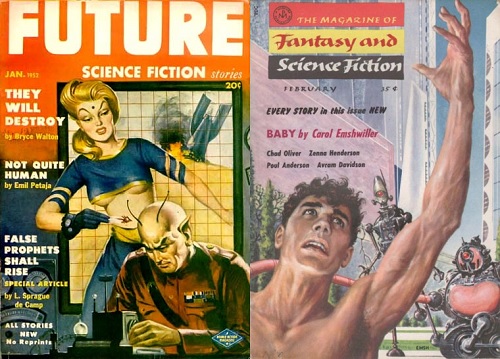
In my New Jersey youth and in my New York days I read lots of Simak's novels.  Simak is a good writer, but I haven't read much by him since this blog sprang from my cabeza fully armed like some kind of quixotic literary Minerva because I got kind of sick of his sentimentality and his famous "pastoral" attitude.  This "pastoral" attitude, as far as I could tell, manifested itself as a belief that rural life is better than city life and the world would be better off if the only inhabitants were animals, robots and stone age Native Americans.  A good example of where Simak is coming from is his 1953 story "...And the Truth Shall Make You Free," which I read back in 2014 (the blog post at the link includes an extended version of my anti-Simak spiel.  You can cut out the middle man and read the magazine version of "...And the Truth Shall Make You Free" yourself at the internet archive in an issue of Future Science Fiction with a very effective cover that features some of our favorite things--a gun, a skull, a space suit, and a healthy-looking blond.)

Earlier this year I considered embarking on a personal Frederik Pohl renaissance, Pohl being another author whom I read a lot of in my Garden State youth, but Starburst cooled me on the idea, and "The Bitterest Pill" hasn't reignited it.  Maybe "The Fence" is going to get me to (re)read some Simak novels?  The one I have fondest memories of is Heritage of Stars, but the one I actually own is The Visitors.  Well, let's see.

"The Fence" is a story about a writer who is worried nobody will ever read the stuff he spends hour after hour laboriously researching and writing!  That is hitting a little too close to home, I daresay!

It is the far future, so far that people don't have to work for money or food, murder is almost unthinkable, and the idea of marrying a woman and having kids with her seems "just a bit obscene" to our protagonist, Craig the historian.  Craig has a machine that can view the past, and he is conducting a detailed survey of events taking place in a single acre over thousands of years.  But lately his work seems a waste of time, and his Personal Satisfaction rating (P. S.) has dipped from 120 last year to a mere 75.  (P. S. scores are reported on a ticker tape that everybody can see.)  Craig goes to see a shrink, makes little progress, goes for a walk.

On his walk Craig meet a guy who is living "off the grid."  This joker, Sherman, says that people have it too easy now, that everything is handed to them so they feel no real satisfaction.  Sherman makes his own way, growing his own vegetables, trapping rabbits in snares and catching fish on a hook--he has satisfaction because he doesn't live on handouts.  Craig realizes that he is not sure where all the free stuff like food and clothes and energy that everybody except Sherman takes advantage of comes from, and Sherman subtly guides him to clues that suggest that aliens are keeping the human race as pets, that we are the object of their contemptuous pity.

Here we have one of the few legitimately good stories I've encountered in An ABC of Science Fiction; smoothly written and with gentle jokes that are actually amusing and philosophical ideas that actually deserve respect--thumbs up!  Like so many other stories in this anthology it is a pessimistic piece that portrays humanity as defeated and deceived, but it has a seriousness and maturity about it, and leaves room for a glimmer of hope in the form of Sherman, the man who has decided to live his own life as much as he can in manly defiance of the degrading conditions he finds himself in. 


Simak is giving Brian Aldiss a run for his money in the contest of who has the best story in this anthology.  "The Fence" first appeared in Space Science Fiction and has been reprinted numerous times in various languages.

"Project Hush" by William Tenn (1954)

I've always avoided Tenn's work, I think because I have got the idea he writes sarcastic satiric joke stories like Robert Sheckley and Ron Goulart, two writers I have written off.  I am sick of parodies (when you just imitate something else, like plunking Homer Simpson down in the same milieu as The Prisoner) and I am sick of comedy that is just mean-spirited score-settling with your political or class enemies.  I saw part of a Marx Brothers movie recently, and it just seemed to be about Groucho swindling and physically abusing others with his superior wit.  Am I supposed to identify with Groucho as he humiliates people?  I'm not the kind of person who humiliates people--I am the kind of person who gets humiliated!  I was sympathizing with Groucho's victims!  I like comedy that is based on human fallibility and human relationships.  I laugh every time I see Laurel and Hardy in Block-heads or Chickens Come Home, I love I Love Lucy and the original Flintstones and the first TV version of The Odd Couple (I am told there are other versions)--I can identify with screw ups who have been defeated by life, people who set themselves impossibly lofty goals and fall on their faces in pursuit of them.

My suspicions about Tenn are more a case of my spider-sense tingling than any actual direct or indirect research.  Well, today we conduct a little research in the primary sources!

I guess you could call "Project Hush" a joke story, a satire of government and the military, but Tenn plays it straight and the jokes consist of believable events and realistic dialogue, nothing absurd or over the top.

Our narrator, and his subordinates, are academics who have been mustered into the US Army and are leading the project of building a secret base on the moon from which to protect the USA from foreign attack.  (It is not made clear how a base on the moon will protect us from the USSR or Red China or whoever better than a base in Europe or Japan or something, but might as well just go with it.)  Our heroes secretly cross the void and are setting their dome up on Luna when a recon mission reveals that there is another dome on the Moon already!  Is it aliens?  Is it hostile foreigners?  Throughout the story the narrator has stressed again and again how the Army has striven to keep its moon base effort secret, and the punchline to the story is that the other dome has been set up by the US Navy, which has its own moon base project, just as secret as the Army's.


Marginally good; all the military and technology stuff feels real, as if this were a hard SF story, which I guess it kind of is, and as I have suggested the comedy stuff doesn't distract you from the story.  Maybe I have been unfair to Tenn and should look for more stories by him in my anthologies.  Originally appearing in Galaxy, "Project Hush" has been reprinted many times in compilations of short-shorts and anthologies of humor pieces, as well as Tenn collections.

"The Finer Breed" by Helen M. Urban (1956)

Urban has only six stories listed at isfdb.  After its initial printing in F&SF, "The Finer Breed" only ever appeared here in An ABC of Science Fiction.

"The Finer Breed" appears to be a spoof of advertising, TV and popular psychology, in particular specific verbal strategies or tics emerging at the time it was written.  The sometimes odd grammar and syntax of the story related to use and overuse of comparatives and superlatives (a lampoon of advertising verbiage and its alleged malign influence on ordinary people's grammar, I guess) make the story clunky to read, and its apparent reference to cultural trends from 15 years before I was born shook my confidence that I was really grasping what was going on.  Maybe Urban is referring to a specific TV commercial or ad campaign with which I am not familiar?

Anyway, in the future, government institutions have their own TV channels and ad campaigns—the captain of the police station at the center of this story, Northwest Station, ruefully monitors the TV commercials and programs of a rival station, Center Station, and considers that his station needs a better slogan.  These police organizations don't seem to be dedicated to deterring thievery and murder like we (vainly?) hope today's police are but rather to providing psychiatric services to people who self-diagnose mental problems and call the government up to voluntarily commit themselves to confinement for such infractions as “self expression.”  (Maybe this story is also about the conformity we always hear about when people complain about the 1950s.)  The "clients" who call up describe themselves in the same way people reporting a crime in detective and police fiction always describe a perp: "White; blue eyes; brown hair. five foot nine...."  The squads that collect these clients put on make up and are accompanied by a TV crew so their exploits can be .  (Maybe this story is goofing on the prevalence of TV shows about doctors and police?) 

The twist ending of the four-page story is that the captain of Northwest Station breaks the strange grammar rules of this future and has himself committed.

This story was annoyingly opaque the first time I read it and I was ready to give it a thumbs down, but on a second, more careful, read I think I sort of get it.  I didn't really enjoy it, but maybe somebody more familiar with the cultural artifacts or phenomena which Urban is parodying here might find "The Finer Breed" an amusing or interesting historical document.  Let's call it acceptable.

**********

A much better batch of stories than the last one.  In our next episode we'll finish our odyssey through the alphabet as represented by SF authors selected by Tom Boardman, Jr.

Sunday, September 9, 2018

N, O, P & Q: ABC stories by Alan E. Nourse, Chad Oliver, Fred Pohl and Frank Quattrocchi

We're working our way through the alphabet here at MPorcius Fiction Log, reading British editor and publisher Tom Boardman, Jr.'s 1966 anthology An ABC of Science Fiction in its American paperback edition.  Today we tackle N, O, P, and Q.  So far An ABC of Science Fiction has been dominated by joke stories and denunciations of human violence, mendacity and bigotry; let's see if these trends continue.

"Family Resemblance" by Alan E. Nourse (1953)

A year ago I read Nourse's pessimistic humor story "Nize Kitty," an experience which leads me to expect we've got another jocular downer on our hands here.

This story starts with a practical joke.  Three young doctors, stressed out by the long hours in the hospital where they are interning, get a little recreation by putting a piglet in among the newborn brats in the maternity ward, thereby intending to scare the unintelligent but pretty nurse on duty.  The nurse faints--mission accomplished!

By chance an anthropologist, Dr. Tally, is on the scene.  This college prof is suffering under the tyranny of the head of his department, a Dr. Hogan, who Nourse again and again reminds us is fat and looks like a pig.  Hogan is writing a book that seeks to prove that human beings are primates related to the apes, and makes his subordinates like Tally do all the real work on the book.  (In my experience this is actually how academic work is conducted, so Nourse gets realism points here.)  The unfolding of the joke gives Tally an idea that will destroy Hogan and further his own career.

Basically, Tally argues that perhaps man is descended not from apes but from swine.  He gets together the Board of Trustees (five skinny old men) and Hogan and takes all six men to the maternity ward.  What they see makes Hogan faint and convinces the trustees that Hogan is unreliable and that Tally's prima facie absurd theory deserves to be investigated.

I'm giving this story, a ten-page fat joke, a thumbs down, but I note that it follows the forms of a traditional SF story.  It is about science, and is one of the few stories in An ABC of Science Fiction that actually has some real science in it, as Nourse devotes over a page to the similarities between pigs and humans.  Like so many old-fashioned SF tales, the plot is resolved via intelligence and trickery.  Following this traditional SF template as it does, it makes sense that "Family Resemblance" appeared first in Astounding, the old SF magazine we most associate with hard core science and engineering.  "Family Resemblance" would reappear in Nourse collections and anthologies of SF about doctors and mutations edited by famous anthologist Groff Conklin.   

Click to read the fine print--whoever composed the cover text of Adventures in Mutation loved
to write "etc." and you don't want to miss that.
Whoa, we're almost back in
1940 Horror Stories territory
"Final Exam" by Chad Oliver (1952)

From a story about anthropologists to a story by an anthropologist, Chad Oliver.  We can usually count on Oliver to decry our modern industrial society and advocate living like a primitive in harmony with nature; let's see if old Chad is running true to form in this story selected by Boardman.

In "Final Exam" we have a sort of anti-imperialist wish-fulfillment fantasy in which the colonized primitives turn the tables on the colonizers.  Decades ago Earthmen colonized Mars.  The native Martians have almost disappeared; it is theorized that they died from Earth diseases. (The Earthling characters explicitly liken the taciturn and stoic Martians to Native American Indians, while also saying, again and again, in an echo of Rudyard Kipling, that the natives are like children.)  The plot consists of vapid tourists and academics on a field trip on Mars, visiting a sort of ranch where some of the few remaining Martians work. After eight pages of the humans acting dumb and callously we get our climax when these doomed Earthers are witness to the old switcheroo!

(The old switcheroo, as I call it, when a German U-boat captain is punished in Hell by having to sail on an Allied merchant vessel as it gets torpedoed or when a guy who torments spiders gets caught in the web of a kaiju-sized spider, is one of my least favorite literary devices.)

You see, most of the Martians, millions of them, have been hiding in caves--the small number of visible Martians who work at unskilled jobs for humies are spies.  The Martians may have been technologically backward when the Earthman first arrived, but by employing their mind-reading powers and their superior intelligence, the natives of the red planet have become experts on Earth technology, and the hidden Martians have been able to build a fleet of rocket ships and an arsenal of ray guns that are better than their Earth models!  As the story ends we can be confident that the Martians are going to exterminate most of the human race and keep a small number of us alive for their amusement!

Oliver makes his use of the switcheroo obvious by having the Martians, formerly silent but verbose now that they have the whip hand, repeat mockingly to the doomed humans all the bigoted things the Earthers said about them earlier in the story.  Oliver also makes it clear that we are not supposed to think poorly of the Martians or sympathize with our fellow homo sapiens—all the references to children, students and (despicable) teachers tell us that if the Martians do anything bad it is because we have taught them by example to be bad, and whatever they may do to us, we deserve it.

I was surprised by the cataclysmic ending to "Final Exam;" I was expecting it to just be one of those Ray Bradbury things in which it was sad that the Martians were going extinct but it was inevitable; maybe the Martians would kill a few explorers or colonists, the way in real life Indians massacred a few frontier settlements and defeated Custer, but they were doomed in the long run. Instead, we get a thing like Michael Moorcock’s Land Leviathan in which black Africans build a land battleship and conquer Europe and America.

"Final Exam" is heavy-handed and over the top, and I can’t cheer on Martians as they destroy Earth civilization (I wouldn’t cheer on Indians who destroy the United States or Africans who destroy Western Europe, either) so this one gets a thumbs down.

This is the best scan I can find of the front cover of the British edition of The Best from Fantastic,
but I didn't want you to miss out on another "etc."
"Final Exam" first appeared in Fantastic, and was reprinted in Amazing in 1965 and in the 1973 anthology The Best from Fantastic. 

"The Bitterest Pill" by Frederik Pohl (1959)

Frederik Pohl, important SF editor, writer and memoirist, got "The Bitterest Pill" in Galaxy during a period in which he was more or less editing the magazine himself ("ghosting" is the word Pohl uses in The Way the Future Was) because the official editor, H. L. Gold, was suffering psychological problems.  (Gold sounds like a real neurotic Jewish New York character--scared to leave his apartment, going through a divorce, yelling at his writers, fraudulently awarding victory in a writing contest to his cronies, etc.  Malzberg should write a roman a clef about this dude's inner life and his difficult relationships with women and writers.)

The plot of "The Bitterest Pill" is as follows: a baby boy takes pills that “weaken” the “blocks between cell and cell in your brain;” this renders him a super genius and in short order he makes himself emperor of the USA. This plot takes up like two pages, and Pohl tacks on like nine pages of sitcom/soap opera stuff that at times feels gratuitous.

The story starts with a complaint about what we would now call "income inequality"—what kind of world are we living in when our narrator, who spends his time in an air conditioned building, has more money than the cop who protects him, a man who spends his days out in the heat sweating?  (Wikipedia quotes Pohl as saying Gold wanted SF to be "relevant.")  Our narrator is Harlan Binn.  A few years ago Binn’s fiance Margery left him at the altar and ran away with scruffy and erratic scientist Winston McGhee.  After six months she returned, and Binn forgave her and married her.  (This is what I am calling "soap opera stuff.")  The couple live in Levittown, the prototypical suburb and the kind of place city boy pinko Pohl can be expected to detest.  The importance of this detail is reflected in the fact that when "The Bitterest Pill" was reprinted in the 1961 Pohl collection Turn Left at Thursday and the 1975 collection The Best of Frederik Pohl it appeared under the title "The Richest Man in Levittown."  How did Binn become the richest man, you ask?  After his marriage to untrustworthy Margery, Binn's uncle, some kind of big wheel in the petroleum industry in the Middle East, died and left Binn a fortune.

As our story begins Harlan and Margery are having a hell of a time handling their little kids and all the letters and telephone calls from people wanting to borrow money or sell them junk. Their baby boy eats dog food and puts a graham cracker in his ear and so forth.  (This is what I am calling "sitcom stuff.")  Then McGhee reenters their lives, asking them to finance his new invention, those intelligence pills. (Margery obviously is still attracted to McGhee, fixing her hair and changing into sexy clothes and so on--a fusion of soap opera and sitcom stuff?)  The baby, who, as we have seen, puts everything in his mouth, gets a hold of the pills and then becomes a genius and takes over America.  The body of the text is mostly the contentious meeting with McGhee and the juggling of the brats--we are just told about the baby's conquest of America in a tiny bit at the end.

I guess the point of this story is that the world is unfair and people are all selfish jerks, and that nobody earns big money--the rich got rich via swindles or dumb luck.  (Smart people are not to be trusted because their smarts just give them the power to swindle others.)  I suppose this is what we should expect from Young Communist League alumnus Pohl and from editor Boardman, who is filling this anthology with pessimistic stories and joke stories. This particular work of pessimism full of weak jokes is getting a thumbs down.


"The Bitterest Pill" was actually made into an episode of Tales from the Darkside in 1986. If the viewer reviews at IMDb are any guide, the episode is not a fan favorite.

In May I spotted a foreign language version
of F&SF
with a version of this image on its cover,
but quite different contents
"He Had a Big Heart" by Frank Quattrocchi (1955)

I feel like I'm being a real hard ass today--three negative reviews in a row!  Maybe I'll like this story by Quattrocchi, who has eight short fiction credits at isfdb ("He Had a Big Heart" is the last one) and it will provide an opportunity for me to display the true core of my personality, the real me as it were, which of course is all sweetness and light.

In keeping with the tone of this anthology as a whole, "He Had a Big Heart" is a story about petty criminals and is full of jokes.  Our narrator is Bailey, a guy who hangs around with a bunch of other lowlifes at a bowling alley.  One of these lowlifes is Bailey's brother Dave--Dave makes a habit of stealing the narrator's unemployment checks and skipping out when it is time to pay the rent on the apartment they share, so when the narrator learns his brother has been shot through the heart by a jealous boyfriend while in bed with a young woman, it doesn't faze him.

Dave's heart was destroyed by the bullet, but Dave is still alive, having been hooked up to an experimental artificial heart, a machine I guess the size of a desk.  (The story takes place about the time it was written--news about Dave's remarkable survival vies for space in newspapers with news about Marilyn Monroe's nude calendar photos--these photos were one of the big stories of early 1952.)  The plot of the story is a mishmosh of the consequences of Dave being the first person to benefit from the experimental device: there is the question of whether the guy who shot Dave can be tried for murder when Dave is still alive; the artificial heart's inventor suggests he wants to unplug poor Dave so he can use the machine on the philanthropist who financed its development, who has heart trouble himself; Dave becomes a cause celebre and considers running for president, and is in some vague way involved with organized crime.  Quattrochi doesn't explore these plot threads in a way that I found very satisfying, they just fizzle out indecisively. 

The ideas behind this story, and the deadpan humor of a callous narrator who doesn't care if his ne'er-do-well brother lives or dies*, show potential, and maybe this could have been a good story if it had gone through some revisions.  (Genre fiction pros would perhaps have advised Quattrocchi to "run it through the typewriter one more time.")  "He Had a Big Heart" is a disappointment, but I am going to have a heart myself and judge it barely acceptable.

After its first appearance in F&SF, "He Had a Big Heart" only ever appeared in one other venue, here in An ABC of Science Fiction.

*Bailey is like the opposite of Rael, the protagonist of Peter Gabriel's masterpiece The Lamb Lies Down on Broadway.

**********

Don't you believe it!
Oy, this was a rough batch.  I wouldn't have bought or started reading this anthology if it had been advertised as a bunch of humor pieces and pessimistic satires.*  The come-on text on the first page makes no mention of the book being a downer or a would-be yukfest--in fact, it tries to convince you that the anthology is going to showcase variety--"All of SF's contemporary modes are utilized...." Sheesh!

Well, I'm committed to this mission to the bitter end!  Four more stories handpicked by Tom Boardman, Jr. in our next episode!

*If I had known that the anthology Boardman edited before this one was called The Unfriendly Future maybe I would have stepped back from the brink. 

Thursday, September 6, 2018

I, J, L, M: Stories from ABC by Washington Irving, Laurence M. Janifer, Fritz Leiber and Walter M. Miller, Jr.

It's four more stories from An ABC of Science Fiction, the 1966 anthology of SF stories edited by Tom Boardman, Jr.  I have the 1968 US paperback from Avon.  Because I read it in 2014, I'm skipping the K story, Damon Knight's "Maid to Measure," a brief joke story vulnerable to charges of sexism, of perpetuating the dumb blonde stereotype, and (worst of all) of not being funny.

"The Conquest By the Moon" by Washington Irving (1809--this version 1955)

Remember when people were taking public domain works by iconic writers from the Georgian and Victorian past like Jane Austen and Charlotte Bronte and filling them with zombies and other faddish genre elements?  (Are they still doing that?)  Well here's an "updated" version of a work by an early 19th-century literary icon in which the included genre elements were part and parcel of the author's original version!

In 1955 Anthony Boucher included in F&SF a condensed selection from Washington Irving's satire A History of New York From the Beginning of the World to the End of the Dutch Dynasty entitled "The Conquest By the Moon."  Boucher credits leftist folk-singer Lee Hays with alerting him to this pioneering example of invasion-from-space speculation.  This adapted fragment of Irving's book hasn't been reprinted very often; maybe Boardman resorted to it because there are not many SF writers whose names start with an "I," or perhaps Boardman just likes stories that try to be funny while denouncing white racism and the human propensity for violence.  Whatever the case, it's time for me to get edjumakated because everything I know about Washington Irving up to now I learned from cartoons.

"The Conquest By the Moon" is more like a sarcastic essay than a story with a plot or characters.  First, Irving points out, in ironic parody, the weakness of the moral claim of European colonists to the New World.  Then he pulls the old switcheroo on us: how would the people of England, France and the United States like it if the inhabitants of the Moon, green cyclopes who find our white skin and lack of tails disgusting, came to Earth and used their "concentrated sunbeam" weapons to force us to renounce Christianity and abandon our cities to live on reservations in inhospitable Arabian deserts or icy Lapland?

Like Samuel Johnson's Idler No. 81, from 1759, this is an interesting historical artifact that documents Georgian era criticism of British and French imperialism in the Americas, but it is not really a work of fiction.  For SF fans "The Conquest By the Moon" is perhaps interesting for its depiction of extraterrestrials whose biology differs radically from our own and their high tech weaponry--"concentrated sunbeams" sounds a lot like the ray weapons that are a staple of SF.

I guess we'll call this acceptable.

"In the Bag" by Laurence M. Janifer (1964)

I recently read Janifer's Slave Planet, and here he is again. Unfortunately, "In the Bag" is one of those short shorts that is supposed to be funny.  This one employs the same gag used by Phillip Jose Farmer in his short short "The King of the Beasts," letting us think, until the end of the tale, that alien characters are humans.

Through an unlikely mix-up an alien emigre and rebel who is running a laundry service on Earth reveals himself to a customer whom he believes to be a human; the customer turns out to be an agent of the secret police of the government the disguised launderer is rebelling against.  This story may be a spoof of the strange phenomena we see in Edgar Rice Burroughs-type lost race stories in which the lost race consists of brutish men but sophisticated and sexy ladies--here Janifer posits a race of aliens the male members of which effortlessly pass as Earthmen while the women have five arms and three breasts and a foot like a slug or snail's.  "In the Bag" may also suggest that those who rebel against tyranny often turn out to be little or no better than the tyrants they oppose--the launderer is willing to kill the customer before the customer reveals he is also an alien.

Barely acceptable filler.  After seeing print first in F&SF, "In the Bag" reappeared in a collection of Janifer stories put out by our friends at Belmont as well as in several foreign magazines and anthologies.

"X Marks the Pedwalk" by Fritz Leiber (1963)

When I was in academia there was a lot of complaining among my leftie colleagues about suburban sprawl and white flight.  (Many of these carpers, of course, indulged in all the sins they deplored when committed by those of their fellow white Americans who had the misfortune to work in the private sector instead of within the taxpayer-funded walls of the academy, like owning houses in the suburbs, evading NYC taxes by claiming their summer home in the Hamptons was their primary residence, sending their offspring to private and/or suburban schools, etc.)  "X Marks the Pedwalk" by Fafhrd and Grey Mouser chronicler and Grandmaster Fritz Leiber is about the suburban-urban divide, though set in Los Angeles, that center of American car culture, instead of my own old stomping grounds of New York, because in Leiber's story that social divide is manifested in the conflict between motorists and pedestrians.     

"X Marks the Pedwalk" is also one of the joke/satire stories with which An ABC of Science Fiction seems to be infested, and as such its plot is a little absurd and the story full of absurdist jokes.  La-La Land, an environment characterized by a steadily decreasing level of sanity, is divided between the hoity-toity suburban Wheels and the slum-dwelling Feet--the Government tries to maintain order and avoid taking sides.  Leiber hints that the situation of LA is like that of Paris during the French Revolution, and it is apparently normal for drivers to run over pedestrians who can't scurry off the street in time, and for pedestrians to heave bricks at or lay spike traps for cars.  At the start of the story one clash between pedestrians and motorists leads to four fatalities, and sparks a heightening of hostilities.  Luckily, the leaders of Wheels, Feet and Government get together to hash out a deal which limits the sorts of weapons that can be used and defuses the tense situation, diminishing if not eliminating the violence of the long-running low-intensity conflict.

Leiber is a good writer, and this is a good story; the action scenes are good and the jokes (like the suburbanites' posh hyphenated names) add to the story, conveying informationand setting tone, instead of distracting you from it.  I had some deja vu reading this piece; I think I may have read it, or part of it, before.  "X Marks the Pedwalk" is an acknowledged inspiration for the Car Wars game, the early editions of which I played back in my school days, and maybe I encountered it in connection with that?


"X Marks the Pedwalk" made its debut in the first issue of Worlds of Tomorrow, an irregularly published magazine edited by Frederik Pohl for most of its run.  That first issue looks pretty good, with lots of big names--besides Leiber and Pohl there's Keith Laumer and Arthur C. Clarke on the writing side and Virgil Finlay, Wallace Wood and Jack Gaughan on the illustration side.  The story has been reprinted quite a bit, including in some anthologies marketed to fans of mysteries and horror, which I thought was interesting, as it is by no means a traditional mystery or horror story.

"No Moon for Me" by Walter M. Miller, Jr. (1952)

Here's the first story in An ABC of Science Fiction from Astounding.  "No Moon for Me" doesn't seem to have been as successful as many of the stories we've already looked at from this anthology, only having been reprinted in one other anthology, William Sloane's 1953 Space, Space, Space, which has a nice wraparound cover.

Colonel Denin has spent his career trying to convince the Congress to finance manned space exploration, and Congress has always refused to make the long-suffering taxpayers shoulder the extraordinary expense.  After all, what is the point of going to space?  There's nothing up there we don't already have down here!

But today, September 9, 1990, Denin and two other men are boarding a rocket to the Moon!  You see, a few years ago an indecipherable transmission, obviously artificial, started coming from the Moon, and Denin, a pilot, and an academic linguist are going to Luna to investigate!

I admit that I have read so much Malzberg that I have Malzberg on the brain, but I think I am perfectly justified in seeing Malzbergian elements and themes in "No Moon for Me."  These elements and themes:

1) The lack of public support for the space program.

2) The rocket ship carries nuclear weapons in case of trouble with aliens.

3) An astronaut (the fat college professor) goes insane on the trip to Luna, and Denin has arguably been insane for years: the transmissions from the Moon are not from aliens, but from a transmitter Denin himself secretly sent up there in an unmanned drone rocket, a scheme to trick the US government into financing his trip!  If that doesn't make you question his sanity, there's this: Denin plans to detonate the nuclear weapons so he and all the evidence of his scam (and two innocent people!) are destroyed, and the people of Earth will think a battle took place and be inspired to set up a permanent military base on the Moon and explore the universe in the interest of security!

How Denin and company's trip to the Moon is resolved is reminiscent of traditional adventure fiction, with people holding guns on each other and tying each other up, etc.

I like this one; I don't know why it isn't included in any of the Miller collections that have appeared over the years.  Maybe it is unrepresentative of Miller's work?  (I have read very little of Miller's oeuvre, so I can't judge such things.)  Maybe people think the plot twists are too obvious or too unbelievable?


**********

I'm halfway through An ABC of Science Fiction and I think I can detect some trends.  First, there are lots of brief joke stories--maybe a page limit forced Boardman to include many such stories if he wanted to present 26 total.  Second, the general tenor of the stories chosen by Boardman is very pessimistic, quite misanthropic.  There are plenty of stories denouncing white racism and the human propensity for violence; stories in which humans make bad choices, get outwitted or get defeated; stories that predict things will get worse in the future; and stories whose protagonists are criminals or fraudsters or the agents of tyrants.  There is a dearth of stories that exhibit hope for the future or celebrate man's ability to overcome adversity or anything like that.  Boardman seems to have deliberately constructed a book that is a downer!

Well, at least none of the stories in this batch (because we skipped Knight's contribution) were actually bad.  Hopefully the next batch will be at least as good--and maybe we can hope there will be at least a gleam of optimism among them?     

Tuesday, September 4, 2018

ABC Part 2: Carol Emshwiller, Philip José Farmer, Daniel F. Galouye, and Harry Harrison

Let's read four more stories from Tom Boardman Jr.'s strange 1966 anthology, An ABC of Science Fiction, which prints 26 stories, each story written by a writer with a different last initial.  This time we've got stories from two Grandmasters with whose work I have some familiarity, Philip José Farmer and Harry Harrison, and two people whose work I don't believe I have read before, Carol Emshwiller and Daniel F. Galouye.

There's Myra and her creepy kid!
"Day at the Beach" by Carol Emshwiller (1959)

In the introduction to An ABC of Science Fiction, editor Boardman apologizes because there are only two women represented in the anthology.  Here's the first of the two, Carol Emshwiller.  Emshwiller's wikipedia article is pretty short, reminding us that her husband was important SF illustrator Ed Emshwiller (AKA "Emsh") and quoting Ursula K. LeGuin who heralds Emshwiller as a "consistent feminist voice."  Hopefully "Day at the Beach" isn't going to be a lecture on how I sit incorrectly on the subway and don't do my fair share of the dusting.

Four years ago there was a nuclear war (I guess) and Myra and Ben, a married couple, were among the survivors.  Neither of them has any hair, not even an eye lash!  What they do have is a three-year old son, the only child in the vicinity, apparently; it is hinted that the kid is a mutant, maybe a cannibal!

Emshwiller gives us vague clues as to the state of the world.  Ben "commutes" on a train during the week, and there is sometimes electricity, so I guess there is some kind of heavy industry and maybe government agencies still in operation, but there are very few cars and it seems like Ben doesn't bring money home after commuting but preserved food, and it sounds like it is common for fights over the food to erupt on the train. 

It is the weekend, and Myra talks about how before the cataclysm they used to go to the beach on the weekend, and now they just hide at home.  So they drive to the beach for the first time since the war.  At the beach they are menaced by bandits, but Ben, who was fat before the war but is now a lean hard fighter, beats the bandits' leader to death with a hammer, which scares off the rest.  Then the family goes home, Myra asserting, repeatedly, that it has been a good day.

This story is a sort of "slice of life" thing, with no flashy twist ending or shocking revelation that I could detect (I was hoping the three-year-old would try to eat the dead bandit, but he just sort of investigates it before Ben swats him away from it--Emshwiller was teasing me!)  Maybe "Day at the Beach" is meant to be a satire of bourgeois people, people who would continue their middle-class routine of commuting and going for weekend drives even after an apocalypse?  Maybe it is supposed to induce a mood, maybe horrify us by showing that a life of fighting for food and confronting child-molesting thugs and raising a monster can come to seem routine, that for Myra to retain any sanity she has to act like it is routine?  (It is perhaps significant that "It was no day at the beach," like "it was no picnic"--and Myra does actually pack a picnic basket--is a cliched euphemism for a dangerous challenge or arduous task.)

Both Judith Merril and Isaac Asimov (or likely Martin H. Greenberg) consider
"Day at the Beach" to be one of the best SF stories of 1959
"Day at the Beach" is OK, no big deal.  It is a commercial and critical success, however, having been reprinted numerous times in four languages after first appearing as a cover story in F&SF.  The effective cover illustration is by Emshwiller's own husband--the picture's composition is reminiscent of a Renaissance Madonna and Child, so maybe the story is supposed to be a hopeful one and I am totally misinterpreting "Day at the Beach" when I am thinking of it as a horror story or a satire of the bourgeoisie.  Maybe Myra's little cannibal child is going to be the redeemer of the fallen world!     

"The King of the Beasts" by Philip José Farmer (1964)

Oy, this is one of those allegedly clever one-page stories that people seem to love but which I consider a gimmicky waste of time.  Two people are in a zoo where extinct species are recreated.  We get a list of resurrected beasts--passenger pigeon, dodo, quagga, etc.  Then comes an animal so diabolical, so monstrous, so sinister, that the scientists needed special permission to resurrect one.  Of course, it's a human man, so we now know that the people talking are aliens who came to Earth after we also went extinct, no doubt because we threw candy wrappers in a creek or something of that nature.

Lame filler.  The most interesting thing about the story is that Farmer has one of the aliens (before we know they are aliens) say "You might say that man struck God in the face every time he wiped out a branch of the animal kingdom."  Is this just a trick to make us think the speakers are human, or, is this Farmer expressing his own religious belief, pushing back against the atheism typical of SF writers?  (Remember that article Farmer wrote for Brian Ash's Visual Encyclopedia of Science Fiction?)

"The King of the Beasts" was mentioned on the cover of the issue of Galaxy in which it originally appeared, and despite my distaste for it, has been reprinted many times.   

"Homey Atmosphere" by Daniel F. Galouye (1961)

Here's another one from Galaxy.  I don't think I have ever read anything by Galouye, who, wikipedia is telling me, is one of Richard Dawkins's favorite writers.  Hopefully "Homey Atmosphere" isn't going to be a lecture on how religious people are all insane and taking your kid to church is child abuse.

"Homey Atmosphere" is a traditional SF story about space travel and robots, people's reaction to machines which mimic life and whether there is any difference between "true" consciousness like you and I have and very sophisticated artificial simulations of consciousness.

Lorry is a young astronaut, and Burton an older one, on a months-long voyage exploring the galaxy, leaving a string of navigation beacons in their wake.  Their hyperdrive ship is managed by three computers which respond to voice commands; to keep the two spacemen from suffering psychological problems, the three computers have been given personalities, one that of a grumpy and forgetful old man, one an enthusiastic kid, one an attractive young woman.  When the ship starts to malfunction (perhaps because the forgetful computer has forgotten to lay in spare parts!) Burton wants to jump in the lifeboat and get back home, but Lorry is too fond of the "crew" to abandon them!  The astronauts argue over to what extent the personalities of the ship are "real" as the ship's problems increase in severity.  When the apparent risk reaches catastrophic levels Lorry and Burton finally abandon ship with the encouragement of their artificial shipmates.

I say "apparent risk" because on the last page we learn that the three artificial personalities have developed independent desires and curiosity, and their ambition is to explore the galaxy unsupervised!  All the problems with the ship were a sham designed to (humanely) get rid of the human astronauts.

An ordinary but acceptable entertainment.  Over twenty years after its original publication "Homey Atmosphere" would be the cover story of an issue of the Croatian magazine Sirius.


"Mute Milton" by Harry Harrison (1966)

Harrison has a very smooth and readable style and in my youth I read a ton of his books, and as an adult was impressed by the first two Eden books (the third, which I have been more or less planning to read for years now, awaits.)  So I have been looking forward to this one.

Harrison's work is often tendentious, attacking religion or the military or pollution or whatever, and "Mute Milton" is a heavy-handed anti-racism story.  An African-American college student from New York City, down in Mississippi, by chance meets a local college professor, another black man.  The college prof has invented a means of converting gravity into electricity--he can generate power practically for free.  The New Yorker is studying economics, and immediately recognizes that such a device could radically improve human life, but seconds later an overweight cop who is in the Ku Klux Klan murders the college professor and destroys the only working model of the device.

This is the kind of story whose point you can't argue against, but which is too over the top, too obvious and manipulative, to be effective as literature or entertainment.  There is no tension or ambiguity, the characters don't evolve, the villain is a flat caricature, etc.  It is like a homily for a child.  Thumbs down.  "Mute Milton" has been reprinted numerous times in Harrison collections, as well as in an anthology almost as gimmicky as An ABC of Science Fiction, A Treasury of American Horror Stories: 51 Spine-Chilling Tales from Every State in the Union plus Washington, D. C.--I guess there is a shortage of horror stories set in Mississippi?

**********   

It looks like today the Grandmasters gave us limp polemics bitterly denouncing humanity's failings  while the people I never read before made an effort to give us stories imbued with human feeling that press us to speculate on life in strange future circumstances.  Today our Grandmasters let us down!  Well, maybe a Grandmaster will live up to his title in our next episode, when we read another batch of stories from An ABC of Science Fiction?  Until then, Brian Aldiss, himself a Grandmaster, still has the best contribution to this anthology. 

Wednesday, August 29, 2018

1950s stories by Brian Aldiss, Fredric Brown, Arthur C. Clarke, and Avram Davidson


When I haphazardly reorganized my SF anthologies a few days ago I put aside five paperbacks containing stories by authors who interest me but which I didn't recall having read, so our next batch of posts will each tackle a selection of stories from one of those five books.  First up, a 1968 Avon paperback printing of the 1966 anthology An ABC of Science Fiction, edited by Tom Boardman, Jr.

An ABC of Science Fiction was constructed based on a goofy premise: it includes 26 stories, each by a different author, each writer the sole representative of those with his last initial.  To make this idea work somebody had to contribute something under the pseudonym "B. T. H. Xerxes" to fill in the "X" slot; "Xerxes" came up with half a page of limp limericks, and isfdb suggests it was likely Boardman himself who penned the ribald verses, or perhaps Brian Aldiss, who was already doing duty in the "A" stall.  Today we'll look at the stories by the delegates from the honorable letters A, B, C and D, Aldiss, Fredric Brown, Arthur C. Clarke, and Avram Davidson.

"Let's Be Frank" by Brian W. Aldiss (1957)

Aldiss's offering first appeared in an issue of Science Fantasy alongside stories by E. C. Tubb and J. G. Ballard, and has been beloved by editors ever since, appearing in ten different periodicals, anthologies and collections since then.

"Let's Be Frank" is a fresh take on the collective consciousness concept we see so often.  In Tudor England, Sir Frank Gladwebb's wife gives birth to an odd child, a boy who remains in a coma until he is nineteen.  At that age he awakens, looks into his father's eyes, and Sir Frank finds that his consciousness has expanded into his son's body--Sir Frank has control of both bodies as effortlessly as you or I have control of both our hands!  When Sir Frank's son Frank has a child of his own, Sir Frank finds that his consciousness expands to inhabit the body of his grandson and he now has control of three bodies.  As the decades and then centuries pass, the number of "Franks" increases, gender and ethnic differences proving to be no barrier!  Will the single consciousness of Frank spread to include every person on Earth, and then colonize the universe?

This is an idea story, and because the idea is new and compelling and Aldiss has a good writing style, I quite liked "Let's Be Frank."

"Pattern" by Fredric Brown (1954)

Fredric Brown has been on my mind recently after seeing an announcement that his autobiographical novel The Office is being reprinted by the good people at Makeshift Press.  You'll remember I enjoyed his novel Rogue in Space and his story "Puppet Show."  

It looks like "Pattern" first appeared in a hardcover collection entitled Angels and Spaceships.  When Angels and Spaceships was released in paperback it was retitled Star Shine and adorned with a beautiful Richard Powers cover featuring not only Powers's famous abstractions but a brilliant and expressive realistic male face and hand, as well as a slinky stylized female silhouette and a biplane.  Gorgeous! 

"Pattern" is a story that takes up one page, a piece of gimmicky filler.  Lots of people like this kind of thing, but I generally find these types of stories an irritating waste of time.  Anyway, in this one, mile-tall aliens land on Earth and a woman thinks they are harmless as they totally ignore us.  Then, while she is spraying insecticide on her garden, the aliens themselves start spraying something in the air high above--is the Earth the aliens' new garden and we humans mere pests minutes away from extinction?

A trifle.

"The Awakening" by Arthur C. Clarke (originally 1942, this version 1952)

isfdb is telling me that "The Awakening" appeared first in the fanzine Zenith in 1942, but then was published in a "somewhat different form...significantly revised," in Future Science Fiction Stories ten years later.  Zenith was the labor of love of British artist and SF fan Harry Turner; read all about Turner here and read all six issues of Zenith here.  I like Turner's art deco-style renderings of nudes, space craft, and Egyptian and Near Eastern bric-a-brac for Zenith and for other people's fanzines; his later work seems to consist largely of optical illusions and "impossible objects" that are reminding me of M.C. Escher.  (I find that kind of thing to be a sterile and lifeless drag, mere mathematical trickery.)

It is the future!  Mankind has conquered the solar system and built a Utopia!  But Utopia is a bore and many people are committing suicide!  Marlan declines to go the Kervorkian route, and instead does what Galos Gann did in Edmond Hamilton's 1936 story "At the World's Dusk," and Professor Jameson did in Neil R. Jones's 1931 story "The Jameson Satellite": put himself in suspended animation to be awakened in millions of years!  When Marlan wakes up we get our twist ending--man is gone and insect people have taken over the solar system!

This story is just OK, its surprise underwhelming.  I guess you could call it juvenilia.


"I Do Not Hear You, Sir" by Avram Davidson (1958)

The back cover of An ABC of Science Fiction
lists Sheckley (presumably Robert Sheckley)
 but in fact it is Clifford Simak who represents
the letter S in the text!
Davidson is something of a stylist, and he includes lots of cute names and jocular wordplay and reworked cliches in the 20th-century beginning of "I Do Not Hear You, Sir," which first appeared in F&SF.  The story begins like a crime story--Milo Anderson is a crook who is in debt to more powerful crooks ("the Syndicate") and needs money fast.  He recently swindled a collector of 18th-century objets d'art out of numerous pieces, and is scrambling to find something to sell among the stolen goods when he stumbles upon what appears to be a working circa 1770 telephone complete with a little telephone directory.  The directory is titled, "The Compendium of the Names, Residences, & Cyphers of the Honorable & Worthy Patrons of the Magnetickal Intelligence Engine;" the gag in the second half of "I Do Not Hear You, Sir" is Davidson's comedic reproduction of late 18th-century speech and writing and caricatures of War of Independence-era worthies like George Washington, Benjamin Franklin and Benedict Arnold, all of whom Milo calls on the phone, looking for help.  Nobody is interested in helping Milo, save Arnold, who transmits through time and space a little box to Milo--it contains pills with which to commit suicide.

"I Do Not Hear You, Sir," strikes me as quite similar to other Davidson short stories I have read; I guess this is a good example of what people who like Davidson like about him, the in-your-face wordsmithery and erudition and assumption of various distinctive voices.  Some people will find jokes which consist of the American Cincinnatus complaining about his false teeth and the author of Poor Richard's Almanac telemarketing Fanny Hill amusing, but while the style shows a lot of ambition, education and verve on the part of Davidson, the tale has no emotional content and the plot is contrived and nonsensical, so I didn't find it compelling or entertaining.  (I find it easier to admire this sort of thing than to actually enjoy it.)  Thumbs down, I'm afraid.

**********

We'll advance further in the alphabet in our next episode.  Aldiss is our star player so far, we'll see if anybody can unseat him.