Thursday, July 7, 2022

A Century of Noir: F Brown, G Brewer, M Spillane and B Pronzini

Welcome to our third Mickey Spillane-centric or Mickey Spillane-adjacent blog post in a row.  In 2002, New American Library published A Century of Noir: Thirty-two Classic Crime Stories, a volume edited by Spillane and Max Allan Collins, and today we'll read four of those thirty-two, tales by Fredric Brown, Gil Brewer, Spillane himself, and Bill Pronzini.  A Century of Noir actually includes a story by a fifth person who interests us here at MPorcius Fiction Log, Leigh Brackett, but we've already read her contribution, "I Feel Bad Killing You," which I blogged about (along with some other Brackett crime fiction) back in 2020.

"Don't Look Behind You" by Fredric Brown (1947)

This seems to be a well-liked tale, first appearing in Ellery Queen's Mystery Magazine and then being reprinted in numerous magazines over the years.  Those who chose to reprint it had reason to do so, because it is quite good.

"Don't Look Behind You" tells the story of a talented printer who gets mixed up in a bad crowd when a well-dressed criminal recruits him to join a counterfeiting operation.  The horrendous adventures the printer has among the criminals and in the clutches of the police drive him insane and turn him into a serial killer!  The text is actually penned by the printer, so Brown is able to very convincingly show us how insane his main character is, rather than just show us.  Another strength of the story is that it is centered on a human relationship, that between the career criminal and the naïve printer; this relationship is movingly pathetic, as the criminal, of course, is just using the printer, but the printer admires the crook and, in his mind, the printer builds up the delusion that they have a wonderful friendship--this fantasy of having a bosom comrade gives the printer, when the going gets tough, the strength to carry on, to triumph over adversity, but his triumph does not redeem or ennoble him--on the contrary, it serves only to give him the opportunity to work monstrous evil on innocent people.  

Thumbs up for this well-written and emotionally powerful tragedy.  

Verdict and Suspense are two magazines which reprinted 
"Don't Look Behind You" in the 1960s

"The Gesture" by Gil Brewer (1956)

We recently read Brewer's Backwoods Teaser; I thought all the psychological and dramatic stuff in the novel was good, but was irritated by the cop-out ending.  Fortunately, this very short little tale has a much better, much more believable ending.

A successful business owner has a beautiful wife, and he is so jealous that he has moved them out to an island so no men will be able to ogle her.  But as the story begins his wife has convinced him to let a photographer stay over a few days to take pictures of the photogenic island for a magazine.  The husband gets insanely jealous, thinking the journalist is trying to steal his wife, and plots to kill the photographer.

Something happens that makes the business guy reappraise what he has done, and he realizes he has ruined his wife's life, that he has kept her a prisoner on this island.  We readers also get an astonishing surprise--the couple have been on the island for like 50 years!  The idea that the young photographer is going to steal away an eighty-something man's seventy-something wife is absurd!  Suddenly cognizant of how silly, and how unjust, he has been, the guy takes the gun he was going to murder the photog with and commits suicide!

Thumbs up for this economical, totally convincing and quite surprising melodrama.    

"Tomorrow I Die" by Mickey Spillane (1960)  

The three Mickey Spillane stories we read for the blog post prior to the last all included lots of clue hunting, lots of the main character going here and there and talking to many minor characters, collecting all the clues with which to solve the mystery.  "Tomorrow I Die" has none of that, it is a sort of battle of wits for high stakes practically from the start to the finish.

Our narrator is riding the train through the dusty desert near the border; when the train stops briefly in a little town he gets out to get a drink.  In the bar he meets the local sheriff and the sheriff's hot daughter, who is engaged to the town's mayor.  She seems to recognize the narrator, and he explains that he used to be in movies--the young woman is starstruck as she identifies the narrator as an actor she used to have a crush on.

Bank robbers who have an elaborate scheme to loot the local bank take over the bar and hold everybody hostage.  They think that the narrator is the mayor because he wears an old-fashioned hat of the same style habitually worn by the mayor.  Using the sheriff's police car and another vehicle, the gang of crooks and the hostages travel to the bank, where the hoods get all the money, and then proceed into the desert.  The sheriff drives his own police car, and complicated circumstances arise that allow him to trick the driver of the second car into going off the road and down into a deep ravine.  That second car carried the sheriff's daughter--luckily she was thrown clear and not hurt.  That car also carried the money, which is now down at the bottom of the ravine.

By now it is night and it is too dangerous to go down into the ravine to get the dough.  The survivors end up at some isolated cabin; in the morning the crooks send the narrator and the girl back to the ravine to retrieve the cash--they have the sheriff and some other minor characters as hostages, and will slay them if our heroes don't come back with the cash in time.

The narrator and the girl run into the police and the mayor, her fiancé.  The mayor sees an opportunity in this caper to achieve fame that he can use to make his way into the governor's mansion--when the girl realizes how greedy and craven her fiancé really is, she loses all interest in him and falls in love with the narrator.  The narrator tricks the cops and the mayor into separating, directing the fuzz in the wrong direction so they won't find the crooks and hostages in the cabin, and ties up the mayor so he won't cause any trouble.

The narrator and his new girlfriend retrieve the cash, and then divide it up and secrete it in multiple hidden caches not too far from the cabin, but out of sight.  The narrator writes down where the money is and when they get back to the cabin he gives the directions to the boss of the gang.  The two most senior members of the gang leave with the page of directions to dig up the money, leaving behind their henchman to murder all the hostages.  The two crooks stumble upon the police, who outnumber and outgun them and kill them.  

Then comes the twist ending.  The narrator is not really a former actor, but a killer who looks like the actor and sometimes impersonates him.  He has had a small pistol with him the entire time and now that he faces only one foe, he is he able to outdraw and kill him.  The narrator escapes to Mexico, leaving behind the girl who fell in love with him.  

(You'll recall that Spillane's "Kick It or Kill!" and "The Bastard Bannerman" also featured main characters whose true vocations were kept a secret from us until the end of the story.)

This story is not very believable; again and again people act in ways that I found inexplicable or at least unconvincing.  It was a little hard to believe that the bank robbers had no idea what the mayor looked like.  And that the crook who frisked the narrator wouldn't discover his pistol.  (The text says he did a "professional job" of patting the narrator down, but didn't pat down his arms, so the .32 in his sleeve went undiscovered.)  And that the narrator and other hostages could keep doing things to piss off the crooks without the crooks killing any of them.  This is in contrast to the Brown and Brewer stories we are talking about today, in which everybody acts in a way that feels absolutely authentic.  Another contrast is that Spillane's story has no emotional resonance; I felt for the characters in Brown and Brewer's stories, and when those writers unleashed their plot twists I was genuinely surprised.  Spillane's male and female leads in "Tomorrow I Die" are flat and I observed what happened to them and the twist ending with only a distant curiosity.  Spillane's minor characters, like the hoods with their various psychological quirks and the insightful old man who owns the cabin (one of the odd elements of the story is the idea that real killers can recognize each other by looking into each other's eyes), are sort of fun, but like cartoon characters, not real people.

"Tomorrow I Die" isn't irritating or boring, but it isn't immersive or impressive, much less thrilling or moving.  I'll call it acceptable.

It looks like this one first appeared in Cavalier under its deadname "I'll Die Tomorrow."  In the 1980s it would serve as the title story of an anthology of uncollected Spillane tales with a cover by Jim Steranko.

"One Night at Dolores Park" by Bill Pronzini (1995)

I'm primarily interested in Pronzini as a collaborator with our hero Barry N. Malzberg, though we have read a few stories he wrote all by himself, like the crime tale "Night Freight" and three SF short shorts I thought were bad bad.  This one first saw light of day in a copy Ellery Queen's Mystery Magazine which had Pronzini's moniker in the most prominent position on its cover.
     
The intro to "One Night at Dolores Park" here in A Century of Noir argues that Pronzini is a literary genius who ignores the dictates of today's "bottom-line oriented" publishers and writes about "serious concerns" and will be respected after he is dead for chronicling "our time."  Good grief; is this going to be a detective story about welfare reform or sanctions on Iraq or war in Bosnia or Rwanda?  I lived through the '90s, I don't need to be lectured about them via the medium of a detective story.  I almost decided to skip this one, especially after I saw it was part of a long series ("The Nameless Detective"), but it is only eight or nine pages so I bit the bullet and took the plunge.

The story starts like a newspaper account of a San Francisco neighborhood gentrified by "well-off Yuppies" and then stricken by a plague of drug dealers and junkies who make the place too dangerous for decent people to walk through at night.  The narrator is staking out this neighborhood one night, sitting in his car by a park in which lurk the aforementioned drug dealers and drug addicts; he is on a job, trying to serve a subpoena to some alleged stock fraudster who is hiding out in his yuppie friend's house nearby.  

The narrator sees a woman walking--a guy in a ski mask with a pistol is stalking her!  The narrator rushes to help her, the mugger grabs at her purse and then shoots her, then shoots at our hero before  disappearing into the park.

The woman was just hit in the upper arm, so the narrator takes her to her place to call the cops and the paramedics.  She is a successful artist, her house full of her paintings comparable to those of Hans Hofmann or Burgoyne Diller--geometric abstractions, squares and triangles in primary colors.  Her husband is a failed sculptor whose many sculptures just look like blobs.  The woman describes her relationship with her husband--he is envious and jealous and they argue all the time. 

When the husband shows up the narrator immediately figures out hubby was the "mugger" based on his gait and other clues.  Our hero holds him until the cops arrive.

The theme of "One Night at Dolores Park" is that the world is in a constant state of war; Pronzini explicitly calls the relationship of the married couple "their private war," the struggle of the yuppies vs the druggies is called "Armageddon" by a cop, and Pronzini ends the tale with narrator's musings about how the world is locked in a struggle between good and evil and he is confident that good will triumph.

Acceptable.  Seeing as our lettered class and so much of our popular culture has such a positive--or at least permissive--view of drugs nowadays, and is so skeptical--even hostile--to law enforcement, especially when it comes to marijuana, it is interesting to see in this relatively recent story what amounts to an attack on drugs and an endorsement of the police.     

**********

I want to like Mickey Spillane because he seems like a fun guy (Steranko used Spillane himself as the model for the guy on the cover of Tomorrow I Die--come on, that is awesome!) and he hates the commies, but of these four stories his is obviously the least sophisticated and least technically accomplished.  The Brown is my favorite, with the Brewer second.  The Pronzini and the Spillane are about equally "fun" or "entertaining," but Pronzini's is more ambitious and polished, as well as more realistic and believable; it is also more engaged with the real world and real life, it offers opinions and theories about relationships and society--Spillane's story is outlandish, and I'm not sensing that in it he is trying to say much about life or society or whatever.  Spillane's name is on the cover of A Century of Noir as editor, and you'd think he'd choose one of his best things to include in it--did he think "Tomorrow I Die" was one of his best short stories?    

Of course, it is possible Spillane's writing is so subtle it is sailing right over my head.  We'll read more hard-boiled detective stuff for our next blog post, something by Spillane as well as stories by writers associated with the SF world, so soon I'll have another chance to see if Spillane is my cup of tea.  

Wednesday, July 6, 2022

Barry N. Malzberg: "Ship Full of Jews," "Amos" and "Improvident Excess"

Here at MPorcius Fiction Log we are working our way through Barry N. Malzberg's collection In the Stone House, published by Arkham House in 2000 and purchased by yours truly in 2021 at Second Story Books in Rockville, MD.  We are like half way through our journey, which has been chronicled in blog posts you can find at these links: 


"Andante Lugubre," "Standards & Practices," "Darwinian Facts" and "Allegro Marcato"

"Something From the Seventies," "The High Purpose," "All Assassins," and "Understanding Entropy"

Today's ports of call: the three stories from the early '90s that inhabit pages 118 to 141 of the book.

"Ship Full of Jews" (1992)

This is a sort of grim flight of fancy; we might perhaps think of it as a bad dream.  "Ship Full of Jews" first appeared in Omni, in an issue apparently full of quizzes, and later that year in Gregory Benford and Martin H. Greenberg's Alternate Americas, the fourth volume of a series of alternate history anthologies, and it offers us a surreal rethinking of Columbus's first voyage to the New World.  In this universe, Chris isn't a particularly ambitious adventurer, but has been manipulated by a flirtatious Queen Isabella, about whom he has obsessive sexual fantasies as he stalks the deck of the Pinta, to carry to the New World into exile a cargo of hundreds of undesirables and troublemakers.  The Pinta's lower decks are stuffed full of Hasidic Jews, while the Santa Maria carries across the Atlantic the worst criminals in Spain.

A representative of the Jews petitions Columbus to allow the exiles to leave the stinking crowded lower decks to get some fresh air on the upper deck; Columbus refuses.

When the scene switches to the Santa Maria we learn that Columbus has been tricked, that there is an even more sinister motive behind this voyage and a gruesome climax to the trip ahead.  Aboard the Santa Maria, among the criminals in disguise, is Torquemada, the Inquisitor!  Torquemada has made himself the desperadoes' leader, and plans to lead them in a massacre of the Jews once they make landfall in the New World--the blood of the Hasidim will serve as a sacrifice that will consecrate the New World!

There isn't much plot here, and the story doesn't make much literal sense (for example, the people we today call the Hasidim are a sect that formed in the 18th century, and it seems like everybody in the story knows the New World is there, even though no European has been there yet.)  I guess we have to see it as a literary exercise, a dark caprice or nightmarish mélange of disparate elements meant to disturb the reader by evoking thoughts of the suffering of the Jews, the cruelty of the Spanish Inquisition, the morally ambiguous nature of the discovery and colonization of the New World, etc.  Maybe some people today would be angered by what they might see as Malzberg's cultural appropriation, done with the aim of dramatizing the sufferings of his own people, of the experience of Africans brought to the New World against their will.

A strange and surprising thing, ambitious and audacious, though I can't say I can grade the final result as anything above "Acceptable"--it is not thrilling or fascinating or fun or anything like that, merely odd and curious.  Greenberg would include "Ship Full of Jews" in another book of alternate history stories, The Way It Wasn't, just four years later.  I guess he was crazy about it. 

"Amos" (1992)

"Amos" debuted in F&SF.  In her little intro to the story, F&SF editor Kristine Kathryn Rusch gushes that Malzberg "has written some of the finest fiction I have ever read," and says Barry told her "Amos" is his most "stylistically ambitious work" in years; Rusch assures us that "the ambition succeeds."

Don Winograd was a minor Jewish-born scientist or technician or engineer or something when he was plucked "from the back room" and made the chief spokesman of The Institute of the American Academic Sciences--they even gave him a stage name, adding an "n" to make from Winograd the more euphonious "Winogrand."  Winogrand now travels the country, giving talks and speeches and making countless radio and TV appearances, promoting science and the advances in knowledge and technology that will improve our lives.

But Winogrand has an inner life that is always threatening to burst out, an inner life he must suppress with all his might because if it was exposed it would end his lucrative career.  Winograd converted to Christianity years ago, and has become a religious fanatic, an expert on the Bible who even thinks of himself as a prophet and who is confident in the imminent return of Jesus!  On TV, on the radio, he often feels himself about to start shouting Bible verses!  He controls himself by looking at, by thinking about, women's breasts--the thought of breasts calms him down, allows him to keep his job.  

The story has a climax of sorts, when Winogrand finds himself in a Hasidic synagogue and starts speaking in tongues and shouting about Jesus and is thrown out violently by the Jews, and then, on the last page of the story, we learn about Winograd growing older and mellower and losing his job as spokesman and losing his "n" along with it.  Malzberg hints that the climax of Winograd's life is when he returns to the synagogue from which he was forcibly ejected, but offers no details.

A good character study of a man who has to hide his true self, as perhaps many of us feel we must, wedded to the theme that, in the modern world, science and technology play something of the same role in our lives and societies as religion and sexual desire (at one point Winogrand tells us the satellite dishes he lectures on are like breasts) though perhaps not quite so successfully.  One wonders how much of Malzberg himself is in Winograd--not that I think Malzberg is a Christian, but that he hoped to be a literary writer like Updike or Nabokov or Bellow, and ended up writing vast amounts of SF (which has a reputation as being a sort of spokesorgan for science and technology), pornography, violent action stories, and movie and TV tie-ins to make ends meet.

"Amos" is better than "Ship Full of Jews," but I guess lacked a champion like Greenberg, because it has not made multiple reappearances the way "Ship" has, only ever getting reprinted here in In the Stone House.   

"Improvident Excess" (1994)

Our last blog post was about three Mickey Spillane stories from the 1960s, and, amazingly enough, this story has a Spillane connection!  "Improvident Excess" first appeared in Murder is My Business, an anthology edited by Mickey Spillane and Max Allan Collins and published in 1994 by Dutton.  (It took me a few minutes to figure this out, as the publication page of my copy of In the Stone House has the wrong date and lead editor, and isfdb also has the wrong date, and there are several books and films with the title Murder is My Business.)     

For his story "in the hard-boiled tradition of Mickey Spillane" as it says on the back cover, Malzberg mixes his fascination with political assassinations with his interest in classical music.  "Improvident Excess" also has an air of despair, one of its themes being that we don't run our lives, that we all are following orders or otherwise at the mercy of "larger forces."

Our main character is a "political consultant" who changes the course of elections by murdering candidates; his ironic name is "Gerald Harmless."  Harmless has committed numerous such killings.  He has two contacts, one man, Curly, who meets him before each job, and a second man, Brown, who debriefs him after each job.

After one of these jobs, meeting Brown in a hotel room, Harmless realizes that Brown looks like Tchaikovsky, and he tells Brown a whole story about how the Russian aristocracy forced Tchaikovsky to commit suicide because the czar was embarrassed by Tchaikovsky's homosexuality.  Then Brown tells Harmless that Harmless must murder Curly.  Harmless resists at first, but of course he is at the mercy of those larger forces.

Meeting and killing Curly, Harmless begins to identify with Tchaikovsky--he realizes that his superiors are going to kill him--and resolves to go down fighting instead of killing himself the way Tchaikovsky did.

I guess in deference to the assignment to write in "the Spillane tradition," "Improvident Excess" is much more straightforward and easy to understand than the dreamy surreal "Ship Full of Jews" or the disjointed stream of consciousness "Amos."  The only real Malzbergian stylistic touch is that there is a lot of dialogue but none of it is set off in quotation marks.  I think we have to ask how much this story really is in the "Spillane tradition," however.  I am no expert on Spillane, but the three 1960s Spillane stories we read in our last blog post have happy endings in which the villains are defeated, making the world a better place, and we are assured the hero and his new girlfriend, their time of trial behind them, are going to get married and live a happy and fulfilling monogamous life together.  The world and the lives of individuals may be crummy in those Spillane stories,  but if you are brave and lucky, you can make things better.  Obviously, Malzberg's story here is about how America is going down the tubes and there is nothing that can be done about it, and its main character is a villain who is about to be killed.    

Acceptable.

**********

Not a bad crop; sometimes Malzberg's work can feel lazy or rushed, but these three stories all show effort and ambition.  "Amos" is actually good, and "Ship Full of Jews" and "Improvident Excess" are certainly worthwhile for Malzberg fans and people interested in portrayals of what America is all about in genre literature, and the former is interesting to those studying depictions of Jews in SF and the latter for those interested in the tradition and legacy of hard-boiled crime fiction.

Tuesday, July 5, 2022

Mickey Spillane: "'Kick It or Kill!'," "The Seven Year Kill," and "The Bastard Bannerman"

Many years ago, when I was living in New York City, I read several of Mickey Spillane's Mike Hammer novels.  I believe I read the first five or six; I am positive that I thought the fourth, One Lonely Night, the best, and stopped reading them because the fifth (and maybe the sixth) was not nearly as good as One Lonely Night.  Just recently I bought a stack of worn out Mickey Spillane paperbacks with salacious covers from the outdoor clearance racks at the Wonder Book in Frederick, MD, and feel like it is time for me to check in with Spillane again.  Let's try a collection of three non-Hammer short stories printed in 1969, The Tough Guys.  This book is pretty easy to find, and a scan of it is also available for free at the internet archive.   

"'Kick It or Kill!'" (1961)

Like David Bowie's "'Heroes,'" this story has quote marks in its title that make it look odd when you type it out.  The publication page of my copy of The Tough Guys lists the copyright of this story as "Transworld Publishers Ltd., 1963," but it certainly looks like "'Kick It or Kill!'" appeared in a 1961 issue of Cavalier, complete with an illustration of two guys whipping a bound woman.  The New Thrilling Detective Web Site suggests this story is also known as "The Girl Hunters," which is confusing, because a Mike Hammer novel bears the name The Girl Hunters as well as the film based on that novel, a film which, by the way, stars Mickey Spillane himself as Mike Hammer.

Our narrator, Kelly Smith, starts off the story (which is like 45 pages here in The Tough Guys) making a common mistake I have made myself--leaving New York City!  Listening to his doctor (another mistake!) he has said good-bye to the Big Apple for a two weeks rest on remote Lake Rappaho.  The little town there, Pinewood, turns out to be inhabited by mobsters Kelly knows from New York, as well as a hot chick who is bitter because her sister committed suicide last year by jumping out of a Manhattan skyscraper.  Outside of town, up on a hill, is a mansion, home to a secretive millionaire who got rich bootlegging; Kelly Smith, by going here and there in this town of 2,500, and--when he isn't beating people up or getting beat up--talking to people, quickly enough learns that the millionaire hires young women from Pinewood to work in the mansion and pays them big bucks to endure whippings.  Lots of perverted wealthy people come to the mansion to participate in parties that center on drug use and the whipping of these attractive young ladies, including a Soviet attaché who uses the mansion as a sort of distribution point for the narcotics with which the commies are flooding America as a means of weakening our society.

Kelly and the hot chick fall in love, and work together to bring down the evil in the mansion.  For most of the story, Spillane is cagey about Kelly's line of work--is he a criminal, or a P.I., or some kind of cop?--and near the end we learn his true affiliation.  The female lead is admirable--tough and brave--but she also acts emotionally and impulsively, jumping to conclusions and taking stupid risks without thinking them through, and one reason she falls for Kelly is that he is man enough to tell her what to do and keep her under control.  While Kelly is recovering from an injury, his reckless new girlfriend tries to infiltrate the mansion all by herself in order to kill the millionaire, and Kelly has to follow her in there to save her.  In the final moments of the story, which climaxes with the mansion going up in flames and scores of perverts, crooks and commies getting killed, we learn that the secretive millionaire is a United States senator.  

This is an entertaining trifle, competently written, paced and constructed, that perhaps will interest readers in our current era as a reflection of popular attitudes in the early 1960s about drugs, communism, corruption in Washington, and gender roles.  I guess the title refers to the importance of drug addiction to the story (as a means of controlling them, the millionaire hooks the women he hires  on drugs--what other source of drugs is there up here in the wilderness?--and the female lead initially suspects Kelly is a drug addict because he has brought morphine capsules to Pinewood to treat the pain from his healing gunshot wound) but lots of people get kicked in the story, some kicked to death, so maybe the title has a sort of double meaning.

"The Seven Year Kill" (1964)

The publication page of my copy of The Tough Guys lists the copyright of "The Seven Year Kill" as "Mickey Spillane 1964."  Galactic Central clued me in to the fact that the story has been included in various printings of a British collection of Spillane stories, The Flier, the first of which came out in '64, and also appeared in Intrigue Mystery Magazine in 1966.  (It looks like the collection The Flier has never been printed in America, and that the story known as "The Flier" in England was printed in the United States as "Hot Cat.")  

Our narrator this time around is Phil Rocca, washed up journalist.  A decade ago he wrote a terrific story, but it would have ruffled the feathers of wealthy gangster Rhino Massley and Phil's editor and publisher refused to run it.  Rhino then framed Phil and out hero spent seven long years in prison.  Now Phil spends his time drunk and hungover in a crappy Manhattan apartment, day dreaming about murdering Rhino, whom he believes is already dead.

As our story begins a hot chick takes refuge in Phil's apartment--she is being chased by killers!  After the killers beat up Phil and leave, the girl comes out of Phil's closet and tells Phil her story.  In one of those coincidences we see in fiction all the time, she is Terry Massley, the daughter of Rhino with his estranged wife; Terry grew up with Mom in California and never met her father, in fact knows nothing about him, not even that everybody calls him "Rhino."  Terry's mother just died, and when Rhino heard the news he sent Terry a letter, asking her to come to New York so he could lay eyes on her for the first time.  Wait, Rhino is alive!?  When Terry got to Gotham people started trying to kill her and she hasn't been able to make her rendezvous with Dad!  Phil can barely believe his good luck--Terry can lead him to Rhino so he can achieve his long-dreamed-of revenge!  Of course, Phil doesn't tell Terry that her father is a mobster and Phil's only goal in life is to choke the life out of this louse; he just tells her he'll help her find her Dad.

Phil travels around town, and when he's not beating people up or getting beat up by people, he is using his contacts from his reporter days to figure out if Rhino really is still alive.  There is plenty of evidence Rhino had polio and died in an iron lung in Phoenix, but Phil figures that was all faked.  Of course, maybe some guy is impersonating Rhino in order to capture or kill Terry--the criminal underworld thinks Terry might have some papers of Rhino's that could incriminate important hoods.  Phil and Terry fall in love, and Phil explains the horrible truth about her father to her.  In the second half of the 70-page story Phil heads to Phoenix to look for more clues while Terry stays in NYC and investigates a lead, hunting down Rhino's private nurse, who it seems was also his lover.   Phoenix turns out to be more like New York than you might expect, at least from Phil's POV--he talks to people in the process of collecting clues, pushes a thug around, and gets beat up--you know, the usual, just like at home.  He forces that thug to dig up Rhino's grave, and finds it empty!  Rhino really is alive!  

Back in New York Phil works with the cops and an old newspaper pal as they tangle with mobsters, and then in the climactic scene Phil rescues Terry from Rhino, who is beating her--Rhino hates women and wishes he had had a son.

"The Seven Year Kill" is fine, but it has fewer interesting themes than "Kick It or Kill!", which, however shallowly, addressed or at least mentioned the Cold War, the problem drug abuse presents to individuals and to societies, and gender roles in sexual relationships.  There are two potentially interesting character things in "The Seven Year Kill" which Spillane could have done more to develop.  First, Phil's alcoholism.  Phil's addiction to the sauce could have been a hurdle he had to overcome to achieve his vengeance on Rhino and to build a relationship with Terry, but instead Spillane perfunctorily just has Phil throw off his addiction with ease--one day he is a wretched drunk and in the space of like two days he has evolved into a healthy social drinker who can drink one glass of the stuff and effortlessly dismiss any desire for a second drink.  Maybe we are supposed to see in this astounding recovery a testament to the power of the love of a good woman, presenting a contrast to the second potentially compelling character element of "The Seven Year Kill," Rhino's misogyny.  

Throughout the story we get repeated indications that Rhino hates women and is always beating them up, leading up to the climax in which he is beating his own daughter, whom he wishes was a boy.  This misogyny doesn't jive very well with the other big component of Rhino's personality, his obsession with that nurse--much of what Rhino does in the story, and what sets the whole plot in motion, is Rhino's pursuit of the vast amounts of money he needs to keep the faithless lucre-loving nurse by his side.  Spillane tries to square this circle by having Phil say that the nurse is "the exception that proves the rule" and with the fact that the nurse has movie star good looks--she is an actress who has a nursing degree and only works as a nurse between acting gigs on Broadway and the idiot box.  All the clues indicating Rhino was a woman-hater had me kind of expecting Rhino to be gay or a woman in disguise or something like that, and I was a little disappointed that Spillane didn't do anything more interesting with Rhino's sexuality, but I guess Spillane figured he'd done those sorts of things enough already in the Mike Hammer novels and didn't want to do them again.

Speaking of repetition, the scenes of violence in "The Seven Year Kill" are good but multiple times Phil is one second away from getting shot dead and then the police arrive just in time to save him or Terry distracts the gun man just in time or something.  I know this is a staple of fiction, but more than once in a 70-page story is a little much. 

"The Bastard Bannerman" (1964)

This one made its debut in the magazine Saga.  Like Cavalier, Saga has a guarantee--readers who were dissatisfied with the magazine were eligible for a refund.  How would you get your refund?  Through the mail from the publisher?  Would they send you a 25¢ or 50¢ check?  (If you look close, you can see that Cavalier offers double their money back to readers unhappy with this month's stories about beating people up and getting beat up.)  Or would you just get cash from the news agent?  Would you have to give the magazine back to the small businessman who sold it to you so he could sell it to the next guy curious about methods of goading candy dancers or the bedroom habits of French and Arab girls?  Did anybody actually go to the trouble of getting his money back?

Cat Cay Bannerman is the bastard of the title, the illegitimate son of a rich guy who lived in a big mansion.  Cat's mother died giving birth to him, and Cat lived in the mansion as a child.  Cat's father then died, and after that Cat suffered the tyranny of his uncle Miles and his cousins Rudy and Ted.  At age  twelve Cat ran away.  Today, twenty or so years later, out of curiosity while passing through town, Cat--now a big tough guy who is packing heat--returns to the mansion.  Miles is now a pathetic old man!  Rudy and Ted are now fat!  And Cat's other cousin, Anita, who had a crush on him when they were twelve-year-olds, is now a total fox!  She has "deep purple eyes" and "her breasts accentuated the womanliness of her, dipping into a pert waist and swelling into thighs and calves that were the ultimate in sensuous beauty."  The ultimate!  And there are more surprises.  One is that there are gangsters from Chicago whom Cat recognizes hanging around the mansion.  Cat immediately beats them up in front of the Bannerman clan.  But Cat doesn't beat up the other new addition to the Bannerman household--real estate guy Vance Colby, Anita's fiancé!  Beating up Vance Colby will have to wait a few dozen pages!

Cat flits hither and thither in town, talking to people and collecting clues in between episodes of getting beaten up and beating up other people (Vance Colby is among those who get beaten up.)  One of the themes of the story is that rich people get special treatment, and, because his last name is Bannerman, doors open up for Cat that help him unravel the mystery of what is going on in the Bannerman mansion, why those organized crime figures are there.  You see, Rudy and Ted have wasted a lot of the family money on gambling, and got mixed up with mobsters in hopes of recouping the family fortunes by becoming partners with the mob in an illegal enterprise.  But a disaster occurred that has left the Bannermans at the mercy of the gangsters: there was a murder at a night club when Rudy was there, and because Rudy was blind drunk at the time he suspects the mobsters are telling the truth when they say they saw Rudy do the killing and claim they retrieved the murder weapon with his prints on it.  The gangsters want a million bucks or they will pin the murder on Rudy.

Other plot threads involve Cat and Anita's rekindled love and a femme fatale, the wife of the murder victim; this hot number dances burlesque at the night club and is a nympho who sleeps around and is very eager to seduce big strong Cat.

In some ways "The Bastard Bannerman" is better than "Kick It or Kill!" and "The Seven year Kill."  The characters and their relationships are more interesting here, and because of the love triangles (Cat-Anita-Vance Colby and Anita-Cat-nympho dancer) and a depressing unrequited lust element (Rudy is crazy for the nympho dancer but when he wangled his way into bed with her he coouldn't get it up and was humiliated) the sex side of this story is better than that of the other two.

However, the way the plot of "The Bastard Bannerman" is resolved is far less satisfying.  In "Kick It or Kill!" and "The Seven Year Kill" we get an ending in which there is a terrible bloody fight as the narrator rescues the female lead from torture and death.  "The Bastard Bannerman" uses two of literary history's lamer devices.  First, we have Cat suddenly learning he is the heir to two million bucks put onto a trust for him by his father.  Second, there is a scene in which all the characters sit in a room and Cat describes how he figured out who really murdered the guy at the night club--it was Vance Colby.  Boring!  We also learn after 60 or so pages that our narrator is a cop, something (as in "Kick It or Kill!") which Spillane has kept from us, allowing us to speculate that Cat is some kind of criminal himself or maybe a P.I.  

While the first two stories in The Tough Guys try to provide the reader catharsis by having the hero rescue his lady love and destroy his enemies in battle, I guess in "The Bastard Bannerman" we are supposed to achieve satisfaction by witnessing Cat, who was put upon by the idle rich in his youth, prove he is better than they are--he bangs the nympho with whom Rudy was unable to perform, outwits the criminals who had Rudy and the other Bannermans over a barrel, and ends the story a millionaire while the previously rich Bannermans are penniless.  

**********

The three stories in The Tough Guys are acceptable entertainments--they move at a fast pace and the sex and mayhem are diverting, and while the constant talking to people to collect clues isn't exactly thrilling, the colorful characters who wittingly or unwittingly, willingly or under duress, provide the narrator the clues he needs to get to the next scene, are sort of fun.  Spillane, at least in these stories, unfortunately fails to portray his main characters in enough depth to offer us any real human drama or real human emotion; I didn't really care who got killed or whether the narrator succeeded in his goals, the perils and the gore generated no real tension or fear, just a sort of amusement.  

Reading these crime capers set in the middle of the 20th-century, by the contrast they provide, served for me as a powerful reminder of what I enjoy about science fiction and fantasy stories.  An SF story, even an adventure one by, say, Edmond Hamilton, Leigh Brackett, Robert Howard, Henry Kuttner or C. L. Moore, the appeal of which is as much based on sex and/or violence as is that of one of these Spillane stories, almost always offers at least a thin additional layer of interest--the surprise, intellectual challenge and/or spur to stretch the imagination triggered by its speculations about future technologies or alternate social arrangements or alien biologies, or its descriptions of milieus in which the supernatural is real.  A cop busting into the mansion of a corrupt senator to rescue a woman who is being whipped pushes the same buttons as does a barbarian busting into a wizard's tower to rescue a woman from being sacrificed to an evil god or a spaceman busting into a flying saucer to rescue a woman from being experimented upon by space aliens, but wizards and aliens and spells and spacecraft are inherently more stimulating than drug-dealing senators, raise more interesting questions and paint more exciting pictures in the mind.

I'm thinking we'll read more hard-boiled detective fiction soon, by Spillane and other authors, but first a visit with the sage of Teaneck!

Saturday, July 2, 2022

Keith Laumer: "Thunderhead" and "The Devil You Don't"

The 1976 collection The Best of Keith Laumer contains nine stories, and we have already read seven of them:

Today we finish up with the book, reading the two remaining stories, "Thunderhead" and "The Devil You Don't" in the scan of The Best of Keith Laumer's 1976 printing at the world's finest website, the internet archive. 

"Thunderhead" (1967)

There's only one small town on frontier planet Longone, and it sits under a giant mountain, Thunderhead.  James Carnaby is responsible for the Space Navy's beacon on Longone, and has been for twenty years, so long that much of his equipment, including his aircraft, have fallen into disrepair.  Over all that time he has never received a message from the Navy, much less been relieved.  But tonight a message finally comes through!  It is an emergency transmission calling all Terran stations, an urgent alert about an enemy blockade runner!  All beacons must be activated!  Carnaby, no spring chicken, has to climb Thunderhead to make sure the beacon is still operational!

This is a good military adventure story, with the sorts of themes we see so often in military-oriented fiction: Duty!  Snafus!  Do the top brass care about the enlisted men and junior officers or just blithely send them off to be massacred?  Do the top brass even know what the hell they are doing?  Do the soldiers on opposing sides actually have more in common with each other than with the civilians in whose name they are killing each other?  I don't know if we want to count "Thunderhead" as space opera or as hard sf, but it has plenty of the stuff we love from those subgenres, like space suits, ray guns, FTL, hostile telepathic aliens and three or four different space craft, and Laumer does a good job with all of it. 

The human drama of "Thunderhead" is centered on Carnaby, a man who has devoted his life to the Space Navy and in return been given a boring dead end job and then totally abandoned.  But we also spend time in the Terran space warships pursuing the spider-like aliens in their blockade runner, and in the actual spider-freakos' ship.  The spider peeps have developed some new weapons and propulsion systems, so even though their ship is a "converted tender" it can still give the Terran ships of the line a run for their money.  Even more alarmingly, the blockade runner carries what amounts to an egg sack with a bazillion spider babies in it that can spread the  arachnid menace to new sectors of the galaxy.  Laumer, through the spider people's dialogue rather than through exposition, sketches out a whole culture for these aliens, one obsessed with fate that prizes epic poetry.   

Accompanied by a 17-year old who admires him and who himself wants to join the Navy, Carnaby makes the treacherous climb up the mountain in a blinding snow storm.  In the scenes on the Terran naval vessels we learn why Carnaby has been left alone for so long, and in one of those coincidences we see in fiction all the time, the commanding officer of the Terran flotilla in this sector is Carnaby's brother, who has thought Jim dead for twenty years!  The naval officers direct James Carnaby to send a transmission that should attract the spider men to Longone.  Will the scheme work?  If Carnaby has to fight the spider peeps, will he survive or die in battle?  And what about that 17-year old?--I wonder if maybe he shouldn't have brought his asthma medicine with him for this climb up a nine-thousand-foot mountain in a blizzard.

Laumer handles the military stuff and the SF stuff well here--thumbs up for "Thunderhead!"  The tragic tale of Lieutenant James Carnaby debuted in Fred Pohl's Galaxy, in the same issue that saw the debut of Kris Neville's "Ballenger's People," a story about mental illness and democracy I read and blogged about back in 2015.  Laumer's story, which is pretty long but moves fast and feels just the right length, has been republished in multiple collections of his novellas and novelettes.


"The Devil You Don't" (1970)  

"The Devil You Don't" first saw print in an Anne McCaffrey anthology of original stories, Alchemy and Academe.  I guess people like AaA, as it has been reprinted quite a few times.  Personally, I am skeptical; after relishing the super serious nature of "Thunderhead," I am worried "The Devil You Don't" is going to be a joke story; after all, it was included in the 2002 collection Keith Laumer: The Lighter Side.

Professor Dimpleby has a sexy wife who wanders around half naked even when there is company because she grew up in Samoa, her parents missionaries.  Today the company she is embarrassing by flaunting her impressive mammaries is none other than the Devil himself!  Satan embarrassed by female nudity?  It's true!  You see, as Lucifer explains, he is not really evil, like they are always saying he is, he's just a shy nice guy!  Lucifer doesn't actually want to trick you out of your soul, and he's opposed to murder and theft and all true evil.  The fact is, the powers that be have blackened Lucifer's reputation because he is a fun-loving guy, and the prudes in charge of heaven are against fun, and have declared most fun activities to be sins.  What we call "sins," Lucifer further explains, aren't really evil, just forms of fun that go against social norms. 

A large proportion of this story consists of feeble risqué jokes (to prove he really is the Devil, the Dimplebys' visitor summons a demon and said being has a huge penis and huge feet) and boring exposition about the nature of sin, Heaven and Hell that turns conventional Abrahamic thinking on its head--Hell isn't such a bad place, God is a pain in the ass, the Vikings and the Ancient Greeks had a more accurate view of the afterlife than do Christians, etc.  The plot concerns how aliens are invading Hell and messing with the laws of probability, so that everybody in Hell has bad luck.  This bad luck is starting to bleed into our world, causing a lot of slapstick accidents that Laumer describes at length (a guy trips, this causes another guy's mustache to be caught on fire, a third guy tries to put out the fire but the water hits a fourth guy in the face, etc.); we also get long stretches of pseudoscience babble dialogue about the particle physics behind entropy and probability.  Satan has come to Professor Dimplebys because he is an expert on particle physics, and the plot is resolved through diplomacy, convincing the invaders to eat a different kind of subatomic particle.

An irritating waste of time with terrible pacing and a poorly constructed plot that just serves as a frame upon which to hang lame jokes and weak criticisms of Christianity.  Did Laumer write this thing with the market of twelve-year-old boys who had just embraced "the Playboy philosophy" in mind?  


**********

Quite divergent reading experiences today, but part of the excitement of reading these old books is that you never quite know what you are going to get.  Stay tuned to MPorcius Fiction Log for more surprises.

Thursday, June 30, 2022

R A Lafferty: "What's the Name of that Town?," "Hog-Belly Honey," and "The Hole on the Corner"


Let's read three more 1960s stories by R. A. Lafferty that were included in the 1970 collection Nine Hundred Grandmothers.  Over the years, we've already talked about quite a few stories from the collection, including "Slow Tuesday Night," "All the People," "Through Other Eyes," "The Six Fingers of Time," "Snuffles," "One at a Time," "Land of the Great Horses," "Thus We Frustrate Charlemagne," "In Our Block," "Seven-Day Terror," "Name of the Snake," and "Ginny Wrapped in the Sun."  After today's three, we will be pretty close to having covered them all.  We may live to see such a day, my friends!

"What's the Name of That Town?" (1964)

It is the year 2000.  The eggheads at the Institute set one of their most powerful computers, a machine with a reputation for telling jokes and concocting hoaxes, a difficult task: "seek to discover something not known to exist, by a close study of the absence of evidence."  The supercomputer uncovers a number of odd anomalies--two examples: young bears are called "pups" nowadays but there are hints they were called something else in the past; there is a mysterious extra space lying between two words in an Hungarian encyclopedia--adds them up and makes a startling discovery.  Back in 1980 a Midwestern American city of seven million people was totally destroyed, and everyone in the world resolved to forget this heartbreaking catastrophe--to that end one of the scientists at this very Institute invented a marvelous machine that erased every reference to the city and the disaster from recorded history!  In addition, a hypnotic signal was broadcast throughout the world that made everyone suppress the memory of the town and cataclysm.  When the computer reveals to the collected scientists that once there existed a city named Chicago and it was wiped out, and they were essential parties to the suppression of the memory of his horror, the hypnotic effect is so powerful the scientists refuse to believe it, thinking the machine is playing an elaborate joke on them.

A fun little tale, and our second joke about the Chicago Cubs in less than a month (the team was the butt of a joke from Fred Saberhagen in his novel Love Conquers All, you may recall.)  The story raises an interesting question--do we, in real life, actually try to forget historical calamities, wars and revolutions and plagues and so on?  Or do we endlessly memorialize them, even build our identities and political programs around them?  Maybe we strive to remember some disasters and forget others?  Is Lafferty spurring us to consider whether forgetting terrible events is a good or bad idea, or just sort of riffing on the standard SF idea that we see so often in Lovecraft- and Howard-style fiction that the human race has forgotten a past full of strange human civilizations as well as aliens and magic or whatever?

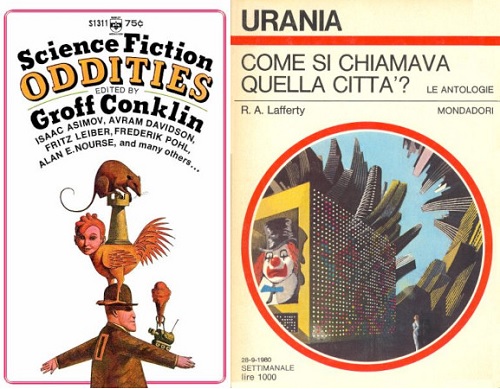
"What's the Name of that Town?" first appeared in the same issue of Galaxy in which editor Fred Pohl  dared to present to the public "The Children of Night," a story by Fred Pohl which I recently denounced as lame.  "What's the Name of that Town?" would go on to appear in Groff Conklin's anthology Science Fiction Oddities, and in the souvenir book, Fantastic Chicago, put together by Martin H. Greenberg for the 1991 SF Convention held in the Windy City.  A final fun note: An Italian Lafferty collection based on the contents of Nine Hundred Grandmothers took "What's the Name of That Town?" as its title story and bearing a Karel Thole cover illustrating the story with the images of a clownish computer and a distorted Chicago skyline.  Karel Thole is like a hero; not only is he an able artist when it comes to line, color and composition who works in a distinctive style, but he actually reads the fiction of the magazines he illustrates and tailors his illustrations to match the specific stuff that happens in the stories, often in surprising and creative ways.  He deserves some kind of medal.    


"Hog-Belly Honey" (1965)

The narrator of "Hog-Belly Honey" is what we might call an idiot savant: the text is full of grammatical mistakes and weird spellings and/or pronunciations and our hero's behavior betrays a total lack of understanding of social conventions and etiquette and an absolute dearth of empathy.  Despite committing a dozen solecisms on every page, the narrator is an inventor who has made a bazillion dollars and can do complex math in his head as fast as a computer.  

The narrator meets another genius and together they invent an intelligent "nullifier," a device of use in cleaning and tidying--it can make things disappear, and with great discrimination select what should be saved and what is only worthy of being discarded.  "It can posit moral and ethical judgements....it can set up and enforce categories."  If directed at a man's face, it will shave him, but leave a mustache and beard if this would enhance his appearance.  Aimed at a drawer full of love letters, it will make vanish the insincere ones and let alone those expressing genuine passion.  And so on.

The punchline of the story is that the nullifier starts making a small percentage of people that come within its range disappear, people the machine deems worthless.  Friends and relatives of the disappeared violently disagree with the nullifier's murderous assessments, and while the narrator escapes their wrath his partner is lynched.  Is Lafferty suggesting it is folly to leave moral and ethical decisions to a machine?  If the vanished individuals are missed, surely somebody saw value in them, and so the machine's judgement that they were worthless is faulty.

Entertaining.  "Hog-Belly Honey" debuted in F&SF, and was later included in a volume of The Best from Fantasy and Science Fiction and, in 1973, the French edition of the magazine.     


"The Hole on the Corner" (1967)

"The Hole on the Corner" was first printed in Orbit 2, and Damon Knight liked it enough to include it in the Best of volume covering the first ten Orbit anthologies.  It also made its way into themed anthologies on time travel and alternate dimensions.

"The Hole on the Corner" is more absurd, less surprising, and less philosophical than the last five (six if we count "Snuffles") Lafferty stories we have read, and less rewarding, but still not bad.

Homer comes home to find his wife Regina in a clinch with a green-skinned, hooved and tentacled monster that looks somewhat like Homer, and which Regina seems to think is Homer, despite the physical dissimilarity.  She also seems to be enjoying this Homer-like monster's caresses, even though to Homer and the kids their embraces resemble the life and death struggle between a carnivore and its intended prey.  Suspecting somebody here is insane, Homer hurries to his headshrinker, who tells him that he has had numerous patients report very similar events just this day.  The psychologist suspects the local mad physicist is somehow to blame and he and Homer accost this gentleman.  Sure enough, Diogenes the genius explains why these bizarre events are plaguing the neighborhood.  Diogenes has discovered a means to open up passages between our dimension and several parallel dimensions, and those other dimensions' analogues of Homer and other men have been slipping through these passages, perhaps not realizing they have done so, and just going about their normal business.  The story ends with Homer in the clutches of a Regina from another dimension, whose show of physical affection resembles nothing so much as breaking his limbs and devouring him alive.

Perhaps the most novel and interesting part of "The Hole on the Corner" is Lafferty's raising of the idea of how we identify other people; in explaining why Homer's husband would welcome the caresses of a green-skinned version of himself with tentacles and hooves, Diogenes says,
"...nobody goes by the visual index except momentarily.  Our impression of a person or thing is much more complex, and the visual element in our appraisal is small." 
Most disturbing about the story is its attitude about sex.  Not only is sex in the story likened to one person violently slaying and devouring another, but Regina relishes the alien Homer's violent caresses, expressing her preference for the alien to her own husband.  Perhaps significantly, while Regina is thrilled by the caresses of the alien version of her husband, when the shoe is on the other foot and Homer is being devoured by a spider-like alien Regina, he experiences it as a horror, crying out for help and making desperate, and unsuccessful, efforts to escape.  If you want to enliven your Gender Studies class with discussion of Raphael Aloysius Lafferty, just offer the observation that "The Hole on the Corner" reflects cisgendered heterosexual men's fear of women's sexual appetites.


**********     

Three more thumbs up for R. A. Lafferty; it is good to know that there are hundreds of more pages of Lafferty material out there I haven't read yet.

More 1960s SF in the next exciting installment of MPorcius Fiction Log.

Wednesday, June 29, 2022

R A Lafferty: "Seven-Day Terror," "Name of the Snake," and "Ginny Wrapped in the Sun"

Hello, and welcome to MPorcius Fiction Log.  I so enjoyed rereading R. A. Lafferty's 1960 "Snuffles" in my copy of Nine Hundred Grandmothers while putting together my last blogpost that I decided to read three more stories from that 1970 collection, which has been translated into numerous languages.  I have the Ace printing with the cover by Leo and Diane Dillon.

"Seven-Day Terror" (1962)

This is a charming trifle, an absurdist joke story with a little bit of  twist ending.  In "an obscure neighborhood" in "the boondocks" live the Willoughby family.  The Willoughbys have seven kids, and all are geniuses, and, in the way of kids, mischievous, amoral, callous, and cruel.  Devastation ensues when one of the kids constructs a handheld device that makes things disappear.  This may be a joke story, but as we often see in Lafferty stories, it has an edge, because some of the jokes are about bloodshed, and the story could easily be seen as an example of how people with superior intellect use that intellect to exploit or rob others, or just hurt them for fun.  Does Lafferty mean for us to simply enjoy this silly story, to laugh along as the precocious Willoughby kids make life hard for other people?  Or are we expected to reflect on our own light-hearted reactions to a story about disruptors who turn the world upside down and suffer no punishment for their crimes?

Thumbs up.  "Seven-Day Terror" is beloved of editors, chosen by Judith Merril for her famous Year's Best S-F series and by Isaac Asimov and Martin H. Greenberg for their Great SF Stories series.  It first was printed in Fred Pohl's If.  

"Name of the Snake" (1964)

It is the spacefaring future, and the Pope has encouraged missionary work among the stars, for aliens have just as much right to hear the Gospel as anybody.  This story tells of a Terran missionary on the planet Analos.  The natives, the Analoi, are somewhat similar to humans, but more advanced, or so they say, and when the missionary tries to spread Christianity among them they claim to have no sin, to have transcended greed (their economy provides each individual everything he could possibly want) and lust (they have evolved a new form of reproduction which obviates all requirement for or interest in sex) and the rest of the sins.  What need have they of religion if they have no sin?

The missionary is certain that the Analoi must in fact sin, and his investigations quickly uncover the sins that have, initially, been hidden from him.  Among these sins are the fact that some of the long-lived Analoi grow bored of life and commit suicide, and that Analoi society has no tolerance for disability or inferiority or dissent, and those young who do not meet societies standards are euthanized.

The quite predictable joke that finishes off "Name of the Snake" is the revelation of another sin of the Analoi, who don't appreciate outsiders trying to change their ways--like in all those old cartoons and movies and TV shows, they cook missionaries in an oversized pot and eat them.  

This feels like a minor story, but it is entertaining, and can be seen as a Christian commentary on the themes that modern advances, however much they make life longer or easier, do not make people better, and that utopias are built on the blood and bones on those who refuse to conform.  Like other Lafferty stories, "Snuffles" in particular, it also reminds us that virtue has to be its own reward, that good people's virtues often do not protect them from a horrible death--hell, sometimes people suffer a horrible death because they chose to do the right thing.  "Name of the Snake" also hints that we are not the first spacefaring civilization on Earth, that memories of the Analoi are the source of the human idea of the gargoyle, a common SF theme (we see this in C. L. Moore's Northwest Smith stories, for example, in which we learn that the Greek idea of the Gorgon Medusa is based upon the dangerous race of which Shambleau is a member); Lafferty's novel The Devil is Dead, which I blogged about almost ten years ago, also has such hints that our civilization was preceded by another, perhaps more sophisticated, one.

Not bad.  After its debut in Worlds of Tomorrow, "Name of the Snake" has primarily reappeared in different editions of Nine Hundred Grandmothers, but also in 1976 in the French edition of Galaxy


"Ginny Wrapped in the Sun" (1967)

More dangerous amoral genius children!  The Ginny of the title is a four-year-old mastermind who mercilessly dominates those around her.  We might call "Ginny Wrapped in the Sun" a homo superior story--Ginny seems to be the pioneering exemplar of the new race which is going to overthrow our own human race, and she is the target of a band of religious people who have foretold her arrival and seek to destroy her to preserve the status quo.  Lafferty's story also features esoteric speculations on the history of human evolution; one of the story's characters is a biologist who has a theory considered crazy by the scientific establishment--but supported by all the evidence presented in the story--that argues that at one time the human race consisted of three-foot-tall monkey-like creatures bereft of speech who matured at four years of age.  The humans of today are the mutant descendants of that race, but the biologist believes that humanity could suddenly revert to this earlier form at any time.  Ginny, we are led to believe, is such a reversion, and as the story ends and Ginny's absolute ruthlessness is fully revealed, it seems that the current form of the human race is in trouble, that Ginny has a cunning plan to evade the religious crusaders who would kill her and so her kind will inherit the Earth.

An odd element of the story is that Ginny is currently a genius who can do complex math in her head and employ psychic powers to control other people like puppets on a string, but is, apparently, about to "evolve" into a mindless and cultureless ape.  I suppose this is a comment on "progress" from Lafferty, a suggestion that what we may take to be civilizational or biological advances are simply steps on the road to a new savagery or barbarism or a reversion to the animal.  The physical and cultural forms we may admire are not stable, but likely to crumble at any moment, or perhaps represent transitional forms which carry within them the seeds of inevitable change into something loathsome.   

An entertaining little piece that features themes we see in Lafferty all the time, like the renegade scientist, horrible violence, esoteric history, and the triumph (in this material world at least!) of the immoral or amoral. 

The horrible revelations contained in "Ginny Wrapped in the Sun" were first aired in the pages of Galaxy, alongside a story by Roger Zelazny I read in 2014 and called "reasonably good," a story by Barry Malzberg I read in 2020 and called a "gimmicky joke story," and a story by Robert Silverberg I read before this blog monkey had climbed upon my back and which I enjoyed.   "Ginny Wrapped in the Sun" was included by Silverberg in his anthology Mutants, and also appeared in the back of Michael de Larrabeiti's novel The Borribles Go for Broke as a promotional gimmick meant to drum up interest in the 1982 printing of Nine Hundred Grandmothers.  

**********

In the September 1983 issue of Amazing there is an interview of Lafferty by Darrel Schweitzer that I recommend to all those interested in post-war SF.  Among other interesting tidbits, Lafferty talks about his relationships with famed editors Horace Gold and Damon Knight--as we might expect from the idiosyncratic Lafferty, he seems to have a different take on them, or have had a different experience with them, than have many other writers.  Lafferty also mentions a conversation with Barry Malzberg, in which both of these odd and unusual writers professed to not understand much of what the other wrote.  

A reputation for being obscure or difficult isn't all that Lafferty and Malzberg share; a major theme of both of these men's work is skepticism of what many people consider progress, and both men also regularly feature in their writing characters who suffer horrible disasters.  But while the work of the secular liberal Malzberg is characterized by a deep despair, Lafferty's work, however grim the events he depicts, tends to be jolly--I guess as a Christian and a conservative, he has a confidence Malzberg cannot share that if you do the right thing, even if doing the right thing leads to you getting tortured or massacred, you will be rewarded in another world.

*********

Next time on MPorcius Fiction Log, it's three more SF stories from the 1960s.  We'll see you then.