Saturday, November 7, 2015

Inheritors of Earth by Gordon Eklund and Poul Anderson

He was Alec Richmond--a Superior.  But what was the use?  The point? Where did all of these talents lead?  His greatest accomplishment so far was producing a flesh-and-blood machine capable of committing legal murder with speed and precision.    
Oy, this cover has to be one of the very worst I have ever scanned for this blog. 
This blog has not been particularly kind to Gordon Eklund (check out examples here and here) but I decided to give this novel a chance because Poul Anderson's name was attached to the project (as they say in Hollywood.) First published in 1974, on the publication page of my 1979 paperback edition we are told Inheritors of Earth is based on a 1950 story by Anderson called "Incomplete Superman." 

Our story begins in the California of the future, a world of hovercars, moving sidewalks, and android servants (not robots, but artificial biological people). The Northern hemisphere has enjoyed a long period of stability and peace under a government which controls how many kids you can have and keeps an eye on everybody--there is almost no violent crime, for example, and nuclear weapons have been outlawed for decades. But this period of tranquility is about to end, due to the machinations of a cabal of over 300 geniuses who call themselves "the Superior."

The Superior can telepathically sense other people's emotions, and communicate with each other by projecting and receiving each other's thoughts.  A Superior person can read a book as fast as he can turn the pages, and do math in his head almost as quickly as a computer.  The Superior have kept their existence a secret, ostensibly out of fear of the prejudice of the mundanes.

Our main protagonists are engineer Alec Richmond and his artist wife, Anna, both of them Superiors. Alec is one of the foremost developers of those androids.  Anna is one of the world's leading creators of "tape sculptures."  It wasn't really clear to me what a "tape sculpture" was.  At times I thought it was just abstract music (maybe like Frippertronics?) or some kind of psychological holographic sculpture (maybe like those in one of Robert Silverberg's best novels, 1971's The Second Trip), but at other times it seemed to be something akin to a film that could relate a story.

Life for the Superior is far from a picnic. For one thing, they are sterile; for another, they are psychologically unstable, prone to suffering bouts of insanity. Early in the novel we witness both Anna and the leader of the Superiors' Inner Circle, Samuel Astor, throw violent fits that require they be physically restrained. Then there is the fact that some equally secret group, about whom the Superior know nothing, opposes them. As the novel begins these mysterious "others" have tortured and murdered Alec's business partner Ted Mencken, the very day he and Alec got a government contract to manufacture an army of androids for employment as infantrymen.

Astor invites Alec to join the Inner Circle, and reveals his plans to trigger a cataclysmic world war between the wealthy Northern ("civilized") nations and the poor overpopulated ("primitive") nations of the Third World.  After the catastrophe the world will be weak and weary, and the Superior will take charge of what is left. Alec's android army has a role in these plans, but he is a softie who does not share the contempt for ordinary humans felt by most of the Superior, and is skeptical of the war project.

Inheritors of Earth has many characters and many subplots.  Anna and Alec Richmond's loveless marriage collapses and Alec takes up with Mencken's daughter Sylvia, his new boss.  Anna tries to teach her android servant Eathen to feel real human emotion. She has also hired the police detective who is investigating the Mencken murder, Cargill, to investigate the fate of her parents. (None of the living Superiors were raised by their own parents--Anna was raised in a foster home and her husband in a government orphanage.) Cargill appears to be a follower of Ah Tran, the Oriental leader of a religious movement who makes public and TV appearances, claiming "the Messiah" is soon to arrive, and warning that some cataclysm is soon to come. Anna and Alec Richmond suspect Cargill and/or Ah Tran know that the Superior exist and about their plan to trigger a tremendous war.

This scenario bears similarities to A. E. van Vogt's Slan, and Eklund and Anderson obliquely acknowledge this, informing the classic SF fan via clues that Richmond has read Slan, without actually using the novel's title or van Vogt's name. A more easily recognized inside joke is their reference to DC Comics' Kal-El--the Superior eschew the name "supermen" because that word "conjured up visions of an overly muscled creature dressed in brightly colored long underwear." Another 20th century cultural reference: one of those big-eyed Keane paintings makes an appearance--Anna considers it "horrendous" and Sylvia calls it "ugly," and I'm guessing Anderson, whose conservative taste in the fine arts we've noticed before, felt the same way.

In the second half of the novel we learn the truth of what is really going on.  The Superior are hybrid mules, each the offspring of a normal human and one of the true supermen, space aliens whom the Superior have been calling "the others" and who call themselves "The Inheritors."  The Inheritors have psychic powers that enable them to control people's minds and work them like puppets--the whole time the Superior thought they were manipulating the mundanes they themselves were being manipulated by the Inheritors, their own evil parents! Sylvia is an Inheritor, as is Anna's father--in fact, he acts as their leader.

Luckily, the government (with all its surveillance measures) figured all this out a while ago, and Cargill and Ah Tran (not really a Tibetan mystic but a Brooklyn-born "Negro" in disguise) are working to defeat the Inheritors.  Ah Tran's newest disciple is Eathen the android.  Like Rei Ayanami in Neon Genesis Evangelion, Eathen, being soulless, is used as a vessel for the souls of two dozen disciples as they and Ah Tran make an effort to achieve transcendence, but Anna's father, with his superior psychic powers, foils this attempt. After Anna commits suicide rather than obey her father's psychic command to murder Alec, Cargill convinces Alec to act in Eathen's place, as a conduit for the souls of the two dozen seekers after transcendence.  Alec, Ah Tran, and the two dozen disciples achieve transcendence because a minor character, Anna's biggest fan, vengefully murders Anna's father, removing the obstacle to their spiritual strivings.  

Inheritors of Earth isn't great.  At times it may be a little slow, and some elements seem a little vague and undeveloped.  The mystical transcendence business is one example; it is introduced on page 123 of the 198-page novel with little fanfare and feels unconnected with the larger Superior-Inheritor-war plot.  Samuel Astor and the Inner Circle, which seem important in the first third of the book, are not even mentioned later on.  We never really learn where the Inheritors, who were born to human mothers, came from--it is hinted that they are the product of alien spores which somehow impregnated Earth women.  And I had to wonder how it was that Cargill was the head of the San Francisco police department's homicide squad, and a private investigator, and the leader of the federal government anti-alien task force.

The way the plot is resolved is not very satisfying--Anna and Eathen are dead, and Alec and Ah Tran are part of a noncorporeal collective consciousness in touch with other races of the universe, but we don't find out what happens with the war between the advanced Northern nations and the impoverished Third World nations, or with the war between the Superiors and Inheritors.  I suppose that, now that (a small portion of) humanity has achieved collective consciousness and made contact with benevolent aliens, we are not supposed to care about the rest of the population of the Earth.

But, as a whole, Inheritors of Earth deserves a mild, borderline, recommendation. The scenes about the Superiors' and the Inheritors' psychic powers, the ramifications of their being able to sense people's emotions, are good.  I liked all the scenes with Anna--she is alienated from society, borderline insane, and half the time under the psychic control of the merciless Inheritors, which makes her an interesting character whose scenes focus on her psychology and are full of tension and suspense.  In particular I liked the scenes near the end of the book in which she struggles to disobey the programming of her father, which has her feeling compelled to murder Alec.

Alec, on the other hand, is a wishy washy sort of character who can't really make up his own mind about the war or Ah Tran's project of pursuing transcendence and so just goes with the flow, letting Astor, Sylvia, or Cargill tell him what to do.  Alec's love affair with Sylvia, and Sylvia's personality, could have been much better developed; Alec witnesses Cargill shoot Sylvia down (this is before Alec realizes she is one of the evil Inheritors), which should have been a powerful scene, but isn't because Eklund and Anderson didn't spend any time telling us about Alec's feelings for Sylvia or building up much of a picture of Sylvia for the reader.

Inheritors of Earth has many problems, but I think people who like van Vogt-style plots with secret factions of psykers and lots of weird plot twists might enjoy it.          

Wednesday, November 4, 2015

Three Tanith Lee stories from the early '80s selected by Donald Wollheim

Followers of my twitter feed may recall that I have been buying 1980s hardcover book club editions of Donald A. Wollheim's Annual World's Best SF.  I have been purchasing these largely because of the Richard Powers covers and because many contain stories by Tanith Lee.  (Wollheim was an important champion of Lee's--her breakout novel The Birthgrave, as well as much of her other early work, first appeared in DAW editions.)  This week I cracked open these recently acquired anthologies and read three tales by Lee, one each from 1982, '83 and '84,


"Written in Water" (1982)

Jaina is a thirty-five-year-old woman, anti-social, hermitish.  When a plague wipes out all of humanity it seems she is the only survivor.  She is oppressed by a terrible loneliness.  Then a beautiful young man falls from the sky, and she immediately falls in love with him.  He does not speak or eat, but he efficiently tends the garden, maintains her battered car, and has sex with her.

Jaina's love sours as she comes to believe her mute inamorato is an artificial construct, sent to her by space aliens out of pity or as a part of some kind of experiment, or maybe just for fun.  Are the aliens playing with her the way a child prods an insect with a stick?  Jaina kills her mysterious lover, and as the story ends she spots a second companion falling from the sky, and we are left to wonder if her second go at a relationship with an alien being will be more successful.

"Written in Water" was first published in Perpetual Light, an anthology of SF stories about religion, and Jaina does compare herself and her alien lover to Adam and Eve, and his manufacturers to God.  As God created Eve for Adam, to be his helpmeet, and commanded Eve to obey Adam, so the aliens seem to have created Jaina's lover and instructed him to aid and obey her.

To me, the story seems to be about how relationships that are radically unequal are not satisfying.  Jaina is lonely, but a lover who is merely a submissive and mute servant, and benefactors who are like unknowable gods and treat her as a pet or a specimen, cannot assuage her unhappiness.  If we are optimistic, we can hope that Jaina has conveyed this to the aliens, and that the second alien landing presages the start of a more mature, fulfilling relationship.  Perhaps we are to see the efforts of the aliens and Jaina to start again as exemplifying the Christian virtues of forgiveness and reconciliation.

Thought-provoking with its poetic and Biblical references and the feminist switcheroo of having an Adam presented to an Eve, well-written and at times surprising, "Written in Water" is a solid piece of work.

"As Time Goes By" (1983)

"As Time Goes By" first appeared in Chrysalis 10, which has a very cool cover by Tom Barber.

This is a disappointing and gimmicky story, a sort of SF riff on Casablanca with time travel paradox elements. The main story is embedded in multiple frame stories (our narrator is repeating a story he heard from another guy), which perhaps is a clue that one of the story's characters is making the main story up, basing it on the Bogart/Bergman movie.

The universe is riven by a chaotic space war in which there are lots of mercenaries and space pirates who switch sides all the time in response to higher pay.  These jokers make money running blockades, seizing merchant vessels, and scavenging wrecks at the sites of space naval battles.  Space travel in this story is connected with "time streams" in a way I did not understand, which means people sometimes see ghost ships and that sort of thing.

In a piano bar on a neutral space station where space crews from opposing sides fraternize, the most ruthless and successful of the space pirate captains is confronted by a beautiful woman, who says that in her past she fell in love with him and he broke her heart.  This love affair, though in her past, is in his future.  By the way, she also informs him that his spaceship will get destroyed on its next mission.

The story is resolved with further ambiguities and time paradoxes and reasons to doubt half of the stuff described in the story even happened.

"As Time Goes By" is below average for Lee, and I can't really think of much good to say about it.  Gotta give this one a thumbs down.  

"Medra" (1984)          

I read this story, which first appeared in Asimov's, back in the 2000s, but I had forgotten the title.  I immediately recognized it when I started reading because of the tale's striking central image: a futuristic city, on an alien planet, fallen into ruin and inhabited by huge docile lizards and a single beautiful woman who resides on the 89th floor of the tallest surviving structure, a hotel maintained by automatic systems.

Like Jaina in "Written in Water," Medra is the last human being on a desolated planet until an attractive man falls from the sky and comes to her.  Jaxon is a mercenary-adventurer type, who has been hired by a government to investigate rumors that Medra's abandoned world is the site of a doomsday weapon.

Jaxon and Medra become lovers, and plan to leave the planet together.  But then it is revealed that Medra cannot leave the planet--she is an extraordinary entity, a sort of psychic sorceress who must remain on the planet (the location of a weak point in the fabric of the universe) to make sure the universe does not unravel.  Asleep, her soul leaves her body and she performs this essential service, weaving together the strands of reality, but awake all that is forgotten, and she is merely a naive Earth girl.  It was Medra's own sleeping aspect that started the doomsday weapon rumor in order to attract a lover to ease her waking personality's loneliness.  (Compare to the monstrous spider-like vampire in Lee's "Winter Flowers," who uses illusions to attract a lover to her lair.)

The title of "Written in Water" seems to refer to the inscription on Keats' grave (suggesting that life and love are fleeting and soon forgotten.)  "Medra" also refers to the verse of a major early-nineteenth century poet, that of Tennyson--Lee compares Medra to the Lady of Shallot, who, like Medra, is stuck in a lonely tower, weaving a magical web or tapestry.

I like this one quite a bit.    

*************

All three of these stories have lonely women and their unusual male lovers at their centers, and all three strongly reference important cultural artifacts (Keats' epitaph and the Bible, Casablanca, and "The Lady of Shalott.")  But while "Written in Water" and "Medra" are well-written, involve the reader in their female protagonist's psychology, and are enriched by their cultural references, "As Time Goes By" is convoluted, confusing, makes distracting use of the film that apparently inspired it, and fails to generate any emotional energy.  Well, as I have said before, they can't all be winners.      

Tuesday, November 3, 2015

Four stories by Mack Reynolds from the early 1960s

When I read Mack Reynolds' Commune: 2000 A.D. in 2011 I thought it was kind of lame.  In the same year Joachim Boaz reviewed Reynolds' Rolltown and thought it deserved 2 of 5 stars and "isn't worth the effort of procuring" due to an "average plot," a "silly final twist" and "endless info-dump lectures...."  But you hear good things about Reynolds now and again (famous SF historian and critic Barry Malzberg praises him, and Reynolds at one point won a readers' poll and was thus proclaimed SF's most popular writer), so when I saw the thick (370 pages!) 1976 collection The Best of Mack Reynolds for sale for one dollar at Half Price Books, I bought it.  Maybe, I reasoned, Reynolds shines in the short form. Besides, Reynolds's own introduction to the book, about his life as a professional writer and his travels around the world, was charming.

What kind of exotic system of voting did they use that allowed Reynolds to beat Asimov and Heinlein?
  Ranked Choice?  Instant Runoff?  Range Voting?  Limiting the franchise to the Reynolds family?    
Last week I read four stories from the collection, which I chose based on their provocative one-word titles.  By chance, all turned out to have been published first in the early 1960s.

"Revolution" (1960)

A lot of SF stories ask you to accept things which don't make much logical sense and for which there really isn't much evidence, like hyperspace, psychic powers, and time travel.  Mack Reynolds' "Revolution" asks you to accept that the central planning and dictatorial rule of the kind of psychos who ran the Soviet Union could produce an economy that by 1985 was surpassing the economy of the United States.  Our hero in this story is Russian-born American agent Paul Koslov, who is sneaked into Communist Russia in hopes he will be able to spark a revolution, in the same way Lenin was sent to Czarist Russia back in 1917.

In the introduction to the volume (remember a minute ago when I told you it was charming?) Reynolds compares himself to Isaac Asimov and Arthur C. Clarke, major science fiction writers whose work focuses on the hard sciences.  Reynolds tells us he knows little of "the physical sciences," but has a background in "the social sciences...especially socioeconomics...." The impression I get from "Revolution" is that, in the same way Asimov or Clarke might use a SF story to talk about robotics or astronomy or oceanography (remember Imperial Earth?), Reynolds uses SF to talk about forms of government and different models of society, based on his readings in theory and history and his own travels around the world (in the intro he says he spent ten years travelling among over 75 countries.)    

So, "Revolution" starts out with discussions of MPorcius fave Somerset Maugham and anti-Soviet leftist intellectual Milovan Djilas, author of The New Class: An Analysis of the Communist System with Koslov's boss in Washington.  Later, in Russia, we get a lecture from one anti-Soviet activist on the "three bases of government evolved by man": the family (example: Native Americans); property (example, European slave, feudal, and capitalist societies); and "your method of making your livelihood," (the activist hopes to replace Communist Party rule with just such a system, one in which each sector of the economy would elect representatives.)  Another Russian rebel gives Koslov (and us readers) a lecture on revolutions--we are told revolutions come from the people when they need them, not from leaders--great leaders are created by the desperate times they live in, and often struggle to stay ahead of the popular tide.
    
The story ends with the anti-communist revolutionaries, thanks to Western aid, in position to overthrow the Soviet Union.  But since these revolutionaries have chosen to maintain the USSR's nuclear arsenal and have not embraced British- or American-style democracy and capitalism, Koslov wonders if the new Russia he is playing midwife to might be an even greater threat to the West than the Soviet Union--maybe he should report his friends to the KGB and put the kibosh on the whole thing!

Reynolds tries to create an interesting character in Koslov, who, over the course of the story, realizes, despite his Russian blood and 15 years of single-minded dedication to liberating Russia from communism, that his upbringing in the USA has made a true American out of him.  Reynolds also tries to create an interesting relationship--Koslov and one of the Russian anti-communist rebels fall in love, but their love founders on their different loyalties (hers to Russia, his to the West) and political attitudes.  But these facets of the story are not very effective; most of the story is all those lectures and historical references.

Acceptable, but I wouldn't urge anybody to rush out and find it.  "Revolution" first appeared in Astounding-- the Galactic Journey blog earlier this year analyzed that entire issue.  Worth checking out.

"Freedom" (1961)

Each of the 22 tales in The Best of Mack Reynolds has a little introduction by the author himself.  In the intro to "Freedom," which was first published in Analog, Reynolds tells us that he has spent considerable time in Moscow and Prague, and that he has not heard from Czech friends since the 1968 invasion by a Soviet army which crushed Czech efforts to secure liberal reforms.

"Freedom," like "Revolution," is set in a hypothetical future in which socialist economics has worked and the Soviet Union and its satellites have achieved the world's highest GDP and standard of living.  Our main character, Ilya Simonov, is a security officer whose job is to kill and imprison Soviet citizens (without a trial, of course!) who oppose the rule of the Communist Party.  His superiors want to know why there are so many such people--aren't they grateful for the economic health created by the Communist Party and its policies?  The Kremlin assumes malign Western influence is the cause of their problems, and sends Simonov to Czechoslovakia to ferret out any possible Western sources of this inexplicable hostility to the Soviet regime.

In Prague, Simonov finds that government controls over speech and the press have loosened--people openly criticize the Communist Party, read Western books, even meet American journalists.  At first he is outraged, but over a period of months he not only realizes that the people he is investigating are not dupes of the West, but spontaneous seekers of personal liberty--he even comes to share their dreams of a free Eastern Europe.  Simonov returns to Moscow and shoots his boss and burns the official records of his mission (in order to protect his new friends back in Prague) but is then killed himself while trying to escape.

Obviously, I'm behind this story's ideological content--even if, in some fanciful way, the Communist Parties of the Soviet Union and the countries it had conquered had produced economic plenty, their murderous, arbitrary and unaccountable rule could in no way be morally justified.  But does this make "Freedom" a good story?  No.  The story is full of political lectures, even a page-long extract from Aldous Huxley's Brave New World Revisited, and the plot and characters fail to generate any real feeling.

Reynolds addresses interesting and important ideas here, which is presumably why John Campbell published it in his famous and important magazine Analog and Judith Merril included it in one of her famous and important The Year's Best S-F anthologies, but as a story I'll have to judge it as merely acceptable; it does the job you'd expect of an article in an opinion magazine, not what you hope a piece of fiction does.  

"Subversive" (1962)

This one, which also first saw light of day in Analog, is even more lecture-heavy than "Revolution" and "Freedom."  The foundation of those stories was the dubious assertion that the command economy of the Soviet Union could outproduce the market economy of the United States.  In "Subversive" Reynolds presents what he perhaps considers one of the advantages of the command economy over the free economy--the money and manpower devoted to such things as advertising and TV shows in a market economy.  We get long lectures on how one bar (or "cake," as I guess people said in 1962) of soap is much like another, and is manufactured very cheaply.  Likewise for electric razors and loaves of bread (!).  These products sell dearly to the consumer because of all the advertising costs and middlemen.  (This reminds me of Bernie Sanders' apparent belief that it is immoral for there to be several brands and types of deodorant on the market.)

A company is formed that can sell soap and razors and bread cheaper than the other middlemen because it eschews advertising.  Such competition will make the American economy more efficient, so Soviet agents attack the new company, killing everybody involved.

This story is like 19 pages of lectures with 2 pages of plot.  There is no effort at presenting a human story, and Reynolds even dispenses with the historical anecdotes and quotes from intellectuals with which he peppered "Revolution" and "Freedom." I'm going to have to give this one a thumbs down.

"Pacifist" (1964)

"Pacifist" was a cover story for The Magazine of Fantasy of Science Fiction, even though the cover illustration apparently depicts a scene from the magazine version of Damon Knight's Beyond the Barrier, the paperback edition of which I read, more or less on a dare from Joachim Boaz, back in the summer of 2014.  "Pacifist" takes place in an alternate universe much like our own but in which the Cold War is between the Northern and Southern hemispheres.  The brainiacs of this world have determined, Hari Seldon-style, that, unless government policies change, nuclear war will break out in three years.  Instead of working through the media and the democratic process, presenting their ideas and hoping the voters and their representatives are swayed by them, these elitists form a secret society called The Pacifists and engage in terrorism designed to change government policies.  They eschew no tactic in their quest for peace, no matter how outrageous: they kidnap a Senator's son and threaten to murder his friends and family if he refuses to resign, they strafe a military academy graduation ceremony with a hijacked jet fighter, and more.

The point of the story, I guess, is to examine this paradoxical strategy for achieving peace; does the noble end justify the murderous means?  Would such a campaign hope to succeed?  Reynolds may also have hoped to shock the reader with characters who suggest that strategic bombing (like the British and Americans inflicted on the Axis countries less than 20 years before the story was published) is no different than the cold-blooded murder of children and that in modern war conscientious objectors are more brave than volunteer soldiers.

The plot follows the lead "hatchetman" of the Pacifists, Warren Casey, the guy who actually gets his hands dirty threatening, beating, kidnapping, and killing people whom I (and who could be more reasonable than me?) would consider innocent.  Casey joined the Pacifists after his experience as a bomber pilot in this universe's equivalent of World War II, which led him to the conviction that war should be outlawed at any cost.  Over the course of the story he becomes skeptical of the Pacifists' strategy of using violence to end violence.  Casey is killed while trying to escape from police officers because he didn't take an opportunity to shoot the police in the back, an ambiguous ending.

The audacity of this story, and the effort put into the psychology of its main character, makes it probably the best Reynolds story I am discussing today.  Mild recommendation.

***********

These stories are not appallingly bad, but they lack literary value; their value is in the ideas they present.  (I'll leave aside the fact that the more you think about their ideas, the goofier the ideas appear.)  Reading four of them over the space of three days in the 21st century probably doesn't present them in the best light; for one thing, you easily notice a sameness about them (e.g., all four stories are about agents and include meetings between the agent and his boss; Koslov and Simonov are almost the same character: both had little time for women before the story begins because they were busy fighting for or against communism, and during the story they fall in love with a woman with a different political point of view; Simonov and Casey have almost the same fates and their stories the same ending: both are shot dead while trying to escape government forces and then subjected to musings on their psychologies by their killers.)  SF fans who read only one of them a month or so, during the height of the Cold War, decades before we knew how the Soviet empire would collapse, perhaps found them very thought-provoking.

In our next episode more science fiction short stories, but I hope and expect these stories will have (what I consider) literary value: a distinctive style, human feeling, vivid images.  I highly doubt they will have much to say about the Soviet Union or economics, but you never know!

Wednesday, October 28, 2015

Fire Pattern by Bob Shaw

"Secrecy has always been a big thing with you people," Jerome said, voicing a minor criticism as a camouflage for the deep revulsion the Dorrinian's words had inspired in him.

I guess like a lot of people my age, when I was in my teens in the 1980s my family had a copy of Reader's Digest's Mysteries of the Unexplained, a book about paranormal phenomenon.  One of the things which really got to me in the book was the section on spontaneous human combustion.  I wasn't a sailor, I didn't believe in God, and I lived in the suburbs, so sea serpents, demonic possession, and sasquatch didn't scare me, but spontaneous human combustion seemed like something that might be real and could happen to anybody, anywhere.  Around the same time this phenomenon was scaring a young MPorcius, Bob Shaw wrote and published a science fiction novel based on spontaneous human combustion, Fire Pattern.

Published in 1984 and set in 1996, Fire Pattern has the words "science fiction" on the back cover but starts out much like a conventional thriller, one of those books about an ordinary middle-class person facing quotidian life challenges who starts a new love relationship while doing detective stuff and uncovering a conspiracy. Fifty-year-old Ray Jerome is still recovering from the death of his wife and the loss of his job as an engineer.  His current job is as a reporter at a small New England newspaper (British subject Shaw set this novel in the United States, apparently an alternate universe USA in which Americans measure distances in "kilometres" instead of "miles" and call their summer homes "chalets.")  Jerome, who is older than everybody in the office and worked at a trade journal, is always correcting everybody's grammar and writing style and ridiculing people's beliefs in goofy nonsense like spontaneous human combustion.  Circumstances force him to change his tune about fortean phenomena when a case of "SHC" occurs in his little New England town, and the editor of the paper (a forty-year-old woman our hero has a crush on) assigns Jerome to investigate.

Like in any detective story, Jerome talks to the witness, reads background material, visits the morgue, looks for clues in photos, blah blah blah.  You can bet I was relieved when, 75 or 80 pages into the 208-page paperback, we plunge into Van Vogt territory!  Cases of SHC are revealed to Jerome to be botched mind transfer operations originating from Mercury!  For centuries the telepathic Mercurians (who call themselves "Dorrinians"), by the hundreds, have been colonizing Earth by switching bodies with Earth people (and in the process building up a colony on Mercury of Earthlings in Mercurian bodies!)  Jerome finds himself in the middle of a secret war between factions of telepathic Mercurians on Earth, and then, in classic wish-fulfillment fiction style, is transferred to a young healthy body on Mercury!  In the first part of the book Shaw kept reminding us of Jerome's arthritis and poor eyesight, making the move to the Mercury body cathartic.  Even better, the Terran colony on Mercury has a culture of sexual promiscuity--I mean free love!

Despite his improved physical health and active sex life, life on Mercury is no picnic for our hero!  He misses Earth and finds that he doesn't really get along with the natives, who can be arrogant, dismissive, and selfish.  But the wish-fulfillment fantasy continues when it is Jerome (earning the title "Dances with Dorrinians") who saves the Mercurian civilization and then helps the Mercurians secretly conquer the Earth with their telepathic powers! Like in so many anti-human/anti-Western science fiction stories (The Day the Earth Stood Still, The Killer Thing, Hero's Walk, Childhood's End, The Forever WarThe Cosmic Rape, etc) we are expected to cheer on the aliens as human free will is extinguished and the Earth becomes some kind of utopia under the imperialism of the extraterrestrials.  If these Mercurian psykers hadn't hypnotized all of us, we'd all have died in a nuclear war caused by humanity's failings!  (Like my college professors, these SF stories never want to blame the Soviet Union for the Cold War, but instead blame the West or some abstraction like "tribalism" that places equal blame on the corrupt and racist bourgeois democracies and poor Uncle Joe's misunderstood, well-intentioned and hard-pressed worker's paradise.)  Jerome's reward for putting the Mercurians in charge of his fellow Earthlings is getting his memory of all he has learned about SHC and Mercury erased, getting his mind put back in (a healthier version of) his old body, and getting married to that sexy newspaper editor.          

Even if the ending disappointed me, there is a lot to like about Fire Pattern; it is a very entertaining read.  Shaw is a skilled writer, and the plot is good.  Because the cover illo and blurbs make no reference to outer space, I was truly surprised when the whole Mercurian telepath angle was sprung on me, and surprised again when Jerome ended up on Mercury in an alien body.  I had expected Shaw to explain spontaneous human combustion to be the work of callous big business or wealthy predatory physicians or something like that (sort of like what Pohl did in Drunkard's Walk.)  And because Shaw shows how self-important the Mercurians are, and has them keep bragging about how ethical they are (the Mercurian doth protest too much, I thunk), in the last few pages, when Jerome has to make his big decision, I thought there was a real chance he would side with the people of Earth over the invaders.

A curious element of the novel was its anti-computer, anti-technology attitude.  Computers put Jerome out of work, a computer that checks grammar is to blame for Jerome's fellow journalists' poor grasp of the English language, and Jerome thinks recording interviews via shorthand is more effective than using a tape recorder.  Mercurian engineering is inferior to that of the Earth, but the Dorrinians' superior mental abilities mean it is they who conquer us, without us even knowing what is happening!

Maybe I've got Van Vogt on the brain, but another thing about Fire Pattern I found interesting was possible links or similarities to that wild Canadian's work.  Besides all the telepathy stuff, the hidden secret aliens, and the secret conspiracies, I found Fire Pattern's explanation for spontaneous human combustion to be very similar to a striking scene in one of Van Vogt's better stories, "Secret Unattainable."  I also wondered if the ways Jerome was always criticizing other journalists' grammar and word usage was some kind of oblique reference to how Van Vogt's writing is famously confusing and clumsy.

Do I wish Fire Pattern was a ringing endorsement of human independence and loyalty to the Earth? Of course I do.  But since it is a well-written, well-constructed, and surprising novel, I still enjoyed it and am looking forward to reading the other Shaw books I own.

Monday, October 26, 2015

The Iron Lords by Andrew J. Offutt

"I could want for more, and do.  I have need of a place to be and to belong!  I who have been called Orrikson and Strodeson and yet am son of neither.  I need more, Lords of Iron!  It's people, people I can be calling my own I have need of...and vengeance, the vengeance I've dreamed of."  

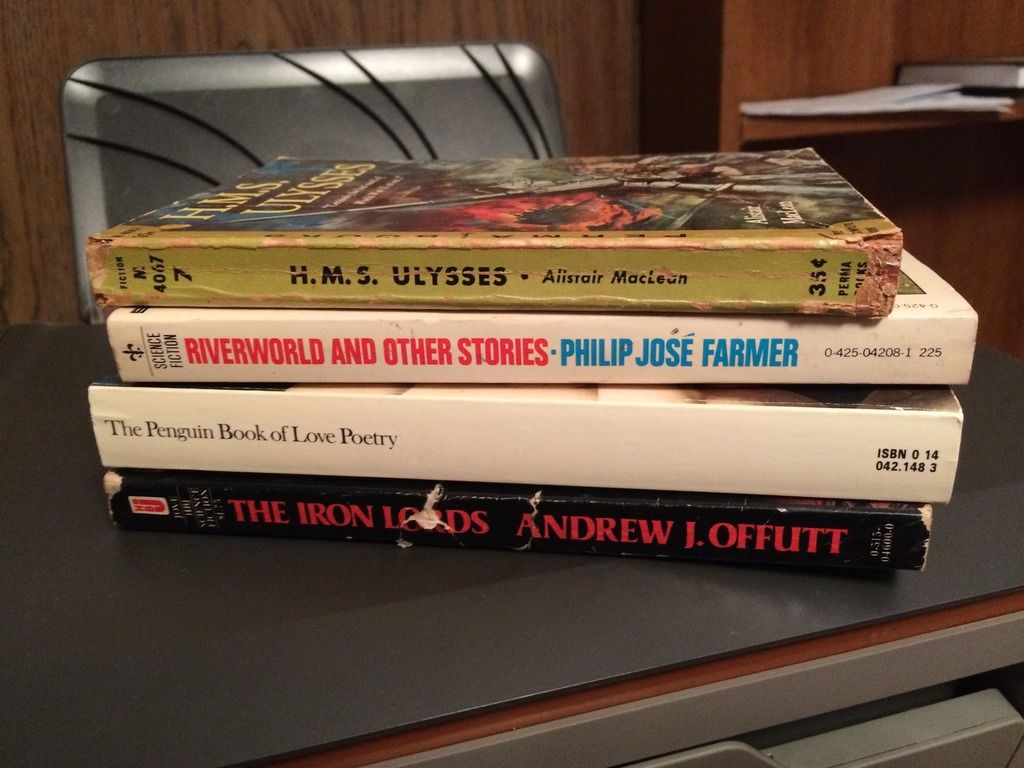
I purchased Andrew J. Offutt's The Iron Lords on the same trip to the Des Moines Salvation Army that yielded Alistair MacLean's H.M.S. Ulysses.  How could I resist Rowena Morrill's cover painting, which shows a coldly beautiful woman's helmeted face and a big slab of beefcake fighting improbably silly monsters (is that a crab with a human face?), as well as Poul Anderson's enthusiastic blurb ("Great entertainment of epic scope!")?  The Iron Lords is the first volume of a trilogy, and was first published by Jove in 1979.  My edition includes interior illustrations signed "rw."

Seven-year-old Jarik and his eight-year-old sister Torsy witness, from the safety of the woods, their seaside village raided Viking-style, all their friends and family raped and murdered.  Jarik vows revenge on these "Hawkers," and has a vision of himself wielding a black sword, and of a cruel, taunting, silver goddess.  After a sea voyage in a little boat the kids are taken in by people from another village, one inland.  Jarik grows up to be a skilled warrior with a hugely muscled body who performs prodigious feats, but most of the villagers never really accept the two foundlings.  Jarik has rivalries and feuds, and after killing one of his tormentors, Jarik, accompanied by Torsy, now around 18 years old, is exiled from this second village.

After some violent and rapey adventures Jarik and Torsy are taken in at a third village.  In the center of this village is an iron meteorite with a black sword embedded in it.  When Torsy is murdered by yet another bunch of raiders (the villages in this world are constantly raiding each other), Jarik draws the sword from the stone Arthur-style and becomes a virtually invincible fighting machine.  The three black armored gods who put the sword in the meteorite appear, and spirit Jarik away to their mountaintop fortress where they are tended to by beautiful maidens.

The three black clad gods are the Iron Lords.  These powerful beings turn out to be refugees from another planet, among the last survivors of a high-tech society that was destroyed in a cataclysmic collision between planets.  The three Iron Lords are at war with one of their fellow refugees, the silver goddess Jarik saw in a vision a decade ago, who is known as the Lady of the Snowmist.  The Hawkers who massacred Jarik's community back in that first village worship the Lady, so when the Iron Lords ask Jarik to pursue the quest of killing the Lady of the Snowmist, he is eager to do so.  The Iron Lords transport him to the Hawker village, where he confronts both the Hawkers and the Lady!  

This confrontation does not go as planned, and at the end of this first volume of Jarik's saga he has been enslaved by the Lady of the Snowmist and sent on a mission by her, a voyage to the other side of the world in the company of the Hawkers' leader!

While much of the plot and its components feel derivative, Offutt includes some interesting and unusual elements in The Iron Lords.  One of the novel's main themes is that of the outsider who does not belong, wherever he may go.  The alien gods are outsiders, as is Jarik himself.  It turns out that Torsy is not really his sister, that Jarik was adopted by the people of that first seaside village.  (When Torsy realizes this she falls in love with him and contrives to have sex with Jarik--Jarik resists because of the incest taboo and because Torsy is too skinny for his taste.)  When Jarik is made an ally of the Iron Lords he finally feels like he has found a group to which he belongs; the Lady tells him they were just using him, as she will now use him.

The later Ace edition with a cover
by Tom Kidd
The origin of the "gods" and their relationship with the common people is also interesting; to renew their physical bodies, the gods occasionally appear to their worshippers and take away with them the community's healthiest young men.  Another unusual element is how Jarik is two people--usually he is the angry and violent Jarik who feels estranged and seeks revenge, but when he comes upon a wounded loved one (like Torsy after she has been gang raped) his mind leaves his body and another consciousness, perhaps his unborn adoptive brother Oak (killed in the womb during the attack of the Hawkers), takes over his body and expertly administers first aid.  While Oak has possession of Jarik's body Jarik has visions that foreshadow his fate and hint at the realities of his world.

I'm OK with The Iron Lord's plot, but the style and execution have some problems--Offutt is trying to accomplish something "mythic" and "epic," and does not quite get there.  He employs poetic devices like repetition and lots of metaphors; page 23 contains a good example, a paragraph in which variations of the couplet "he was strong, he could row" appears three times, and bloody wounds are described as mouths crying out for vengeance (compare the Old Testament's "What hast thou done? the voice of thy brother's blood crieth unto me from the ground.")


Most of the time Offutt writes in the voice of an omniscient narrator who knows Jarik's every feeling and thought, but sometimes he acts like a chronicler working from contradictory oral and written sources.  This sloppy lack of consistency was kind of disconcerting.

A bigger problem is that Offutt can be long-winded.  There are long dream sequences, long descriptions of people's houses and clothes, a long blow by blow fight scene that gets a little tedious, and a long scene that details a religious ritual that doesn't add anything to the story.  There are also many characters, and while Jarik, Torsy, the gods and the leader of the Hawkers are interesting enough, each village is populated by a multitude of vaguely drawn and essentially interchangeable people.

The Iron Lords is no masterpiece, but the odd elements kept my interest and I was genuinely curious about what would happen next,  If I see the rest of the trilogy on the shelves of a used bookstore I will probably pick them up to find out what happens to Jarik and the alien gods who are manipulating him.

Friday, October 23, 2015

Vampiric tales by Tanith Lee and Harlan Ellison

If isfdb is to be believed, in 1984 SF Chronicle presented awards (based on reader voting) for "Most Attractive Writer."  Winning the Female category was Tanith Lee. Walking away with the award for the Male category (well, it looks like he tied with Thomas F. Monteleone) was Harlan Ellison,

These two lookers would be reunited in 2009's The Vampire Archives, edited by Otto Penzler and billed as "The Most Complete Volume of Vampire Tales Ever Published;" it includes two stories by Lee as well as a tale by Ellison, and features their names prominently on its covers. The book is even dedicated to Ellison, whom Penzler declares is "the antithesis" of a vampire!

"Lonely Women Are the Vessels of Time" by Harlan Ellison (1976)

This story first appeared in the program book of the 1976 34th Annual World SF Convention, held in Kansas City, Missouri, the cover of which appears to depict an idealized image of Missouri native Robert Heinlein in a space navy uniform accompanied by a hot babe! This image (by George Barr) sums up so many of the conventional reasons that people give for why classic SF is great and why it is terrible that I am loving it sincerely and ironically with all my heart!

Ellison's story:  A man, Mitch (didn't we just deal with an unsympathetic Mitch?), goes to one of his regular singles' bars after attending the funeral of one of his girlfriends, Anne, a suicide.  Mitch is promiscuous, moving quickly from one woman to the next, and he didn't love Anne. Anne, however, fell in love with him, and perhaps killed herself over him.

We learn a little about Mitch and the singles dating scene as he recollects insulting a feminist (telling her in colorful language that if she didn't like "the system" she should go have a sex change operation!) to the cheers of the rest of the people in the bar. Then a pale girl approaches him, seduces him.  Back at her place the pale woman (Mitch never learns her name), I guess via the sex act, fills Mitch with the terrible loneliness felt by the women he has seduced and abandoned.  

This is a good enough story, apparently a criticism of men who seduce women and use them for sex, and perhaps of the whole culture of promiscuity we associate with the 1970s.  When last we read a story by Ellison ("Shattered Like a Glass Goblin") he was attacking the drug culture, and here it seems he is pointing out a possible dark side to the sexual liberation that came to the West in the 1960s and 1970s.  Since we always hear people celebrating the '60s and free love and all that, it is certainly interesting to encounter stories by somebody with unimpeachable counterculture bona fides like Ellison expressing skepticism about these social changes.  It is like encountering the cultural conservatism of counterculture hero Robert Crumb: surprising, exciting, and thought-provoking, and fun for all those reasons.  

Speaking of "thought-provoking," "Lonely Women Are the Vessels of Time" is the kind of story that could serve as the impetus for one of those fascinating "What is feminism?" discussions.  (You know you love them!)  Is "Lonely Women Are the Vessels of Time" feminist because it is about a woman getting revenge on a man who has used women for his own sexual pleasure and hurt their feelings, because it portrays a man forced to walk in women's shoes?  (Remember that time Fred had to put on Wilma's apron and do all the housework?  Groundbreaking social commentary!)  Or is "Lonely Women Are the Vessels of Time" patronizing and patriarchal because it suggests women don't enjoy casual sex like men do and can't survive the 1970s' liberated dating scene, because it implies men and women are very different and perhaps women need some kind of protection?  Either way, a story which makes you consider such issues is worth reading in my book.

"Bite-Me-Not or, Fleur de Fur" by Tanith Lee (1984)

This one first appeared in Asimov's Science Fiction Magazine.  Talk about a lifeless, uninspired cover...zzzzzzz.

For some seventeen years the castle has been under siege by black-feathered blood-sucking bird people! Every night the Duke, whose wife and daughter were among the very first victims of the weird flying fiends, and the other aristos have loud parties or stuff their ears so they don't have to hear the avian vampires' flapping wings and eerie singing!  As our story begins, the leader of the vampire people, who are savages with no technology or literature, only their beautiful singing voices and their love for blood ("a perfect food"), named Feroluce, finds a narrow broken window and squeezes through it to enter the castle.  After being wounded in a fight with a lion from the Duke's menagerie, Feroluce is captured.

Rohise the simple-minded teenaged scullery maid has lived her entire life in the castle during this vampire siege.  When she sees Feroluce in his cage, she immediately falls in love with his beauty.  She contrives to liberate the monster, and flies off with him. Feroluce is rejected by his people, and he and Rohise become lovers, then die in the snowy mountains.  (Shades of Romeo and Juliet!)  In the final paragraphs we learn the dreadful secret of Rohise's birth and the horrible fate suffered by the Duke and his people.

This story is very good, full of striking images, great metaphors, various surprises. And of course as I have said on this blog before, I love Lee's somewhat old-fashioned, romantic and decadent writing style.  With economical strokes Lee also creates alien but believable cultures within the castle (hinting at the psychological and sociological effects of being shut up in a fortress, harried by vampiric raptor-people, for seventeen years) and among the vampires, who have little or no language but still have traditions and mores.

As we expect with Lee, "Bite-Me-Not or, Fleur de Fur" is full of outre sex references. The fact that the vampires have been hanging around the castle for seventeen years before getting inside is compared to foreplay, and Lee tells us the castle's fortifications inspire desire the way a woman excites the lust of a man by saying "No."  When Feroluce wrestles with the Duke's lion and drinks its blood their grappling is explicitly compared to sexual congress.  The image of the vampires flying around the castle, trying to get inside, made me think of sperm wriggling around an ovum, and the way Feroluce penetrates the castle and then finds himself captured within it reminded me of the prototypical male experience of pursuing a woman and then finding one's self ensnared by her, domesticated and severed from one's old life of freedom and friends.

Another triumph for Lee!

"Winter Flowers" by Tanith Lee (1993)

"Winter Flowers" first was published in Asimov's.  The cover of this issue resides on the borders of the "loving it ironically" and "rolling my eyes and groaning" camps.

Our narrator for this tale is Maurs, the captain of a small mercenary company in a fantasy version of medieval Europe.  He is a vampire, as are all of his soldiers--in this story vampires don't mind sunlight or garlic and can get killed by being stabbed or shot full of arrows like the rest of us. They do live for centuries (our narrator is like 300 years old) and have superior eyesight and that sort of thing.  And they love to drink blood.

At the start of the story Maurs and his men are in the service of a Duke, as part of his army, which is sacking a town which has just fallen to their siege.  This is a Christian region, in which witches and vampires are exterminated when discovered, so Maur and his subordinates have to try to hide their nature.  One of Maur's soldiers lets his lust for blood get away with him, and is caught drinking a boy's blood, and so is executed by being burned at the stake!  In order to keep their secret, Maur and his crew have to pretend they didn't know their comrade was a vampire and even help out at the burning!

After this dreadful episode, Maur and company leave the Duke's employ and march off into the countryside.  They discover a beautiful abandoned castle full of fine art, old books, and delicious food.  All this finery is an illusion--an even more powerful vampire, a gorgeous woman, employs the castle as a spider does a web, and she begins cunningly killing the mercenaries and drinking their blood.  Maur she desires to take as a lover, and uses hypnotic powers to excite his love and lust--will he succumb to slavery or kill her with his sword?

This is a good sword and sorcery story; fans of Conan and Fafhrd and the Grey Mouser and Elric and Kane might like it.  I'm not quite certain what exactly "grimdark" is, but this story may qualify; atrocities are the norm and there are no characters whose ethics or morals would be considered admirable according to conventional late 20th century standards.  The vampire woman is an interesting and original monster because of her subordinate monsters, who are too weird and complicated for me to briefly describe; suffice to say they feel new and Lee does a good job of bringing them to life for the reader.  Those of us who pay any attention to speculative fiction and RPGs see lots and lots of monsters, and a monster that feels fresh is exciting; these minions of the villain are my favorite part of "Winter Flowers."

While I have compared it to a classic sword and sorcery tale by the titans of the genre, Howard, Leiber, Moorcock and Wagner, "Winter Flowers" still bears the characteristic marks of a tale by Lee.  Besides her writing style, there is the sex angle, of course; as in "Bite-Me-Not or, Fleur de Fur," we have a castle that, like a woman, seduces a man and separates him from his male friends and his society.  Rape is a prominent topic in the story.  The vampire mercenaries enjoy sex with women, but also apparently have sex with each other, and, when the opportunity arises, with young boys.  You can argue that the whole basis and point of the story is love and its relationship to sex, and that the decisions and choices Maur and the other mercenaries have to make over the course of the plot are all guided by their love for each other.

***********

Three good stories, horror stories with vampires that also address the timeless human issue of sexual love and the catastrophic mess it can make of people's lives. Well worth checking out.

Tuesday, October 20, 2015

Vampiric stories by M. R. James

Some readers may recall that back in March I read the short story "A Serious Call" by George Hay, a story which referred to and was some sort of homage to M. R. James, the British intellectual and writer of ghost stories.  As I have so many times, at that time I resolved to read some work by a writer--this time James, whom wikipedia is telling me was admired by many writers I am familiar with, like H. P. Lovecraft, Clark Ashton Smith and Ramsey Campbell, and was a "reactionary" who opposed "modernity and progress" and hated the literature of his time--but I did not follow through on this resolution.

Until this week!  Last week I was flipping through Otto Penzler's huge 2009 anthology The Vampire Archives and saw James's name in the Table of Contents, and was reminded of my resolution.  So this week, I read the three James stories included in Penzler's book.

"An Episode of Cathedral History" (1914)

Through multiple layers of framing devices concerning scholars investigating the history of an English cathedral, we learn a story which took place in the early 1840s. The cathedral in question (in 1840) is being renovated to align it with the currently popular Gothic Revival style, thanks to a new young Dean who is swept up in the fad. It is perhaps evidence of James's purported conservatism that all the sympathetic characters oppose this radical alteration of the church's architecture, that much beautiful woodwork is destroyed in the process, and that the renovation unleashes a menace to society.

The removal of a pulpit reveals an unmarked tomb.  There is no evidence of who is interred there, but various episodes indicate to the reader that a monster of some type was imprisoned in the tomb, and is now preying upon the populace.  People have horrible dreams, at night dreadful cries are heard, a child looks out a window and sees two dim red eyes in the shadows, and numerous people fall mysteriously ill and some even die.  In the end the wiser elements of the community drive off the dimly perceived monster despite the objections of the reforming Dean.

"Count Magnus" (1904)

For this story our narrator is a scholar, who has examined a bunch of old documents about a Mr. Wraxall.  Wraxall, in 1863, went to a seventeenth-century manor house in Sweden in order to examine a bunch of old documents there.

The noble who built the manor house and is infamous for mercilessly crushing a peasant uprising, a Count Magnus, is buried in an elaborate mausoleum nearby. Wraxall visits the mausoleum, where he finds the tomb has three padlocks on it!  He feels drawn to visit the Count's tomb again and again, and with each visit one fewer padlock is secure!  When he realizes some supernatural agency must be hypnotizing him into freeing the undead Count, it is too late!  Wraxall flees to England, but the Count is on his tail, and Wraxall dies in a remote village of unknown causes; unknown, that is, until our narrator finds his hidden papers, years later.

"Wailing Well" (1928)

To my surprise, this is a humor piece, full of deadpan jokes about life at an English boarding school.  Did I borrow a book of vampire stories from the library in hopes of reading a bunch of jokes?  No, I did not.

Arthur Wilcox is a student admired and beloved by all.  One of the story's many gags is the list of wacky good conduct medals and merit badges he receives. Stanley Judkins, in contrast, is a troublemaker whom the school authorities have no use for. The story's most extravagant joke is the revelation that, to provide opportunities to earn a "Life-saving Badge," younger boys are tied up and thrown in a body of water. When it is his turn to earn the badge Judkins simply lets the young boy drown, creating a hassle for the school administration.

Near the school is a field avoided by all the locals.  In the center of the field is a clump of trees and a well; Judkins is told to avoid the well, as it is home to sinister monsters. He goes to investigate it anyway, and students and faculty watch from a hilltop as he fights, unsuccessfully, for his life against a crew of weird skeletal beings.  Judkins' body, drained of blood, is retrieved, but his spectre joins that of his murderers in haunting the evil clump of trees.  There is a strange discontinuity of tone between this gruesome material and the broad jokes of the first part of the story.

**********

These stories are all entertaining, if not spectacular.  The monsters (James never uses the word "vampire") all have an interesting look to them, and interesting abilities, and each story has scenes designed to "chill" or "creep out" the reader, which are effective.

It is perhaps remarkable how many layers James puts between the reader and the characters who actually suffer fear and death at the hands of the monsters in the stories.  In "An Episode of Cathedral History" we learn about the monster from the narrator, who has the papers of another guy, which describe the conversations he had with a third guy.  This third guy was present during the monster's campaign of terror, but never saw the monster; his descriptions of it come from others.  The narrator of "Count Magnus" is describing to us documents he found in an old house, and in "Wailing Well" we never see the well or its evil inhabitants at close quarters, only from a distance.  I'm not sure how I feel about this storytelling strategy; is the fact that we witness the humans' interactions with the monsters from a distance make them more or less believable, or more or less horrifying?  Or is the distance significant because it instills in the reader a different type of horror; instead of the horror of pain and imminent death, the reader experiences the horror of uncovering new knowledge, knowledge that the universe is more complicated and irrational than previously thought, as well as more dangerous.

In our next episode we'll check out stories included in Otto Penzeler's The Vampire Archives from celebrated post-World War II writers of short stories whose work I already have some degree of familiarity with.