Sunday, August 11, 2019

Moonraker by Ian Fleming

She glanced at the ruthless brown face of the man beside her.  Did he have moments of longing for the peaceful simple things of life?  Of course not.  He liked Paris and Berlin and New York and trains and aeroplanes and expensive food, and, yes certainly, expensive women.  
I don't know about your computer,
but when I scroll down on my computer
this image looks really freaky
In our last episode I vowed to avoid Signet editions of the James Bond novels by Ian Fleming because I noticed that paragraphs, sentences and phrases I saw in the 1978 Panther paperback edition of the second 007 novel, Live and Let Die, had been wholly expurgated from Signet's 1963 printing of the book.  But when I looked up the third James Bond novel, 1955's Moonraker, at the internet archive I saw that the Signet edition was the only scan available. So I crossed county lines to borrow from a public library many miles away a 21st-century edition of Moonraker, one put out by Thomas & Mercer, who I guess are owned by amazon or something, in 2012. I can only hope this printing presents the text of the British first edition.  Don't let me down, amazonians!

The first chapters of Moonraker give us insight into Bond's life in London, what his work is like when he's not on an assignment gambling and killing people, and how he spends his free time.  We learn he is the best shot in the Secret Service, and that he regularly has sex with three different married women.  Don't ask me what happened to Solitaire, the Haitian-born Frenchwoman with psychic powers Fleming seemed to be suggesting was a love match for Bond in the last novel.  Maybe her psychic powers, which didn't protect her from getting kidnapped by the kind of guys who feed young ladies to barracudas, protected her from getting involved with a guy who has no respect for the sanctity of marriage?

M calls Bond into his office to talk about a dude he plays bridge with at his club, Sir Hugo Drax.  This is only the third James Bond novel but Fleming, we see, is already reusing his gags.  Do you remember how in Casino Royale the villain was a guy who (allegedly) suffered amnesia because of some tragedy in the war and then went on to become a mover and shaker in French society?  Well, Hugo Drax, who let's pretend we don't yet know is the villain of this one, is a guy who (allegedly) suffered amnesia after getting severely injured in a German attack on his British Army unit during the war and then went on to become a mover and shaker in British society.  Drax got rich and famous by buying and selling rare metals that are valuable because they are needed for making jet engines, and then started throwing his money around London, donating to charities and so forth, making himself a hero of the people.  Drax's latest exploit has been to design and build a missile, the Moonraker, and gift it to the British people to serve as Britain's deterrent against foreign attack!

M tells Bond that he is sure Drax is cheating at bridge, but he can't figure out how.  Bond being the best gambler in the Secret Service, M asks 007 to come to dinner at his club (Fleming spends a few pages explaining how awesome this club is--it is "probably the most famous private card club in the world," after all) and play with him and Drax and see if he can figure out how Drax is cheating.  M and Bond admire Drax, and want to prevent this hero from besmirching his reputation, especially since he has become a critical part of the United Kingdom's defense establishment!

The way to get Drax to quit cheating, so he and the best club in the world and the best missile in the world aren't embarrassed in front of the whole world, Bond decides, is to outcheat him and beat him.  Hopefully this will shock him into behaving like a gentleman.  When Bond meets this titan of industry, this pillar of the free world's nuclear defense, Bond is amazed to find he is no gentleman, but a loudmouth boor who bites his nails and sweats a lot.  Putting on his psychiatrist's hat, Bond figures Drax is under some terrific tension.

Bond is so offended by the guy's bad manners that 007 enters the game of bridge against Drax with gusto, hoping to teach this bounder a lesson.  (One of the subtler nuances in Moonraker is the fact that Bond himself, were Drax not there, would probably be the least gentlemanly person in the club--people who see him are always thinking he looks tough and ruthless and dangerous.)  Bond gets so caught up in the excitement--or maybe it is the booze and benzedrine he takes before the bridge game--that he bets more than his entire year's salary against Drax.  But he is a better cheater than Drax, and Bond wins something like ten times his yearly salary.

(Benzedrine is a recurring element of these Bond novels--Le Chiffre in Casino Royale used lots of benzedrine, and Bond used it in Live and Let Die before attacking Surprise Island and the Secatur.  Like the limpet mine used in that operation, benzedrine is a kind of call-back to WWII, when servicemen would take benzedrine to stay alert during long periods of duty.  Bond and so many of the people he interacts with, in the first three 007 novels at least, are what you might call products of the cataclysm of the Second World War.)

The next day Bond, still playing head shrinker (he does his psychoanalyzing several times in the novel), decides that Drax must be paranoid, a victim of delusions of persecution and delusions of grandeur.  Luckily Drax is no business of his anymore...oh, wait, Drax is his business.  Last night one of the fifty Germans working on the Moonraker project murdered the head of security for the project, a British government official, and then committed suicide.  M has decided that Bond should fill the vacancy left in the Moonraker security office!

Bond finds that, on the job, Drax is not the jackass he was at the club, but an efficient manager and skillful leader of men with a deep knowledge of rockets and associated subjects.  Drax hosts a dinner where Bond meets the German scientist at the top of the Moonraker project, Walter, Drax's German assistant (Drax says he's like a "dogsbody" or "A.D.C.") Krebs, and Drax's secretary, Gala Brand, a beautiful Englishwoman.  Brand, as Bond knows but Drax presumably does not, is a Special Branch undercover police officer who was insinuated onto Drax's staff to act as a spy for the British government.  After dinner Drax shows Bond the missile, which will be test launched in just a few days.  Bond goes back to admiring Drax for conceiving and managing such a large, complicated and groundbreaking project.

Bond, now living at the Moonraker site, does detective stuff involving fingerprints and going through files and all that.  He tries to get help from Gala Brand, but she is cold to him, resenting the fact that a foreign operative--a ruthless killer, no less!--instead of a fellow domestic cop got the position of head of security at the Moonraker site.  "...why had he been sent down instead of somebody she could work with, one of her friends from Special Branch, or even somebody from M.I.5?"  Suspicion centers on Krebs, who is a snooper whom both Brand and Bond find looking through their personal things, but is Krebs a saboteur working for the commies, a trusted member of Drax's team who is acting as an additional, secret, layer of security at Drax's orders, or just some neurotic with a compulsive need to go through people's drawers and bags?     

The Moonraker site is on the coast, and while investigating the beach below a chalk cliff to consider the way a Soviet commando team might attack the site, Bond and Gala Brand are almost killed by an avalanche that Bond is certain was no natural accident but an attempt to murder the two English spooks.  (Getting buried in chalk fragments is just one of the numerous instances of Bond and Brand getting bruised and lacerated over the course of the three or four days they work together.  Bond is like a bad luck charm, just ask Felix Leiter!)  Who is responsible for this assassination attempt?  A small group of the Germans?  All of the Germans?  And are they working against, or in concert with, British hero Drax?

Brand does a little detective work on her own, picking Drax's pocket, and figures out that on test day--tomorrow--the missile will not be launched into the ocean but into the heart of London!  Krebs spots her pretty English fingers in Drax's pocket as she is trying to return the evidence, and, lickety-split, the lady police officer finds herself tied up in the room of the house in Central London with the transmitter that will guide the missile into the city from the coast.

HQ knows about this rarely used house of Drax's (they just figure he has sexual liaisons there) so when Brand is missed Bond knows to look there.  He arrives just as Krebs and Drax are bundling the policewoman into Drax's Mercedes, and a car chase ensues, Bond's British Bentley pursuing Drax's German machine.  This car chase is very good, very exciting, the best scene in the novel.  As with the exciting car chase in Casino Royale it ends with triumph for England's enemies and Bond a captive of the villain.

Drax, as the reader may have been anticipating, was not a British soldier who lost his memory after being caught in an explosion during a German attack.  Rather, he was one of the German attackers severely injured by his own men's explosives while disguised as a Tommy.  As Bond and Brand sit, tied to chairs (getting tied to a chair is a normal occurrence in these 007 books), Drax tells them the story of his amazing career, from young German aristocrat studying in England to one of Otto Skorzeny's commandos, to a man missing half his face who is taken for a working-class English soldier suffering amnesia.  Once patched up and set loose in post-war London, he robbed a Jewish moneylender to get the cash to start his metals business.  Once established, he launched his ambitious scheme of revenge!  With Soviet help, he assembled a fifty-man crew of hardcore Nazi technicians and brought them to England to build the Moonraker rocket and install atop it a Soviet nuclear warhead.  (In return he sends to Moscow all the British scientific instruments that were supposed to be in the missile nose cone.)

After Drax is finished telling them his life story he leaves our heroes in a room that will be exposed to the incinerating exhaust of the missile test firing tomorrow.  Bond frees them by operating a blowtorch (one of Krebs's torture implements) with his mouth.  As Drax's secretary, Brand is very familiar with the gyros that control the missile's course, and knows what settings Drax has been sharing with the British government, settings that would guide the missile to the North Sea where a test target awaits.  She tells Bond how to reset the gyros and he sneaks into the missile and changes the settings from that London building to the target zone.  So, when the missile is launched it takes the course the British public listening to the radio expect, not the one the Germans expect.  The Germans, as the missile is taking off, are picked up by a Soviet submarine disguised as a Royal Navy sub.  I'm not sure it makes any sense, considering the disparate speeds of a supersonic missile and a submerged submarine, but somehow the Soviet sub with Drax and Krebs aboard is in the target zone when the Moonraker missile arrives and the atomic explosion sinks the sub, killing all on board.  In the last chapter of the novel M tells 007 that the British government is going to somehow cover up this whole mess--part of the cover up is sending Bond and Gala Brand out of the country on paid leave for a month so nobody asks why they are covered in bandages.  Bond hopes that Brand will become his girlfriend, but she is engaged to be married and Bond has to go to France alone.  (I guess none of those married women can get time off.)

This Croatian cover successfully
captures a memorable scene in which
Gala Brand looks up at the missile and
Bond notices the beauty of her throat
Above, and when I wrote about Live and Let Die, I mentioned the shadow cast on these 007 novels by World War II, and this is true of Moonraker even more than the others--it's a chance for the British to defeat German aggression yet again, with Allied World War II vet Bond in a struggle over the fate of London with Axis World War II vets Drax and Krebs.  In Live and Let Die Fleming presented stereotypes about blacks--e. g., that they are superstitious--and here in Moonraker he has Bond and other British characters voice stereotypes about Germans--they are "robot-like" and "precise," for example, and Drax's voice when giving orders is the essence of "Prussian militarism." 

Another of the recurring themes of the three James Bond novels I have now read has been the depiction of a United Kingdom in decline that requires US help to stay afloat.  In Casino Royale, Bond's operation is facing disaster until it is saved by an influx of American cash.  Here in Moonraker, the British government isn't capable of developing its own deterrent to Soviet attack and expects a private businessman to foot the bill and even manage the development of the necessary weapons!  As Bond puts it to M early in the novel, "...when you think what he's [Drax] doing for the country, out of his own pocket and far beyond what any government seems able to do, it's extraordinary...."  Near the end of the novel Drax calls the English "Useless, idle, decadent fools...too weak to defend your colonies, toadying to the Americans with your hats in your hands...."  Ouch! 

Because Moonraker is set entirely in England and Bond is sort of stuck in one place trying to figure out who the bad guy is among a bunch of foreign weirdos and jerk offs, it feels less like an adventure and more like a detective story.  The car chase is very good, but it feels like a revision of the car chase in Casino Royale, with Fleming whipping out some of the same striking images (e. g., the sound of the Bentley's exhaust reverberating from buildings along the road and Bond grabbing his Colt revolver* and laying it beside him in preparation for blasting the other car's tires.)  The bridge game is more confusing and less exciting than the baccarat game in Casino Royale, and calling Germans a bunch of robots isn't as shocking or edgy as the talk about African-Americans in particular or America in general in Live and Let Die.  Vesper Lynd in Casino Royale and Felix Leiter, Quarrel and Solitaire in Live and Let Die are more interesting people and have more interesting relationships with Bond than does Gala Brand.  I liked Moonraker, but I think it the weakest of the first three Bond novels, though I know there are those who think it the best of those first three.

More James Bond soon, but I haven't got my hands on a copy of Diamonds Are Forever yet so we'll take a different tack in our next blog post.  After a long series of posts on spy thrillers and weird tales and space operas we'll take a look at what you might call mainstream or paradigmatic science fiction stories, stories that first appeared in Astounding in the early 1950s.

*[UPDATE: September 15, 2019: Other readers think the Colt Bond has secreted in his Bentley is an automatic, as a commenter below points out.  In a 2017 article, Michael Connick discussed this issue, and other firearms mentioned in the 007 novels. 

Wednesday, August 7, 2019

Live and Let Die by Ian Fleming

Never before in his life had there been so much to play for.  The secret of the treasure, the defeat of a great criminal, the smashing of a Communist spy ring, and the destruction of a tentacle of SMERSH, the cruel machine that was his own private target.  And now Solitaire, the ultimate personal prize.
1978 Panther
Here's the second James Bond novel, Ian Fleming's Live and Let Die from 1954.  I definitely read this one as a kid, but all I remember about it is that it was the first time I ever encountered the term "negress" and that M tells Bond that "...the negro races are just beginning to throw up geniuses in all the professions--scientists, doctors, writers.  It's about time they turned out a great criminal."  I've seen the silly but spectacular Roger Moore movie, of course, which has so many recognizable faces (Jane Seymour, Yaphet Kotto, Geoffrey Holder) but I doubt much of the book made it into that two-hour extravaganza.

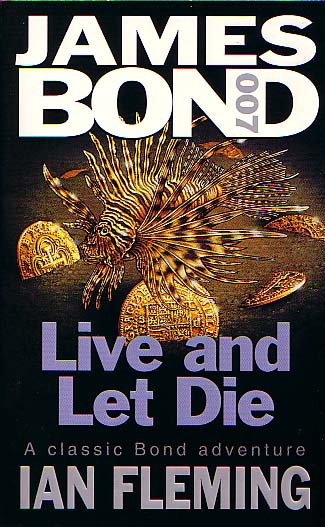
I read a scan at the internet archive of a 1978 Panther paperback with a white-gripped automatic pistol and a woman in a red dress (not to scale) on its cover.  Chapter V of this British printing was titled "Nigger Heaven."  I glanced at a scan of a 1963 American edition by Signet and there Chapter V bore the title "Seventh Avenue."  A scene of two pages in Chapter V of the UK printing in which Bond listens in on the conversation of two African-Americans in a Harlem restaurant and Fleming laboriously reproduces their accents and lingo ("Guess ah jist nacherlly gits tahd listenin' at yah") was absent from the US paperback.  Flipping back and forth between the scans, I found another instance where text containing "the n-word" had been excised for American publication, as well as changes to the text the purpose of which I cannot fathom.  I will have to avoid these Signet editions as I continue to read the Bond novels. 

Signet 1963
In dribs and drabs here and there--but most frequently in Harlem and Florida--a large quantity of sixteenth and seventeenth century gold coins is turning up on the US market, sold to curio shops and pawnbrokers by black people.  CIA, the FBI, and the British Secret Service think Mr. Big, "probably the most powerful negro criminal in the world" has found the buried treasure of pirate Henry Morgan in Jamaica and is liquidating it.  Mr. Big is not just a gangster--he's also the leader of a voodoo cult and a Soviet agent, a member of SMERSH trained in Moscow!  The money gained by the selling the gold, laundered through a multitude of innocent African-Americans, is probably being used to finance communist espionage in the USA.  Bond is eager to exact revenge against SMERSH, and so is happy to lead the British half of the joint US-UK investigation of Mr. Big and is soon on a plane to New York where he meets Felix Leiter, CIA man, whom he knows from his recent adventure in France (chronicled in Casino Royale.)

In New York, Bond receives American clothes and a little training in how to act like an American, and learns more about the Haitain-born, half "negro" and half French Mr. Big and about voodoo. Bond reads a travel book about the Caribbean, The Traveller's Tree by Patrick Leigh Fermor, and Fleming generously (and perhaps pointlessly--these long extracts are by far the most boring parts of Live and Let Die) reproduces three and a half pages of text from it that describe a voodoo ceremony.  Mr. Big already knows Bond is in America and why he is there, and Bond receives some menacing mail at his hotel room.  Leiter, who loves jazz and says he likes black people, takes Bond barhopping up in Harlem so Bond can get an idea of what African-American life is like, and in hopes of getting a look at Mr. Big holding court at one of the many night spots he owns.

In Casino Royale and here in Live and Let Die, Fleming does not limit himself to presenting only Bond's point of view or to only writing scenes in which Bond himself appears.  In Casino Royale there were a few scenes with M and S (head of the division of the British Secret Service devoted to the USSR) and Moneypenny in which Bond was absent, and a scene inside Le Chiffre's automobile while Bond was pursuing him in his Bentley.  Sometimes we are privy to the thoughts of characters besides Bond.  Here in Live and Let Die, Fleming includes scenes of Mr. Big and his head of communications, The Whisper, and other Harlem residents--Fleming uses these scenes to demonstrate to us that Mr. Big has all of Harlem under his thumb and knows everything that happens in Harlem.  Mr. Big rules by fear, and by taking advantage of how superstitious black people are--they believe that Mr. Big is a zombie, one of the living dead and thus unkillable.

Bond and Leiter are captured via a trapdoor mechanism and Bond finds himself separated from the American spy, bound to a chair in the book-lined office of the very tall, very broad Mr. Big, a man of intelligence and education and extreme ambition.  Mr. Big has a beautiful Haitian-born French woman, purportedly a telepath, come in to assist in his interrogation of 007.  Bond senses that this woman, called Solitaire because she has rejected all male companionship, is attracted to him and may want to help him.  ("Solitaire" is also apropos because she uses tarot cards to liven up her telepathy act.)  Unfortunately, she can't prevent Tee Hee, a guy who giggles in a falsetto while he tortures people, from breaking Bond's left pinky finger at Mr. Big's order.

Mr. Big doesn't want to kill 007 or Leiter, just hurt them as a warning and an incentive to stop investigating him, so he lets them go.  Tee Hee is supposed to toss Bond in a pond in Central Park, but Bond outwits the torturer, killing him and two other of Mr. Big's thugs and getting back to his hotel in a car he steals from the criminals.  Leiter is supposed to be beaten severely, but the man in charge of him goes on easy on Leiter because they share a love of Duke Ellington and other jazz greats.

Bond takes a train south for St. Petersburg, Florida, while Leiter takes a plane.  St. Petersburg is where Mr. Big's yacht, Secatur, unloads the gold coins from Jamaica.   Solitaire, who hates the "nigger gangsters" (as she calls them in the British version, but not the American one) she has been shut up with for a year sneaks away from Harlem and contacts Bond, who agrees to take her with him in his private compartment on the train.  But most of the black people in NYC are working for Mr. Big and Bond's movements are observed, and an enemy is on the train, waiting to strike!  Luckily, a brave and decent black train employee warns 007 and he and the French psyker get off the train early, in Jacksonville, and transfer to a different train.

The Florida section of Live and Let Die sees Fleming unleash a lot of criticisms of the land of the free and the home of the brave.  Bond, an expert on fine foods, bitches about American eggs and coffee; an expert on cars, he bitches about the automatic transmissions and spongy suspensions on American cars which render driving a breeze instead of a challenge to one's athletic ability.  There's a crack about how the US is a land covered in junk and litter.  Solitaire and Bond both react with horror to St. Petersburg, which is full of gossipy old people and the young people who figure out ways to part the geezers from their retirement funds.  Solitaire complains that it is too easy to make money in America, which she says leads to poor customer service, and Bond calls North America the "great hard continent of Eldollarado."  

Bond and Solitaire reach St. Petersburg halfway through the novel and are immediately spotted because of Solitaire's foolishness.  (Remember how in Casino Royale Bond declared that working with women was dangerous?)  While Bond and Leiter are away from their rented cottage doing a preliminary recon on Ourobourous Worm and Bait, the live bait and sea shell company which they believe is where the gold coins are warehoused, Solitaire is kidnapped.  Then while Bond is asleep Leiter goes off on his own to infiltrate the Ourobouros warehouse, and is brought back by Mr. Big's henchmen a broken man--the CIA op is barely alive after having lost an arm and a leg to Ourobouros's ravenous man-eating shark!  (I guess this shark doesn't give two shits about Duke Ellington!)  At night Bond sneaks into the warehouse, where he discovers that the gold coins from Jamaica are smuggled in in fishtanks holding poisonous fish that the Ourobouros peeps are ostensibly importing to sell to scientists.  Bond gets in a fight with the guy who manages Ourobourous; this joker falls in the water with the shark that maimed Leiter, and doesn't come out again.               

Bond proceeds to Jamaica, where the final third of the novel takes place.  Bond, reflecting Flemings' own life experience, loves Jamaica and its "staunch, humorous people."  Aided by Strangways, the head of British intelligence on the island, and Quarrel, a mixed-race Cayman Islander said to be the best swimmer and fisherman in the Caribbean, Bond launches a one man assault on Surprise Island, where Mr. Big's people have set up shop excavating Morgan's treasure and where Mr. Big holds Solitaire prisoner.  (With binoculars the good guys can see that the crime boss and the telepath have arrived on Suprise Island in Mr. Big's yacht, the Secatur.)  Strangways provides equipment and oceanography books, and Quarrel trains 007 in swimming and spearfishing.  Then, on a moonlit night, while Mr. Big's men load the Secatur with the fish tanks full of gold, Bond, in scuba gear, crosses the three hundred yards of Shark Bay that lie between mainland Jamaica and Surprise Island.  He fights a huge octopus and a twenty-pound barracuda, and attaches a limpet mine to the Secatur's hull.  Then he gets captured, of course.

As a captive, Bond is witness to the efficient way in which Mr. Big's crew processes Morgan's vast treasure (Bond thinks it worth four million pounds) and is reunited with Solitaire.  Mr. Big had hoped to marry and create amazing children with Solitaire (I suppose children with his genius and her psychic powers) but her treachery has convinced Mr. Big that she must die.  Mr. Big proposes to chain Bond and Solitaire to the back of the yacht and drag them through a coral reef so they get all cut up and then into the shark- and barracuda-infested waters beyond the reef where their blood will attract the fish.  Luckily, the limpet mine detonates seconds after the Secatur has passed beyond the reef and seconds before 007 and his psychic girlfriend reach the reef, sinking the yacht within the danger zone and leaving our heroes in the safe zone.  The blacks who survive the explosion are killed by the sharks and barracuda, including Mr. Big, who is close enough to Bond that the Englishman can see him being ripped apart by piscine teeth and hear his screams of agony.

By 2019 standards Live and Let Die seems pretty racist.  But to be fair to Fleming, Bond repeatedly stresses the similarities between whites and blacks.  He points out that most blacks are law-abiding, he says that British people ("particularly the Celts" Bond says to Leiter) are also superstitious, and says (in that restaurant scene deleted from the US edition) that blacks are like whites in that they are interested in sex and keeping up with the Joneses, the only difference being they don't bother to be "genteel" about it.  Leiter rhapsodizes about the central role played in American culture by blacks, saying that "most modern dances were invented" in Harlem, and that all the big bands Bond has heard of were proud to play in Harlem, the "Mecca of jazz and jive."  Bond finds black women attractive and finds the music he hears in Harlem mesmerizing.  I don't list these things to defend Fleming or try to convince people who are offended by the book that they shouldn't be, but to make sure I don't falsely characterize the author or his novel, which is full of black people who are villainous or gullible, but also includes admirable black characters and praise for aspects of African-American culture.

Another thing I found noteworthy about Live and Let Die, and this also goes for Casino Royale, is the large shadow WWII casts over the novel.  In both books Bond's service all over the world during the 1939-1945 war is mentioned repeatedly.  One reason Mr. Big is such an effective leader and successful criminal is that before he was trained in Moscow he was trained by the OSS and served the Allied cause in Vichy France.  When Bond requests equipment he wants things he used or learned about during the war: "And some of that shark-repellent stuff the Americans used in the Pacific....And one of those things our saboteurs used against ships in the war.  Limpet mine, with assorted fuses."

Live and Let Die is a good thriller; I thought all the train scenes were good--tense, and I liked the fight in the warehouse full of tanks of worms and venomous fish, and Bond's harrowing trip through Shark Bay.  The novel's gruesome violence is shocking (Leiter's dismemberment by a shark was a big surprise to me) and it was interesting and sometimes funny to hear a foreigner's assessments of 1950s America, its culture, landscape, and its people, white and black.  (If our English and French friends have such harsh things to say about us in these 007 books, my fellow Americans, I can only imagine what Russian communists will say if Fleming chooses to allow them to give voice to their opinions on the USA.)

On the negative side, Fleming does quite little with voodoo, socialism or telepathy beyond introducing them into his stories--these topics, rich raw material for philosophical discussion or supernatural or science fiction plot elements are mostly just window dressing.  The story would have been basically the same if Mr. Big wasn't involved in voodoo or revolutionary communism at all, but was just a gangster who ruled Harlem by murder and torture and was smuggling and laundering buried treasure and Solitaire was not a psychic but just some chick he wanted to sleep with who saw Bond as her ticket to freedom.  The voodoo/USSR/telepathy angles as written don't really detract from the book, but they feel like lost opportunities--for example, I was a little surprised that Solitaire's psychic powers neither came in handy, nor were ever debunked.

Next stop: Moonraker.

**********

The 1978 Panther paperback I read has an ad in its final pages for "All-action Fiction from Panther."  I was a little surprised to see science fiction writer Philip Jose Farmer's name on the list among all these espionage writers; the Panther book advertised is his 1970 novel inspired by Edgar Rice Burroughs's Tarzan, Lord Tyger.  I have not read Lord Tyger, but my man tarbandu has, and he wrote about it a year ago.          


Tuesday, August 6, 2019

Casino Royale by Ian Fleming

'The office was very jealous although they didn't know what the job was.  All they knew was that I was to work with a Double O.  Of course, you're our heroes.  I was enchanted.'
Bond frowned.  'It's not difficult to get a Double O number if you're prepared to kill people....How do you like the grated egg with your caviar?'  
As a kid I loved the James Bond movies with Sean Connery, George Lazenby or Roger Moore which would periodically show up on network TV full of commercials.  I even read four or five of the Ian Fleming novels, though I don't think I really "got" them, being so young, and they being so radically different than the films.  This was before puberty, so all the references to sex in the movies and in the books either went over my head or bored me.  I liked James Bond the way I liked the first Star Wars movie--I savored the ceaseless violence!

Reading Kingsley Amis recently brought James Bond to mind, so I decided to read the Ian Fleming 007 novels.  Even though Wikipedia says the county I live in is one of the wealthiest counties in America and one of the top five place to live in the USA as determined by some magazine, the county library system has no novels by Ian Fleming.  (I guess quality of life is subjective.)  So again my recourse is to the internet archive.  The first James Bond novel, Casino Royale, was published in 1953; I'm reading a scan of a paperback published in 1983 by Berkley.  This isn't one of the books I tackled as a child, and the only Casino Royale film of which I am aware is the spoof one starring Barbara Bouchet (you loved her in The Red Queen Kills Seven Times), so I have no idea what the plot of this thing is going to entail.

A dude named Le Chiffre, which is French for "The Number," is the head of a major French labor union (50,000 members!)  This joker goes by the name "The Number" because he purportedly lost his memory during the Second World War, in a Nazi concentration camp or something like that, and doesn't remember his birth name.  Le Chiffre's union is closely allied with the Soviet Union--the Reds send a pile of money to the union, and if World War III should erupt it is expected that those 50,000 working class brutes will sabotage NATO installations and otherwise pave the way for the Red Army to take over France.

One of Le Chiffre's many girlfriends is a British spy, and she alerts Her Majesty's Government that Le Chiffre has a big problem.  Le Chiffre invested most of the union's money in a chain of brothels, which you would expect to be a sort of no-brainer investment in France, but a sudden and unexpected change in French government policy has led to the gendarmes closing down all those whorehouses and the union losing all that money.  Should the commies in Moscow find out that Le Chiffre blew all the money they sent him, agents of SMERSH (the Soviet agency whose name is an acronym for "Death to Spies") will murder him, so Le Chiffre comes up with the plan of winning all the money back by gambling at a seaside casino.  (This guy's memory may be damaged but his brain is otherwise puttering along just fine--check out all the good ideas he has!)  The British government comes up with the idea of making sure Le Chiffre loses the rest of Moscow's money at the casino, which will discredit the Red union and neutralize Le Chiffre, by sending their best gambler to the casino to play against Le Chiffre.  And who is their best gambler?  James Bond, Agent 007, of course!

What kind of guy is James Bond?  We are told he is cold and all-business while on a job, and somebody says he looks like Hoagy Carmichael.  But one of the attractions of the James Bond books, and one thing they are criticized about, is the fact that Bond enjoys what you might call luxurious and sensual living, or taking advantage of the many fine goods and services a capitalist economy and the remnants of an aristocratic culture have to offer, or conspicuous consumption, and it feels like Fleming spends as much time describing the stuff of the good life Bond leads as on actual spycraft stuff.  Bond has a fancy car, a 4 1/2 liter Bentley.  He smokes seventy cigarettes a day, a special blend of tobaccos he has made by a fancy tobacconist.  In one scene he gets a massage.  Bond describes to a bartender exactly how he wants his drink constructed, telling Felix Leiter, the CIA agent accompanying him, "This drink's my own invention."  To a beautiful female colleague, Vesper Lynd, (she wears a black velvet dress that is "simple, and yet with the touch of splendour that only half a dozen couturiers in the world can achieve") he admits "I take a ridiculous pleasure in what I eat and drink."  And Bond is crazy about casinos:
He loved the dry riffle of the cards and the constant unemphatic drama of the quiet figures round the green tables.  He liked the solid studied comfort of cardrooms and casinos, the well-padded arms of the chairs, the glass of champagne or whisky at the elbow, the quiet unhurried attention of good servants.            
Back to plot.  The seaside town of Royale is apparently full to the gills with French security personnel and foreign spies.  Besides Texas-born American spy and former Marine Felix Leiter and British wireless expert Vesper Lynd there is a Frenchman, Rene Mathis, who works closely with Bond.  But don't think "The Number" is outnumbered!  A multinational legion of commies and thugs is in league with Le Chiffre!  He has two bodyguards, one of whom reminds Bond of Lenny from Of Mice and Men; the other has bad teeth, a hairy body and carries a cane that turns out to be a gun.  Bond's hotel room is bugged, and a married couple called the Muntzes--he German, she Czech--is in the room upstairs listening in.  Bond's cover, that of a Jamaican millionaire, is blown before he even gets to Royale, and a pair of Bulgar assassins try to kill Bond by throwing a bomb at him but are instead blown up themselves--Bond's survival is due to pure luck, not anything Bond deserves credit for.

Luck is a theme of the novel, as you might expect it to be in a novel about gambling.  "Bond saw luck as a woman, to be softly wooed or brutally ravaged, never pandered to or pursued;" which sounds like something Machiavelli would say.  The second quarter or so of Casino Royale is taken up by baccarat.  Bond explains the game to Miss Lynd, which takes some pages, and then Bond has his big match with Le Chiffre.  As far as I could tell, this game is 100% luck; there's no planning or strategy or bluffing.  I guess you could count cards, but no mention of such a technique is made by Fleming.  Bond loses all of the British taxpayers' money to the Red union leader, but then the American taxpayers bail out their friends on Airstrip One--Felix Leiter gives Bond a huge wad of cash and 007 goes on to bankrupt Le Chiffre and gets all of the lost money back.

Having triumphed over one of the many tentacles of the international communist conspiracy via an all night gambling session, Bond and Vesper Lynd go to have a fancy breakfast to celebrate.  Bond, we have been told, is all business during a dangerous job, but now that the job is over he is focused on convincing the beautiful black-haired Vesper to have sex with him.  "He wanted her cold and arrogant body....to see tears and desire in her remote blue eyes and to take the ropes of her black hair in his hands and bend her long body back under his."  Bond is into what we might call rough sex--one of the things about Vesper that attracts him is how she is self-contained, independent, rather than submissive--Bond figures having sex with her will always "have the tang of rape" because she will never give up herself entirely to a man, but always keep a private inner core.

We have also been told that Bond hates working with women, that he thinks they are just trouble with all their emotional baggage--instead of helping to accomplish the mission, a woman is a distraction: "One had to look out for them and take care of them."  As the second half of Casino Royale begins, Fleming provides evidence that Bond has the right attitude as Vesper Lynd gets kidnapped from the restaurant where they are drinking champagne and eating scrambled eggs.

After a car chase Bond is captured by Le Chiffre who tortures him by hitting him repeatedly in the testicles with a carpet beater.  This is a scene with powerful sadistic, masochistic and homoerotic overtones, undertones, and in-between tones.  Le Chiffre wants to know where Bond has hidden the money he won at the baccarat table, but 007 doesn't crack up.  Le Chiffre is about to castrate Bond with a carving knife when a SMERSH agent arrives to shoot Le Chiffre in the face, carve a Shcha (щ), which I guess is the first letter of the Russian word for "spy," in Bond's hand, and leave.

In the third quarter of the novel Bond is in the hospital recovering and having doubts about the morality of his career of spying on and assassinating people as well as suffering fears that he won't be able to perform sexually after the torture he has suffered.  Matis tries to convince him that he should continue doing his part in the defense of the free world, and Vesper Lynd starts making regular visits and the two begin to fall in love.

When he is released from the hospital, Bond and Vesper go to a little seaside hotel together, where they have sex and Bond even considers proposing to Vesper, but then odd little events and Vesper's moodiness spoil the whole holiday.  All is explained by the note Vesper leaves when she commits suicide--Vesper's Polish boyfriend, an RAF hero, was sent back home to spy for the British after the end of WWII and was captured.  The commies forced Vesper to act as a double agent for years; they threatened to execute her Polish lover if she didn't regularly send them info obtained in her office at the Secret Service.  It was Vesper who blew Bond's cover and exposed him to the Bulgar bomb attack, and the kidnapping was fake, so she is also to blame for Bond getting tortured.  She fell in love with Bond, but a relationship was impossible--she would have to betray Bond to the Soviets or SMERSH would kill her with the ease with which they killed Le Chiffre.

This tragic horror galvanizes Bond's hatred for SMERSH and he decides to dedicate his life to destroying that monstrous Soviet apparatus.

Casino Royale is a fun novel.  Fleming's style is brisk and the novel, 180 pages, is a quick read.  The car chase is quite good, and I enjoyed all the talk about spy craft, and even about baccarat, about which I knew nothing.  Bond doesn't come off as a superman but as a tortured soul (he puts so much effort into having fine meals and superior booze because he is alone all the time, he tells Vesper) who gets into trouble and is saved from total disaster by his colleagues or just sheer luck.  Let's see what the second Bond novel, Live and Let Die, has to offer. 

Sunday, August 4, 2019

Weird Tales by Clark Ashton Smith from late 1932

Let's check out five more stories by Clark Ashton Smith that first appeared in Weird Tales in the year 1932.  While three of the four 1932 Smith stories we read in our last episode are more or less science fiction that deal with other planets and depict alien societies, four out of five of today's pieces are closer to the sword and sorcery or science fantasy realms, depicting an ancient or medieval past when people fought with halberds and bills or a bizarre future full of wizards and necromancers.  Also of note, today we read stories from three of Smith's famous series, two tales set in Hyperborea, and one tale each set in Averoigne and Zothique.

"The Weird of Avoosl Wuthoqquan"

It is the Year of the Black Tiger in Commoriom, the greatest city of Hyperborea, a prehistoric civilization full of wizards and monsters and so on.  The greediest money lender in Hyperborea, the Avoosl Wuthoqquan of the title, buys two colossal emeralds from a thief.  While he is playing with the emeralds (he passes time by pouring his gem collection out onto his table and sifting through them and making patterns with them like a child) they, of their own accord, roll off the table and out of the room!  The money lender chases them outside, down the street, outside of town, into the jungle, and finally into a cavern, where the emeralds join their fellows in a deep pool of thousands of fabulous jewels.  Avoosl Wuthoqquan greedily jumps into the pool of precious stones but begins sinking, as if in quicksand.  He panics and calls for help, and is addressed by the hideous monster who lives among the jewels, a creature with a toad-like face and a long pale body with limbs like the tentacles of an octopus or cuttlefish.  After the monster explains how it lost its emeralds and how it got them back, is swims over to the money lender and saves Avoosl Wuthoqquan from the indignity of drowning by eating the usurer alive.

"The Weird of Avoosl Wuthoqquan" has some of the feel of a fairy tale that warns you against being greedy--there is even a prologue in which Avoosl Wuthoqquan refuses to give any money to a beggar and the beggar prophesies that he will suffer a terrible fate (don't take it too personally, Avoosl, when I refuse to give money to beggars in Dupont Circle and Union Station sometimes I get yelled at, too!)  But it also has some of the edge of a sword and sorcery story.  As with "The Vaults of Yoh-Vombis," which I praised in my last blog post, Smith's extensive descriptions here add to the story rather than distract from it and help to build a mood and inspire emotion in the reader.  I especially liked one of Smith's metaphors:
Somehow, somewhere, he had taken a narrow path that wound among monstrous trees whose foliage turned the moonlight to a mesh of quicksilver with heavy fantastic raddlings of ebony.  Crouching in grotesque menace, like giant retiarri, they seemed to close in upon him from all sides.
Clever and evocative, and, of course, flattering to the reader who knows what a retiarius is.

Quite good.  As well as in many Smith collections, "The Weird of Avoosl Wuthoqquan" has appeared in several anthologies that purport to represent the cream of Weird Tales or fantasy stories in general.


"The Maker of Gargoyles"

It is 1138, the year of the completion of the cathedral in Vyones, the principal town of the French province of Averoigne.  The two most accomplished of the cathedral's gargoyles were carved by Blaise Reynard, who grew up in Vyones but then left to wander the country and spend time in Paris.  Perhaps because of his ugly face, the people of Vyones never liked the temperamental Reynard, but he returned anyway because of his desire for Nicolette Villom, the tavern keeper's daughter.  He came back just before the cathedral was completed and was hired to carve those two gargoyles.  One of these exquisite masterpieces of the carver's art is a ferocious expression of Reynard's hatred for the people of Vyones, and the other the very quintessence of lasciviousness, an expression of the craftsman's lust for Nicolette.  Some of Reynard's many detractors claim the striking power of these representation of sinfulness could only have been created by a man in league with the Devil!

To the surprise of everybody in Vyones and nobody reading Weird Tales, not long after the cathedral is completed, citizens who venture out of doors at night are subjected to deadly attacks by a flying demon!  The efforts of the authorities temporal and spiritual to fight the airborne nocturnal killer with halberds and holy water are fruitless, and many people are mangled to death.  A second flying demon joins the first, but this one merely leers at women, often through windows, but does not assault them, as if "it was seeking throughout Vyones for someone whom it had not yet found."

One evening Reynard the unpopular stone cutter is sitting in the tavern of Villom, gulping down wine and staring at Nicolette.  He becomes enraged when Nicolette starts flirting with some guy, and Villom and his friends move to prevent a fight.  Suddenly, the flying demons burst through a window, one of them killing all the men save Reynard, who is knocked unconscious, and the other raping Nicolette.

When Reynard comes to, he collects a hammer and goes to the cathedral to destroy the gargoyles, which he now realizes are the monsters terrorizing the town, but he is killed in the attempt.

This story is just OK; it is not surprising--we all know that the gargoyles are going to come to life--and there isn't much to it that feels original.

The component of "The Maker of Gargoyles" that is sticking out at me is its ambiguous dealing with the matter of moral and personal responsibility.  Even if Reynard's rage and lust are to blame for the demons who kill all those people, including himself, he is not in fact consciously in league with Satan.  He does have a ferocious temper and a powerful lust--Smith makes it clear he would love to kill the guy Nicolette flirts with and then ravish Nicolette whether or not she was willing--but we don't actually see him commit any trespasses against other people.  So are we supposed to sympathize with him as a victim of society's prejudice, to recognize that he is an outsider merely because of his ugly face?  Or condemn him because of his hatred and lust, and see that (like the usurer in "The Weird of Avoosl Wuthoqquan," a victim of his own avarice) it is his own bad character traits that have undone him?  Similarly, should we think of the townspeople who are killed by the monsters as somehow deserving their terrible fate because of their unfair suspicion of Reynard?  In the same way Reynard carved the murderous demons from stone, did they by shunning Reynard make him into a sinful monster?

This is a lesser piece by Smith; we can surmise something about its reputation by the fact that while it has been reprinted in many Smith collections, it has never been featured in an anthology.   

"Il Destino di Antarion," which I assume means something like "The Fate of Antarion," is the title
affixed to the Italian translation of "Planet of the Dead," which we talked about in our last blog post 

This cover by Brundage seems more mature
and sophisticated than much of her work,
particularly the overall composition and the
individuals' faces.
"The Empire of the Necromancers" 

Where Hyperborea is set in the distant past, Zothique is "the last continent" of a far future dying Earth where the sun is dim and people are depressed.  Smith, in a little prologue, tells us the story he is about to tell, that of Mmatmuor and Sodosma, is a legend told among the people of Zothique--it is a story of death and those who welcome it, a meet entertainment for those living in end times.

Mmatmuor and Sodosma were necromancers, driven from the town of Tinarath into the desert of Cincor by traditional-minded people who were uncomfortable with the duo's practice of raising the dead.  Two hundred years ago Cincor was a mighty empire, but a plague wiped out the entire population, and M & S find the desert sands littered with the skeletons and mummies of men, women and domesticated beasts.  With their black arts, they return to a semblance of life all these dead people and animals, as well as those they find in tombs.  At the head of an army of the dead, astride the dried cadavers of horses, M & S enter the capital city of Cincor, Yethryleom, and they raise from the dead everyone there, including every generation of the royal family that ruled Cincor for two thousand years!  The best preserved of the female corpses M & S take as their lovers--I know love comes in all shapes and sizes, but, yuck!

Mmatmuor and Sodosma are now dictators of a populous slave empire, their living dead subjects cultivating gardens, farming, building towers, etc., all the things they did in life.  The risen dead feel an ache to return to the peace of true death, but their death-diminished and sorcery-entranced minds are unable to resist the necromancers' commands.  But even from the ranks of the dead can heroes arise!  The last emperor of Cincor, who died two centuries ago, and the first emperor, who died twenty centuries ago, and are now serving as M & S's wait staff, begin to recall their days of glory and to resent the indignities visited upon them and their people by the necromancers!  The first emperor of Cincor was a wizard in life and recalls a prophecy (always with the prophecies in these stories) about the two necromancers that not only predicted their abominations but prescribes how to overthrow them.

In a secret vault the two undead emperors get a special sword with which to decapitate and then quarter the sleeping M & S.  Then they lead their people to a secret stairway that descends to a pool of magma ("the verge of that gulf in which boiled the ebbing fires of Earth")--the people of Cincor, happy to return to the sleep of death, jump into the lava and are annihilated.  Finally, before joining his people in eternal rest, the first emperor of Cincor casts his own spell of necromancy on M & S, each of whom is in five pieces.  Mmatmuor and Sodosma will live in the eternal torment of living death, unable to do more than wretchedly wiggle around the floor.

I like "The Empire of the Necromancers;" it is more strange and feels more fresh than "The Maker of Gargoyles," even if the plot relies on yet another prophecy.  According to Sam Moskowitz, who acquired some of Weird Tales editor Farnsworth Wright's records, "The Empire of the Necromancers" was the story most popular with readers in the September 1932 issue of the unique magazine.

"The Empire of the Necromancers" has of course been reprinted in plenty of Smith collections, but also in several foreign anthologies.


"The Testament of Athammaus"

This is a first-person narrative written by the former government executioner of the biggest city in Hyperborea, Commoriom--it is the story of why Commoriom was abandoned by all its many inhabitants!  The writer, the Athammaus of the title, warns us not to believe what others say about the fall of Commoriom, assuring us that we can trust him to give us the real story because he was there and saw the whole thing!

Of all nine of the 1932 stories by Smith I read for these two blog posts this one is the most successful at presenting a vivid and sympathetic character. In Athammaus the executioner Smith depicts a man with a realistic personality, a writer who displays a false modesty about his writing ability and career accomplishments, a pride in his work, civic pride in his city of Commoriom, and a deep feeling of loss for that city, which is now being overrun by the jungle.  The way this guy, now old, brags about how in his youth he daily chopped off numerous people's heads and in the next paragraph expresses his contempt for the "vulgar multitude" and their credulity is at once endearing, amusing, and a little disturbing!

Athammaus outlines for us the career of Knygathin Zhaum, a notorious bandito who terrorized the countryside in the last years of Commoriom's prominence.  Smith's descriptions of the physical nature of the marauder, and the rumors of his parentage, are fascinating, both funny and chilling.  Knygathin Zhaum is a sort of throwback to an earlier race who walks in a way that reminds one of a serpent and is reputed to have flowing in his veins the blood of Tsathoggua, one of the extra-galactic monster gods we find so often in stories by H. P. Lovecraft and his corespondents.  It was Smith who invented Tsathoggua in 1929, but many other writers have made use of him--for example, he is mentioned in two quite good stories co-written by Lovecraft and Hazel Heald that we read back in 2017, "The Man of Stone" and "Winged Death." 

Under mysterious circumstances Knygathin Zhaum is captured by the authorities and after a trial is brought to the block to be decapitated by our narrator:
As I looked upon him with a calculating eye, and made ready for the lethal stroke, I was impressed more powerfully and more disagreeably than ever by the feeling of a loathsome, underlying plasticity, an invertebrate structure, nauseous and non-terrestrial, beneath his impious mockery of the human form.  
Knygathin Zhaum is beheaded and buried in a disreputable grave in the city dump.  But the next morning he is up and about, and in full view of scores of citizens who are helpless to stop him, commits a shocking atrocity--eating a small businessman alive!  The fiend is again tried and executed, and this time buried in a pit carved out of the bedrock and covered in boulders.  Regardless, Knygathin Zhaum reappears again and repeats his crime of the day before, this time devouring a government official.  After his third execution the monstrous brigand's head is buried in one part of the city and his body in another, and an armed guard, led by our narrator Athammaus, spends the night where the head is interred in a metal sarcophagus.

Knygathin Zhaum has looked somewhat different, less human and less stable, after each of his resurrections, and when the head breaks out of the sarcophagus, as we knew it was going to, and starts rolling across town to rejoin the body, it is a sort of blob of goo.  When the monstrous creature is again whole it is a mish mosh of human and mostly inhuman body parts, with tentacles and suckers and the like, and after it has devoured some innocent townspeople, it begins to grow to kaiju size.  The monster being invincible, the entire city is evacuated.

This story is compelling and fun; Smith had my full attention from the first paragraph.  With its comic mix of understatement and hyperbole and its farcical repetition of impossible events, one might consider "The Testament of Athammaus" a joke story.  I regularly denounce joke stories with some venom, but Smith overcomes all such objections.  For one thing, the jokes here are actually funny, and for another, they are accompanied by truly effective horror elements and the rich descriptions that characterize Smith's work in general--"The Testament of Athammaus" feels like a legit sword and sorcery story, not a parody of fantastic literature, that is transmitted to us through the sensibilities and prejudices of a not quite trustworthy narrator whose own character adds a layer of humor to a fundamentally horrific tale of weird mayhem.

Very good--nine out of a possible ten flesh-eating orifices!

L. Sprague de Camp and Robert A. W. Lowndes saw fit to include this classic in their publications.


"The Supernumerary Corpse"

Here's the one science fiction story we're talking about today; our narrator for this caper is a bitter and jealous chemist, Felton Margrave!  Jasper Trilt financed Margrave's chemical research, setting up a lab for him in an old mansion, but then he took the lion's share of the profits that came from our hero's innovative work!  And then Trilt married the girl Margrave was sweet on, Norma Gresham!  And so, for years, the chemist has been plotting to murder Trilt, researching the most effective and the most untraceable poisons and synthesizing them in the lab Trilt himself had finance the construction of!   

One evening Trilt comes by the lab, drawn there by Margrave's hints that he has made some kind of breakthrough.  Margrave tells Trilt, who is a fatso who enjoys fine foods in mass quantities, that he has developed an elixir that will provide the drinker immortality and guarantee an "inexhaustible capacity for pleasure, a freedom from all satiety and weariness."  Trilt credulously gulps down a glass of the stuff and immediately falls to the floor paralyzed, unable to move but still conscious, still able to see and hear.  This is a torture we see people suffer all the time in genre literature; at this blog in October of last year we saw Clifford Simak and Poul Anderson inflict this fate on characters, though Simak's victim used her 1000 years of time off from moving to become a genius at higher maths.  Margrave's poison isn't meant to suspend animation however, just to kill Trilt after an hour, an hour during which Margrave insults and disparages his paralyzed employer.

After he thinks Trilt must be dead he calls up Norma to tell her that her husband just died of a sudden "seizure."  To his shock, before he can get a word out, she blurts out that Trilt has just died in their house of some kind of seizure.  When a disbelieving Margrave goes over to the Trilt house, sure enough, there is a corpse identical to that in Margrave's lab!

Margrave fears for his sanity, but examination of both corpses proves they are real, neither a hallucination or fake.  The body that Norma witnessed fall dead is embalmed and buried as per normal, but the body in the lab has queer properties--it does not decay, and the acids with which Margrave tries to destroy it have no effect!

I was curious to see how Smith would resolve this story, what explanation he would provide for this bizarre phenomenon.  Unfortunately, Smith offers no explanation.  Margrave says something vague about the universe being inexplicable, and predicts that he will go insane, and that is that.  Smith, bro, don't leave me hanging like that!

An inferior effort.  Not only is the end a disappointment, but the main plot has some weaknesses--would a cunning businessman in the field of scientific research just drink some goop that was there in the lab without having first seen hard evidence of trials?  Trilt obviously has some kind of antagonistic relationship with Margrave and he expresses skepticism that an immortality potion is even possible, so why does he just drink it then and there?  If the rest of the story was solid such a flaw could be overlooked, but the weak ending makes the weak middle less forgivable.  Let's be generous and call this one barely acceptable because the whole "shy boffin resents slick operator who got his girl" beginning showed promise.

"The Supernumerary Corpse" has only ever reappeared in collections of Smith's work, with good reason.


**********

I enjoyed these nine Clark Ashton Smith stories more than I had expected to--maybe The Emperor of Dreams, which I read over ten years ago, was not a good selection of his best work?  Or maybe my own sensibilities have changed over the years.  Whatever the case, this has been a successful foray into weird territory.

One of the things that struck me about most of these stories has been a sort of similarity to the work of Jack Vance.  There is the dying Earth setting of Zothique, obviously, but more importantly the subtle humor, the evocative lists of weird items and the esoteric words, as well as the gruesome scenes of horror, remind me of memorable facets of Vance's fiction.

I prophesy that there will be more Weird Tales and more Clark Ashton Smith in the future of MPorcius Fiction Log, though not the immediate future.

Thursday, August 1, 2019

Weird Tales by Clark Ashton Smith from early 1932

You'll be disappointed to hear that there
is no sexy flapper in "The Monster of the Prophecy"
Wandering around the Second Story Books warehouse store in Rockville, MD recently, I came upon a copy of the 1971 Arkham House book of Clark Ashton Smith's Selected Poems, which was going for $75.00.  This brought Smith to mind, and, having enjoyed Smith's 1948 story "The Master of the Crabs" in June, I decided to read a bunch of Smith stories.  My copy of the 2002 Gollancz Masterworks collection The Emperor of Dreams being currently out of my possession, and none of the libraries in the suburban dead zone I now inhabit having any Clark Ashton Smith books, I resorted to the indispensable internet archive.  (I keep hearing talk about how the internet is ruining people's lives and ruining the country, but I find the internet has opened up innumerable avenues for me to pursue my hobbies and interests.)  I hit upon reading all the stories by Smith published in Weird Tales in 1932, which I believe comes to a total of eight stories.  We'll explore four today; three of them I read in scans of the original issues of Weird Tales, the exception being "The Monster of the Prophecy."

"The Monster of the Prophecy"

For some reason I couldn't find the January 1932 issue of Weird Tales at the internet archive.  Fortunately, in 1967 Robert A. W. Lowndes reprinted "The Monster of the Prophecy" in his Magazine of Horror, and that issue is available at the internet archive.  Lowndes presents a very charming intro to the story, all about the SF reading of his youth, with reference not only to C. A. Smith but also MPorcius fave Edmond Hamilton and SF satirist Stephen Coblentz (you'll recall we read Coblentz's satiric 1935 novel Hidden World back in 2015.)

Smith immediately gets me on his side by setting his tale in New York City, where Theopholis Alvor, failed poet from "an upstate village," stands on the Brooklyn Bridge and contemplates suicide.  A mysterious figure appears, leads Alvor to his fine house, feeds Alvor his first decent meal in days.  Who is this character?  He is Vizaphmal, a space alien in disguise as a human, a mind-reading scientist who invented a means of travelling between star systems and has been hanging around the Earth, the inhabitants of which he finds "quaint and curious and monstrous," because he has "a taste for the bizarre."  It is time for him to go back home to the Antares system and he asks Alvor to come with (as my MidWestern relatives might say); he apparently chose Alvor because the poet looked like he was ready to leave Earth (the hard way) anyway.

Smith's description of the interstellar vehicle he devised for this story, a sort of projector with spinning disks for motors and strings like those on a musical instrument for controls, is pretty cool and interesting, but his description of the journey, on which Alvor faints and has insane hallucinations or visions, is mind-numbingly tedious--if this story had been written in the '60s or '70s I would have called it trippy or psychedelic (these terms are appropriate because the story includes references to opiates and narcotics.)  To the left find a sample, two long sentences that I was too lazy to type.

Alvor wakes up on Antares I, where the gravity is like a third greater than Earth's and the natives have three eyes, three legs, and five arms, and come in two classes: the small elite class of tall and sterile rulers and the short fecund working-class majority whom they control, eugenically guiding their breeding, for example.

Smith is into giving long descriptions, and "The Monster of the Prophecy" is a longish story, like 35 pages here in The Magazine of Horror, and we learn quite a lot about the material, political and religious culture of Antares I.  As for the plot, most of the inhabitants of the high tech and pleasure-loving kingdom of Ulphalor, where Viz lives, are superstitious, but scientist Vizaphmal is an atheist who is determined to take advantage of his fellows' credulity.  A prophecy says a white-skinned two-legged monster will be seen before the king's palace at such and such a date accompanied by a wizard, and this wizard will overthrow the current king and be crowned king himself.  Vizaphmal has been searching the galaxy for just such a creature, and of course Alvor fits the bill to a T.  The date Alvor recovers from his interstellar bad trip is the date in question, and when Vizaphmal and the Terran versifier show up at the palace the mob gathered to see if the prophecy was going to come true install Viz on the throne.

Alvor lives a life of lonely leisure for some time, but the priesthoods of the numerous gods of Antares I soon conspire to overthrow Vizaphmal, who, after a fight, disappears in his space travel machine, leaving Alvor in the hands of the priests, who inflict on him an elaborate torture--this torture is a good example of Smith's macabre creativity and the best part of the story.  Before he is subjected to any of the additional tortures the priests have on their agenda, Alvor, by luck, is able to escape the kingdom of Ulphalor and make his way to a less superstitious empire, where he is taken to the empress.  This empress is also a poet, and, despite their radical physical differences, Alvor and this three-eyed royal fall in love.

"The Monster of the Prophecy" is a fun story.  At times I feared the masses of description would overwhelm the plot, but this only happens on the trip between Earth and Antares I.  The story is vulnerable to the charge that the hero doesn't do anything, something I often complain about, but this problem is mitigated by the fact that Vizaphmal fills the role of active protagonist through much of the story, and because Smith doesn't really present "The Monster of the Prophecy" as a thrilling adventure so much as a travelogue and satire.  (In his intro to the story Lowndes contrasts the subtle satire of Smith to that of the heavy-handed Coblentz.)  Smith in this story pokes fun at modern tastes in art and poetry and takes aim at religion and intolerance, but this polemical material coexists comfortably with the fantastical and adventurous elements.  Thumbs up!

As SF historian Sam Moskowitz describes in his article, "The Most Popular Stories in Weird Tales 1924 to 1940," Weird Tales editor Farnsworth Wright kept track of reader correspondence and judged--scientifically(!)--which stories were the most popular in each issue; it was "The Monster of the Prophecy" that was the most popular story in the January 1932 issue.  "The Monster of the Prophecy" has been reprinted in numerous collections of Smith's work, including the 1942 Out of Space and Time and the 2009 The Return of the Sorcerer.


"The Planet of the Dead" 

Francis Melchior is a romantic and a dreamer, a dealer in antiques who loves the artifacts of the past
and an amateur astronomer who loves to gaze at the stars and imagine what other worlds are like.  With no great interest in women or making friends, he is a lone eccentric.  One late night he is staring at a distant star for which he feels a strange affinity, and suddenly, through some impossible process, finds himself drawn through space to an alien planet that orbits that oh so attractive star!

Melchior finds himself in the body of a poet, Antarion, of that alien world, Phandiom, home to a civilization so old its towering monuments to the dead and their loftily spired tombs far outnumber the residences of the living.  After a few minutes, Antarion only dimly recalls the boring life of Francis Melchior, which he considers was only a dream!

Phandiom's culture is one of decadence and sterility--the current generation is stifled by the omnipresent reminders of their people's long past, by their ancestors' voluminous history.  Antarion is one of the most vital and vigorous of his generation, but he is in love with the beautiful princess Themeera of the city Saddoth, one of their cohort's most depressed and moody and erratic members.
The palace wherein she lived, and the very streets of Saddoth, for her were filled with emanations that welled from the sepulchral reservoirs of death; and the weariness of the innumerable dead was everywhere; and evil or opiate presences came forth from the mausoleum vaults, to crush and stifle her with the formless brooding of their wings.   
Things only get worse for blonde beauty Themeera and all of Phandiom.  The ruthless king wants to have sex with the unwilling Themeera, and the astronomers predict that Phandiom's sun has only one month to go before it is extinguished!  Under cover of a sort of Carnival where everybody wears elaborate costumes (Smith describes the festivities in elaborate detail) Antarion and Themeera sneak out of the city of Saddoth and make their way to an abandoned city, moving by night and hiding by day among the innumerable crypts and monuments to the dead that cover the countryside.  Their slaves have preceded them and prepared for them an abandoned palace, where they live out their last days, drunk on their mutual love, until the sun dies and they, like everybody the world over, freeze to death.

Melchior wakes up in the chair in front of his telescope, and cannot find the star he felt such an affinity for.  Was it all a dream, or did his soul really travel to the doomed world of Phandiom to enjoy the final embraces of the princess Themeera?

This is a mood piece, and I consider it more or less successful.  Of the four stories I'm talking about today, this is the weakest, but it is still acceptable.

After first appearing in the March 1932 issue of Weird Tales, "The Planet of the Dead" would show up in numerous Smith collections, including the various printings of 1944's Lost Worlds.

I believe those are Smith's own sculptures there on the cover of the 1944 edition of Lost Worlds

"The Gorgon"

The April issue of Weird Tales included "The Gorgon" along with Edmond Hamilton's "The Earth-Brain," which we just read, and H. P. Lovecraft's "In the Vault."  Smith doesn't even get his name on the cover of this one.

Our narrator, in hopes of forgetting the woman he loved, who was sundered from him by death, traveled across the Earth, settling for some weeks or months in fog-shrouded London, the city of labyrinthine streets where the sun rarely shines!  In the beginning of this memoir he tells us that he has been fascinated by the macabre all his life, but was never truly disturbed by anything until that thing he saw in London one day, the memory of which has his mind teetering on the brink of madness!

On the streets of London a terribly old man in terribly old clothes with a sinister smile accosted our narrator and offered to show him the genuine head of Medusa, the Gorgon slain by the hero Perseus!  As if hypnotized, our hero followed this character, whom he repeatedly compares to Charon, to his dilapidated mansion.  Smith gives the impression that this old man is able to travel through time because he knows of places where different eras and universes overlap, and that his house lies in just such a place, a place the style of architecture and decor of which the narrator cannot pin down because it exists in some grey zone between realities and is the product of influences from multiple cultures and time periods.

Once at the house the story proceeds more or less as we expect.  There are a bunch of "statues" from every period of European history that of course are the people who looked upon Medusa's head.  The narrator looks at the head in a mirror and resists the powerful urge to gaze upon its fascinating beauty and grotesquerie with his naked glazzies.  The old man attacks, trying to force our narrator to look at the baleful head, they wrestle with their eyes closed, the old man trips on one of the earlier victims and accidentally opens his eyes and is turned to stone himself, so our guy can escape.

This is a well-written and well-constructed story, but it suffers because the meaty part of it is kind of predictable. 

"The Gorgon" was reprinted in a bunch of Smith collections, including The Emperor of Dreams, which means I must have read it during my New York days, and a French collection of which it is the title story.  It has also been anthologized, including in a book credited to that beloved star of the cinema of the fantastic, the great Christopher Lee.

 
"The Vaults of Yoh-Vombis"

With the May issue, Smith's name is back on the cover of the magazine of the bizarre and unusual; inside lies his story "The Vaults of Yoh-Vombis." This tale is categorized by isfdb as one of Smith's Mars stories and Sam Moskowitz reports that it was the second most popular story in the issue--with 25 votes it lost to David H. Keller's "The Last Magician," which received 26.  (Missed it by that much!)

The narrator of "The V of Y-V" is an anthropologist who has conducted excavations on Venus.  He is now on Mars, and writing a memoir to serve as a warning to those who may come after him, because he expects to die in a few hours!

The doomed man was a junior member of a team of eight humans and two Martian guides who went to explore the ruined city of Yoh-Vombis, which it is believed has been abandoned for over 40,000 years.  It is said the current race of Martians exterminated the race who built the city, the ruins of which lie close to the modern "commercial metropolis" of Ignarh.  For some reason, the eight archaeologists, who one presumes rode a space ship to Mars, didn't ride a helicopter or a truck to Yoh-Vombis from Ignarh, but spent seven hours marching there.  🤷

In the city, which the Martians refused to enter, the humans explored crumbling buildings and a vast network of catacombs full of oversized funerary urns--the Martians cremate their dead and every family has an urn of its own in which the ashes of the newly dead join those of their relatives who preceded them in death.  Smith does a great job of describing the subterranean vaults, and, more importantly, perhaps, of describing the horrendous monsters the Earthmen discover there, their vain efforts to combat the monsters and their feverish, nightmarish flight from them through the labyrinth.  The monsters are original and creepy, and Smith lays on not only the effective psychological terror but some shocking gore as the archaeologists all meet terrible fates at the suckers of their invertebrate tormentors.  In a story like "The Planet of the Dead" or "The Monster of the Prophecy" Smith sometimes seemed to be just piling on the baroque and rococo details for the hell of it, the images he painted being an end unto themselves, but in "The Vaults of Yoh-Vombis" Smith's vivid images serve the goal of conveying to the reader the foreboding, the shock, the horror and the disgust experienced by the Terran archaeologists.   

The narrator was the only human member of the expedition to escape Yoh-Vombis, and is in Ignarh as he relates his story, deathly ill due to a wound suffered in the catacombs and expected by the doctors to expire momentarily.  A postscript, however, indicates that our narrator suffered a fate worse than death--a portion of the protoplasmic Martian monster who wounded him has entered his brain, and he has an irresistible urge to escape the hospital and join his colleagues deep under Yoh-Vombis, where they will serve the prehistoric aliens in terrible ways we shudder to imagine! 

This is a very good horror story; I have noted that is is more economical and cohesive than "The Planet of the Dead" or "The Monster of the Prophecy," and will add that it benefits greatly by having a new and original monster, unlike "The Gorgon," which, while well-written, features a monster we already know all about.  Highly recommended.  Four and a half out of a possible five Martian cinerary urns!

"The Vaults of Yoh-Vombis" has appeared in many Smith collections, was reprinted in magazines edited by Donald Wollheim and Robert A. W. Lowndes, and was chosen for inclusion in anthologies edited by S.T. Joshi and Martin H. Greenberg--I think we can call it an acknowledged classic of the weird.


**********

These are good stories--I'm looking forward to reading four more pieces from Weird Tales by Clark Ashton Smith in our next episode.