Friday, September 16, 2022

Frank M. Robinson: "The Reluctant Heroes," "Two Weeks in August," and "The Fire and the Sword"

I liked the three 1950-51 stories from Astounding by Frank M. Robinson that we read in our last blog post enough that today we are reading three stories Robinson got published in Galaxy in 1951.  

"The Reluctant Heroes" 

The issue of Galaxy in which "The Reluctant Heroes" made its debut includes reviews by Groff Conklin of three books, Stanton Coblentz's After 12,000 Years, A. E. van Vogt's The House that Stood Still, and Robert E. Howard's Conan the Conqueror (AKA The Hour of the Dragon), and to the amazement of this reader he argues that Coblentz's book is the best of the three!  Conklin himself seems to be a little surprised by this turn of events, and his dismissive descriptions of the van Vogt detective caper and the Conan novel make them sound like fun reads, while he fails to make the Coblentz satire sound like anything other than a tedious slog.  I haven't read After 12,000 Years myself, so I can't really judge, but reading Conklin's reviews makes me want to read The House that Stood Still and The Hour of the Dragon again, and has not inspired any urge to hunt up After 12,000 Years.   

"The Reluctant Heroes" (the real reason we directed our browser to the internet archive scan of the January '51 issue of Galaxy) was a hit with editors, being reprinted in anthologies by Galaxy editor H. L. Gold, Donald A. Wollheim, and T. E. Dikty (two different ones!)  Let's check it out!

Chapman has been on the moon for three years and is dying to get back to Earth.  He arrived with the first expedition, as pilot and mechanic; the other members of that first expedition were all scientists.  A practical man, Chapman has been the informal leader, keeping the eggheads alive by constantly reminding them to check their space suits for leaks and making sure their air tanks are full and that sort of thing--these absent minded nerds are likely to kill themselves without his nagging!  

The first expedition was relieved after eighteen months, but Chapman was persuaded to stay to manage the second squad of boffins.  Today the third crew is coming to relieve the second, and Chapman is determined to go back to Earth this time, to marry his girlfriend.  Everybody, however, is trying to convince him to stay for a third tour of duty!  The guy from the second expedition chosen to stay on is having cold feet, and people are very skeptical he can do as a good a job as Chapman has.  They offer Chapman money, a fancy title, etc., but he turns them down repeatedly.  

When the third ship arrives they bring the mail along with them.  Among the other letters are a Dear John letter from Chapman's sweetheart!  The wedding is off!  He decides to stay on the Moon after all, having no reason to go back to Earth if his girl isn't waiting for him!

The first twist ending is that the letter is a lie!  Chapman's girl was persuaded by the government to say she didn't want to get married; they convinced her of the vital importance of the moon base and that there was only one guy--her guy!--who could be trusted up there to keep it going!  

"The Reluctant Heroes" is about the terrible costs paid, the heavy sacrifices individuals make, when society embarks on some tremendous endeavor.  Robinson depicts the dangers of being on the moon and just getting to and from the moon, the psychological stresses of being up there and the way people have to compromise their values (like by lying) to make the project a success.  But Robinson's point in this story isn't that exploring space or conquering the moon is a load of crap, a delusional crusade or an elite conspiracy, like a Barry Malzberg story might suggest.  Instead, "The Reluctant Heroes" is like Walter M. Miller Jr.'s 1953 "Crucifixus Etiam"--conquering space is tough, but it's all worth it!  Robinson points out the short term and the long term benefits of the base on the moon, and in the italicized frame story we learn that Chapman and his girlfriend eventually got married and lived the rest of their lives in the moon city that grew out of the little research base Chapman helped to found and expand!  The Chapmans have a son, and he is chosen to go on the first expedition to Venus!

Pretty good!  All the human stuff and all SF stuff works, and the philosophical content is compelling, so thumbs up.                


"Two Weeks in August"

This issue of Galaxy starts off with an ad bragging that Galaxy has covers that won't embarrass you in public* and has added Ray Bradbury to its stable of writers ("The Fireman" debuted in this issue.)  In his book review column, Groff Conklin praises Henry Kuttner, in particular Fury and "This is the House" (I liked Fury quite a lot but haven't read "This is the House" yet.)  Conklin expresses reservations about the Hogpen stories, which had me nodding in agreement, as I am also skeptical of them.  A theme of his column in this ish of Galaxy is that SF has improved and SF writers matured since the dawn of modern SF; in talking about Robert Heinlein's juvenile Farmer in the Sky, Conklin stresses that it is better and more mature than the books aimed at an adolescent audience in the past, like Tom Swift, and in talking about Clifford Simak's Cosmic Engineers he says Simak's writing has improved since he first penned the serial version of the tale in 1939.  (Farmer in the Sky, which I read before the launch of this blog, is good, and I agree with Conklin's analysis of what is good about it; I read The Cosmic Engineers back in 2018 and while I fully endorsed its ideology and attitude I thought it bland and flat because of poor construction and writing style.)  Conklin finishes up with a discussion of the memorial edition of A. Merritt's The Ship of Ishtar and its Virgil Finlay illos, which he calls "superb."  Conklin likes the novel, but admits it is "corny" and wonders if perhaps he just likes it out of nostalgia, Merritt having been a big deal in Conklin's youth.  (You can take a gander at this book at the internet archive, and you definitely should if you are a fan of Finlay's.)

Now back to Frank M. Robinson.  "Two Weeks in August" would be reprinted in the French edition of Galaxy in 1958 and in the 1960s in Isaac Asimov and Groff Conklin's Fifty Short Science Fiction Tales, a book which has gone through many printings; did contributors like Robinson get another check every time the anthology was reprinted?  I hope so!

The narrator of "Two Weeks in August" works in an office with an irritating guy.  I've worked in an office myself, and it's no fucking picnic!  But I've also worked in a machine shop, a book store, a warehouse, a department store, and as a delivery driver, and working in an office was better than those jobs, all of which entailed actual labor.

The irritating guy always one-ups everybody else; his kids are smarter, his car gets better gas mileage, his vacation was more luxurious, etc.  The narrator, one day, as a joke, puts on an act, claiming his coming vacation this year will be a trip to Mars, and his other colleagues play along.  I guess everybody in this office takes vacation at the same time, and on the day they all return to the office they discuss their vacations.  The punchline of the joke is that while the narrator, for reasons of economy, had a staycation, the irritating guy says he went to Mars--and he has the photos and souvenirs to prove it!

Lame filler.         

"The Fire and the Sword"

"The Fire and the Sword" was reprinted several times; Robinson himself took sufficient pride in it that it was printed in Harry Harrison's SF: Author's Choice 4, which you can read at the internet archive.  In his intro to the story there, Robinson tells us it is about alienation, how "we" discriminate against blacks, women, Communists (Robinson capitalizes "Communists") and homosexuals, keeping them out of our society, refusing to open our hearts to them, refusing to accept them as human beings.  But Robinson seems to hedge a little, giving us reason to suspect that maybe he didn't really write this story in the early Fifties to protest the fact that some people are reluctant to open their hearts to poor ol' Mao Zedong and Joseph Stalin, but is sort of projecting his 1974 feelings onto his 1951 self.  "Some of this I was conscious of when I wrote the story, though not all of it," he writes, and goes on to explain how he originally thought one faction in the story was the bad guys, and later realized it was the other faction who were the villains; if he wrote the story today (1974), he tells us, it would be quite different.  As we read "The Fire and the Sword" today in its original appearance in the pages of Galaxy, form, let's try to put ourselves in the shoes of the SF fans of 1951 by pretending we haven't read Robinson's 1974 assessment of the tale and see how the text on its own, without ancillary elaboration or interpretation, strikes us.

It is the space faring future!  Tunpesh is a minor planet with natives much like Terrans, but they have no space ships of their own and few Terran ships ever visit them.  Three years ago, the first Earth diplomat ever stationed on Tunpesh, a Pendleton, took up his post there.  Recently the Earth authorities learned he had committed suicide.  Oddly, the Terran anthropologist who had been on Tunpesh also killed himself.  Terra sends two men to Tunpesh for a six-month stay, to figure out why the only two Earthers to ever spend any time on Tunpesh did away with themselves.  Eckert is an old space hand, seasoned, tough, mature, steady.  Templin is young, in fact, Pendleton's age; Templin and Pendelton were friends, and Templin is confident Pendleton was not the type to commit suicide, that the Tunpeshans murdered Pendleton!  Something that Eckert knows but Templin does not is that Templin was chosen for the mission because his psychological profile is very similar to Pendleton--Eckert is to observe how Templin reacts to life on Tunpesh to gain insight into how Pendleton likely reacted.

Tunpesh, Eckert and Templin find, is a utopia like something out of a Theodore Sturgeon story.  Everybody is good-looking, nobody ever gets sick, people never fight or lie, nobody is greedy or lonely or bitter, there is no heavy machinery but there is plenty of food and housing and they have medical equipment as good as that of Terra.  The tension of the first part of the story lies in the fact that Templin is very suspicious and trigger happy, and Eckert fears he is going to overreact and start a fight they can't escape from (no Terran ship will be able to collect them until the appointed date) or commit some atrocity.

Both conventional and unconventional (lie detector machine) means of investigation uncover no evidence that Pendleton was murdered, nor any reason why he committed suicide, even though the natives are fully cooperative.  The crucial clue we readers get that is that while all the Tunpeshans say Pendleton was a good guy, they also say it would have been impossible for them to be Pendleton's friend or for a native woman to fall in love with him.

Finally convinced that the natives didn't kill his friend, Templin starts to like living in paradise, and when the ship comes to collect them he announces his decision to stay.  But Eckert uses a sleep gas gun on him and drags him aboard the ship.  Shipboard, as Tunpesh recedes, Eckert explains that Pendleton (and the anthropologist) killed themselves because they fell in love with the paradise that is Tunpesh, but the Tunpeshans were unable to accept them--lying, violent, ambitious, individualistic, forever unsatisfied Terrans are just too repulsive for the honest, pacific, community-minded and perennially satisfied Tunpesh to ever like.  Eckert and Templin agree to falsify their report so Earth won't try to strike up a trading relationship with Tunpesh--contact with human evil would no doubt corrupt the Tunpeshans' paradise!  "The Fire and the Sword," here in Galaxy, appears to be an example of the common SF strategy of presenting an alien utopia as a means of attacking our own civilization.  In his 1974 intro to the story in SF: Author's Choice 4, Robinson says if he had written the story today the Tunpeshans would be severely punished for their crime of killing Terrans with their refusal to embrace them.  (No tolerance for intolerance!) 

Presumably Robinson in 1974 thought of this story as one of his favorites because he saw it as dramatizing his own feeling that, as a gay man, American society was rejecting him (or would have rejected him if his sexual orientation was known--seeing as the top SF magazines and top men's magazines were eager to publish his stories and columns, and Hollywood turned his first novel into a film, it is hard to see Robinson's career as a story of rejection.)  The text as it appears in Galaxy doesn't make this interpretation of the story very obvious to the reader, and, in any event, I'm finding "The Fire and the Sword" to be just OK.  The writing style is fine, but neither the obvious interpretation (humans are too jerky to get into paradise) nor the esoteric interpretation (people who have it good are jerks if they don't open their hearts to every single other person) is terribly original or compelling, and neither are the supposed sources of suspense (will Templin's suspicions cause trouble? will Templin go native?)


**********

"The Reluctant Heroes" is good, but "Two Weeks in August" is a lame joke story and "The Fire and the Sword" is just tepid.  Of course, I always cotton to stories about climbing into a vacuum suit and getting out there and conquering the cosmos and am allergic to joke stories and utopia stories, so, your mileage may vary.

I've got a big stack of books and magazines I want to read, but maybe we'll find time to read more 1950s  Frank M. Robinson stories in the future.  Time will tell.


**********

*Intrigued by the idea offered in this 1951 ad that a hackie, housewife or haberdasher might be ashamed to be seen with a SF magazine, I looked at all the 1950 covers of seven of Galaxy's most prominent competitors, looking for the most potentially embarrassing covers borne that year by Amazing, Astounding, Fantastic Adventures, F&SF, Planet Stories, Thrilling Wonder Stories, and Weird Tales with the idea of getting a gander at what the writer of the ad was thinking of.  For each of those magazines, I chose the 1950 cover I felt most likely to embarrass you should you be seen carrying it around town as you pursued your regular duties driving a cab or selling ties.  Goggle at these allegedly shameful covers below.

Some of the 1950 issues of Amazing have emblazoned on their covers such a legend as "Today's Fiction Can Be Tomorrow's Fact!" or, more succinctly, "Today's Fiction--Tomorrow's Fact!", the earnestness of which might be considered juvenile and thus embarrassing.  Many of Amazing's covers for the year under review feature attractive young ladies showing off their chests as they fly through space, dance before a giant face, lead an army of robots into battle, or just appear out of nowhere to the amazement of present-day construction workers, all of which have the potential to embarrass.  However, I am choosing as the most embarrassing cover of a 1950 Amazing that of the March issue, which shows what I assume is a metaphorical image of a man made of fire who has the hindquarters of a rocket ship. The text "Earth Lay Helpless Before This Cosmic Killer" adds to the level of potential shame.


Compared to Amazing's sex-oriented covers, Astounding's 1950s covers are pretty sedate and serious.  As most embarrassing I'm selecting the humor cover of the June issue, which depicts a young man in a wacky getup suffering the frustrations we have all felt while dealing with computers.  We just read the Robinson story from that issue.

With Fantastic Adventures we return to the world of sexy babes--I think every one of the magazine's twelve 1950 covers features a fetching lass, and more power to them, I say!  Of course, I'm sitting in my secret lair admiring these things, not carrying them on the subway or down the boulevard.  Our three candidates for most embarrassing are the comedy cover featuring a bum and a rube along with the sexy girl (who is holding a fizzing bomb), the cover in which the sexy girl is in the jaws of a drooling King Kong-sized canine, and our winner, in which the sexy girl looks naked at first glance and is apparently in communication with the disembodied head of a leering devil.


F&SF's covers for 1950 are pretty bad, one below-average Chesley Bonestell rocket ship cover and three faux-sophisticated covers featuring muted colors and distorted figures that I guess are supposed to be whimsical.  All four of these are so nondescript and boring they wouldn't embarrass you because nobody would even notice them--they are like white noise, your gaze just slides right off them.  I'm going with the cover presenting headless figures dancing as the most embarrassing--I say, one of these cavorting tumblers sports four feet, and his compatriot has four hands!  My word, how droll!   

There were four issues of Planet Stories printed in 1950.  The November issue's cover is too cluttered and hard to read at a glance to be embarrassing.  The Fall cover is a legitimate thing of beauty (we read four stories from it a year ago), and the Summer cover is solid, if routine.  I guess the Spring cover, while not particularly embarrassing, is the most embarrassing, its subject a couple inexplicably flying through space, the woman almost expressionless and carrying a glowing sphere.

We read "The Voice of the Lobster" and Leigh Brackett's "The Dancing Girl of Ganymede"
in 2020 and enjoyed them.

Thrilling Wonder put out six issues in 1950. All six covers seek to woo customers with bare female flesh, but the most embarrassing of them is the bondage-themed February image; the attire of the villains is silly, and the facial expression of every individual depicted is sort of disturbing. The name of the Henry Kuttner story on the cover, "The Voice of the Lobster" is also kind of ridiculous.  I wouldn't want to be seen with this one.

Of Weird Tales' six 1950 issues the most potentially embarrassing has to be the March issue, which shows a big bold unmissable portrait of a bloody maniac with oversized hands, a pin head, and lots and lots of hair. Adding to the insanity are the phrase "When the Rats Take over!" and the story title "Home to Mother."  I think this cover may not only be the most embarrassing from 1950 WT, but the most embarrassing SF cover of any magazine from that year!  Anybody seeing you carrying this around while you are schlepping groceries, or reading it while slouching in your cab between fares, is going to wonder if maybe you aren't a little off!

Wednesday, September 14, 2022

Frank M. Robinson: "The Maze," "Situation Thirty," and "Untitled Story"

Frank M. Robinson's name came before my eyes recently when I read Harlan Ellison's collection Gentleman Junkie and when I spotted at Wonder Book in Frederick, MD one of the thrillers he co-wrote with Thomas N. Scortia.  Robinson had a wide-ranging career, inside and outside SF, including authoring in 1999 one of those glossy pictorial histories of SF that in 1977 Christopher Priest told us he detests.  (You can read Robinson's Science Fiction of the 20th Century at the internet archive, and Priest's attack on the genre of "slickly printed, glossily jacketed, mass-produced book[s]" that cater to "codswallop-chic: the trendy middle-class taste for nostalgic ephemera" in general and David Kyle's contribution, A Pictorial History of Science Fiction, in particular in Maya 12 & 13 at the link to fanac.org.)  I don't think I have ever read any fiction by Robinson, so let's sample some of his earliest published SF work, three stories that appeared in 1950 and 1951 in Astounding, the magazine to which Robinson's history devotes an entire chapter titled "Astounding: The Class Act."

"The Maze" (1950)

This is one of those switcheroo stories, and also one of those stories about a guy with false memories, the twist ending of which undoes much of what went before.

Our narrator lives on the Terran colony on Venus, where it is so hot everybody wears shorts all the time and sweats constantly.  (Air conditioning was well known by 1950, so its absence is an odd oversight or a deliberate choice of Robinson's, a sign the story may be a farcical satire.)  He works as a PR guy for the colony, coming up with ways to convince Terrans to come to this planet of bad weather and constant danger.  One source of danger is the colonists' crazy laws and customs; for example, you are allowed to murder a guy if you declare your intention to do so--you have 30 days to kill him before it will again be illegal to do so, and, of course, he is allowed to kill you first, if he can.

After a mysterious frame section in italics, the plot proper begins as a long flashback.  The narrator has a girlfriend, and a rich guy named Kennedy wants her, so the big K announces his intention to terminate our hero.  With his money, Kennedy can afford all manner of weapons and surveillance and can hire innumerable assassins and spies, so PR boy has no chance of outfighting him.  He decides to go hide with a friend who is doing research in the remote swamps; on the way out of the city and into the country our dude survives a number of attacks from Kennedy's hirelings.

The narrator's friend is doing research on the intelligence of some bipedal natives.  It is unclear how intelligent these Venusians are, and he has gotten grants to figure out if they should be legally considered animals or people.  As part of his testing, the scientist has been putting captive Venusians in a maze like you would rats, using their favorite food as an incentive (after starving them for a few days, naturally.)  But the results of the tests are inconclusive; instead of getting better and better at navigating the maze, the natives seem to get bored with the maze after solving it once, regardless of how hungry they are.

The big surprise ending is that the Venusians are much smarter than humans and have pulled a switcheroo on the narrator and the scientist--in the period covered by the italicized frame portions fo the story, the PR guy and the scientist are captives of the natives, who are now giving them intelligence tests.  The narrator is not really being pursued by the agents of Kennedy--the narrator is in a cage much like the cage the scientist put the Venusians in, and the scenario of being marked for murder by Kennedy, and the series of attacks on him, are being fed into his mind as a sort of illusion or dream, knitted almost seamlessly with his memories of his mundane real life visit to his friend out in the swamps.  Every time one of these false memory dreams ends the scientist has to explain to him again that the Kennedy murder caper is not real, but being imprisoned by the natives is all too real.  So far the PR guy has passed all the tests by figuring out how to survive the illusory attacks.  But will he continue to pass the tests?  And if he should fail a test and get killed in his mind, will that drive him insane?   

An acceptable story that moves briskly and is entertaining enough as it proceeds.  It seems to pursue several themes we have seen in SF stories we have read in the past, stories we might classify as left-wing or anti-Western or misanthropic; I refer to Robinson's portrayals of advertisers as a bunch of liars, the common people as a bunch of dopes, colonization of other planets as a folly committed by a bunch of merciless imperialist exploiters who abuse both human dupes and noble natives who live in harmony with nature and are in fact our betters, even though they don't seem to have any property or technology.

"The Maze" would be included in the 1981 Robinson collection A Life in the Day of... and before that appeared in French and Italian anthologies.  Mamma mia!

"Situation Thirty" (1951)

This is a classic style SF story with space navies, space empires, mass death, and a hero who solves the problem presented by the plot with intelligence, knowledge of science, and trickery.  It is pretty good.

A Terran Space Navy fleet enters a new system and is ambushed, with the result that the entire fleet except a destroyer is wiped out, and that small ship is crippled, its weapons and engines and most of its electronics out of commission.  The alien fleet departs, leaving behind a single battleship, a warship far larger than the surviving Terran ship.  The battleship tries to communicate with the Terrans, and finally hits upon a signaling system based on the language of a civilization both species have encountered in the past, a signaling system based on flashing lights in various color patterns.  They demand the Terrans' surrender.

Terran naval officers are conditioned to be incapable of surrender, or even considering defeat.  Terrans must fight to the death!  So the top surviving officer on the little vessel is psychologically compelled to fight on, whatever way he can.  This guy is a psychologist, and is able to figure out a bunch of stuff about the aliens based on their behavior.  He deduces that the aliens who ambushed the Terran fleet are biologically and culturally very similar to us humans, and we readers know he is right because like half the story is set on the alien ship.  The officer devises a scheme that takes advantage of his knowledge of human psychology.  He has a hand-sized cube of metal, perfectly harmless, sent over to the aliens.  He is confident that the aliens will be flummoxed by this cube, fearing it is a trap and so worried by it that they will let the Terrans go, or even surrender to them.

The plan more or less succeeds, but Robinson still gives us a twist ending that sees the psychologist hoist by his own petard; luckily, an old-fashioned spaceman who is skeptical of all this psychology stuff and who has not been conditioned steps in and picks up where the psychologist left off, ensuring the Earthers survive this adventure.  I guess Robinson wants us to know that, however awesome science may be, it has its limits. 

I like it.  "Situation Thirty" would be reprinted in Gordon R. Dickson's Combat SF.  

"Untitled Story" (1951)    

"Untitled Story" is pretty long story (isfdb calls it a novella) that has a lot in common with hard boiled detective stories and with van Vogt tales of a guy becoming aware that the universe is secretly under the control of warring elites with super technology, and it has a sense of wonder ending.  It seems like this is a rare Robinson story, never reprinted after being published in Astounding.  It was, however, adapted for use on the radio program Dimension X, which fact is advertised in the issue of Astounding in which it appeared.

Our hero is a private detective in the 20th century, and he is hired by the corrupt mayor of Chicago to investigate an oddball who sold the mayor a potion that the weirdo promised would cure the politician's  inoperative cancer and even offer him tremendous longevity.  The mayor hasn't drunk the elixir because he received a mysterious phone call that warned him it was a deadly poison; he gives the PI the vial of fluid to aid him in his investigation.

The private dick realizes that the mayor's sexalicious blonde secretary was listening in on his convo with His Honor, so when bizarre futuristic death traps almost kill him--and succeed in killing his dog!--he figures blondie tipped off somebody, probably somebody connected to the elixir salesman!  There follow many plot twists, additional minor characters, and many scenes of chases and of violence--people get captured, people get killed.  The detective gets drugged and hypnotized and works for one side at one point and the other side at another point, and is fed all kinds of lies by all kinds of people.  The detective actually gets killed at one point, and, like his dog, comes back to life (sort of.)  Robinson does a good job with the strange technology and the action scenes--this story is pretty entertaining.

Eventually the amazing truth is revealed.  It turns out the 20th century is often visited by time travelers from the distant future, when people have lifespans of 1,000 years or more.  These chrononauts are like students who disguise themselves as natives to learn about ancient life by living among us doing mundane jobs for a few years at a time.  The blonde secretary is one such time traveler; on other trips to the past she has been an Egyptian priestess in the time of the pharaohs, for example.  These students are severely enjoined to not let natives learn about the reality of time travel--natives who do so are to be killed to hide the secret!

The elixir salesman is another time traveler, the leader of a proscribed political party.  He came back to 1950s Chi-town to save the corrupt Chicago mayor from cancer so the mayor would continue in office and affect politics in such a way that it would pave the way for elixir guy's party to come out on top many centuries from now.  The secretary and her fellow time travelers are trying to stop this guy (they made that mysterious  phone call to the mayor, for example), and the detective has become mixed up in their struggle, each side at one point or another manipulating him to aid them or just trying to kill him.  As I mentioned, he is actually killed, but a time traveler just goes back in time to make sure he escapes the event that slew him; a similar stratagem also brings the dog back to life.  Of course, pulling such shenanigans creates new branches in the time stream or whatever they call it in this story, and risks throwing history out of whack in unexpected ways. 

To make a long story short, the detective and the blonde fall in love, they defeat the elixir salesman by chasing him back in time to the age before the rise of life on Earth, where the detective and he wrestle to the death beside a pool of lava, and then our heroes are hauled before the court of the time police of the future because they have changed history with their reckless adventures.  The blonde is forbidden from ever travelling through time again, and she elects to stay with the detective in the 20th century.  But wait, isn't she going to live another 975 or so years while he only has another 50 or 60 years to go, maybe 70 if he is really conscientious about eating his vegetables?  Oh, don't you worry about these love birds!  Before anybody can stop him, the PI drinks from that vial, which he has kept with him intact through all kinds of fights and accidents.  Now he and the blonde can live together from 195X to 295X, observing all the exciting political and technological and social changes that will take place!  The dream of every Astounding reader!

This is a good story; Robinson handles all that stuff I sometimes talk about, like style and pacing, quite well, and the detective jazz and the SF gadgets are all fun.  I'm a little surprised this story hasn't been reprinted; maybe its length makes it hard to fit in anthologies, or maybe my taste doesn't match that of most editors and/or most readers?  Well, "Untitled Story" gets a thumbs up from me.

**********

I liked these stories more than I thought I might; they are just the sort of stories you expect to read in Astounding, "The Maze" done to an acceptable standard and "Situation Thirty" and "Untitled Story" done quite well.  I think I'll dig up some more Robinson stories from 1950s magazines available at the internet archive for the next episode of MPorcius Fiction Log!       

Tuesday, September 13, 2022

The Black Star by Lin Carter

For a time, under the First, or Lemurian, Dynasty of glittering Caiphul, a technological renaissance had brought science to new golden heights; but the collapse of that Dynasty and the dark ages that followed before the rise of the City of the Golden Gates, had robbed the Atlanteans of much that they had so slowly and painfully re-won from the wreckage of the past.

I keep telling myself I'm a reader and not a collector, but I have recently bought a lot of Lin Carter books because of their Jeff Jones and Frank Frazetta covers.  We read one pretty recently, Time War, Carter's A. E. van Vogt pastiche, and today we're reading another, Carter's 1973 novel The Black Star which has a Frazetta cover full of naked musclemen facing a dreadful fate on a collapsing stone bridge.  There's also a wizard in there--is he rescuing the pale face by destroying the bridge with his sorcery, or is he the one who had blondie chained up?  Maybe we'll find out when we read this thing, which is like 220 pages of text.  Or maybe this cover illustration has no relationship to the contents, which sometimes happens with these SF novels.

The Black Star is set in Atlantis, and the book begins with a prologue made up of quotes about the mythical lost continent from Plato and Madame Blavatsky and others; the text proper consists of six books, and each of these is headed by an epigraph of similar theme and source, e.g., Pliny or W. Scott-Elliot, author of Atlantis and Lost Lemuria.  First up is The Book of Diodoric.  Diodoric is an ethnic Celt, pale, blonde and blue-eyed, whose ancestors were enslaved by the Atlanteans but earned their freedom.  A fighting man pledged to defend Atlantis and its White Emperor, as the story begins Diodoric is about to commit suicide because the war against the evil wizard Thelatha is lost and the Emperor has fled the half-ruined capital city--The City of the Golden Gates--and the enemy is moments away from taking the palace.  But his comrades convince him to live on, and Diodoric rescues from assassins a sixteen-year-old brunette noblewoman with "shallow sweet breasts and long supple legs" who was left behind by her fellow courtiers as they made their getaway.  Together our hero and this tasty dish, Lady Niane, escape the city in one of those flying boats so common to Barsoom and to fiction influenced by Edgar Rice Burroughs.

Carter seems as interested in the architecture and history of Atlantis and its predecessor Lemuria as he is in the adventure plot of his novel, and as the heroes escape we learn a lot about the city and the provenance of these air boats, and we get such digressions throughout the novel.  As with so many sword-fighting adventure stories, from Burroughs to Tolkien to Vance to Wolfe, the setting of The Black Star is a civilization in decline and its characters are members of a nation inferior to those that preceded theirs; there is a lot of talk about how the Lemurians and the early colonists of Atlantis were masters of innumerable technological wonders, but the secret of building and maintaining such devices is now lost--these air boats are one example, common thousands of years ago but now rare.

The Book of Diodric ends back in the palace, where we watch a mysterious wizard, cloaked and masked, enter a treasure room and find the thing he was seeking is gone.

Book 2 is The Book of Niane, and as it begins we learn how Niane acquired the as yet unspecified thing that masked wizard sought and was enraged to find gone from its accustomed perch.  When they stop the airboat in some mountains to rest, Diodoric and Niane are captured by Troglodytes, barbaric dark-skinned dwarves whom it is suspected are the natives of Atlantis, forced into caves when the Lemurians colonized Atlantis many centuries ago.  (I guess in a book written nowadays these people would be the good guys.)  These illiterate little bastards carry our heroes for miles through their slimy tunnels and dark caves to the cell where Diodoric and Niane are to await their scheduled torture and cooking.

Book 3 is called The Book of Nephog Thoon.  Nephog Thoon is a 200-year old wizard of pure Lemurian blood who lives the life of a hermit in his tower in the same mountain range where reside the Troglodytes, whom he easily keeps at bay via various sorceries.  Carter describes this dude's tower over several pages.  Then we hear how the worldwide network of good wizards, apparently worried about the conquest of the capital of Atlantis by evil wizard Thelatha, now calling himself the Black Emperor, contacts Nephog Thoon and gets him to go rescue Diodoric and Niane before they are eaten.  The foremost episode of this caper is the destruction of a bridge over a monster-haunted abyss, the inspiration for Frazetta's cover. 

Book 4, The Book of Gryphax, offers more insight into green-clad Thelatha, and we observe as he sends one of his top soldiers, Gryphax, after Diodoric and Niane.  The horse has yet to be domesticated, and Gryphax's company rides big flightless birds.  Thelatha's sorcery cripples the airboat, bringing our three main characters down in a jungle.  Niane reveals to Diodoric and Nephog Thoon that she is carrying the Black Star, the jewel from Heaven that no Emperor can safely rule without, and Carter waxes superlative about it for a few pages.  For one thing, it glows with "eleven colors otherwise not known to human vision."  Trippy!  I wish Carter had done a better job explaining what the Black Star's powers were, however; he says that our heroes have to keep the Black Star out of Thelatha's hands because "Even the Gods could not dethrone Him Who Held The Star," but Thelatha dethroned the White Emperor, who had the Star in his palace with him.  Hey, why did the White Emperor leave the Black Star behind when he fled the palace, anyway?  Seems a little irresponsible!

Book 5 is The Book of Kashonga, named for a jungle dweller who is like nine feet tall and has blue-black skin.  An attack by a saber-toothed tiger splits up the three adventurers; Nephog Thoon uses his sorcery to overcome the soldiers of Gryphax he meets, but Niane and then Diodoric are not equal to the task of surviving in the jungle, and are rescued by Kashonga.  They build a raft to travel down a river to Caiphul, a city loyal to the White Emperor, but on the way are attacked by Gryphax's forces; Carter leaves us with a cliffhanger--will our heroes drown?

In the final Book, Book 6, the Book of Athothmose, we learn how our heroes fared in the attack on their raft--and the answer is, not too good!  Diodoric is on the brink of death, having been hit by a poisoned arrow.  Nephog Thoon lost his staff and so most of his magical powers are inoperative.  And the Black Star is missing, presumably dropped on a jungle trail or sunken to the bottom of that river!

When our exhausted cast gets to Caiphul, where Diodoric is patched up, they learn the headlines from across Atlantis--more bad news!  The White Emperor is dead, having been hit by one of those venomed arrows himself.  His infant son is rightful heir to the Imperial throne, but civil war has broken out across Atlantis as the monarchs of the individual kingdoms that constitute the Atlantean Empire each claim the White Throne for themselves.  Athothmose, the Seer of Atlantis is in Caiphul, and using his farseeing ability reports breaking news from the City of the Golden Gates--the capital of Atlantis is sinking beneath the ocean and Thelatha and his legions are being wiped out!  Those who are in the know, like Nephog Thoon, recognize that a long period of chaos, known to scholars as The Long Night, has begun.

(The Black Star is dedicated to three men, among them Poul Anderson.  As you classic SF fans know, the idea of a Long Night of chaos after the fall of an Empire is a major theme of Anderson's Flandry stories.)

The novel ends with Nephog Thoon back home in his tower.  We learn he stole the Black Star at the behest of the council of good wizards, and he hands it over to their representative.  This representative tells NT that Diodoric will go on to have further adventures, and one of Diodoric's descendants a thousand years hence will be permitted to find the Black Star.  Carter expected to publish an entire Atlantis trilogy, and announces at the end of The Black Star the sequel, titled The White Throne, but it seems this and a third book were never produced.

Following the story proper and an epilogue drawn from W. Scott-Elliot, Carter provides several pages of notes, detailing his classical and theosophist sources for the novel, and indicating that his many Thongor stories are set in the same universe as The Black Star.

The Black Star is not great, but it is not bad, and I enjoyed it mildly.  It feels short, because there are relatively few actual incidents, so much of the page count being taken up by history and architecture.  I also prefer a sword and sorcery story in which the main character, through his desires and decisions, drives the narrative over one of these tales in which unseen elites the hero doesn't even know about are manipulating him and other characters are forever rescuing him.  The Black Star is also sort of lacking in the climax department, seeing as the hero fails to deliver the MacGuffin and the villain gets killed offscreen not by one of our heroes but by climate change--this I guess is a reflection of the fact that The Black Star was meant to be the first of a series of three books following Diodoric, Niane, and their buddy Kashonga.  

On the good side, Carter tries to have a distinctive style and to depict a strange alien world, and also endeavors to portray how Diodoric and Niane grow as people over the course of their adventure, not just falling in love with each other but also, under the pressure of new responsibilities, maturing.  Carter is ambitious, he isn't just shoveling hack work at us here in The Black Star; Carter's work here may be derivative, but he actually loves his sources, he doesn't have contempt for them or for his audience and he isn't lazy.  I was never bored or irritated by The Black Star. 

I guess we'll say this is a mild recommendation.

**********

My copy of Dell 0932 has five pages of ads in the back, and somewhat to my surprise one of them is for a dictionary, two are for mainstream fiction---including a full page devoted to Catch-22--and one is for Desmond Morris's The Naked Ape.  Only one page is really SF-related, and that page is dedicated to Kurt Vonnegut, who is essentially regarded as a mainstream literary writer.  Of all the books advertised, I think the only one I have read is James Dickey's Deliverance, which I can recommend.  If you have read Philip L. Greene's The Jane Castle Manuscript or Cheryl Nash's The Ms. Girls or any of these other books, feel free to tell us about it in the comments.

Sunday, September 11, 2022

Imagination, December 1950: John Wyndham, Mack Reynolds and Milton Lesser

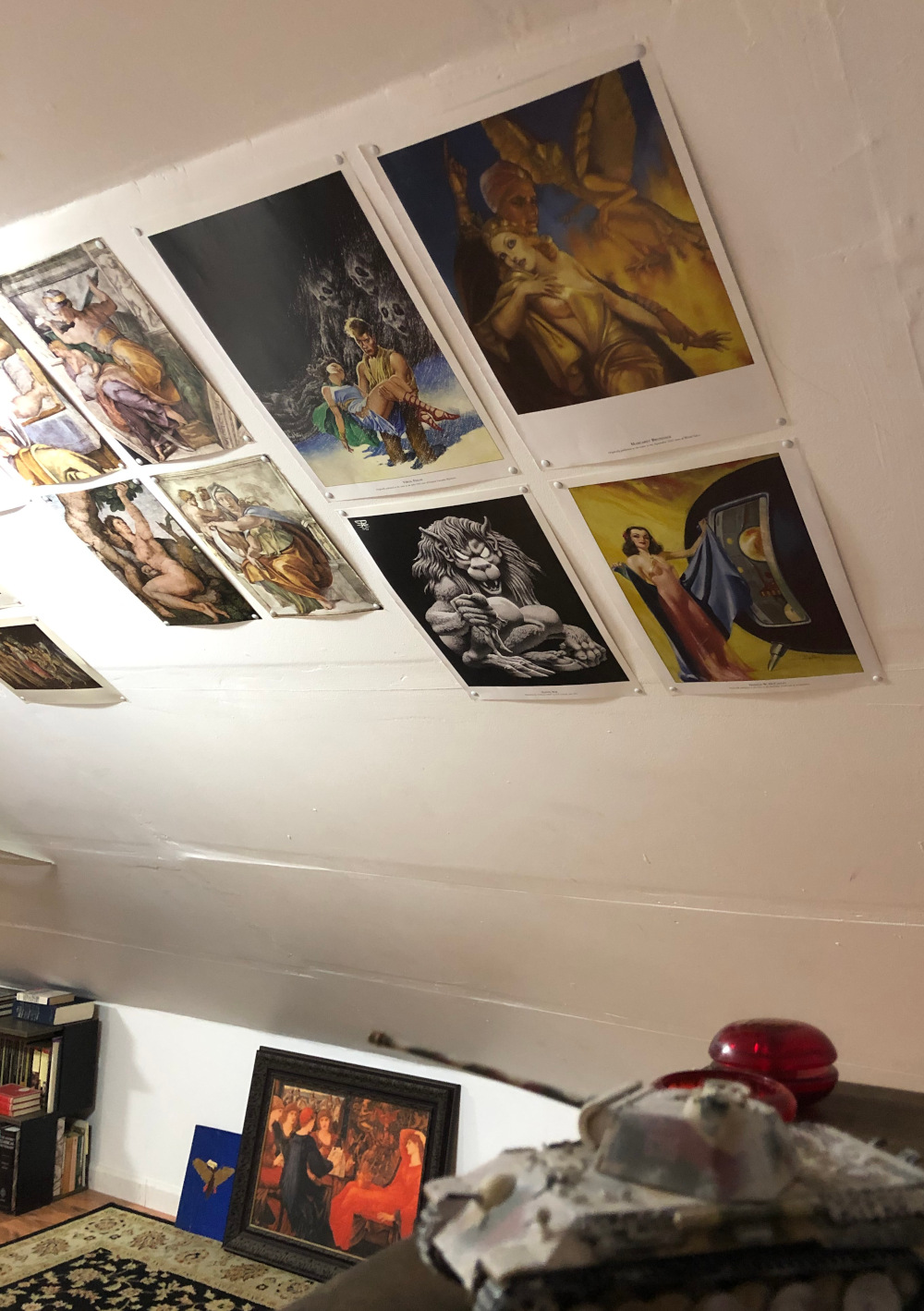
As readers of my twitter feed may remember, I bought a book of posters of art from pulp magazines in August.  In September I chose four of these posters to tack up here in MPorcius HQ: a Hannes Bok illustration of H. P. Lovecraft's "Pickman's Model;" Margaret Brundage's cover of the issue of Weird Tales with Clark Ashton Smith's "The Empire of the Necromancers" (one of the best of Brundage's productions;) Virgil Finlay's cover of the July 1942 issue of Famous Fantastic Mysteries; and Harold McCauley's cover for the December 1950 issue of Imagination.  It seemed appropriate to have actually read something connected to each of the four images, and so today we tackle three stories from that 1950 issue of Imagination, a magazine then edited by Raymond Palmer.  I'm reading these stories, all by people we have talked about here at MPorcius Fiction Log before, in the scan of the original issue of Madge (as we fans call Imagination) available at my favorite website and yours, the internet archive.

"Technical Slip" by John Wyndham 

John Wyndham, famous author of Day of the Triffids and Re-Birth AKA The Chrysalids, bore the legal name John Wyndham Parkes Lucas Beynon Harris, and "Technical Slip" appears here in Imagination under the name John Beynon.  The story would reappear four years later in the Wyndham collection Jizzle, and the next year after that in a paperback anthology by Groff Conklin which I own, Operation Future, and have already blogged a little about.  I didn't read "Technical Slip" when I sampled the contents of Operation Future back in 2017, maybe because Re-Birth had rubbed me the wrong way, maybe because I didn't recognize Wyndham under that disguise.

"Technical Slip" is one of those stories about a guy selling his soul to the devil, and also a time travel story.  It is well-written, but underwhelming and ends up feeling trifling.

Our dude is a 60-year-old Englishman, on his death bed.  He sadly reflects that all the wisdom he has acquired over a long and successful career is about to vanish.  Then a guy appears whom we are obliquely obliged to understand is a representative of the devil, though the devil in this story seems more like the manager of the bureaucracy that maintains the universe than a malevolent figure.  Having adapted to the rise of the market economy, these bureaucrats no longer barter boons for souls, but sell their wares for money.  After the hero agrees to hand over a large fraction of his wealth he is given a chance to live his live over again, and finds himself seven years old again, back in 1910, but with all his memories intact.  Wyndham does a good job describing the world of 1910 through the hero's eyes, and of depicting the sadness of seeing his little sister, knowing she will soon be crippled for life in an accident, seeing his father and knowing in a few years he will be killed fighting in the war, and seeing his uncle and knowing the financial disaster unk is going to be responsible for.  Wyndham succeeds in painting both a striking visual landscape and a moving emotional landscape here and is to be commended for doing so--all this stuff rang true to me.

The hero wonders if he can use his knowledge of the future to his advantage, and the advantage of the world--could he perhaps prevent or shorten the World Wars?  His test case is his sister, and when he  saves her from the accident which, in his first go round of life crippled her, he has proof that he really can change history!  But then the bureaucrats step in and weaken the protagonist's hold on his memory; their failure to do so initially is the "technical slip" of the title.  Our protagonist forgets he has lived through the tumultuous first half of the 20th century before and his efforts to alter history for the better are quashed.    

I felt like the plot sort of fizzled out, but Wyndham's technique in that middle section of the story when our hero is back in 1910 as a kid and retains his 1960s knowledge, is quite good; "Technical Slip" is better than most deal-with-the-devil stories and does something more literary with the idea of time travel than do most time travel stories.  So, I'll give it a moderate recommendation.

"Tourists to Terra" by Mack Reynolds 

Reynolds had a remarkably strange and diverse career as a radical leftist activist, a travel writer for men's magazines, and a SF writer whose work I generally dislike (check out the links for my past comments on some of these topics.)

"Tourists to Terra" is a brief gimmicky story.  Life on an alien planet has become too easy, too luxurious, driving wealthy individuals to seek new thrills.  One of the extravagant pastimes their advanced technology has made possible is travelling to primitive planets like our Earth to participate in wars among the natives.  The early scenes of "Tourists to Terra" the story depict these aliens--who look just like Earth people and equip themselves with anti-grav devices and special armor and weapons--fighting in the Trojan War, Reynolds rehearsing the scene from Book V of the Iliad in which Diomedes injures Aphrodite.  (This is one of the numerous SF stories that offers a theory of the source of some ancient myth, legend or religious belief.)

The complaints of the beautiful woman who will be the germ of the Greek goddess of love over getting hit by a spear convince the people running the space cruise that it would be safer to get their customers involved not in hand-to-hand combat but in a war fought with firearms in which they can act as snipers, killing natives from a distance from a place of concealment.  (These aliens think of us as no more than game animals.)  These aliens have the ability to not only efficiently travel between the stars, but through time, so the ship's crew crosses the eons to 1945 in search of a war affording opportunities for safe sport.  But our Earth technology has advanced faster than they anticipated, and by chance their ship materializes at an atomic bomb test site just moments before the detonation--the thrill-seeking aliens and their space ship are totally annihilated.

This disposable bit of ephemera would not be reprinted until 2011.

"It's Raining Frogs!" by Milton Lesser

This will be the fourth story by Lesser we have read here at MPorcius Fiction Log.  Feel free to feast your glazzies on my scribblings about "'A' as in 'Android'," "The Graveyard of Space" and "Ennui."

"It's Raining Frogs!" begins with an epigraph from Charles Fort's Lo!  Fort apparently loomed large in the minds of SF writers and fans in the middle of the 20th century--Lo! was serialized in Astounding in the early Thirties when F. Orlin Tremaine was editor, Tremaine's successor John W. Campbell, Jr. recommended Fort's collections of questionable reports of unusual phenomena as source material, Eric Frank Russell praised Fort highly, Damon Knight wrote a biography of Fort, and so on.  The epigraph here mentions frogs, Fort arguing that all the universe shares a single existence, so you can study the entire whole from any starting point, be it economics, the life of Napoleon Bonaparte, or frogs.

Myra is a beautiful, intelligent and athletic woman, and an enthusiastic fan of Fort and student of Fortean phenomena.  She is married to George, a mediocrity in the looks and career department, but something special anyway--he is what Myra calls a "catalyst," a man who attracts Fortean phenomena.  When he rolls large numbers of dice the totals do not follow normal bell curve expectations, and sometimes frogs and other small creatures start falling from the sky upon him, spontaneously.  The main plot of this story concerns how George, unwittingly, summons a man from another dimension, and not just any man, but the King of the Fourth Dimension.  Like George, this alien monarch (who looks exactly like an Earth man) is married to a woman who dominates him, something he is quick to tell George and Myra.        

This king from the Fourth Dimension and Myra have a longish conversation about the physics of two-dimensional, three-dimensional, and four-dimensional universes, but eventually His Majesty gets worried his wife will be angry if he isn't home soon, and wants to leave, but he can only return to his universe with the permission of George, who summoned him.  George refuses, Myra insists, and in response to George's intransigence she starts hitting him--it is hinted that this sort of spousal abuse is a normal feature of their married life.  For the first time after years of marriage, George asserts himself; he outwrestles Myra and spanks her, breaking her will and becoming master of his home.  

The Queen of the Fourth dimension arrives, and tries to dominate the situation by seducing George; she also sets about using her alien powers to steal a fortune in jewels from Earth to take back home.  George not only stands up to her but his example inspires the King to stand up for himself and become master of his relationship.  The stolen jewels are returned to their rightful owners and everybody lives happily ever after in both our dimension and the Fourth now that these troublesome hot women know their place.

Obviously a story which suggests that women are selfish and greedy and that specimens of the weaker sex who are intelligent and attractive will use their brains and looks to run roughshod over everybody if a man doesn't firmly assert dominance over them runs counter to the values we in 2022 all hold dear or at least pretend to ascribe to if we know what is good for us.  Putting that hot potato aside, "It's Raining Frogs" is too long and repetitive, and the mechanism of how George summons frogs, beetles, birds, a henpecked king and a sexalicious jewel thief of a queen to our universe is poorly worked out.  George does not voluntarily summon these aliens--in fact, he considers these phenomena a nuisance, they are appearing against his will--but for the plot to work we are expected to believe he can by an act of will send them back or confine them here.  Seems a little contrived.  

Weak filler.  Like Reynolds' "Tourists to Terra," "It's Raining Frogs!" would have to wait until this century to be reprinted.

**********

Imagination is one of those magazines the critics look down upon, and I didn't exactly find a storehouse of ammunition today with which to challenge their dim assessment, though "Technical Slip" demonstrates Wyndham's considerable writing ability and "It's Raining Frogs!" is a useful document for those interested in the relationship of Charles Fort to SF and those looking for evidence of sexism in SF (spanking fetishists may also want to check it out!)

Speaking of stuff the critics look down upon, we've got a 1973 sword and sorcery novel coming up, so have your square-cut mane and mighty thews ready the next time you surf on over here to MPorcius Fiction Log!

Saturday, September 10, 2022

The Haven by Graham Diamond

Thus were the sides drawn; men, wolves and birds pitted against the wild dogs and bats.  A war to end all wars.  Win or lose, both sides knew that by summer's end the world would never be the same again.

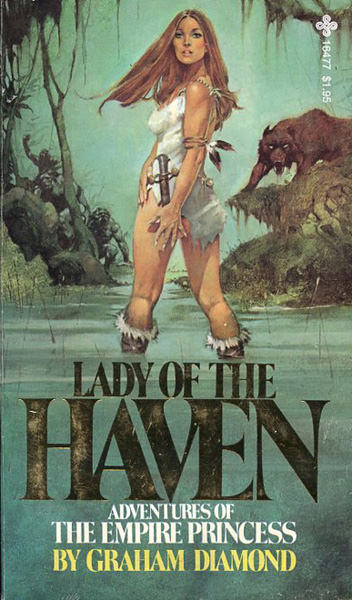
Left: What the front of my copy of The Haven looks like
Right: What the front of your copy probably looks like

When I heard on the news that the federal government is making the taxpayers pay my debts for me (thanks, suckers!) I decided to splurge and buy some crazy books I have been curious about and can't find on the internet archive, even though I suspected I wouldn't even like them.  When other people pay your debts for you, you might as well make risky investments!  First up, The Haven by Graham Diamond!

I have been curious about The Haven (1977) and Lady of the Haven (1978) for years, my interest piqued by ads for them in places like Richard Meredith's No Brother, No Friend and the Winter '78-79 issue of Algol.  Sometimes The Haven is marketed as a horror novel (it looks like one of those "paperbacks from hell," doesn't it?) and sometimes as a "fantasy adventure."  The thing is apparently rare and collectible--at least it is expensive!  I managed to buy one online for only ten bucks because its cover is missing.  It seems pretty lame to spend ten smackers on a book with no cover, I grant you, but I'm a reader, not a collector, and there was no sexy girl or dinosaur on the cover, so I figured, hey, no big loss.

It is the future, two thousand years from today!  But it is not the future of which you have dreamed, the one with anti-grav scooters, interstellar trade and sex robots!  Oh no, buster, this is one of those futures in which nobles riding horses and wearing swords lord it over, I mean have pledged their lives to protecting, a bunch of farmers and servants and everybody is liable to die from plague at any moment.  Oy!  This future sucks!  And it gets worse!  The human race has been reduced to a mere 13,000 souls in a valley, half of them living in a fortified city--the Haven of the title--and the other half living in a bunch of villages within 15 or 20 miles of the Haven.  Beyond the capitalized Valley is the capitalized Forest, which conventional wisdom suggests covers the entire planet, and which sad experience has proven is home to the intelligent talking dogs who hate humanity and have been trying to exterminate us for as long as anybody can remember!

A bookish young lord, Nigel, isn't so sure that the Forest covers the entire planet; he wants to lead an expedition into and through the Forest, thinking it possible that better lands lie beyond it.  He keeps petitioning the Council to put in action such an ambitious policy, but to no avail; after all, all such expeditions in the past have been massacred by dogs and packs of dogs are currently attacking the villages in the western part of the Valley so it seems silly to send soldiers away on such an risky expedition.  

In this feudal future in which the most complicated machine is a crossbow it is not only the dogs who are intelligent and will talk your ear off, but the birds!  Fortunately the birds are on our side, providing aerial reconnaissance and close air support in our endless war with the dogs!  The king of the hawks reports to the Council that the traditionally disparate packs of dogs are uniting--the prophecy of a dog king has come true and this revolutionary figure is massing a huge army to the south with the aim of leading a crusade against the Haven that will  wipe out us bipeds once and for all!  

In a way I didn't quite understand, this horrible news convinces the Council to let Nigel take some of the Haven's precious few soldiers on an expedition into the Forest.  They will travel north to look for "new lands," which they hope will, somehow, help them defeat the dog army.  This component of the novel would have been more convincing if there were some ancient legend of an arsenal of super weapons or a rumor of a fortress inhabited by a lost tribe of men or something, but Diamond offers no rationale for this expedition whatsoever.  Another problem with the whole "we gotta explore the woods that we fear covers the entire world" idea is that these humans are intimate friends with talking birds who draw maps in the sand with their beaks--don't birds migrate for hundreds of miles?  Can't our fine feathered friends tell us in detail what lies beyond the Valley?

In Chapter Seven (The Haven has thirty-five chapters) we get more talking among rulers and their counsellors, but not among humans this time, but wolves!  The king of the wolves has to decide how to respond to the fact that a decisive war is about to break out between the dogs and the men.  Wolves are small in number, and so will be easy prey for the dogs once the humans are gone, so the wolf king decides to ally with mankind, even though man and wolf have never been friends.  So, after several chatty chapters set back in the valley that cover recruitment and diplomacy, when Nigel's expedition finally sets out in Chapter Sixteen, Nigel is accompanied not only by ten soldiers and two birds (a hawk and Nigel's friend the parrot), but the wolf king's closest adviser and his two bodyguards.  

(Besides all the chapters of wolves and birds and men talking blah blah blah, we get Chapter Twelve, set in the camp of that new dog king, whom I had been hoping would turn out to be a wizard or a werewolf or a robot or something cool, but is just a dog.  His Majesty gives a totally forgettable speech, just like any other politician in this book.  He announces an alliance with the kingdom of the venomous vampire bats, but the wolves gave this intelligence to the humans back in Chapter Eleven, so it is old news to us readers.)

Nigel's expedition journeys north, overcoming obstacles like quicksand and fog as well as attacks from various animals.  This stuff is marginally more interesting than the talk talk talk that characterizes most of The Haven, but is not good.  The action/violence elements are handled poorly, with bad word choices; at one point Diamond says of a guy reaching for his sword that a wolf "could have sprung and slit his throat before the knife was out of its sheath"--in the space of a paragraph Diamond uses the words "sword" and "knife" to describe the same weapon, and suggests a wolf's jaws "slit" throats rather than crush them or rip them out or whatever.  In the next paragraph the guy with the knife/sword looks at the wolf's claws and can see they are "sharp as razors."  Are a wolf's claws really sharp as razors, and could you tell that just by looking?  And these are not isolated examples of distractingly bad sentences--The Haven abounds with such sentences, and all the fight scenes and all the discussions of weapons and military matters feature them.

Nigel and co. find the decades-old bones of an earlier explorer, and the diary found among them guides them to a valley beyond some mountains, a paradise where animals all live in harmony under the beneficent rule of giant snakes--nice snakes, not like the venomous giant snakes they fought several chapters ago!  The lord of the nice snakes generously guides them to a ruined human city, where Nigel digs up books over a thousand years old.  Nigel sends the soldiers back to the Haven and stays in the happy valley to excavate and research the human past.

The almost tolerable chapters covering Nigel's expedition are interwoven with boring and irritating chapters on the war down in the Valley and the woods to the south of it as the humans and wolves launch an unsuccessful spoiling attack on the dog king's gathering army and then the human and wolf survivors are besieged in the fortress city that is the Haven.  These chapters are very tedious, inhabited by flat characters who spend page after page discussing routes of march and detailing plans for flanking maneuvers and ruses and then, when these plans invariably fail, reporting exhaustively on the disaster.  Late in the book the head of the Council decides to build a huge wooden dog on a wheeled platform and give it to the new dog king, ostensibly as a peace offering; it will be filled with soldiers (that the dogs will somehow not smell) with the job of assassinating the canine monarch, and we actually have to read a politician's long retailing of the story of the Trojan Horse, suggesting Diamond fears we've never heard of this classical caper.  

(It seems possible that Diamond took Virgil and Homer as models for this book here, and the description of the episode of the Trojan Horse is his way of making it obvious for us.)

When we are not reading brain-numbing dialogue we are enduring long, tedious and badly-written fight scenes in which characters whom we can't tell apart get killed.  Diamond repeatedly uses the word "snipe" to describe dogs biting their opponents; officers order archers to "fire" and multiple times arrows are said to "pound" dogs.  If the fighting were entertaining we might forget the fact that the whole idea of an army of thousands of dogs marching for miles and laying siege to a town for weeks is a little hard to take--what are the dogs eating and drinking?  They have no supply wagons or backpacks or canteens or anything... they can't be eating plants, can they?  Of course, these dogs torture a man by peeling off his skin and then spike his dead body to a wheel to display to the other humans, so I guess anything is possible for these pooches, hands or no hands.

In the middle of a boring battle which the humans and wolves seem doomed to lose, there are suddenly inexplicable explosions that panic all the dogs so the lupine-human alliance can hunt them down and exterminate them with ease.  The dog king is killed by a minor character.  In the book's final pages we learn through dialogue, as usual, that the lord of the snakes lead Nigel to a cache of gunpowder left over from a thousand or more years ago and Nigel brought this stuff back to the Valley and secretly planted mines all over the battle zone, then at an opportune moment somehow detonated all these IEDs without harming any humans.  The survivors of the war live happily ever after, with Nigel and his best friend both getting engaged to forgettable women characters who have had almost no screen time; one of these women's names is misspelled half the time it appears.

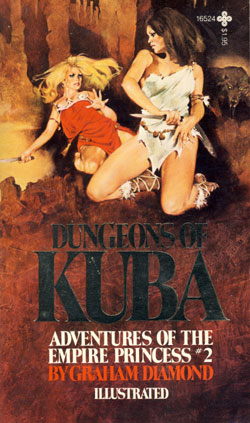
The Haven is a real disappointment.  Seeing that this book was published by Playboy Press, that its cover looks like one of those crazy horror books covered so extensively by Will Errickson and Grady Hendrix online and in an award-winning book and the covers of its first two sequels feature attractive young ladies by Vampirella artist Jose Gonzalez, I expected The Haven to be a wild exploitation novel full of sex and/or gruesome violence.  As for sex, there is zero.  ZERO.  There is some gory violence, dogs getting their eyes gouged out and their legs chopped off and people getting their heads chopped off and their eyes gouged out (lots of eye-elated violence in this book), but Diamond's writing is so lame none of it is shocking or entertaining.  Rather than a paperback from Hell, The Haven is like a young adult or juvenile novel, complete with scenes of little kids embracing adorable wolf cubs!  

Diamond's writing has no personality or style.  His prose is simple and straightforward, but that doesn't mean it is sharp and clear--rather, it is muted and bland.  Diamond's rare efforts to introduce some excitement are ludicrous, like when he declares that Nigel the scholar, in battle with some bats, "fought as no man had ever done before."  If I can complain some more about his vocabulary (thank you for indulging me), Diamond uses the hackneyed and stupid phrase "will never be the same" like four times in the course of this book.  Annoying!    

The plot of The Haven is like that of a pedestrian fantasy novel--the boy who goes on a journey and becomes a man, the fortification under siege, the humans making alliances with non-humans--but it lacks much of the stuff that makes high fantasy epics like Tolkien's or sword and sorcery stories like Howard's or Leiber's compelling.  There is no supernatural element--no sorcery, no divine or alien entities, no living dead, no elves or dwarves--and there is no ideology, no philosophy.  There are no jokes.  There is no fun larger-than-life character like a Conan nor a somewhat realistic character you might identify with, and there are no interesting, much less moving, human relationships like those between Fafhrd and the Grey Mouser or Frodo and Sam.

Diamond fails to create a vivid alien world; he sets his tale in a totally crazy environment of talking animals and medieval technology and institutions, but everybody talks and acts like a late 20th-century person, saying banal lifeless gunk that middle managers at a widget factory might say, like "peak performance" and "maintaining efficiency."  In Chapter Fourteen there is a scene in which an officer is training "raw recruits," and one of the fresh squaddies asks the officer, "You've told us about choosing our specialty, but what can you tell us about what to do when we actually come face to face with the enemy?"  This sentence might make sense in 20th-century America, where the Army teaches people to be radio technicians and engine mechanics, but we're talking about a feudal milieu in which people fight with crossbows and swords.  In this pre-capitalist economy, what does "specialty" even mean?  And it is not just the humans I'm talking about--the dogs, birds and wolves speak and act just like the men do--the birds shake their heads "no" and shrug their shoulders to express ignorance just like a human being does.  The birds even smile and frown!  Do birds have lips?  Why fill your book with animal characters and then have them act just like humans?

The Haven is like 340 pages of text; by the time I got to page 240 I was bitterly wishing the ordeal that was reading it was over.  Gotta give it a thumbs down--a quite bad investment, a loss which I compounded by buying three of the sequels as a lot that same day.  Ouch!   

Tuesday, September 6, 2022

Harlan Ellison: "High Dice," "Enter the Fanatic, Stage Center," "No Fourth Commandment" and "The Night of Delicate Terrors"

It is time to put Harlan Ellison's 1961 collection Gentleman Junkie and Other Stories of the Hung-Up Generation behind us by reading the four remaining stories.  I had been thinking I had five left to read, but that is because I had forgotten I had read "The Late, Great Arnie Draper" in another publication like a year ago.  Oops.  

"The Late, Great Arnie Draper" (1961)

I read "The Late, Great Arnie Draper," which first appeared here in Gentleman Junkie, in a scan of a 1967 issue of the men's magazine Adam and blogged about it in 2021.  Interestingly, there is a mistake on the Harlan Ellison website, which suggests "The Late, Great Arnie Draper" debuted in a 1961 issue of Adam.  See, we all make mistakes!

"High Dice" (1961)

Another story that made its initial appearance in Gentleman Junkie.  It would be reprinted in the men's magazine Knight in 1964, which promoted it on its cover with the description, "Fantastic World of Black Hate and Dope."  Sounds controversial! 

"High Dice" takes place in the restroom of a crappy restaurant!  The restaurant's cook is Kurt, a big muscular black guy who carries a "gravity knife," cheats on his wife, and loves to gamble.  Kurt is not a very good cook, but the boss is too scared of him to fire him and if a customer should complain about his cooking, Kurt beats said customer up.  Talk about customer service!  Look out, Karens, this guy Kurt is having none of your lip!

"High Dice" is all about the end of Kurt's reign of terror!  Our narrator is an unlikely ogre slayer, Teddy, a college student and drug addict.  Teddy needs "a fix" bad, is having all sorts of horrible withdrawal pains (these withdrawal pains are a recurring feature of Gentleman Junkie, I'm glad I'm a square and have no experiences like those described in this collection, because they sound terrible.)  Teddy's dealer is asking thirty-five dollars for a hit, but Teddy has only twenty-five bucks to his name.  So, Teddy and the dealer met in this crummy restaurant so Teddy could ask Kurt for the ten bucks the cook owes him.  Kurt ushered Teddy into the filthy restroom, and the dealer sat down to drink a chocolate Coke and wait.

(I would like to see a recipe for these chocolate Cokes people in Gentleman Junkie drink--this is a Gentleman Junkie experience I think I might enjoy.  Should I just start putting my Ovaltine in Coca-Cola instead of in milk?)

Instead of just forking it over like a gentleman, Kurt insists that Teddy give him a chance to win that ten dollars back, and so on the floor of a disgusting restroom they play craps and a game called "high dice" which is when you each roll a die and high roller wins.  Kurt may be famous for cheating, but somehow Teddy wins again and again, and each time Kurt demands a rematch ("Come on, throw, double mah bet,") and if Teddy resists this demand Kurt just hits him.  Teddy figures Kurt hates all white people and refuses to allow a white person to beat him, and has no money on him and is just going to browbeat Teddy into playing until he has won whatever money Teddy has on him. 

Teddy suffers increasingly severe withdrawal pains and starts crying, while Kurt gets increasingly violent as Teddy wins throw after throw.  Things climax when Teddy vomits and some of the vomit gets on Kurt.  Kurt starts cutting Teddy with his gravity knife, but there is a "line wrench" in the restroom, and Teddy seizes it and beats Kurt to death, providing a welcome catharsis to those of us readers sitting in the anti-Kurt bleachers.  But Teddy doesn't expect that the world will thank him for liberating the neighborhood from Kurt's physical, financial and culinary abuse; he figures he is going to get thrown in prison or the funny farm, and, even worse, his dealer will be spooked by the arrival of the cops and he'll be that much further from getting the fix he needs.  

I like this one, despite (because of?) how sickening it is, what with Ellison describing in detail the dirty restroom and the vomit and all that.  My copy of Gentleman Junkie has a list of controversial topics on the cover, and one is "Negro Prejudice;" maybe that refers to Kurt's hatred of the white man, a bad attitude that leads him to his doom.

"Enter the Fanatic, Stage Center" (1961)

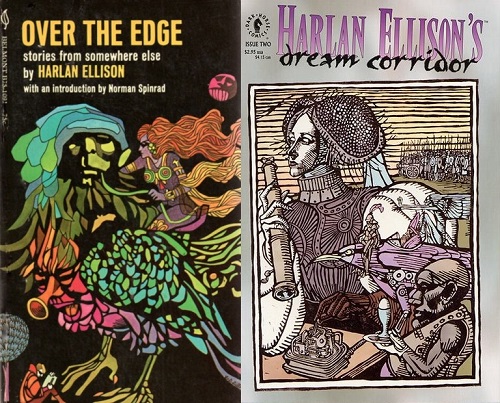
Like "The Late, Great Arnie Draper" and "High Dice," "Enter the Fanatic, Stage Center" debuted here in Gentleman Junkie and would be reprinted in a men's magazine, in this case a 1966 issue of Adam.  That issue of Adam actually reprinted two Ellison stories; the other, 1956's "Both Ends of the Candle," appeared in the 1966 magazine under a pen name.  (It seems weird to publish a story in a book with your name plastered on the front of it, and then publish the story again in a nudie magazine under a pseudonym, but I guess life is weird.)  In 1970 "Enter the Fanatic, Stage Center" appeared again in a collection put out by our friends at Belmont, Over the Edge.   

"Enter the Fanatic, Stage Center" is a gimmicky filler story that I thought was sort of inconclusive and lacked focus.  Issuing a negative judgement on this one.

A man with a beard comes to Prince, a town where nobody wears a beard.  The stranger is an artist, and opens an art gallery where he shows his paintings in the shop window.  These paintings reveal the dark secrets of the members of the community--this guy is an adulterer, that guy is biracial ("half-Negro,") these women are lesbians, the town beggar is secretly rich, that guy is impotent and leaves his wife unsatisfied, etc.  These revelations lead to people losing their jobs, marriages collapsing, and violence, wrecking the previously orderly community.  When somebody confronts the painter, the town wrecker says that he is the son of a German couple murdered by a mob during the war in a fit of anti-German hysteria.  But then admits that is a lie.  It is hinted that this bearded troublemaker is the Devil or a servant of Satan, but he also says "I am quite as human as you."  The painter then murders his interlocutor, and then he leaves town, apparently to go destabilize some other town.

I guess this story is an expose of the hypocrisy and bigotry of small towns and religious people (the first scene features everybody coming out of church on Sunday, and the guy who confronts the painter in the final scene is a minister) but references to a poor section of town and to the painter taking "long, late night walks in obscure parts of town" make Prince feel like kind of a big place.  I also thought it felt out of place for the painter to just blow away the minister in the end; he destroys the town in a way that is meant to be clever and expose people's self-destructive tendencies, but just blasting a guy with a gun is neither clever nor emblematic of the blastee's shortcomings.  So the point of the story is a little muddy, and the characters and plot are not powerfully drawn but sort of vague; also the story feels long and tedious.  Not good.

Finding "Enter the Fanatic, Stage Center" kind of limp and diffuse, I was a little surprised to learn it was the basis of a story in the 1995 Harlan Ellison comic book, Dream Corridor.  (The great tarbandu just recently blogged about Dream Corridor.)  This comic is available to read online for free (probably illegally, but I'm no lawyer) so I checked it out.  In the framing device page before the story proper begins, Ellison tells us "Enter the Fanatic, Stage Center" is one of his "personal favorites," and that it was inspired by William Faulkner's "The Ears of Johnny Bear."  (Ellison also suggests that what I have called "muddy" and "inconclusive" is in fact "enigmatic."  Life is all about spin.)  The comic version of "EF,SC" is revised a little: the black boys who beat somebody up are now white, and the murdered German couple are explicitly described as "immigrants;" in the 1961 story the word "immigrant" isn't used, though maybe you are expected to assume they are immigrants?


"No Fourth Commandment" (1956)

This one debuted as "Wandering Killer" in a magazine called Murder! that it seems only endured for five issues.  There's Harlan's name right there on the cover of the second issue, on the thigh of some poor woman suffering some dreadful abuse.  In 1971, men who went to the magazine rack in their tireless quest for images of naked ladies had the opportunity to read "No Fourth Commandment" as a bonus after they had, er, taken care of business, as the tale was republished in Pix ("Magazine for Men Who Like Action!") under the pen name Jay Solo.

Our narrator is an itinerant farm laborer, picking a field of strawberries in Louisiana.  Picking alongside him is a teenaged boy whom we are told looks lean and hungry.  The narrator, who I suppose is middle-aged, takes a liking to this kid, even though he seems like he is about to explode and says stuff like that he is going to kill his father.

Eventually the boy explains that his father returned from the war in Europe with a German wife, even though his American wife, the kid's mother, was still alive.  The mother was so broken up she repeatedly tried to destroy herself.  Dad abandoned them, and now the son is crisscrossing the country, doing odd jobs, searching for his faithless father so he can murder him.

Eventually the horrible truth comes to light.  The boy has already killed his father, and is totally insane, travelling around, killing men he finds almost at random that in his delusions he sees as his "Paw," immediately forgetting his murders and so thinking he still has to find and kill his father.  He has already been caught by the police twice, and escaped twice.  As the story ends, after the narrator has watched his little buddy chop up an innocent man with a scythe, the police have captured him again.

This story felt long and repetitive, as Ellison describes the kid's eyes and body and affect again and again, and the narrator tells us again and again that he is lonely and likes the kid and so forth.  I guess the story is about loneliness and how love is irrational and can lead us to do stupid and even dangerous things, which is a good theme, but I was not moved, and in fact was rushing to finish this story, not caring a whit about who got killed or didn't get killed.

Thumbs down.

(It sounds to me like a better story could have been written about the German wife, who leaves war-torn Europe to learn she has married a guy who already has a wife and then sees her husband get massacred and is thus left alone in an alien land.)

On the right, 1979 French edition of Gentleman Junkie, volume 2 of 
Les Humaoides Associes' Harlan Ellison: Oeuvres, the cover of which 
reliably makes me laugh 

"The Night of Delicate Terrors" (1961)

"The Night of Delicate Terrors" debuted in The Paper: A Chicago Weekly and would be reprinted in a number of Ellison collections including Love Ain't Nothing But Sex Misspelled and The Essential Ellison.  The Harlan Ellison website suggests that "The Night of Delicate Terrors" also appears in From the Land of Fear but when I dug out my copy from the shelf I couldn't find it in there.  Looking on the sunny side, in my search I did discover that I actually own a paperback copy of Over the Edge, not the edition with the Dillons cover, but the 1972 printing with the Bob Foster cover, something I had forgotten.  Over the Edge is dedicated to Hugo-award-winning cartoonist and pornographer William Rotsler, and includes a Rotsler cartoon, something all you Rotsler completists will want to be aware of.

Alright, back to "The Night of Delicate Terrors," a candidate for best story in this book.  A Northern-born African-American man, apparently some kind of civil rights activist with a position of mid-level authority in a national group, is driving with his family to Chicago from Georgia in a snowstorm that has slowed traffic to a crawl and left many tractor trailers jack-knifed and many passenger cars in the ditch.  Tired and hungry, they are desperate for a restaurant or motel to stop at, but they don't know of any establishments here in Kentucky that serve black customers.  They go into a place and are angrily rejected by the ugly white staff.  The big reveal at the end is that the protagonist's organization is calling for an uprising or a revolutionary war or something of that nature ("so many would be killed, so many, many, many who were innocent") and he, a man of peace, has been skeptical of this radical expedient, but his experience in the restaurant with the ugly white people ("thick neck supporting a crew-cut head...like some off-color, fleshy burr on the end of a toadstool stem") has convinced him of the rightness of setting off the cataclysm.

Ellison does a good job describing the experience of driving in a snowstorm, and generates tension as the black family enters the white establishment hoping to be treated decently but expecting to be abused; "The Night of Delicate Terrors" is pretty good.

**********

Time to mark our Gentleman Junkie scorecard!  Each story gets one of three marks: Good, Acceptable, or Not Good.  I am counting the four components of "May We Also Speak?" each as an individual story.

Adding up the results, we see 11 Good marks, 5 Not Good marks, and 9 Acceptable marks, for a net total of 6 points.  This book is better than I expected, as I feared the stories on "controversial issues" would be just harangues or manipulative slosh, but Ellison actually tries to make the plots of his stories about racism and other touchy issues surprising and to populate them with characters that are actually interesting, and sometimes he succeeds.

Sounds like this collection deserves a recommendation!  Head on over to Amazon or Ebay and get your copy, but don't expect to pay the low low price I paid for mine at Second Story Books!    

**********

Ohmigosh, we almost forgot to read Ellison's preface and Frank M. Robinson's intro to Gentleman Junkie! 

Gentleman Junkie is dedicated to Robinson, writer of stories for Astounding and Galaxy, a column for Playboy and speeches for Harvey Milk, editor of Rogue and Cavalier, novelist and inductee to the Chicago Gay and Lesbian Hall of Fame.  In his Introduction, Robinson returns the favor, gushing about how great Ellison is; worse, he engages in some embarrassing snobbery about how writers are a special breed, how they are better than most people, how they have talent other people don't and have suffered agonies other people haven't and make sacrifices other people don't and have an empathy other people don't and all that garbage.  I am so glad I read this after reading all the stories, because it would have put me in a bad mood and left me primed to find fault with the stories!

In his Preface, Ellison advances his theory that there are four types of people in the world, and gives examples of each type from the stories here in Gentleman Junkie.  The fourth category of person is "Those Who are Hung-up," and Ellison explains that these people cannot "get a handle on Life," apparently quoting some other writer whom he doesn't name.  The "Hung-Up Ones" have been "boxed-in by Life," they are desperate, they are "hamstrung" by "neuroses" or their own poor decisions.  I guess Ellison thinks there are more such people in the middle of the 20th century than there were in earlier times.    

It seems that our pal Harlan believes the world is in real trouble, that the current time (this preface is dated March, 1961) is uniquely corrupt, that the people of his age--"our Decade In Degeneration" characterized by its "Crap-Game Culture"---have loose morals, that they are following false values and false gods, like listening to rock and roll, which is not real music, and reading confession magazines, which is just "keyhole-peeping."  Ellison is frightened for the human race!

(The attack on rock music is amusing because Ellison would eventually graduate to wishing death on people who don't like rock music, as we saw when we read the introduction to The Beast That Shouted Love at the Heart of the World back in the early days of this blog.  The fanaticism of the convert!)

Let's pretend we didn't read these two overwrought and fundamentally lame pieces of introductory material and leave Gentleman Junkie and Other Stories of the Hung-Up Generation with the good feelings we had when we finished "The Night of Delicate Terrors," shall we?