Tuesday, March 8, 2022

Astounding Dec '35: Raymond Z. Gallun and Murray Leinster

The December 1935 issue of Astounding includes three stories by Raymond Z. Gallun, two appearing under pseudonyms.  It's like a sub rosa special Gallun issue!  Let's see what these three tales are all about.  Plus, as a special bonus, let's read the included story by Murray Leinster, even though editor Orlin F. Tremaine warns us it is a "delightful satire."

"Davey Jones' Ambassador" by Raymond Z. Gallun

This is a traditional old time science fiction tale in which the author envisions an alien society, portrays human first contact with that society, and in which a scientist, the protagonist, uses his brains--his science and engineering knowledge and his ability to outwit others--to overcome plot obstacles.  There are no swords or sexy princesses--this is true hard science fiction that glorifies the search for knowledge and Man's ability to improve life by manipulating His environment through application of that knowledge.

Clifford Rodney is in his one-man submarine on the bottom of the Atlantic when he is attacked by the heretofore unknown local intelligent race, people with crustacean-like bodies, eyes on eye-stalks, and lots of fins and tentacles.  These people have developed a whole technology based on selective breeding--they use specially bred beasts as vehicles and weapons and construction machinery, for example.  These submarine people have no way to refine or work metal, so some of their most complex devices integrate metal components from sunken ships--while we on the surface know nothing about the submarine civilization, from these wrecked vessels--and especially from the books that sank with them--the undersea people know quite a bit about us.

And want to learn more.  Rodney and his submarine are put into a dome made from mollusk shell and pumped full of air--this terrarium has been specially prepared for the human the ocean floor's natives have been hoping to capture someday.  One of the sea people, a scientist who like Tarzan learned written English entirely from books, communicates with Rodney by writing notes on the clear surface of the dome--Rodney writes back in sand left in the terrarium for the purpose.

It seems like the submarine people expect to keep Rodney until he dies, learning from him while he survives, but Rodney, of course, wants to get back home, and figures out how to do so, employing his vast knowledge of chemistry and physics and engineering.  It is a longshot, but he gets the unexpected aid of that scientist whose desire to see the surface world for himself Rodney has encouraged.

The ideas and themes of the story are good, but it is a little dry--his story lives up to the stereotype that old SF is all about ideas and its authors neglected (or, if you want to be a jerk about it, were incompetent to provide) literary values.  This is one of those stories that doesn't feel like hot stuff while you are reading it because it doesn't push any of your buttons, seeing as it lacks sex, violence, surprises or poetic sentences, but after you've read it you have fond memories of the story's meaty substance.  We'll say it is on the high end of "Acceptable."  A good example of its type, "Davey Jones' Ambassador" has been reprinted in quite a few anthologies as well as in The Best of Raymond Z. Gallun.

"Nova Solis" by Raymond Z. Gallun

"Nova Solis" appeared under the pen name E. V. Raymond and has never been reprinted.  Soon I will be one of the few people who has read this story since the 1930s!

Brad Keyston awakes after spending two thousand years in suspended animation!  It is explained to us, via flashback exposition and in a speech from luxuriously bearded scientist Dr. Elias Heth, that in the 1950s a "cloud of meteoric refuse from interstellar space" drifted into the solar system and was sucked up by the Sun, causing old Sol to go nova on us!  What did the government do to try to save our civilization?  Who knows?  Luckily, private industry stepped into the breach!  The chemical company Keyston co-owned with Dr. Heth had discovered a gas called "hibernite" and here was just the opportunity to test it out!  The company dug a miles-deep shaft and sheltered three hundred employees of the company down there; after setting the alarm clock for twenty centuries they put everybody into a state of suspended animation.

Those centuries are up and Keyston and his blonde wife and her brother put on sealed and armored suits and ascend the shaft to explore.  They find that the Earth's surface is a hell of temperatures exceeding 130 degrees Centigrade!  The three hundred survivors only have one year's worth of preserved food, and they won't be able to cultivate any crops in these conditions, so it looks like it is all over for the human race.

But wait!  Keyston and the two beneficiaries of his nepotism see some kind of weird flying thing--like "Davey Jones' Ambassador," "Nova Solis" is a story of first contact.  Our heroes learn that aliens, beings of superheated gas, colonized the Earth during the centuries after the nova, but as the Earth cools they are departing, leaving behind domes of superinsulation.  Within these domes the aliens maintained the kinds of conditions they find comfortable, temperatures around 4,000 degrees Centigrade, but the humans can use them to create cool microclimates in which they can live and grow crops.  Within these domes the human race can endure!

A competent filler story.  In describing Dr. Heth's beard, Gallun mentions Sennacherib, assuming his audience has a level of education or familiarity with the Bible that I for one lack.  Did a majority of readers of Astounding in 1935 know who Sennacherib was?  The past was a different world!

"Avalanche" by Raymond Z. Gallun 

Here's another story that has never been reprinted.  

Fai Toran and his "Negro servitor" Nareth are "the greatest wizards of the period," master scientists and the leaders of the resistance to the Rothel.  The Rothel are the product of a centuries-long eugenics program, a race of seven-foot-tall warriors who are conquering the world.  With bombs they level the last city to hold out against them, with poison gas they exterminate its citizens.  Fai Toran and Nareth, the town's only survivors, the only living foes of the Rothel, are temporarily safe within their specially shielded HQ, which is shortly surrounded by the Rothel soldiers, half of whom are women.  The Rothel may be committed to conquest and genocide, but you gotta hand it to them, they have a progressive attitude about gender roles.

The scientists have built two spherical flying robots, one animated by a perfect mechanical replica of Fai Toran's brain, the other by a similarly exact mechanical duplicate of Nareth's.  Fai Toran delivers a speech to the surrounding Rothel, explaining what these spheres are, and warning the conquerors that they will face a doom in three years' time.  The robots fly off into space and then Fai Toran detonates an atomic bomb that kills them and many of the Rothel.

Three years later a horde of millions and millions of self-replicating spherical robots, lead by the Fai Toran and Nreth robots, devours not only the Earth but every significant body in the solar system, converting the raw material of the Sun, and every planet, moon and asteroid, into still more robots.  These robots will, it seems, conquer and destroy the galaxy, maybe the universe.  In the final scene the Fai Toran robot muses on the meaning of progress and the meaning of life, not sure if his accomplishment is a source of pride or regret.

This is an acceptable sense-of-wonder story that depicts an alien milieu and has as its themes amazing technology and the planet-shattering physical implications and norms-shattering philosophical implications of such technology.  The thing people today will find noteworthy about the story, of course, is that Nareth the black scientist is the slave of Fai Toran instead of his equal partner or his trusty lieutenant or something.  What role does Nareth play in the story, why is he even included?  It sort of makes structural sense for Fai Toran to have somebody to talk to, so that the story's themes can be presented in dialogue form, but why a black guy and why a slave?  One possibility is that the inclusion of a black slave is a device to sort of make the story seem like an "Oriental" fable; the same motive is likely behind the fact that the scientists Fai Toran and Nareth are introduced as "wizards."  Another possibility is to make the distant future of Fai Toran seem more alien, to indicate that Fai Toran's values are not the values of 1935 Americans, and to foreshadow that, while Fai Toran is an enemy of those destructive conquerors, the Rothel, he is not some freedom fighter deeply opposed to destruction and conquest, but perhaps sees such achievements as a form of progress and is not averse to committing destruction and conquest  on a scale even greater than that of the Earth-conquering Rothel. 

"The Fourth Dimensional Demonstrator" by Murray Leinster

This story seems to be well-liked, appearing in many Leinster collections and anthologies, in multiple languages.  This is where I have the opportunity to go against the grain--I didn't like "The Fourth Dimensional Demonstrator," finding it a tedious waste of time.  It is introduced as a satire, but, while I suppose it satirizes government employees (corrupt and incompetent goofballs) and women (greedy and petty bitches) and men (ensorcelled by pretty girls, no matter how greedy and petty they might be) it is more like a slapstick comedy.  

Pete is in love with Daisy, sexy performer in the "Green Paradise floor show" and owner of a pet kangaroo.  Daisy will marry Pete if he has money, a lot of money.  Pete's uncle, a scientist with a butler or valet or whatever the guy is, has just died, and Pete has inherited everything, but it turns out Unk was deep in debt, so there is no money.  Will Daisy abandon Pete?

The valet points out that Unk completed his time machine just before he died.  In a conventional SF satire, you jump in the time machine to visit the future, to see how the commies that the author hates or the capitalists that the author hates have screwed up the world.  In a conventional SF adventure story, you jump in the time machine to visit the past and sword fight with Vikings or hunt a tyrannosaur.  In a conventional blow-your-mind SF story you jump in the time machine and have sex and become your own ancestor.  In "The Fourth Dimensional Demonstrator" you don't do any of that stuff, stuff that conventional readers might find interesting.  Instead, the time machine performs as a duplicator.  You put an object into the machine, turn it on, and the machine reaches back in time to snatch the same item from the past and bring it to the present, meaning you now have two such items, for all purposes totally identical.  This sounds so convoluted and lame that I fear I am getting it wrong, but I'm not going to read the story again to figure it out (and "convoluted and lame" describes the story as a whole, anyway, so it fits.)

Anyway, Pete and the valet do the obvious thing and duplicate precious metals, jewelry, and cash.  Daisy is of course thrilled.  Then comes the slapstick.  Duplicating cash was stupid, because the police eventually are alerted by a concerned citizen to the fact that the local economy has been flooded with many bills bearing the same serial number.  Some Irish cops come by, and get mixed up in a fracas with Daisy's kangaroo--the kangaroo likes to eat cigarettes, and it hops at these doughty sons of Erin because one of them is smoking.  At the same time, Daisy has accidentally duplicated herself several times over and all these greedy bitches are squabbling.  In the ensuing chaos lots of people, kangaroos and items fall in and out of the time machine, and animals and people accidentally turn the machine on, off, into reverse, etc., with the final result that there is only one Daisy and the counterfeit cash has vanished so that there is no case against Pete and the valet.  Pete is still rich and free because the gold and jewels he duplicated do not expose him to legal risk, but Daisy is still angry the money is gone.  The end.

Obviously this story offers nothing worthwhile in the speculative or satirical departments; unlike the Gallun stories we've read from this issue of Astounding, "The Fourth Dimensional Demonstrator" does not reflect any innovative thinking on the part of the author or spur any thought upon the part of the reader.  Even worse, there is no human feeling and the jokes are not funny.  Thumbs down!


**********
The Leinster we can forget about, but the Gallun stories are full of paradigm shifts, speculations about new technology and alien societies, the glorification of the scientist and his quest for knowledge, and the philosophical implications of high technology, the very stuff of old school classic SF.

Sunday, March 6, 2022

Hauntings by A Derleth, M W Wellman & R Aickman

If you search for "Aickman" at the internet archive, one of the results is the 1968 anthology Hauntings: Tales of the Supernatural, edited by a Henry Mazzeo.  Hauntings is Mazzeo's only credit at isfdb, but the book includes a high volume of illustrations by a man with a list of publication credits longer than your arm, Edward Gorey, whom all the cool kids go gaga over, so if you are one of those Gorey fans, you should definitely check Hauntings out.  Gorey's interior illos are actually based on the stories themselves--he must have actually read them.  

Besides Robert Aickman's contribution to the book (which we'll be leaving for last), we'll tackle stories by Weird Tales habitues August Derleth and Manly Wade Wellman.

"The Lonesome Place" by August Derleth (1948)

"The Lonesome Place" debuted in an issue of Famous Fantastic Mysteries that features a pretty good cover by Virgil Finlay depicting mass destruction, a sexy babe, and a bespectacled man in some distress, as well as a reprint of a 1934 novel by major mainstream writer C. S. Forester.  "The Lonesome Place" has been embraced by anthologists, and has reappeared many times, including in books edited by foremost expert on the weird S. T. Joshi and critical darling Joyce Carol Oates.

I've attacked quite a few weak and some just plain bad stories by Derleth on this blog, so it feels good to read a story by the co-founder of Arkham House that I can honestly say is well-written and quite effective.  Two boys, like seven years old, live on the outskirts of a small town, and are regularly sent on errands downtown around sunset.  One leg of the trip, when they have to walk along a dark section of street by a grain elevator and a bunch of trees after the sun has disappeared, strikes fear into them.  They can feel that some monster lurks in that blackness by the elevator, and that by running at their best speed through the island of darkness that lies between the corner street lights they have only just barely escaped being devoured.

Derleth does a good job describing the boys' fear, and their interactions with incredulous adults.  The lion's share of the story is a realistic nostalgic thing, but, as is foreshadowed on the first page, in the end we get a weird and perhaps surprising supernatural twist--as adults, the boys hear that a child was killed, apparently by an animal, on that dark stretch of street, and the narrator suspects that he and his friend somehow created the monster with their overactive imaginations and are this complicit in the child's horrible death.

Mazzeo, Oates and Joshi were right to pick this one out of Derleth's large and uneven body of work; thumbs up for "The Lonesome Place."   


"'Where Angels Fear...'" by Manly Wade Wellman (1939)

When this story first appeared in John W. Campbell Jr.'s Unknown it had quotation marks and an ellipsis in its title, but for its appearance here in Hauntings that additional punctuation was dispensed with.  It has appeared in numerous anthologies besides Hauntings, including Helen Hoke's More Ghosts, Ghosts Ghosts and the German volume Frankenstein wie er mordet und lacht.

"'Where Angels Fear...'" is a competent filler story.  Two people, Scotty McCormack, he of the "fine, bony, Gaelicly wide" face, and Muriel Fisher, she of the "spectacled, good-humored young face," decide to go investigate an old abandoned house that is reputed to be haunted around midnight, a house in which there have been multiple suicides--all of them hangings and all of them in the same room.  In the house, by means undisclosed to us readers and incomprehensible to McCormack and Fisher, the explorers, like their predecessors before them, end up hanged to death in the suicide room.  Scotty and Muriel are sitting there in the room, holding hands, waiting for the stroke of midnight, when they see some vague visual phenomena they think must be optical illusions and hear some equally mysterious sounds; then, somehow, they see their own bodies hanging--they have, almost unnoticed, become disembodied souls.  They soon drift apart and lose sight of each other and of this universe.

Acceptable.  Wellman includes direct references to Sherlock Holmes and Arthur Conan Doyle which perhaps helped win the hearts of the many Holmes fans out there.


"The Visiting Star" by Robert Aickman (1966)

Colvin is an academic, and "The Visiting Star" takes place during his extended stay in a drab coalmining town where he is doing research on the history of the town's now defunct lead and plumbago mines.  (I've never heard of plumbago; I guess it is what I have always called graphite or pencil lead.)  He spends much of his time in libraries and archives, and in exploring abandoned mining shafts and pits.

Colvin has gotten to know one of the few people in this dirty working class town who has any kind of education or culture, the guy who heads the local theatre company, Malnik.  Malnik is obsessed with 19th-century British drama, and one of his heroes is the nearly forgotten playwright Nethers, who was born in this very town.  Nethers killed himself at age 22.  Malnik, this Christmas Eve, is going to put on a performance of Nethers's most successful play, Cordelia, and he has managed to secure the services of the once famous actress Arabella Rokeby, who played the lead in Cordelia when it was put on in London during Nethers's lifetime.

Three odd characters show up in town, first a strange little man who looks like some kind of foreigner (his face is "brown" and "sharp," like that of a "Levantine.")  He acts like Rokeby's manager, but describes his relationship to the star in very vague terms, and is rarely seen after taking his room in the same hotel where Colvin is lodged.  Then arrive Arabella Rokeby herself and her constant companion.  Though Rokeby must be elderly, she looks like a short and slim young woman.  Her companion is a sort of weak- and sick-looking tall young woman.  These skinny women also get rooms in the hotel, and Colvin has some interactions with them over the days before the big performance.  In a series of strange episodes, which feature the apparent suicide of a local actor, an adventure in an abandoned mine shaft, and the dashing of Malnik's hopes, Colvin gains insight into the weird relationships that bind together, perhaps unwillingly, and certainly uncomfortably, the three queer visitors, and the possible truth about the death of Nethers and the recent "suicide" of that actor.  Colvin becomes fascinated with Miss Rokeby, and will never forget her, but immediately after the play, at which she delivers a performance of astonishing power, comes a cataclysm.

To put it bluntly, and here comes the big spoiler, the little dark man is some kind of wizard or mad scientist, and he has split Rokeby's body and personality--the tall skinny girl is the real Rokeby, the creature presented as Rokeby is an animated but empty shell, a series of masks.  This body, bereft of its personality, does not age.  When Colvin asks if she means that the tall fragile woman is her soul, Rokeby tells him she uses the word "personality" because "Artists don't have souls."  The dark man manipulates Rokeby and guides her career from behind the scenes--Rokeby doesn't see him for years at at time, and she is deathly afraid of him, believing that he does not balk from slaying those who might hinder her career, like Nethers.

I'm not sure exactly what happens at the end of the story, but it seems that right after her smashingly successful performance that Rokeby dies; I don't know if she commits suicide or is somehow murdered by the dark man.  The motive or trigger for her destruction may be that Rokeby's career has reached its pinnacle and has nowhere higher to go, or perhaps jealousy on the part of the dark manipulator.  

Quite good; Aickman does a great job on the one hand of presenting sharp and clear images and believable emotions and on the other of offering up beguiling mysteries--everything feels real, authentic; there are no nonsensical surprises or cheap manipulative tricks.  The idea that creative people are essentially fake and artificial, that their success depends on them having no personalities of their own but instead taking on the personalities of others, is sad and compelling. 

After first appearing in the collection Powers of Darkness, "The Visiting Star" has been reprinted in a number of anthologies, including one edited by Aickman himself, The Third Fontana Book of Great Ghost Stories, and one with a holiday theme edited by Richard Dalby.   


**********

Three stories that achieve a level of emotional realism and focus more on creepiness and the mystery of the unknowable than on shocks and gore; worth the time of fans of the weird.    

No doubt we will be seeing more of Messrs Derleth, Wellman and Aickman here at MPorcius Fiction Log.  But first, a return to the 1930s and science fiction stories which I expect will actually be about science.


Thursday, March 3, 2022

The Pianoplayers by Anthony Burgess

"Half a dollar every time you come," he said.  "I know this is going to be Against the Law, you being under the Age of Consent, but I reckon you don't want to be put away as a Young Person in Need of Care and Protection any more than I want to be put away for having Seduced a Minor."

Anthony Burgess was one of the most respected writers of the 20th century, and the first four pages of my 1987 paperback copy of the 1986 novel The Pianoplayers are full of extravagant praise for the novel from such august institutions as Time magazine, USA Today and the Worcester Sunday Telegram.

The Pianoplayers is the memoirs of an aged Englishwoman, Ellen Henshaw, living in the south of France, who has dictated them into a tape recorder and had them typed up by a young American writer.  In the first chapter of the novel we learn that Ellen became wealthy as a sort of high-class prostitute who has had sex with famous men, and that her father was a talented but unheralded musician, and the succeeding chapters recount the courses of their difficult lives and Ellen's final triumph (if it really is a triumph.)

Ellen's father Bill was a pianoplayer and a petty thief, forced to raise Ellen by himself when, while he was serving in France in World War I, his wife died of the famous Spanish influenza.  Bill is a creative and individualistic musician, unable to follow rules or direction, and so unable to play with an orchestra, so he gets jobs playing the piano in motion picture theaters; he watches the film and makes up his own music and contrives sound effects that go along with the action on the screen.  His career is a spotty one, as he has trouble getting on with his bosses, and drinks too much besides, and then arrive the talkies, which render him obsolete.  Bill then gets work with a "concert party," a sort of musical/comedy troupe, and fouls that up by getting mixed up with the unfaithful wife of the group's violin player.  

Meanwhile, little Ellen is learning about music from her Dad, who has his own idiosyncratic methods of teaching musicians, and learning about sex from the adult men--and at least one adult woman--who admire her thirteen-year-old body and take advantage of her.  These relationships have a mercenary character, allowing Ellen to supplement the family income. 

After he is thrown out of that troupe, Bill is recruited by a shady character to be the star attraction of a crazy business scheme: Bill will embark on a piano marathon, try to play for thirty days straight, with only a two-hour break each day.  Halfway through the marathon, which features Bill not only playing pop tunes and famous classical pieces but composing his own opera on the fly (one about the struggle between communism and businesspeople, international war and modern man's abandonment of God) as well as his own symphonies, and two-thirds of the way through the novel, Bill dies of a heart attack.

Ellen, not yet 14 and an orphan, with no relatives with whom she gets on well, is recruited by some sneaky French people posing as nuns and taken to the Continent to work in a brothel catering to men who have some kind of father-daughter incest fetish.  When Ellen gets too old for that, she graduates to vanilla sex at a different brothel.  Our narrator returns to England shortly before the start of the Second World War and gets married and gives birth to a son.  One of the more disturbing aspects of the novel is the revelation that Ellen does not love her son, and considers raising a child pretty boring after an exciting career of being a whore in France:

...he was a sweet child, but I don't know what it was, I didn't have a real motherly feeling towards him, perhaps I was not cut out to be a mother, and I liked him only as I liked the kid of the lady next door.

Ellen leaves her son with some of her husband's relatives and gets a job as a liaison with the Free French, and returns to her calling of having sex with strangers for money.  When her husband unexpectedly comes back from fighting the Axis in North Africa to attend Staff College, he catches her with a client and the marriage goes kaput.  Showing us readers what sex means to Ellen, she tells him

"What you've had for the cost of a marriage license...adds up to a fair sum of money at the rate I'm entitled to."
For Ellen, sex is not an expression of love, but a service to be bought and sold.

After the war, Ellen returns to France and advances in her career as what we now call a sex worker.  As we approach page 200 of The Pianoplayers we get the metaphor/analogy/allegory trumpeted on the cover of my paperback: having sex with a woman, Ellen suggests, is like playing the piano--doing it successfully requires talent and training most men lack.  By 1956, Ellen is running her own brothel in Singapore and she puts into practice an idea she has had for a while, teaching men how to sexually satisfy a woman, using principles not dissimilar to those used by her father to teach her how to play the piano.  She founds schools which provide practical instruction all over the world.    

The success of the schools is the real end of the novel, in my humble opinion, but there is a final chapter in which Ellen relates the absurd and farcical history of her son Robert's marriage.  Robert loves music, but is not quite good enough to be a professional, and gets a 9-to-5 job but loves to play the piano on his time off.  He marries a woman who, before the ceremony, pretends to love music, but who reveals after the wedding that she would rather watch TV.  Even worse, she is not interested in having sex.  Worse still, her fat domineering mother moves in with them.  His tyrannical mother-in-law sells Robert's piano, buys a car, and insists Robert drive her and her daughter across France to Italy for her first trip abroad.  On the trip the mother-in-law dies and there is some black humour about getting the body back in England, complicated by the fact that the secondhand car the mother-in-law bought keeps breaking down, neither Robert nor his wife can speak Italian, the Italian police engage in a car chase and a shootout with kidnappers on the same road the English tourists are on, etc.  Finally back in England, Robert, driven to the edge of insanity, becomes violent and his aggression breaks his wife's resistance to music and to sex, and the two love happily ever after.  This chapter, though competently written, is barely connected to the main narrative and is by far the weakest part of the novel.  

Putting aside the last chapter, The Pianoplayers is an engaging mainstream novel.  A musician himself, Burgess fills the novel with information about music, and the same age as the narrator, offers charming anecdotes and insights about ordinary life in the 1920s and 1930s--what people ate, what cinema and the popular theatre were like, etc.; all this is entertaining and enlightening.  The pace is brisk and Ellen's voice is colloquial and fun; though almost everything that happens in the novel amounts to some kind of tragedy, act of exploitation or crime, the whole thing is presented in a spirit of fun, and it is fun.  

Maybe today people would object to a man writing in the voice of a woman and depicting in a pretty light-hearted--on the surface at least--fashion sexual relationships between adults and a teen-aged girl, relationships that we today would label abuse, sex trafficking and pedophilia or ephebophilia, and that even at the time depicted were considered sinful by the religious authorities and were prosecuted as crimes by the secular authorities, a fact of which Ellen and the Englishmen who take advantage of her are very aware (though the Frenchies seem to blow it off as business as usual!) 

Remember when we read Burgess's The Wanting Seed, how we talked about Burgess's theories of history and government and all that?  Well, is there a "point" or an argument we can discern from The Pianoplayers that we can discuss?  It can't just be a wacky comedy with a strong vein of nostalgia that serves a means for Burgess to voice his love of music, can it?  

Perhaps the comedic tone of the novel indicates that the point is that, no matter how hard life is, you can find some pleasure in it if you have the right attitude,  Another, related, possibility is that we should see Ellen's wit and bright attitude as a mere smokescreen, that the novel is a reminder that life is horrible and perhaps getting worse.  If we move into esoteric territory, perhaps we can see The Pianoplayers as a sneaky defense of traditional gender roles and an attack on sexual license and the sexual revolution.  (I know I said this sort of thing about a Thomas Disch story in my last blog post, but it fits here too!)  Ellen, deprived of a stable home life by the death of her mother and her father's irresponsibility, becomes a whore who is unable to love her husband or her own child.  (Just like I said about the Disch story, the depiction of men's treatment of women, and of employers' treatment of employees, may also make the story fertile ground for feminist and anti-capitalist interpretations.  What Burgess's novel has that Disch's lacks is a bunch of religious references that perhaps put forward the idea that mankind's unhappiness is a reflection of our refusal to embrace God and comport ourselves properly in the wonderful world He has given us, a world that, were we to behave, would offer us all a decent life.)   

The breathless blurbs overdo it, but The Pianoplayers is an easy to digest, entertaining piece of work.  

Wednesday, March 2, 2022

Tales of sex and horror by T M Disch, R Aickman & H B Cave

As I recently reported on my twitter feed (hard-hitting journalism!), on the back wall of the 2nd & Charles in Hagerstown, MD, is a sort of art installation consisting of hundreds of hardcover books glued (I guess) together in such a way as to recreate the 2nd & Charles company logo.  A brief look at this hecatomb of literary artifacts revealed one book I own and have read from--Nova 2, edited by Harry Harrison--and another I have considered buying--I Shudder at Your Touch, edited by Michele Slung, a 1991 anthology of "Tales of Sex and Horror."  In honor of the sacrifice of this hardcover SF anthology, let's read three stories from I Shudder at Your Touch by authors of interest to us here at MPorcius Fiction Log, Thomas M. Disch, one of SF's most able writers and critics, Robert Aickman, who has some level of mainstream literary cred, and Hugh B. Cave, veteran of the 1930s pulps who kept on writing new material into the 1990s.  I'm reading them at the scan of the book at the internet archive, where we can hope it will live forever.

"Death and the Single Girl" by Thomas M. Disch (1976)

"Death and the Single Girl" is a sort of satire of upper-middle class young women who live in Manhattan, the kind of girls who own copies of books with titles like Gestalt Therapy, attend functions like "a World Fellowship event in the Catskills" and make half-hearted, performative suicide attempts in order to get attention.  Jill Holzman has decided to end it all, and she calls up Death on the phone, makes a date with him.  Disch analogizes committing suicide to a blind date; when he comes by it becomes clear that, for her to die, Jill must bring to orgasm Death, who appears as a quite ordinary middle-aged man whose office job keeps him too busy to enjoy life.  Despite Jill's best efforts, Death can't get it up.  After multiple dates, because he is tired or she is incompetent or whatever, he is unable to achieve a sufficient level of arousal, and Jill gives up her hope of killing herself and instead takes a clerical job at Death's office--working such a job is almost like being dead, after all.

"Death and the Single Girl" paints such a bleak picture of casual sex and of career life, portrays such experiences as so unfulfilling, that it sort of feels like a sneaky subtle attack on the sexual revolution and feminism, that it is hinting, without actually using words like "marriage" and "children," that lots of women who in the 1970s were having promiscuous sex and pursuing careers might actually have been happier doing the traditional thing of getting married--to a man!--and raising his kids.  I guess if you are a leftie, though, you might see it as an attack on the bourgeois work ethic and American decadence or the way women are treated as sex objects by men, who don't even bring women any sexual satisfaction.  One of the great things about Disch's work is that it is hard to put much of it into convenient boxes; Disch doesn't follow anybody's program.

Suicide, New York (I've done plenty of depressing pointless clerical work in Manhattan offices myself!), and disastrous sexual relationships are some of my favorite topics, and Disch crafts good sentences and good paragraphs and this story is just the right pace and length, so of course it's getting a thumbs up.  

"Death and the Single Girl" first appeared in the Disch collection Getting into Death and Other Stories, which includes another Manhattan life story I have blogged about, "Slaves."  (If you want another Disch story about a sad young woman's horrible relationships with sex and death, check out "Linda and Daniel and Spike.")  Our Italian friends included "Death and the Single Girl" in two different Disch anthologies, both with covers by the great Dutch illustrator Karel Thole.


"The Swords" by Robert Aickman (1969)

"The Swords" first appeared in The Fifth Fontana Book of Great Ghost Stories, which Aickman himself edited.  

Aickman writes the story in a smooth engaging style, understated and  very real, offering lots of detail about ordinary local color stuff that feels "authentic," like stereotypes about black people and the people and weather of England's Midlands, as well as about the story's weird elements that make them believable.  These descriptions are vivid and compelling, never feel too long or superfluous, each sentence holding your attention and adding something to the tale.

The main theme of the story, as with "Ravissante," the last Aickman story we read, is the fact that your life is full of mysteries you will never solve, its main topic our narrator's first sexual experience.

Early on in his working life, our narrator has a job for which he has no ability or passion, travelling around England trying to sell grocers lines of cheap products; a relative has lined this job up for him.  In various little towns he stays in crummy little boarding houses recommended by this relative.  In one such town he stumbles upon a sad little poorly-attended fair with shooting galleries and a merry-go-round ("roundabout") upon which nobody rides.  In a tent is a surreal show that the narrator attends.  On a stage are a man who runs the show, a pale inert woman sort of slumped in a chair who wears green powder and is clad in provocative attire, and a pile of cheap-looking swords.  Men in the audience are called up one by one and each drives a sword through the woman and then kisses her, lengthy passionate kisses.  The tent is dark, and the men's bodies obscure what exactly is going on, but it seems that the men really are stabbing the woman, but that she does not bleed--in fact, with each stabbing she seems more healthy and alert.

The narrator falls in love with the woman, but lacks the nerve to go through with the strange stabbing and kissing ritual, and leaves the tent before he is called up to the stage.

He runs into the man and woman in a restaurant the next day, and ends up hiring the taciturn but friendly woman, through the offices of the man (a much better salesman than is the narrator), to spend the night with him.  Their tryst does not go well, a disturbingly bizarre development cutting it short, and then a disturbingly sordid and mundane denouement capping it off.

Besides the main mystery about the man and the woman--I guess they are robots or more likely the living dead--there are plenty of little mysteries that add powerfully to the main themes and atmosphere.  Besides the pervasive mystery aspect, the story may also be "about" the shabby disreputable desires men have regarding women, and the way sex, love, work, family, and just about everything in life disappoints.

Quite good.  "The Swords" would be included in the Aickman collection Cold Hand in Mine as well as David Hartwell's anthology Dark Descent.


"Ladies in Waiting" by Hugh B. Cave (1975)  

A young couple is house hunting, and goes to look at an old remote house they looked at a few months ago.  The wife is eager to see it again, the husband reluctant.  As they look it over we learn all about their last visit, when they got stuck there overnight during a snowstorm.  The house, for like 150 years, was occupied by a family reputed to be demon-worshiping witches, and we readers get all the clues we need to suspect that, while the husband was outside trying to dig the car out of the snow during that first visit, the wife was having a sexual experience with a ghost or demon, and the reason she wants to visit the house again, to buy it and live in it, is that she has the hots for her supernatural lover!  Amazingly enough, on this second trip car trouble again gets them stuck in the house.  But this time, it isn't only the wife who has sex with a demon--the husband is seduced by a whole squad of semi-corporeal demonic women with scales and tentacles! 

We kind of know where this story is going from the start, but it is not too long and it is competently told, so it is not bad; slight, but not bad.  The forms and appearances of the demons feels a little incongruous and silly, poorly integrated with the rest of the story; the real authentic horror of the story is based on our fear of and guilt over infidelity, betrayal, and sexual inadequacy, and switching gears at the last second to disgust over contact with scaly tentacled creatures undermines all that. 

Acceptable.

After first appearing in Whispers, "Ladies in Waiting" has been reprinted numerous times, including in three different anthologies with which Martin H. Greenberg was involved.

"Ladies in Waiting" works, but "Greatest" is really overselling it

**********

Three stories that leverage our anxieties and misgivings about sex: our fears of being unable to perform and to satisfy a partner, and our recognition that sex, like so many things in life, is never going to live up to our hopeful expectations.  Perhaps ironically, there three stories succeeded in meeting my hopeful expectations of Disch, Aickman and even the sometimes quite poor Cave.

Monday, February 28, 2022

"Doorway to Hell" by Raymond Palmer

"...instead of a batch of worthless shorts, get Patton to write another novel like 'Doorway to Hell.'"  So wrote voluble SF fan, and soon-to-be prolific SF author, Chad Oliver in a letter to Fantastic Adventures printed in the April 1944 issue.  "Frank Patton" was a penname used by several people who published stories and articles in magazines edited by Raymond Palmer, including Palmer himself, the author of "Doorway to Hell."  After reading that Oliver letter recently, I became curious about "Doorway to Hell," and decided to read it.  The story was serialized over the February and March issues of Fantastic Adventures in 1942 and has never appeared elsewhere.  Not exactly a ringing endorsement from the SF community.  But Chad's letter and the striking cover illustrating the story have me curious enough to surf on over to the internet archive, the indispensable source of primary documents for the student of early 20th-century SF, to check it out.

Max Welson is president of a downtown bank, the one right on King's Highway across the street from the newsstand.  Welson is not only a banker, but also a collector.  One of the art treasures he has acquired is a big pair of bronze doors carved with allegorical images of the deadly sins and of sinners being tormented in Hell and bearing the inscription "Abandon all hope, ye who enter here."  Welson had these doors imbedded in the concrete exterior wall of the bank, right on the sidewalk, where all the foot traffic, people driving by, and the guy at the newsstand can see them.  They are not functional--they don't open...or do they?

The first installment of "Doorway to Hell" is a detective story with a strong supernatural element.  Our hero is Arnett Huston, a newspaper reporter who hangs around the downtown neighborhood where this bank is, the area being his beat.  He sees local gangsters mow down some joker with a tommy gun--the victim is standing by the bronze doors, and Huston could swear he glimpsed the doors open and somebody or something pull the bullet-ridden corpse inside...but where?  Not into the bank, surely, as a thick layer of concrete lies between the doors and the bank lobby.  

Huston investigates, talking to comic relief Irish-American cops, gangsters in the hospital, and the guy who runs the newsstand, and reading through files at the police station and at the newspaper.  He uncovers many clues involving some financial frauds and schemes, and learns the guy at the newsstand is in fact Peter Hardwicke, a financial wheeler-dealer in hiding from the fuzz because he was framed by crooked financier John Arkway.  Arkway, who was in league with the mob, died some time ago.  Hardwicke has seen numerous people go through those doors, and then Huston sees another somebody pulled through them, a hot girl who was lured to the dread portal by a letter from a friend who had disappeared!  In the brief time they are open, Huston sees beyond the doors fire and hideous monsters!  It turns out that the hot girl was Elaine Hardwicke, Peter Hardwicke's daughter, and the friend who had vanished was dating that fraudster Arkway!  

Huston and Hardwicke figure out a way to lure the head of the local mob to the doors, and as a stunned Huston watches, a bold Hardwicke takes the initiative, shooting down the mob boss after said gangster, somehow, opens the doors.  Hardwicke and the corpse pass through the doors, and Huston, who has fallen in love with Elaine Hardwicke, wants to follow, but the doors shut before he can reach them.  As the first episode of the serial ends, Huston has figured out the secret to opening the doors, and he and one of those Irish cops descend the stairs beyond the bronze portal, into a world of fire and monsters!

Since most of what was going on in that first installment of the serial was more or less realistic murder mystery jazz, I was dreading the possibility that the "hell" behind the bronze doors was a special effect consisting of a film projection and a guy in a monster suit or something.  So I was relieved to find that the doors were a portal to another planet and/or dimension, one where the laws of physics operate differently--the fire Huston saw was just his Terran eyes and brain misinterpreting the different ways molecules and waves behave in this other dimension.  All our ideas of what hell is like are based on such misunderstandings of people's brief glimpses through the bronze doors.

Palmer does in "Doorway to Hell"'s second installment what Philip José Farmer would do in the 1960s and the succeeding decades with his various "Riverworld" writings: come up with a whole science fiction explanation and depiction of the afterlife.  When we die, we go to this other world, where live some aliens but which is run by human beings who have very advanced technology, disintegrator pistols and teleporters and so forth.  Many of those who make up the bureaucracy and technical staff of this other universe are people from Earth who died and passed some kind of vetting or something.  Arkway, the crooked financial guy who was allied with the mob and framed Hardwicke, has continued his clever schemes in the afterlife!  He has gotten himself a good position in this afterlife world, and he has been learning about the technology there and amassing high tech equipment; he has even learned how to return to Earth after having died!  After some chapters in which Huston learns about the afterlife and tangles with the mob boss and reunites with Hardwicke and so forth, Arkway returns to Earth with an arsenal of super weapons and the hope of becoming dictator of Terra.  The resolution of the story comes about as the people who rule the afterlife world give Huston a ray pistol and send him and Hardwicke and the Irish cop back to Earth to destroy Arkway.  The afterlife overlords destroy the doors after Huston and company have passed through them so that these sorts of shenanigans never happen again.  

I generally am skeptical of these detective stories in which there are lots of clues, a convoluted plot full of doublecrosses and secret identities, and a legion of indistinguishable and disposable characters who serve as suspects and victims.  But Palmer moves things along at a brisk pace in the first installment, and I was curious about the truth behind the door and the monsters, so that first episode was not onerous.  The second installment is a little weaker, being somewhat slower paced and including some scenes set in various locales in the afterlife world that felt superfluous, to just be there to run up the page count.  But as a whole, "Doorway to Hell" is acceptable; it is not exactly good, but it is a curious production that is too strange and original to be considered mere filler, and put together more or less competently, with some decent violence and monsters.  I'm glad to now understand what the quite good cover of the February '44 issue of Fantastic Adventures is all about, and to have gained some familiarity with the output of Raymond A. Palmer, one of the many unusual characters who populate SF history.  

Saturday, February 26, 2022

The Return of Jongor by Robert Moore Williams

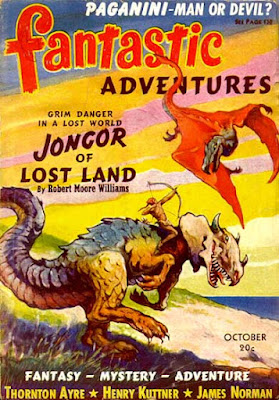
In his editorial in the April 1944 issue of Fantastic Adventures, editor Ray Palmer, in introducing the second Jongor tale, "The Return of Jongor," relates to us SF fans a behind-the-scenes story about the first tale of Robert Moore Williams's ersatz Tarzan.  According to Ray, whom I practically called a liar in my last blog post, in late 1940 Fantastic Adventures was about to go out of business.  Only one more issue would be published!  That issue, the October issue, had a dinotastic cover by famous illustrator J. Allen St. John, bringing to life the cover story, Williams's "Jongor of Lost Land."  Williams, St. John, and Jongor saved Fantastic Adventures--the publisher decided to continue putting out the magazine when that October issue sold twice as many copies as the previous issue.

Besides the second Jongor caper, in the April '44 ish of FA we have a long letter from outspoke SF fan Chad Oliver, who would go on to produce many SF stories, of which I have blogged about quite a few.  Chad criticizes Fantastic Adventures with some asperity ("a succession of dull issues, that were inadequate to say the least,") sparing neither fiction nor art, even complaining that the covers too often depict women.  It's not unrelieved pans, though; like all of us, Chad loves J. Allen St. John and Virgil Finlay, and he has kind words for recent stories by Wallace West, Leroy Yerxa (writing under the pseudonym Lee Francis--Chad denounces with venom a story Yerxa published under his real name), and David Wright O'Brien.  He also expresses admiration for a story of Palmer's, "Doorway to Hell," which was published under the pen name Frank Patton--did Chad know about Palmer's and Yerxa's pen names?  Are some of his spirited assessments, in part, in-jokes?

This issue also includes a story by Robert Bloch, "Lefty Feep Does Time," but I can't bring myself to read a joke story today, even one from a series so popular that isfdb lists over twenty installments (among them, "Stuporman," "Time Wounds All Heels," "Jerk the Giant Killer" and "Son of a Witch."  Bloch loves puns.)  So we'll be sticking with Jongor, and give the rest of the fiction in this number of Fantastic Adventures a pass.

"The Return of Jongor" by Robert Moore Williams       

I had hopes that we would see Jongor in New York or on a steam ship or something, but "The Return of Jongor" starts up shortly after "Jongor of Lost Land," with Ann Hunter, her twin brother Alan, and their savior, Jongor, an American who was born in an Australian jungle full of pterosaurs after his parents' aircraft crashed there, marching away from Lost Land, towards whatever counts as civilization in Australia.  When they stop to drink from a pool, they see moving images on the surface of the water--Jongor says this is a message from one of his friends, Queen Nesca.  Her system of sending messages seems like magic, but for some reason Williams and/or Palmer want to maintain the perception that  "The Return of Jongor" is a science fiction story, and so in a footnote it is explained that there is a technological apparatus and a psychic element behind this medium of communication.

Alan spent months in a dungeon in a city of monkey people and only just recently escaped, a half-starved wreck, but he's not depressed or mentally scarred or anything.  I make this armchair diagnosis based on the fact that Williams spends much valuable ink describing Alan teasing his sister for being jealous over Jongor's having received a secret message from another girl.  I didn't sign up for this trip down under to hear the saccharine juvenile banter of two New York socialites, so I was relieved when Ann and Alan were captured by aborigines and tied to stakes alongside two white men captured earlier by the natives, Schiller and Morton.  These guys claim they are kangaroo hunters who got lost.  

I would have moved Alan to the head of the line, but instead the aborigines start torturing Morton.  Before Morton suffers any permanent damage, and before they even start on the New Yorkers, Jongor, riding a dinosaur, rescues the four prisoners.  Jongor announces that his trip to civilization must be postponed, as he is duty bound to return to Lost Land to answer Queen Nesca's plea for help her; after all, Nesca saved him from a pterosaur years ago.  The Hunter twins and the two 'roo hunters decide to go along, seeing as they will probably get killed if they aren't within rescue range of the indispensable Jangor.  Jongor, an expert judge of character despite the hermit's life he has lead, thinks there is something fishy about Schiller and Morton, but he lets them come along anyway.

Jongor stories are full of treachery and trickery.  That message Jongor received didn't come from Queen Nesca, but from one of her traitorous countrymen; Nesca's people love jewels, and in return for a handful of gems, this traitor is helping a band of monkey men get revenge on Jongor--he sent the message with the aim of luring Jongor into an ambush.  This band captures Ann, but fails to snag Jongor, who tricks one of the monkey men into revealing that the message purportedly from Nesca is a trick.

Ann manages to escape from the monkey people on her own steam, but then she is chased up a tree by a lion.  As fate would have it, Ann is rescued from the great cat by Queen Nesca, who guns the feline down with a ray gun and then brings Ann to the city of her people, a city older than Babylon which, while kind of decrepit, a reflection of how her race is falling into decadence, still houses some high technology.

Her name might lead you to think Nesca is the heiress to the fortune of a coffee and cocoa magnate, but in fact the noteworthy thing about Nesca is that she, like all her people, is a centaur.  These centaurs have idiosyncratic traditions and psychologies, and that traitor who sent the bogus message is exploiting these peculiarities to overthrow Nesca.  When Jongor, who has been following Ann's trail, shows up, we get a debate between Jongor and Nesca about how the centaur government operates.  (Remember the debates about government we got in Zanthar At Trip's End?)  Nesca's dedication to thousands of years of tradition prevents her from resisting the effort to overthrow her, so Jongor cuts the Gordian knot by just murdering an anti-Nesca official in the middle of the ceremony during which Nesca is to relinquish power.  The tradition that was shackling them thus shattered, the pro-Nesca forces leap into action and Nesca, her supporters and Jongor and company fight their way to a secret passage to an underground citadel and arsenal.  Schiller betrays them to the anti-Nesca centaurs, killing Morton and opening the gates to the enemy, so the Nesca team flees deeper into the mountain, to a beautiful temple. 

Jongor thinks they are going to make a last stand, but Nesca gives a histrionic speech about how her race is doomed, and Williams contributes a whole thing invoking evolution and Darwinism without using those words, suggesting the centaurs had some "elements of greatness" but also a genetic flaw or something and so had been "passed by" in "the fight for life."  Nesca tricks Jongor and the Hunter twins into a secret boat and, as the current of a subterranean river carries them to safety, the whole city blows up, exterminating the centaurs.           

"The Return of Jongor" is quite inferior to "Jongor of Lost Land."  The plot is haphazard, just a collection of underdeveloped people and loosely connected incidents.  Williams wants us to see some kind of tragedy in the fall of the centaur race, but he doesn't make them interesting enough that we care about their disappearance from the face of the Earth; the suicidal ending of the centaur people also renders moot all the debates about politics and all the fighting Jongor engages in.  Schiller and Morton are just stuck in there; unlike the two treacherous men in "Jongor of Lost Land," they are lacking in personality and do not add anything to the plot.  Like the characters, the fights and the alien technology in "The Return of Jongor" are less interesting than those in its predecessor, and less connected to the plot--instead of being integral pieces of the plot that help drive the narrative, they are just attached to the thin and inevitable plot like barnacles attached to the underside of a sluggish vessel put-putting in a straight line to a drab destination.  

The style is weak; I complained that the style of Williams's Zanthar At Trip's End felt like that of a children's book, with simple sentences that overexplained everything, and I got that same feeling here as well.  Also, there are too many jokes--Alan Hunter is like a jester character, constantly teasing Ann and teaching Jongor the battle cry the he-man uses throughout the story: "Give 'em hell, Yale!"  All the jokes and cutesy sibling teasing undermine any tension or horror the scenes of death and torture might generate.

Speaking of Alan, Williams pulls a major boner regarding this kid.  In "Jongor of Lost Land," Alan describes how he found the treasure rooms of the monkey city.  But in "The Return of Jongor," Alan needs to have explained to him that the monkeys have all that treasure.  Very annoying--it is like Williams and Palmer didn't reread "Jongor of Lost Land" before they penned and edited and published this thing.  

I have to call this one bad.  It doesn't look like I will be reading the third Jongor story, "Jongor Fights Back," any time soon.

In 1970, Popular Library put out a paperback edition of The Return of Jongor with a brilliant cover by Frank Frazetta.  So much do I admire this painting that a few months ago, long before I actually read any Jongor, I bought an old somewhat worn poster of this image at Wonder Book in Frederick, MD, though I have yet to frame it.    

Thursday, February 24, 2022

Oct '40 Fantastic Adventures: R M Williams and H Kuttner

I know it wasn't that long ago that I told you that Robert Moore Williams's 1969 novel Zanthar at Trip's End was "bad in almost every way."  But let's not be too hasty when it comes to throwing Williams into the dustbin of SF history.  Today we take advantage of the inestimably valuable internet archive to look at the October 1940 issue of Fantastic Adventures, the cover story of which is Williams's "Jongor of Lost Land."  To sweeten the deal, there are also two stories in this issue by Henry Kuttner, and we'll spoil, I mean scrutinize, those as well.

Fantastic Adventures editor Raymond Palmer, in his editorial, stresses that the magazine's emphasis is on fantasy, not science, and talks up the upcoming Science Fiction Convention in Chicago, as well as Edmond Hamilton's story "The Horse That Talked," which will appear in the next (the January '41) issue of Fantastic Adventures, and the fanzine Stardust.  He tells us about hanging out in Wisconsin with Robert Bloch (he calls him the "idea man of science fiction") and August Derleth (he has "one of the finest sf mag collections.")  He also relates some wacky legends I never heard of before and for which he offers no citations--maybe he just made them up?--one about how Moses and Pharaoh are said to have had access to electrical weapons and another about how in the early 15th century an Italian countess was scammed by some rapscallions who sold her a nonfunctional time machine, preying on her hopes of getting back with her dead husband.

The publisher of Fantastic Adventures, William B. Ziff, has his own two-page editorial in which he urges us to write our congressmen and tell them we are willing to pay a pile of taxes for a rearmament program so we don't go the way of the French and the Chinese.  Just change a few of the proper nouns and you can probably print this thing again today in your local paper.  In the letters column are missives from Duane W. Rimel, friend of H. P. Lovecraft (he praises the magazine's art and fiction) and the famous space opera scribe Edward E. Smith (he engages in a mind-numbing debate with another reader about the possibility that "thought waves" might exist--Smith is not sure they exist, but feels there is not yet sufficient data to rule out their existence.)

"Jongor of Lost Land" by Robert Moore Williams

In 1970, Popular Library published Jongor of Lost Land as a paperback novel with a cover by Frank Frazetta.  I'd like to see this, and satisfy my curiosity about whether Williams might have revised his text for book publication, but I have not spotted it in any stores and I am too cheap to get it on ebay.  So our first exposure to Jongor will be in his 1940 magazine form.

Ann Hunter is a wealthy young New Yorker whose parents are dead.  But something has occurred that has impelled her to leave this enviable situation and risk her life in a wilderness thousands of miles from the bright lights of the Big Apple.  You see, some time ago her twin brother Alan decided to take a break from college and explore some remote part of Australia with this joker Richard Varsey, and then Varsey came back to Manhattan without Alan, with a story that the natives had taken Ann's brother captive!  So, as the story begins, Ann, Varsey, and their guide Hofer, who doesn't seem to have a first name, are at the edge of a forbidding Australian mountain range, in the middle of a dispute with their "carriers," aborigines whom they call "blackfellows," which I guess you aren't supposed to say anymore but which apparently in 1940 was still on the lips of every paleface down under.  

The aborigines refuse to advance any further, and then a mysterious disembodied voice calls to them, tells them in their own tongue to attack the white people!  Ann, Varsey and Hofer's rifles take a heavy toll on their now murderous hired men, who only have spears, bows and knives, but there were forty of them at the start of the fight and they threaten to overwhelm the trio.  They are saved by Jongor, a brown-skinned giant whose leopard-skin clad body (do they have leopards in Australia, mate?), the product of a youth spent evading death, is like that of a Greek statue.  He adds his archery to the gunfire of the three white interlopers and the aborigines are repelled.

The few surviving aborigines have barely had a chance to flee when Varsey, an emotional man whom we have been primed to suspect (e. g., Ann doesn't have a good feeling about him and he almost panicked during the fight) shoots Jongor, the man who just saved their bacon!  Jongor falls behind some rocks and disappears.  The three adventurers, despite the shaken Varsey's misgivings, continue their search for Alan, marching through the only pass through the mountains into Lost Land, a valley of swamps and jungles teeming with prehistoric reptiles.

Jongor (birthname: John Gordon), whom we learn is the son of an American pilot and his wife who crashed in Lost Land, watches the three white people from concealment.  Ann reminds him of his mother, and so he not only forgoes avenging himself on Varsey for winging him, but also rescues the hapless trio a second time, this time from a pterosaur attack.  And then a third time, from an attack by some kind of tornado or vortex that is directed by some unseen enemy.  Ann wants to make friends with the jungle hunk and get his help in finding Alan, but the three male characters are all deeply suspicious of each other and just can't get along--Jongor can tell that Hofer and Varsey are not Ann's friends, but have come to the Lost Land to pursue their own agendas, and Varsey won't shut up about his conspiracy theory that Jongor is colluding with the aborigines, pterosaurs and vortex operators.  So Jongor leaves them, and, lickety-split, Ann and company have been captured by monkey people who drop on them from a dirigible equipped with searchlights.

In the ruined city of the monkey-people they are brought before the monkey king by his majesty's  lieutenant, a young monkey-man who openly lusts after Ann's "lithe body."  Ann is made to parade before the throne "as though she were a model displaying clothes before a group of prospective purchasers," and she fears that she will be added to the king's harem.  Hubba hubba.  These furry tailed weirdos speak a language much like that of the aboriginal Australians, and Hofer learns from their chatter that, in fact, they are going to sacrifice her to their sun god.  Hofer also realizes that these degenerate monkey-people and their once beautiful, now decrepit, city are the sad remnants of a colony founded by people from Mu.  (These Murians are thus much like the Oparians of the Tarzan stories, who are the degenerate descendants of a colony of people from Atlantis.)

While Ann is being prepared for sacrifice--a days-long process--the lieutenant conspires with the sneaky sneaky Varsey.  Varsey is given his rifle back, and uses it to murder the monkey king--now the lieutenant can be elevated to the throne and get his paws all over Ann!  But when he tries it Ann punches the monkey masher in the face and makes a break for it.  The monkey-men--and traitorous Varsey!--are hot on her trail.  Ann climbs a cliff and decides to jump to her death rather than let the newly crowned king of the monkey-folk defile her body.  Jongor suddenly appears, arresting her suicide attempt and fighting off the horny monkey man, Varsey, and over a dozen rank and file simian sun-worshipers.

Jongor and Ann fall in love and head out of the jungle.  On the way they meet an emaciated Alan, who was in the dungeons of the monkey-people but made it out during the chaos following the murder of the king.  He explains how months ago Varsey betrayed him and left him for dead; Varsey was determined to get back to Lost Land only because he knew that, like Burroughs's Opar, this monkey town has a huge treasure vault stuffed to the gills with gold and jewels.  

Reunited with her brother, and with a world-class muscle man for a boyfriend, Ann thinks she is out of the woods.  But she isn't!  Among the Mu technology the monkey-men have at their disposal is a remote viewer and two-way communications system much like a crystal ball; those long-tailed bastards used this thing to turn the carriers against the expedition on the first page of the story, and it is also how they aim their tornado weapon.  (Fu Cong, the villain in Williams's Zanthar at Trip's End, also has a disembodied voice system and a remote controlled tornado weapon--I guess these are some of Williams's go-to ideas.)  Now that the monkey people have dispersed, Hofer, Ann's erstwhile guide, has control of all these high-tech Mu instruments.  He speaks to our three heroes, suggesting they return to the monkey city.  But Alan knows the terrible (or amazing--you know, opinions may differ on some points) truth about Hofer--he is a madman who is able to hide his insanity from others and he is also an anarchist who has dedicated his life to overthrowing all government!  Like Varsey, he was using Ann to finance an expedition to the Mu city, but while Varsey was doing it in hopes of getting some treasure, Hofer's aim was to get a hold of the super weapons of ancient Mu, which he hopes to use to destroy all government the world over!  (Here in Fantastic Adventures there is actually a footnote explaining what anarchism is and assessing to what extent Hofer's actions are the result of his mental illness and to what extent his political convictions.)

Before Ann and Alan can even consider freezing Hofer's bank account as punishment for his heretical political beliefs, Hofer aims that tornado weapon at them.  In perhaps my favorite paragraph of the story, Hofer makes snide comments about how rich the twins are ("that will fix you, too, you snooty society girl!") as the vortex gets to work on them.  Jongor, who you would think would have learned skepticism of government over his lifetime of fending for himself and evading the super weapons of the tyrannical and ultimately unstable monkey regime, nonetheless saves Ann and Alan and foils Hofer's ambitions.  When Hofer sets a vortex in the one pass out of the valley, trapping his foes within it, Jongor stampedes a herd of dinosaurs into Hofer's control room, driving him to flee in that airship.  Before he can gain an altitude from which he can snipe our heroes from safety, Jongor throws a spear at Hofer with deadly accuracy.

The story ends with Jongor and the twins riding a dinosaur back towards civilization.

"Jongor of Lost Land" is an acceptable Tarzan pastiche with some half-baked science fiction ideas thrown in there; besides the stuff I've mentioned, there are the crystals Jongor uses to command the dinosaurs and that the monkey men use to control the pterosaurs.  Williams tries to give the characters motivations and relationships that make sense, and he more or less succeeds.  One odd note is that while he describes the pterosaurs in some detail, the author never names the species or type of dinosaurs Jongor commands, or describes them very clearly.  References to an "incredibly horned snout," "hoofs" and "horny head plates" lead me to suspect these beasts are ceratopsians, even if cover artist J. Allen St. John depicts Jongor riding some kind of therapod (maybe Ceratosaurus?) and interior artist Robert Fuqua portrays Alan and Ann mounted atop a therapod who lacks horns (Allosaurus, I guess.) 

There are two more Jongor stories and it seems quite likely I will be reading them as I continue to explore 1940s and 1950s issues of Fantastic Adventures. 

"The Uncanny Power of Edwin Cobalt" by Henry Kuttner

"The Uncanny Power of Edwin Cobalt" appeared under the pseudonym Noel Gardner.  It is a gimmicky filler story that is a total waste of time and to which I am assigning a failing grade.

The narrator of the five-page tale, is a lawyer living with his wife in Manhattan.  He is a skeptic, a doubter.  This story chronicles his shocking discovery that, when he doubts something, it ceases to exist--more than that, the entire universe changes so that the thing he doubted never existed.  His wife hangs an ugly picture on their wall; the narrator "started to wonder if the picture was real.  That travesty should never have been painted.  I felt myself doubting its existence."  The picture vanishes, and so does all evidence of its existence, except the narrator's memory of it.

This sort of thing happens again and again, the incidents escalating in scale and importance--buildings disappear, people disappear, finally, the narrator himself disappears.  This story doesn't make much sense, as there is no reason for an ordinary person to doubt the existence of a skyscraper he has worked in for years or of his wife, and Kuttner barely even tries to come up with reasons why the narrator might doubt the existence of such familiar quotidian things.  Kuttner, I guess, tries to make the narrator's less than credible doubts a little more believable by having the narrator drink a lot, and by suggesting it is possible he is insane.  There is also no consideration of how the narrator got this power, or why it began operating all of a sudden.

Thumbs down.

"The Uncanny Power of Edwin Cobalt" would reappear in book form in 2016 in Haffner Press's Kuttner collection The Watcher at the Door.

"The Elixir of Invisibility" by Henry Kuttner                 

"The Elixir of Invisibility" appeared under Kuttner's real name.  This is a filler joke/mystery story.  Ugh.    

Richard Raleigh works as the assistant and errand boy of a ruthless, perhaps sadistic, scientist, Meek, whose beautiful but dim-witted daughter, Binnie, Raleigh hopes to marry.  Meek has invented a drink that makes you (and your clothes, somehow) invisible.  Journalists who have scoffed at his efforts receive packages which contain invisible frogs--Meek stole the frogs from Raleigh, who was breeding them to supplement his meager income.  When the pressmen burst into the lab after opening their packages, Meek announces he will demonstrate his invention, and instructs the journalos to go back outside and wait on the street--invisible, Meek will pick their pockets and leave in them his calling card, proving his invention works.  Meek, who is fat, isn't actually going to perform this feat--he orders Raleigh to drink the elixir and perform it.  

Raleigh's demonstration is complicated by the antics of Binnie's big affectionate dog.  Even worse, while Raleigh is picking the pockets of the reporters, some other invisible man is robbing a bank.  Meek is arrested by the police, but he accuses Raleigh of the crime and Binnie insists Raleigh try to find the real thief.  With the help of the dog, Raleigh finds the invisible crook, is held captive by the thug, escapes, enlists the help of a safe cracker he meets while visiting Meek in the big house, traps and captures the crook, clears Meek and convinces Binnie to marry him over the objections of her father.  

The slapsticky action scenes are neither exciting nor funny, much of the plot is contrived, the characters and their motivations and relationships are uninteresting, and the story feels very long ("The Elixir of Invisibility" is like 16 pages.) 

Totally lame.  Thumbs down. 

I say it is lame, but "The Elixir of Invisibility" was reprinted in a 1970 issue of Fantastic that has a beautiful Jeff Jones cover.  (There was a whole lot of drama about the reprints that appeared in Fantastic and Amazing in the 1960s and '70s, a cost saving measure for the not-exactly-profitable magazines that caused considerable unhappiness among editors, writers and readers.) 

**********

Thanks for taking this little trip to 1940 (and fantasy versions of Australia and Manhattan) with me; there will be more fantasy and insanity in our next episode--see you then.