Wednesday, October 7, 2015

Post-War American Tales of the Fantastic: Beaumont, Ligotti & Wolfe

The college library that is within walking distance of the dilapidated and spider-infested house the wife and I rent has a copy of Volume II of The Library of America's American Fantastic Tales, edited by Peter Straub and published in 2009.  Volume I, which I read three stories from last week, covers the period before 1940; this one presents work from 1940 to 2007.  A few days ago I borrowed the volume, and early this week read three of the stories therein.

"Black Country" by Charles Beaumont (1954)

Beaumont is one of those writers I have often thought I should read, but whom I have not gotten around to.  So here is my chance.

"Black Country" first appeared in Playboy. The story is about jazz.  It's my understanding that Playboy, at least in its early incarnations, was marketed as the magazine for the sophisticated man, and one of the things the Platonic ideal of the sophisticated man of the '50s and '60s cared about and knew about was jazz, and Playboy covered jazz within its pages quite extensively.  (Personally, I know nothing about jazz.)  The cover of the issue in which Beaumont's story appeared is actually adorned not with some hot chick, as has been the norm for decades, but a cartoon depiction of jazz musicians.

"Black Country" is a first person narrative by a member of an African-American jazz band whose talented and charismatic leader, Spoof Collins, plays the trumpet.  The group has a dedicated white fan, Sonny, who takes over for the saxophonist when he is killed in some kind of fracas.  The band later decides to take on a female singer, Rose-Ann.  Rose-Ann falls in love with Spoof, but Spoof loves his trumpet more than anything, and when she gets a little too cloying, Spoof hits her.  Sonny rushes to her aid, staring down Spoof; Sonny is in love with Rose-Ann, and they become an item. Spoof dies soon after (committing suicide because he has cancer) and Sonny becomes leader of the band, shifting from saxophone to trumpet.  The story's climax is when Sonny digs up Spoof's horn from the grave and Spoof's spirit plays through Sonny; the two men, of two different races, who butted heads earlier, are reconciled in their quest to achieve the ultimate, purest jazz.  

This story is just OK.  Maybe I would enjoy it more if I was a jazz aficionado--the numerous scenes describing musical performances ("Spoof lifted his horn and climbed up two-and-a-half and let out his trademark...Jimmy kanoodling the great headwork that only Jimmy knows how to do...Henry did that counterpoint business that you're not supposed to be able to do unless you have two right arms and four extra fingers...." etc.) left me cold.  Maybe others will find the story's racial and sexual politics interesting; presumably Beaumont is arguing for racial harmony here, but some readers might find the way a white man takes over the black band, or even the way Beaumont speaks in the voices of black men, condescending or offensive.

"The Last Feast of Harlequin" by Thomas Ligotti (1990)

A year ago (gadzooks, has it really been that long?) I announced to the world my deep and abiding love for Thomas Ligotti's story "Vastarien."  Can I experience such a love again?  I started this story, which first appeared in The Magazine of Fantasy and Science Fiction, with hopes that I could.

Ligotti dedicated "The Last Feast of Harlequin" to "the memory of H. P. Lovecraft," and in the introduction to American Fantastic Tales' second volume Straub calls the story "a loving and exacting tribute" to Lovecraft.  Straub's description is perfectly apt; this is a finely crafted Lovecraftian story, carefully emulating the plot structure and themes and tone of Lovecraft's own works.

The story is a memoir or testament, written by an academic anthropologist, describing his investigation of an odd festival in a Midwestern town, a town founded by New Englanders in the nineteenth century.  Like the characters in various Lovecraft stories, our narrator travels around town meeting creepy characters, delves into old newspapers and other old documents for clues, and then learns a horrifying truth before escaping with his life, but not without dreadful psychological scars and the knowledge that something catastrophically terrible awaits him in his future.  In the climactic scene we even get the subterranean ritual of human sacrifice led by an evil wizard or priest which we expect to find in a Weird Tales-style story.

Maybe because I was exposed to so much Marxism in college, and maybe because in my twenties and thirties I spent so much time reading books in which social class is important (like Proust and various 18th-century things like Casanova and Boswell), I am always finding these SF stories to be worthy of some kind of class analysis. "The Last Feast of Harlequin" is perhaps a more appropriate subject of a class-based analysis than most.  The town at the center of the story is split into "desirable sections" of "normal residents" and a darker, uglier, poorer side, "the south end," which the narrator calls a "slum" or "ghetto" and which is home to "lethargic," "gaunt" and "nauseatingly passive" people.  The slum dwellers keep to themselves, and are, in fact, monsters of some type.  Every winter they have a dark, creepy, sinister celebration, and the loud and brightly lit festival in the "normal" part of town is (our narrator theorizes) devised to drown out or distract from the evil celebration of the monstrous freaks.  The narrator, as a professional scientist and college professor, is of course solidly middle-class, but, by putting on a disguise of old shoes, blue jeans and a coat whose pockets he tears and to which he applies stains, he has little trouble infiltrating the dark side of town.

The surprise at the end of the story, which is not really a surprise to careful readers because Ligotti foreshadows it quite clearly, is that the anthropologist is, previously unknown to himself, one of the freaks.  "He is one of us....He has always been one of us" says the wizard/priest, who turns out to be the narrator's mentor back from his days at his New England university.  This kind of class anxiety strikes a chord with me because of similarities to my own life.  My parents are working class, and my mother expresses hostility to white collar workers and complains when she sees me in my J. Crew outfits ("Why don't you wear jeans and sneakers?  Does Joe College think he is better than the rest of us?")  Does my own college degree, my intellectual hobbies and time spent working in universities and offices make me middle-class, or does my blood and the time I've spent working in machine shops, warehouses, and the stock rooms of stores make me working-class?

"The Last Feast of Harlequin" is like a smoothly running clock, each of its glittering gears rotating in harmony with every other.  Every paragraph serves a purpose and serves that purpose well.  I can enthusiastically recommend this story to Lovecraft fans, who may enjoy picking out all the little Lovecraftian elements and themes.   Because it is so good, I would also strongly recommend the story to people curious about Lovecraft's influence on later "weird" writers.  

I didn't like "The Last Feast of Harlequin" as much as "Vastarien," however.  It is so like a finely polished, exquisitely constructed exemplar of a Lovecraft story (dare I use the phrase "Platonic ideal" twice in one blog post?) that it is a little lacking in the surprise and novelty department.  Ligotti here has put together a masterpiece of an homage; it feels like the best possible version of something we've seen before, rather than something original or new.  I thought "Vastarien," while definitely Lovecraftian in feel, had something new to say and was more challenging, more mysterious, making for a more powerful reading experience.

"The Little Stranger" by Gene Wolfe (2004)

I'm one of those people who thinks of Gene Wolfe as his favorite writer and who thinks Wolfe is a strong candidate for "best" or "greatest" or "ultimate" SF writer of all time, so for me reading a Wolfe story that is new to me is always a significant event in my intellectual life.

This is actually the second time I've read "The Little Stranger;" when I checked out the book I thought it was new to me, having forgotten the title, but by the second page I realized I had read it before.  Perhaps I read it in Jonathan Strahan and Karen Haber's Fantasy: The Best of 2004; I used to get those anthologies at the New York Public Library all the time.  I'm sure I didn't read it in its first place of publication, The Magazine of Fantasy and Science Fiction.  

The story begins on a heartbreaking note: the tale is a series of letters written by a terribly lonely old woman, Ivy, to a dead cousin.  "Please forgive me for troubling you with another letter....You are the only family I have, and as you are dead you probably do not mind."  The story quickly becomes light-hearted, however.  The conceit of the story is that everybody thinks Ivy is a witch, and various coincidences, like a black cat joining her household and two little kids named Hank and Greta coming to visit her "gingerbread house," reinforce this idea and provide an opportunity for Wolfe to make jokes (of Hank and Greta our narrator says, "[they] are such sweet little strangers.  I could just eat them up!")  It is strongly suggested that Ivy's house is haunted or somehow alive, and also lonely, and manipulates events to relieve its own loneliness as well as Ivy's.  There are also hints that Ivy is hundreds of years old.

While I have suggested the story is light-hearted, at the same time we are constantly reminded that the world is full of evil.  Ivy often worries about thieves and burglars, and is very concerned that business people will cheat her.  There are gypsies in the story (our narrator doesn't use that word, but I think all the clues point to them being gypsies) and they have a contentious relationship with the authorities: one of the female gypsies opens a fortune telling business and is investigated by the police bunco squad, while the others flee into the woods at the very sight of the police. Readers may recall that I had the same attitude about Wolfe's 1990 novel Pandora by Holly Hollander; that it was outwardly fun, but full of reminders of war, crime, and broken families.

As usual with Wolfe, an economical and dense story worth rereading, with an odd, novel premise.

************

I'm not the audience for the Beaumont story, but these three stories are all worthwhile reads.  While I, an inveterate cheapo, have borrowed the two volumes of American Fantastic Tales from libraries, I hope other people who care about genre literature have been purchasing them.  We certainly want to encourage The Library of America and other organizations to continue producing books like this, books full of stories about ghosts, witches, and evil cults but composed of fine paper and fine bindings, with attractive and easy-to-read typefaces and no typographical errors.  (Lovecraft and Philip K. Dick have volumes of The Library of America dedicated to them--if I eat my broccoli maybe I'll live to see similarly handsome volumes of Gene Wolfe's work.)

Sunday, October 4, 2015

1949 Stories from Kuttner & Moore and Edmond Hamilton

I recently found myself with time to kill before an appointment in Urbandale, Iowa, so I looked into the public library there.  On the science fiction shelves I saw a hardcover 1988 printing of one of the volumes of the Isaac Asimov Presents the Golden Years of Science Fiction series edited by Asimov and Martin H. Greenberg, the volume covering 1949 and 1950.  I noticed on the contents page some stories I had yet to read by authors I am interested in, so the book found its way back to headquarters where it joined the pile of library books.  This weekend I read three stories that first appeared in science fiction magazines in 1949: two credited to "Lewis Padgett," one of the pen names used by Henry Kuttner and C. L. Moore; and a story by Edmond Hamilton.

"Private Eye" by Henry Kuttner and C. L. Moore

The editors suggest that this story, which first appeared in Astounding, was probably written by Kuttner.  It seems to be universally loved; not only was it the cover story at Astounding, but it has been widely anthologized in such books as The Mirror of Infinity: A Critics' Anthology of Science Fiction and Astounding Stories: The 60th Anniversary Collection (Vol. 3).  On the negative side I now can't get that Hall and Oates song out of my head.

It is easy to see why this story would be popular with critics and editors.  There are hundreds or thousands of stories speculating about space travel, robots, time travel, nuclear power, and so forth, and "Private Eye" speculates about something that in 1949 maybe hadn't been done to death already, extensive government surveillance, but in the context of an individualistic market society with a limited government, more like early 20th-century America than the kind of totalitarian society we see in 1984 and so many other books.  According to the story, light waves and sound waves leave a semi-permanent impression on materials, impressions that can be translated into audio and video by a device employed by law enforcement.  Thus anything that has happened within sight of a wall or floor in the last fifty years has essentially been recorded for viewing by the government, making getting away with a major crime a difficult proposition!

The plot of the story follows Sam Clay, murderer.  Clay's girlfriend has been stolen by a more successful man, and Clay crafts and pursues an elaborate scheme over the course of 18 months, manipulating people and contriving situations so he can stab his rival to death in full view of the watching government and jury and get off on a plea of self-defense. As Golden Age SF fans probably already know, Kuttner was fascinated by psychology and studied the field in college, and "Private Eye" is full of psychological theories spouted by government scientists and descriptions of Clay's state of mind, a mind warped by childhood experiences, driven by a lust for revenge and oppressed by the knowledge that his every move is being recorded as if by cameras for viewing by law enforcement.  Over the course of the story we observe Clay's psychology, and to a certain extent that of other characters, evolve.

This is a good story, well paced and structured, achieving genuine tension and presenting interesting characters and situations.  Even the little throwaway details about life in the future (like a restaurant where a computer analyzes your face and lights your table to your best advantage like a Hollywood director) are good.  Maybe some 21st-century readers will be put off by the 1940s-era psychology theories and the less than flattering portrayal of women in the story, but to me that stuff just adds a layer of historical interest.        

"Prisoner in the Skull" by Kuttner and Moore

Each of the stories in Isaac Asimov Presents the Golden Years of Science Fiction has two introductions, one by each of the editors.  In his intro to "Prisoner in the Skull" Greenberg thanks important SF writer, critic and historian, and Kuttner and Moore superfan, Barry Malzberg for pointing out this story to the editors.  Asimov takes the opportunity to sneer at "woman's romance" and "the typical Western," and suggest SF is superior to these genres.

A recurring element in Kuttner and Moore's work is artifacts or individuals from the future appearing and befuddling people.  We see this in some of Kuttner and Moore's most acclaimed work, like "Mimsy Were the Borogoves" and "Vintage Season," and we see it in "Prisoner in the Skull."  "Prisoner in the Skull," which also appeared in Astounding, feels like a companion piece to "Private Eye," in that it is about the evolving psychologies of an unsympathetic main character and the less than admirable woman with whom he is obsessed.

John Fowler is a successful commercial artist.  He is courting a beautiful model, Veronica, a shallow and greedy woman.  One day a mysterious man, a man lacking will and individuality, a man with a "blank" face who is almost unable to talk, appears at Fowler's door.  Fowler takes this "blank man," whom he dubs "Norman," into his home, and discovers that he is easy to dominate, and has terrific mechanical and engineering ability.  At Fowler's direction, Norman improves various household items (like a light switch) and invents radical new consumer products, like a window upon which one can project images via telepathy.  (This story also includes the device I admired in "Private Eye," a system of artificial indoor lighting that can be calibrated to flatter individuals.) By marketing these inventions, over the course of a few years Fowler becomes rich.

Having a virtual slave to dominate, and vast wealth, corrupts Fowler. Kuttner and Moore describe the excuses and other psychological devices used by Fowler to justify his exploitation of Norman.  When Veronica marries a stock broker, Fowler bends his wealth and Norman's amazing abilities to the task of concocting and executing a complicated conspiracy to break up the model and the broker, and get Veronica back under his control. As in "Private Eye," the female lead is not so easily outmaneuvered.  In the end it is revealed that Norman created himself by inventing a device that altered Fowler's brain; Norman thus turns Fowler into a proto-Norman and sends him (himself) back in time to meet his earlier self.

This is a good story, though I don't think it is as well put together as "Private Eye," and the time loop ending is not, to me, as satisfying as "Private Eye"'s resolution.  For one thing, I often find time loops and that sort of thing unsatisfying (my brain bridles at such explanations as "he became a genius inventor when his later self, a genius inventor, went back in time to make him a genius inventor.")  For another, the end of "Private Eye" is a conclusive one, with the immoral male and female leads suffering final, punishing fates.  In "Prisoner in the Skull" I felt like the stories of Fowler and Veronica weren't quite over, and I wasn't sure if they had been punished for their sins. What happens to Norman after he liberates himself from Fowler by sending Fowler (his earlier self) back in time?  Is he still obsessed with Veronica?  Is he still rich?  Is he still a genius inventor?

Leftist readers may appreciate what appears to be a Marxist subtext to the story. Fowler, I guess representing the capitalist, exploits Norman to become wealthy, but wealth corrupts him and Norman rises up against him, and it turns out Fowler was hurting himself by exploiting Norman.  An offhand comment about economics early in the story (it is suggested that in the future there is no shortage of raw materials, so businesses create artificial scarcities in order to make customers more willing to make purchases) is perhaps a clue that Kuttner and Moore want readers to view the story as some kind of allegory about economics.

"Alien Earth" by Edmond Hamilton

I've read quite a few stories by Hamilton during this blog's life.  The last time we encountered Hamilton was when I was praising his story "The Legion of Lazarus," which I read in a crumbling old magazine I found in an antique store.  As he does in the collection Before the Golden Age, in this volume of Isaac Asimov Presents the Golden Years of Science Fiction Asimov expresses his admiration for Hamilton.  For his part Greenberg calls "Alien Earth" "a wonderful, moody story that is science fiction at its finest."  

Hugh Farris is an American in the teak business, travelling here and there through the jungles of French Indo-China searching for teak trees. (Apparently American wood isn't good enough for some people!  Do Bernie Sanders and Donald Trump know about this?  It may be time for a tariff on these foreign woods!)  In the forest Farris discovers a weird native cult of people who inject themselves with some green goop that slows them down so that they "live a hundred times slower."  Hamilton gives us numerous descriptions of how they breathe slower, walk slower, blink slower, etc.

You don't care what these goofy natives are up to?  Why doesn't Farris just leave them to their goofy drugs and religion and get back to collecting that teak which is putting perfectly good American oak and pine out of work?  A woman, of course!  In the jungle Farris meets Lys Berreau, a French blonde (ooh la la) whose brother Andre has gone native and is using the green drug so that he can spend weeks at a time living at a speed one hundredth of the speed most of us are living at.  The French girl begs Farris's help, and can we blame him for not refusing?

Under ordinary fictional circumstances, I'd expect an evil priest and/or evil god to be at fault, and for Farris to have to read a spell from an old book and/or hit some people with a sword to resolve the plot.  This is what I would expect in a Weird Tales-style story.  But "Alien Earth" is endorsed by Isaac Asimov, and we all know from Before the Golden Age that Asimov has contempt for the Weird Tales crowd.  The Asimov seal of approval means this story must be about science!  Farris carries the almost motionless Andre into a house and keeps him there for weeks until the green goop injection wears off.   When the Frenchie is back at normal speed he explains that he is a botanist and wanted to live at one percent speed because it helped him get in tune with the life of plants!

Farris and the mademoiselle try to get Andre to give up on his obsession with what he calls "a botanist's heaven" and get back to France, but he refuses to budge.  In fact, he drugs their food so Farris and Lys are tricked into entering the world of plants themselves!  Perfidious Gaul!        

So, what is so awesome about the world of plants?  As far as I can tell plants can't have sex or read books or go to art museums or listen to old Blondie albums, the kinds of things that make life as a human being barely tolerable.  Why is the botanist so keen to live out his life in that vegetative world?

Farris and Lys venture into the rain forest to find out!  Living at one hundredth normal speed, they experience the sun crossing the sky in like seven or eight minutes, while the growth of grass and the budding of leaves on trees moves at an apparent speed much like that of the stalking of animals.  Hamilton compares the engulfing of trees by vines and fungus as being much like the attacks of wolves on quadruped herbivores.

More significant is the revelation that plants have thoughts and emotions just like animals, and project these telepathically.  Moving at one hundredth normal speed our heroes can pick up these transmissions!  It turns out that the French botanist worships the oldest trees of the forest, whom he believes have great wisdom to impart!  So, even though this is a sciencey story, Hamilton manages to shoehorn in an evil priest and god.  When Andre orders the plants to kill Farris and his own sister(!), we even get something like a traditional Robert Howard hero-interrupting-virgin-sacrifice scene.  Farris even has a big bolo knife, a good stand in for a sword, that he and Lys use to chop away at the vines, which move like snakes when you are living at one hundredth speed!  

This story is pretty ridiculous.  It is hard to accept the idea that plants have thoughts, much less "wisdom."  The idea of thinking, breathing, and moving at one hundredth speed is also a little suspect.  Farris and Lys run at this speed, which would seem to be impossible--wouldn't you just lose balance and collapse when your second foot left the surface?  What about insects and germs--if you are in the middle of a damn jungle and you can't swat bugs and your white blood cells are moving at one hundredth normal speed, aren't you going to be devoured?

I'll grade "Alien Earth" acceptable, but Greenberg is really exaggerating when he suggests it represents "science fiction at its finest"--the sciency stuff is mediocre, and the story is not redeemed by being a good adventure with memorable images (like Hamilton's better work such as "The Legion of Lazarus") or by having traditional literary values like a good style or characters or the ability to evoke emotion in the reader.  I suspect Asimov and Greenberg thought Hamilton deserved to be included in their series, which he does, being a major writer of the Golden Age, and hit upon this one because it is sciency and not Weird Talesy, and because Hamilton published no other stories in 1949.  I do have to say it is a little odd that Asimov felt comfortable presenting a story in which the scientist is the villain and the violent businessman-adventurer is the hero.

************

The Kuttner and Moore stories are solid; classic SF fans should definitely check them out.  I guess the Hamilton story is interesting if you are interested in Hamilton's long and productive career, or are trying to read every SF story about botany!

I'll probably read some more stories from this volume before it ends up back on the library shelves--stay tuned.

Thursday, October 1, 2015

The Sorrows of Young Werther by Johann Wolfgang Von Goethe (trans. Mayer & Brogan)

"My friend," I exclaimed, "Man is human, and the small amount of intelligence one may possess counts little or nothing against the rage of passion and the limits of human nature pressing upon him."

Copy I read this week
Close followers of this blog will know I recently read Mikhail Lermentov's "Princess Mary," an early 19th-century novella which I viewed as a piece of Russian Romanticism.  This inspired me to borrow, from the local university library, one of the foundational texts of the Romantic movement, Johann Wolfgang von Goethe's 1774 novel The Sorrows of Young Werther.  I read Werther in the 1990s, when I was working at a New Jersey bookstore for minimum wage, in a paperback Penguin edition that I believe I still own, but which is packed away in storage.  The hardcover edition I read this week was put out in 1993 by The Modern Library, and presents a translation by Elizabeth Mayer and Louis Brogan that first saw light of day in 1971, the year of my birth.  It includes on its back cover a quote from Thomas Mann that includes an anecdote indicating that Napoleon Bonaparte was a tremendous fan of Werther.  Well, we won't hold against poor Goethe the fact that one of history's premier monsters was practically president of his fan club.

Think back, if you can, to the year 1771!  The place, Germany!  The Sorrows of Young Werther is, primarily, presented in the form of letters written by our title character, a sensitive soul who likes to draw, write, read Homer and look at mountains, and who apparently has enough money that he never has to do any work, has a servant, and is always throwing money to the poor.  The letters in Book One (73 pages in this edition) are to Wilhelm, a friend of Werther's.  Werther is spending the summer in some little country town to run some trifling legal errand for his mother (some aunt is trying to keep Mom from getting her share of an inheritance or something) and, it seems, to get away from some love triangle mess back home.  "Poor Leonora!  And yet I was blameless.  Was it my fault that, while the capricious charms of her sister provided me with a pleasant entertainment, her poor heart built up a passion for me?"  This whole book, from page one, is about people being carried away by their caprices and passions and causing themselves and others considerable suffering.

Out in this little town Werther meets and falls in love with a pretty girl, Charlotte, whom he calls "Lotte."  Lotte is more than a pretty face--she likes the writers Werther likes and she is the picture of virtue, dutifully and lovingly raising her little brothers and sisters after their mother's death.  But Lotte is not on the market!  The girl of Werther's dreams is engaged to Albert, an honest, decent, level-headed and productive citizen!  In the intro to this edition modern English poet W. H. Auden declares that Albert is a "square!"  Werner spends all his time either hanging out with these two paragons or weeping his eyes out alone because Lotte will never be his.

A ringing endorsement from the Corsican Ogre
In Book Two of the novel (just 17 pages) it is autumn and winter, and Werner has left the country to take some kind of diplomatic or civil service job at court, working with an "envoy," a "Count," and a "Minister," drafting documents.  In letters to Wilhelm and Lotte he complains that the people at court are obsessed with status and the rat race, and ruin every day with their bad attitudes.  Due to an embarrassing faux pas at a party, in the spring Werther quits his job and moves back to Lotte and Albert's environs. In Werther's absence Lotte and Albert have married.

The last section of the novel, entitled "Postscript" and running 70 pages, is a conglomeration of documents written by Werther and narration by a nameless editor who has investigated Werther's last days.  Werther hangs around Lotte, putting strain on her marriage to Albert, and he gets upset when some guys want to chop down some trees he likes and when a guy with whom Werther identifies, a component of one of the novel's ubiquitous love triangles, commits murder.  Werther finally goes off the deep end and commits suicide with some pistols he borrows from Albert.  (A friend in need....)  This suicide is no surprise to the reader; not only has it been foreshadowed again and again, with Werther discussing suicide with Albert and writing to Wilhelm about committing suicide and even play acting suicide with Albert's pistols back on page 57, but after the "editor" baldly tells us on page 135 that Werther has decided to kill himself, we have to wade through 30 more pages before the deed is done.

I didn't enjoy The Sorrows of Young Werther as much as I had expected to.  With the exception of a mind-numbingly tedious seven-page extract from James MacPherson's famous fraud The Works of Ossian (MacPherson wrote poems in English that he based very loosely on Gaelic sources and then claimed they were translations of centuries-old manuscripts he had discovered) the book is an easy read, but it is repetitive, extravagant, obvious, and fails to pull the heartstrings.  There is no surprise, little ambiguity or depth, and surprisingly little insight into 18th-century life or thought.  And who can care one way or the other about these goofy characters?    

Among the elements I thought reflected "Romanticism" in"Princess Mary" was how the narrator waxed poetic about Nature, expressing his love of the trees and the dew and the sunlight and all that, and how all the characters acted irrationally, tossing reason and logic out the window and taking catastrophic risks because they are driven by passions for love, revenge, or honor.  We see some of these same elements in Werther.  There's lots of talk about how lovely mountains and valleys and sunsets and the rest are, and when he is mentally stable Werther blabs on and on about how much he loves Nature, but somehow the book fails to inspire any of these feelings in the reader.

The edition I read in
the '90s resembles this 
More interesting to me was the recurring theme of how intelligence, education, knowledge and reason can be a detriment rather than a virtue, can make people less happy rather than more happy.  Werther argues the charm of the classical poets comes from their ignorance: "You see, dear friend, how limited and how happy were the glorious Ancients!  how naive their emotions and their poetry!"  Werther later claims that true emotion, love in its purest form, is felt by "those people whom we call uneducated and coarse."  Werther and Wilhelm have been diminished, not elevated, by their educations: "We educated people--miseducated into nothingness!" When Werther meets a mental patient who has been released into the custody of his family, the maniac asserts that he was happier when he was totally insane and chained up in an institution than he is now, free and partially cured.

At the same time that Werther's rhetoric denounces the intellect, suggesting that education and reason corrupt, or deaden, or sadden us, the actions of the characters, especially Werther himself, demonstrate that people do not act logically, are not guided by reason, but are instead driven by whims and irrational passions.  It is hard to believe that Goethe is celebrating this emotionalism, even if the character of Werther is, because their passions drive the characters to destructive actions: among other disasters, we hear the story of a girl who committed suicide because of a love triangle, and the story of a man who committed a bloody murder because of a love triangle.  Werther, in a debate with Albert and in response to the aforementioned murder case, claims that suicides and murderers should not be judged guilty or punished for their sins because the passions that drove them are like a disease, and we don't blame a guy for catching the flu!  This surprisingly modern attitude towards mental health and crime (think of how nowadays we aren't supposed to look down on drunks and compulsive gamblers and junkies as irresponsible jerks with no values and no common sense, but instead to empathize with and support them as victims of a disease) is probably the thing in Werther that made the biggest impression on me this time around.

In my real life I have often been moved by the beauty and sublimity of mountains, oceans, sunsets, lightning bolts, birds and so on, and all too often I have acted stupidly over a woman or because I was angry about something.  I should be a receptive audience for what Goethe is selling here.  And yet I was not emotionally affected by Goethe's novel.  Is Goethe to blame because the book is too extravagant, too repetitive, too poorly structured?  Or could the translation be (in part?) to blame?

Don't be fooled by the cover of this kindle edition! 
The only German I know is stuff I've picked up via pop culture that does not paint a flattering portrait of the German people, phrases like "Schnell! Schnell!," "Achtung, Spitfire!," "Judenfrei," and "schadenfreude."  So I am in no position to criticize Mayer and Brogan's translation.  But I still have some questions.  When Werther causes confusion during a dance by making some missteps, he uses the phrase "everything was at sixes and sevens," which I always think of as a British idiom.  Do Germans say this as well? Or is Werther making a clever joke related to the fact that the dance he screwed up was an anglaise? Or are Mayer and Brogan just translating some German cliche they fear their American audience won't get into an English cliche they are confident English readers will know?  (I had similar questions when Werther used a variant of the phrase "It's all Greek to me.")  I would have appreciated a footnote or endnote here, but this edition has no notes.

Several times I felt that notes would have been appropriate.  Sure, I am familiar with The Vicar of Wakefield, but presumably some readers of this edition of Werther were not.  And even though this is my second reading of Werther I had no idea what or who the Klopstock that Lotte and Werther are so excited over was, or what Emilia Galotti was all about, until I googled them.

Obviously, I don't regret reading a major novel by a major writer, but I won't be recommending The Sorrows of Young Werther to people with the enthusiasm with which I recommend other canonical novels, like Don Quixote, Moby Dick, or In Search of Lost Time.

Saturday, September 26, 2015

Stories of the Fantastic by Important American Authors: Hawthorne, Melville, & James

You and I, dear reader, may recognize that Robert Heinlein, Jack Vance, Poul Anderson and Thomas Disch are important American writers, but I fear many ordinary people have never heard of them, while many "educated" people would dismiss them as mere genre writers who wrote for money and perhaps had suspect politics.  But this weekend I read short stories that qualify as what we now call "speculative fiction" by writers nobody would deny recognition as major figures in the American literary canon: Nathaniel Hawthorne, Herman Melville, and Henry James.


I found these stories in a public library copy of the first volume of The Library of America's 2009 anthology American Fantastic Tales, edited by Peter Straub.  I'm not crazy about the jacket of the book; the photos seem too contemporary for the contents (stories from before 1940), and their colors are irritatingly garish.  I have no opinion of Straub, whose fiction I've never read, but his intro to the volume has interesting things to say about the use of allegory in speculative fiction (he argues that "to respond to the particulars of the fantastic as if they were metaphorical or allegorical is to drain them of vitality") and American attitudes toward independence ("For Americans of all decades, it seems, the loss of agency and selfhood, effected by whatever means, arouses a particularly resonant horror") and Nature ("the belief that the natural world itself deludes, tempts, misleads, wishes to devour careless human beings, takes a commanding role here [in several of the stories in the volume.]"

"Young Goodman Brown" by Nathaniel Hawthorne (1835)

I was the worst kind of student in grammar school and high school, totally lazy and disconnected, absorbed in my own thoughts and hobbies, but just clever enough and obedient enough to get passing grades while doing almost no studying.  I would learn things long enough to pass the test, and then absolutely forget them.  As a result, I gained very little knowledge in school, and very little experience of, or respect for, hard work.  Like a lot of the books we were assigned, I passed tests on The Scarlet Letter, but today I know almost nothing about it.

I'm not sure whether "Young Goodman Brown" is about the ubiquity of human evil and hypocrisy, or the way unfounded suspicions can sabotage your happiness, or both.  Brown leaves his wife Faith to walk in the woods in the evening--he has an appointment with the Devil!  The Devil reveals that everybody in the town is a worshipper of his, even those who are the most outwardly pious, like the town's religious leaders and the woman who taught Brown his catechism.  A sort of black mass is taking place, and even Faith appears, to be baptised with blood along with her husband.

It seems that, to at least some extent, this is merely a dream from which Bown awakes before the baptism of evil is accomplished.  But is it a dream that reflects the reality that the human race is fallen, and people are all hypocritical sinners, or one that simply reflects Brown's own irrational anxieties?  Whatever the case, we are told that after this event Brown becomes "A stern, a sad, a darkly meditative, a distrustful, if not a desperate man," unable to enjoy a happy relationship with his wife and neighbors.  Is it his accurate knowledge of human evil that cripples his emotional life, or vain scruples and unfounded suspicions?

Of the three stories I read in Volume I of American Fantastic Tales, this is the least remarkable, the one that feels most conventional in style and content.  It's not bad,  but it's no big deal, either.  

"The Tartarus of Maids" by Herman Melville (1855)

I'm a big fan of Moby Dick, which I have read multiple times as an adult.  So I had high hopes for this story, hopes which were realized.  "The Tartarus of Maids" is a great little story, full of terrific sentences, images, metaphors, and ideas.  I can highly recommend this one, especially to people interested in industrialism and women's issues.

A businessman who purchases vast quantities of paper for his firm's operations visits a paper manufacturer in a remote region of New England to make a deal and to tour the factory.  Melville's descriptions of the pale white women who work there, the blank white paper that is produced, and the  complicated black machines and intricate processes involved in paper production are very evocative.  The journey of raw pulp through a machine that turns it into usable paper seems to be a metaphor for our journey from conception to birth, and perhaps to the course of our lives in a deterministic universe.  The narrator inquires why female factory workers are always called "girls," no matter their age.  The names of all the people and places in the story seem to have been carefully selected to give clues as to what Melville is thinking. There's a lot of thought-provoking stuff going on in this little story!

Very good.  "The Tartarus of Maids" is a companion piece to another story, "The Paradise of Bachelors," and apparently they are usually printed together as a single story in two parts.  For whatever reason, this volume only includes "The Tartarus of Maids;" I should track down the other component of the pair ASAP.

"The Jolly Corner" by Henry James (1908)

Henry James is one of those writers, like Jane Austen, whose work I am familiar with only through TV adaptations.  (Specifically, a 1972 six-hour BBC presentation of The Golden Bowl which I bought for my wife, then my girlfriend, back in the VHS era.) So this will be my first taste of what Henry James is really all about.

Oy, these are some long convoluted sentences!  I'm having flashbacks to my first reading of Swann's Way!  This is no light reading--it seems that you really have to focus when reading Henry James!

Spencer Brydon grew up in a mansion on a corner in Manhattan.  As an adult he went to Europe to experience culture, and after three decades there has returned to New York, in his fifties, to look over his properties.  Supervising the construction of a massive apartment building on one of his lots, he realizes he has a talent for managing such business, and suspects that, if he had stayed in America instead of gallivanting across Europe ("leading...a selfish frivolous scandalous life"), he might have become a real estate billionaire, a sort of Victorian Donald Trump!

Brydon tells a woman he is courting, Alice Staverton, that he senses within himself an "alter ego" which, under different circumstances, might have blossomed into a man of power.  He wonders if Staverton might prefer a super rich industrious Brydon to the current art lover Brydon, who is merely rich.  Can he start a new career, still become that man of greatness?

Our hero takes to haunting his childhood house late at night, during what the woman who comes over to the mansion everyday to sweep calls "the evil hours"--she is afraid to go there at night, sensing some kind of weird presence!  Brydon's family is extinct, and the house is almost entirely empty of furniture, and he stalks the physically barren but emotionally resonant rooms for hours, sure that the ghost of who he might have been lurks somewhere among one of the shadows of one of the mansion's four vacant floors.  Brydon compares hunting for this ghost to hunting a dangerous tiger or bear: "...he found himself holding his breath and living in the joy of the instant, the supreme suspense created by big game alone."  Is he hunting the ghost, or is the ghost hunting him?

They say sometimes you get the bear, and sometimes the bear gets you, and when Brydon finally confronts the ghost he loses his nerve and retreats, and then collapses in a swoon.  He is awakened by the tender touch of Miss Staverton.  She also saw real-estate-magnate-Brydon, the Brydon who might have been, in a dream, and took it as a signal to come looking for real-life artsy-fartsy Brydon.  "...I knew it for a sign. He had come to you."

Brydon's lady friend kisses him and assures him she loves him regardless of whether he is a powerful mover and shaker in New York business circles or just a rich slacker who loafs at art museums and nice restaurants all day.  The reader presumes these two aesthetes live happily ever after, and that the point of the story is that if you were born on third base, it makes no sense to work hard to get to home plate, if you will permit me to repurpose one of those cliches lefties love.

This plot of "The Jolly Corner" is fine, and I support any story that tells me I should avoid real work and devote my life to experiencing culture, but it feels long and difficult.  James's style is quite challenging.  I'll make sure to eat my Wheaties before tackling another of his works.

**********

The Melville is the standout, but all three of these stories are worth reading.  And even if I think the jacket is bad, I like Straub's introduction, and the way the book itself has been produced, the fonts, and the paper, and binding and all that.  American Fantastic Tales is a good piece of work, and I will certainly read more stories from Volume I and get my hands on Volume II when I have the chance. 

Wednesday, September 23, 2015

H.M.S. Ulysses by Alistair MacLean

God, the craziness, the futile insanity of war.  Damn that German cruiser, damn those German gunners, damn them, damn them, damn them!...But why should he?  They, too, were only doing a job--and doing it terribly well.

I don't really read much bestselling mainstream popular fiction, Tom Clancy, John Grisham, that sort of thing.  Maybe P. G, Wodehouse, W. Somerset Maugham and James Dickey (I read Deliverance right before I moved to the Middle West) qualify as mainstream popular fiction, though I like to think of those writers as "literary figures." When I worked at a bookstore in northern New Jersey in the mid-90s all the bestsellers seemed to be either about lawyers and serial killers chasing each other, or knock-offs of Bridges of Madison County.  Those sorts of things do not interest me. What does interest me is British military history, and so the obvious exceptions to my aversion from popular mainstream fiction would be all those Sharpe books by Bernard Cornwell I read as a teen, and the 15 or so Aubrey and Maturin books by Patrick O'Brian I read in my thirties.  It was also my interest in British military history that led me to dip my toe again into the mainstream fiction pool this week with a novel by Alistair MacLean, author of The Guns of Navarone.

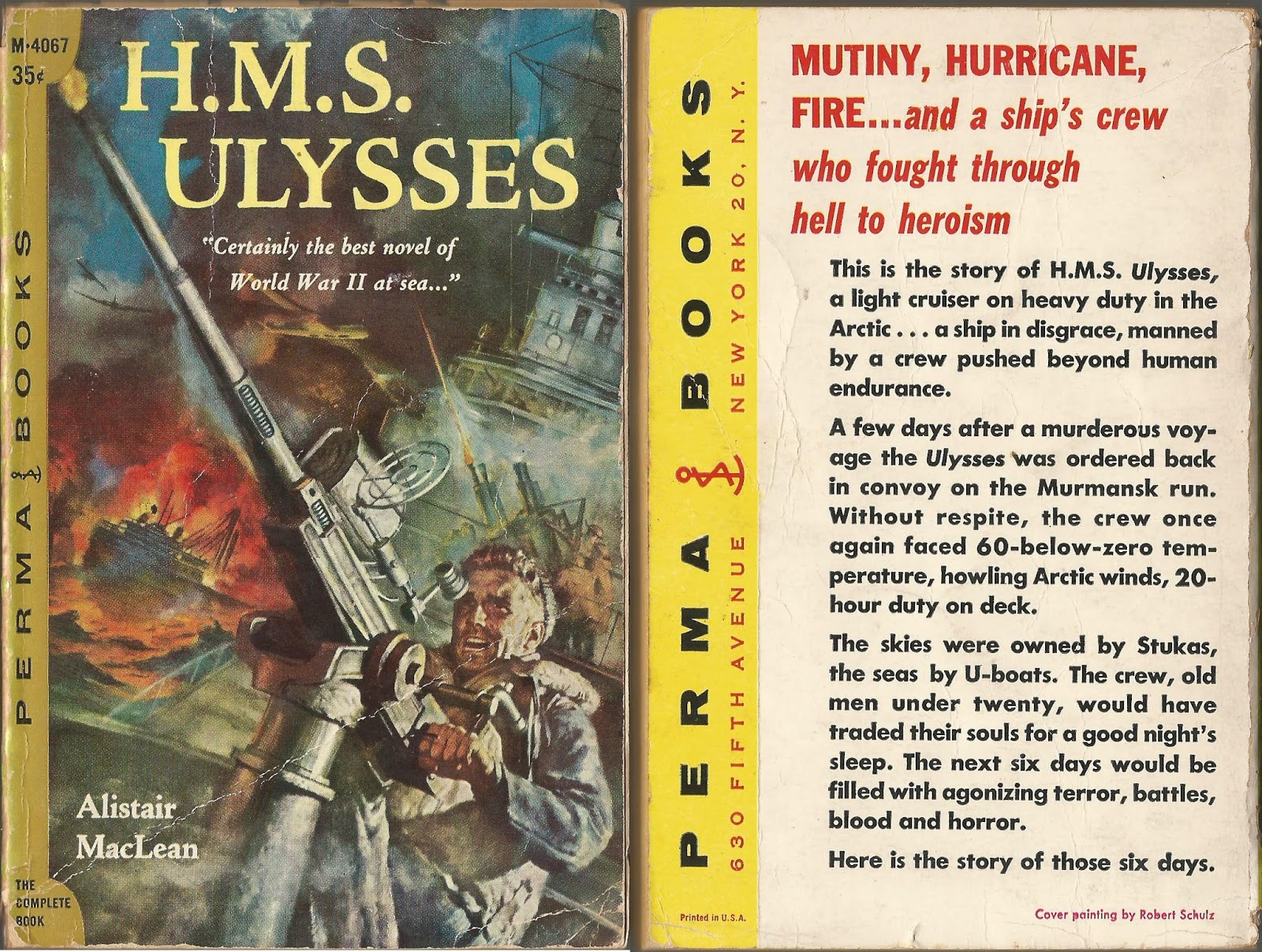
I never thought about reading anything by Alistair MacLean until, at the Des Moines Salvation Army earlier this month, I stumbled on a crumbling 1957 paperback edition of H.M.S. Ulysses, its cover adorned with a sturm und drang depiction of British sailors manning Oerlikon and pom-pom guns in defense against what I guess are He-111s.  Informed by the advertising text on the first page that Scotsman MacLean actually served in the Royal Navy during the Second World War, I decided to read H.M.S. Ulysses in the same spirit in which I read Sapper's No Man's Land, with the presumption that reading fiction about a military campaign by a person who actually served in that very campaign would be worthwhile.  

H.M.S. Ulysses, first published in 1956, starts off with 15 lines from one of those poems everybody likes, Alfred Lord Tennyson's "Ulysses," a cool map of the voyage described in the novel, and a cool diagram of the fictional light cruiser on which the novel takes place.  Then we get down to the novel, all 319 pages of it.

H.M.S. Ulysses chronicles the week-long voyage between Scotland and Russia of a convoy bringing to the Soviet Union Canadian-built tanks, fighters, fuel and ammunition for use on the Eastern Front; nearly all scenes take place on the flagship, the light cruiser Ulysses.  MacLean seems to be the kind of writer who deals in superlatives.  Ulysses is the best ship in the world ("She was the first completely equipped radar ship in the world"), with the best captain in the world ("Among naval captains--indeed, among men--he was unique. In his charity, in his humility, Captain Richard Vallery walked alone"), and its crew have been charged with the toughest duty faced by any servicemen anywhere in the world ("The Russian convoys, sir, are something entirely new and quite unique in the experience of mankind.")  Because she is indispensible, Ulysses has been going on more convoy missions than any other ship in the Royal Navy, and under the strain some members of the crew, just before the novel began, staged a little mutiny.  As a result, Ulysses has to redeem itself on its next trip from Scapa Flow to Murmansk.

A theme in military fiction is that those officers superior in the hierarchy to the main characters are stupid and corrupt.  (In fiction in which the main characters are top commanders, it is the politicians above them who are stupid and corrupt.)  I haven't served in the armed services myself, but I suppose it is possible that real military personnel think their superiors are all unethical jerks--everybody I meet in civilian life thinks his or her boss is a corrupt idiot who is running the organization into the ground and doesn't appreciate all the hard work he or she does.

Novels and movies about military men often have a scene in which one of the guys who has been in the trenches doing the real fighting gives a speech to one of the guys who has been maxing and relaxing back at HQ, a speech about how hard the real fighting men have it, and how the jerks in HQ do not appreciate them.  MacLean fits one of those scenes into the very first of the novel's 18 chapters when the ship's doctor yells at the Admiral sent from London to investigate the mutiny.

Military (and police) fiction is also full of scenes in which some officer has to tell somebody his or her spouse or father or brother or whoever got killed in action. MacLean also fits one of those scenes into the first chapter.  Talk about efficiency!

You may recall that I interpreted Sapper, in his book about the Western Front in World War One, to be praising the British soldier, denouncing the German people, and arguing that the rigors of war could have beneficial effects on individuals and societies.  MacLean in H.M.S. Ulysses takes the opposite tack; far from glorifying war, the novel is one grisly horror scene after another.  And it doesn't glorify the British people or their institutions, or condemn Nazi Germany or its citizens, either.  Sure, there are brave and skillful and decent British characters, but there are also evil British characters and British blunderers, and the Germans (who are only ever seen at a distance, from the deck of the Ulysses) are universally depicted as courageous and clever.  In fact, the Germans outwit the British again and again over the course of the book, and if the National Socialist German Worker's Party's genocidal racism and monstrous tyranny are ever mentioned, I missed it.  Instead Maclean tells us that German flying is "magnificent," German gunnery is "fantastic" and the like.

When I started the book I expected the convoy to suffer some losses, of course, but I thought Ulysses and most of the convoy would get to Murmansk and drop off a big shipment of war material to the grateful Bolshies.  Instead, the mission is a disaster! Of 32 ships that left Scotland and the New World, only five get to Russia, and the Ulysses is not among them.  Only a handful of people from the Ulysses, which starts with a crew of over 700, even survive the mission!  This is partly because the sub rosa purpose of the convoy is to lure the German battleship Tirpitz out into the open sea so a Royal Navy battlefleet can attack it, but the Tirpitz doesn't take the bait!  The Ulysses, and with it over two dozen other British, Canadian and American ships, is sunk for nothing!

Four topics fill up the lengthy narrative as the Ulysses and the rest of the convoy travel for 18 chapters through Arctic waters, enroute to Uncle Joe's worker's paradise in the teeth of German resistance.  These topics all reinforce MacLean's themes of the horror and futility of war and redemption through suffering and death.

1) The weather: MacLean spends lots of time talking about how cold it is, how windy it is, how the seas are rough, and how this can incapacitate the ships and the men. Several ships get damaged by storms and sent back to Britain, and people regularly freeze to death or have the skin ripped off their bodies when they touch cold metal.  In Chapter 6 the Allied sailors face the most severe storm in human history!  ("It was the worst storm of the war.  Beyond all doubt, had the records been preserved for Admiralty inspection, that would have proved to be incomparably the greatest storm, the most tremendous convulsion of nature since these recordings began.")  I didn't keep track of how many pages were devoted to the weather, but I felt like maybe the Weather Channel was sponsoring this novel.  Enough with the weather already!

2) The captain is sick: Captain Vallery, the world's finest captain, is always tired, always coughing up blood, etc.  This reminded me of the captain of the Space Battleship Yamato.  Maybe I'm supposed to feel bad because this dude is on his deathbed, but MacLean doesn't make him realistic or interesting enough for me to feel bad; besides, this is the middle of the most devastating war in history, in which are participating two of the most evil regimes in history--people are getting murdered in death camps and blown up in battles all over the place, why should I cry over this particular guy?  Hell, this very book is full of people getting killed in a dozen horrible ways!

Vallery, it turns out, is a Christ figure.  In the middle of the book he staggers through the ship, giving everybody a pep talk that raises their spirits as if magically, and in the end of the book he gives a speech over the PA system and dies a moment later.  Vallery's speech and death energize the British sailors, giving them the strength to fight on and redeem themselves.  I'm not a Christian so I might have missed this if a character on page 318 hadn't thought, "Vallery would have said, 'Do not judge them, for they do not understand.'"  I don't mind when the author makes it easy for us dummies in the audience.

3) Morale and mutiny: The stress faced by the crew, who are, after all, on the most stressful endeavour in human history, leads to trouble.  Most of the trouble is triggered by misbehavior by cruel officers, but there is also a rating, a career criminal, who is the ringleader of the mutinous sailors.

4) Attacks by the Germans: This is why we are reading this book, right?  The human and technological struggle between the RAF and the RN on one side, and the Luftwaffe and the Kriegsmarine on the other, is one of the great dramas of human history!  Since I was a kid I've been fascinated and thrilled by radar, asdic, depth charges, hedgehog, torpedoes, the Hurricane, the Spitfire, the Bf-109, the Wellington, the Bismark, Window, Flak towers, the Dambusters, all that business.  When I read about this stuff I cheer on the British and their allies, and groan when something bad happens to them.  And I never feel any sympathy or guilt when I read about a U-boat being lost with all hands or an entire German city being reduced to ashes--my attitude is, "Take that you bastards!"

(Maybe that is the kind of thing about myself I shouldn't be putting on the internet for all to read.)

Anyway, the attraction of a book like this, for me at least, isn't hearing about the way ice on the deck can overbalance a ship or how some guy is coughing up blood from TB, it is hearing about naval warfare.  I have already suggested that MacLean's project in H.M.S. Ulysses is not to express patriotic sentiments or denounce Nazi Germany and celebrate its destruction, so I was doing a lot more groaning than cheering over the course of this novel.  When it comes to portraying the variety of naval actions experienced by sailors in the Second World War, however, MacLean really delivers--he unleashes on the poor doomed convoy and on us readers just about every type of German attack you can think of.  A midget submarine.  A drifting mine.  Condor reconnaissance planes.  A Hipper-class heavy cruiser.  The "largest concentration of U-boats encountered in the Arctic during the entire course of the war."  Bombers that drop all matter of ordnance: flares, glider bombs, torpedoes, and just garden variety bombs.  The fighting is so prolonged that for the first time in the history of the Arctic convoys the naval vessels run out of depth charges.

The fighting doesn't get that repetitive, because MacLean presents a variety of scenarios, many different problems the British sailors have to try to solve.  They fight in the dark, they fight with radar , they fight without radar, they hide in a smoke screen, they have to figure out what to do when a burning oil tanker is illuminating the convoy, etc.  

There are over thirty ships in the Allied convoy when it gets underway, crewed by thousands of sailors, and MacLean describes in graphic detail all the horrible things that can happen to them, all the different ways a ship can be crippled, sink or explode, and all the horrible ways people can be burned up or drowned or frozen to death or blown to pieces.  MacLean's dwells on the horror of war: the horror of men floating on the surface of the icy ocean amid a burning oil slick or paddling for their lives away from the murderous propellers of an approaching ship, and the horror of the men on intact ships who have to watch helplessly as these men, in their hundreds, perish.  We hear all about people being burned to skeletons, frozen solid, blasted to shreds, shot full of holes.  There are lots of mistakes and friendly fire incidents, and plenty of euthanasia, and lots of guilt-ridden men who commit suicide or sacrifice themselves to assuage their guilt.  Several ships and airplanes are destroyed crashing directly into enemy vessels, so that the bodies of Allied and German servicemen are intermingled.

Did I enjoy this novel?  Can I recommend it?

On the one hand I was surprised that the mission described in the novel was a tragic disaster instead of a triumph for justice and democracy.  Even though I was a little disappointed, I have to admire a book that holds genuine surprises.  We are used to adventure stories that start with some guy saying "It's a suicide mission!" and end with our heroes coming home safe after accomplishing the mission, so it was interesting to have a story in which the characters go on a suicide mission and it turns out to really be suicidal.

I learned some things I hadn't known about Royal Navy vessels: for example, I had never even head of the Kent screen, and I also had not know the Boulton Paul gun turret was mounted on ships.  That was good.  Hearing about the multitude of ways things can go wrong on a ship was also interesting.

On the other hand, there are some problems with the book.  It is too long, for one thing.  How many pages of weather do we need?  And how many guys who sacrifice themselves?  This happens again and again.  There are also so many characters and so many ships that it is not easy to keep track of them, and MacLean will not talk about some of them for a hundred pages, then they suddenly take center stage while they are getting killed.  It is hard to care about people you've never really been introduced to until they are getting immolated or disintegrated just like a bunch of other guys did a few pages ago.  This reminded me a little of the Iliad.  It's been a long time since I read the Iliad, but I seem to recall guys we never heard of before getting extravagant death scenes in which Homer laments that they will never see their wives or participate in their favorite hobbies again.

Another of the problems with H.M.S. Ulysses is that MacLean doesn't let you decide, and doesn't require you to figure out, how to feel about the characters; he tells you how to feel about them on the first page you meet them.  Captain Vallery is a unique man, an authority on music and literature who is deeply religious, hates war, volunteered to come out of retirement the first day of the war, but never brags about any of this (we readers know he is the best thing since sliced hard tack because of the omniscient narrator.)  Sublieutenant Carslake "was the quintessence of the worst by-product of the English public-school system....he was a complete ass."  Chief Petty Officer Hartley "was the Royal Navy at its best."  The mutinous stoker Riley "had at a very early age, indeed, decided upon a career of crime...his intelligence barely cleared the moron level."          

In my last blog post I talked about Mikhail Lermontov's novella "Princess Mary." Because "Princess Mary" has a first-person narrator who is deserving of skepticism, and all the characters act irrationally and are driven by their emotions, we have to figure out how to feel about every character based on their words or actions and our own moral and ethical sensibilities.  This generates a level of mystery and tension for the reader, and forces the reader to think, and means different readers will have different reactions to the novella, some identifying with or sympathizing with characters that other readers might condemn or dismiss out of hand.  The characters in "Princess Mary" also change as the story progresses, which may force readers to rethink their earlier assessments.

H.M.S. Ulysses lacks that mystery and tension, and does not provide the reader space to think and decide, because MacLean tells you immediately how to feel about each character.  With a minor exception, I don't think the characters in MacLean's novel evolve, either.  

Despite these problems, its vivid depiction of the world of the Arctic convoys, its gruesome catalog of horrors and the wide variety of naval engagements it presents make reading H.M.S. Ulysses a worthwhile experience.  Fans of military and nautical fiction, especially fiction that eschews patriotism, unrealistic heroics and happy endings, should check it out.

**********


The final three pages of my edition of  H.M.S. Ulysses contain ads.  Two indicate that the people at Permabooks expected MacLean's novel to appeal to history buffs.  I often see the advertised hardcover American Heritage volumes in used bookstores and antique stores.

If I'm going to read Veus Eruopesnl or Olnuzle,
I'd prefer to read the original unabridged texts
The third ad is for Reader's Digest Condensed Books.  My mother's mother, whom we kids called "Nana" and whom we saw often (multiple times a week before I started school, then every weekend when I was older) had a bunch of Reader's Digest Condensed Books, and piles and piles of the Reader's Digest magazine.  (The magazine is actually mentioned in passing in H.M.S. Ulysses.)  I would often look at the pictures in the books and magazines, and read the little jokes in the magazines, but I don't think I found them very funny (perhaps just because I was too young to get the jokes.)

I do find something funny about this ad-- the drawing that accompanies it. For whatever reason, the people that put the ad together decided, instead of showcasing one of their most popular or exciting volumes, bursting with real life bestsellers, to include a picture of a book so generic that the titles on the spine are not real, and in fact are not even real English words.  I'm not even sure all the characters are real English letters!  A strange choice whose rationale I am unable to conjecture.

Friday, September 18, 2015

"Princess Mary" by Mikhail Lermontov (trans. Nabokov & Nabokov)

Back cover
Russian literature has a lot of boosters--even comedian Norm MacDonald is on the "you gotta read the Great Russians" bandwagon.  My own experience of Russian literature has not been extensive.  Recently I was flipping through a library copy of Penguin's The Portable Nineteenth-Century Russian Reader, and noticed that the included translation of "Princess Mary," an 1840 novella by Mikhail Lermontov and a component of his novel A Hero of Our Time, had been done in 1958 by Vladimir Nabokov and his son Dmitri.  I'm a Nabokov fan, so I decided to give "Princess Mary" a shot.

Wikipedia says that the hero of A Hero of Our Time is "the embodiment of the Byronic hero."  So here was a chance for me to learn a little about Romanticism, another literary movement or period with which I am woefully unfamiliar.

"Princess Mary" is one of those stories in which fashionable witty people meet at resorts, "taking the waters," and have intrigues, some sincerely falling in love, others callously manipulating others for their amusement.  The story, like 60 pages in this edition, is in the form of the diary of Pechorin, whom Lermontov apparently intends to be an exemplar of the vices of his generation.  Pechorin is a master at seducing women and manipulating men, and considers "to subjugate to my will all that surrounds me, and to excite the emotions of love, devotion, and fear in relation to me" to be the primary source of happiness in his life.  At one point, savoring the knowledge that a woman is weeping over him, he compares himself to a vampire!

At one of those towns at the foot of a mountain where people go to enjoy the alleged benefits of "sulphurous" springs, Pechorin runs into several acquaintances of his, including a Grushnitsky and a Werner.  Pechorin is quick to point out to us that he has no friends: "I am not capable of true friendship.  One of the two friends is always the slave of the other, although, often, neither of the two admits this to himself." Grushnitsky he dislikes, but they hang around together because they met in the army. Werner, a doctor, and Pechorin are like two birds of a feather, both learned, cynical, witty.
"Consider: here we are, two intelligent people, we know beforehand that one can argue endlessly about anything, and therefore we do not argue; we know almost all the secret thoughts of each other; one word is a whole story for us....Sad things seem to us funny, funny things seem to us melancholy, and generally we are, to tell the truth, rather indifferent to everything except our own selves."       
Pechorin's wit reminded me of the kind of paradoxes I associate with Oscar Wilde--"platonic love is the most troublesome kind," "[I had] no charitable action on my conscience," "Women only love those whom they do not know," are representative specimens of his bon mots.

Also at the town is Vera, a woman Pechorin had an affair with in the past.  Vera is married to some old guy, but still aches with love for Pechorin.

Grushnitsky falls in love with a Princess Mary, a friend of Vera's who is in town, and Pechorin, for fun, encourages Grushnitsky to pursue her while he seduces the princess himself.  At the same time he is charming the princess Pechorin toys with Vera, breaking her heart.  After a climactic scene of humiliation, Grushnitsky, pursues revenge against Pechorin.  Despite Werner and others trying to stop them, Grushnitsky and Pechorin fight a duel--Grushnitsky tries to cheat, but is found out and is killed.  Vera, stressed out over the duel, can't hide her love for Pechorin from her husband, and her marriage and life are ruined; she is forced to depart, never to see Pechorin again.  Pechorin has a chance to marry the princess and live an easy life, but doesn't take it; he doesn't love the princess, in a final letter Vera begged him not to marry her friend ("you must make this sacrifice to me: for you I have lost everything in the world"), and Pechorin is a restless soul, irrationally unable to accept marriage and give up the freedom he doesn't even enjoy.  In the last paragraph Pechorin writes
I am like a sailor born and bred on the deck of a pirate brig.  His soul is used to storms and battles, and, when cast out onshore, he feels bored and oppressed, no matter how the shady grove lures him, no matter how the peaceful sunshines on him.   
Front cover; that's Tolstoy on the horse
As we expect from Romanticism, there's a lot of descriptions of natural beauty and sublimity: cliffs, gorges, sunrises, sunsets, rivers.  Pechorin describes his ride through a gorge to the location of the duel, dewdrops falling from leaves and refracting sunlight and all that, and tells us "more than ever before, I was in love with nature."  At one point Princess Mary looks down at the water while they are fording a river on horseback and she is hypnotized, almost falling off her mount.  One of my favorite passages of the story is when Pechorin describes the jagged rocks three hundred feet below the ledge where the duel will take place, rocks upon which Grushnitsky is about to fall to his death, as "dark and cold as the tomb...awaiting their prey."  In the final pages of the book Pechorin's horse dies underneath him while he is galloping in pursuit of Vera--"Everything would have been saved had my horse's strength lasted another ten minutes."

People in "Princess Mary" are at the mercy of the natural world, just as they are at the mercy of their own passions (which, of course, are part of the natural world--at one point Pechorin makes the materialist argument that the "soul is dependent on the body").  Pechorin, despite the fact that he is so clever and carefully plans all his moves, is driven by irrational feelings and succeeds or fails in his endeavours due to luck or "destiny," this is a repudiation of reason and rationality that, I am told, is one of the essential characteristics of Romanticism.

I enjoyed "Princess Mary."  Even though we are expected to see Pechorin as a creep, I found it easy to identify with his skepticism about friendship and his irrational fear of marriage, attitudes I have shared.  (I got over my fear of marriage.)  I liked how Pechorin and Werner were always referring to Cicero or Tasso or some other literary luminary; I wish I knew people who would say interesting things like that.  People I run into just talk about the weather, or, even worse, "the game."  When they whip out references it is usually to Saturday Night Live ("We're going to pump you up" or "More cowbell!") or Seinfeld ("He's a low talker" or "Not that there is anything wrong with that.")  Even the college professors I meet talk just like working class people, the men about sports or video games or some girl's ass, the women about shopping, gossip, and their "crafts."  

The style is good, of course, Nabokov having had a hand in it, and the character of Pechorin is engaging.  The plot isn't surprising, but is acceptable (except for the tragic ending it actually reminded me a little of a Wodehouse plot, people sneaking around and trying to outwit each other.)  The characters besides Pechorin are sort of just there to be acted upon by Pechorin, to show how superior but also what a jerk he is.  

There is at least one sizable problem with the story.  In a way that somewhat strains credulity, the plot is driven by the fact that Pechorin and Werner are always sneaking up behind people to listen to their conversations, or just by chance coming upon people, unnoticed, so they can hear critical information.  I suppose fiction, especially first-person narratives, wouldn't really work without these sorts of devices, and this goes for high literature as well as popular fiction: I can think of two pivotal scenes from Proust in which Marcel fortuitously finds himself in the position of observing, undetected, the exotic and secretive behaviors of homosexuals, as well as other scenes in which he observes people who are unaware he is watching them.  The reader of fiction has to be willing to suspend disbelief, even if what he is reading isn't full of nonsense like hyperspace and psionic powers.

So, a thumbs up for Mikhail Lermontov and the Nabokov family; "Princess Mary," a little excursion into Russian Romanticism, was certainly worth my time.

Wednesday, September 16, 2015

No Brother, No Friend by Richard C. Meredith

On the one hand there was a sense of sincerity, of total and complete honesty exuded by the old female Krith, yet, on the other hand, over the years the Kriths had told so many lies, so many lies that had seemed to be totally convincing, I found it hard to credit truth to anything a Krith said without hard objective proof to back it up.
I'm blonde myself, so I think I am permitted to make the requisite
"blonde brings an axe to a ray gun fight" joke
My mother, for reasons I cannot fathom, has become a partisan of Thriftbooks.com, and for my birthday got me a gift card usable at their website.  I'd prefer a gift card usable at amazon, because the people at Thriftbooks.com ruin the appearance of the books they sell by affixing to them large stickers which are impossible to remove.  It is similarly impossible to tell this to my mother, who doesn't let one get a word in, and already thinks I am a snob ("Why do you wear those fancy clothes?  Why don't you wear something comfortable like the rest of us, like jeans and a T-shirt?") an ingrate ("We are very disappointed that you aren't using that education we paid so much money for") and a failure ("We thought you were going to be a professor, and now you have that dead end job....")  My whining to her about stickers on the books she bought me is not going to have a positive effect on our relationship.  So I guess that makes me a steady Thriftbooks.com customer.


Anyway, I liked the first volume of Richard C. Meredith's Timeliner Trilogy, At The Narrow Passage, enough that I used my birthday present to buy the rest, as well as Meredith's The Sky is Filled with Ships.  To my disappointment We All Died at Breakaway Station is quite expensive online; I'll have to hope to stumble on a cheap one in real life.

This week I read No Brother, No Friend, the 1979 paperback edition put out by Playboy.  Originally, the novel appeared in 1976 with a very odd, modern art collage cover that reminded me a little of Max Ernst.  The text of the Playboy edition, with a more conventional sex, violence, and aliens cover, is apparently revised in some way.

I was pretty disappointed as I started No Brother, No Friend.  It felt long and slow, with nothing much happening.  Our narrator from At The Narrow Passage, Eric Mathers, is hiding out with a girlfriend on one of the multitudes of alternate Earths, and after just a few pages they get captured by the Krith.  The Krith are one of two advanced nonhuman races competing for dominance of the multiverse, in part by manipulating the more numerous but less sophisticated humans; in the past Mathers has worked in their employ as a mercenary, but in the course of the earlier novel he became disillusioned with them.

The portion of the narrative covering Mathers's captivity includes lots of flashbacks to scenes from At The Narrow Passage and surreal dream sequences when Mathers gets drugged.  The style is irritating, tedious and overwritten, with unnecessarily wordy sentences (a Krith says "I am rather certain that your murder of Kar-hinter will not go unavenged" instead of just "I am certain you will be punished for murdering Kar-hinter" or "I am certain your murder of kar-hnter will be avenged") and odd and distracting metaphors--check out this sentence on page 17:
This one was tall, a full seven feet, built like a wrestler, but with no fat, and he carried an energy pistol exactly like Pall's--big, black, and ugly as patricide and incest.
Maybe this apparent non-sequitur about patricide and incest is supposed to foreshadow the relationship between humanity and the Krith which is revealed in the final third of the novel?

Fortunately around page 60 Mathers escapes to a timeline with a kind of Norse Viking flavor, and the style and pacing of the novel make a turn for the better. In this timeline North America is split up into smallish competing English ("Anglian"), German ("Imperial"), French ("Frankish") and Native ("Skralang") political units, and Mathers falls in with the English, who are allied with the American Indians.

As you may remember, At The Narrow Passage began in a dimension where the Krith were aiding the British, and featured Mathers participating in a British commando raid in France, the object of which was to capture a German aristocrat.  In the Norse world which is the setting for the middle part of No Brother, No Friend the Krith are working against the English, and Mathers participates in an English-American commando raid in Georgia, the object of which is to capture a Krith secret headquarters.  The German aristocrat is back, this time as a leader of the raid and a comrade of Mathers's.  It is nice to see this guy doesn't hold a grudge, even though Mathers not only tried to kidnap him but has been sleeping with his wife.

This middle part of the novel that focuses on the attack is an improvement over the slow and clumsy beginning.  The military and espionage aspects are entertaining, and a new character is introduced who is somewhat interesting, an embittered female spy who acts as a love (or maybe we should say "lust") interest for our narrator.  (She is a lot more interesting than the girlfriend I mentioned.)  The pace is faster, things actually happen, and the writing seems tighter.  I wonder if the first third of the novel got more revision, or less revision, than the rest of the book; this could perhaps account for the differences in style.

The English force falls into a Krith trap, and most of the characters don't live to see the final third of the book.  Mathers survives, of course, and after some shenanigans revolving around him capturing Kriths and Kriths capturing him, back and forth across a variety of dimensions, he ends up in the Krith home dimension.  Here he finds himself before the Krith ruling tribunal, the handful of rare female Krith, who are repulsively obese and wrinkled from age, but also gifted with tremendous psychic powers.  These female rulers explain the crisis facing the universe, hint at the multiverse-shaking importance of Mathers himself, and explain the bizarre origin of the Krith race--they are the descendants of genetically-engineered human beings, created and then abandoned by callous high-tech humans from a particularly advanced timeline.  (Of course, any or all of this could be a lie!)

When I talked about At The Narrow Passage I compared elements of the novel to the work of Isaac Asimov and Robert Heinlein.  Today I am going to compare elements of No Brother, No Friend to the work of A. E. van Vogt and Alfred Bester.  A few times in these first two Timeliner books a shadowy figure appears out of nowhere to aid Mathers.  In the last few chapters of No Brother, No Friend we learn that this figure is Mathers himself, the Mathers of the future, who has attained great psionic power and travelled back in time to help his younger self.  Van Vogt, of course, is known for having characters who develop super mental powers.  (At one point Meredith actually uses the word "supermind," which I thought might be significant.  While the first edition of No Brother, No Friend was published a year before DAW published Van Vogt's Supermind, Supermind is a fix-up of stories that appeared long before, and, of course, the revised edition of No Brother, No Friend appeared two years after Supermind.)  One of the memorable elements of Bester's well-known 1956 novel The Stars My Destination (AKA Tiger! Tiger!) is how the protagonist's future self travels back through time to periodically appear before him in a dramatic and mysterious fashion.

At the end of No Brother, No Friend, Mathers reunites with the (boring) girlfriend from the start of the book, and with the help of shadowy future Mathers they escape the Krith to a presumably safe timeline.  Of course, they hoped they were safe in the timeline that started the book.

The first quarter or so of No Brother, No Friend is weak, but the remainder has some of the strengths that led me to enjoy At The Narrow Passage--the military stuff, and the uncertainty surrounding  the true nature of the universe and which factions deserved the reader's sympathy.  So, a mild recommendation.  I'm definitely curious about what goes on in the third Timeliner volume, Vestiges of Time.

**********

The back pages of No Brother, No Friend advertise other paperbacks produced by Playboy, including a horror novel, The Siblng by Adam Hall, that Robert Bloch says will haunt your dreams, and a series of adventures by Graham Diamond which are apparently about a sexy princess who fights "the creatures of the forest" in a grim far future.