Monday, January 5, 2015

Future Corruption 1: Lupoff, Gloeckner, Goldin & Lafferty

The world is full of evil, I think we can all agree about that!  (What we can't agree on is exactly who or what is evil; one man's courageous freedom fighter is another man's murderous terrorist, after all.)  If the world is full of evil today, what can we expect to see in the future?  Greater evil? Different evil?  Let's get our pessimism on (the kids still talk that way, right?) with Roger Elwood and a bunch of scribblers the people in the advertising department call "science fiction's top writers" and indulge in some literary speculations about Future Corruption.

Future Corruption, unleashed on the public in 1975, has a gloomy Richard Powers cover (gorgeous reds and purples) that reminds me of Abraham Bosses's famous frontispiece to Hobbes' Leviathan, and text on the back cover that is meant to invoke Anthony's funeral oration from Julius Caesar.  All the stories are new to this collection.  All this is giving me a good vibe.

For fun, let's rate these stories not merely on whether they are entertaining or show literary merit, like we always do, but also on to what extent they further the supposed mission of the anthology, and on the magnitude of the evils they depict.

"Saltzman's Madness" by Richard Lupoff

I recently read Lupoff's novel Sandworld and gave it a mixed review.  "Saltzman's Madness" is actually a decent horror story, but I'm not sure it really belongs in a book that aims to "explore the outer limits of our potential for evil" or "speculate on the spread of corruption" in the future.

This is a longish (over 30 pages), rambling story with quite a few characters. Basically, Saltzman is one of the lead computer programmers at a software firm that makes operating systems.  Saltzman hates wasting time, is in fact with obsessed with using time wisely.  He hates to sleep, he insists on working on documents while riding in the car, and so forth.  One night in the bathroom (!) he has a sort of epiphany, and becomes convinced that there is a lot of time out there that we don't experience, that each minute is actually something like 100 seconds long, and each hour 100 minutes long, but beings from another dimension are using those extra 40 seconds and minutes.

Saltzman talks to a scientist who is doing research on tachyons, and to the office beatnik who talks about how marijuana, LSD and "speed" effect one's "time sense." Finally, Saltzman comes up with the idea that if he listens to Josef Rheinberger's "Organ Concerto in G Minor" through headphones, with the orchestral track and the organ track moving at different speeds, maybe he will be able to access all that extra time that is out there.

(I listened to the rendition of the Concerto at the link above while I wrote this, and have to admit I found it too high pitched; all those high notes pained my poor ears. Maybe the speakers on my laptop are to blame?)

H. P. Lovecraft-style, this experiment drives Saltzman insane and almost summons malevolent monsters to our universe from another dimension--or maybe not almost; could Saltzman's insanity in fact be possession by an alien creature?

Also Lovecraft-style, we know from the first page that Saltzman is in a government funny farm with some kind of multiple personality disorder; the story is almost entirely a flashback.

I enjoyed the story, but if someone complained that it was padded with overly long lectures on Einsteinian time-space theory and illegal drugs, and discussions of computer programming and high end hi-fi equipment, I would be hard pressed to disagree.

So, a thumbs up for "Saltzman's Madness," but a very low reading on the evilometer.

"Saltzman's Madness"   Is the story good?: Moderately good.   Evilometer Reading: Very Low


"Andrew" by Carolyn Gloeckner

Gloeckner has only four entries on isfdb, all for short stories published in the first half of the 1970s.  Googling around suggests that there is a Carolyn Gloeckner who writes biographies of sports figures and adaptations of popular classics for kids, but I don't know if this the same individual.  "Andrew," apparently, is her last published SF story.

"Andrew" reminded me of Thomas Mann's Death in Venice as well as episodes from Casanova's memoirs.

A black hole flies through the Solar System, destroying all the planets and exterminating the human race.  Just in time, a space ship leaves Earth with less than 2,000 survivors. The captain of the ship is a homosexual, and the twenty page story is about how he uses his position as captain to seduce a beautiful boy ("His face was childishly rounded, but his features were those of a Greek bust-- classic, symmetrical, elegantly defined.") The boy moves from his family's spartan cubicle where they eat protein bars every day and into the captain's richly appointed quarters where he can drink booze and eat gourmet food.  The captain fears that Andrew Garland's parents will object, but when they come to see him they just extort some extra rations out of him--they have essentially sold their son to the captain for use as a sex toy.

Before moving in with the captain, Andrew was recognized as one of the smartest pupils in the ship, and everyone expected him to become a high officer, even captain. However, access to alcohol and drugs absolutely corrupted him, and he abandoned his studies.  Years later the captain realizes the selfish thing he has done, turning a promising young man, who could have had an exciting and productive career and done a great service to humanity as a leader in the ship, into a parasite.

This is a quite good story.  All the human relations stuff is good, and all the SF stuff is good, and the story and all its scenes are just the correct length--Gloeckner conveys emotion and presents us a clear picture of life in the ship with the minimum amount of verbiage.  And "Andrew" is actually about what this anthology is supposed to be about: corruption.  The captain is corrupted by power and lust, Andrew's parents by poverty and greed, and Andrew by temptation.  In a situation in which the entire human race is reduced to fewer than 2,000 people, all these characters, instead of doing their duty to a fragile society, selfishly pursue their animal desires.

"Andrew"   Is the story good?:   Good!      Evilometer Reading:  Moderate


"Prelude to a Symphony of Unborn Shouts" by Stephen Goldin

Recently I read a very short story by Goldin and thought it pretty good.  Years ago I read one of Goldin's novels, A World Called Solitude, and also liked it.  

One of the reasons I liked the Goldin short short referred to above is that it had characters, plot and emotion.  Unfortunately, "Prelude to a Symphony of Unborn Shouts" has none of these.  It is one of those stories (six pages long, in this case) which consists entirely of newspaper clippings and quotes from fictional pundits.

The topic Goldin is addressing here is overpopulation.  (I guess he thinks it is evil to have children?Or more children than he has had?)  Set in the 1990s, the newspaper clippings describe how governments react to an overpopulation crisis by encouraging people to use contraceptives and have abortions.  Religious people resist these moves. The story is supposed to be funny (I think), and includes banal jokes from a fictional comedian.  Here's one of the jokes:
"You know, if they really wanted birth control, they'd simply outlaw aspirin.  Then the girls could have as many headaches as they wanted."  
The clippings about religion paint the religious as violent goofballs, and the final clipping is about food riots that (presumably) resulted due to overpopulation, so it is clear where Goldin's sympathies lie.  Maybe this story will appeal to militant atheists and people who are really worried about overpopulation.  I'm a laid back atheist and I'm not worried about overpopulation, and the story is not interesting or amusing or persuasive, so I thought it was quite lame.
"Prelude..."  Is the story good?:   No.      Evilometer Reading:  Low

"Heart Grow Fonder" by R. A Lafferty

I've read a sizable amount of Lafferty stories since I started this here blog, and for the most part I have found his stories amusing and thought-provoking.  It will be poetic justice if, after dedicated atheist Goldin laid that clunker on us, committed Catholic Lafferty can deliver the comedy goods.

Lafferty does not disappoint; "Heart Grow Fonder" is fun and entertaining and is all about temptation and the evils of deceitfulness, marital infidelity, thievery, and trying to be something (and someone) you are not.

Simon Radert is happily married and enjoys his work (apparently he is some kind of accountant or finance expert--Lafferty calls him a "paper pusher" and assures us he is well remunerated.)  When some swingers, the Swags, move in next door Radert is initially hostile to them, calling them "creeps," but it is not long before he is coveting sexy Mrs. Swag.

We learn that Mr. Swag has the ability to swap minds and bodies with people, and he shifts his own consciousness into Radert's body for an hour at midday so he can have sex with Radert's wife.  Mrs. Radert, at least initially thinking this is her own husband expressing renewed interest in her, is thrilled.  Swag starts doing this every day at noon like clockwork, and Radert, in Swag's body during these periods, succumbs to temptation and starts having sex every noon hour with Swag's wife.  (Swag's wife is aware another man is inhabiting her husband's body and responds with enthusiasm; she has many such liaisons every day!)

Radert not only succumbs to the temptation to betray his wife and marriage.  Being in Swag's body provides him access to Swag's bank accounts and financial papers, and Radert begins shifting money from Swag's accounts to his own (as well as engaging in far more complex swindles.)  Before the story is over Radert is even plotting Swag's murder.

"Heart Grow Fonder" benefits from Lafferty's jocular style, and moves briskly, but I found the end of the story, as various characters' duplicitous schemes collide, somewhat confusing.  

Notable about the story is that Lafferty does not follow the paradigm set out by the text on the cover of the paperback, that the stories be about the future and science. (To be fair, in his introduction to the volume, editor Elwood does not lay out these "rules," and perhaps they were concocted just for marketing purposes after the stories were compiled.)  This story is not about science or the future.  Lafferty specifically informs us that the body switching as depicted in the story is not scientifically possible, and attributes it to supernatural means, mentioning the devil repeatedly, and implying that Radert is bound for hell thanks to his sins.  Lafferty also argues, as we might expect a religious person to, that there are more ways to look at the world than the "scientific" way, and suggests that scientists are as susceptible to bias and error as anybody.

Like most of Lafferty's work, fun and thought-provoking.
"Heart Grow Fonder"  Is it good?: Yes.   Evilometer Reading: High.
     
********************

The Goldin piece was poor, but it was short.  I enjoyed the Lupoff story, and the Gloeckner and Lafferty stories were even better and addressed issues of temptation and corruption in an emotionally affecting and intellectually engaging way.  So far I'm really enjoying Elwood's anthology.

In our next episode, more corruption, this time with our old friends J. J. Russ, Bill Pronzini, and Barry Malzberg.

Friday, January 2, 2015

Astounding 1940s stories by Van Vogt, Kuttner & Moore, and Neville


I recently purchased a severely worn copy of Berkely's 1956 paperback edition (G - 41) of The Astounding Science Fiction Anthology.  I bought it largely because of the terrific Richard Powers cover, which is full of battling space craft, baroque towers, and mysterious banks of mist.  The cover text includes a typo, a misspelling of Lester del Rey's name--maybe this book is worth a billion dollars, like that stamp with the plane upside down?

My copy was once owned by a Kay Whitley.

Yesterday I read three stories from this crumbling artifact of an earlier world, two by MPorcius Fiction Log faves, and one by an author I've never read before.

"Vault of the Beast" by A. E. van Vogt (1940)

I've read a lot of Van Vogt in my day, but not this one, which I am told is his first written (but not first published) tale.

This is a quite good story; it's easy to see why Van Vogt was such a big deal back in the '40s and '50s (his is the top name on the cover of this anthology, for example.)

A shape-shifting Martian creature has stowed away on a Earth space freighter.  The creature is on a desperate mission, to find and bring back to Mars the greatest mathematician on Earth!  Van Vogt does a great job using this alien as a main character, getting into its psychology, and showing us how it infiltrates Earth society and employs any means necessary to accomplish its goal.  It turns out the shape-shifting creature is a kind of robot, created by extra dimensional aliens who need the help of a mathematical genius to open up the colossal prison on Mars in which one of their comrades was imprisoned millions of years ago.  The story includes cool SF devices like anti grav and rocket technology, and cool settings, like inside the space ships and an ancient Martian city.  There's also esoteric math; did you know that 23,058,430,092,139,351 is a prime number?  Me neither!

A classic Golden Age story; strongly recommended.

Fellow SF fan Kay Whitley, we salute you!


"When the Bough Breaks" by Henry Kuttner and C. L. Moore (as by Lewis Padgett) (1944)

This story first appeared in the same issue of Astounding as Theodore Sturgeon's "Killdozer!"  Mysteriously, the title heading on page 137 of this anthology reads "When the Bough Bends," though the Table of Contents has "When the Bough Breaks."

As with the Van Vogt, I've read lots of things by Kuttner and Moore, but not this one until this week.

Kuttner and Moore like to write about people and artifacts from the future that come back to the 19th or 20th centuries and interact with people.  Some of their most recognized work, like "Vintage Season" and "Mimsy Were the Borogroves" are along this line, and so is "When the Bough Breaks."

Physicist Joe Calderon and his wife Myra have a baby son, Alexander.  Four little dwarves with oversized heads begin visiting them to train Alexander--Alexander, his parents are told, is the first specimen of Homo Superior, and is still alive in the year 2450, from whence they have come.  When Myra and Joe try to interfere the dwarves use a paralysis ray on them, and try to console them by telling them they are worshiped in the twenty-fifth century.

In a month the infant has a bigger vocabulary than his parents and when he wants candy he just teleports mom to and from the store.  He develops a cruel and callous sense of humor, and uses his superpowers to play jokes on his parents (shocking them with electricity, for example.)  The ending took me by surprise.  Because Alexander is invincible it is impossible to discipline him.  The dwarves had warned him to be careful with one of the training devices they brought with them from the future, but Alexander ignores their advice and immolates himself.

A good story; I like the ending, which says something about the way an individual's superiority can corrupt him (something the baby's name cleverly foreshadows).  I also like how the parents' attitude towards their child changes over the course of the story, and the mystery presented by the four deceitful dwarves from the future: are they trying to foster Alexander's development, or laying a trap for him?  Do they hope he will found a race of supermen, or are they subtly undermining him because such a superior man will inevitably become a monstrous tyrant?

Another Golden Age classic.


"Cold War" by Kris Neville (1949)

I'd never read anything by Kris Neville before, and one reason I purchased this anthology was to read this story.  Who is this guy whom John Campbell, Jr, saw fit to include in this anthology along with such famous names as Van Vogt, Asimov, Leinster, Simak and Del Rey?

The Wikipedia page on Neville consists mostly of quotes from Barry Malzberg in which Malzberg declares Neville a brilliant genius far superior to other SF writers and in fact too good a writer to waste his time on SF.  (Malzberg can lay it on pretty thick when he wants to.)  Reading "Cold War" makes it easy to see why Malzberg would admire and identify with Neville--"Cold War" includes some of the themes and tone which characterize Malzberg's own work.

In the world depicted in "Cold War" the peace is maintained by American space stations armed with nuclear weapons; should any nation act aggressively against American interests, the space stations can quickly nuke the aggressor.  There is a secret about the space stations, however, a secret the President will go to any length to hide.  Congressional investigators, and crusading journalists, try to figure out the secret, and the President is not afraid to use the Secret Service to murder such researchers, should they discover the truth.

The secret?  That no human is psychologically equipped to man the space stations. Being responsible for the lives of millions of people, having the power to obliterate millions of people, is driving the space crews crazy.  So far the astronauts have only cracked up upon returning home on leave, but when they do flip they commit horrible crimes.  One guy slices up his family with a knife.  The President and his closest advisers live in terror, knowing that eventually one of the space station crew members will likely go insane while in orbit and release a station's load of nuclear bombs on Earth, annihilating millions of innocent people.

Malzberg's fiction is full of astronauts that go insane, including astronauts who go insane and nuke the Earth from space.  It was pretty surprising to see what I thought of as a stereotypical Malzberg scenario in a story published over twenty years before Malzberg's own Falling Astronauts and "Out From Ganymede."  I guess there really is nothing new under the sun.

"Cold War" is a good story, but its strength lies almost entirely in its surprising idea; it is not a fun story, and the style and characters are totally unremarkable.

***************

Three good stories full of cool ideas and human drama that serve as solid examples of how exciting and even subversive (parents who dislike their own kids and presidents who assassinate journalists and congressmen!) Golden Age SF could be.  Hopefully some of the other anthologies I purchased during my holiday travels will be as good.

Thursday, January 1, 2015

Day of the Beasts by John E. Muller

"At the moment, I'm afraid I can't believe that these creatures come from the stars.  I believe they came from earth, but from the earth of some distant future."


I purchased quite a few odd paperbacks at Rainy Day Pal, a used bookstore in Lexington, South Carolina, while on my end-of-the-year travels.  Here's one of the oddest: not only had I never heard of its author, I'd never heard of its publisher!

In 1961, British publisher Badger published Day of the Beasts by John E. Muller in hardcover.  Several paperback editions followed, including mine, which was released on some unspecified date by Modern Promotions, a division of Unisystems, Inc.  (The device on the cover says "Uni Book.")  A little googling around suggests Modern Promotions put out lots of children's books based on properties like the Flintstones, Huckleberry Hound and The Dukes of Hazzard, as well as a few SF books, romance novels, and cookbooks.

John E. Muller, it turns out, is a pseudonym used by several writers associated with Badger.  According to isfdb, the author of Day of the Beasts is John Glasby.  Back in September I read two Lovecraftian horror stories by Glasby, and wasn't very impressed by them.  (If I had known Glasby was behind this novel it would probably still be enjoying the balmy temperatures of the Palmetto State instead of shivering along with me here in the land where the tall corn grows.)  Glasby, a professional scientist, produced a high volume of genre fiction at great speed, apparently leaving himself limited time for constructing original ideas or editing and polishing his prose.

I purchased Day of the Beasts largely because of the cover painting by Jeff Jones, which suggests the book is about a naked guy who fights giant spiders.  That sounds pretty good, but does Glasby's story live up to Jones' illustration?    

Day of the Beasts takes place in the late 1970s or early 1980s, in an alternate universe in which the Soviet Union has maintained a lead over the free world in the space race.  (The novel first appeared only four years after Sputnik and the same year as Vostok 1, so when Glasby wrote it such a turn of events must have seemed all too plausible.)  In fact, as the story begins, the commies have put men on Luna, Mars, Venus and the moons of Jupiter and Saturn, and American scientists are rushing to build an interstellar drive in hopes of beating the Soviets to Alpha Centauri.  Major Brad Norton, a physicist and astronaut as well as an Army officer, is sent by Washington to the South Western desert to report on progress of the star drive.

Just as a major test of the interstellar drive is about to take place a freak tornado appears and wrecks the prototype interstellar ship.  In the succeeding weeks giant arachnid-like monsters lay waste to New York City (egads!) and many other US cities. Do the commies have the ability to control the weather and these monsters?  Or are extraterrestrials to blame, as Major Norton theorizes?  (We SF fans are well aware that aliens are always employing dirty tricks to keep us from achieving our destiny among the stars!)

As the back cover told us even before we opened the book, we can't blame these disasters on the Bolshies (as much as we might like to.)  Major Norton, in the second half of the book, figures out that it is not merely aliens who are causing all this trouble, but aliens from the future!  Those are the worst kind!  The aliens send one of their number back in time to take over the mind of a scientist, who begins promoting the theory that the monsters are from outer space, but the Major sees through this ruse.  In a few weeks the US government builds a time machine and in the final third of the book Norton travels forward in time to sabotage the device the aliens are using to send all those monsters back to the 20th century.

Day of the Beasts reminded me of those old SF movies in which the characters are all in a lab talking, and watch the aliens and monsters on a screen or read about them on teletype machines.  The characters in this novel are all bland scientists or military officers who are more spectators to the action than participants.  They find evidence of monster attacks, spot the monsters way off in the distance, arrive in New York after it has been flattened, etc.  Only in the last 40 pages of this 144 page book, when the Major travels to the future, do we get any real action.

The novel definitely feels thrown together and unrefined.  There is no style or personality to the writing, and the characters are just there, lacking personality, emotions or relationships.  There are science-fiction elements that don't seem to serve any purpose to the plot, and others which are simply not explained. Robots are prevalent, for example, but play no role in the story.  The 20th century characters call the future people "aliens," but when Major Norton goes into the future to meet them they look and act just like humans, and the giant monsters are proven to be native to the Earth.  How the future people control the weather or take over people's minds is never explained.  It is also not clear why the future people destroy the star drive and New York; there is no scene in which the future people explain their motives, and Glasby doesn't drop any clues to their ideology or belief systems.  The future people's campaign of sabotage is made even more incredible when it is explained to us that they knew they would fail.

I'm in the same position with Glasby's Day of the Beasts that I was in with Richard Lupoff's Sandworld just a few days ago.  The thing has many obvious flaws, but somehow they didn't stop me from enjoying it.  Am I getting soft in my old age?  Day of the Beasts was not good, and I don't feel like I can recommend it to people, but I was never bored and I was always curious about what would happen next.  So, a (very marginal) passing grade for Day of the Beasts.

Monday, December 29, 2014

Sandworld by Richard A. Lupoff

"They only two places...inside and outside.  Inside is inside a fence.... Inside any jailhouse....Outside is anyplace else...."
Years ago, back in New York, I borrowed from the library an old hardcover edition of Richard A. Lupoff's Edgar Rice Burroughs: Master of Adventure and read quite a bit of it.  It was exciting to find that someone was taking Burroughs seriously, and I found the book to be very interesting and entertaining.

Besides that major work of genre literature criticism, Lupoff wrote quite a few SF and mystery novels. (One of these novels features H. P. Lovecraft, another writer Lupoff had a scholarly interest in, as a character.) While on my holidays travels I bought one of the less well-known of Lupoff's novels, Sandworld, a 1976 paperback from Berkley, for one dollar in a used bookstore in South Carolina.

Sandworld stars Red O'Reilly, who is serving time in San Quentin.  Shackled to two other jailbirds, a tall elderly black man and a foul-mouthed young Latino, Red is put into the back of a police car for transport to the courthouse. Behind the wheel of the car is the prison guard who is to drive the felonious trio, and beside him sits a female ACLU lawyer, there to make sure the guard doesn't abuse the "cons" during transit.

In the true tradition of Edgar Rice Burroughs, while driving down the highway the police vehicle is inexplicably teleported to an alien planet where the three crooks, the prison guard and the attorney have to fight for their lives against a giant snake!  They all survive the struggle with the monstrous serpent, and then trek across a strange desert, to a cyclopean city.  In the true tradition of H. P. Lovecraft, the city is abandoned, haunted by alien monsters, and filled with reliefs which tell the story of the fall of its advanced civilization.

Contra Burroughs and Lovecraft, the aliens the Earthlings meet after solving the riddle of the city are kind and generous.  (They even explain how the humans got teleported to this crazy planet in the first place.)  In fact, in classic sense of wonder fashion, the aliens provide our heroes with the technological means to explore thousands of planets! To employ this technology, the Earth exiles need only learn to "become at one with the universe" through meditation!

Then in the last 30 pages of the book, for some reason, we're back in Weird Tales territory.  On their very first exploration trip Red and company are captured by the "degenerate" descendants of a once great race and presented to these degenerates' mysterious god.

Lupoff's main focus seems to be not the book's plot, but its characters; there are many scenes of them debating what to do and squabbling with each other.  The characters, their relationships with each other, and their response to being sent to a planet full of monsters, reflect what I take to be the conventional 1970s liberal ideas held by Lupoff.  The prison guard is fat, ugly, racist, stupid and obsessed with rules and regulations.  Lupoff repeatedly uses the word "authoritarian" to describe him, and likens him to Nazis, fascists, and the alien monsters.  All the other characters enjoy multiple opportunities to humiliate him physically and verbally.  (If you want to read about an Italian-American corrections officer being beaten, shot, and insulted by a multi-ethnic crew of criminals and social justice types, this is your book!)

Our hero, Red, is a college-educated "fiery Irishman," and quickly takes command of the group.  Red somehow "parlayed a role in a campus political demonstration into an indeterminate sentence to a maximum security prison."  Red keeps the violent Hispanic, a mugger and thief who has spent eight years in prison and wants to rape the lawyer, under control.  The elderly black murderer has been in prison over 30 years, and is a "gentle giant" who plays the harmonica and, despite his bad grammar, utters pearls of wisdom.  ("God don't like us kill except we have to.")

The woman lawyer is there largely to serve as a lust interest for the Hispanic and a love interest for Red.       

Over the course of the story Lupoff denounces the harshness of prison life, questions the efficacy of imprisoning criminals, and questions the very idea of rules and authority.  (Of course, Red is always telling everybody what to do, which could muddle Lupoff's message a little, so we are shown time and again that Red is a reluctant leader who only takes the leadership position because the others beg him to do so.)  It is also suggested that criminals are not really to blame for their crimes--when the Latino tries to rape the lawyer she (after being rescued by Red) forgives her assailant, saying, "That was only natural."(!)

What is Sandworld trying to be?  What did Lupoff want to accomplish in writing it? On the back cover Burroughs' name is invoked and we are told this novel is a "rousing adventure in the SF pulp tradition," and it obviously owes some inspiration to Burroughs and Lovecraft.  But it doesn't really succeed as a "planetary romance" adventure or a piece of "cosmic horror."

For one thing, the book's politics don't mesh with the daring-do swashbuckling of a Burroughs story or the existential cosmic horror of a Lovecraft tale.  The politics of the book are very specific to its time and place, late-20th century USA, so the novel can't emulate the sort of timeless adventure of a Burroughs tale or the universal existential cosmic horror of a Lovecraft story.  The characters are not archetypes that represent us all and our hopes and fears (the man who triumphs over challenges, or the explorer who learns some dreadful truth) but stereotypes who represent very specific real people (the minorities who are oppressed by the system and react violently, the stupid ugly white guy who does the system's dirty work, and the sexy college-educated whites who work to change the system) and Lupoff's opinion of them.

Besides the distracting focus on parochial political issues, the novel's pace is slow, even in the action scenes; Lupoff is kind of long-winded and a little repetitive.  There is also no climax to the story; the last 30 pages with the degenerates and their god feel tacked on and are poorly conceived in any case.  

Seeing as Sandworld doesn't work as a pulp adventure story, I am forced to consider that it may be: a rush job done for money that Lupoff padded out with his banal political views; a half-hearted debunking or satire of pulp adventures that fails to be insightful or amusing; or, a sincere attack on criminal justice in America that Lupoff made salable to Berkley by setting it on another planet.  Or some combination of these.

Despite all my criticisms, I'm giving Sandworld a (marginally) passing grade.  I haven't talked about the original science fiction components that Lupoff brings to Sandworld, the astronomy and ecology of the planet, for example, but they are pretty good.  And I was never bored by the novel; I was always curious about what would happen next. The novel is not good, but it kept my interest.  Rather than passing "an indeterminate sentence" for "political demonstration" on Lupoff, I'll let him off with a warning this time.

Saturday, December 27, 2014

Three stories by David R. Bunch from Fantastic

Not long ago I read a very short story by David Bunch that appeared in the January 1974 issue of Fantastic and pronounced it horrible.  But Joachim Boaz of the SF Ruminations blog has endorsed some of Bunch's other work, so this holiday week I read three Bunch stories I found in recent additions to my SF collection.

UK edition of the anthology
"Training Talk" (1964)

Published by Dell in 1966, Judith Merril's 10th Annual Edition: The Year's Best S-F is full of stories by authors I've never heard of, and by authors I don't typically think of as SF writers, like Isaac Bashevis Singer, Russell Baker, and John D. MacDonald.  (Though I have already reviewed some of MacDonald's SF right here at MPorcius Fiction Log.)  In an effort to allay the fears of the SF book buyer, on the back cover of my edition of the volume the publishers printed an assurance from The Chicago Tribune that the book is a "Jim Dandy" and "Fantasy land really comes through in this one...."

David R. Bunch's contribution to 10th Annual Edition: The Year's Best S-F, "Training Talk," is five pages long and originally appeared in Fantastic's March 1964 issue.  I guess it is some kind of allegory or something.  A single father living in the country tries to teach his four-year-old daughter and five-year-old son something (about death?) by carving up hunks of baloney into likenesses of a deceased aunt and burying them in cigar boxes along with the little girl's paper cutouts of angels.  When they dig up one of the boxes six months later they find a snake has been making the box its home.  The end.

Maybe I'm missing some kind of deep symbolism here.  Maybe "Training Talk" is a satire of the scientific method?  (A theme of the anthology as a whole, judging by Merril's introductions and summations, seems to be skepticism of science and technology.)

Maybe I'm supposed to enjoy the folksy style, with all its similes and metaphors ("It was one of those days when cheer came out of a rubbery sky in great splotches and globs of half-snow and eased down the windowpanes like breakups of little glaciers.")?  The story is a little like an R. A. Lafferty story, but one shorn of any laughs.

Maybe I'm supposed to look for clues as to what really happened to the aunt and the kids' mother?  What city the mother may currently be residing in is a topic of conversation among the characters.

This is a thought-provoking story, but my thoughts don't seem to get me anywhere; is the story a puzzle for which I lack a key, or just absurd nonsense without any real meaning?

"Short Time at the Pearly Gates" (1974)

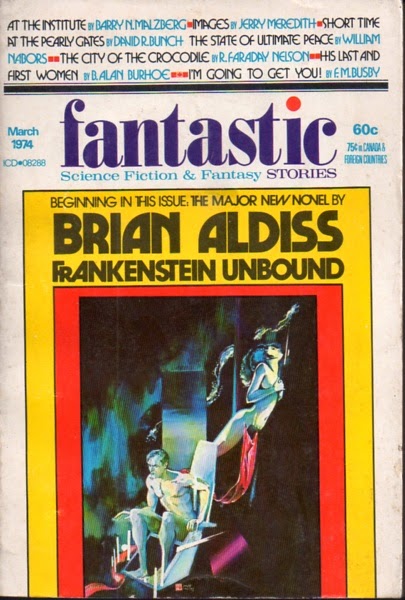
This three page tale appears in my copy of Fantastic's March 1974 issue.  In his intro, editor Ted White admits that "for some Bunch is an acquired taste."  The isfdb suggests that this was "Short Time at the Pearly Gates"'s only appearance anywhere. 

A man is hit by a truck while crossing the street and awakens at the entrance to Heaven.  One of Saint Peter's subordinates plops him in a tub and scrubs away his sins with abrasive soaps and wire brushes. But just before he passes through the Pearly Gates the narrator wakes up to find himself still alive, in a hospital, confronted with his wife and children.

I guess the tension of the story is in wondering whether the man really went to Heaven or was simply dreaming, and whether we should suspect that his life on Earth, working to pay his doctor bill and feed his family, is literally or metaphorically Hell.  There are also some lame jokes (e. g., the attendant at the Pearly Gates keeps track of the oddballs who come up to Heaven, and our narrator is approximately the 485759th most absurd.)  This is some pretty thin gruel. 

"At Bugs Complete" (1974)

Like "Short Time at the Pearly Gates," "At Bugs Complete" appeared in Fantastic (the July 1974 issue in this case) and was never printed again.  Poor Bunch isn't even listed on the cover.

Bugs Complete is a large business firm in a dystopic world in which the government is spying on everybody all the time, and this story is mostly a conversation between an executive (our narrator) and his direct subordinate, a scientific type.  Bugs Complete sells surveillance devices to the government, and the scientist is presenting a new idea to the narrator, a system of bugs that will catalog a person's every experience from birth, thus allowing the government to extrapolate what he or she will do in the future.  Knowing what people will do before they do it, the scientist claims, will be the ultimate power!

This is easily the best of the three stories I'm discussing in this blog post.  Unlike in "Short Time at the Pearly Gates," in "At Bugs Complete" something actually happens, and there are actual relationships between the characters (we learn how the narrator manipulates the scientist to further his own career, for example.)  Now, in "Training Talk" there was also a plot and characters, but in that story everything was inexplicable and absurd; in "At Bugs Complete" you can actually understand the plot and characters--call me old-fashioned, but for me that is a plus.  "At Bugs Complete" also addresses philosophical debates I find interesting--nature vs nurture and determinism vs free will--and includes actual science-fiction elements, the proposed methods of government surveillance.  This is a story I can recommend.

************

So, we've got a bewildering but acceptable story, a story I thought a total waste of time, and a story that actually worked.  It's a mixed bag, to be sure, but good enough that I will read more Bunch in the future, if and when the opportunity presents itself.

Wednesday, December 24, 2014

Spawn of the Death Machine by Ted White

"This is the Com-Comp.  Your creator."
"I don't believe that."
"You are an artificially constructed human being, a mobile data-gathering device."

I recently praised two pieces of writing by Amazing and Fantastic editor Ted White, a short story that was apparently the first (and only) episode in an abortive series of stories about a barbarian exploring a strange world, and an autobiographical story in which Ted's buddy and fellow jazz critic Harlan Ellison abused their friendship.  I thought both items well-written, and became curious about White's work.  I still had some credit at the iTunes Store, a Christmas gift from my brother, and used it to purchase the Gateway digital edition of White's 1968 novel, The Spawn of the Death Machine.

Robert Tanner wakes up naked in a tiny metal room.  A computer voice tells him he was created to act as a data-collecting device, and now is the time for him to go gather up that data!  Tanner isn't sure how much of that to believe--he thinks he's a real human being!  A door opens into the sunlight and Tanner is sent out into what the computer calls "the world of Man;" he is to return in one year to have his memories downloaded.

Tanner has been released into New York City, but it is not the NY we know and ♥, it is a ruin grown over with vegetation, and almost completely abandoned!  Tanner wanders around Manhattan for five days, meeting no people, and starts getting a pain in his stomach.  Tanner's memory of his previous life is almost entirely gone, so much so that he has forgotten that he has to eat!  Things start to slowly come back to him, though.  (TRIGGER WARNING: Tanner's first meal is a domestic cat that he eats raw!)

It is when Tanner leaves Manhattan that his troubles truly begin.  (I know what that's like!)  All the bridges are down, so he swims to the Bronx, where he is promptly captured by cannibals!  (These guys haven't yet joined the feline cuisine craze.)

When his captors beat him Tanner gets angry, and goes Lou Ferrigno on them, killing their leader with his bare hands. Tanner, it turns out, is super strong. Accompanied by Rifka, a teenage girl whose life up to now has been characterized by rape and incest, Tanner marches on, leaving the cannibals and New York behind.  

As Tanner and Rifka cross the post apocalyptic landscape westward to California, battling rapists, dogs, and bears and making friends with various people and animals, Tanner's true identity, and his relationship to the computer that once ruled civilization, and then centuries ago destroyed it, gradually become clear.

In the first half of the book I suspected that White was trying to disgust the reader; besides all the explicit violence there are numerous references to vomit, defecation, semen, saliva, parasites, scabs, blood, etc.  We hear a lot about bad smells.  This eases up in the second half of the novel, and I now wonder if White meant this as a satire of traditional adventure fiction, in which close quarters combat, torture, the life of the "noble savage," and being shipwrecked or otherwise lost in the wilderness are romanticized, sanitized, and/or sensationalized. (As I say this I have Norman Spinrad's 1967 novel Men in the Jungle in mind.)  

Some of the towns Tanner and Rifka encounter are certainly vehicles for satire.  One has a culture based on the tiny collection of books that survived the apocalypse, most prominent among them Henry Miller's Sexus and a bound collection of Playboy magazines.  Another town, cut off from the rest of the world under a geodesic dome, is run stringently on eugenicist lines by a cadre of scientists who maintain a society of exactly 500 men and 500 women, and breed them for intelligence and other desirable genetic attributes.  The twist is that the scientists are "Negroes" and one's social status is largely determined by how dark one's skin is, the darker the better.  (The dome society's ruler is called "Mr. Black.")

Our travelers' journey ends in California, where, among the redwoods, lives a community of telepathic (more "empathic," I guess) nudist Indians who are in tune with each other and with nature.  White, who includes more than one obese villain in the book, makes sure to tell us that not one of these people is fat!  Tanner and Rifka are welcomed into this paradise, but Tanner cannot truly enter this Promised Land-- the empathic waves can't penetrate his stainless steel skull!

In the epilogue Tanner returns to New York to tell the computer that humankind will be better off without high technology, at least for a while.

I found The Spawn of the Death Machine entertaining, though I am not sure how widely I can recommend it.  In part I enjoyed it the way you might enjoy an exploitation B movie; the description of a cannibal rapist that includes the phrase "his genitals covered with the glistening slime of a rutting animal" makes me laugh, but maybe some would find such prose repellent.  The satire can be wacky (and what kind of book tries to tell you life in California is better than New York life?) but the satirical parts are not long-winded or hectoring, and, for me, the wackiness is part of the charm.  So I'm giving Spawn of the Death Machine a thumbs up, though with the caveat that it may take a particular kind of reader to appreciate it.

Friday, December 19, 2014

The Misenchanted Sword by Lawrence Watt-Evans

No Ethsharitic had ever killed a shatra in hand-to-hand combat, Valder knew--but he resolved to try.  The sword's magic might possibly give him the edge he needed to do it.

In my teens I read Lawrence Watt-Evans' The Cyborg and the Sorcerers and enjoyed it quite a lot.  Decades later I still recall parts of it.  For whatever reason, I never read any more books by Watt-Evans, but a year ago I purchased a 1989 copy of 1985's The Misenchanted Sword, the first of several novels set in the land of Ethshar, and this week I read it.

The land of Ethshar has been at war with the Northern Empire for as long as anybody can remember, and Valder is a conscript in the army of Ethshar, one of three million such draftees.  As the novel begins Valder, a scout trapped behind enemy lines, is fleeing three Northern soldiers.  Magic is common in this world, and the people of the Northern Empire worship demons; one of Valder's pursuers is a sorcerer, and another is a shatra, a sort of demon/human hybrid.  Valder is concealed by a hermit, an Ethsharitic wizard, and narrowly escapes death.

The wizard then casts various spells on Valder's sword, but doesn't explain to Valder what they are or how they work.  Valder sets off back homewards, and along the way, besides having to deal with such threats as dragons, demons, and enemy soldiers, he has to figure out how to use his enchanted weapon.  As we often see in these fantasy stories, the magic sword will basically fight for its bearer: "Valder made no attempt to direct it; his hand went where the sword chose to go."  Even mediocre fencer Valder can now hack and slash with the best of them!  But several of the sword's wizardly attributes are inconvenient, and some amount to burdensome curses.

When he reaches the Ethsharitic lines the army's staff of magic users figures out much of the magic of the sword, and, because the sword makes Valder almost unbeatable in one-on-one hand-to-hand combat, the army's commanders send Valder off on assassination missions, deep into the northern reaches of the Northern Empire.

The Misenchanted Sword is not a traditional sword and sorcery Conan/Elric/Grey Mouser tale, nor is it a Tolkein-style epic of high fantasy.  It lacks the romance or poetry or melodrama of many fantasy stories, and instead is quite rational and realistic, almost low key.  The characters act like ordinary 20th century people, not larger than life figures of myth.  It is not nearly as gritty or cynical as something Glen Cook would write, and while you might call it light-hearted, it is not (thank heavens) full of dumb jokes.

In fact, The Misenchanted Sword reminded me quite a bit of a Heinlein juvenile, one of those in which a young person comes of age and learns about the world and life in the midst of an adventure or a period of crisis.  Watt-Evans' novel includes a surprising amount of realistic politics and economics, for example, and the second part of the story, in which Valder is acting as the army's special forces squad, focuses more on Valder's personal relationships and "down time" at HQ than his desperate missions.  The war ends (due to cataclysmic divine intervention that happens off stage) and Watt-Evans includes long scenes in which Valder witnesses the effect of peace after centuries of war on people, politics and the economy, and tries to figure out what he will do with his own life.  In the final third of the book Valder is a small businessman, an innkeeper.

One of the many spells on the sword is one that preserves Valder's life, but not his youth; like Tithonus, he risks living virtually forever as an immobile mindless vegetable.  When he begins losing his sight in his sixties, Valder sets forth from his inn to try to find a wizard who can free him from this curse.

An entertaining story with an interesting premise and a competent, unobtrusive writing style.  I enjoyed The Misenchanted Sword and if I run into the second or third of the Ethshar paperbacks I am likely to read them.