Thursday, November 6, 2014

1981 stories by Vonda N. McIntyre, Gordon Eklund, and Jack Dann & Barry Malzberg

On November 2nd the wife and I went to a flea market held in the 4-H building at the Iowa State Fairgrounds.  Many vendors had box after box of romance novels, and box after box of Westerns, but one vendor had about a dozen boxes of SF paperbacks.  My poor wife waited patiently while I went through each box; unfortunately, almost all the books were recent, less than 25 years old.  I purchased only a single book, 1981's New Dimensions 12, edited by Marta Randall and Robert Silverberg.  (Randall's introduction seems to suggest that she did all the editing, and Silverberg's name is on the cover to help sell copies.)  I bought it because Barry Malzberg and Vonda McIntyre's names appeared on the contents page, and today I read their contributions, as well as a story by Gordon Eklund.

"Elfleda" by Vonda N. McIntyre

I was impressed by McIntyre's early '70s story "Only at Night," a primary reason why I purchased New Dimensions 12.

Through elaborate surgical techniques unscrupulous scientists have recreated mythical creatures like centaurs, unicorns, and mer-people, apparently by grafting the torsos of human accident victims to the bodies of animals.  These half-human, half-animal creatures are kept in a park, and are periodically visited by normal humans who use them as sex slaves.

The sixteen page story is a first person narrative by a centaur, Achilleus, and its theme (beyond callousness and cruel exploitation) is disappointment and unrealized desire. Achilleus is in love with a unicorn, Elfleda, a human woman whose torso is attached to a quadruped body and has a horn implanted in her skull.  Elfleda has always rejected Achilleus's advances; his love is unrequited.  Most of the creatures in the park are obedient to their human masters (due to some kind of brain implants or something) but Elfleda is allowed her freedom, and doesn't have to participate in the orgies organized by the normal humans.

One day the "creators" trick Elfleda, using an unwitting boy as bait, and try to capture her with nets and ropes.  Achilleus tries to rescue her, and breaks his leg in the process. As per time honored equestrian tradition, Achilleus is euthenized as Elfleda is led away.

"Only at Night" was also about the callousness of people towards their unfortunate fellows, but while I found that story powerful, "Elfleda" is just OK.  Despite the strange sexual content of the story (for example, Achilleus and Elfleda have two sets of genitals each, their human ones and the set from their animal bodies, which permits some outre erotic gymnastics) there is nothing about the story that makes it stand out to me. "Elfleda" gets a passing grade, but I didn't find it special.

"Elfleda" is afforded an unmemorable illustration by Wendy Rose.

Gene Wolfe wrote two stories on a similar theme and topic, 1979's "The Woman Who Loved the Centaur Pholos" and 1981's "The Woman the Unicorn Loved," which I read over seven years ago, according to my notes, and do not remember very well.  My notes suggest I wasn't thrilled with them, either.
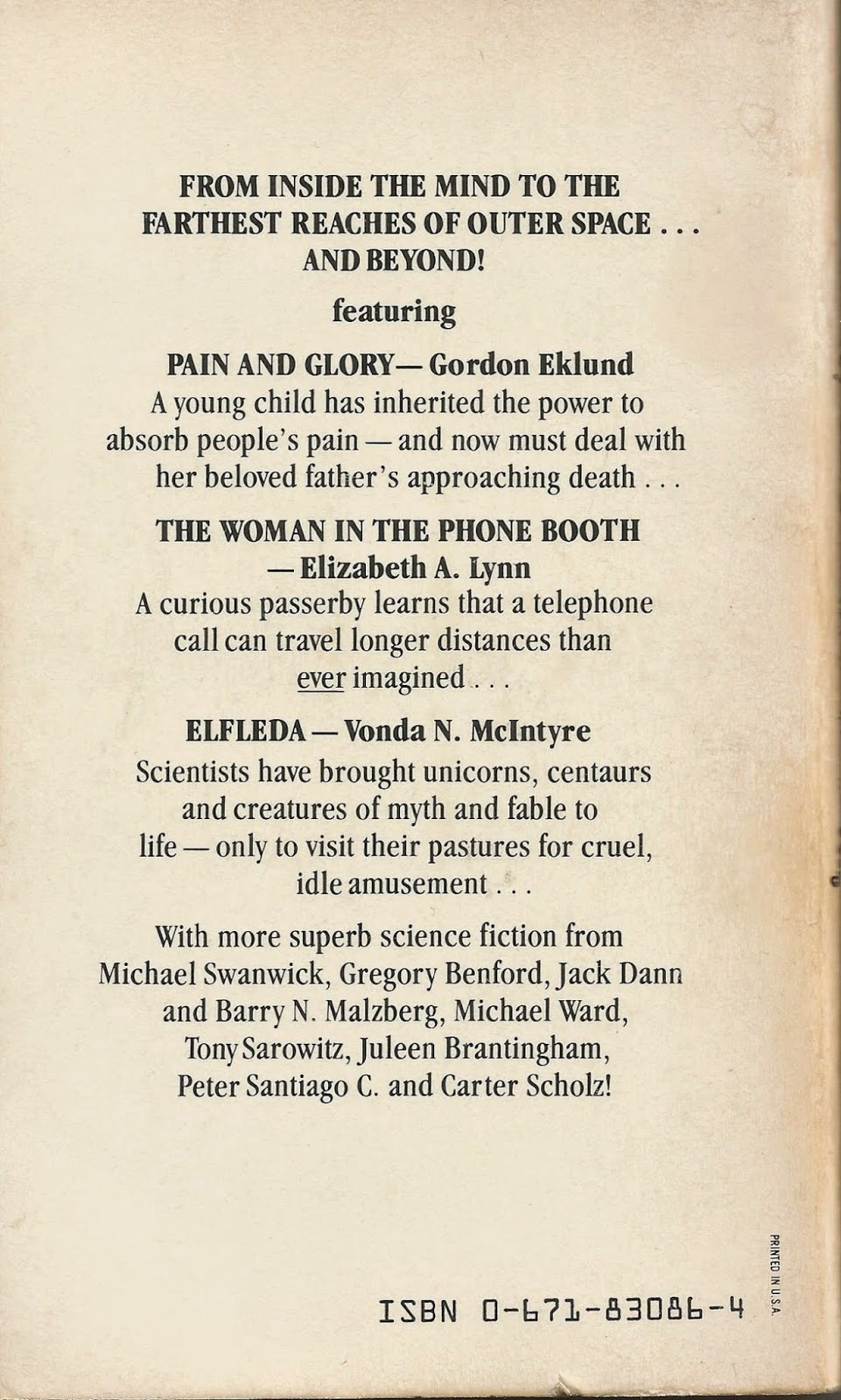
"Pain and Glory" by Gordon Eklund

I gave Gordon Eklund's novel A Trace of Dreams a marginally negative review, and I described his story "Home Again, Home Again," as "lame" and "poor."  But as people who watch sports might say, let's give him another swing at the plate, or chance at bat, or something.

In "Elfleda" we had a woman writing a first person narrative in the voice of a man, and here we have a male writer writing a first person narrative in the voice of a 16-year old girl.

Kelly Cohen of San Francisco is the youngest of the seven children of Isaac Cohen.  The Cohens have the power to relieve the pain and anxiety of people they touch.  Kelly regularly visits the poor neighborhoods and eases the pain of a catalog of unfortunates: the 12-year old black girl with a birth defect who is molested by a 14-year-old boy, the gullible hippies who are trying to live off the grid and are adherents of the guru Matthew Samson (does that rhyme with "Charles Manson?"), the old woman who is so poor she eats dog food, a blind man, a deaf girl, a drug addict.

Isaac Cohen is dying, and his kids, among them a high-powered lawyer, a sociology professor, and a Berkeley student, gather round.  (The Berkeley student, an aspiring poetess, is always urging Kelly to lose her virginity.)  Isaac tells Kelly the story of how his Ukrainian village of psychic Jews was massacred by the SS.  Kelly learns that many of her siblings have lost their power to relieve pain, perhaps because they have lost the ability to love, or because they got sick of the responsibility their talent brought and were tired of being different.

This is a pedestrian story, I guess an allegory for the burnout experienced by social workers and doctors and for the idea that Jews are an "other" wherever they go and/or a "chosen people" with special abilities and responsibilities.  There is nothing particularly noteworthy about it.  I'll judge this one barely acceptable.

"Parables of Art" by Jack Dann and Barry N. Malzberg  

Attention Malzberg completists: according to isfdb, "Parables of Art" has only ever appeared in this volume.

I enjoyed "Down Among the Dead Men," a Dann collaboration with Gardner Dozois, and I generally like Barry Malzberg, so after reading the mediocre McIntyre and Eklund selections, I expected this to be my favorite of the three.  My expectations were realized.

Fans of Malzberg will not be surprised to hear that this story is four pages long but is divided into three chapters.  Nor that it begins, "Walter Taplin was forty-five and a failed artist."  Taplin is "enormously fat," as is his wife.  We are told that the couple has lots of sex.

Taplin discovers a secret room at the back of his house; within this room he has the ability to create exciting paintings that are sought after by gallery owners and collectors!  (The authors tell us Taplin's early work was like that of Rosa Bonheur, while his work in the secret room is reminiscent of Bosch.)  Taplin enjoys critical and financial success, and loses weight! But he has less time for sex!

Taplin's wife is envious of her husband's success, and jealous that he spends less time with her, so she seals the secret room with concrete.  Life returns to normal (meaning: lots of sex!)

This story is crazy, feels new, and made me laugh.  Winner!

*************

For me, Dann and Malzberg deliver, but the McIntyre and Eklund just sit there inoffensively.  Still, I can see people embracing the McIntyre and Eklund for their conventional earnest liberalism, and finding "Parables of Art" offensive for its selfish and obese female villainess.  (But is she really a villainess?  If we view a happy love relationship as more important than fame and fortune, maybe we should see her as a heroine!)

***********

The final page of New Dimensions 12 is an advertisement for "science fantasy" novels.  Of the seven books listed, I have only read the two Jack Vance books, The Dying Earth and The Eyes of the Overworld.  I think The Dying Earth is overrated, but I love The Eyes of the Overworld to death, and consider it one of the most fun books I have ever read.  I'd probably give the Poul Anderson and Theodore Sturgeon selections a try, but I'm weary and leery of L. Sprague de Camp.  William Barnwell I've never heard of.  Cecilia Holland's Floating Worlds is widely discussed and apparently sui generis, so I am intrigued, but I've heard it is over 600 pages, which is an investment I am reluctant to make.                  

Wednesday, November 5, 2014

Nausea by Jean-Paul Sartre

You must love people.  Men are admirable.  I want to vomit--and suddenly, there it is: the Nausea. 
My wife's copy

One summer while I was in college I had a part-time job with a company called RGIS, doing inventory of retail stores. I worked with a young woman who turned out to be the valedictorian or salutatorian of my high school in the year after my class.  (I think I was our forty-seconduatorian.) She was into existentialism, and we talked about Camus and Sartre. At Rutgers I read The Stranger, which I liked, and I tried to read Nausea in my free time, but it defeated me. Five or ten years ago I read The Plague, and finished it, but found it kind of boring.

Anyway, this week I took another stab at Nausea. I have to admit that as I took my wife’s copy off the shelf I had second thoughts about spending over 200 pages with a guy whom I'd heard would run around Gay Paree praising Stalin and Mao and denouncing the bourgeoisie and Proust, but I told myself that it would be like a literary version of TV’s “Chopped,” where they sometimes trick a vegetarian into cooking up an octopus.  (Summer Kriegshauser, I have not forgotten your plight!)

I need not have worried--Nausea, first published in 1938 and translated by Lloyd Alexander (apparently not the Black Cauldron guy) in 1959, isn't a Communist propaganda screed or even a particularly difficult novel.  (I guess I failed to finish it back in the late '80s out of sheer laziness.)  My wife's copy is the ninth printing of New Directions' paperback edition, copyright 1964. 

Nausea is the diary, dated 1932, of Frenchman Antoine Roquentin.  After spending some years traveling the world, getting involved with various women and getting caught in various scrapes, Roquentin, age approximately 30 years, is staying in the French port town of Bouville, researching a book he is writing on the Marquis de Rollebon, an adventurer of the Revolutionary/Napoleonic Era.  Many of the Marquis's papers are deposited in the library of Bouville.  As the story begins, Roquentin has noticed a change in his life; he used to enjoy touching paper, picking up stray bits of paper from the ground, but all of a sudden he can no longer bring himself to pick up pieces of paper--they disgust him.  Similarly, picking up a stone on the beach, he find that the feel of the stone disgusts him.  Soon, everything disgusts him, from a statue in the town square to the way a barkeep's purple suspenders blend in with his blue shirt.  Our narrator calls this existential disgust "the Nausea."

Roquentin describes in detail his walks through the town, his time sitting in the library and in bars and cafes, and a visit to a local museum full of portraits of the prominent men of Bouville, the bourgeois types who made Bouville a bustling place of trade and maintained order in the town during periods of social unrest.  Roquentin seems to be subtly mocking the middle class, their Sunday rituals of church attendance and promenading in the commercial district, their devotion to business and public order (he thinks it hilarious that one of the civic leaders memorialized in the museum was very short.)  But he also envies them their family life and respectability--Roquentin himself has no family to speak of, and no friends.

A later translation
The most interesting character in the novel is perhaps a man who frequents the library and who approaches Roquentin and tries to strike up a friendship with our narrator. This man has taken up the task of systematically reading all the nonfiction books in the library, starting with the authors whose names begin with "A" and proceeding through the shelves alphabetically.  Roquentin dubs him "The Self-Taught Man."  The Self-Taught Man is a socialist, and hopes Roquentin shares his sentiments.  However, when The Self-Taught Man dramatically reveals his creed, our narrator finds him ridiculous and staggers off, afflicted with an attack of The Nausea.    

At the end of the novel things go to pieces for our small cast of characters.  Roquentin abandons his work on his book.  He meets for the first time in four years the woman with whom he had a long term relationship, and the subject of numerous flashbacks, Anny.  Anny explains that she has abandoned her career as an actress and is a kept woman; she is as disgusted by life as Roquentin and all her dreams have been discarded.  Roquentin's hopes of renewing their relationship are dashed.  The Self-Taught Man is caught touching a teenage boy in the middle of the library, and is exposed as what we would nowadays call a pedophile.  (This was foreshadowed by earlier references to a flasher who wanted to expose himself to a little girl, and the rape and murder of a little girl reported in the newspaper, as well as the Self-Taught Man's description of his socialism as "a love for all men.")  The Self-Taught Man's quest to read all those books has been aborted; he won't be allowed to return to the library.

Roquentin determines to leave Bouveille for Paris.  He sits in one of his haunts one last time, asks to hear his favorite record one final time, a jazz record that includes the lyric, "Some of these days/You'll miss me, honey."  He thinks about the Americans who produced the record, the black female singer, and the man who wrote the song, whom he imagines to be a fat sweaty Jew on the 21st floor of a Manhattan skyscraper(!)  On the last two pages of the book Roquentin realizes that if he produces a work of art, a novel, say, maybe people will think of him the way he is thinking of the "negress" and the New York Jew, and so maybe life won't be meaningless after all!     

Despite Sartre's purported hostility to Proust, Nausea actually reminded me quite a bit of In Search of Lost Time.  Both Marcel and Roquentin are slacker writers who have inheritances and need not work, and have trouble knuckling down and making progress in their literary enterprises.  They both expend a lot of ink describing minutia, like what they see out the window or what the ocean looks like and so forth. They both talk about memory, and describe odd people they encounter.

Sartre adds a dark or cynical twist to Proustian themes.  In Swann's Way Marcel is fascinated and inspired by the sight of two church steeples in the distance; as his carriage follows a winding road the steeples appear to be moving in relation to each other.  The narrator of Nausea is similarly fascinated by mild optical illusions, like the aforementioned purple suspenders (which the people at New Directions saw fit to mention on the back cover of my wife's copy), but he finds these illusions sickening rather than inspiring.  Sartre describes at length the influence on Roquentin of that jazz record, and a particular musical composition, the sonata of Vinteuil which serves as the "national anthem" of the love of Swann and Odette, plays a major role in In Search of Lost Time.  But while Marcel, Swann and Odette knew Vinteuil and listened to the powerful "little phrase" of his sonata played live, Roquentin's favorite song is a jazz vocal on an old scratched gramophone record, and Roquentin (for over 200 pages) rejects it and all art: "To think there are idiots who get consolation from the fine arts."  Where Proust's novel is a vindication of the arts, Nausea reads like a debunking of the arts for 235 pages, until art is vindicated at the last minute.

(The Self-Made Man's description of enjoying being crammed into a building with fellow prisoners during the First World War also reminded me of some of Proust's remarks about his military service.)
 
What does the novel have to tell us about Sartre's philosophy (I'm tempted to call it his "brand"), existentialism?  In the absence of God, life has no essential meaning, it is merely existence.  The obvious response to this knowledge is for individuals to create a meaning for their own lives, and one can see the existentialist revelation as a heavy burden of responsibility, and/or as liberating: how much better to be free to determine the essence of your own life than to have a meaning imposed upon it by a distant and omnipotent figure, but also how much more challenging.  When The Self-Taught Man directly suggests this to Roquentin, attributing it to the unnamed American writer (apparently William James) of the book Is Life Worth Living? ("Life has a meaning if we choose to give it one.  One must first act, throw one's self into some enterprise...."), Roquentin immediately rejects it (only to embrace it later.)

Another Dali cover from Penguin
Roquentin also implicitly rejects the many ways one could give one's life meaning.  All through the book the narrator talks about individuals who have pursued various paths in life, paths that have given their lives meaning, and Roquentin (and, I suspected, Sartre) rejects them all.  He rejects the middle class people who gave their lives meaning by pursuing the project of maintaining order in the face of the Commune and other uprisings, and who built Bouville into an economic success.  The Self-Taught Man, who, as a socialist has ostensibly dedicated his life to changing the world for the betterment of the workers (though it seems in reality that he has devoted his life to sterile reading and taking sexual advantage of boys) is rejected by our narrator and beaten up by a library employee in his favorite locale, the library.  Roquentin says he doesn't understand sculpture, is critical of the painter of the museum portraits, and both the narrator and Anny, whom Roquentin believes has come to the same bleak conclusions about life he has, abandon their creative projects.  Roquentin also rejects a life devoted to human relationships, friendship and love, making little effort to cultivate friendships, having a mechanical sexual relationship with the patroness of a bar, and finding the young lovers he sees in a restaurant sickening.

In the last few pages of the novel Roquentin, after rejecting all these strategies for living a meaningful life, embraces the idea of writing a novel; creative endeavor can "save" him as it saved "the Jew and the negress."  Is Sartre telling us Roquentin, all through the book, was wrong to reject other people's chosen enterprises?  Or just wrong to reject art as a worthwhile enterprise?  Is Sartre endorsing the solution to the meaning of life quoted by the Self-Taught Man (an idea produced, like the pivotal jazz record, by an American)? 

Nausea is a pretty good novel; I laughed at times, and it contains thought-provoking puzzles (I was never sure to what extent Sartre was denouncing or sympathizing with the middle class, homosexuals, artists, Americans, socialists, etc.)  And I have to admit the ending was a surprise; I thought Roquentin was going to kill himself or just drift away into a life of empty despair and depression.  But I don't know if I would say it is "unquestionably a key novel of the Twentieth Century," as the people at New Directions assure us it is.  For one thing, the idea that we should devote our lives to some project in order to give our lives meaning, while definitely sound, feels more like folk wisdom than some tremendous modern revelation.  (Compared to the world-changing theories of Adam Smith, Charles Darwin, Karl Marx, or Sigmund Freud, existentialism, at least as expressed in this novel, seems minor and even obvious.)  There is also the fact that Roquentin's nausea seems to come out of nowhere (why does he suddenly find everything disgusting and life meaningless?) and then to be cured just as abruptly.

Not as fun as Elias Canetti's Auto-da-Fe, but a worthwhile read.  With Sartre under my belt, who should be my next Nobel Laureate?

Sunday, November 2, 2014

Winter in Eden by Harry Harrison

There are no families among the Yilane, no suckling babies among egg-laying lizards, no possible friendships where these cold females rule, where the males are locked from sight of all for a lifetime.
Fun covers from a 1986 UK edition, and a US 2001 edition.

Back in December of last year I read Harry Harrison's 1984 novel about a war between cave men and reptile people in an alternate universe in which dinosaurs escaped extinction, West of Eden, and quite enjoyed it. This week I read my withdrawn library copy of the 1986 sequel, Winter in Eden.

Winter in Eden picks up exactly where West of Eden left off, with the surviving reptile people (the Yilane, the bipedal descendants of mosasaurs) sailing away from the smoking ruins of their colony in the New World, which the human natives have destroyed.  Over the course of the 350 page novel, we follow four main plot threads that at times intersect:
  • Kerrick's, leader of the human band who burnt the Yilane colony. Kerrick lived among the Yilane for years, and can speak their language.  Over the course of this novel he travels around, first trying to figure out the secrets of the destroyed Yilane city, then rejoining his wife Armun, participating in a whaling expedition, and a final confrontation with a powerful Yilane leader, all the while trying to reconcile his human biological heritage with his largely Yilane way of thinking, and attempting to end the murderous war between the humans and lizard people.
  • Armun's thread, while she is separated from Kerrick.  She meets a furry race of generous and welcoming people, the Paramutan, who live amid the ice and snow up north and hunt whales.  These people look like Sasquatches with tails and are incurably optimistic and happy.  I thought Harrison was perhaps evoking with them an idealized version of Eskimos--one of them is named Nanuaq, reminding me of "Nanook," and we are told the Paramutan share their women, as well as everything else.   
  • Vainte's, the Yilane leader who ruled the New World colony that was burned by Kerrick in the first book.  Back in the Old World she marshals support from the Yilane cities there, and returns to the New World with new armies and new technologies to wage a genocidal war of revenge on the humans.
  • Enge's, a Yilane who is the leader of a small sect of peaceniks, the Daughters of Life.  The Daughters escape persecution in the Old World and try to start their own New World colony with a non-hierarchical society.  They encounter a race of primitive Yilane natives with a different skin color and a different sort of technological and social structure than those of the Old World Yilane. 
All the good things I had to say about West of Eden equally apply to Winter in Eden; and I really enjoyed it and recommend it.  Harrison, working with a cadre of scientists, does a great job of creating and bringing to life an alien society which is truly alien (a cold-blooded totalitarian matriarchy whose technology is based entirely on selective breeding and genetic engineering and where males are treated as slaves) but also believable.  (There are 50 pages of appendices after the main part of the book that describe the Yilane and the other inhabitants of the novel's setting.)  Harrison succeeds in making the characters who inhabit this alien society compelling; I actually cared whether Vainte achieved her revenge, whether Enge figured out how to succeed in the task of creating a new society, and so forth.

My copy
The human characters are just as sympathetic and realistic, with realistic psychologies we can identify with.  Winter in Eden is an adventure story full of long marches, sea voyages, exploration of new worlds, and fights, but the characters act and react more like real people than action heroes; for example, there is one minor character who suffers what we would now call PTSD as a result of fighting in the war against the Yilane.  Kerrick is the hero of the story, but he's not the best fighter, he suffers depression and other mental issues, and his leadership ability is often questionable and often questioned.

In a way that is amusing, surprising, and thought-provoking, Harrison uses the alien milieu of the Yilane to turn gender stereotypes upside down.  In one funny scene Kerrick complains that while the female Yilane only talk when they have something important to relate, the males chatter on pointlessly and at great length.  The male Yilane also demonstrate greater sensitivity and artistic ability than the females; all Yilane painting and sculpture is done by males.  (All the ruthless politicians and scientists, who are willing to sacrifice everything and everybody for power or knowledge, are female.)  Less amusingly, the female Yilane rape the males out of hand.

One of the dozens of charming illustrations by Sanderson

Harrison also seems to be addressing the age-old nature versus nurture dispute; to what extent are gender roles, and other ways we have of looking at and dealing with the world, the result of biology, and to what extent are they conscious decisions made by a society (or its most powerful members)?  Kerrick struggles in his relationships with other humans because he has many Yilane mannerisms and attitudes.  Two male Yilane characters escape the harem males are traditionally confined to and must reluctantly learn the female skills of hunting, fighting and marching.  Enge's sect of idealistic peace-lovers, refugees from a society which has consisted of merciless dictators and their unquestioning subjects and slaves for millenia, struggle to create a viable individualistic society in the wilderness, where they encounter a society of lizard people with very different ideas about gender roles.

Eight legs better than six, I guess.
The style and pacing are good, and the comic relief actually made me laugh and served to tell the reader more about the characters and their world; I often find comic relief distracting and diluting, but in Winter in Eden Harrison does a great job with the humorous elements.

The novel also benefits from the inclusion of Bill Sanderson's fine illustrations.

The cover of my copy, by Jery Lofaro, is just OK. LoFaro seems to think a mantis has eight legs, like a spider.

A very enjoyable, very satisfying novel.  I bought a quality-sized paperback edition of the third Eden book, Return to Eden, last year, and expect to read it early next year.

Saturday, October 25, 2014

Three adventures set on Venus by Leigh Brackett

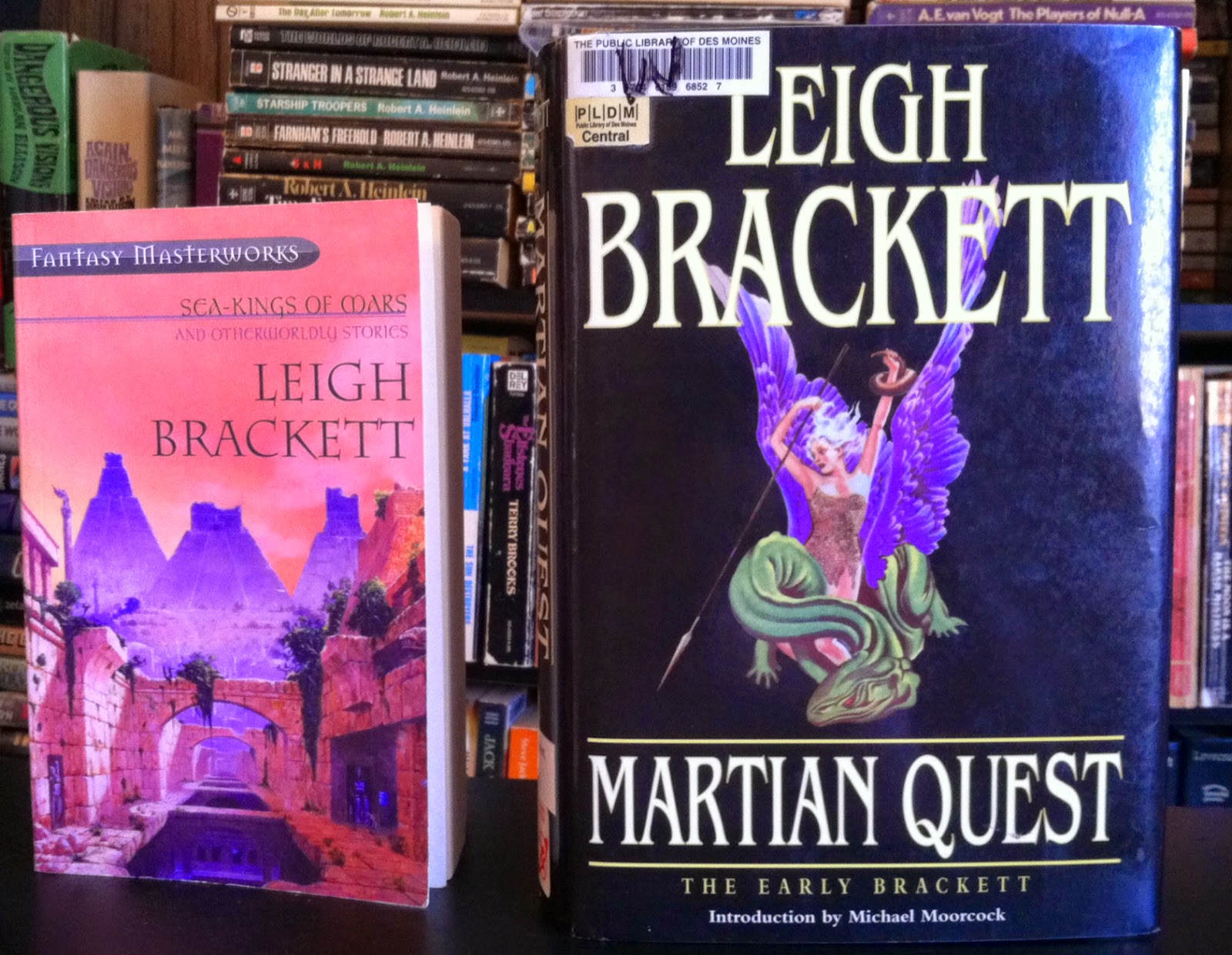
Let's travel back in time to the 1940s, and across the aether to our sister planet, through the medium of three tales by Leigh Brackett, and see what is going on on that world of mystery we know as Venus!  These stories first appeared in pulp magazines, where they were the lead stories; Brackett's name, apparently, sold copies.  I read them this week in my copies of Gollancz's 2005 collection Sea-Kings of Mars and Otherworldly Stories (Fantasy Masterworks 46) and Haffner Press's 2002 Martian Quest: The Early Brackett.  You frugal types can get all three of the stories I'm talking about today in a single four dollar e-book from Baen entitled Swamps of Venus, complete with the kind of cover art Baen is famous for.

Cover must illustrate some other story
"Citadel of Lost Ships" (1943)

Earthman Roy Campbell is a renegade!  When the government seized his family's farm and flooded the area to create a reservoir so it could generate hydroelectric power for factories, Roy took up a life of interplanetary crime.  He didn't want to work in a city like a sheep ("He'd tried it, and he couldn't bleat in tune"), so he became a space wolf, hijacking space ships and selling the hot goods to fences on Venus.  When the space patrol is hot on his trail he hides out among a tribe of peaceful Venusian natives.

But now the Terra-Venus Coalition Government is about to pull the same eminent domain chicanery on Roy's Venusian buddies!  The government is going to relocate the tribe to town, drain their swamp, and extract coal, petroleum and other valuable resources from the area!

Roy, who somehow has a better space ship than the government fleet does, blasts off from the swamp, evades the space patrol, and visits Romany, a private space station that orbits Venus and is made up of dozens of decrepit old space ships welded together.  Romany is the home of thousands of space gypsies, people of many species and races who have been driven from their homes like Roy and his Venusian friends.  Romany, Roy finds, is in the midst of a civil war between those who want to continue being a refuge for interplanetary outcasts and those who want to come out of the shadows and integrate Romany with the Terra-Venus government.  Part of getting along with the government is handing over space pirates like Roy to the space patrol, which is on its way!

"Citadel of Lost Ships" is about ethnic minorities ("little people") who use their special powers to try to resist the "progress" and "efficiency" pursued by mainstream society.  Among the various aliens on Romany are psychics from Titan who can create impenetrable force fields and a harper from Callisto whose music stuns people.  Even Roy and the human girl from Romany with whom he falls in love because of her musical voice, pale heart-shaped face and "long and clean-cut body" which has "the whiteness of pearl," are mystical minorities because of their Celtic blood: "'The harp of Dagda,' whispered Stella, and the Irish music in her voice was older than time.  The Scot in Campbell answered it."

In the end Roy sacrifices his space ship and allows himself to be captured so that Romany and his Venusian swamp-dwellers can remain independent.  Brackett gives us the hope that Roy, who has money secreted away somewhere and apparently is some kind of folk hero, will be able to get out of prison soon and be reunited with Stella.

This story is entertaining, and I like all the space ship stuff, particularly the idea of the space station built up out of old ships, and the story's attitude about progress is interesting.  Roy, the Venusian swamp-dwellers, and Brackett herself admit that the new industrial society is inevitable, and will be safer and wealthier, but they care more about freedom and independence than safety and wealth and would like to be left alone. Government seizures of land and relocation of communities "for the common good" were presumably on many people's minds in 1943; a gander at the website of the Center For Land Use Interpretation informs you that during the 1930s and early 1940s numerous communities in New England and New York were condemned and flooded to provide drinking water for Bostonians and New Yorkers, while Wikipedia tells us that over 1,000 families were relocated by the Tennessee Valley Authority to make way for the Fontana Dam, which started construction in 1942.

The weakness of the story is that the pace is a little too fast, and there are perhaps too many elements jammed into its short length (36 pages).  The Titanians and the Callistan, for example, aren't foreshadowed or developed, they just suddenly appear deus ex machina style to use their powers to resolve the plot.  And the fact that Roy and Stella are Celts is raised on one page, mentioned on the next page, and then dropped.  Some may also complain that Brackett is taking the easy way out and softening the story's drama by having everybody use nonlethal weapons (Roy, Stella, and the government agents shoot at each other with needle guns that use anesthetic needles.)

It is interesting to compare "Citadel of Lost Ships" with Henry Kuttner's "Raider of the Spaceways" from 1937.  Both are about a space pirate on Venus, both include a cast of characters from various planets, and both include interesting space battles.  But whereas in Kuttner's story the pirate is the villain, the Space Patrol is good, and our protagonist is the son of the President of a future version of the United States, in Brackett's tale the hero is the pirate, and he's a poor boy who's been disenfranchised by the government and is pursued by its agents.  Kuttner's plot holds together a little better; the thing that saves the day in the end is foreshadowed early in the story, unlike Brackett's psychics and harper, who appear in the fourth chapter of a five chapter story.

I guess this is meant to illustrate our story (?)
"Terror Out of Space" (1944)

Venus has passed through a cloud of cosmic dust, and male inhabitants of the planet are going insane, committing murder and even worse crimes! Operatives from the Special Branch of the Tri-World Police, Lundy and Smith, have captured one of the aliens from the cloud that are driving every guy nutso, and also have Farrell, one of the victims, in protective custody.  But while they are flying back to base the alien uses its special powers to drive Smith and Farrell so bonkers that the aircraft the taxpayers have provided them crashes into the black Venerian ocean.

Smith and Farrell are killed, and Lundy, in his space suit, walks the ocean floor towards the shore.  He comes upon an ancient road that leads to a city that sank beneath the waves ages ago.  Nowadays the city is inhabited by plant people.  The cosmic alien has driven the male plant people insane, and the female plant people request Lundy's help.  Lundy provides them succor, which involves fighting some voracious plant monsters that come out of a fissure in the ocean floor (with two blasters, John Woo style) and catching that cosmic alien again.

"Terror Out of Space" reads like a draft that could have stood a few revisions.  There are lots of elements and ideas in the story, maybe too many, and the clipped, rapid style, full of metaphors and abstractions, is a little difficult to follow.  Some of the similes could have been toned down; at the end of Chapter 1 we are told that Lundy "was colder than a frog's belly in the rain...."  Two pages later, in the start of Chapter 2, we read that Lundy is "cold as a toad's belly and as white."  In Chapter 4 Lundy is cold again, but happily Brackett doesn't tell us he's as cold as a salamander's belly--this time he's "as cold as a dead man's feet and just as numb."  

The cosmic alien is described as a three-inch-long engraved and fluted crystal cylinder, and it is not clear how it moves.  Until the end of the story I wasn't even sure it ever moved of its own volition; through most of the story it is captive in a little net, or (I thought) driven by ocean currents.  The crystal creature generates illusions in the minds of men--they see the most beautiful woman they can imagine, their dream girl, and they do whatever she says, despite whatever harm it causes themselves or others.  This dream girl wears a veil over her eyes, or keeps them closed, and when she opens them the man is driven permanently insane or simply dies.  Because when his dream girl opens her eyes, a man sees that behind the lids is nothing, that his dream is nothing more than a dream.

At the end of the story it is revealed that the crystal aliens have no idea they are causing so much trouble, because pain and death were never factors in their existence out in space, and they've never been on a planet before.  They like being worshiped, and were just playing around with the people of Venus as if they were toys.  This carefree attitude doesn't quite jive with the other thing we learn about the cosmic crystals at the end of the tale; being on Venus is painful to them, the gravity, which they never experienced out in space, is crushing them and will soon kill them.  The wave of madness sweeping Venus will soon burn itself out, and Lundy's detective work and plant monster blasting was essentially unnecessary.

In "Terror Out of Space" Brackett seems to be saying something about gender roles and about men's view of women, and also about the way women can use their sex appeal to manipulate men and destroy stable family life.  We see how life is lived among the plant people, whom Brackett intends us to be sympathetic to.  The plant women spend their time tending flower beds of seedlings--these flowers are their children who are not yet old enough to leave the sand.  Lundy denounces the cosmic alien for causing men to leave behind their wives and kids, and we watch as the alien commits this very crime against the entire plant people community-- the plant men abandon their wives and children to chase a sexy illusion, an illusion that leads them straight into the jaws of their deadly enemies.  Perhaps "Terror Out of Space" should be seen primarily as a criticism of home-wrecking femme fatales and a lament over how dumb men can be when they see a pair of pretty legs.  You could call it a conservative message that endorses traditional gender roles; I recall that Alpha Centari or Die! also seemed to be endorsing traditional sex roles.

It's a good idea to write a story about how men's fantasies of the ideal woman can wreck their lives, and how men will do dangerous or stupid things to impress women, but I didn't find the story to be very well-executed.  The whole thing, from the action scenes to the way the plot elements fit together, felt abstract, impressionistic, dream-like.  Maybe that was Brackett's intention?  Personally I prefer things to be sharp and clear, and so I have to give this one a (marginal) thumbs down.

Finally, an illustration that matches the story
"The Moon that Vanished" (1949) 

Of the Venerian stories we are discussing today, this is the best; plot and style are smooth, the action scenes and characters are interesting.

David Heath is an Earthman on Venus.  There is a weird site on Venus, where sits the radioactive Moonfire, apparently a fragment of Venus' long lost satellite.  The natives of Venus, whose language has no word for "radioactive," believe that the Moonfire is part of a fallen god and that those who visit the Moonfire will achieve godlike power.  Heath himself once quested for the Moonfire, but only reached its fringes, and then fled, to live as an emaciated wreck in a tavern for three years, drunk out of his mind every day!

A brave barbarian, Broca, and his girlfriend, Alor, whose "body was everything a woman's body ought to be...wide-shouldered and leggy..." demand to be guided to the Moonfire by Heath, so our hero sobers up and off they go.  Broca wants to make himself a god and Alor his goddess, and, for his part, Heath wants to use the power of the Moonfire to create a simulacrum of his lost girlfriend, Ethne.  He's even named his ship after Ethne.

For some reason, there are no space ships, ray guns, computers, radios or even internal combustion engines in this story; the Ethne is a sail boat and Heath, Broca and Alor have to use a sail to get across the ocean and then scull their way through the monster-infested and fever-inducing swamp that surrounds the Moonfire.  They are pursued by the merciless priesthood of the Moon, whose ship has an emerald green sail.  This whole sequence is well done, real adventure stuff.  During the perilous trip Alor loses interest in the brutish Broca and falls in love with Heath, adding human drama.

The Moonfire gives those who remain in its environs the ability to manipulate matter, to make their dreams come true.  As in "Terror Out of Space," Brackett suggests that men's foolish dreams can ruin their lives and the lives of those who love them; the crater around the Moonfire is littered with the bodies of men who lived in dreamworlds of their own creation and died of starvation rather than leave.  Heath tries to create his dream vision of Ethne, but realizes it is Alor, a flesh and blood human being, whom he truly loves.  Broca creates a huge castle full of slavish courtiers and tries to achieve revenge on Heath for stealing his girl, but Heath and Alor escape to live happily ever after.  It would be easy to see this business of the Moonfire as being Brackett's attack on drugs, masturbation or even (ulp!) escapist literature as cheap and artificial ways of producing happiness which only serve to get in the way of true happiness, which comes from mature love relationships with other human beings.

I'm glad I read this one last, as it is by far the most satisfying of the three stories.

**********

Recently, Jesse of Speculiction reviewed Leigh Brackett's "Black Amazon of Mars" and made the bold assertion that Brackett is superior to her towering predecessor in the planetary romance field, Edgar Rice Burroughs.  He has also posted a hostile review of Edgar Rice Burroughs' first novel, A Princess of Mars, one of my favorite books.  I like Brackett, and I like "Black Amazon of Mars," and I certainly recommend that fans of Burroughs read "Black Amazon of Mars," but I'm going to have to register some disagreement with Jesse here.

I can certainly see why Jesse, whom it appears believes literature should instill progressive values in readers and raise cultural standards, would prefer Brackett to Burroughs.  Brackett is a woman, and her hero, Erik John Stark, is non-white, and Brackett includes more proactive and heroic women in her stories than does Burroughs, so all the identity politics points are on Brackett's side. And Burroughs certainly celebrates martial prowess (I recall John Carter in his later adventures telling us he enjoys life-or-death fighting!), aristocracy and imperialism (though both Carter and Tarzan do go native, preferring the violent barbaric world they come to dominate to the modern Western world, even as they bring some of the cultural benefits of Western society to the barbarians), while Brackett's heroes are working-class and Brackett is skeptical of elites.

Beyond these political considerations, Brackett, as Jesse points out, has a more modern style than Burroughs, and, writing decades after Burroughs began his own career, has a modern noirish or "hard-boiled" sensibility.  Brackett's stories also tend to be more believable than Burroughs', in which Carter and Tarzan single-handedly fight off dozens of foes at a time in close combat.

However, for me, Burroughs is the superior writer.  I recognize that it is not for everybody, but I love Burroughs' old-fashioned style, which is clear and straightforward, but, as Jesse suggests, somewhat formal.  I also enjoy his Victorian attitudes.  One reason I read science fiction and fantasy books is to explore a different world, and nowadays every TV show, every film, every newspaper, and every college class goes out of its way to decry racism, sexism, and homophobia and promote the interests of women, minorities and "the environment."  Burroughs' books, which simply accept or actively celebrate values we are now reminded tirelessly to abhor, are a window on a different world.  Similarly, nowadays "sophisticated" people are all cynical, sarcastic and "ironic," while Burroughs' books are sincere and optimistic.  Carter has a clear sense of right and wrong, loves Dejah Thoris utterly, and declares more than once in his career, "Where there is life, there is hope!"  Paradoxically, Burroughs' books, some published over 100 years ago, feel fresh.

Jesse hints at this paradox when he likens Burroughs' work to a sexy dangerous rebel, which in some ways is odd, because Burroughs' values were mainstream values, and it is the modern cynics who are (or purport to be) the sexy rebels.  I also think Jesse is mistaken when he suggests Burroughs' work is empty or meaningless.  In the same way that the Brackett stories I talked about above are adventure tales that try to say something about topics like the role of the individual in society, what constitutes freedom, how men and women should deal with each other and what role men and women have in society and family, some of Burroughs' work addresses important topics like the role of the state, eugenics, religion, and the virtues and pitfalls of modern and primitive societies.  Jesse's issue may not be that Burroughs fails to address life and the human condition, but that Jesse simply doesn't agree with what Burroughs has to say.

(Perhaps, on the subject of the racism of Burroughs' work, I should point out that in the second Barsoom novel, Gods of Mars, we meet the white men of Mars, who are arrogant creeps who have been bamboozling the people of Mars for centuries with their self-serving and bogus religion.  By current standards the Barsoom books are certainly racist, as Burroughs shows that different cultures and ethnic groups are different and some are superior to others, but I think his depiction of such topics is more nuanced than Jesse perhaps recognizes.)    

Most important to me, when comparing Burroughs and Brackett as entertainers (and of course their primary objective is to entertain) is how vivid and vibrant their settings are, and how thrilling their scenarios are.  I find Burroughs' Barsoom, and his fantastic version of Africa with its intelligent apes, to be more memorable, striking and "alive" than Brackett's settings. The weird alien cultures and exotic beasts Burroughs created have taken up permanent residence in my mind, and I think it is this facet of Burroughs' work which clearly sets him above Brackett.  I haven't read all of Brackett's work, but of what I have read, including "Black Amazon," the settings and action are not nearly as memorable as those in Burroughs'.

***********

Oy, longest blog post ever.  We'll see if I can stick closer to the "pithy" end of the scale next time.

Tuesday, October 21, 2014

Three Worlds to Conquer by Poul Anderson

"As always, he found engineer thoughts soothing.  Forces and matrices were so much easier to deal with than people." 
My (and Bill Meeker's) copy of the novel
Jesse at Speculiction recently reviewed The High Crusade, one of Poul Anderson's more famous novels. I read High Crusade soon after the start of my exile (it was in the local library here on the prairie), like four years ago, and I have to agree with Jesse that the novel is just too incredible. The idea that medieval English fighting men might have admirable qualities that are lacking in modern technological societies, like physical courage or a willingness to take risks or whatever, is an interesting insight and is typical of Anderson's work, but it is too difficult to accept them conquering societies with the wealth and organization required to achieve interstellar travel.

(On the other hand, I recall High Crusade being more readable and memorable than some of Anderson's later work, like For Love and Glory, which I read and have completely forgotten, and Harvest of Stars, which I read and remember being tedious.)

I may not be Poul Anderson's biggest fan, but I enjoyed Brain Wave and The Enemy Stars, and on this blog I have praised several Anderson stories and collections. I am quite sympathetic to Anderson's point of view, so, despite periodic bumps in the road, I keep going back to him.  This week I read a novel published four years after 1960's High Crusade, Three Worlds to Conquer, which was first serialized in If in the first months of 1964. I have the Pyramid paperback, X-1875, printed in 1968.  This copy, for which I paid $1.50 in Minnesota, was originally owned by a Bill Meeker.  

Fellow SF fan Bill Meeker,
we salute you!
Three Worlds to Conquer is a traditional science fiction story about science and wars.  Our hero is Mark Fraser, an engineer on the Ganymede colony of 5,000 people.  He's a skilled pilot of space craft and also the human most adept in the lingua franca that has developed between humans and the natives of Jupiter known as the Nyarr.  Because Jupiter is so inhospitable to human life, humans and Jovians have never met in the flesh, but for over a decade the two civilizations have corresponded via a neutrino-based transmitter system.  As the novel begins Fraser's counterpart on Jupiter, Theor, is asking for Fraser's help because another Jovian society, the Ulunt-Khazul, have launched an aggressive war on the Nyarr.  But Fraser has his own problems--the civil war taking place on Earth has just spread to Ganymede, and the crew of a space battleship (a huge sphere bristling with gun turrets--awesome!) is arresting all the technical personnel on the colony!

The narrative alternates between Theor and his war on the Jovian surface and Fraser's struggle on Ganymede; Theor and Fraser conduct their relationship entirely through electronic communication.  Three Worlds to Conquer thus reminded me of those hard SF classics A Deepness in the Sky, by Vernor Vinge (1999) and Mission of Gravity, by Hal Clement (1954), which also centered on long distance human-alien relationships.

After suffering military defeats at the hands of their enemies, Fraser and Theor use their engineering ability, rhetorical skill, and willingness to incinerate people with rocket exhaust, to win the day.  

There is a lot of science in Three Worlds to Conquer; we hear all about neutrinos, the solar wind, the atmosphere and geology of Jupiter, and what kind of orbits space ships have to take to efficiently travel about the solar system.  I think Anderson spends two entire pages of Chapter 2 describing the neutrino communications device to us readers.  For the most part this stuff is convincing and interesting.  More fun, perhaps, is the strange ecosystem Anderson comes up with for Jupiter, particularly the plants, animals and people that fly/swim in the thick Jovian atmosphere.  He also makes a creditable effort to figure out what kind of technology the Nyarr and other people living on Jupiter's surface, under tremendous pressure and in terrible cold, would have.

Anderson has a tragic sense of life, and, besides all the people who get massacred in these wars, this is expressed in Fraser's relationships.  A skinny 40-year-old who complains about getting old, he has a wife and children, but his marriage has obviously grown stale.  When Fraser returns from a week-long mission to Io, he goes to the neutrino transmitter to talk to Theor before he goes to see his family.  ("Bros before hos," I guess, even if your bro is an alien you've never seen.)   Fraser and Lorraine Vlasek (mmm, pickles), a woman whose loyalties seem to vacillate between the two different sides in the Earth civil war, have a sad unconsummated love affair.  Fraser also deals with the stress of his work on Ganymede by smoking a pipe and taking "happypills," and frets when tobacco and "psych medicine" are in short supply.  Anderson doesn't imply any moral judgments about Fraser's attitude towards his family or his reliance on stimulants to get through a Ganymedean day.

Characters and style aren't the strong point of this short (143 page) novel; it's a story about plot and ideas.  There aren't any libertarian speeches like the one at the end of the Van Rijn collection Trader to the Stars, but Anderson's politics are in evidence; Fraser carps about government censors and bureaucrats, and Theor gets out of a predicament by trading with primitive natives he encounters.  Anderson portrays war as preferable to living under tyranny or surrendering what is yours, but many minor characters are willing to give up and/or collaborate and have to be convinced by people like Fraser and Theor to do the right thing and stand up for what is right.  And while wars will happen, at the center of the novel is the idea that different cultures will most profit through trade and friendship.

Not spectacular, but solidly entertaining; Three Worlds to Conquer has all the classic hard SF elements, and doesn't outlast its welcome, as new things keep popping up to maintain the reader's interest.

*********

Some four years ago Joachim Boaz reviewed Three Worlds to Conquer; you'll have to take my word for it that I read his review after drafting mine. 

If we have any substantial disagreements about the novel, it is about Fraser's wife, Eve.  Joachim seems to think her lack of "screen time" is a careless flaw, perhaps a sign of sexism.  I, as I have suggested above, think this is a conscious artistic choice by Anderson, an effort to depict a stale marriage.  The very last line of the book is actually about Eve, and Fraser's strained relationship with her, suggesting Anderson thought the Fraser marriage an important element of his novel.

Joachim also suggests the aliens in the novel are silly-looking, but I thought them better than the cat people, teddy bear people, and girls with blue or green skin we so often get in SF.

***********

The last page of my edition of Three Worlds to Conquer is an ad for the "Latest Science Fiction!" published by Pyramid.  Of the seven books advertised, I've only read the two included Jack Williamson Legion of Space novels, first written in the 1930s ("latest" indeed.)  I remember enjoying The Cometeers (yay, space war!), but being disappointed in One Against the Legion (instead of interstellar naval warfare we get a detective story in a space casino.)  Joachim read the Sturgeon collection A Way Home last year, and gave it a mixed review.

Feel free to let the world know via the comments why we should seek out The Butterfly Kid, Venus Equilateral, Against the Fall of Night, and The Synthetic Man, or why we should avoid them like we'd avoid the ammonia seas of Jupiter.

Saturday, October 18, 2014

Auto-da-Fé by Elias Canetti

"Humanity is fickle.  In general, I do not love it.  Yet how gladly at that moment I would have joined with them.  The mob brooks no jesting.  Fearful is its vengeance...."
Growing up, then commuting to college and then work in suburban New Jersey, meant that for the first 25 years of my life I spent approximately 30,000 hours a week in an automobile. Then for over ten years I lived and worked in New York City, a blissful motor-car-free interlude. Four years ago I was driven by the black verdict of fate from that Eden, so I’m back on the 30,000 hours/150,000 mile a week plan.

As a kid, I loved to sleep in the car; similarly, as an adult, I loved sleeping on Metro North, the commuter train that travels between beautiful Grand Central Terminal and points north. I find the movement of the vehicle very soothing, the passing landscape hypnotic. Of course, I can’t go to sleep while crisscrossing the Middle West in the driver’s seat of my dented Toyota Corolla, so to stay awake I listen to the radio.

One black September night while I was barreling home at 70 miles per hour on Route 69 (or 65, I can’t keep these damn highways straight) John Batchelor, while talking to a scientist about monkeys, started running his yap about a Modernist novel called Auto-da-Fé by an Elias Canetti. It sounded pretty good, so I tried to find it at various nearby libraries, but had no luck. So I broke down and purchased a 1984 printing of the novel used, and this week read it.

Elias Canetti was born in Bulgaria, traveled Europe in his youth, and in 1981 received the Nobel Prize in Literature. Auto-da-Fé, published in 1935 in Germany under the title Die Blendung, consists of three parts and totals 464 pages in the 1947 English translation by C. V. Wedgwood, which Wedgwood did in collaboration with Canetti himself, who lived in the UK for some decades following the Anschluss.

In Part One, "A Head Without a World," we meet eccentric and reclusive genius Peter Kien. Kien is the world’s foremost sinologist, and resident in a German city with his library of 25,000 books. Kien has refused many offers of university chairs, and conducts his work in private, living on an inheritance. Thanks to his peerless memory, vast erudition and iron discipline, each of the few papers he produces is a work of seminal and revolutionary importance in its field.

Kien lives for his work and his beloved books—money, food, sex, friendship, these mean nothing to him. He recognizes a need for rest and exercise, so every morning he takes a walk around the city, carrying with him a briefcase full of books to keep him company. He carefully selects which books to carry each day, and holds the briefcase close to his body as he takes his constitutional.

One day, in a moment of weakness and delusion, 40-year-old Kien is tricked by his ugly 57-year-old housekeeper, Therese, into marrying her. An ignorant, greedy, domineering and stupid woman, in short order Therese destroys Kien’s life, rearranging his orderly and comfortable home and schedule, stealing his money, physically beating his frail body, and finally throwing him out of his own apartment and onto the streets.

Part One of the novel is full of memorable images (Canetti’s description of Kien’s book-lined apartment is quite fine), psychological insights (throughout the book we are privy to the characters’ fantasies and dreams), and compelling scenes. Many scenes struck a chord with me, reflective as they were of the difficulties some of us have living with another person. In one scene Kien is so disturbed by the sight of the new furniture his wife has introduced into his rooms that he takes to walking around the apartment with his eyes closed. Kien’s memory is so exact and his library so well-organized that even blind he is able to retrieve any book he requires from among their thousands. In another scene, while confined to a sick bed, Kien has the delusion that he has grown ear flaps with which he can stop up his ears and protect his mind from Therese’s repetitive and moronic chatter.

In Part One we saw evidence of Kien’s tenuous grasp on sanity—he gives a stirring speech to his assembled books, for example, and has long conversations with apparitions of Chinese philosophers—but in Part Two, "Headless World," Kien’s mental state deteriorates further. Having memorized all the books in his library, Kien figuratively carries his books around in his head. But Kien comes to take that phrase literally, and each night he pantomimes pulling the books out of his skull and piling them up in his hotel room.  Kien even lays paper on the hotel room floor, so his noncorporeal books won’t get dirty, and hires a man, a hunchbacked Jewish dwarf, to help him with this task.

The dwarf, Fischerle, is a brilliantly realized and brilliantly funny character.  Fischerle is an unacknowledged chess master with ambitions of moving to America and building himself a palace.  He haunts a low class café where he pimps out his wife.  Kien in the second part of the novel reminded me of Don Quixote, and Fischerle plays the role of his Sancho Panza, but a malevolent Sancho who takes advantage of Kien’s delusions, stealing the money that Therese didn’t manage to get her mitts on.  Part Two climaxes with a long chapter that serves as an epic of Fischerle's hilarious adventures with Kien's money, which he uses in a tragic attempt to learn English, move to America, defeat the official chess champions and marry a millionairess.

In the third part of the novel, "The World in the Head," Kien totally, self-destructively, loses his mind, and we meet Kien's brother George, a psychiatrist who lives in Paris and is in many ways the polar opposite of Peter.   Where Peter has abandoned humanity and lived a life dedicated to favor of books, George has abandoned books and embraced humanity.  George comes to Germany to help his brother, and they find something to agree on when they have a learned discussion on how evil and disgusting women are, replete with scholarly references to Confucius, Buddha, Homer, and the Bible!  George tries to patch up Peter's life, getting rid of Therese, installing Peter back in his apartment, and rescuing Peter's books from the state pawn shop, but he is too late; absolutely insane (or "crackers," as Fischerle puts it) Peter immolates himself and his unique library.

The elements of Auto-da-Fé that most appealed to me were those about tragic male-female relationships (and there are several such miserable relationships in the book), but on the back cover of my edition Salman Rushdie and the publishers imply the novel is a “terrifying” work “concerned with the horror of the modern world….” What does this mean? Presumably men and women have been treating each other shabbily and suffering from unrequited love since the dawn of time, so that horror hardly counts as “modern.”

In about the final third or so of the book Kien, after a fight with Therese and others in the government pawn shop (Therese has come to sell her husbands books to this institution, which Canetti condemns with some bitterness), comes under the power of crowds (the subject of Canetti's famous non-fiction volume) and of the state. These powerful forces are irrational, corrupt, and quite dangerous. The crowd is eager to play some role in the Kien-Therese conflict, but its attitude towards the couple changes by the second as its members exchange one wrongheaded idea for another. When the police bring the combatants in for questioning we find that the police inspector and his officers act just as badly as the fickle and ignorant mob. Both the police and the citizens who make up the crowd relish committing violence against the helpless, and embrace any opportunity to do so.  Society, in Auto-da-Fé, as represented by the people and by the state, is an erratic and predatory monster.

Besides the horror of the urban crowd and of modern government, the talk of “horror” and “the modern predicament” on the back of the book is probably a reference to Auto-da-Fé being an attack on the importance of money and property in Western bourgeois society. With the exception of the Kiens, all the characters (and there are like eight or ten whom I haven’t mentioned) are motivated by a desire for money, and most try to obtain it through fraud. The characters often use the word “capital,” and Fischerle’s whore of a wife is called “The Capitalist” by the denizens of the café because she has a steady john who provides her a steady income. The dwarf calls his elaborate arrangements to defraud Kien of his cash his “firm,” calls Kien, the man he is robbing, his “business partner,” and calls his accomplices in this crime his “employees.” Similarly, a forger hired by Fischerle is obsessed with advertising his products to other members of the underworld.  The narcissistic and obsessive police inspector has a seat cushion which he has labelled “Private Property” and which he permits none of his colleagues to use.  In Auto-da-Fé business and remunerative work are synonymous with crime and predatory selfishness.

What are we to think of Kien, whom I have compared to Don Quixote?  Some readers of Cervantes see Don Quixote as a figure to be admired, even though he is insane and commits many anti-social acts, because The Knight of the Woeful Countenance represents a noble spirit or humanistic ideology that is in contrast to the fallen world in which he, and we readers, live. Should we admire Kien in the same way? Kien is obviously insane, and quite anti-social, but perhaps Canetti expects us to admire his dedication to books and learning and his disdain for money, despite his contempt for the common people, repeated refusals to provide even the most meager aid to his neighbors, his fantasies of murdering Therese, and dehumanizing misogyny.  Or is Kien an admonitory figure, directed at the intellectual and artistic classes, meant to dissuade them from or condemn them for turning their backs on humanity and using their gifts selfishly instead of for the betterment of society?  Perhaps it is significant that Peter and George Kien, who are undoubtedly intelligent and highly educated, make boneheaded mistakes just like the crowds and police, misjudging people and misinterpreting clues.  In my experience it is typical for academic types to look down on the uneducated common masses, and Canetti could be castigating them, pointing out that they are no better morally than those they despise, and are prone to the same mistakes. 

I enjoyed Auto-da-Fé, and would definitely recommend it. I laughed at many of the jokes (best joke: page 337), and found many of the situations, images, and characters compelling. I have to admit to enjoying the first part (pages 9 to 166) and the end of Part Two (the saga of Fischerle, pages 326 to 366) the best; a few of the middle sections, such as the long sequence at the police station, felt a little slow and repetitive. The novel is long, but not particularly difficult; I thought it was an easier read than (to pick another novel by a Nobel winner) Thomas Mann’s The Magic Mountain, which I finished and can recommend, and (to pick another Modernist work) Hermann Broch’s The Death of Virgil, which soundly defeated me after only a dozen pages or so.  I guess I should warn that some may be offended by the depictions and treatment of women in the book, and perhaps by the Jewish dwarf character, whose long nose and hideous hump are used to absurd and comedic effect time and again. On the other hand, you could easily interpret the novel as an expose of how women and the underprivileged are abused by men and society; Auto-da-Fé is the kind of book which rewards criticism from varying angles.

Friday, October 10, 2014

Far-out tales by A. E. Van Vogt: "Fulfillment," "Ship of Darkness" and "The Ultra Man"

This 1974 UK paperback edition has a mistake on the back cover,
referring to "The Ultra Ship" instead of "The Ultra Man."
This will be our last episode exploring the 1968 collection The Far-Out Worlds of A. E. Van Vogt.  I've liked the stories so far; let's hope the last three selections don't let us down.

"Fulfillment" (1951)

"Fulfillment" was published originally in a hardcover anthology of new stories, New Tales of Space and Time.  It seems to have been well-received; Brian Aldiss and Isaac Asimov both included it in anthologies they edited, Aldiss in the '60s and Asimov in the '80s.


This story is a first person narrative told in the voice of a super computer that has achieved self-awareness.  At the start of the tale, the computer sits on a hill in the far future, on a desolate Earth bereft of people and even atmosphere.  An opportunity to travel back in time presents itself, and the computer explores the twentieth century.  It has a battle of wits with another computer (Van Vogt readers will perhaps not be surprised that this other computer is, in fact, its own younger self), meets its creator, and solves the mystery of what happened to the Earth's atmosphere and population.  

"Fulfillment" has a philosophical point to make.  At the beginning of the story the computer is selfish and merciless, and also dissatisfied, living a life without meaning, wondering what its purpose could be.  At the end of the story it finds satisfaction in working in partnership with others, putting its abilities to use for the good of a community.  There may be a note of tragedy, though; we know that after helping humanity achieve the stars and immortality, that the computer will be abandoned on the dead Earth.

Another solid story, good and pretty far-out.

"Fulfillment":          Is it Good?: Yes.          Is it Far-Out: Yes.

"Ship of Darkness" (1948)

ISFDB is telling me that Fantasy Book, where "Ship of Darkness" first appeared, was printed in both a standard edition on pulp and a deluxe edition on higher quality paper, and that each edition had its own cover.  "Ship of Darkness" was also the cover story for the February 1961 issue of Fantastic Stories of Imagination.   


Dispensing with any kind of realism, this is a sort of dream story.  D'Ormond lives some centuries in our future, in a time when interstellar travel is common.  He wants to test a time machine, and to do so must be very far from any planet, so he spends six months, all alone, flying out of and away from the Milky Way galaxy.  When the galaxy is far behind he sets the time machine for 3 million AD and activates it.

The time machine vanishes, and D'Ormond spots a bizarre space ship, a flat platform just a foot thick, but two miles long and a mile wide.  Naked people are walking on the platform, and using mental powers or something they get D'Ormond onto the platform and out of his little ship.

There's a lot of rigmarole with D'Ormond trying to figure out what is going on on the platform, trying to communicate with the people, etc.  He thinks the people on the platform are from the future and are spectacularly advanced, through evolution and/or some kind of high technology.  There is some New Age gobbledygook about men being anodal powers and women being nodal powers, and when a  similar, rival, platform appears the men sit cross legged and the women kneel, and they hold hands to generate power.  D'Ormond's platform generates more power and defeats the other platform, and the naked people become one with the universe. D'Ormond and one woman, who like him has clothes and was on some kind of probation, are left alone.

The two get in D'Ormond's space ship.  Looking at the stars, he realizes that his malfunctioning time machine sent him back in time instead of forwards.  (Greddar Klon feels your pain, D'Ormond!)  He spends months teaching the woman to speak; she pronounces his name "Idorm," and when they finally reach the unpopulated but fertile virgin Earth he has taken to calling her Eve.

To my mind this is the worst story in the collection.  Of course the Adam and Eve ending is groanworthy.  But the entire story offers little of interest--no character, no tension, no excitement, no speculations about technology or life in the future, no philosophical point of view.  I guess the story is meant to blow your mind with its crazy images and ideas ("whoa dude, this guy is his own ancestor!") but it is so unmoored from reality that it has no effect; it is like listening to somebody's surreal dream.  "Ship of Darkness" is a sterile exercise.  I've gotta give this one a thumbs down.

"Ship of Darkness":          Is it Good?: No.          Is it Far-Out?: Yes.

"The Ultra Man" (1966)

This is the kind of crazy, convoluted story in which a man attains tremendous mental powers that Van Vogt is famous for, and a good piece to end the book on.  "The Ultra Man" first appeared in Worlds of Tomorrow.

The story takes place early in the history of human space flight. There is a multinational moon colony, and our main characters are the head of security, an Englishman named Wentworth, an American psychologist named Carr, and a Soviet psychologist, Denovich. Wentworth has noticed that a small but significant number of people who come to the moon suddenly develop terrific ESP powers.  These powers persist for two days, then go away, then return in a different and more powerful form for a brief period.  Carr is one such person, and while testing his novel mental ability he, by chance, uncovers an alien spy who has infiltrated the moon colony!

The alien, Xilmer, has disguised himself as a black African Muslim.  He has a communications device and a powerful ray gun hidden in his turban!  He is observing the humans on the moon colony, sending messages back to a space battleship twenty miles long!  These aliens plan to conquer the human race, and Xilmer is assessing our defensive capabilities.

Wentworth tries to catch the alien spy with the help of Carr's new powers.  Denovich, called in to help Carr deal with his new powers, instead uses a sleep drug oncarr so he can steal Carr's notes and send them home to the KGB.  Xilmer tries to dispose of Carr, but Carr's mental powers reach that second level just in time and he blows Xilmer away.  Xilmer's turban is not destroyed, and the captain of the alien battleship and Wentworth conduct negotiations through the turban as it lies on the floor in a pool of Xilmer's blue blood.

Carr's (temporary) super mental powers allow him to see the connections between things in the universe.  He can look at a person and see threads travelling from the person to every person he has interacted with, every place he has been.  He can also cut these threads, which has various effects.  He drives Denovich insane by cutting the threads linking Denovich to the woman he impregnated years ago; she died in childbirth and Carr's cutting those threads inflicts upon Denovich soul-crushing guilt. Then Carr teleports to the alien battleship, survives attack by a vast battery of energy weapons, and cuts threads linking the aliens to the moon and Earth--this destroys any memory the aliens have of the human race.  The aliens, unaware of us, leave the solar system, never to return.

Of course this story has loose threads and plot holes.  It is never explained how the moon energizes people's latent psychic powers.  And won't the aliens wonder what happened to Xilmer?  Don't they have any written or digital notes about their contact with the human race?  Recordings of their conversations with Xilmer and Wentworth? Still, I liked it.

"The Ultra Man":          Is it Good?: Yes          Is it Far-Out?: Yes.          

**************

Before we bid a fond farewell to The Far-Out Worlds of A. E. Van Vogt, let's do a little tally.  Of twelve stories, eight are good, three are OK, and only one is bad.  So, a quite good collection.  But we were promised more, stories that were far-out, full of surprises and unforgettable "nova" concepts.  Did the book deliver?


I think the collection does deliver--I think it is far-out.  By my reckoning, seven stories are definitely far-out, three are somewhat far-out, and only two are not at all far-out.  

The Far-Out Worlds of A. E. Van Vogt is a collection I can strongly recommend.  It includes both characteristic Van Vogt works like "The Ultra Man" and "Purpose" which Van's committed fans should love, and stories like "Process" and "The First Martian" which I believe would appeal to a broad spectrum of SF readers.